For many readers of modern Chinese literature, Zhang Ailing (Eileen Chang) (1920–95) is a fascinating writer in multiple ways. She was popular in Shanghai during the 1940s, but was dismissed “as a banal boudoir realist” for many years (Lovell Reference Lovell, Chang and Lovell2007, xv), and she is now gaining more and more critical attention as a serious and unique modern writer. With the success of Ang Lee's film Lust, Caution (2007), which was based on a short story by Zhang, and the recent publication of her autobiographical novel Xiao Tuanyuan (Little Reunion), Zhang appears to be one of the most popular modern Chinese writers. The reader is fascinated with both her writing and her dramatic life experience. Born into a declining late-imperial aristocratic family a few years after the 1911 revolution that established the new Republic of China, Zhang had a childhood that, as Julia Lovell puts it, was “in conflict between forces of tradition and modernity” (2007, x). Zhang was educated in Shanghai and Hong Kong at a time when China was wracked by civil war and by the Sino-Japanese War. She published her major writings in popular journals in Shanghai during the Japanese occupation in the 1940s; as more established writers fled the city, Zhang “stepped into that silence like a diva entering the limelight” (Kingsbury Reference Kingsbury, Chang, Kingsbury and Chang2007, xii). She went to the United States in the 1950s, and stayed there for the rest of her life. Her fame peaked again in the last years of her life, when “a ‘Chang craze’ was starting to build not just in Taiwan and Hong Kong but in the liberalizing People's Republic of China, too” (Kingsbury Reference Kingsbury, Chang, Kingsbury and Chang2007, xiv).
For critics who are interested in alternative models of literature outside the May Fourth tradition in modern Chinese literature, Zhang Ailing's writing represents a “better” approach to Chinese modernity. C. T. Hsia, in his A History of Modern Chinese Fiction, highly praises Zhang's fiction, and argues that, “to the discerning student of modern Chinese literature, Eileen Chang is… the best and most important writer in Chinese today” (Reference Hsia1971, 389).Footnote 1 Nicole Huang in her innovative study of Zhang calls attention to the fact that Zhang and others like her “were the principle architects of a unique wartime popular culture,” which was situated at the center of public life, mediating between public and private, work and life, and breaking boundaries in literary conventions and cultural practices of the day (Reference Huang2005, 37, 132).
Most critics in mainland China and Taiwan, along with David Wang, approach Zhang's work by prizing her writing of desolation. Zhang's aesthetics of desolation involves both a focus on revealing destruction and loss in life, and a tendency to lament over such destruction. The sense of destruction and desolation that Zhang emphasizes is obviously linked with the Sino-Japanese War, which shaped her life during the peak of her writing career. However, what is especially important to contemporary critics is that this writing of “desolation” does not try to convey the ideologies prevalent in the May Fourth discourses. Rey Chow, for example, characterizes Zhang's language as creating “a nonanthropocentric affective structure that is often expressed through the figures of ruin and desolation” (Reference Chow1991, 114). Stressing Zhang's focus on the mundane, the ordinary, and the feminine, Chow maintains that the resistance to idealism in Zhang's writing is inscribed in a “trivialized and privatized affective structure” (Reference Chow1991, 116). This is a structure that engages both sensuous, “irrelevant” details from a vulgar reality, and a sense of desolation (1991, 114).
A general question emerges from these appraisals of Zhang Ailing: how do we evaluate the “affective structure” of desolation that resists enlightenment idealism in Zhang's writing? Is the fact that it resists idealism adequate ground on which to base our value judgment? What prompts these questions is the fact that there is another interpretive framework in which Zhang is often read, one that has not been sufficiently addressed by contemporary critics. I am referring to a framework that defines Zhang's work as petty bourgeois writing for the reader's pleasure of consumption, and in this sense as popular. Zhang's writing has always been in one way or another associated with popular literature and consumption. In 1944, Xun YuFootnote 2 published an article informed by leftist perspectives that characterizes some of Zhang's stories as “little delicacies” (xiao gudong 小骨董) intended to cater to the reader (Reference Xun1944, 4:414).Footnote 3
Readers show similar impressions of Zhang's writing, particularly of her aesthetics of desolation. She is recognized as a “petty bourgeois” (xiaozi 小资) writer—or rather, she is synonymous with Chinese petty bourgeois, which is not primarily about social class, as in Marx's theory. A search for the Chinese word xiaozi in any search engine on the Internet yields endless articles explaining—often with a touch of irony—that xiaozi is a lifestyle, a standard of taste, a way of experiencing oneself, the world of petty desires, and its materiality that emphasizes both an ability to dwell in a world of triviality and the superior spiritual quality of this experience. This term matches Zhang's self-conceit of her own writing, as she self-consciously represents herself as an author who writes about “the trivial things that happen between men and women,” and who also provides a reflection on reality that supposedly transcends it (Zhang Ailing Reference Zhang, , Jones, Jones and Huang1944a, 18). In what Lovell calls the “commonplace” (2007, xiii) in Zhang's writing, we find calculating Shanghai urbanites and their petty desire, as well as an aesthetics that, according to Zhang, provides a “revelation” (qishi 启示) of reality through the perspective of desolation (Reference Zhang, , Jones, Jones and Huang1944a, 17–8).
The description of Zhang's writing as “little delicacies” or “petty bourgeois” raises the question of whether Zhang's writing is for consumption and the market through a certain stylistic self-fashioning. The term “petty bourgeois” points to Zhang's self-conceit that her writing both belongs to the bourgeois commercial world of her xiao shimin characters, and yet is outside it through its good taste and a perspective superior to reality, as offered by the aesthetics of desolation. I want to examine in this paper whether this aesthetics is really outside the market, or whether it is for consumption. My purpose in looking into the commercial dimension of Zhang's writing is not to dismiss her as a popular writer. On the contrary, I think that the idea of the commercial has not been adequately explored. The central questions I ask in this article are whether the commercial constitutes a framework for reading the subjective values in Zhang's work and, if so, how? How should we understand the “trivialized affective structure” that Rey Chow stresses? Is it something for consumption, or does it exceed commercialization and consumption? How do the law and logic of the market circumscribe the value of writing that resists enlightenment idealism?
These questions are not only about Zhang Ailing's work, but also, more importantly, about understanding how the commercial principle frames subjective values in a commercial society. Critics tend to consider emotive forms that are “trivialized” and grounded in ideas of ruin and inevitable failure as pure negativity, as something that is critical and revealing but does not construct any positive value. This idea implies that only value forms that have a positive relationship with discursive categories or human identity, such as humanism, are value constructions. Thus, negativity and pessimism, such as that demonstrated in the writing of desolation, are often treated as outside the market, as a deconstructive perspective, not a “thing” that can carry value and become a commodity. The common perception that Zhang's writing is petty bourgeois, however, implies that the popular aspect of her writing lies precisely in its aesthetics of desolation, in the negative affective structure that it offers to experience reality.
This article argues that commercialization is evoked as a dominant principle for meaning production in Zhang Ailing's work. Commercialization or the market represents a mechanism of value, which manifests itself in Zhang's writing by showing the essential meaninglessness of any particular objective or pursuit, and by turning cultural products that appear to have absolute meaning into something for consumption. Zhang's aesthetics of desolation is turned into a commodity precisely through this mechanism, as this aesthetics builds an assumption of naturalness and absolute meaning into the structure of desolation. Before turning to the aesthetics of desolation, I will examine how a commercial framework is evoked and considered as a general condition of the modern world in Zhang's writing.
A World of Interest Exchange: The Past and the Modern
What do I mean by “the market” or commercialization as a framework of value for Zhang Ailing's work? Or rather, if the judgment that Zhang's writing is petty bourgeois suggests the involvement of the marketplace in framing the value of this writing, what kind of marketplace is it?
Part of the commercial aspect of Zhang's “serious” writing, as commonly perceived, comes from the fact that she is highly aware of the commercial market associated with popular writing, and interested in incorporating some popular aspects of it into her writing. As Huang and many others point out, Zhang published her fiction in popular magazines, and she made herself famous through the ambiguous space of popular literature in Shanghai during the Japanese occupation. In various essays that try to distinguish her own writing from revolutionary literature, Zhang stresses that, like a lot of popular literature, her work dwells on the vulgar desires of ordinary people, on the interest calculation and exchange that penetrate every detail of their lives, and does not try to transcend this life by resorting to a revolutionary perspective. She does give the reader “something extra” in addition to the popular elements, as Chen Hui claims (Reference Chen2004, 137), which is, however, not an enlightenment perspective through which to criticize ordinary vulgarity, but a perspective of “desolation” that sympathizes with and laments trivial desires. Zhang's writing thus delves into commercialization by presenting a commercial world in which desires are necessarily involved in interest calculation and exchange, from which there is no escape—including her own writing.
Zhang emphasizes this aspect of her work particularly by connecting her writing with traditional Chinese fiction, such as Jin Ping Mei (The Plum in the Golden Vase) and Honglou Meng (Dream of the Red Chamber), which depict a world of interest calculation and petty desires. She wrote extensively on these works and on the Qing novel Haishang hua (The Sing-Song Girls of Shanghai), which she later translated from Wu dialect into both English and Mandarin Chinese, and characterizes the human relationship described in those works as precisely the kind of relationship that she depicts in her own work: genuine affection coexisting with interest calculation. Zhang emphasizes that her work focuses on the “numinous essence of humanity,” or “the essence of femininity” (Reference Zhang, , Jones, Jones and Huang1944a, 16), which has nothing to do with sacredness, purity, or innocence, but points to the selfishness and vulgarity of what she calls the “weak and ordinary people” (1944a, 17).
Zhang emphasizes that the same interest calculation of the past continues in the present to define “the essence of femininity.” In her essay “Tan nüren” (Speaking of Women), Zhang uses a term that is taken explicitly from traditional China to describe women: “the way of concubines” (qiefu zhi dao 妾妇之道). The “way of concubines,” according to Zhang, is “grudging, pretentious, deceptive, narrow-minded and near-sighted, and bewitching like foxes” (humeizi 狐媚子) (Reference Zhang1944c, 4:68). Concubines are “deceptive” and “bewitching,” obviously, in order to gain material and social advantages. Zhang does not distinguish “the way of concubines” from “the way of prostitutes.” In fact, they are essentially the same to her, and both represent the way of human relations. In her analysis, the relationship between prostitutes and their customers as described in The Sing-Song Girls of Shanghai is not different from ordinary human relationship as described in Dream of the Red Chamber or The Plum in the Golden Vase, or in her own work (Reference Zhang1983; Reference Zhang1984, 4:341–66). This is a commercial world because interest calculation and interest exchange dominate human relationships, making them comparable to commercial transactions.
In connecting her work with the past, however, Zhang Ailing also depicts the modern commercial world by differentiating it from this past. What is essential to Zhang's concept of modernity, in fact, is a form of desire and perception of value that is drastically different from those in the traditional past. Zhang talks about the difference of the modern and the past explicitly in a self-preface to one of her books:
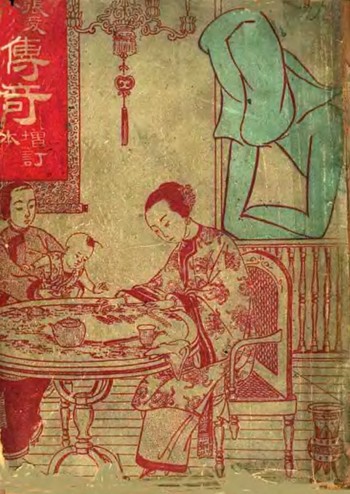
The front page [of the book] is designed by Yan Ying, and borrows a late Qing painting of a beautiful woman in fashionable clothes, which paints a woman, with remote thoughts, playing dominoes; beside her sits a nanny, who holds the child. This looks like an ordinary scene after dinner. But outside of the railing, abruptly, there appears a human shape, out of proportion, like a ghost. That is the modern person, curiously and intently looking inside. If there is anything in this painting making one feel uneasy, that is the effect I hope to create. (1946, 4:257)
The title of this book, Chuanqi (Romance), is the name of the fiction genre in the Tang dynasty (618–907) and a genre of late Ming (1368–1644) and Qing (1644–1911) drama. Apparently, in using this title, Zhang Ailing suggests that her stories are chuanqi stories like the traditional narratives. Yet her explication of the painting suggests that this evocation of the past is only intended to dramatize an “uneasy” relationship of the modern to the past. The “modern person” in the front-page painting of Zhang's book (see figure 1) appears in the upper-right corner; he or she has the shape of a body but does not have a face—this person's head is big, and looks like a white bag. In contrast to this person are the rich details of the Qing painting that occupies most of the space on the front page: the two women's clothes and ornaments that have elaborate and delicate patterns, and the abundantly patterned surfaces of the furniture inside the room, including a table, a chair, and a chandelier. Life in this Qing painting is self-contained: the young woman who appears to be the mistress is playing dominoes and looking pensively at the dominoes on the table; the servant woman and the little boy in her arms are also looking at the same object on the table. Obviously, the “modern person,” who only appears as a ghost—empty and faceless—is separated and exorcised from the rich details of the late Qing painting, and from this self-contained life. However, its eagerness in looking into the room suggests its attraction to and desire for those details.
Image was first printed as the cover of Zhang Ailing's book, Chuan Qi (Romance), in Reference Zhang1946, by Shanhe tushu gongsi in Shanghai. (Copyright belongs to Huangguan chubanshe in Taiwan.)

What makes this “modern person” empty and faceless? If he is “curiously and intently looking inside” at the details of the Qing painting, why is he lacking such rich material details? Is not the modern person supposed to have more material abundance, as the “modern” is often associated with materiality?
The Law of the Market
These questions, in fact, are about how interest exchange in “the way of concubines” functions differently in the traditional past and in Zhang Ailing's modern world to frame value. Zhang's work presents interest exchange as a process in which desire is insatiable, blind, and emptied of meaning. In describing this desire, Zhang Ailing points to a value principle of the modern marketplace that is marked by unnaturalness, and that turns any form of natural value into a commodity for consumption.
Zhang Ailing's “modern person” is exorcised from the Qing painting, and is empty not because he or she does not possess the kind of materiality that the Qing women possess, but rather because his or her materiality no longer has the meaning and significance that material details in the Qing painting have. As Zhang's idea of the “way of concubines” suggests, human relationship in the traditional past is empirical, calculating, and interest oriented, but there is a definite ethical order that regulates desires and provides value measurement for interest calculation. This order is no longer available to the modern person. Zhang Ailing's novella Lianhuan tao 连环套 (Chained Links) is a good example that points to and exemplifies this difference between the past and the modern. This novella intently evokes “the way of concubines” of the past while showing that the framework of meaning in the era of the story is actually a “modern” one.
Chained Links was published as a serial novel in the popular magazine Wan xiang 万象 (Myriad Images) in 1944. Set in late nineteenth-century Hong Kong, the novella focuses on the experiences of a woman, Nixi, who supports herself as the lover of relatively wealthy men. Nixi was sold to an Indian silk shop owner in Hong Kong when she was fourteen, and subsequently became involved with a rich old drugstore owner and an Englishman. Nixi appears to resemble a traditional concubine both because of her “unalloyed passion for material life,” as Zhang Ailing describes her (Reference Zhang, , Jones, Jones and Huang1944a, 21), and, more importantly, because she pursues material life solely within the structure of family. Nixi tries relentlessly to obtain material security by marrying a man, which, in her case, is like a concubine obtaining the position of a wife. Yet the story of Nixi resembles a traditional narrative not only on this surface level, but also in its narrative details: its depiction of characters and human interactions. Xun Yu severely criticizes this novella by pointing out that it “puts the language of Jin Ping Mei and Honglou Meng into the mouths of foreigners and people of Guangdong” in colonized Hong Kong (1944, 4:415–16). Apparently, Zhang Ailing did not deny these charges.Footnote 4
The implication of this borrowing is much deeper than a similarity in language. Indeed, it allows the narrative of Chained Links to depict everyday details in the way that the Qing painting does on the front cover of Zhang Ailing's book. That is, the significance of these details and the characters' understanding of them seem to be grounded in a framework of value that is definite and recognizable. Nixi's interactions with her first cohabitant husband Yaheya resemble Ximen Qing's relationship with his concubines in The Plum in the Golden Vase, particularly Pan Jinlian. We can cite an example from the narrative of their interactions to get a glimpse of this relationship. After a fight between them when Nixi lets out her anger about not being formally married, and she is in turn kicked by Yaheya, they have a more peaceful conversation:
Yaheya puts his hand inside her collar, and smiles, “What is going on with you today, full of resentment?” Nixi throws away his hand, jumping up like a fish, and says with anger, “You know I am not in a good mood. Why do you just hassle me?” Yaheya looks at her and smiles, “My fault; I have spoiled you, so that now you often use that flirtatious tone.” Nixi jumps up, “When have you spoiled me? Have you made many clothes for me, given me jewelry, or lots of money to buy snacks?” Yaheya's face darkens, “Although I have not given you jewelry, where have I mistreated you? Have you been short of food or clothes?” (1944d, 2:175)
The effect of this narrative is not limited to constructing stereotypical characters. Surely, Yaheya is a Ximen Qing type of character: he sometimes flirts with Nixi, while he is shown to be the master of the family who rules over Nixi with violence and controls her future. On the other hand, Nixi is like Pan Jinlian, flirtatious and strong in personality. Yet, more importantly, the narrative evokes a world in which characters' thoughts, emotions, and actions are accountable on the basis of values prescribed and defined by an imperial institution and a definite ethical and social order. In this world, value is essentially empirical, as the conversation between Nixi and Yaheya exemplifies, but these empirical values are always regulated or framed by ethical and social relations.
Here the central issue is Nixi's desire to become Yaheya's wife, which also determines Yaheya's power over her. The significance of becoming a wife, which is the motivation for the quarrel here, is presented as empirical and completely transparent. Nixi wants the security and status associated with a formal wife. In the foregoing scene, the calculations of and interactions between Nixi and Yaheya are based on the order of a husband–wife relationship, and of the relationship between a master and a bought concubine. Yaheya describes Nixi's words as “flirtatious” to remind her of her actual status; Nixi, on the other hand, rebuts the word “spoil” by referring to jewelry and money, implying a standard of “spoiling” used for a wife. They do not agree on what “spoiling” means in their situation, but there is a crucial assumption behind their arguments that the implication of “spoiling” can be found, and that people's motivations can be defined or that their behavior can be judged with terms defined by an ethical relationship that they think regulates the situation. Likewise, Nixi might be lying about her flirtatious relationship with other men, but she agrees with Yaheya that she can be judged according to certain standards on the basis of this relationship.
This mode of traditional narrative, however, is contrasted with moments of emptiness in Chained Links that belong to the “modern person.” These moments often happen when Nixi suddenly loses her “home” and her fortune; she finds that she has nothing except for her body. For example, after her second “husband” dies and she is deprived of everything except for her children, the narrative states,
Nixi suddenly has a sad feeling of being an “outsider.” She has rolled through the human crowd, but she has not gained any human scent.
She raises her head to look at the child sitting on her shoulder; the child does not understand her heart; actually she does not have a heart at all. The child… is a little piece of flesh that does not know human affairs, a little flesh… Next to the child, she herself is pure flesh too, female flesh, with little human odor. (1944d, 2:210)
The term renqi 人气, which I translate as human scent or odor here, has the implication of humanness, or humanity, referring to the things that make a person human. The notion that Nixi has lost not only her home and money, but also her renqi is striking, for it implies that when she loses all of her belongings, she also loses her humanity. That is, she does not have humanity in herself; all of her humanity is embodied in the home, property, and social relations that she has lost. She “does not have a heart,” and is “purely flesh.”
These moments of emptiness and her identity as female “flesh” place Nixi in a process of interest exchange that does not have an end. Nixi is not a prostitute, but she is more “commercial” than prostitutes in traditional narratives because, essentially, she does not internalize or commit to any values, and she sells herself solely for material security and interests. Therefore, she is completely an “outsider” in a world that appears to have definite order and values. Although having a family has always been Nixi's dream, family does not have the ethical authority as an institution of value to her. Nixi wishes to get married, as Zhang Ailing suggests, not because she places any significance on family life, but rather because this is the means for her to get material support and security. Even her children are used as a wager for her marriage gambit. In this sense, whom one marries is not important.
The novella uses a free, indirect style to describe Nixi's thoughts after she is abandoned by the Englishman and learns that another man whom she knows is sending a matchmaker to see her:
She is still beautiful; men are not reliable; money is not reliable either. It's still oneself that is reliable. The window is wide open, letting in whistling sounds of ships in the sea. Townsend has left Hong Kong. Let him go. Another one is coming after he leaves. (1944d, 2:220)
“Men are not reliable” because they are as calculating as she is, and no particular man would sacrifice his own interest for her. “Money is not reliable” because she does not have enough of it and because it will run out. Herself, or rather her body, is the only reliable thing, it seems to Nixi, because it is her own resource that appears to guarantee security: her body is valuable in endless exchanges, and this exchange is the only way to bring in the material support and security she desires. Although the next man whom Nixi expects to propose to her turns out to come not for her but for her daughter, Nixi's thoughts indicate a logic that still holds true. It puts faith not in a particular object or person, but in a process of exchange. Now her daughter, or her daughter's body, becomes another resource invested in the same process of exchange.
These narrative moments point to a larger context for thinking about value, one that is very different from the context framing value in Nixi's ordinary life. In this narrative context, the value of Nixi's life is not judged according to a definite ethical order, but according to the principle of an endless process of interest exchange. This is a world of the market, a complete commercial world. Commercialization and the market in this sense point to a situation in which interest calculation is the organizational principle of change, and the market becomes the institution of value. This does not mean that there is no morality in Nixi's world; rather, it means that commercialization becomes the major framework to which value, ethical codes, and desire are subjected.
The emptiness of the “modern person” is consequential to the fact that desire is inscribed in this process of interest exchange, or that desire cannot find full meaning in a particular object and is therefore empty. This notion of desire and meaning speaks to the theory of meaning production in a capitalist society. As Marx suggests, the mechanism of commodity value consists in abstracting all natural properties of goods, or their use value, into what Marx calls general value, which does not have a particular form. This concept of a general value that cannot be specifically located and does not have a natural form becomes a trope for the production of meaning in a capitalist society, and the market becomes a trope for the modern world. As Slavoj Žižek points out, in our everyday practice, this commodity law as a general principle of subjective value shows its effect in two aspects. On the one hand, the commodity is emptied of natural value; on the other, we still attribute real value to the commodity, which, paradoxically, is how it acquires market value and becomes a commodity. Žižek emphasizes that the effect of the commodity principle is to turn any form that assumes natural value into a fetish for consumption (Reference Žižek1989, 50).
While Zhang Ailing's work tries to describe this principle of value, it also subjects value constructions in her work to this principle. In fact, Chained Links is read as commercial and for consumption. Xun Yu in his article particularly criticizes Chained Links for its tendency to cater to the vulgar taste of the reader and thus to be explicitly commercial. The essay states, “Except the beginning, the more the novel progresses, the more it emphasizes plot. One set of melodrama after another (I will almost say that it is vulgar tricks): it is more and more dramatic, more and more thrilling… like a fashionable drama script, or like the flashy programs of a dance and singing troupe.” In pointing out that the novella uses language from the Ming and Qing novel, Xun Yu claims that these borrowed usages are “such worn-out stereotyped expressions, the garbage from old fiction that even the current ‘Mandarin Duck and Butterfly’ writers as well as ‘Black Secret Story’ writers feel them too vulgar and do not use them anymore” (1944, 4:415–6).
“Melodramatic,” “thrilling,” “plot”: these seem to be words characterizing a work that aims at being a best-seller, and Xun Yu seems to suggest that this novella is nothing but a best-seller. What it sells is not really the subject matter, but rather the form and the narrative perspective of the story. Xun Yu's terms “melodrama,” “worn-out stereotyped expressions,” and “fashionable drama script” all point to ways of packaging meaning for the reader's consumption. This packaging has a lot to do with the way in which the novella establishes value and meaning by borrowing language and style from Jin Ping Mei and Honglou Meng, as Xun Yu suggests.
The fact that this packaging of meaning turns out to be a form of commodity points to the important value mechanism of commodity exchange, as Žižek points out: the commodity acquires value by offering definite meaning, and this meaning is often constructed through formal features and affects: narrative sequence, attitudes, sentimentality, pleasure, and so on. Xun Yu's criticism points to a parallel between this packaging of meaning and sensational consumption of sexual contents and violence. In fact, he compares Chained Links to two types of popular literature that are considered sensational: “Black Secret Fiction” (Heimu xiaoshuo 黑幕小说) and “Mandarin Duck and Butterfly Fiction.” “Black secret stories,” which claim to be true stories that reveal black secrets of society, are judged by May Fourth critic Liu Bannong (Reference Liu1918) as propagating excessive sexual desire and robbery and are equated with the traditional romance of “talented scholar and beautiful maiden.” The journal that publishes “Mandarin Duck and Butterfly Fiction,” Saturday, is known for being “fragrant and sexy” in storytelling. These sensational stories participate in the same economy of desire as the “black secrets” of society that they claim to reveal, and capture their readers' most common sentimental fantasies.
Bourgeois Desolation
In an article in which she explains the philosophy of her writing, Zhang Ailing describes the modern era:
In this era, the old things are being swept away and the new things are still being born. But until this historical era reaches its culmination, all certainty will remain an exception. People sense that everything about their everyday lives is a little out of order, out of order to a terrifying degree. All of us must live within a certain historical era, but this era sinks away from us like a shadow, and we feel we have been abandoned. In order to confirm our own existence, we need to take hold of something real, of something most fundamental, and to that end we seek the help of an ancient memory. (1944a, 17–18)
The modern era, then, is one in which the essential, fundamental value of humanity has disappeared, to the extent that human existence is felt to be hollowed, while tradition is evoked as a source of value, so that, in Leo Ou-fan Lee's words, “tradition and modernity [make] their appearance in a sort of mismatched and ‘de-cadenced’ contrast” (Reference Lee1999, 288). As Zhang describes elsewhere, this is an era of “bourgeois desolation, emptiness within emptiness” (Reference Zhang1944e, 198).
The terrifying sense that everything about everyday life is out of order in Zhang's essays is partly linked with her impression of the bombing of Hong Kong by the Japanese in 1941, which she experienced when she was a student there, the Sino-Japanese war, as well as wartime life in occupied Shanghai. The destruction of war sometimes becomes to Zhang a synonym or a metaphor for the annihilation of value with which her writing is occupied. As critics have pointed out, the war does not often appear in her work directly, but it is implicit in a lot of her writings. Zhang often uses the word “desolation” to describe the sense of destruction and emptiness that come from both war and the destruction of values, which are both presented as natural and external forces. As she uses it, desolation often involves a perception of destruction caused by an absolute external force, and a feeling of pity and lamentation over what is being destroyed.
I argue in this section that Zhang Ailing's notion of desolation resorts to what she calls “ancient memory” by evoking classical Chinese aesthetics, while this memory, as Zhang stresses in the foregoing quotation, can only underline the “emptiness” of the present, being offered as something for consumption. Through the perception of destruction caused by a natural force, I argue, Zhang Ailing's notion of desolation presents desolation as outside of and exempt from the framework of interest exchange that governs modern meaning production. It is this assumption of natural value built into the affective structure of desolation that turns desolation into a commodity for consumption. Critics' emphasis (such as Rey Chow's) on desolation as the deconstruction of humanism is based on ignoring the affective structure of desolation, and thus ignoring this naturalness built into its structure.
Zhang Ailing's short story “Qingcheng zhi lian” (Love in a Fallen City) elaborately dramatizes the structure of desolation, and Zhang uses this story in “Writing of One's Own” to exemplify the aesthetics of desolation. Collected in her book of short stories entitled Chuanqi (Romances), “Love in a Fallen City” focuses on the “romance” between Liusu and Fan Liuyuan. Bai Liusu, a Shanghai woman in her late twenties, divorced from her first husband and constantly under pressure from her family to return to him, meets a rich man, Fan Liuyuan, who grew up in England and returns to China at the age of twenty-four. Through Fan Liuyuan's arrangement, Liusu is brought to Hong Kong. They stay in the same hotel and start a flirtatious relationship. Liusu's goal is to turn the relationship into a marriage. However, Fan Liuyuan seems to have no intention of leaving his first-class, gentlemanly flirtations behind.
As in most of Zhang Ailing's fiction, the world in this story is presented to be continuous with traditional China, but it is completely commercial, no longer governed by the authority of the old ethical order. Liusu's apparent determination to make Fan Liuyuan marry her without much concern for their emotions toward each other is presented as coming from the custom of traditional China. The story suggests that the centrality of practical interests is characteristic of family relationships of the past, exemplified by Liusu's family, in which everyone tries to step on each other to fight for their own interests. Seven years after Liusu divorces her abusive husband, her brothers and sisters-in-laws try to force her to go back to his home right after his death so that Liusu will not be a burden to them. A marriage with Fan Liuyuan, a rich man with high social status, becomes an opportunity for Liusu both to secure a home and to take revenge against her family.
The story, however, presents another version of “Chineseness” that is very different from the one defined by interest exchange. Fan Liuyuan's attraction to Liusu is overtly attributable to Liusu's “Chineseness.” He explains to Liusu that the “fall” that turns him into the present insincere and flirtatious person is his first meeting with China—the disappointment sees him “slipping downward” (1943b, 140). “Chineseness” in his imagination has to do with sincerity, and it is the opposite of the present China, from which, Liusu says, she is hardily distinguishable. Yet Fan Liuyuan tells Liusu that she is “a real Chinese” (1943b, 137), and insists that she should not change herself because, he says to her, “it is not easy to find a real Chinese girl like you” (1943b, 135). Presenting himself as someone who really understands what “Chineseness” is, Fan Liuyuan claims that he is “a foreigner who has become Chinese,” who is “more reactionary even than an old-fashioned scholar from the dynastic era” in insisting on a nonchanging Chineseness (1943b, 136).
Fan Liuyuan's exoticization of Chineseness and “Chinese women” implies an Orientalist flirtation with “Chineseness.” Different from the Orientalism investigated by Edward Said, which sees the Orient either as “an Old World to which one returned, as to Eden or Paradise,” or “a wholly new place to which one came as Columbus came to America” (Reference Said1978, 58), Fan Liuyuan's Chineseness points not exactly to an existent paradise or an uncultivated land, but to a nostalgic structure of perception. It is a structure that, in a way, evokes a general aesthetics of classical Chinese poetry and yet is different from it. On one occasion, Fan Liuyuan recites and explains to Liu Su some lines from a poem in Shijing (The Book of Songs), the first collection of poetry in Chinese history:
As in the classical mode of poetry, the notion of “life, death and distance” in this poem points to forces of the world outside one's control; the poem emphasizes a sense of devotion to the beloved, and brings devotion to confront these forces. The first two lines can be read as “despite death and life with separation, I will realize my pledge to you.” “Life, death, and distance” here are not empirical obstacles, but point to natural laws that inevitably separate lovers, and the emotion is unconditional love and devotion, which persist while confronting these laws. The law of nature is turned into a structural element of subjectivity in this poem, as devotion consists of both love and its confrontation with the law of separation, and is structured by the absolute condition of “life, death, and distance.” In this way, the subjectivity of this poem acquires a natural and absolute value.
Fan Liuyuan's interpretation of these lines, however, shifts from the notion of dedication structured by a natural law to the practical question of possibility; this shift registers the difference between Zhang Ailing's aesthetics and the classical mode of lamentation. “I think this is the saddest poem,” Fan Liuyuan says to Liusu. “Life and death and separation are enormous things well beyond human control. Compared to external forces, we human beings are so very small, but we still say, ‘I will stay with you forever’” (Reference Zhang, Kingsbury and Chang1943b, 149).Footnote 5 In this interpretation, the promise of growing old together is “sad” because it cannot be realized. The emotion here shifts from the poem's dedication and love to a feeling of sadness that is concerned primarily with possibility. Desire in this interpretation is oriented toward realization, accompanied by an understanding that this realization is impossible. Although both the original poem and Fan Liuyuan's interpretation are concerned with “life, death, and distance,” which make union impossible, in Fan's interpretation, desire is empirical instead of being unconditional devotion. Natural inevitability in Fan's interpretation is not structured into love, but rather into the feeling of sadness, as sadness brings the empirical desire for realization to encounter absolute external forces. This sadness is what Zhang Ailing calls desolation; it acquires a natural value and overcomes the pettiness of desire by thus encountering an absolute natural law. It is in this sense that desolation affirms practical desire and the humanity linked with it, as desire is brought into an emotive structure that laments and sympathizes with desire in perception of absolute external laws.
The difference between the classical mode of lamentation that confronts natural laws through nonpractical devotion and Zhang Ailing's conception of desolation is significant, for this difference points to two different ways of, and historical conditions for, value construction. As Fan Liuyan's interpretation of the poem suggests, the aesthetics of desolation laments the failure of practical desire. It points to a world in which desire is primarily defined by practical interests, instead of by the devotion that characterizes classical poetry. This is precisely the world of interest exchange, one in which, as Zhang Ailing states, the union between Fan Liuyan and Liusu can only be “prosaic” (1944a, 17). While desire in this world appears petty and meaningless, the aesthetics of desolation provides an emotive structure to affirm and endow this desire with meaning and value. The feeling of desolation affords subjectivity a position outside of desire, as it comprises both objective “external forces” and lamentation of the helplessness of desire.
For this reason, the mode of desolation is often presented as a moment of authenticity in Zhang Ailing's writing. In “Love in a Fallen City,” Fan Liuyuan indeed sees authenticity—which he links with Chineseness—as possible only when one confronts disasters that appear to bear natural necessity and totality. The narrative presents Fan Liuyuan as a bourgeois individual who searches for authenticity, but finds it nonexistent in a world dominated by concerns of empirical interests, even in himself, who indulges in a luxurious, flirtatious lifestyle. His imagination of authenticity through resorting to classical poetry is an effort to deliver himself from this indulgence, and he tries to evoke authenticity in Liusu. On another occasion when they are both in front of a “gray,” “cold and rough” wall, Fan Liuyan says,
This wall makes me think of the old sayings about the end of the world. Someday, when human civilization has been completely destroyed, when everything is burned, burst, utterly collapsed and ruined, maybe this wall will still be here. If, at that time, we can meet at this wall, then maybe, Liusu, you will have some authentic affection for me, and I will have some authentic affection for you. (1943b, 139)Footnote 6
Apparently, in Fan Liuyuan's mind, authentic affection does not come from one's will but from confrontation with a scene that suggests the end of the world, a scene of the total destruction of civilization, for a massive scale of physical destruction can create the impression of inevitability. Authentic affection can arise in front of this scene because it forces one to see the impossibility of desire, and thus turns the mind away from desire. This moment of authenticity actually happens to Fan Liuyuan and Liusu, as they experience massive destruction—the bombing of Hong Kong by the Japanese in 1941. The narrative describes the turning point in the relationship between Liusu and Fan Liuyuan as a moment in which Liusu and Fan Liuyuan share a sense of “desolation” in the night after the fall of Hong Kong:
At night, in that dead city, no lights, no human sounds, only the strong winter wind, wailing on and on in three long tones—oooh, aaah, eeei… wailing until even the sky dragons had gone, and there was only a stream of empty air, a bridge of emptiness that crossed into the dark, into the void of voids. Here, everything had ended. There were only some broken bits of leveled wall and, stumbling and fumbling about, a civilized man who had lost his memory; he seemed to be searching for something, but there was nothing left.…
Here in this uncertain world, money, property, the permanent things—they're all unreliable. The only thing she could rely on was the breath in her lungs, and this person who lay sleeping beside her. Suddenly, she crawled over to him, hugging him through his quilt. He reached out from the bedding and grasped her hand. They looked and saw each other, saw each other entirely. It was a mere moment of deep understanding, but it was enough to keep them happy together for a decade or so.
He was just a selfish man; she was a selfish woman. In this age of chaos and disorder, there is no place for individualism, but for an ordinary married couple, room can always be found. (1943b, 164–65)Footnote 7
These two people, who are presented as shrewd and carefully calculating, are not calculating at this moment, but interestingly, they find affection for each other only as they affirm their selfishness. If “money, property, the permanent things” point to objects of empirical desire, Liusu is not holding on to such desire but reflects on the self consisting of these desires. The “selfishness” they see in each other here points to this self; the narrative emphasizes its practicality and the idea that it is limited, but they find tolerance for this selfishness in the face of destruction. If “individualism”—as commonly understood—points to a certain belief in one's free will and volition, at this moment, Fan Liuyuan and Liusu share warm feelings toward each other because they are similarly reduced to two petty people without individualism. Their mutual understanding and forgiveness come from their perception and acceptance of their own and each other's pettiness, and from a sympathy or pathos for this pettiness.
While this description characterizes Fan Liuyuan and Liusu as petty, selfish beings, in fact, it attributes the destruction of humanity to external forces by claiming that individualism is impossible, thus rendering selfishness innocent. Actually, human selfishness here is compared to “the breath” in Liusu's chest and “the person” sleeping beside her—it becomes the location of humanity. Selfishness, or the practical self, becomes the object of lamentation because antihumanistic destruction is seen as coming from outside, and, as a result, the pettiness of human existence is seen as being effected by external forces, not by its own internal quality. This perception of selfishness is thus grounded in the idea that human desires do not take part in the actual operation of power and therefore are innocent, and that political and historical events are inevitable. The fall of Hong Kong in Luisu's perception is not a political event, but is generalized to represent the totality of history. Liusu's feeling of desolation is not only a feeling of the emptiness of the city, of Hong Kong at this particular moment, but of the emptiness of “everything,” of all “civilization.”
Zhang Ailing's aesthetics of desolation does not merely point to these moments of desolate feeling fashioned by her characters, but penetrates her narrative perspective in depicting “selfish” men and women. The sense of desolation fills her narrative through its depictions of her characters' failure in pursuing their vulgar and mediocre desires, which is often conveyed by a free, indirect discourse that merges the characters' self-reflection with the narrative voice. Desolation permeates the narrative as it arises in the characters' everyday psychology and in ordinary settings, and becomes the narrative perspective through free indirect discourse. It can appear, for example, in the observation of a marketplace by the young woman Weilong in “Aloeswood Incense—The First Brazier,” as she wanders in this marketplace in Hong Kong with the husband whom she loves, but who is unfaithful. Weilong sees “the clear desolation of sea and sky” beyond the “lights and people and market goods,” which appears to her as “endless emptiness, endless terror” that resembles her future (Reference Zhang, Kingsbury and Chang1943a, 73–74). Although in these depictions, desolation is always built on ordinary pettiness, it is supposed to go beyond this pettiness through its comprehension of the “sea and sky”—the totality of life.
Desolation is thus believed to endow the narrative with a position above and beyond the petty reality. It is a reflection on the totality of life that, supposedly, is free from motivation. Zhang Ailing writes about the superior position of her narrative:
I often look down upon (kan bian le) people as I ordinarily see them; they are flat little paper people, and are fit for putting in books. “Looking down upon” is not necessarily to find shortcomings of people, but to turn three dimensions to two.… Because I am a fiction writer, I think it is my duty to see very clearly the path of life. Even if I detest them, there is only sorrow and pity in me after I see them clearly.
Moreover,
I can pardon those people I write about, no matter how bad they are; sometimes I even have joy and love (xiai) [towards them], just because they exist and are real.… But if I meet them in ordinary life… if there must be contact, I will be cautious and calculating (jinjin jijiao), and have no forbearance, always being clear about who deserves my gratitude and who deserves loathing (enyuan fenming). (1945, 4:227)
Zhang Ailing is able to adopt an attitude of “sorrow and pity” and even “joy and love” toward her characters, instead of an empirical and calculating attitude, because she can “see very clearly” the paths of these characters' lives in books, particularly seeing inevitable failure and emptiness as the fate of all things. This “seeing” that informs her aesthetics of desolation is supposed to be nonpractical and unmotivated, and is therefore superior to reality, enabling Zhang to “pardon” her characters and have pity and love toward them. Zhang argues that the aesthetics of desolation intends to provide a form of enlightenment about reality (1944a, 18); the value of desolation lies in this revelation. Although Zhang emphasizes that the perception of desolation does not enable one to get away from the world of vulgarity, her writing shows that subjectivity capable of perceiving the desolation of things has a certain nobility, linked with love, tolerance, sorrow, understanding, and sympathy, that is absent in the embarrassing life of her characters. She suggests that desolation is submission to life itself; it is to “let life come to you.” She states, “That sort of submission resembles very little the uncomprehending, wretched, unsightly, and discountenancing submission of the characters in my fiction, yet it's just as desolate” (Reference Zhang, Jones, Jones and Huang1944g, 202). This is why some of Zhang Ailing's characters—Fan Liuyuan and Liu Su in “Love in a Fallen City,” for example—have two incongruous aspects that are somehow felt forced together by the narrative.
Zhang Ailing's aesthetics of desolation finds itself within the symbolic order—rather than transcends it—by recognizing and characterizing desire through what Jean Baudrillard calls “sign exchange value,” that is, a value determined through reference to a system of distinction and differentiation. Market or commodity exchange for Baudrillard includes two types of exchange: economic exchange and sign exchange. Correspondingly, a commodity might have both economic exchange value and sign exchange value (Reference Baudrillard and Levin1972, 113). This process of sign exchange “symbolizes” by producing difference, including castes and hierarchy. Baudrillard suggests that sign exchange in the commodity society bears resemblance to that of pre-capitalist society. The “system of sign exchange” is an “aristocratic model” in capitalist society, a “democratized' logic of caste,” or a mode of “consumption” “instituted on the basis of the exchange of differences,” which is articulated “upon a fiction of aristocratic parity” (1972, 119–20). That is, the sign acquires value by producing difference and presupposing the natural authority of the aristocratic hierarchy. The feeling of desolation is a “sign” for the symbolic order precisely because it presents itself as above empirical desires by offering an understanding of the emptiness of desire, while pitying and affirming empirical desires. It offers “sign exchange value” and is subsumed into the economy of symbolic signification by putting human relations into a perspective that is supposed to have absolute authority. Desolation is therefore a sumptuary gesture to signify by presenting itself as superior to all signs—or all human relations—thus reinventing the caste of signs.
Self-Reflection in a Glass of Emptiness
The examples from “Love in a Fallen City” typify the way in which desolation provides a structure for identity and self-reflection. By building a perception of the totality of life in its structure, desolation presents itself as a form of affective reflection and identity for the egotistic, petty self. This structure of reflection and identity does not simply provide a mirrored image for self-recognition, but, more importantly, it brings the perception of totality or a natural, absolute law to bear on the practical self. Identity here comes from the mechanism of perception, from the way in which the perceiving subjectivity identifies itself with the supposedly absolute law of nature structured into the perception of desolation.
Zhang Ailing's writing presents many self-reflexive images, and these self-images are often placed in a background of ruin and destruction that are interpreted as the inevitability of history. This background constitutes the real “mirror” for self-reflection, for the background of destruction is the mechanism structuring reflection and its value. Zhang Ailing herself experienced the bombing of Hong Kong in 1941; her 1944 essay “Jinyu lu” (From the Ashes) recalls her experience, as well as the lives and desires of the people around her during the war. In this essay, the war becomes a general “era” that destroys and overwhelms personal lives, as she describes toward the end of the essay:
The vehicle of the times drives inexorably forward. We ride along, passing through thoroughfares that are perhaps already quite familiar. Against a sky lit by flames, they are capable nevertheless of shaking us to the core. What a shame that we occupy ourselves instead searching for shadows of ourselves in the shop windows that flit so quickly by—we see only our own faces, pallid and trivial; our selfishness and emptiness. (1944b, 52)Footnote 8
There are two kinds of self-reflection here. The first kind involves occupying ourselves with “searching for shadows of ourselves in the shop windows,” which points to our everyday captivation with our petty desires and trivial concerns. The second kind is to see ourselves through a mirror that is “a sky lit by flames,” through something that is capable of “shaking us to the core.” While it is a shame that most of us are trapped in the first kind of self-reflection, this passage suggests that only the second kind can provide us with revelation: it reveals something much larger—linked with “the sky”—than our everyday pettiness.
What I want to call attention to is the fact that Zhang Ailing not only presents this structure of self-reflection in a nostalgic gesture, but also, more importantly, marks it as a structure of modernity and modernism. The reflection that enables one to position the self in relation to a structure as large and endless as “the sky,” as the last line in the quoted passage suggests, is a perception of “emptiness,” which in this passage is the sense that everything is made empty by “the sky lit by flames.” Indeed, “emptiness” here is a modern “mirror” that endows the reflected image with value. Zhang Ailing equates it with modernist ideas of meaninglessness and nothingness, and thus presents desolation as a structure for modernist self-reflection of the modern person.
Zhang Ailing's construction of the modern person and his or her emptiness implies a strategy of reading the abstract senselessness that structures modern life as “emptiness”; this replacement characterizes her reading of modernity and Western modernism. Zhang sharply perceives the difference between her era and the traditional past, and the alienness of this era, in which desires cannot find their purposes, but are driven by blind, purposeless, and therefore abstract forces. Yet she interprets the senselessness of desire as emptiness, and its destructiveness as external rather than internal. In this way, desolation provides a mode of self-reflective lamentation in reading the ordinary life of this “era,” a reading that reduces the alienness of ordinary life. This aesthetics of desolation, or Zhang's reading of abstractness as emptiness, enables the modern person to repossess material details through a lamentative perception of loss and emptiness behind these details. In this way, Zhang Ailing imagines the modernity of her writing joining a global modernity in mutual sympathy.
Conclusion
In a discussion of Chinese literature, Zhang Ailing observes,
Chinese literature is permeated with big sorrow. It only obtains pleasure in material details—thus Jin Ping Mei and Honglou Meng carefully list all dishes for the whole table without being tired of it. It is for nothing but pleasure—details are often cordial, full of ease, and alluring, but the theme is always pessimistic. All general observations of life point to nothingness (xuwu). (1944f, 4:111)
Zhang Ailing's stories apparently retain these two characteristics: they are immersed in the material details of everyday life—a life that is often constituted by both cosmopolitan modernity and traditional human relationship—and a lamentative emotive structure expressing sorrow over the nothingness of this life. Yet Zhang also sharply reveals to us that both of them are already relocated in a new framework of meaning, which is a framework of interest exchange that is no longer regulated by an ethical order, but driven by desires that cannot find ultimate meaning in any specific objective. It is this framework that turns the feeling of desolation into a commodity for consumption.
Zhang Ailing's work has been approached from two interconnected perspectives. One acclaims its association with traditional Chinese literature, and, echoing Zhang herself, it suggests that Zhang's aesthetics of desolation provides a perception of reality that transcends the triviality of vulgar reality. Another perspective stresses that this work critiques and provides an alternative to May Fourth idealism. Neither approach adequately explores how the commercial framework of value evoked and highlighted by Zhang shapes the values of emotive constructions in her work.
This article hopes to bring not only a fresh view on Zhang Ailing's work, but also a new perspective on how to account for values of emotive constructions under the commercial framework. I suggest that we should look into the particular affective structure of an emotion to investigate its value construction. In fact, not all emotions in Zhang's work are packaged for consumption.. Different modes of affective constructions are intermingled. Zhang's much acclaimed novella Jinsuo ji (The Golden Cangue), for example, presents an affective structure very different from the structure of desolation, and it captures the force of meaninglessness under the law of the market. Although the novella is permeated by the sentiment of desolation, it also demonstrates the principle of the market as a blind and relentless force originated in an abstract form of desire that exceeds the framework of consumption. Of course, the scope of this article does not allow me to elaborate on this form of desire. I will simply end by suggesting that, precisely because the law of the market is inscribed in this kind of abstract subjectivity, which is essentially non-natural, it turns any form of naturalness into a fetish for consumption.