

1. Introduction
Rules regarding post-retirement work (defined as work after beginning benefit collection) have the potential to greatly affect decisions about benefit collection and post-retirement labor supply. This is because when people make decisions about retirement, they must consider how they will replace their wage income and continued work is one way to supplement retirement benefit income. In turn, these decisions will affect the health of pension systems, like public employee pensions and Social Security, by determining the number of years of benefit collection and, sometimes, the annual amount of benefits collected.
Existing research has shown that retirees are sensitive to the Social Security earnings test, which restricts the amount of earnings some beneficiaries can receive (e.g., Friedberg Reference Friedberg and Poterba1998; Friedberg Reference Friedberg2000; Engelhardt and Kumar Reference Engelhardt and Kumar2009; Gelber et al., Reference Gelber, Jones and Sacks2013; Gelber et al., Reference Gelber, Jones, Sacks and Song2017). However, little is known about the effects of other types of return-to-work policies on post-retirement employment. Instead of restricting earnings, many public pension plans restrict the number of hours beneficiaries can work. In 2018, for example, 18 states placed restrictions solely on the time worked by retirees, another 11 restrict both hours and earnings, and just ten set limits on earnings only. In Illinois (the setting of this study), the rules regarding limitations on hours for those returning to work after retirement have changed four times in the past 20 years. This is evidence that the rules are binding enough for policymakers to change them over time in order to affect changes in retiree labor supply. The most recent rule change increased the maximum number of hours allowed to 600 in 2018, which is evidence of how timely this issue is and how important it is that we understand these policies’ effects.
In this study, I aim to provide some of the first evidence on how restrictions on the number of hours worked after retirement affect labor supply decisions. First, I document the post-retirement work patterns of public sector retirees. Using data covering employees in the Illinois school system over a period of over 20 years, I describe the patterns of post-retirement work and how they have changed over time for this population. In doing so, I pay particular attention to how the patterns of post-retirement work vary by employee gender, race, age, occupation, and earnings level.
Several patterns emerge from this descriptive analysis. First, the annuitants with the highest levels of service at retirement are the most likely to return to work after retirement. These are probably the employees with the highest labor market attachment. Since incentives inherent in the pension system encourage employees to retire immediately upon eligibility (Stock and Wise, Reference Stock and Wise1990; Costrell and Podgursky, Reference Costrell and Podgursky2009; Koedel and Podgursky, Reference Koedel, Podgursky, Hanushek, Machin and Woessman2016; Ni and Podgursky, Reference Ni and Podgursky2016), these may be employees who retire early for financial reasons rather than based on their preferences for work. They are also the youngest annuitants and post-retirement employment decreases with age. Although there is a little difference in post-retirement employment patterns by race or earnings, there are marked differences by gender and occupation (position last held). Instructional staff (teachers) are much less likely to return to work after retirement than administrative (principals, superintendents) and support (librarians, counselors) staff. At the same time, men are more likely to return to work after beginning benefit collection than are women. The differences in employment by gender are partly related to differences in the occupations across genders (men are much more likely to be in non-instructional positions, where retirees are more likely to return to work than in instructional positions) and partly related to differences in labor supply within occupation (male instructional staff retirees are more likely to be employed than their female counterparts). Finally, there is a clear variation over time in patterns of labor supply among annuitants. Post-retirement work rises sharply for annuitants after an Early Retirement Incentive (ERI) program in the 1990s; this is likely driven by the compositional shift in retirees toward those who had been less likely to want to retire than retirees in previous cohorts. Employment of annuitants begins to rise again in 2000, peaks just after the increase in the maximum number of allowable hours of work in 2001, and declines thereafter, but what drives the decline is unclear.
Second, I analyze how rules restricting the number of hours that beneficiaries can work affect retirement decisions and post-retirement employment. To accomplish this, I make use of two sources of variation: (i) changes to the rules regarding post-retirement work and (ii) the fact that these rules applied to some employees and not others. Although the rules regarding the maximum number of hours of post-retirement employment in Illinois Public Schools (IPS) have changed multiple times, because of data limitations, I use the variation driven by the policy change in 2001.Footnote 1
To identify how rules restricting the number of hours employees can work post-retirement affect retirement decisions, I use difference-in-difference techniques. This methodology makes use of the fact that, although most employees are restricted in the number of hours they can work in IPS schools after collecting their retirement benefit, employees in certified subject shortage areas in a given district are not. As such, the retirement decisions of those in certified subject shortage areas in a district should not be affected by rules limiting the number of hours that can be worked post-retirement. Therefore, I compare the retirement decisions of employees likely to be affected by the rules (those not in certified subject shortage areas within a district) to those unlikely to be affected by the rules (those in certified subject shortage areas within a district) before and after the state alters the hours restrictions. Doing so will allow me to identify the effects of the hours restrictions under the assumption that there was nothing else that changed concurrently to the rules changes that also differed across these groups. As described in more detail later, I also make use of the fact that it is only the labor supply of those closest to retirement eligibility that should be affected. This further allows me to control for potential confounding factors differentially affecting the labor supply of those nearing retirement eligibility.
I find that the increase in the maximum number of allowable hours of post-retirement work had little effect on retirement annuitant benefit collection. However, it increased the probability of working part-time for retirees, as would be expected given the incentives. As such, these policies appear to be binding on the labor supply decisions of some employees. These results are relevant for designing policies aimed at extending work-lives or improving the health of pension systems.
2. Background on Illinois Teacher Retirement System
Employees of IPS participate in one of two retirement systems, either the Teachers Retirement System (TRS) or the Chicago Teachers Pension Fund. The focus of this study is the former.Footnote 2 In this section, I first provide an overview on the general parameters of the TRS and then describe the specifics about rules regarding work after retirement. There were significant changes to the rules regarding membership in 2011. In what follows, I describe the rules for members employed as of January 1, 2011. Where relevant, I also describe more recent changes.
Many types of employees of IPS are covered by the TRS, including classroom teachers as well as administrators (e.g., principals, superintendents) and support staff (e.g., librarians, nurses, psychologists).Footnote 3 While employed, members of the TRS contribute 9% of their creditable earnings to the pension system and employers contribute another 0.58%.Footnote 4 Members accrue ‘service credit’ in the system for the time they are working (i.e., paid for work, including sick days) and can purchase additional years of service for time spent on maternity leave, teaching in private schools, etc. In addition, members can count up to 2 years of accrued and unused sick leave toward their creditable service.
Upon retirement, members are eligible for a retirement benefit that is proportional to the amount of service credit they accrued and to their final average earnings. Final average earnings is defined as the average of the four consecutive highest earning years in the last ten of employment. Benefits accumulate as a percent of final average earnings, at a rate of 1.67%, 1.9%, and 2.1% for each year in the first, second, and third decades of service, respectively, and 2.3% for any year of service thereafter. There is also a way for employees to pay a fee and have benefits accumulate at a rate of 2.2% per year. The maximum benefit is 75% of ones’ final average earnings. This maximum benefit leads to strong incentives to retire when a benefit size of 75% is reached because the return to continued work decreases significantly at this point (Stock and Wise, Reference Stock and Wise1990; Costrell and Podgursky, Reference Costrell and Podgursky2009; Koedel and Podgursky, Reference Koedel, Podgursky, Hanushek, Machin and Woessman2016; Ni and Podgursky, Reference Ni and Podgursky2016).Footnote 5 Statutorily, this benefit can be reached with 34 years of service, but because of additional service credit, many employees can reach this maximum benefit with closer to 30 years of service.
Members are eligible for their retirement annuity when they reach one of the following combinations of age and years of creditable service: 55 with 35 years of service, 60 with 10 years of service or 62 with 5 years of service. In addition, employees are eligible for a reduced retirement annuity when they reach age 55 and have 20 years of service. Also, in the early 1990s, the state offered members of TRS an ERI. Under this program, for a fee, employees had the opportunity to purchase up to five additional years of age and service toward the calculation of their retirement benefit if they retired in either 1993 or 1994. Nearly 10% of employees participated in this program and retired earlier than they otherwise would have (Fitzpatrick and Lovenheim, Reference Fitzpatrick and Lovenheim2014).
Because of IRS rules, no annuitants can return to work in the same school-year in which they last contributed to the TRS, but after that they can return to work subject to some restrictions. In order to eliminate double-dipping – employees collecting retirement benefits while working full-time – the state of Illinois places limits on the number of hours annuitants can work while collecting benefits. Over the period from 1990 to today, the rules regarding the maximum allowable number of hours worked changed four times. In 1990, the maximum number of hours of allowable employment was raised from 375 per year to 500. In 2001, the maximum was raised again to 600 h. In 2011, the maximum number of hours was lowered back to 500. Finally, in 2018, the limit returned to 600 h.Footnote 6
If an employee exceeds these limits in a position covered by TRS, their retirement annuity is suspended (and employer and employee contributions to the system resume) until she refiles for benefit collection. It is important to note that these rules do not prohibit employment in any private school (or other type of employer in the private sector), university, or college, or prevent employment in Illinois State Board of Education (ISBE) as an employee not covered by TRS (e.g., teachers’ aide, a bus driver).
An exception to this rule is made for teachers in certified subject shortage areas in a district. Certified subject shortage areas are subject areas where a regional superintendent of schools has certified that a personnel shortage exists. Teachers in these positions may continue retirement benefit collection regardless of the amount of time they work in the public school system, a fact I make use of in my identification strategy outlined below.
3. Data
I use two sources of administrative data from Illinois to document patterns in post-retirement work and the relationship between rules restricting the number of hours of work for beneficiaries and decisions about retirement and post-retirement employment.
The first is the Teacher Service Record (TSR), which contains data on employees of IPS collected by the ISBE from 1978 to 2013. The TSR is a database compiled by the ISBE from school district administrators to track employment and earnings of teachers, staff, and administrators in public schools throughout the state. Each observation in the TSR is an employee-school record for a given school year. The TSR includes the following information about employees in IPS: the school and district in which the employee works, total earnings (as reported to the relevant retirement system), number of months employed at the position, full-time-equivalent (FTE) percentage of the position, and the percent of time that is administrative. The data also contain information on the number of years of school experience (within the district, within Illinois, and out-of-state), the position of employment, and the highest degree held by the employee.
I also use data collected by the TRS. The TRS data contain information on the retirement benefits paid to its members. This includes information about the name of the benefit recipient, the timing of benefit receipt, and the creditable years of service and age of the employee.Footnote 7
Several measures are of interest for the empirical analyses. An employee is deemed ‘retirement eligible’ if the combination of her age and years of service in IPS would allow her to collect a full retirement annuity (regardless of whether she is collecting benefits).Footnote 8 She is retired if she is collecting a retirement annuity (even if she is still working in IPS). If a person is working ≤60% of a FTE, I consider her a part-time employee in that school-year. Otherwise, if he or she is employed for more than 60% of the FTE, he or she is classified as working full-time. I do not observe the exact number of hours worked, so I create a measure of hours using the months and FTE percentage recorded.Footnote 9 Since employees working in certified subject shortage areas are exempt from any restrictions on their post-retirement employment, I also create a measure of employment in non-shortage areas. To do this, I used information on an employee's position and main assignment the first time I observe her in the TSR and annual information on shortage areas in each district from ISBE and federal Department of Education.Footnote 10
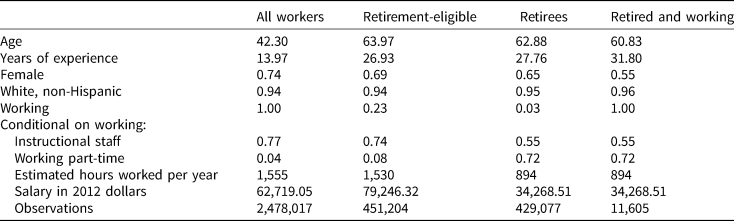
Because the data are from administrative records of all employed service in IPS covered by TRS over a period of more than 20 years, I can completely characterize the employment, retirement benefit receipt, and post-retirement work experiences of employees of IPS over the period. In Table 1, I present information on the samples of employees over the period from 1991 to 2012 that I use in the analyses.Footnote 11 Each observation in the data is a person-year combination. In the first column, the sample includes all employees of IPS. The second column contains information on those eligible for retirement (including observations up to 10 years after becoming eligible). The third column includes only retirees (within 10 years of retirement). In column 4, the sample includes those retirees continuing to work after benefit collection.
Average characteristics

Based on the author's calculation using data from the TSR and TRS from 1991 to 2011. Each observation is a person–year combination. In the first column, the sample includes all employees, retired or not, between 1991 and 2011. In the second column, the sample includes all employees who are retirement eligible, retired or not, and retired within the last 10 years if retired, between 1991 and 2011. In the third column, the sample includes all retirees within 10 years of retirement between 1991 and 2011. In the fourth column, the sample includes all retirees within 10 years of retirement who are currently employed between 1991 and 2011.
The average retiree is older and has more experience than other workers, as expected, but the average retiree who is working post-retirement is younger and has more experience than the average retiree. Only 2% of retirees work, and 72% of those who do work part-time. This rate of employment is similar to the rate of returning to career jobs in Quinn et al. (Reference Quinn, Cahill and Giandrea2018). Women make up a smaller share of retirees who work (55%) than they do retirees in general (65%).
4. Empirical strategy
To identify how rules restricting the number of hours employees can work post-retirement affect retirement and other labor supply decisions, I use difference-in-difference techniques. In using this methodology, I compare outcomes of groups of employees who are affected by the rules regarding post-retirement employment to groups of employees whose labor supply should be unaffected. Since the rules regarding return to work only affect those who have retired, the labor supply of employees ineligible for retirement should not be affected and can be used as a counterfactual for employees who are retirement eligible. (Since retirement behavior might be affected by the policy, I use retirement-eligible and retirement-ineligible to define comparison groups, rather than comparing the behavior of retirees and non-retirees.) Similarly, although most retirees are restricted in the number of hours they can work in IPS schools after collecting their retirement benefit, employees in certified subject shortage areas in a given district are not. As such, the retirement decisions of those in certified subject shortage areas in a district should not be affected by rules limiting the number of hours that can be worked post-retirement. Therefore, I use employees ineligible for retirement and those in certified subject shortage areas to create comparison groups that provide the counterfactual labor supply for those most likely to be affected by the policy change.
As a result, I can compare the retirement decisions of employees likely to be affected by the rules (the retirement eligible who are not in certified subject shortage areas within a district) to those unlikely to be affected by the rules (those in certified subject shortage areas within a district and those who are retirement ineligible) before and after the state alters the hours restrictions. In other words, I will make use of both the variation in who is bound by the rules regarding post-retirement hours worked and the variation over time in the rules regarding post-retirement hours worked to identify the effects of the restrictions on hours worked on retirement. Doing so will allow me to identify the effects of the hours restrictions under the assumption that there was nothing else that changed concurrently to the rules changes that also differed across these groups.
I estimate a triple-differences model using the following equation:
 $$\eqalign{Y_{it} &= \beta X_{it} + \gamma {\rm Post}\; \times \;{\rm Eligible} \times {\rm NonShortag}{\rm e}_{it} \cr&\quad + \theta {\rm Eligibl}{\rm e}_{it} + \pi {\rm NonShortag}{\rm e}_{it} \cr&\quad + \vartheta {\rm Eligible}\; \times \;{\rm NonShortag}{\rm e}_{it} + \mu {\rm Post}\; \times \;{\rm Eligibl}{\rm e}_{it} \cr&\quad + \rho {\rm Post}\; \times \;{\rm NonShortag}{\rm e}_{it} + \delta _t + \omega _i + \varepsilon _{it}.} $$
In the equation, Y represents a measure of labor supply including collecting pension benefits, working in the ISBE, and working part-time. The vector X includes individual time-varying characteristics, such as age and years of experience. It also includes the county unemployment rate to control for potential confounding economic conditions. As discussed in the previous section, a person is defined as retirement eligible in a given year if her age and years of experience would allow her to be eligible to collect a normal retirement annuity from the TRS. I include year fixed effects (δ t) to capture any variation in labor supply that is common across all people in the sample in a given year. I also include person fixed effects to capture heterogeneity in labor supply elasticity across people in the sample. The coefficient of interest is γ. With this specification, the assumption is that there were no other shocks to the labor supply of people in the sample in 2001 that would have differentially affected those retirement eligible who were not in shortage areas from either the retirement eligible in shortage areas or the retirement ineligible who also were not in shortage areas.
5. Results
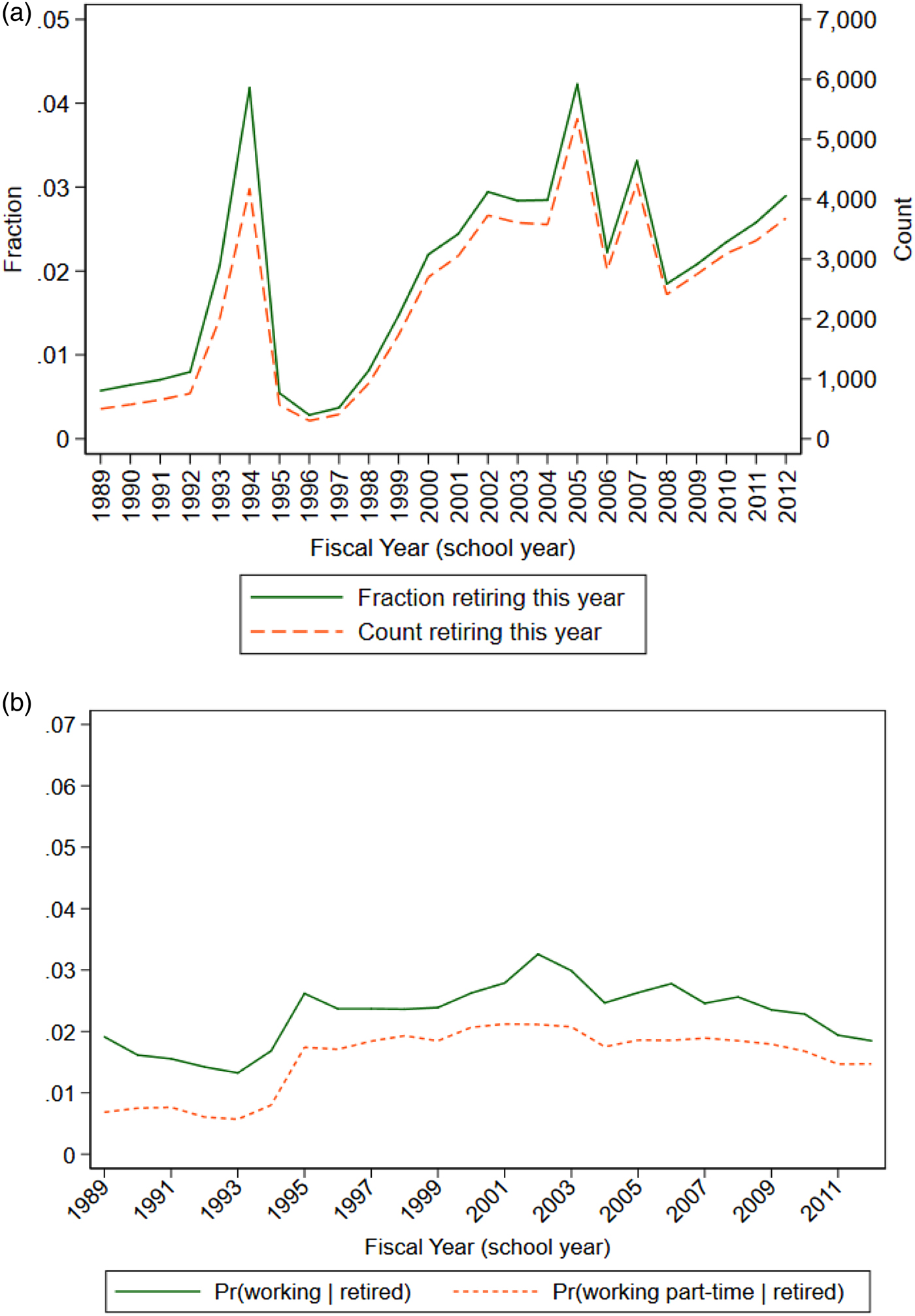
Before closely examining patterns of post-retirement return-to-work behavior, it is useful to first have a sense of retirement behavior. This is useful because patterns in post-retirement return to work will in part be driven by the composition of retirees. In panel A of Figure 1, I plot the retirement rates and number of retirements each year of IPS employees who are working full-time. First, there is a dramatic spike in retirements in 1993 and 1994. This was driven by the offer of the ERI in those years. Second, there is a steady increase in retirements starting in 1998 and continuing the rest of the period. This is largely driven by employee demographics. There are also two spikes in retirement in 2005 and 2007, both are likely related to changes to the availability of an Early Retirement Option (separate from the ERI) that allows those above 55 to retire with just 20 years of services to retire and receive a reduced annuity. Interestingly, these patterns in retirement are not all that closely connected to economic cycles.
Retirement and post-retirement work behavior of IPS employees. (A) Fraction and number retiring among those working, by year. (B) Fraction of retired annuitants who are employed and employed part-time, by year. Note: Based on the author's calculation using data from the TSR and TRS from 1989 to 2012. The sample in (B) includes retirees within 10 years of their retirement benefit collection date.

In panel B of Figure 1, I plot the fraction of retired annuitants who are working at all or who are working part-time in a given year, indicated by the solid and dashed lines, respectively. Since few people work after they have been retired for more than a few years, the sample is limited to just retirees who began collecting benefits within the previous 10 years. For the most part, patterns of overall and part-time post-retirement work behavior trend together meaning that differences over time in post-retirement work are driven largely by retirees that work part-time. There is a sharp increase in both rates in 1995, which was the first year that retirees who took up the ERI could return to work without facing a penalty. Since about 10% of the workforce participated in the ERI program and the program involved leaving work earlier than one otherwise would, it is perhaps not surprising that the set of retirees post-ERI had higher levels of post-retirement labor supply. There is another uptick in employment of retirees starting in 2000 that continues until just after the policy regarding the allowable maximum number of hours worked for retirees increased (2002). I am unaware of what might be driving the pre-policy increase; to my knowledge, there were no changes in pension policy in Illinois at this time. This slightly predates the policy change I study, making it clear that controlling for confounding factors will be important. After 2002, the fraction of retirees employed begins declining until, in 2011, there were about 2% of retirees working, about 80% of whom were working part-time. Here, as with retirement rates, the patterns of return-to-work behavior seem more connected to changes in pension-related policy than overall economic conditions.
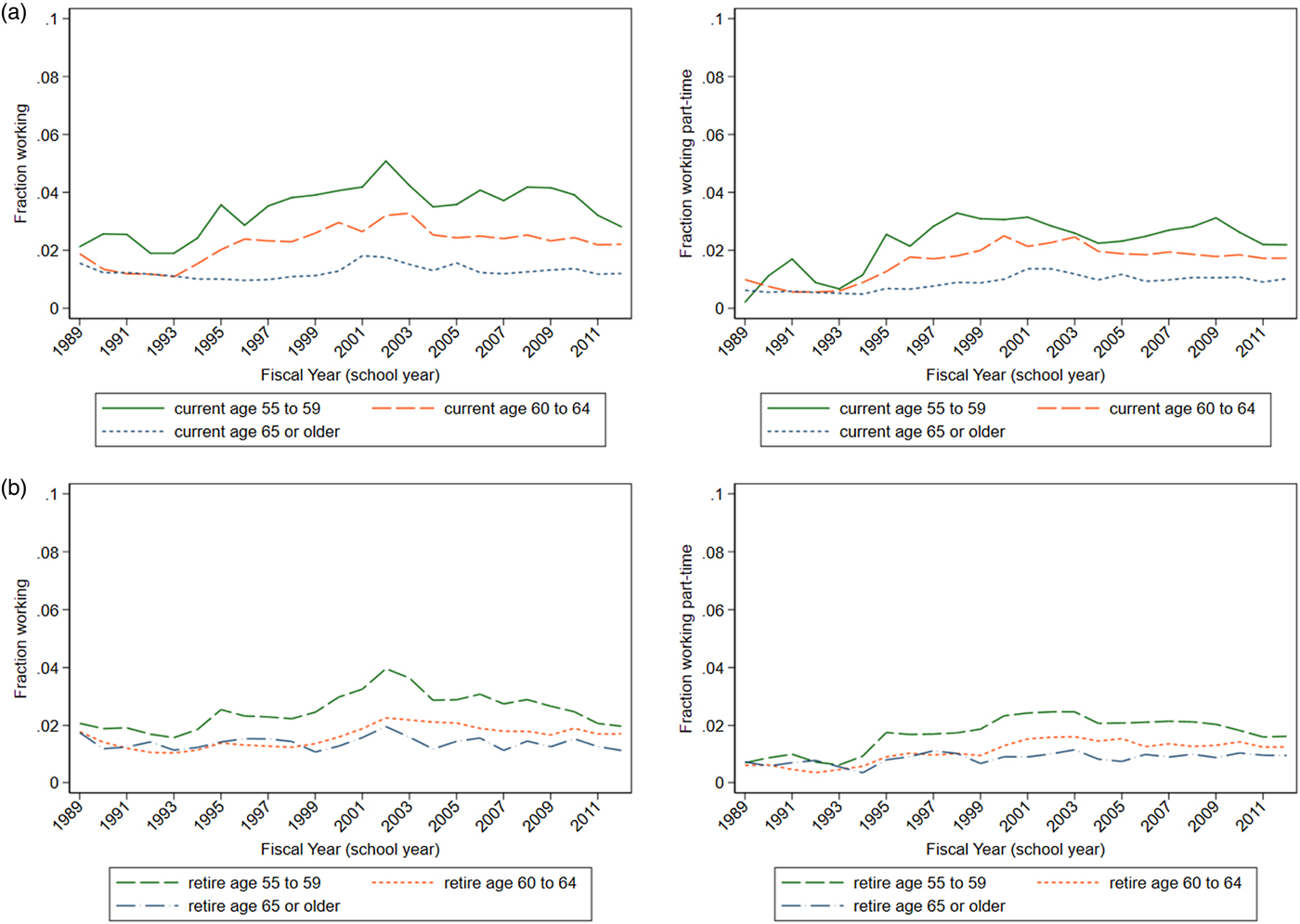
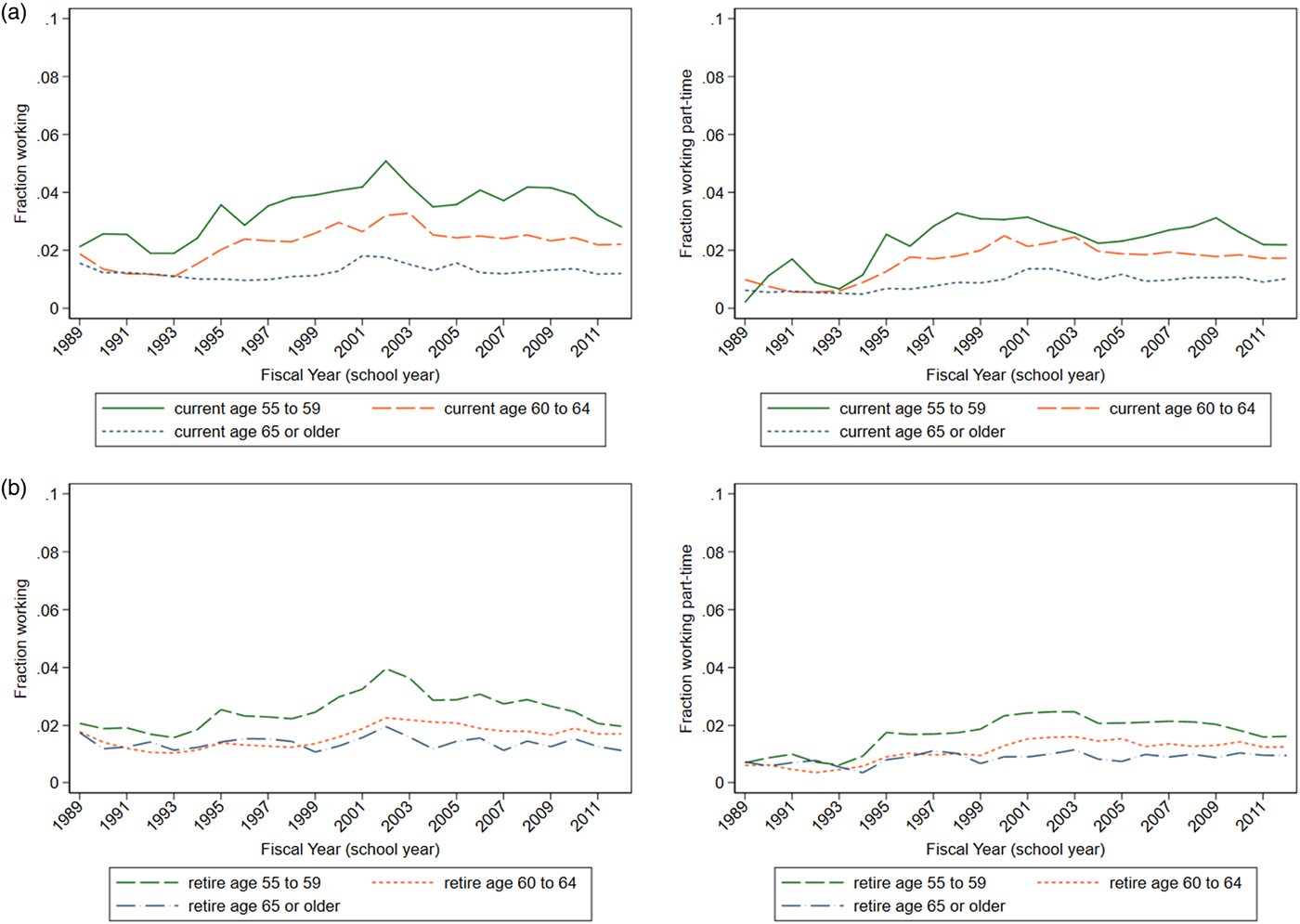
Figure 2 contains information about post-retirement employment for retirees separately by either their current age (panel A) or their age at retirement (panel B). Although these ages are obviously mechanically correlated, some interesting patterns emerge when we compare the figures. In the first set of panels, labor supply after retirement declines monotonically with current age. In the second set of panels, we can see that it is those that begin retirement at the youngest ages (55–59) who have the highest levels of post-retirement employment. Therefore, it is these ‘early’ retirees who are driving the differences in labor supply at different ages. This might seem surprising; given that these employees retire at such a young age, we might hypothesize that their labor force attachment is less than other workers. However, only those employees with the highest levels of accrued service are eligible to retire at 55, making it likely that this is the group with the strongest labor force attachment.
Fraction of retired annuitants who are employed and employed part-time, by year and age at observation or age at retirement. Note: Based on the author's calculation using data from the TSR and TRS from 1989 to 2012. The sample includes retirees within 10 years of their retirement benefit collection date.
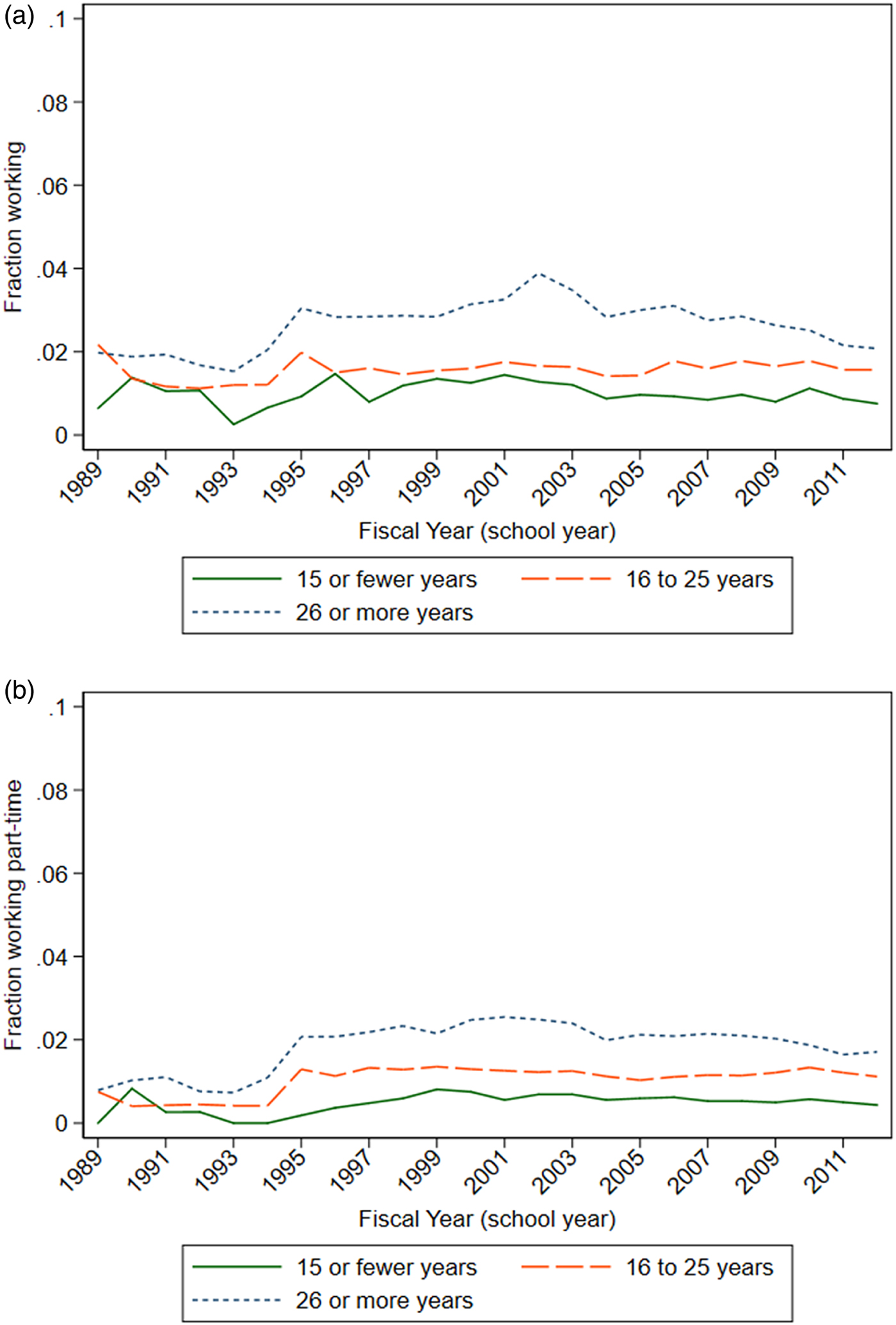
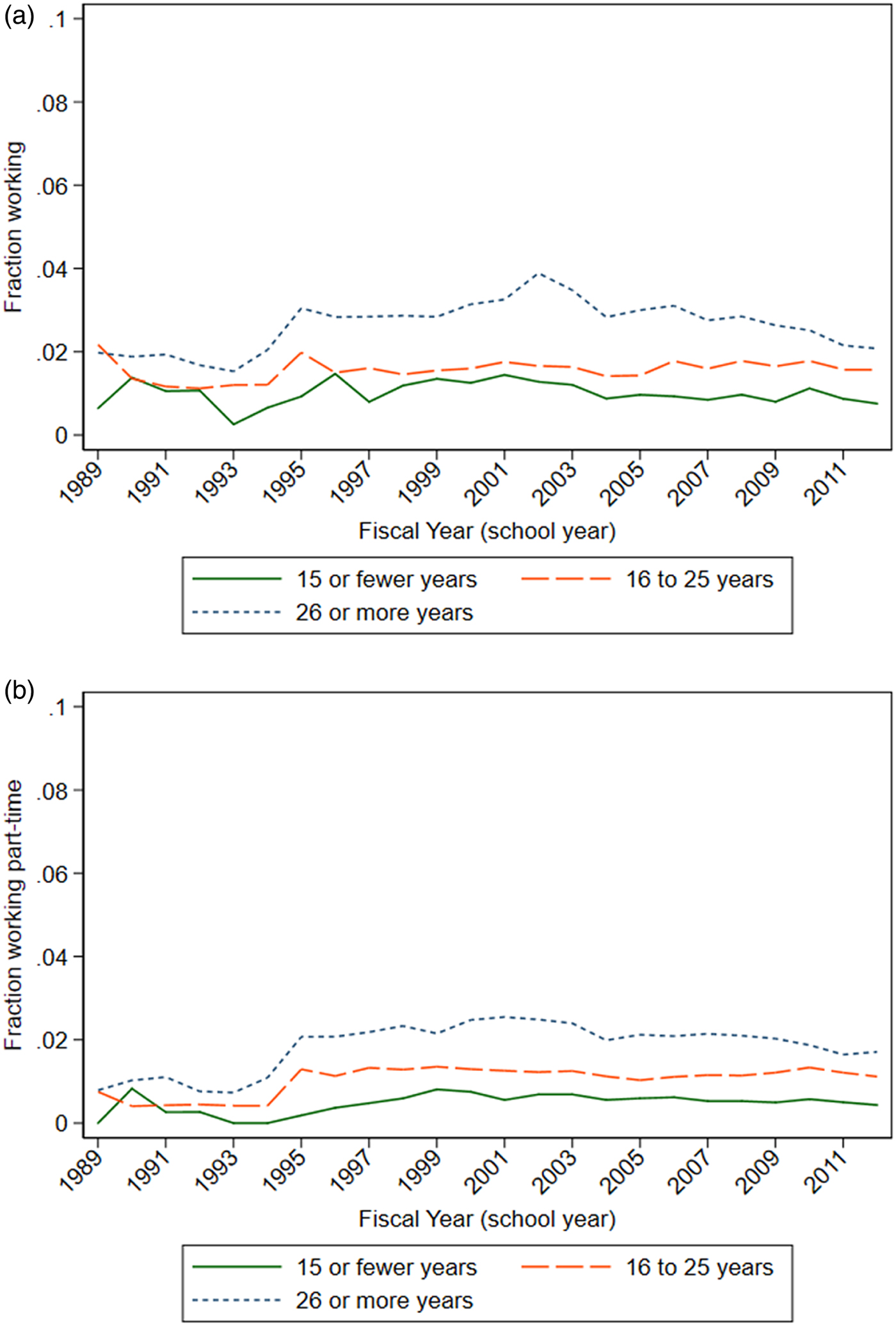
This is confirmed in Figure 3 where I plot rates of employment after retirement by years of service in the system at retirement. In this figure, it is the retirees with the most experience who have the highest rates of both overall and part-time employment. In general, the rates of employment decline monotonically with service. Recall that these young retirees with large amounts of accrued service are the employees for whom the structure of this defined benefit pensions system leads there to be the largest financial incentives to retire. Perhaps, upon retirement, these employees realize that they had stronger preferences for work than thought.
Fraction of retired annuitants who are employed and employed part-time, by year and years of service. Note: Based on the author's calculation using data from the TSR and TRS from 1989 to 2012. The sample includes retirees within 10 years of their retirement benefit collection date.
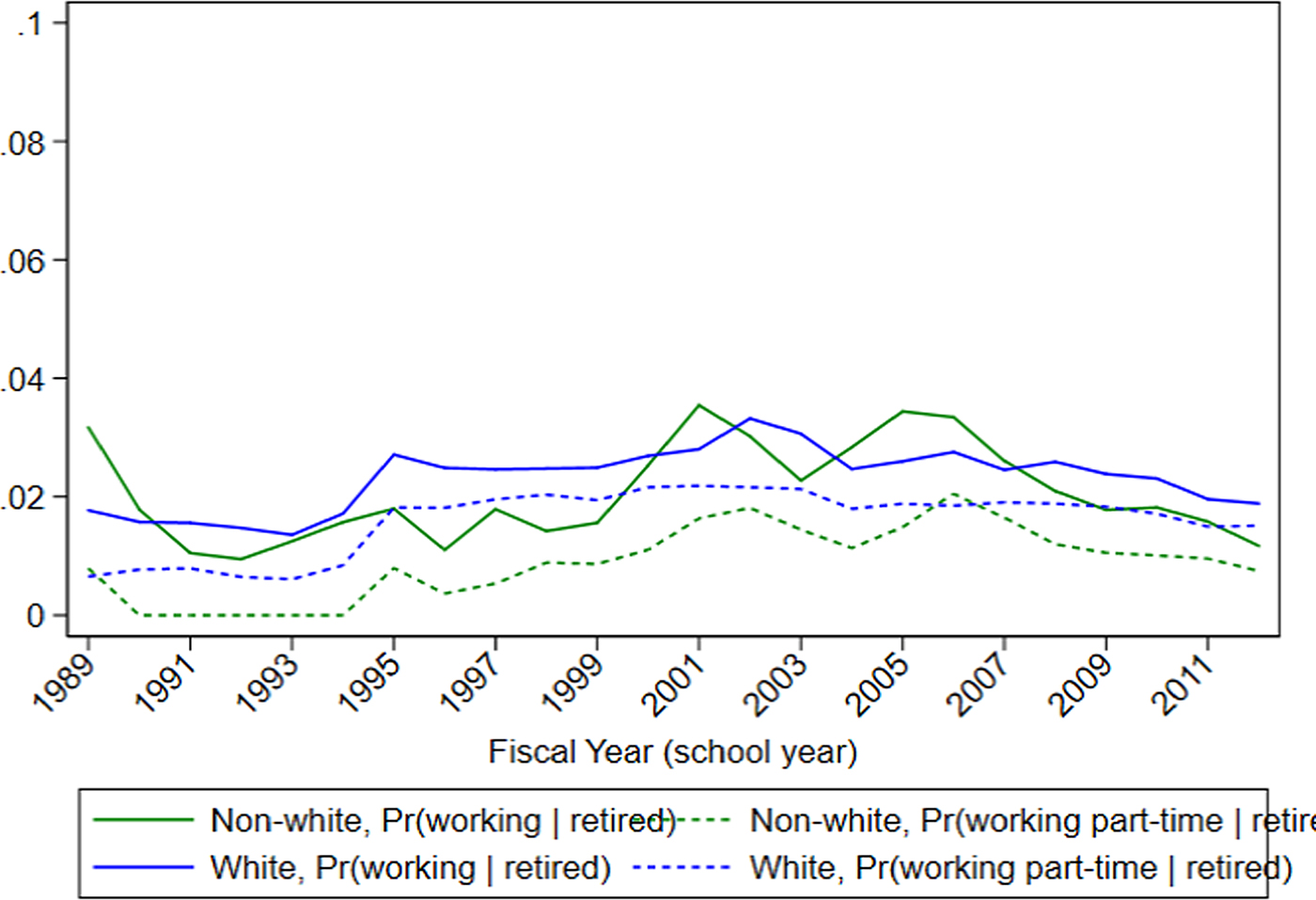
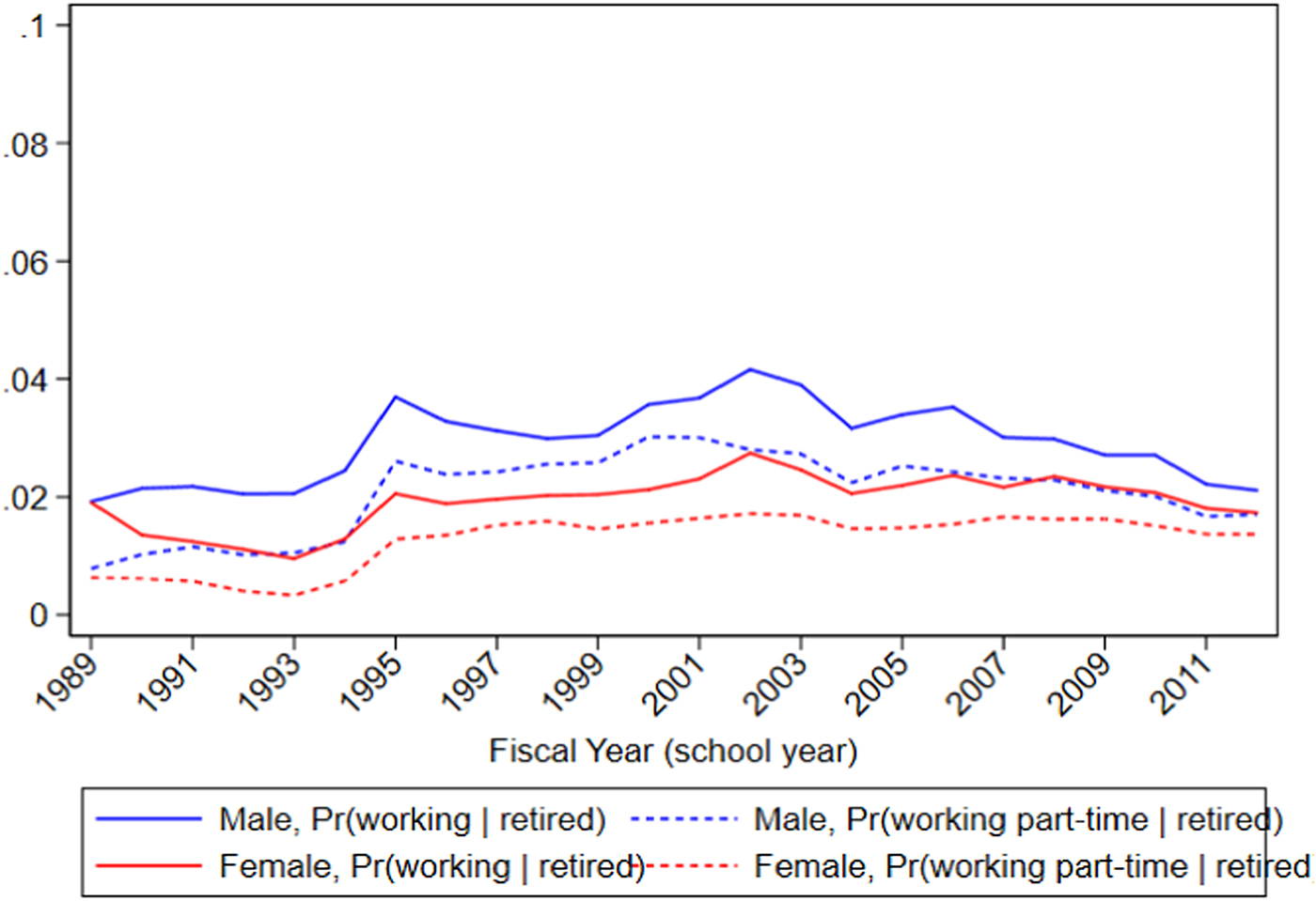
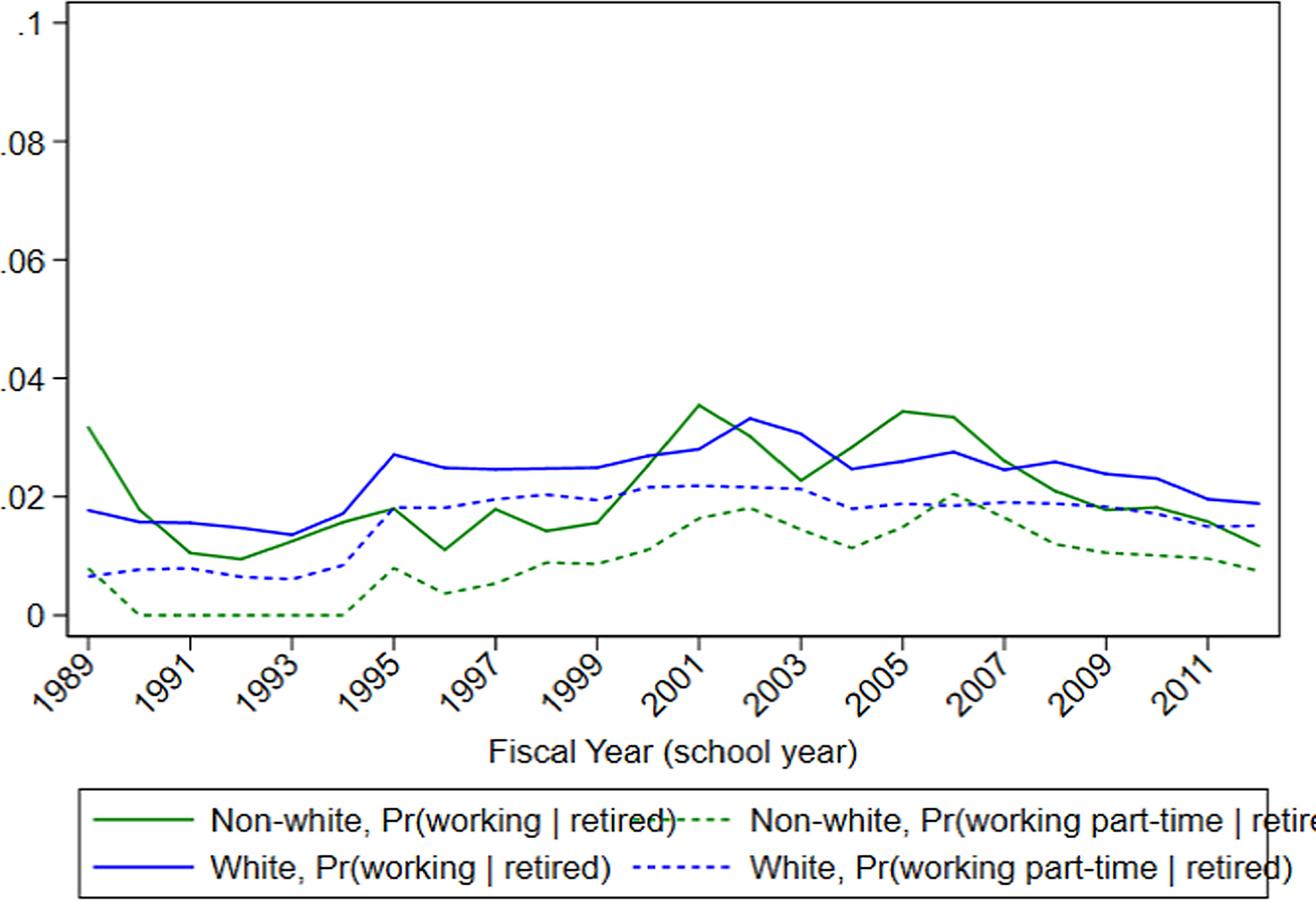
Next, I examine the rates of overall and part-time employment by employee race (Figure 4) and gender (Figure 5). There are no large differences in labor supply of retirees of different races, though non-white annuitants might be slightly less likely to work part-time than their white counterparts. There are, however, clear differences in the post-retirement labor supply of men and women. Retired men are more likely to work and more likely to work part-time than their female counterparts. Several factors could be driving differences in labor supply across the genders, including differences in the composition of employees leading to differences in individuals’ own labor supply elasticity and a difference in labor supply elasticity resulting from differences in spousal labor supply, as well as other differences. I return to this issue later.
Fraction of retired annuitants who are employed and employed part-time, by year and race. Note: Based on the author's calculation using data from the TSR and TRS from 1989 to 2012. The sample includes retirees within 10 years of their retirement benefit collection date.
Fraction of retired annuitants who are employed and employed part-time, by year and gender. Note: Based on the author's calculation using data from the TSR and TRS from 1989 to 2012. The sample includes retirees within 10 years of their retirement benefit collection date.

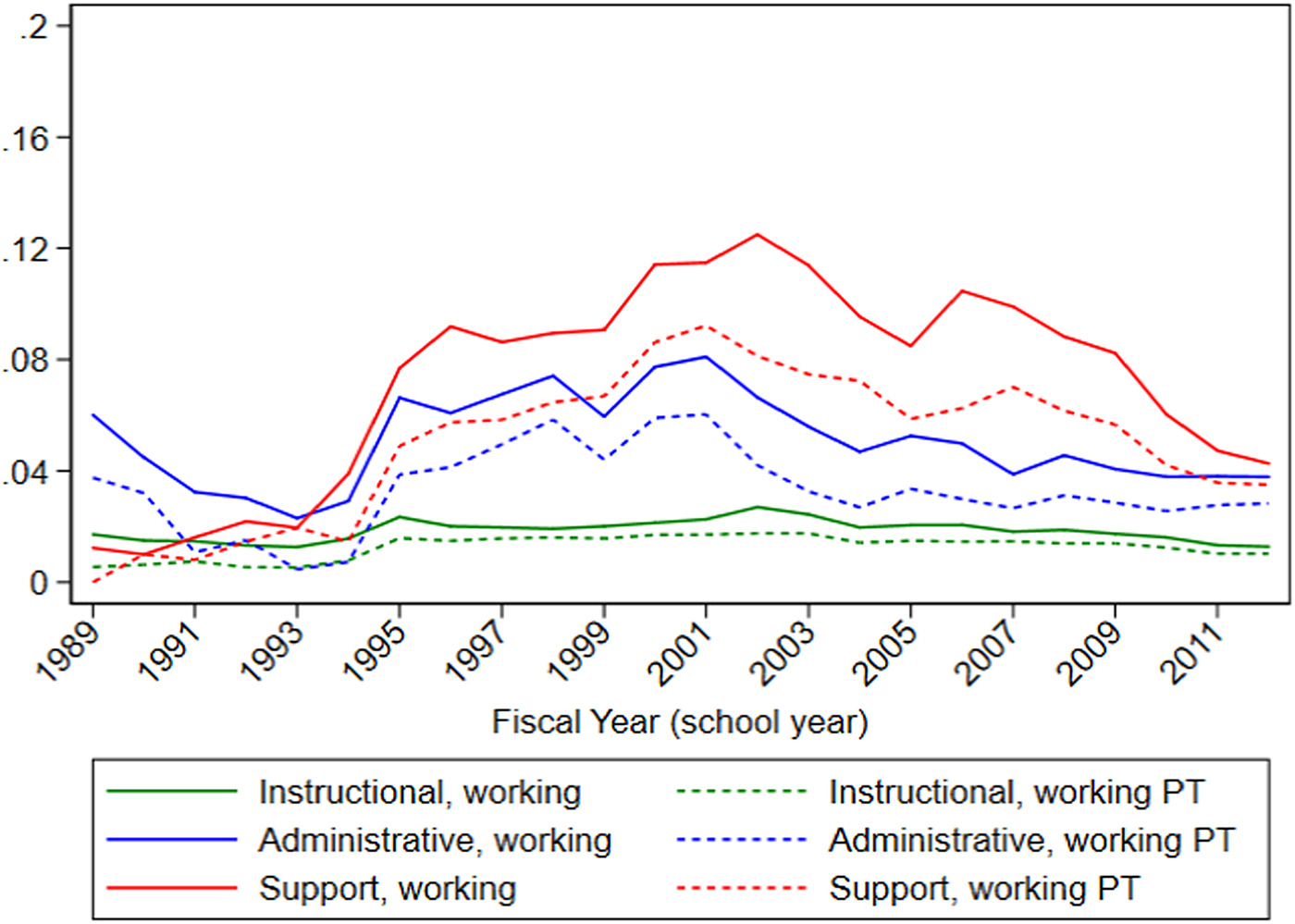
There may be different returns to retiring and/or returning to work post-retirement based on one's income, status, and other labor supply opportunities. To shed light on some of these differences, in the next several figures, I explore how return-to-work patterns differ for annuitants by position. In Figure 6, I plot the differences in labor supply by an employee's last position of employment in ISBE. I have divided positions into three categories: instructional staff (teachers), administrative staff (superintendents, principals, supervisors), and support staff (librarians, counselors, nurses, social workers, etc.). There are quite distinctive differences in the labor supply of these three groups of retirees. The labor supply of instructional staff is the lowest of the three groups and varies relatively little over time (though the time pattern does follow the same overall pattern as that of the other groups). On average over the period, 2–3% of retirees who were instructional staff work after retirement, the majority of which are employed part-time.
Fraction of retired annuitants who are employed and employed part-time, by year and position (occupation). Note: Based on the author's calculation using data from the TSR and TRS from 1989 to 2012. The sample includes retirees within 10 years of their retirement benefit collection date.

For the most part, before 2000, the labor supply patterns of employees who end their careers as administrative and support staff trend together, though the levels are sometimes different. Before the ERI, about 4% work and about 25–50% of that group work part-time. Just after the ERI program, employment of administrative and support staff jumped to 7% and 9%, respectively. Employment of administrative staff remained relatively stable through the late 1990s and began decreasing in 2001. Employment of support staff continued increasing until it hit a peak of about 13% in 2002. By 2012, employment rates for both of these groups was near 4%, most of which was part-time.
It is not clear what drives these differences in the employment patterns of annuitants who retired from different positions in ISBE. It may be that non-instructional jobs have more flexible hours than instructional jobs. Too see if that is the case, I examined the probability of working part-time and the distribution of hours worked among non-retirees in each of the three position types. Although support staff are one-and-a-half times more likely to work part-time than instructional staff (6% and 4%, respectively), administrative staff are just one-quarter to one-half as likely (1–2% over the period). So, it does not seem as though overall differences in the flexibility of hours on these jobs can be driving the differences in post-retirement work (though there may still be more flexibility in hours in support and administrative jobs for retirees). It also could be that support and administrative positions are more flexible than administrative positions in some other ways that appeal to retirees. Or, it may be the case that labor supply preferences are different across people who are in different positions or occupations. These explanations are difficult to disentangle with existing data.
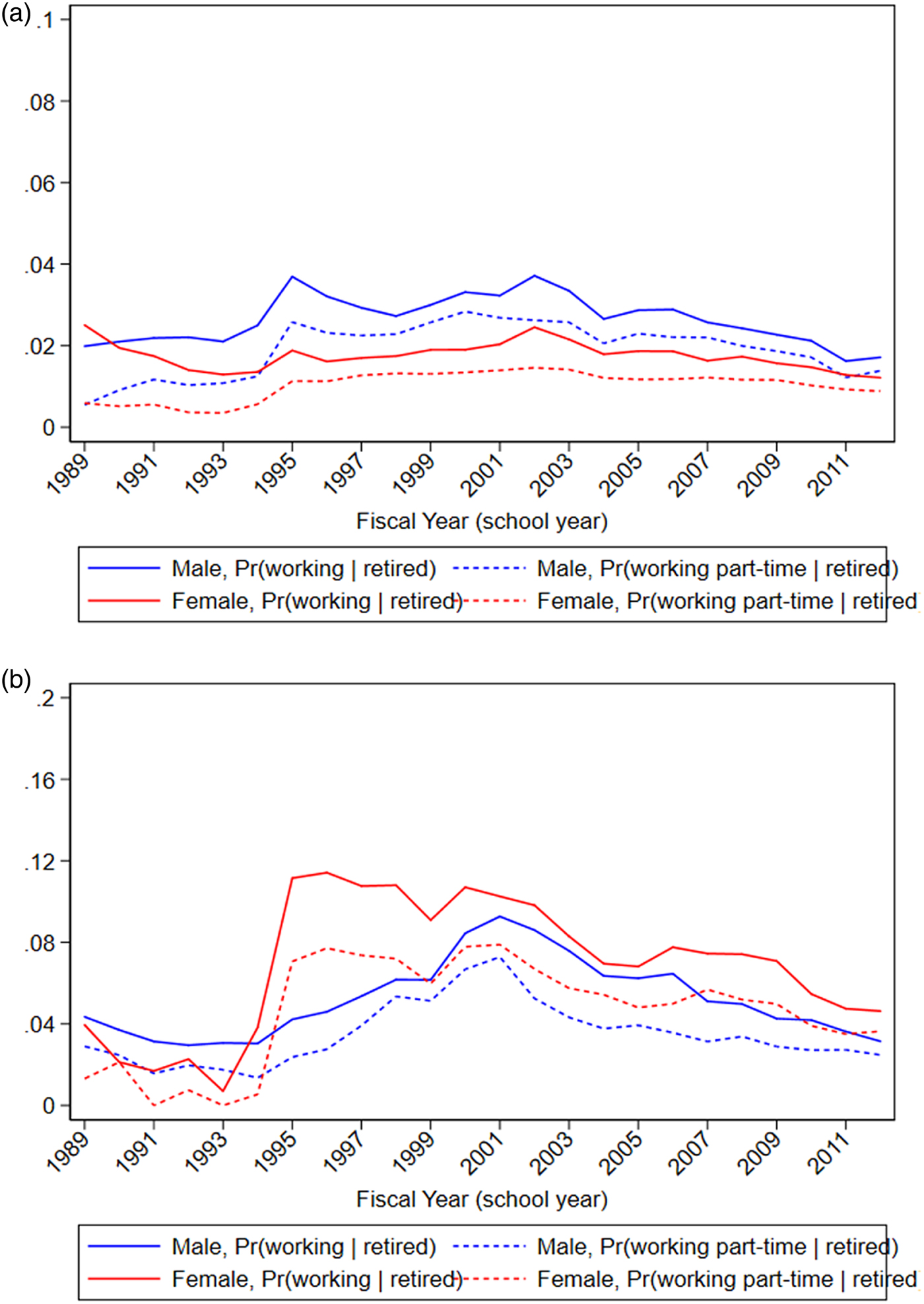
Just like in the broader economy, there are differences in the gender make-up of public school employees by position or occupation. While women make up 70% of the retirees who retired from instructional positions, they make up just 55% of those who retired from non-instructional positions. At around just 20%, they represent an even smaller proportion of the administrative (or leadership) staff of ISBE. Of interest is whether the differences in retirement rates discussed earlier by gender are related to these differences in occupation or whether employment rates of males and females conditional on gender are similar. In panel A of Figure 7, I plot the full- and part-time employment rates of men and women who retired from instructional staff positions. Men in this group are about 50% more likely to work and about 100% more likely to be working part-time than the women. In panel B, we see that the labor supply of men and women who retired from administrative and support staff positions is more similar, though for this group female employment rates are higher than those of their male counterparts. (The exception is in the more pronounced labor supply response to the ERI by former non-instructional staff who are female.) Therefore, overall differences in the labor supply of male and female annuitants is partly related to the fact that they have different positions (occupations) and partly to differences in their labor supply elasticity within position type (occupation).
Fraction of retired annuitants who are employed and employed part-time, by year, gender, and position (occupation). Note: Based on the author's calculation using data from the TSR and TRS from 1989 to 2012. The sample includes retirees within 10 years of their retirement benefit collection date.

6. Difference-in-difference estimates of the effects of the increase in allowed hours of post-retirement work
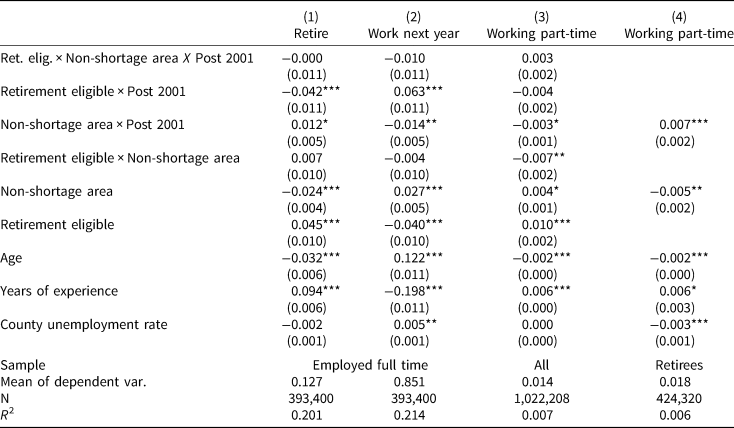
In Table 2, I present the estimates of the effects of the 2001 increase in allowed hours of work on the retirement behavior of employees who are still working. I include only those employees within 5 years of retirement eligibility, as well as those who are retirement eligible, in the sample in order to be sure the treatment and comparison groups are as closely related as possible. In the table, I use two different dependent variables to measure retirement. The first, which is the dependent variable in the specifications reported in column 1, is retirement defined by the collection of a retirement annuity. The second, used as the dependent variable in column 2, is whether the employee is still employed in the following year. In these columns, the coefficient measuring the effect of the policy is the one from the term Post × Eligible × NonShortageit (in the first row). The results show that the policy did little to affect retirement and employment of employees of IPS. The estimate of the policy's effect on retirement and employment are close to zero and are not statistically significant.
Estimates of the effects of the increase in allowable hours of employment post-retirement on retirement benefit collection and employment, employees within 5 years of retirement eligibility

Based on the author's calculation using data from the TSR and TRS from 1991 to 2011. Sample includes all employees, retired or not, between 1991 and 2011. Coefficients presented are from the difference-in-difference specifications presented in the text. Standard errors are in parentheses. *p < 0.05, **p < 0.01, ***p < 0.001.
In column 3, I investigate whether the patterns of part-time employment changed because of the increase in allowable hours of work post-retirement. The policy allowing for more flexible work arrangements increased the amount of part-time work among those most likely to be affected by the policy by 0.003 percentage points, or 21%. However, the estimate is not statistically significant.
The lack of precision in the results in column 3 may be driven by the fact that the treatment groups include the retirement-eligible employees who have not yet retired. Including these workers in the treatment group may attenuate the estimate of the policy's effect since the labor supply of those working is unlikely to be affected by the policy. So, in column 4, I limit the sample to the people collecting retirement benefits, whose labor supply is most likely to be affected the policy change. Although focusing only on retirees might be problematic if the policy changed the number of retirees in ways that might lead to biased estimates of the policy's effects, the results presented thus far suggest that is not the case. So, in column 4, I present results from a specification that includes only retirees in the sample. The estimates are from difference-in-difference models comparing the labor supply of retirees who were in non-shortage subject areas (and thus subject to the post-retirement limits on hours) as compared with those in shortage subject areas before and after the policy change. The estimates of the treatment effect (third row) show that the policy increased the propensity to be employed part-time by 0.7 percentage points (37%). The estimate is statistically significant at the 1% level.
Note that none of the comparison groups creates a perfect measure of the applicability of the return-to-work rules. The definition of retirement eligible does not include those eligible for a discounted early annuity. Additionally, my measure of service is inexact because I do not observe some forms of creditable service (like sick leave). In defining shortage areas, I classified all non-instructional staff as non-shortage unless they were listed as being in a shortage area, but the return-to-work rules do not apply to some types of non-instructional staff even if there is no shortage. As such, the results here represent an underestimate of the effects of the increase in allowable hours of employment post-retirement on labor supply.
In results not presented here, I also checked whether the policy had differential effects for different groups of people whose return-to-work behavior might be different. First, because earlier I showed that retirees in administrative and support staff positions were more likely to return to work than those in instructional positions, I tested whether the policy had different effects across these occupation groups. Also, because employees in districts that border other states have more options for unrestricted employment in public schools than those more internally located, I also tested whether the policy had different effects on return-to-work behavior in border counties than in those more inside the state. Also, since those with the most pre-retirement experience were more likely to return to work after retirement, I also tested whether the policy change affected those retirees more than retirees with less experience. I did not find any statistically significant differences in the policy's effect across these groups, but that may be because the samples are not large enough for me to identify any difference.
7. Conclusion
To summarize, there are interesting differences in return-to-work behavior across gender and occupation. Those with the most service (who are also the youngest) are the most likely to return to work. Moreover, return-to-work behavior is quite responsive to pension system rules, including those specifically aimed at return to work and those aimed at changing retirement decisions (like the ERI). As such, these policies appear to be binding on the labor supply decisions of some employees. These findings may inform policy debates about extending work-lives or improving the health of pension systems.
One limitation of the work here is that the data only include information on the employment of people within the IPS system. As such, I cannot observe people who return to work for other employers (e.g., in the private sector, in another state). If former public school employees are more likely to be employed in other sectors or for other employers after retirement (Quinn et al., Reference Quinn, Cahill and Giandrea2018), this estimate of the elasticity of labor supply with respect to hours limitations may be lower than if the hours limitation applied across all forms of employment. Furthermore, employees of IPS participate in a defined benefit pension system that puts return-to-work limitations on their employment. However, most employees in the private sector no longer have access to such pensions. That may mean the results in this paper do not generalize to other professions.
Acknowledgement
I thank the Sloan Foundation for support of this research. This research also was supported by the U.S. Social Security Administration through grant #5-RRC08098400-10 to the National Bureau of Economic Research as part of the SSA Retirement Research Consortium. The findings and conclusions expressed are solely those of the author(s) and do not represent the views of SSA, any agency of the Federal Government, or the NBER. Martha Johnson provided excellent research assistance. All errors and omissions are my own.