The Barrier Silence
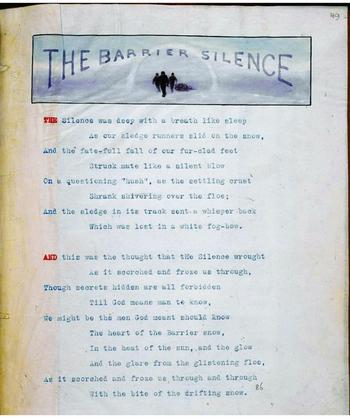
Edward Wilson's poem as published in the South Polar Times, Vol. 3, Part 3 in 1911.
Introduction
Of all the contributions to the South Polar Times (SPT) (Cherry-Garrard, Reference Cherry-Garrard1911; Shackleton & Bernacchi, Reference Shackleton and Bernacchi1907), Edward Wilson's poem The Barrier Silence in volume 3 (SPT3) is perhaps the most evocative (see above and Fig. 1). It was written and ‘published’ (15 October 1911) during the first winter of Captain Robert Falcon Scott's British Antarctic (Terra Nova) Expedition, 1910–1913, at Cape Evans, Ross Island, a few weeks after Wilson returned from an epic sledge journey to Cape Crozier from 27 June to 1 August 1911 with Henry ‘Birdie’ Bowers and Apsley Cherry-Garrard (Cherry-Garrard, Reference Cherry-Garrard1922). Scott revealed the names of his South Pole Party on 13 September (Scott, Wilson, Bowers, Lawrence ‘Titus’ Oates and Edgar ‘Teddy’ Evans), so by the time Wilson wrote his poem he already knew that he had been selected. Two weeks after publication of SPT3 the journey to the South Pole commenced.
The Barrier Silence reproduced from the original publication of the South Polar Times, Vol. 3, Part 3 (Cherry-Garrard, Reference Cherry-Garrard1911, p. 49).

The first two volumes of SPT, comprising eight parts, were produced on board the expedition ship Discovery lying off Hut Point, Cape Evans, Ross Island, during Scott's British National Antarctic Expedition, 1901–1904, in the winters of 1902 (five parts) and 1903 (three parts). However, SPT3, comprising only three parts (22 June, 7 September and 15 October), was produced during the 1911 winter at the expedition's base at Cape Evans, 24 km north of the earlier expedition winter quarters. A fourth part was produced for Midwinter Day (22 June) 1912, but was not published until almost a century later, as volume 4 (Cherry-Garrard, Reference Cherry-Garrard and Savours2010).
In April 1911, Scott appointed Cherry-Garrard as Editor of the expedition's third volume of the SPT. Thomas Griffith Taylor (Reference Taylor1916, p. 231) refers to a notice that Cherry-Garrard posted in the hut stating:
NOTICE.
South Polar Times.
THE first number of the South Polar Times will be published on Midwinter Day.
All are asked to send in contributions signed anonymously, and to place their contributions in the box under the looking-glass as soon as possible. No contributions will be accepted for this number after May 31st.
A selection of these will be made for publication.
It is not intended that the paper shall be too scientific. Contributions may take the form of prose, poetry, or drawings. Contributors whose writings lend themselves to illustration are asked to consult with the editor as soon as possible.
The Editor,
S.P.T.
Taylor adds:
A tin receptacle was nailed under the notice board, and labelled the Editor's Box, and Cherry set to work on his editorial pending the avalanche of contributions (1916, p. 231).
The collated contributions for each part were stitched and bound by Bernard Day, the expedition's motor engineer, using Venesta board (a strong, lightweight and watertight three-ply wooden board used in packing cases) and seal skin (Cherry-Garrard, Reference Cherry-Garrard and Savours2010, p. 71). Although the volume was typed and illustrated in 1911 (Cherry-Garrard, Reference Cherry-Garrard1911) the poem was first publically published two years later (Huxley, Reference Huxley1913, vol. 2, facing p. 1). (All three original volumes of the SPT are held in the British Library [Archive no. 51039-51041].) However, it was not until the following year that the fully illustrated facsimile volume of SPT3 was published (Cherry-Garrard, Reference Cherry-Garrard1914). The poem (p. 151) is the last contribution, besides the explanatory notes.
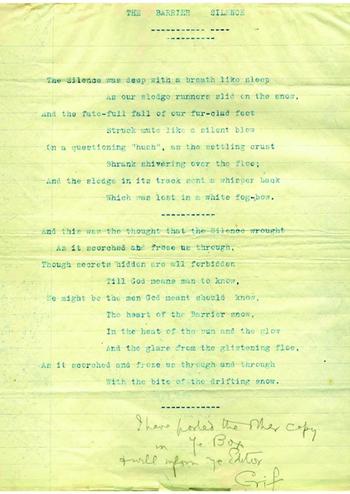
The incentive to write this account was the recent discovery of a page of writing paper bearing a draft of Wilson's poem The Barrier Silence, but typed by Taylor (Reference Taylor1911) with a hand-written signed note below it (Fig. 2). The page was inserted in a presentation copy of SPT3, formerly the property of Violet Oates, sister of Captain Lawrence Oates, one of the five members of Scott's ill-fated South Pole Party. It is probably the penultimate version prior to the poem's publication in SPT3 at the expedition hut in 1911. Wilson's poem is no literary masterpiece, but its significance lies in the fact that it is sinisterly premonitory of his and his four colleagues’ tragic demise on their return from the South Pole a few months after he wrote the poem. This paper examines the evolution of the poem over the few days prior to its publication in SPT3, and considers Wilson's motivation to write his composition.
Draft of The Barrier Silence typed on a page of notepaper by Thomas Griffith Taylor with his signed pencilled footnote (1911).

The Barrier Silence drafts
Taylor's narrative of the expedition (Taylor, Reference Taylor1916, p. 312–313) offers an insight into the origins and significance of the poem:
The last volume of S.P.T. for 1911 was now in preparation. The editor honoured me with an order for another skit on the lines of the Bipe research. . . [‘The Bipes’ by Taylor (SPT 3, Part 2) was a humorous 18 page memoir about a family of wingless bipeds from Ross Island, i.e. the expedition team.] So I wrote a second dealing with sledging trials, purporting to be love-letters between a McCormick Skua and a Weddell Seal. This was illustrated in similar style by Uncle Bill [as Wilson was fondly known]. One day when I was typing this copy on Cherry's typewriter, Bill came to me with a poem he had written. He asked me to type it so that Cherry should not recognize his writing. He [Wilson] wanted it to be perfectly anonymous, for he knew anything of Bill's would go in from our admiration of the writer! I saw that he had copied my footnote (so as to puzzle Cherry further) asking that an illustration be appended by the artist on the staff!
Taylor continues:
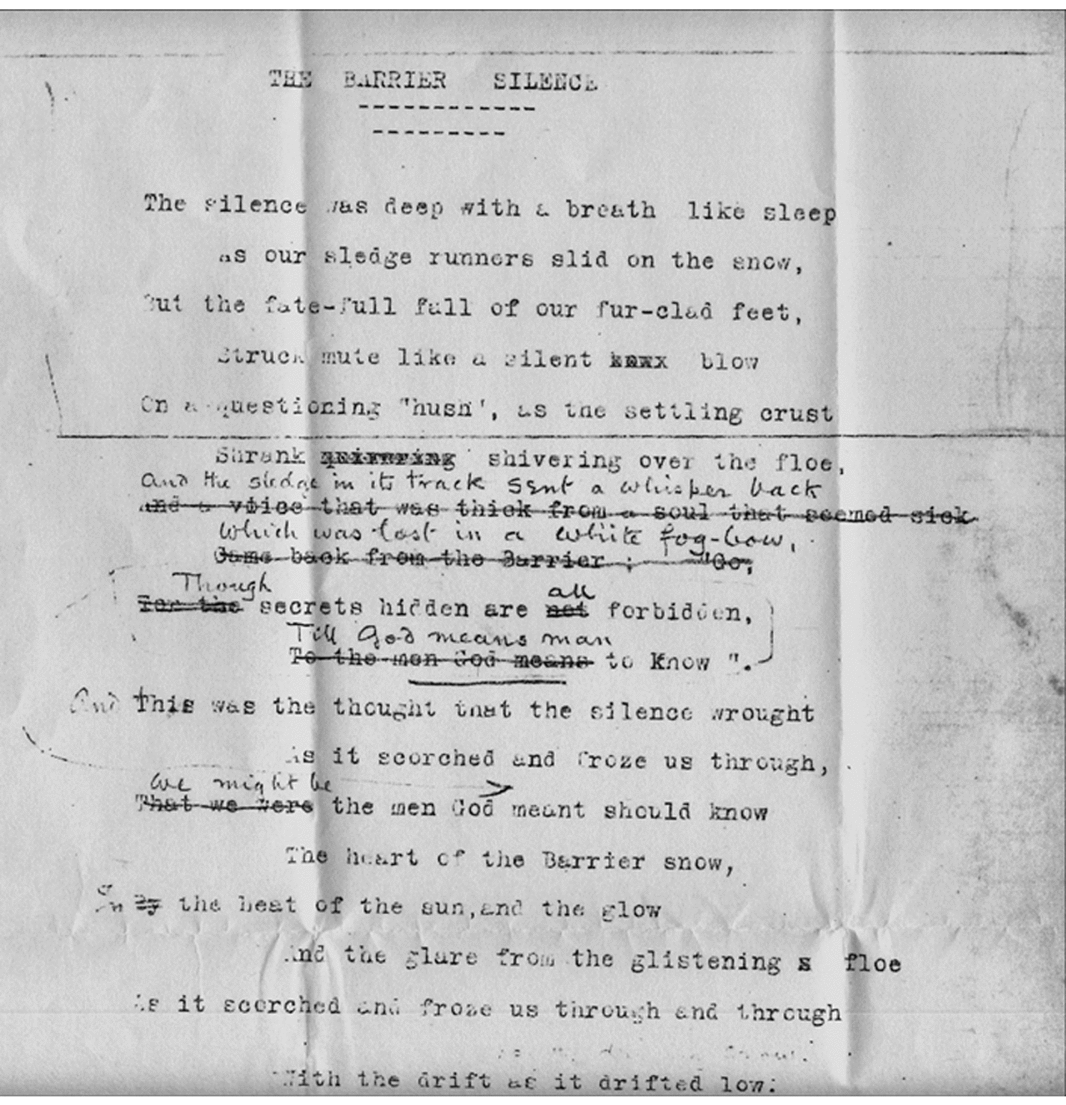
(This poem is that forming the introduction to the second volume of Scott's Last Expedition [i.e. Huxley, Reference Huxley1913].). A few days later Cherry brought me all the MS. and was graciously pleased to compliment me on the lot – especially the poem “Barrier Silence”! So I had to disclaim authorship – in spite of the footnote. After some time I think he believed me, but he wanted two lines cleared up a little and asked me to do it. I declined to alter it, but said that evidently the author expected Bill (as artist) to see the poem, and that I was sure that whatever he and Bill agreed to would satisfy the author! Whereat I heard Bill chuckle, and later it was returned to me emended as shown in the annexed facsimile [i.e. Taylor, Reference Taylor1916, facing p. 313, see Fig. 3].
Typed draft of The Barrier Silence, with subsequent pencilled amendments made by Wilson, reproduced from Taylor (Reference Taylor1916, facing p. 313).

This was a typed version of the poem, heavily amended in pencil and with a footnote stating ‘If your artist could rise to a heading illuminating the poem (sic.) with a sledge party in a waste of Barrier – please get him to do so.’
Taylor then adds:
Two explanations are perhaps helpful. The surface of the Barrier over large areas often sinks suddenly to a slight degree when it is disturbed by a sledge party, and this “shudder” has a very eerie sound. The glare from the blinding surface affects the eyes much as does a hot substance, and this is independent of the temperature. Hence the remark, “Scorched and froze us through and through.”
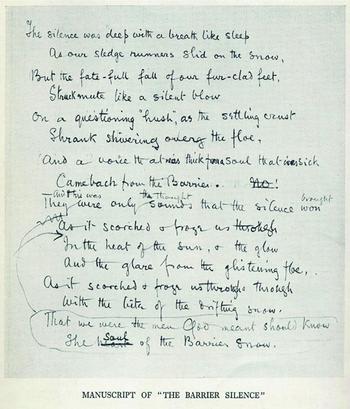
The earliest draft version of The Barrier Silence appears to be that reproduced photographically by George Seaver (Reference Seaver1933, facing p. 241). He describes the handwritten (in pencil) script as ‘a fragment of the first draft of the poem’, i.e. Wilson's original manuscript copy, and includes many amendments (Fig. 4). I have been unable to confirm the existence of this handwritten page. Dr David Wilson (in litt., October 2014), nephew of Edward Wilson, suggests that Seaver had access to this source from Wilson's wife Oriana, and that after he completed his biographies of Wilson (Seaver, Reference Seaver1933, Reference Seaver1937, Reference Seaver1948) she probably disposed of the material. No title to the poem is given, but Seaver captions it ‘Manuscript of “The Barrier Silence”’. The poem comprises 16 lines and there is no clear break to indicate the two separate verses in later versions. Some of the words or lines appear to have been erased and others over-written, and above Line 9 Wilson has written alternative words. The last two lines are ringed and an arrow indicates their repositioning to after Line 10 ‘As it scorched & froze us through’. These words are repeated in Line 13 as ‘As it scorched & froze us through & through’ and were retained in all subsequent versions.
The first(?) draft, with amendments, of The Barrier Silence in Wilson's handwriting, reproduced from Seaver (Reference Seaver1933, facing p. 241).

In the original written draft version (Seaver, Reference Seaver1933) Wilson altered Line 9 from ‘They were only the sounds that the silence won’ to ‘And this was the thought that the silence brought’. However, in the typed version of this amended line (Taylor, Reference Taylor1916), the word ‘brought’ became ‘wrought’, and remained so throughout subsequent versions. Whether this was an intentional change is not known, but Wilson's handwritten ‘b’ and ‘w’ are similar!
Seaver (Reference Seaver1933, p. 241) reproduces this manuscript in print, stating:
The version here printed is taken from the typescript before its final revision.
However, it is certainly not an identical transcript of any of the known draft versions. Not surprising, perhaps, since Seaver makes several misquotations throughout his text. It appears to be closest to the amended typed draft version published by Taylor (Reference Taylor1916, see above). On the same page Seaver adds a prophetic note regarding Wilson's train of thought at the time he wrote his poem:
. . . what is not generally known is that many of the phrases and rhymes of this poem were simmering in Wilson's mind in the Discovery days, and had been jotted down by him then and laid aside. Now he re-cast them into verse-form, with a typical self-criticism, ‘pathological I am afraid, perhaps an early symptom of Polar anaemia’.
Seaver's quotation is taken from Wilson's personal journal, but again not precisely verbatim (see King, Reference King1972, p. 176, 270).
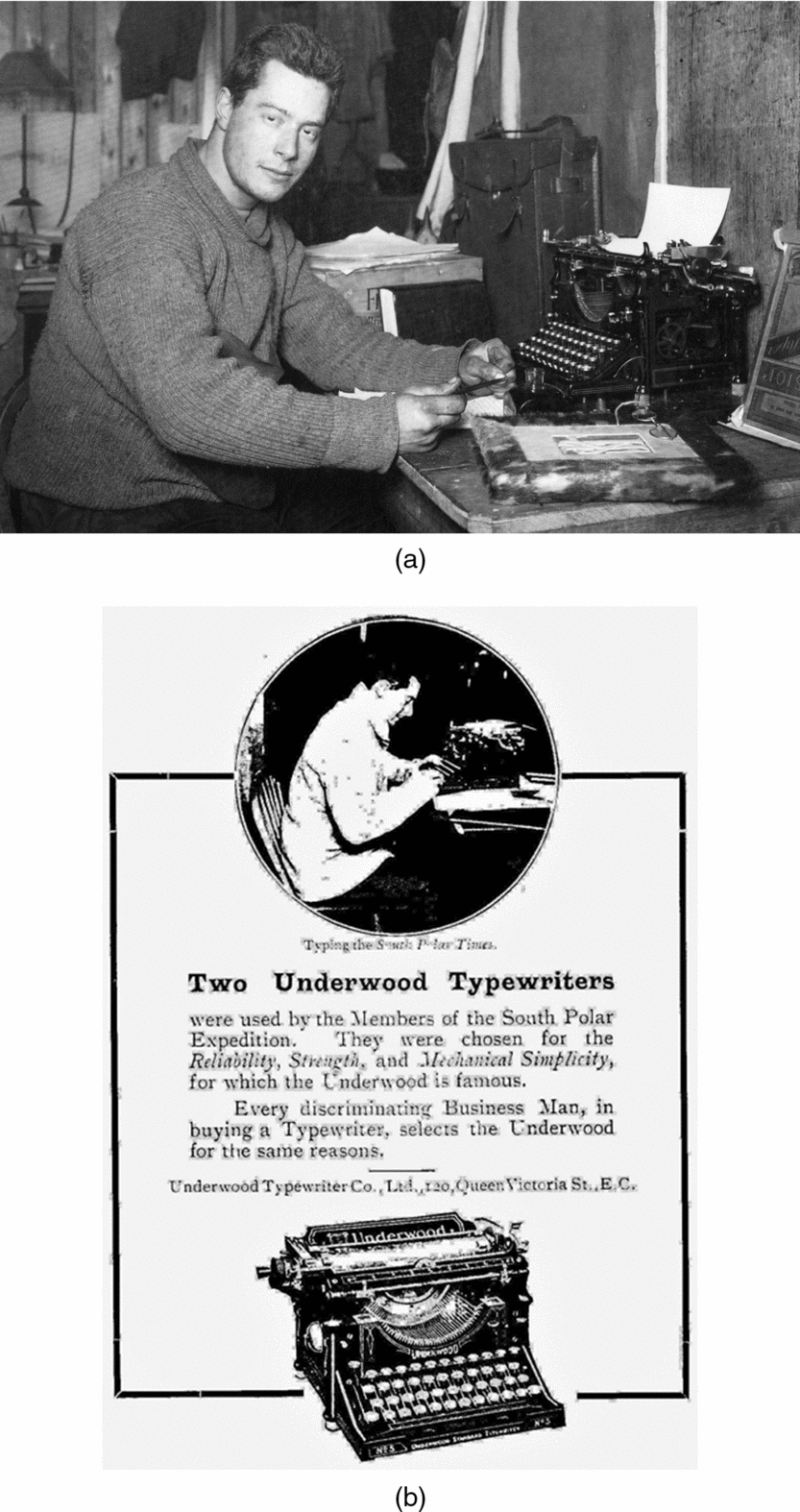
The first typescript of the poem, which included the title, was reproduced (in monochrome) by Taylor in his book With Scott. The silver lining (Taylor, Reference Taylor1916, facing p. 313). It was presumably typed using blue ribbon, as were all typed texts produced on the two expedition Underwood typewriters (Fig. 5a & b). In his personal diary (National Library of Australia, MS 1003/2/79) Taylor entered for Thursday 5 October 1911:
I typed MacCormick [sic] in a.m. Also Bill's Poem ‘Barrier Silence’. He asked me to do it so Cherry would consider it without favour to Bill.
Apsley Cherry-Garrard typing a submitted contribution for SPT3, Part 3, on one of the two Underwood typewriters, 30 August 1911. The sealskin-bound Venesta boards covering the volume lie on the bench to his right. Image reproduced from Riffenburgh et al., Reference Riffenburgh, Cruwys and Arnold2004, p. 152. b. Newspaper advertisement for Underwood typewriters. The caption below the illustration of Cherry-Garrard at his typewriter reads ‘Typing the South Polar Times’.

The reference to ‘MacCormick’ relates to Taylor's own contribution entitled A flight up the Ferrar [Glacier] (see reference above featuring a McCormick's skua; it occupies pages 140–150 in SPT3, Part 3, immediately preceding Wilson's poem). Taylor goes on to say how he confessed to Cherry that he (Taylor) was not the author of the poem, adding that Cherry liked it better than the Bipes, to which Taylor commented to the contrary! Next day he wrote, ‘Bill altered his poem a little [in his handwriting] & I retyped it (6th)’.
His original typescript is heavily amended with pencilled changes—in Wilson's handwriting. Taylor (Reference Taylor1916) adds a caption below the poem:
This is an original copy (reduced) of Bill's poem showing the footnote he added (in imitation of my earlier directions). Also showing his corrections after Cherry's criticism, thus giving the poem in its first and also its final form.
In this form the poem has gained two lines. The title is centred, with two short broken lines beneath it. The title and first five lines have a pencilled box drawn around them. A short pencilled line is drawn below the last line to indicate the end of the second stanza, with the footnote appended below it (see above).
The recently discovered 1911 typescript of the poem (Taylor Reference Taylor1911, Fig. 2) may, in fact, be the version from which Seaver derived his printed version (Fig. 4), although there are a few minor differences in punctuation and the misspelling of ‘floe’ (given as ‘flow’) in Line 16. This unrecorded version was typed in blue on a page of thin, faintly lined note paper. At the foot of the page, written in pencil, is a note by Taylor stating ‘I have posted the other copy in the Box & will inform the Editor. Grif’. The ‘Box’ referred to was the Editor's receptacle for contributions, and it was Taylor who actually typed the manuscript and passed a duplicate to the Editor. Although referred to by his colleagues as ‘Griff’, he referred to himself here as ‘Grif’. Below the centred uppercase title are two typed short broken lines. A broken line separates the two verses, and another is typed below the last line with Taylor's note below it. If the submitted ‘other copy’ was the original top copy, presumably the version referred to here (Fig. 2) is a carbon copy, albeit a very clear one. The first word of each verse is in lowercase, i.e. ‘The’ and ‘And’, and it is possible they were typed in red, but remained in blue in the carbon copy. However, when the final text was typed for SPT3 these two words were in red capitals.
All other published versions of The Barrier Silence differ slightly from this original copy, in some instances in minute detail.
The first published version of the printed poem appeared in Scott's last expedition (Huxley, Reference Huxley1913, Vol. 2, facing p. 1). However, there are significant differences between the two editions, published a few months apart. The first edition is essentially the uncorrected single verse in written form provided by Taylor (Fig. 3), but with some minor differences, mainly in punctuation, and with every second line indented. In Huxley's second edition the poem is almost identical to Taylor's version but incorporating Wilson's hand-written amendments (also shown in Fig. 3) and presented as two verses. In the second edition only eight of the 18 lines are unaltered, while minor changes in wording or punctuation occur in six lines, and four lines are completely different. Below the poem in both editions Huxley adds a note:
These verses were written by Dr. Wilson for the South Polar Times. It was characteristic of the man that he sent them in typewritten, lest the editor should recognise his hand and judge them on personal rather than literary grounds. Many of their readers confess that they felt in these lines Wilson's own premonition of the event.
However, in the second edition Huxley includes an additional sentence:
The version now given is the final form, as it appeared in the South Polar Times.
This is not strictly true as the first word of the second verse has not been capitalised, as published in the SPT, and there is a question mark after the word ‘Hush’ in the first edition. Indeed, there are subtle differences in how the word ‘hush’ is reproduced by different publishers. In the two Taylor versions (1911, 1916) and the original SPT3 (Cherry-Garrard, Reference Cherry-Garrard1911) it is typed as “hush”, implying that all were typed on the same or identical typewriter(s), while in the SPT facsimile volume (Cherry-Garrard Reference Cherry-Garrard1914) it is typed as “hush”, in Huxley's first edition (1913) and Turley's (Reference Turley1914) volume as ‘ Hush ? ’, in Huxley's second edition (1913) as ‘ Hush,’, and in Seaver's (Reference Seaver1933) version as ‘hush’! To add to the confusion, Turley (Reference Turley1914) reproduces Huxley's second edition version but retains the ‘Hush?’ from the first edition.
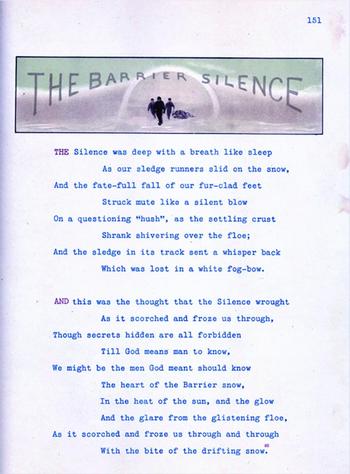
In the facsimile edition of SPT3 (Fig. 6, Cherry-Garrard, Reference Cherry-Garrard1914) a reference superscript number (85) was added at the end of the last line of the poem and an explanation given by the publishers in the final section of the volume, indeed the last entry in the volume (p. 160):
This poem was written by Doctor Wilson before starting on the Southern Journey. It was characteristic of the man that he asked Griffith Taylor to typewrite the verses and give them to the editor from an unknown contributor, lest the editor should recognize his hand and judge them on personal rather than literary grounds. The version now given is the final form in which the editor received it.
The Barrier Silence reproduced from the facsimile version of the South Polar Times, Vol. 3, Part 3 (Cherry-Garrard, Reference Cherry-Garrard1914, p. 151).

In fact, in the original version (Fig. 1) of the poem a reference superscript number 86 (not 85) has been pencilled in, presumably by Huxley for the publisher, but amended to 85 in the printed version.
The illustrated title
All three original volumes of SPT were typed on one side of each page, and the pages were numbered in pencil. In SPT3 Wilson's poem was on page 49 (cf. p. 151 in the Smith, Elder & Co facsimile of 1914). His original watercolour title scene, incorporating the title, appears duller than the reproduced copy in the latter publication, suggesting that it may have faded somewhat over the past century. The delicately painted illustration depicts three persons manhauling a laden sledge across a snowy waste beneath a fog bow. Almost certainly this was inspired by his epic three-man winter trek to Cape Crozier two months earlier (see Cherry-Garrard, Reference Cherry-Garrard1922), but here depicted in a daylight setting. Although Wilson painted many scenes of sledging and meteorological phenomena, that illustrating his poem title bears a close resemblance to features in his Fogbow - on the Great Ice Barrier (Scott Polar Research Institute, Archives Record No. 506); Noon, looking South, April 29 1911 (No. 513); Aug. 8, 1911, 3pm, Cape Evans. Looking North (No. 527); and Sledge hauling on ski. A grey day on the Great Ice Barrier (No. 530).
Wilson wrote in his personal diary (see King, Reference King1972, p. 176):
Thurs 12 Oct [1911] Up at 5 writing and reading. Horse exercise and then up the Ramp and S.P.T. drawing the rest of the day. This just about finishes the S.P.T. for this third volume, and it is to be published on Sunday [15th October]. It is a very poetical number – or rather versical – I am not sure that there is much poetry in any of the verses. I have even run to two verses myself. Pathological I'm afraid – perhaps an early symptom of polar anaemia.
Discussion
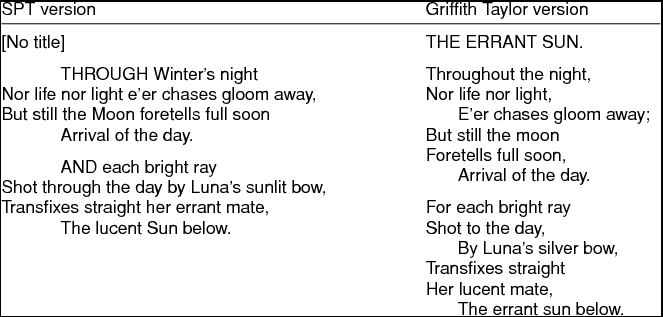
Edward Wilson was a prolific contributor to the SPT, notably as an illustrator, during the first year of Captain Robert Falcon Scott's British Antarctic (Terra Nova) Expedition of 1910–1913. However, The Barrier Silence was allegedly his only written contribution. Or was it? In SPT3, Part 2, on page 92, a poem referred to as Through Winter's Night, for which there is no title, the first line of the poem bears close similarities to Wilson's literary style in The Barrier Silence. Confusingly, in the Table of Contents (SPT3, p. ix), the poem on page 92 is stated as author ‘Unknown’, and on the same page is also indexed the poem The Return of the Sun by H.R. Bowers (written in the lyrical style of the British National Anthem!). In fact, neither poem has a title on page 92. As with The Barrier Silence, Through Winter's Night is not particularly well composed. It comprises two four-line verses, separated by a space, and is flanked to the left and below by an ‘L’-shaped watercolour illustration. In the vertical leg of the ‘L’ an arrow is aimed from the margin of the earthshine (depicted as a bowstring) through a crescent moon (as a bow) towards the sun and its rays, as it reappears through some wispy clouds above the horizon, in the horizontal leg of the ‘L’. This simple illustration perfectly expresses the text of the poem and, from its colour rendition and style, it was almost certainly painted by Wilson. It also cleverly links the themes of the two poems. Bowers’ poem is below the ‘unknown’ one, separated by the horizontal part of the illustration. Both poems have red capitals for the first word of each stanza, as was standard editorial practice for poems, but not for accounts. To add to the conundrum regarding authorship, Taylor (Reference Taylor1916, p. 287) wrote:
When there was no wind it was quite pleasant strolling about by the light of the moon. In the long winter night it was cheering to realize that we could tell where the sun was even if we hadn't seen him for over three months, for the moon's brighter face of course points to the sun. This comforting deduction led to the following astronomical effusion in S.P.T.: - .
He then quotes a poem with the title The Errant Sun (in capitals) which is an expanded version of Through Winter's Night with four added lines and some textual differences, but not included in SPT3, Part 2. Taylor adds:
I wrote at the foot for Dr. Bill's edification – “If your artist can rise to the occasion will he please illustrate this poem (sic) with a sketch?” and to this note there hangs a tale as shall appear later.
These words were almost identical to those he wrote below Wilson's The Barrier Silence five weeks later (Taylor, Reference Taylor1916)!
The two versions are compared in Table 1, but what remains uncertain is whether they were actually written by Taylor, or perhaps by Wilson and typed up by Taylor for publication! In the SPT version the first word of each verse is in red capitals, and the first and fourth lines of each verse are centred. In the Taylor version every third line is centred.
Comparison of two similar poems, one untitled (referred to as Through Winter's Night) and anonymous, but possibly written by Edward Wilson (SPT3, Part 3, Cherry-Garrard Reference Cherry-Garrard1911), the other entitled The Errant Sun by Griffith Taylor (Reference Taylor1916).

Wilson's considerable experience of the trials and tribulations of living and travelling in Antarctica and his scientific understanding of its natural environment must have had a profound influence on his thoughts and mood that inspired the words of The Barrier Silence. He was a deeply religious man who had the ability to interpret and express the soul of the Antarctic environment through the media of pencil, ink and watercolour paint (Seaver, Reference Seaver1937, Reference Seaver1948). Seaver (Reference Seaver1933, p. 241) suggested that Wilson's emotions, so vividly portrayed in the poem, may have been conceived during his two years on Scott's Discovery Expedition ten years earlier. However, there is no extant evidence to support this, although Seaver may have obtained such information from Wilson's unpublished writings in the possession of his wife, which Seaver consulted when he wrote his three biographies of Wilson (D. Wilson, in litt.).
Wilson would certainly have been influenced by the hardships and drama of the winter journey to Cape Crozier—The worst journey in the world (Cherry-Garrard, Reference Cherry-Garrard1922)—two months before writing the poem. His only reference to his poem was an entry in his personal journal for Thursday 12 October (see King, Reference King1972, p. 176, above). As suggested by Seaver (Reference Seaver1933), did Edward Wilson foresee the tragedy that was to unfold a few months later?
Postscript. To add to the tragedy of his fate, Wilson had spent several years between the two Scott expeditions undertaking research, with a team of other scientists, on the Scottish red grouse. His written and watercolour contributions formed a major part of this magnum opus. By the time it was published in 1911 Wilson was already in the Antarctic. The two volumes were sent to the expedition via New Zealand but they arrived too late for him to see the result of his monumental achievement (Leslie & Shipley, Reference Leslie and Shipley1911).
Acknowledgements
I am indebted to the following: Naomi Boneham, Archivist, and Robert Headland, Senior Associate, Scott Polar Research Institute, Cambridge, for providing information and illustrative material; to Tessa Debeljakovic, Reference Librarian, National Library of Australia, Canberra, for providing information from Thomas Griffith Taylor's personal diary; to the British Library, Boston Spa, for providing an image of The Barrier Silence from the original South Polar Times and for permission to reproduce it here; and to Dr David Wilson for providing information regarding his great uncle, Edward Wilson. I am also grateful to two anonymous referees for their helpful comments.