Internationally adopted children (hereafter referred to as IA children) are a special population of language learners since they have a unique language learning experience in which they begin to learn a second language (L2) while acquisition of the L1 is abruptly and usually completely stopped. The language acquisition of IA children cannot be conceptualized easily in terms of L2 acquisition, or simultaneous bilingual acquisition, because IA children are no longer exposed to their birth language in their adoptive families (Glennen & Masters, Reference Glennen and Masters2002). De Geer (Reference De Geer1992) has portrayed the unique linguistic experience of IA children as acquisition of a “second first language”. It is an empirical, as well as a theoretical, question whether the patterns, processes and outcomes of language development in young IA children are affected by their unique language learning experiences and, in particular, whether they differ from those of children learning language from birth. This study was motivated by this issue.
On the one hand, it might be expected that the language development of IA children who are exposed to an additional language around 12 months of age would resemble that of monolingual children who acquire language from birth, because the processes that underpin first language (L1) acquisition are still available, and acquisition of the new language falls well within what is thought to be the critical period for language learning (e.g., Birdsong, Reference Birdsong1999). Moreover, unlike the more typical case of children who acquire an L2 along with their L1, IA children acquire only their L2; in other words, exposure to the L2 is not restricted once learning begins, whereas typical L2 learners divide their learning time between two languages. On the other hand, it has been suggested that the sudden change in L1 exposure that IA children experience may create vulnerability for subsequent language learning and perhaps even an inability to develop complete mastery of the new language (e.g., Schiff-Myers, Reference Schiff-Myers1992) because the neuro-cognitive substrates of language learning are disrupted with cessation of exposure to the L1. Newborn infants have perceptual capacities that allow them to discriminate phonetic units of any natural language (e.g., Werker & Tees, Reference Werker and Tees2002). However, this ability declines markedly toward the end of the first year of life when infants become unable to discriminate contrasts that are not phonemic in the input language, but continue to discriminate contrasts that are phonemic in the ambient language (Werker & Tees, Reference Werker and Tees2002). Researchers have also found that the phonetic discrimination abilities of 7-month-old children are positively correlated with their later lexical and syntactic development and negatively with their ability to discriminate non-native phonetic contrasts (Kuhl, Conboy, Padden, Nelson & Pruitt, Reference Kuhl, Conboy, Padden, Nelson and Pruitt2005). Thus, IA children might be at a disadvantage learning their “second first language” because exposure to the primary language that drives fine-tuning of the neuro-cognitive substrates for language learning is discontinued abruptly around 12 months of age.
In a related vein, in a study of L2 learners of Swedish who varied in their ages of first exposure to Swedish, Abrahamsson and Hyltenstam (Reference Abrahamsson and Hyltenstam2009) found that few of the participants in their study who had begun learning Swedish as an L2 before five years of age demonstrated competence in the native speaker range on most of the measures included in their test battery. They argued that L2 learning may be subject to much earlier age effects than have been reported in past studies, and than is argued in the classic critical period hypothesis, if alternative research methodologies are employed. Abrahamsson and Hyltenstam's results raise the question whether the delayed onset of second first language learning in IA children would result in differences in their language development in comparison to that of native learners of French.
Research to date on the language development of adopted children has generally reported good outcomes. More specifically, within 24 to 36 months post-adoption, many IA children score within the normal range on standardized tests or checklists designed for children learning language from their biological parents (e.g., Genesee, Reference Genesee, Paradis, Genesee and Crago2010; Glennen & Masters, Reference Glennen2002). IA children who are older at the time of adoption generally make faster initial progress acquiring the adopted language than children adopted at younger ages, but the latter are more likely to close the gap with their non-adopted peers and do so faster (e.g., Glennen, Reference Glennen2002; Krakow, Tao & Roberts, Reference Krakow, Tao and Roberts2005). However, it has also been found that there is greater variance in language abilities and a higher incidence of speech and language difficulties among IA children than is found in the population at large (e.g., Dalen & Ryvgold, Reference Dalen and Rygvold2006; Roberts, Pollock, & Krakow, Reference Roberts, Pollock and Krakow2005).
Most studies of young IA children have assessed their language outcomes with reference to standardized norm-referenced tests or checklists (e.g., MacArthur Communicative Development Inventory). The use of such assessment measures may overestimate IA children's language abilities because they fail to take into account factors that favour language development and that are disproportionately represented in IA children and their families and, in particular, socio-economic status (SES) and female gender. SES is particularly important because adoptive families generally have a higher SES than the general population (e.g., Tan & Yang, Reference Tan and Yang2005) and SES has been shown to have a significant impact on the language development of both adopted (domestic) and non-adopted children (Capron & Duyme, Reference Capron and Duyme1989; Duyme, Reference Duyme1988; Hart & Risley, Reference Hart and Risley1995; Hoff, Reference Hoff2006). Hart and Risley (Reference Hart and Risley1995), for example, found that children from families with relatively high SES were exposed to a greater diversity of words compared to children from lower-SES families; they heard more words on a weekly basis than children from mid-SES and low-SES families; and the vocabularies of three-year-old children from high-SES families were significantly larger than those of children from low-SES families. LeNormand, Parisse and Cohen (Reference Le Normand, Parisse and Cohen2008) also found that children from high-SES families produced lexically and morphosyntactically more complex utterances than children from low-SES families.
The children who participated in the present study were part of a longitudinal study that compared the language abilities of IA and non-adopted children matched for SES (Gauthier & Genesee, Reference Gauthier and Genesee2011). More specifically, Gauthier and Genesee examined the language outcomes of twenty-four children adopted from China in comparison to those of twenty-five non-adopted, monolingual French control children who were matched for SES, age and gender (all were girls). The children were assessed initially at 50 months of age, on average, and again 16 months later. The children had been exposed to French at the first assessment for 36 months (range = 19 to 46.5 months) and for 52 months, on average, at the second session (range = 34 to 64 months). The initial assessment revealed that the two groups were similar with respect to non-verbal intellectual abilities, socio-emotional adjustment and receptive language abilities. However, the IA children performed significantly lower than the controls on standardized tests of expressive vocabulary and general language abilities. At the second assessment, the IA children scored significantly lower than the non-adopted children on both receptive and expressive language (both vocabulary and grammar). A third assessment, conducted when the IA children were, on average, 7.8 years of age, continued to show lags in the language development of IA children in comparison to matched control children (Delcenserie, Genesee & Gauthier, in press). Approximately half of the IA children in this study had participated in the first two evaluations, indicating that despite extended exposure to French, the IA children were not closing the gap with their non-adopted peers.
We attribute the differences we found between the IA and non-adopted children to the fact that we made direct comparisons between the groups whereas many studies have used test norms to evaluate IA children's language abilities and to the fact that they were matched for SES (as well as gender and age). In the only other study we know of that also controls SES, Cohen and colleagues similarly found differences in favour of non-adopted children on a measure of expressive language (Cohen, Lojkasek, Zadeh, Pugliese & Kiefer, Reference Cohen, Lojkasek, Zadeh, Pugliese and Kiefer2008). The question remains, why are there persistent lags in the language abilities of the IA children? That the IA children as a group, in our studies as well as in other studies, scored in the normal or typical range would argue that the disruption in L1 exposure that they experienced had not impaired their basic language learning abilities. That the lags between the IA and non-adopted children persisted across time, even after the IA children had had 6 to 7 years of exposure to the adopted language (see Delcenserie et al.), would argue that exposure alone is an unlikely explanation (although arguably with even more exposure the gap would be eliminated). We speculated that the differences we found between the IA and control children may be due to their delayed onset of exposure to French (see Gauthier & Genesee, Reference Gauthier and Genesee2011, and Delcenserie et al., in press, for more detailed discussions of this issue).
In any case, the present study was conducted in order to characterize the nature of the differences between IA and non-adopted children in more detail. More specifically, we undertook a detailed analysis of specific aspects of the expressive language abilities of a subgroup of the IA children who participated in the Gauthier and Genesee study. The analyses were carried out on spontaneous language samples from twelve of twenty-four of the IA and twelve of the twenty-five CTL (control) children in Gauthier and Genesee. We focused our analyses on the acquisition of object clitics, tense morphology and lexical diversity, aspects of French that distinguish learners of French as a second language and children with language impairment acquiring French as a native language from typically developing children learning French as a native language. Object clitics are of particular interest in the present study because they are acquired relatively late in typically developing monolingual children, and thus might be susceptible to the delayed onset of acquisition of French experienced by our IA sample (e.g., Grüter, Reference Grüter2005; Jakubowicz & Nash, Reference Jakubowicz and Nash2001; Paradis & Crago, Reference Paradis and Crago2000; Paradis, Crago & Genesee, Reference Paradis, Crago, Genesee, Beachley, Brown and Conlin2003; Parisse & Maillart, Reference Parisse and Maillart2004). Based on our earlier findings, we expected that the IA children would demonstrate difficulties with object clitics and tense morphology and that they would exhibit restricted lexical diversity in comparison to monolingual French-learning control children of the same age, gender and socio-economic status.
Complement clitics in French
We examined the IA children's use of complement clitics, with a focus on direct object clitics (1st person sing. me, 2nd person sing. te, 3rd person sing. masc. le, 3rd person sing. fem. la, 1st person pl. nous, 2nd person pl. vous, 3rd person pl. les). Direct object clitics in French serve the same referential role as object pronouns in English, which are used when the object is salient in the discourse, either as a result of previous mention or due to the referent's visual presence (deixis). In English, object pronouns have the same distribution as full lexical objects and occur postverbally. In contrast, object clitics in French occur in preverbal position (see examples (1b) and (1c) for correct and incorrect placement of the direct object pronoun les/them). An exception to preverbal placement is affirmative imperatives as in (1d). French clitic pronouns are dependent on a verb and cannot be conjoined with other pronouns (see (1e)); they cannot stand alone; and they cannot be modified, dislocated or separated from the verb except by other clitics (Kayne, Reference Kayne1975).
- (1)
a. Julie nourrit Bruno et Amanda.
“Julie is feeding Bruno and Amanda.”
b. Julie les nourrit.
Julie them feed.
“Julie is feeding them.”
c. *Julie nourrit les.
“Julie is feeding them.”
d. Donne-le.
“Give it.”
e. *Julie le et la nourrit.
Julie him and her feed.
“Julie is feeding him and her.”
Typically developing children start to use complement clitics in French relatively late in development, usually around 2½ years of age, and they emerge after subject clitics (e.g., Hamann, Rizzi & Frauenfelder, Reference Hamann, Rizzi, Frauenfelder and Clahsen1996). Complement clitics, including object clitics, are also acquired late by simultaneous bilinguals (Hulk, Reference Hulk1997; Hulk & Müller, Reference Hulk and Müller2000) and are an area of some difficulty for L2 learners of French (e.g., Grondin & White, Reference Grondin and White1996), as evidenced by their relatively late emergence (White, Reference White and Clahsen1996), low rates of suppliance (when a clitic would be more pragmatically appropriate than a postverbal lexical object), and high rates of omission (in utterances without postverbal objects) (Adiv, Reference Adiv and Anderson1984; Grüter, Reference Grüter2005; Paradis, Reference Paradis2004).
Object clitics have been the focus of considerable research on French L1 learners with specific language impairment (SLI) because difficulty with object clitics is thought to be a marker of SLI in French (e.g., Hamann, Reference Hamann2003, Reference Hamann, Prévost and Paradis2004; Paradis, Crago & Genesee, Reference Paradis, Crago and Genesee2005–2006). Although research on SLI has focused on object clitics, it has been found that all complement clitics pose difficulties for French-speaking children with SLI. Like object clitics, these other clitic forms appear preverbally in French; see examples of these clitic forms in examples (2a), (3a) and (3c). French-speaking children with SLI frequently omit object clitics (Grüter, Reference Grüter2005; Hamann, Reference Hamann, Prévost and Paradis2004; Jakubowicz, Nash, Rigaut & Gérald, Reference Jakubowicz, Nash, Rigaut and Gérard1998; Paradis, Reference Paradis2004; Paradis et al., Reference Paradis, Crago and Genesee2005–2006), and they are less accurate in choosing the appropriate form of object clitic compared to typically developing children (Paradis, Reference Paradis2004); errors include person-, gender- and number-marking, as well as choice of the wrong clitic paradigm (e.g., using the locative clitic y as a replacement for the direct object clitic). French-learning children with SLI have more difficulty acquiring object clitics than definite articles (le – the masculine form of “the”, la – the feminine form of “the”, and les – the plural form of “them”) even though they have the same acoustic form, arguing that their difficulty cannot be attributed to perceptual processing alone (e.g., Hamann, Reference Hamann, Prévost and Paradis2004; Jakubowicz et al., Reference Jakubowicz, Nash, Rigaut and Gérard1998). Hamann and Belletti (Reference Hamann and Belletti2006) claim that while both child L1 learners of French with SLI and child L2 learners of French have difficulty acquiring clitics, the latter, but not the former, demonstrate placement errors. In short, “object clitics are a vulnerable area in the acquisition of French across learner contexts” (Paradis, Reference Paradis2004, p. 80), and thus acquisition of object clitics might reveal differences between IA and non-adopted children.
Lexical diversity
Lexical diversity is an index of a learner's active vocabulary and has been studied extensively in language acquisition and educational research (Duran, Malvern, Richards & Chipere, Reference Duran, Malvern, Richards and Chipere2004). Breadth of lexical knowledge has been shown to be linked to school progress (Walker, Greenwood, Hart & Carta, Reference Walker, Greenwood, Hart and Carta1994) as well as with reading achievement (Harlaar, Hayiou-Thomas, Dale & Plomin, Reference Harlaar, Hayiou-Thomas, Dale and Plomin2008). Researchers have reported that L2 children have a restricted range of lexical verbs (e.g., Harley, Reference Harley1992, for English L1–French L2 learners; and Golberg, Paradis & Crago, Reference Golberg, Paradis and Crago2008, for learners from various language backgrounds learning English as a L2). L2 learners of English, for example, use relatively more general all-purpose (GAP) verbs, such as “to do”, “to go”, “to take”, instead of less frequent and more specific verbs that are appropriate in the same contexts. It has also been found that children with SLI who are acquiring French have restricted lexical diversity when compared to typically developing children of the same age (Thordardottir & Namazi, Reference Thordardottir and Namazi2007). Restricted diversity of lexical forms has also been found in children with SLI learning English (e.g., Rice & Bode, Reference Rice and Bode1993; Watkins, Rice & Moltz, Reference Watkins, Rice and Moltz1993; however, see Thordardottir & Weismer, Reference Thordardottir and Weismer2001, for evidence of no difference) as well as in Cantonese-speaking children with SLI (Klee, Stokes, Wong, Fletcher & Gavin, Reference Klee, Stokes, Wong, Fletcher and Gavin2004).
Tense morphology
Research involving English-speaking children with SLI has found that they have difficulties with tense morphology and, in particular, they often omit tense-marking inflectional morphemes (Leonard, Reference Leonard1989; van der Lely, Reference van der Lely1998). The use of tense-marking morphemes has been found to be less accurate than the use of non-tense-marking morphemes in children with SLI, whereas typically developing children do not exhibit such a discrepancy, or to a much lesser extent (e.g., Rice, Reference Rice, Levy and Schaeffer2003). French-speaking children with SLI also have greater difficulty with inflectional morphology that marks tense compared to typically developing children learning French as a first language, and they exhibit a significant discrepancy in accuracy between tense-marking versus non-tense-marking morphemes (Jakubowicz & Nash, Reference Jakubowicz and Nash2001; Paradis & Crago, Reference Paradis and Crago2001, Reference Paradis, Crago, Prévost and Paradis2004). Tense-marking difficulties have also been found in typically developing English-speaking L2 learners of French when compared to monolingual learners of French (Paradis & Crago, Reference Paradis and Crago2000). In their study, Paradis and Crago (Reference Paradis and Crago2000) included three groups of seven-year-old participants: French-speaking children with SLI, typically developing English-speaking L2 learners of French, and monolingual French-speaking children. The SLI and L2 groups were significantly less accurate in their use of past and future tense morphemes in comparison to the monolingual children. Thordardottir and Namazi (Reference Thordardottir and Namazi2007) found that French-speaking children with SLI and MLU-matched monolingual French-speaking children demonstrated significantly less diversity in their use of verb inflectional morphology than typically developing children matched for age with the SLI children. However, the accuracy of verb inflection was not significantly different between groups.
The present study
This study was designed to examine specific aspects of French language acquisition in IA children which have been found to be delayed or problematic for other learners of French, including L2 learners and monolingual children with SLI. Thus, they may also pose difficulties for IA children whose initial exposure to French is delayed in comparison to children learning French from birth. To this end, we compared IA children's use of these aspects of French to that of non-adopted French-monolingual control children matched for age, sex and SES. Specifically, we examined: (a) complement clitics (all types combined, and direct object clitics separately): number of clitics produced, omissions and error rates; (b) lexical diversity: all words and lexical verbs; and (c) tense-related verb morphology: diversity and accuracy. We also examined general aspects of their French (i.e., MLU, number of utterances) in order to provide a general profile of the children's language use. Finally, we included standardized measures of expressive and receptive vocabulary and of social-emotional adjustment and non-verbal intellectual ability in order to compare the two groups to each other and to the larger longitudinal sample from which these subgroups were drawn.
Method
Participants
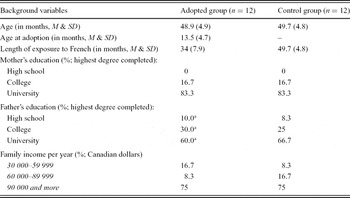
The IA group consisted of twelve children with a mean age at time of testing of 48.9 months (range: 42–56 months, SD = 4.9). The mean age of the IA children at the time of adoption by French-speaking families in Montreal was 13.5 months (range: 10–21 months, SD = 4.7). The IA children had been in their adoptive families for an average of 34 months at the time of testing (range: 20–43 months, SD = 7.9). The CTL group consisted of twelve monolingual French-speaking, non-adopted children, with a mean age at time of testing of 49.7 months (range: 42–57 months, SD = 4.8). There was no significant difference in age between the two groups (t(22) = −.375, p = .711 (two-tailed)). The IA and CTL groups were matched on parent's education and income according to information collected from the parents during a semi-structured interview. Chi-square tests indicated that there were no significant differences between the groups with respect to number of years of education of the mothers (n = 24) (x2 = 0.38, p = 0.54) or the fathers (n = 22) (x2 = 0.11, p = 0.95) or for family income (n = 23) (x2 = 0.68, p = .71). All the IA children in our sample were female, primarily because the vast majority (98%) of adoptees from China in Quebec are female (Beaulne & Lachance, Reference Beaulne and Lachance2000).
As mentioned earlier, the children were part of another study involving forty-nine children (24 adopted and 25 non-adopted children) (Gauthier & Genesee, Reference Gauthier and Genesee2011). The children in the present study were chosen to be representative of the whole sample of IA and CTL children with respect to their expressive language scores on the French versions of the Preschool Language Scale-Third Edition (PLS-III; Zimmerman, Steiner & Pond, Reference Zimmerman, Steiner and Pond1992) and the Expressive One-Word Picture Vocabulary Test-Third Edition (EOWPVT-III; Brownell, Reference Brownell2000). CTL children were excluded from participation in the study if they had: (1) a history of psychiatric or neurological problems; (2) intellectual or language problems; (3) a gestational age at birth of less than 37 weeks; (4) major health problems, past or present; (5) serious motor or behavioural problems; or (6) significant exposure to another language than French (more than 25% of the time). Participants in both groups were monolingual French-speaking children and none of the IA children were exposed to Chinese post-adoption. Recruitment of the IA children was done in collaboration with an adoption agency in Montreal. The CTL children were recruited from daycare centres in Montreal and through ads in a local newspaper. Demographic information from the participants is presented in Table 1.
Demographic data for the adopted and control groups.

notes: an = 10; parents refused to answer this question.
Procedure
The objectives and the procedure of the study were explained to each child–parent pair by the first author or by a trained research assistant and their questions were answered before testing began. Parents were then asked to read and sign the consent form. Naturalistic language samples were recorded from the children during a free-play session with the primary caregiver. Of the twelve IA children, nine were filmed with their mothers and three with their fathers. Of the twelve CTL, ten were filmed playing with their mothers and two with their fathers. The sessions lasted approximately 30 minutes and were filmed either in a lab at McGill University or in the families’ homes. A standard set of play materials, including a small portable kitchen set, toy utensils and a box of pretend food items, was used with every child. Parents were instructed to play with their child as they would normally at home. The play session was part of a larger assessment including four sessions that lasted approximately one hour and a half each, with breaks when needed. The filmed play session, analyzed in this paper, occurred during the last session. During the other sessions, the child completed a non-verbal intellectual test, the Leiter International Performance Scale-Revised (Leiter-R; Roid & Miller, Reference Roid and Miller1997), and a number of language tests in French: the Expressive One-Word Picture Vocabulary Test-Third Edition (EOWPVT-III; Brownell, Reference Brownell2000), the Échelle de vocabulaire en images Peabody (EVIP; Dunn, Thériault, Whalen & Dunn, Reference Dunn, Thériault-Whalen and Dunn1993) and the Preschool Language Scale-Third Edition (PLS-III; Zimmerman et al., Reference Zimmerman, Steiner and Pond1992). However, the results of this last test were not analyzed in the present study. Socio-emotional functioning was assessed using the Vineland Social-Emotional Early Childhood Scales (Vineland SEEC; Sparrow, Balla & Cicchetti, Reference Sparrow, Balla and Cicchetti1998), which took the form of a structured interview with the parents. A background questionnaire containing questions about the child's development, medical condition before and after adoption, as well as parental education, occupation and income was completed during an interview with the caregiver(s) during the first session. Parents also completed a questionnaire concerning the child's exposure to language(s) with others (e.g., parents, grandparents) and in a variety of situations (e.g., TV, radio). They were also asked to estimate the amount of French, English and any other languages that the child was exposed to.
Transcription and coding of language samples
The recorded language samples were transcribed in conformity with the standard CHAT format (Codes for the Human Analysis of Transcripts; MacWhinney, Reference MacWhinney2000) of the CHILDES project (Child Language Data Exchange System). Transcription was done from videotapes. The child's and the parent's utterances were transcribed and running notes about context and non-verbal gestures were made to facilitate subsequent interpretation and coding of the transcripts. Interjections and onomatopoetic expressions (e.g., ha@i, wouf@o), self-repetitions (e.g., Tu [/] tu manges la pomme “You [/] you eat the apple”), imitations, singing and hesitations were excluded. Transcription was carried out using standard conventions of adult French orthography and grammar. Some adaptations were made in accordance with everyday Quebec French usage; for example, expressions such as pis “then” and tsé “you know”, which occur frequently in colloquial Quebec French, were transcribed as they sounded and were not transcribed in standard French form (e.g., pis as puis and tse as tu sais). Pronunciation patterns typical of everyday Quebec French were not considered errors. For example, fait [fɛ] “did” is often pronounced as faite [fɛt], and was not considered as the feminine form. Hyphenated words or other groups of words that frequently occur together were transcribed as compounds (e.g. est+ce+que “Wh form”, là+bas “there”, peut+être “maybe”) and were treated as single words because they were assumed to be considered one word by the children (LeNormand, Parisse & Cohen, Reference Le Normand, Parisse and Cohen2008). The transcription was carried out initially by native or fluent bilingual speakers of Quebec French. Each transcript was subsequently verified completely by two other independent transcribers before being coded. Words or utterances that were unintelligible were excluded from further analyses. Transcriptions of the entire 30-minute sessions were coded using the CLAN program (Computerized Language Analysis; MacWhinney, Reference MacWhinney2000).
Complement clitics. Complement clitics were coded when used in appropriate discourse contexts; that is, when there was a referent mentioned earlier in the conversation or there was a visual referent. More precisely, we coded for: direct object (1st person sing. me, 2nd person sing. te, 3rd person sing. masc. le, 3rd person sing. fem. la, 1st person pl. nous, 2nd person pl. vous, 3rd person pl. les), indirect object (1st person sing. me, 2nd person sing. te, 3rd person sing. lui, 1st person pl. nous, 2nd person pl. vous, 3rd person pl. leur), reflexive (1st person sing. me, 2nd person sing. te, 3rd person sing. se, 1st person pl. nous, 2nd person pl. vous, 3rd person pl. se), partitive (en) and locative (y) forms. Complement clitics were coded as correct or incorrect. Incorrect usage included misplacements, clitics co-occurring along with an object noun, and wrong forms (e.g., masculine instead of feminine, singular instead of plural, or direct instead of indirect object forms). Misplacements and clitics co-occuring with object pronouns did not include dislocations which are correct in French; a dislocation was deemed to have occurred if there was a pause between the dislocated element and the utterance and a change in stress. Complement clitics were coded as omitted if there was no doubt that a clitic was obligatory but not provided. To calculate omission rates, we considered only contexts where a clitic was the most appropriate option in the adult language. The numerator was the number of clitics missing (considering the context) and the denominator was the total number of contexts in which there should have been a clitic (including instances when the clitic was missing, incorrectly used and correctly used). This gave the percentage of complement clitics that were omitted. The coding of complement clitics was done a second time by a native French speaker and disagreements were resolved by discussion with a third person.
Lexical/verbal diversity. Lexical/verbal diversity was assessed using type–token ratios, a common method for assessing lexical diversity, but not without its critics (see Duran et al., Reference Duran, Malvern, Richards and Chipere2004).Footnote 1 To determine the type–token ratio for all words, we calculated the frequency of different words as a percentage of the total number of words produced by each child. Differently inflected forms of adjectives and nouns were counted as the same type: chat/chatte/chats/chattes and grand/grande/grands/grandes were counted as only one type each. Variations in phonological form of the same words or contracted forms of a word were considered as their full and correct form. For example, cikron was considered citron “lemon”. The lexical-verb type–token ratio was obtained by calculating the number of different verbs, without considering inflections, as a percentage of the total number of verbs used. The lexical-verb type–token ratio is an index of the lexical–semantic aspect of verb production since different forms of a verb (i.e., tense, mood or person forms) were considered as one type.
Tense morphology. In order to investigate tense morphology, errors in the use of inflections marking tense or finiteness were coded. The rate of tense morphemes used correctly was calculated as a percentage of the total number of verbs used correctly and incorrectly. The coding of tense morphology was done a second time by a native French speaker and disagreements were resolved by discussion with a third person.
Standardized tests
We also examined the children on a number of standardized language and other tests.
Expressive One-Word Picture Vocabulary Test-Third Edition. A French adaptation of the EOWPVT test and scoring manual, developed by the Speech and Language Pathology Department of the Montreal Children's Hospital, was used to assess the children's expressive vocabulary skills. Psychometric properties may differ from those of the English version. Each child was asked to name objects, actions and concepts that were depicted visually. The EOWPVT was administered and scored according to standard procedures described in the test manual.
Échelle de vocabulaire en images Peabody. The EVIP assesses receptive vocabulary skills in French. Children are shown four pictures on a page and are asked to point to the picture that corresponds to a word spoken by the examiner. This test was normed on native French-speaking Canadian children. The EVIP was administered according to standard administration procedures described in the manual. The basal and ceiling rules of the test were applied.
Leiter International Performance Scale-Revised. The Brief IQ Screener of the Leiter-R was used to measure intellectual ability. This is a non-verbal test that does not require verbal instructions and responses. Four subtests from the Visualization and Reasoning battery compose the Brief IQ Screener: (1) Figure Ground (FG), in which the child has to find, in a picture, an object or part of an object depicted on a card; the test items become more complex as the test progresses. This subtest assesses visual scanning skills and effective search strategies; (2) Figure Completion (FC), in which the child has to mentally organize fragmented pieces of an object from many parts of the object displayed randomly on a card and find the object within complex visual stimuli. This subtest assesses the capacity to identify a “whole object” from a complex visual array (Roid & Miller, Reference Roid and Miller1997); (3) Sequential Order (SO) measures the capacity to generate rules and to understand relationships between pictures or figures. The child has to organize stimuli in sequential order, for example, by arranging squares according to size; and (4) Repeated Patterns (RP) in which the child has to complete a patterned sequence of symbols; for example, the child is presented with a sequence of one red circle, one yellow square, one red circle and one yellow square and has to complete the sequence. This task involves deductive reasoning skills and the capacity to generate rules in order to produce a sequence. The Leiter-R was administered according to the standard administration procedures described in the manual.
Vineland SEEC: Vineland Social-Emotional Early Childhood Scales. The Vineland SEEC is a measure of social-emotional adjustment. It contains three scales: (1) Interpersonal Relationships; (2) Play & Leisure Time; and (3) Coping Skills. The administration procedures were adapted for the present study. Parents were given response choices instead of responding freely to guarantee that scoring was standardized and objective. The scoring system was as follows: 2 points if the behaviour was observed often; 1 point if the behaviour was observed sometimes, with partial success, if the parent did not have the opportunity to observe it, or if the parent did not know; and 0 was assigned if the behaviour was never observed.
Results
Separate one-way analyses of variance (ANOVAs) were carried out to compare the performance of the IA and CTL children on the Vineland SEEC, Leiter-R, EVIP, EOWPVT and the naturalistic language results.
Socio-emotional adjustment
An ANOVA was run to examine possible differences between the IA and CTL groups with respect to raw scores on the Vineland SEEC. There was no significant difference between the IA (M = 157.33, range = 127–194, SD = 17.46) and CTL children (M = 164.91, range = 142–192, SD = 15.00); (F(1,21) = 1.24, p = .279), suggesting that the socio-emotional adjustment of the IA children was comparable to that of the CTL children.
Intellectual ability
Results of the ANOVA on the standard scores for the Brief IQ Screener of the Leiter indicated that there was no significant difference between the IA (M = 118.27, range = 93–137, SD = 15.11) and CTL (M = 125.33, range = 97–143, SD = 15.51) children; (F(1,21) = 1.22, p = .282). IQ standard scores on the Leiter-R were assigned a mean of 100 and a standard deviation of 15. The scores of all children in both groups were within the average range or above, suggesting that the groups were equivalent with respect to their general non-verbal cognitive abilities.
Expressive and receptive vocabulary
ANOVAs were conducted to determine whether the groups differed on the raw scores of either the EVIP or the EOWPVT. There was no significant difference between the IA children (M = 46.17, range = 38.52–53.81, SD = 12.03) and the CTL children (M = 57.25, range = 44.97–69.53, SD = 19.34) on the raw score of the EVIP; (F(1,22) = 2.84, p = .11). However, the IA children (M = 37.33, range = 31.63–43.04, SD = 8.98) scored significantly lower than the CTL children (M = 44.92, range = 39.54–50.30, SD = 8.47) on the EOWPVT; (F(1,22) = 4.53, p = .045). These results replicate those found for the larger sample and suggest that the subsamples analyzed in this study are representative of the larger samples.
Naturalistic language results
General language measures. Each child's MLU in morphemes, based on language samples recorded at this testing, was calculated using CLAN. There was no significant difference for MLU between the IA (M = 3.90, range = 2.77–4.76, SD = .60) and the CTL (M = 4.25, range = 3.37–5.35, SD = .62) children; (F(1,22) = 2.01, p = .17). Two of the IA children had MLUs that were 2 standard deviations below the mean of the CTL group – 2.77 and 2.90. These children were adopted at 10 and 21 months of age and exposed to French for 42 months and 23 months, respectively, suggesting that age at adoption and exposure to French were not the primary reasons for their poor performance. All transcripts were exactly 30 minutes to control for length of transcript. Nevertheless, we ran an ANOVA on the total number of utterances in each child's transcript. There was no significant difference between the IA (M = 328, range = 216–395, SD = 54.48) and the CTL children (M = 293.6, range = 198–469, SD = 80.24); (F(1,22) = 1.51, p = .23), indicating that the CTL and IA children were equally talkative.
Lexical diversity. The type–token ratio for all words, based on transcripts of equal length for all children, as noted earlier, was the same for the IA (M = .18, range = .16–.21, SD = .019) and CTL children (M = .19, range = .15–.25, SD = .031); (F(1,22) = 1.20, p = .285). Similarly, the lexical-verb type–token ratio was not significantly different between the IA (M = .13, range = .09–.18, SD = .02) and CTL group (M = .16, range = .12–.23, SD = .03); (F(1,22) = 3.78, p = .065).
Complement clitics. There was no significant difference in the total number of complement clitics of all types produced (correctly or incorrectly) by the IA children (M = 30.00, range = 18.00–40.00, SD = 6.73) and the CTL children (M = 31.92, range = 9.00–85.00, SD = 18.93); (F(1,22) = .109, p = .74). Examples of correct clitic use are given in (2).
- (2)
a. Je vais aller en acheter à l'épicerie.
I am going to it buy at the grocery store.
“I am going to buy it at the grocery store.”
b. Je le met là-dedans.
I it put in here.
“I put it in here.”
c. Je peux pas les prendre.
I cannot them take.
“I cannot take them.”
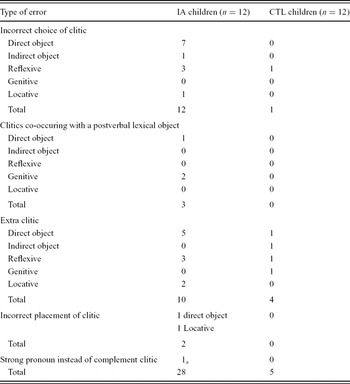
Error rates in complement clitic use (including direct object, indirect object, reflexive, partitive (en) and locative) were calculated as the total number of clitics used incorrectly as a percentage of the total number of clitics used in the 30-minute transcripts. The average percentage of errors was 8.56 for the IA children (range = 0–22.22, SD = 7.03) and 1.42 for the CTL children (range = 0–6.90, SD = 2.50). Because the percentage of errors was not normally distributed, the percentage of errors in complement clitic use was transformed using a square root transformation which reduced the skewness of the data. The square root of the percentage of errors in complement clitic use was significantly higher for the IA children (M = 2.64, range = .0–4.71, SD = 1.32) than for the CTL children (M = 0.66, range = .0–2.63, SD = 1.04); (F(1,22) = 16.65, p < 0.001). Concerning individual differences in clitic errors, eleven of the twelve IA children made at least one error when using clitics compared to only four of the twelve CTL children. Of these four CTL children, three made 1 error and one made 2 errors. For the IA children, four made one error, one made 2 errors, and six made between 3 and 6 errors. Table 2 presents the types of complement clitic errors made by the IA and CTL children. Examples of errors made by IA children are presented in (3).
- (3)
a. *Je s’en va au pique-nique.
“I am going to the picnic.”
[Type of error: Incorrect choice of clitic]
[Target form:] Je m'en va au pique-nique.
b. *Y touche.
“It touch.”
[Type of error: Incorrect placement of clitic]
[Target form:] Touche-y.
“Touch it.”
[Note: The child is asking his caregiver to touch an object.]
c. *Après je vais le mettre quelque chose dedans.
“After I am going to it put something inside.”
[Type of error: Clitics co-occuring with a postverbal lexical object]
[Target form:] Après je vais le mettre dedans or Après je vais mettre quelque chose dedans.
“After I am going to put it inside or after I am going to put something inside.”
d. *On le l'ouvre.
“We it it open.”
[Type of error: Extra clitic]
[Target form:] On l'ouvre.
“We open it.”
[Note: In other instances, the same child used the clitic le correctly with the verb ouvrir, suggesting that the error in (3d) is not due to the fact that the vowel-initial verb ouvrir was misanalyzed but rather due to difficulty with the clitic per se.]
e. *Je vais le servir toi.
“I am going to it serve you.”
[Type of error: Strong pronoun instead of complement clitic]
[Target form:] Je vais te le servir.
“I am going to serve it to you.”
Type of complement clitic errors for adopted (IA) and control (CTL) groups.

note: a toi was used instead of te (indirect object).
We also calculated the percentage errors in the children's use of direct object clitics separately in order to compare the performance of our IA children with that reported in studies of L2 learners and children with SLI (e.g., Grüter, Reference Grüter2005; Paradis, Reference Paradis2004; Paradis et al., Reference Paradis, Crago and Genesee2005–2006). The average percentage of direct object clitic errors was 6.8% for IA children (range = 0–14.29, SD = 5.62) and 0.83 for the CTL children (range = 0–10.00, SD = 2.89). The individual percentage scores were transformed using a square root transformation because the data were not normally distributed. The square root of the percentage of direct object clitic errors was significantly higher for the IA children (M = 2.10, range = 0–3.78, SD = 1.61) than for the CTL children (M = .26, range = .0–3.16, SD = 0.26); (F(1,22) = 11.84, p = .002).
We also calculated the percentage of incorrect use of the definite articles le, la and les, including errors of gender, number and form, which are homophonous with third person direct object clitic forms (le, la, les) in French and compared the two groups’ error scores. This comparison was carried out by Paradis et al. (Reference Paradis, Crago and Genesee2005–2006) to ascertain to what extent errors in the use of object clitics are due to perceptual processing factors. An ANOVA revealed no significant difference between the IA (M = 2.79, range = 0–17.39, SD = 5.46) and CTL group (M = 1.46, range = 0–5.56, SD = 2.25) on incorrect use of articles (F(1,22) = .61, p = .45). In contrast, the average percentage incorrect use of third person direct object clitics was 5.07 % for the IA children (range = 0–18.75, SD = 6.10) and 1.04% for the CTL children (range = 0–12.50, SD = 3.61). These error scores were transformed using a square root transformation because the data were not normally distributed. The square root of the percentage of errors was significantly higher for the IA children (M = 1.56, range = 0–4.33, SD = 1.7) than for the CTL children (M = .29, range = .0–3.54, SD = 1.02); (F(1,22) = 4.95, p = .037). These results indicate that the IA children's difficulties using object clitics was not due to general difficulties in processing phonologically weak elements.
There was no statistically significant difference in percentage of complement clitic omissions between the IA (M = 1.54, range = 0–5.88, SD = 2.40) and CTL children (M = 1.24, range = 0–5.26, SD = 1.92); (F(1,22) = 0.12, p = .74). The percentage of direct object clitic omissions (excluding indirect objects, reflexives, partitives and locatives) was also calculated. There was no difference between the IA (M = 1.83, range = 0–14.29, SD = 4.50) and CTL children (M = 2.19, range = 0–10, SD = 4.06); (F(1,22) = 0.41, p = .841). Examples of complement clitic omissions are given in (4) ((4a) direct object and (4b) reflexive).
- (4)
a. *Ça faut tu qu'on mette dans le f(r)igo. [clear referent in the discourse]
“This should we put in the fridge.”
[Target form:] Ça faut tu qu'on le mette dans le f(r)igo.
“This should we put it in the fridge.”
b. *Oui ben on chican-ait pour le lavabo.
“Yes we were fighting for the sink”.
[Target form:] Oui ben on se chicanait pour le lavabo.
“Yes we were fighting for the sink”.
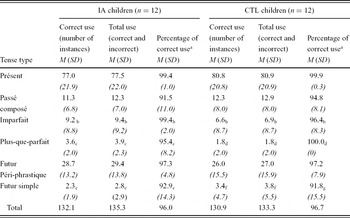
Tense morphology. A summary of the children's diversity scores with respect to tense morphology is presented in Table 3. ANOVAs were conducted to compare the mean number of each type of verb tense used by the IA and CTL children, six ANOVAs in total; no significant differences were found. ANOVAs were also conducted on the percentage of correct use of each verb tense, and again there were no significant differences between the IA and CTL children.
Diversity and correct use of verb morphology for the adopted (IA) and control (CTL) children.

notes: * p < .05. a Mean percentage of correct use of tense morphology: the number of correct tense forms out of the number of obligatory contexts for these forms; b n = 11; c n = 7; d n = 6; e n = 4; f n = 8; g n = 7. One control child was removed from the analysis because she was an outlier.
Relationship between age at adoption, exposure to French and language skills. In order to investigate potential factors that might have influenced the language outcomes of the IA children, we correlated age at adoption and length of exposure to French with percentage of complement clitic errors (square root). In particular, we were interested in ascertaining the role of exposure in the use of complement clitics by the IA children. The correlations calculated between age at adoption and percentage complement clitic errors (square root) was non-significant (n = 12, r = .10, p = .38). The correlation between number of months of exposure to French and percentage complement clitic errors was also non-significant (n = 12, r = −.01, p = .48). There was no significant correlation between MLU age at adoption (n = 12, r = −.16, p = .31) or number of months of exposure to French (n = 12, r = .25, p = .22). In contrast, correlations between age at adoption and the type–token ratio for all words (n = 12, r = −.70, p = .006) as well as for lexical-verb type–token ratio (n = 12, r = −.66, p = .01) were significant. Correlations between number of months of exposure to French with type–token ratio for all words (n = 12, r = .69, p = .006) and for lexical-verb type–token ratio (n = 12, r = .58, p = .024) were also significant. Age at adoption and length of exposure to French were highly correlated (n = 12, r = .79, p = .001) because the younger children were at adoption, the less exposure they had to French at the time of testing. Therefore, our data did not allow us to identify the differential effects of each variable since they are confounded.
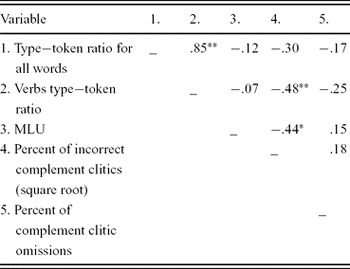
Relationship between language variables measures. Correlations for the IA and CTL groups combined were calculated between different language variables in order to better understand how they related to each other. The groups were combined because the focus was on examining how the language variables related to each other in general, and not on examining specific patterns of correlations in each group since we did not expect them to differ. Combining the groups increased the variance since the number of participants in each group otherwise was relatively small. These correlations are presented in Table 4. Correlations were strong between the type–token ratio for all words and the lexical-verb type–token ratio, (n = 24, r = .85; p < .001). The correlation between MLU and percentage complement clitic errors was significant (n = 24, r = −.44, p = .015). The correlation between the percentage of complement clitic errors and the lexical-verb type–token ratio was also significant (n = 24, r = −.48, p = .008). The latter correlation indicates that children who had a lower MLU and a lower type–token ratio for verbs tended to make more errors when using complement clitics.
Correlations between language variables for adopted (IA) and control (CTL) groups combined.

notes: * p < .05; ** p < .01.
Relationship between early language development and language outcomes. During the semi-structured interview, the IA parents were asked when their children produced their first word(s) in French. The mean length of exposure prior to uttering their first words was 3.95 months. However, there were substantial individual differences, ranging from a few days to 12 months. In order to investigate a possible link between production of first words in French and later language performance, partial correlations were calculated between time taken to produce first words (measured in months) and the language variables (MLU, percentage of incorrect complement clitics, percentage of object omissions, lexical-verb type–token ratios and type–token ratios for all words) controlling for age at adoption. Months to produce first words in French correlated significantly and negatively with type–token ratio for all words (n = 11, r = −.58, p = .04); correlations with all other variables were non-significant. Thus, even when controlling for age at adoption, IA children who produced their first words in French relatively soon after adoption had greater lexical diversity around four years of age.
Discussion
The goal of the present study was to examine if aspects of French language acquisition that differentiate child L1 learners of French from child L2 learners of French and L1 learners with SLI differ in IA children in comparison to native French speakers. To our knowledge, this is the first study to investigate the early lexical and morphological development of IA children using in-depth analyses of language samples. Previous studies of IA children have focused primarily on children acquiring English, and no study has involved children learning French. In the current study, we focused on aspects of French whose acquisition has been found to be difficult and/or delayed in other learners of French (i.e., complement clitics, tense morphology and lexical diversity) on the assumption that they would be sensitive to possible early age effects experienced by these IA children. There was support for our expectation that IA children would have difficulty with object clitics. More specifically, the IA children made significantly more errors when using complement clitics than did the CTL children. Although their error rate was low, it was, nonetheless, significantly higher than that of the non-adopted native speakers. Error rates were also significantly higher for the IA group when their use of direct object clitics was analysed separately. While studies of L2 learners of French and L1 learners of French with SLI have found that the most common error type among these learners is omission, we found no difference between the CTL and IA children with respect to omission rates. Instead of omitting complement clitics, the IA children were prone to make errors in the placement and form choice of the clitics they used. In this regard, Hamann and Belletti (Reference Hamann and Belletti2006) found that errors of placement were evident in the language of French L2 learners, but not in French-speaking children with SLI, arguing that our results for these IA children are more characteristic of L2 learners than children with language learning impairment. This finding is, in turn, compatible with these children's performance on standardized language tests (see Gauthier & Genesee, Reference Gauthier and Genesee2011) indicating that they score in the normal range; that is, the differences between them and the non-adopted children are not clinical in nature. That the IA children were prone to make mistakes in clitic form and placement instead of omitting them suggests that they had acquired underlying syntactic representations of clitics, but were limited in their ability to use them correctly, even after approximately 3 years of exposure to French.
Our findings suggest that delay in the acquisition of complement clitics might be accentuated when French is not acquired from birth, even if acquisition begins as young as 12 months of age. It is possible that the difficulties observed in the current study are temporary (Adiv, Reference Adiv and Anderson1984) and might be resolved with even more exposure. Even if this is the case, these results suggest that the profile of language acquisition in IA children in the short term is uneven since their mastery of complement clitics is delayed in comparison to other spheres of their language development (i.e., tense morphology, overall lexical diversity, lexical verb diversity and MLU) which were at the same level as the non-adopted children. This suggests, in turn, that the developmental pattern of the IA children is distinct from that of L1 learners. They also appear to be distinct from L2 learners of French insofar as their error rates for use of object clitics was lower than that reported by Paradis for L2 learners (Paradis, Reference Paradis2004). More specifically, despite similar MLUs for our IA sample (M = 3.90) and Paradis's L2 learner sample (M = 4.09), the IA children had a substantially lower average error rate than that of the L2 learners, 6.8% compared to 22.2%.
Contrary to our expectations, the IA children did not differ from the CTL children with respect to overall lexical diversity, lexical verb diversity and tense morphology. These findings indicate that the IA children's language profile differs from that of children with SLI and L2 learners who tend to have restricted lexical diversity and difficulty with tense morphology (Jakubowicz & Nash, Reference Jakubowicz and Nash2001; Paradis & Crago, Reference Paradis and Crago2001, Reference Paradis, Crago, Prévost and Paradis2004; Thordardottir & Namazi, Reference Thordardottir and Namazi2007). The absence of a difference in type–token ratio for all words in the present study is, arguably, discrepant with our result of a significant difference between the IA and CTL children with respect to expressive vocabulary, in favour of the CTL children. This discrepancy is probably due to our use of natural language samples in the present analysis. It might be that the toys used to elicit language from the children (e.g., a play kitchen set, toy utensils and a box of pretend food items) were so familiar and restricted in conceptual scope that they could not reveal the full range of the children's vocabulary knowledge. In other words, our play situation may not have been demanding enough to tap into differences in vocabulary knowledge between the two groups. In contrast, the expressive vocabulary test (EOWPVT) is more demanding because it asks children to name figures/objects/events beyond what they might normally be called upon to identify. In fact, the expressive vocabulary scores of the IA children in the present study were significantly lower than those of the CTL children, although their receptive vocabulary scores were at the same level. These results are consistent with those for L2 learners insofar as L2 learners tend to have higher receptive vocabulary knowledge compared to expressive vocabulary (Marton, Reference Marton1977).
The IA and CTL children were equally talkative, as indicated by the similarities in their MLUs and the total number of utterances they produced during the 30-minute play sessions. Thus, differences between the IA and CTL children with respect to clitic use cannot be attributed to talkativeness. Likewise, Glennen and Masters (Reference Glennen and Masters2002) found that children from Eastern Europe, at least those who were adopted before 12 months of age, had caught up to English speaker norms with respect to the mean length of the child's three longest utterances, as reported by the parents, by 24 months of age. However, Glennen and Masters (Reference Glennen and Masters2002) also found that children adopted after 12 months of age lagged behind English speaker norms for MLU even after 37 to 40 months of age. In contrast, despite the fact that seven of twelve of the IA children in the present study were older than 12 months at the time of adoption, their MLUs were similar to those of the CTL children. One notable exception was a child adopted at 21 months, whose MLU was 2 standard deviations below the mean of the controls.
It is of interest that age at adoption and length of exposure to French did not have the same effect on the acquisition of complement clitics and lexical diversity. On the one hand, the younger the IA children were at adoption and the longer their exposure to French, the greater their lexical diversity for all words and for verbs at four years of age. These results are consistent with other studies that have found that the younger IA children from China are at adoption, the better their general language outcomes (Scott, Roberts & Krakow, Reference Scott, Roberts and Krakow2008; Tan & Yang, Reference Tan and Yang2005). On the other hand, and in contrast, the correct use of complement clitics was not correlated with length of exposure to French or with age at adoption. Arguably, acquisition of clitics is affected more by the lack of exposure to French early in life than by length of exposure per se since the three years of exposure to French that the IA children had had at the time of testing is within the time span in which French L1 children learn to use clitics correctly (Paradis et al., Reference Paradis, Crago and Genesee2005–2006). Moreover, their exposure to French, admittedly delayed and briefer than that of French L1 children, was sufficient for them to acquire other verb-related features of French, such as tense morphology, to the same extent as the CTL children. Since exposure to French was correlated with age at adoption in the present sample of IA children, additional research is called for that includes IA children who have had the same amount of exposure to French but are adopted at different ages in order to disentangle these factors. Although the IA children's use of clitics was not correlated with length of exposure to French or age at adoption, it was significantly correlated with MLU and with lexical-verb type–token ratio – the larger the MLU and the greater their verbal diversity, the lower their error rates in clitic use. This, in turn, suggests that the acquisition and correct use of complement clitics reflects general language processing limitations insofar as children with more advanced general language skills have more language processing capacity (e.g., Rice, Redmond & Hoffman, Reference Rice, Redmond and Hoffman2006).
Clitic use also differentiated from lexical diversity with respect to its relationship to the production of first words in French. It will be recalled that the time the children took to produce their first words in French was not related to their later ability to use clitics but was correlated significantly with lexical diversity, even when age at adoption was held constant. Approximately 34% of the variance in lexical diversity at age four was predictable from variability in the time children took to say their first words in French.
In summary, the present findings indicate that despite delayed exposure to French and, as a result, reduced exposure to French, at the time of testing in comparison to native speakers of the same age, the IA children's language competence was quite similar to that of the control children, with the exception of their accuracy of complement clitic use. The IA children's achievement is noteworthy given that the comparison group was comprised of native French-speaking monolingual children from above-average SES families, and the aspects of French that were examined are complex and often differentiate L2 learners of French from L1 native speakers. At the same time, there is evidence that IA children may have difficulty acquiring complex morphological aspects of French, namely complement clitics. The present results should not be interpreted to indicate that the IA children are impaired since their performance in every other respect was comparable to that of the control group, and their difficulty with clitics differs from that found for children with SLI. Whereas children with SLI tend to omit object pronouns, the IA children tended to make errors of form and placement. Moreover, it should also be noted that the overall error rate for the IA children in their use of clitics is quite low, less than 7%.
With respect to future directions, we plan to use an elicitation procedure devised by Grüter (Reference Grüter2005) to examine another group of four-year-old IA children; this procedure will permit us to examine both the production and comprehension of clitics. It will also ensure a larger database for analyzing their use of clitics. The IA and control children in the present study were matched with respect to age, but not with respect to amount of exposure to French. In fact, the IA children had had, on average, one year less exposure to French. Thus, it would be interesting to carry out additional analyses of clitic use by IA children who are matched to native French-speaking children with respect to amount of exposure to ascertain whether the differences found in this study reflect differences in length of exposure. This issue could be explored as well by examining older IA children with more exposure to French to determine if the lags found in this study no longer emerge.