L'Africa ci attire invincibilmente. È una predestinazione. Ci sta sugli occhi da tanti secoli questo libro suggellato, questo orizzonte misterioso che ci chiude lo spazio che ci render semibarbaro il Mediterraneo, che costringe l'Italia a trovarsi sugli ultimi confine del mondo civile… L'Africa, sempre l'Africa!
Cesare Correnti, 1875Footnote 1[Africa draws us unwaveringly. It is predestined. For so many centuries this sealed book has lain before our eyes, this mysterious horizon that encloses the space which makes the Mediterranean appear semi-barbarous, which forces Italy to find itself on the margins of the civil world… Africa, always Africa!]
At 9.30 pm on 9 May 1936 Benito Mussolini looked out over the Piazza Venezia in Rome and proclaimed the establishment of an Italian Empire. The square was packed with troops. Around Italy, village and city squares filled with citizens listening to the radio broadcast:
Camicie nere della rivoluzione! Italiani e italiane in patria e nel mondo! Ascoltate! […] un grande evento si compie: viene suggellato il destino dell'Etiopia, oggi, 9 maggio, XIV anno dell'era fascista.
Tutti i nodi furono tagliati dalla nostra spada lucente e la vittoria africana resta nella storia della patria, integra e pura, come i legionari caduti e superstiti la sognavano e la volevano. L'Italia ha finalmente il suo Impero.Footnote 2
[Blackshirts of the revolution! Italian men and women at home and around the world! Listen!… a great event has taken place: today, 9 May of the fourteenth year of the fascist era, the destiny of Ethiopia has been sealed.
All knots have been cut by our blazing swords, and the African victory is now part of the history of our nation, honest and pure, as our fallen and surviving soldiers dreamed and desired it. Italy finally has her Empire.]
The Italian Empire had been long in the making. Even before Mussolini took power, the post-Unification administrations of Depretis, Crispi and Giolitti had all attempted to expand Italy's influence on the global stage. Most efforts were focused on the East African coast, in attempts to restrict the influence of the British and French in that region. In 1890 the Italian government consolidated its Red Sea port possessions into its first colony, Eritrea; a second, Italian Somalia, was proclaimed in 1908. In 1911, Giolitti's government used air power to take over Tripoli and other coastal cities, forcing the Ottoman Empire in 1912 to cede Tripolitania and Cyrenaica, as well as the Dodecanese Islands in the Aegean Sea. These events set the stage for the more aggressive colonialist ventures of Mussolini's early government, during which various Italian governors gradually attained full control of Somalia, Tripolitania and Cyrenaica in a two-decade struggle marked by much violence.Footnote 3
By the 1930s Ethiopia, a large nation never conquered by Europeans and conveniently positioned adjacent to Italian Eritrea and Somalia, was next in line for attack. Three decades earlier, it had been the setting for one of the most shameful defeats in Italian military history, when in 1896 the army lost five thousand men at the Battle of Adwa while attempting to occupy the province of Tigre. During the 1920s, Mussolini publicly befriended Ethiopia, sponsoring her membership of the League of Nations in 1923 and in 1928 signing a Treaty of Friendship; but in private he had already drawn up plans for her annexation. The Ethiopian campaign, secretly planned from early 1934, was meant to establish Italy as a modern global force, and to avenge Adwa. A skirmish at the oasis of Wal-Wal in December 1934 created a pretext for Italian aggression, and in October 1935 Marshall Badoglio led troops into Addis Ababa, launching a seven-month conflict that ended in Mussolini's May 1936 speech.Footnote 4
Signalling the start of a new phase of twentieth-century military aggression, the Ethiopian campaign was a critical juncture not only in fascist but also in global history. In response to sanctions by the League of Nations, Mussolini turned Italy's aggression into a tale of victimisation: forced to endure a ‘mutilated victory’ after World War I, and cheated out of her territorial dues by her allies, who were unfairly restricting her expansion and ability to arm, Italy was now being ‘starved’ into submission.Footnote 5 The nation was to unite, literally and symbolically, against such attack, and the fascist propaganda machine worked as never before to promote national solidarity – December 1935, for example, saw a remarkable Giorno della fede, in which the Queen led Italian women in surrendering their wedding rings at monuments to fallen soldiers, in return for rings of steel, thus contributing to the campaign for autarchy while pledging their commitment to the state.Footnote 6 On the national level, this propaganda stimulated not only support for fascism but also a range of complex responses that in some cases marked the beginning of decline in support for the regime.Footnote 7 On the global level, the Ethiopian campaign fundamentally destabilised the European status quo, motivating Italy's departure from the League of Nations, its alliance with Nazi Germany and anti-fascist feeling across the continent, while also contributing to an intensification of anti-colonialist sentiment throughout the African nations.Footnote 8
While the Ethiopian campaign's critical role in the politics of the pre-war period has long been recognised, the cultural history of Italian colonialism has only recently become the object of detailed study. As Patrizia Palumbo has explained in her influential recent anthology, the difficulty of accessing colonial archives, the potentially inflammatory politics of such study and the isolation of Italian scholars from the Anglophone academy all worked to discourage any sustained scrutiny of the Italian colonialist project prior to the 1980s.Footnote 9 Since then, following the work of Giorgio Rochat, scholars such as Angelo Del Boca have outlined the realities of Italy's colonial quests, exposing atrocities and practices denied in official historical accounts and interrogating the ‘reified and sanitized constructions of national identity’Footnote 10 that have underpinned what Del Boca identifies as the ‘myths and legends’ of Italian colonial history.Footnote 11 A newer generation of scholars has begun to address the mechanisms of what Ruth Ben-Ghiat and Mia Fuller have described as the ‘selective amnesia that has marked public and official memory about Italian colonialism’, filling in what Del Boca has termed Italy's ‘mancato dibattito’ (missing debate) about colonialism while examining the images and cultural products of Italian colonialism – in architecture, cinema and literature – and their lasting influences on Italian cultural life.Footnote 12
In light of this new focus and context for Italian colonialism, the time seems right to revisit the musical products of the era, and to ask how they participated in the colonial history of Mussolini's Italy. As the work of Italian musicologist Isabella Abbonizio has recently brought to light, from 1934 onwards many composers engaged with the theme of Empire in hymns, orchestral tone poems, film music, chamber music and theatre works; they were encouraged in this by music competitions, propaganda and the patriotic priorities of music journals.Footnote 13 Works such as Adriano Lualdi's Africa: Rapsodia coloniale for orchestra (1936), Antonio Marsilia's Leggenda d'Africa for voice and piano (1936) and Ildebrando Pizzetti's soundtrack for the film Scipione l'Africano (1937) all explored and celebrated the fascist myths of romanità, heroism and colonial victory. But perhaps the most well known product of this body of works was by one of the most influential figures in inter-war Italian musical life, Alfredo Casella, a composer whose work as a teacher, critic and organizer of musical events affected most aspects of musical life on the peninsula and often beyond.Footnote 14 Casella's one-act stage work Il deserto tentato (The Attempted Desert), written for the 1937 Maggio musicale in Florence, depicts the arrival of a group of Italian airmen in Ethiopia and their welcome by the indigenous peoples; it was dedicated to ‘Mussolini, fondatore dell'Impero’.
In this paper, I approach Il deserto tentato as a case study through which to bring music into the broader historical narrative of fascist colonialism. How did the work imagine the Ethiopian invasion and gloss fascist ideals in its images, text and music? What place did it occupy in the composer's oeuvre, and how has it been positioned by musicologists in the longer narrative of twentieth-century Italian music history? Reading the work against contemporary speeches and cultural products such as visual images and popular songs promises to illuminate relationships between fascist rhetoric and the work's textual and compositional features, contributing to a wider debate about the nature of fascist aesthetics. More broadly, contextualising the work musically and historically raises questions about the effects of Italy's ‘memory wars’ on traditional accounts of twentieth-century Italian music.
Terra nuova e antica, terra senza misura
Adriano Grande, Poesie in Africa (1938)Footnote 15In his 1941 memoirs, I segreti della giara, Casella provided the following account of the genesis of Il deserto tentato:
One morning in June [1936], Mario Labroca came to ask me if I would agree to write a one-act opera for the next Florence Maggio Festival.… I felt honored by the proposal but was conscious of the great responsibility it entailed. I accepted and immediately thought of asking Corrado Pavolini, who had helped me so effectively in La favola di Orfeo, to be my librettist.… After many researches, Pavolini remembered a story his brother Alessandro had told him on his return from Ethiopia. It had to do with the impression received from a flight over the desert of Ogaden. Thus originated the plot of Il deserto tentato. It would be a mystery of predominantly religious and martial character, evoking the abstract voices of a virgin Nature, anxious to be fertilized by human civilisation; there would be the arrival of a group of aviators, who descend from the sky into the horrible desert like modern Argonauts, their struggle against the dark forces of barbarism and the snares of nature, and finally peace after the transformation of the colossal surroundings by gigantic human edifices.Footnote 16
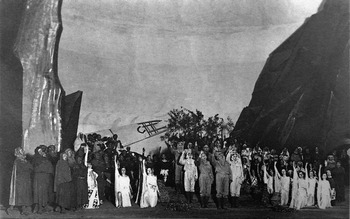
Il deserto tentato was one of several operas commissioned by the Ministero della cultura popolare, and its premiere was given on the first anniversary of the Empire's founding.Footnote 17 In its final version, published by Ricordi in 1937, the work was divided into six episodes, the first and second depicting an initial fly-over by the Aviators, the third a ‘symbolic battle’ between this group and one of indigenous warriors, the fourth comprising a victory chorus, the fifth a processional of welcome by the native peoples and the sixth a final statement by the only solo human character, the ‘First Aviator’, followed by a closing chorus sung jointly by the natives and the Italians (see Figure 1).Footnote 18
Finale of Casella's Il deserto tentato.

The work's thin scenario is entirely constructed from fascist imperial tropes and images: Ethiopia as a foreign land awaiting civilisation and characterized by a barbaric Other; the dominance of a virile, heroic invading force; and the exertion of aeronautical power. The opening moments of the work depict the land lamenting her infertility and ‘closed virginity’:
Tragico paesaggio lunare. Due ciclopiche ambe sul davanti; profile squallidi di altre ambe nel fondo, contro il cielo tempestoso. Ai dirupi delle due maggiori stanno incatenati e come pietrificati giganti nudi, grigi. Da un lato è l'ala di un grande trimotore caduto. Una euforbia.
Fin verso la chiusa, luce come di tremuoto o di eclisse; neri nuvoloni immobili. Poi il giorno si rischiara un poco, il cielo impallidisce.
[A tragic, moonlit landscape. Two huge peaks [ambe are a particular kind of mountain range characteristic of Ethiopia] in the front; desolate profiles of other peaks at the back, against a stormy sky.… The crags of the two biggest are linked, like petrified giants, bare, grey. On one side there is the wing of a great fallen trimotor plane. An Euphorbia. Towards the mouth of the enclosure, light as if from shimmering or from an eclipse; black, immobile clouds. Then day brightens a little, the sky pales.
AN EUPHORBIA (with profound nostalgia) / Roots in uncreation, / Branches in an air without time, / Life without a face.… (With sadness) / My veins are like blind stone. / THE EARTH (with deep sadness) / Blind stone, mute cry. / I would like to give like a mother, / (like a lullaby) / To be bread and flower, / To become one, singing, with the rose of daybreak. / Ah, void strength, void, this my closed virginity.]
Here the image of the land in a primeval, unformed state, waiting for insemination, engages a trope common in contemporary fascist rhetoric: fertility and the desire for production in terms both of the land and of population. The ‘sacred’ calling of motherhood in producing military forces and increasing the fascist population had been emphasized in daily Italian life since 1927, when the ‘Battle for Births’ had been launched.Footnote 19 A critical corollary of this campaign was an emphasis on virility, a trope found frequently in contemporary speeches, images and literature. In Pavolini's text, the (Ethiopian female) earth desires and awaits fertilisation by its invaders: the scenario stages desire for what Barbara Spackman has described as the ‘prolific mothers and virile men [that] people its [the fascist regime's] imaginary’.Footnote 20
The Aviators are not merely going to provide stimulus to the natural resources of the earth, but also to provide a more developed civilisation to society as a whole. There follows a series of oaths sworn by ‘il primo Aviatore’ and his men:
[FIRST EPISODE THE FIRST AVIATOR / Destitute and wealthy, we give you this promise: / To make of every tree a creature, every hut a home, every home a harmony.… / Destitute and wealthy, we give you this promise: / To make of every stone a temple, / of every laugh, of every tear a voice of experience.]
These images of building a civilized society (‘make of every stone a temple’) and of providing an experiential history (‘make … of every tear a voice of experience’) culminate in a declaration that connects past memory and ancient aspirations with new future and hope, before the First Aviator reiterates his vow to provide the land with a history:
[SECOND EPISODE WITH THE OTHER AVIATORS / Memories sustain us, the future calls us, / an ancient hope grows into a child, / the face of ancient glory has new hope. SIXTH EPISODE FIRST AVIATOR / From the silence of nothing / from this malignant void / will blossom here a garden of fleeting thoughts. / From the mysterious convergence of past and future / which our blood cries out, / we swear to this pure earth, / we swear to give it a history.]
Il deserto tentato's text thus clearly reflects contemporary imperialist rhetoric of the Ethiopian campaign as a ‘war of civilisation and liberation’ that would bring enlightenment to a ‘barbarous’ country.Footnote 21 The theme had permeated Mussolini's speeches throughout the Ethiopian campaign: on 23 March 1936 he had told the Assembly of Corporations that ‘the sacrifice faced by the Italian People in Africa is an immense service to civilisation and world peace’,Footnote 22 and the continuation of the 9 May speech proclaiming Empire, cited at the beginning of this essay, wound this civiltà together with the themes of humanity, fertility, labour and armed force that permeate Il deserto tentato:
Impero di civiltà e di umanità per tutte le popolazioni dell'Etiopia. […]
Il popolo italiano ha creato col suo sangue l'Impero. Lo feconderà col suo lavoro e lo difenderà contro chiunque con le sue armi.Footnote 23
[It is an Empire of civilisation and humanity for all Ethiopians.…
The Italian populace has created the Empire with its blood. It will make it fertile with its labour, and will defend it against all with its arms.]
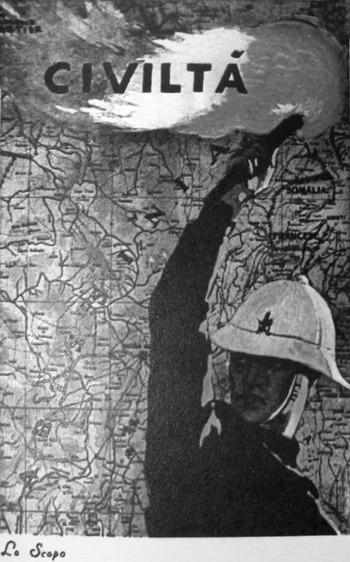
The complex of themes was prevalent in various areas of fascist culture, including visual art such as the contemporary poster shown in Figure 2, where the word civiltà is printed against a map of Ethiopia, or in popular songs such as the simply-titled Etiopia (text by V.E. Bravetta and music by G. Blanc):Footnote 24
[Rise up, Italy, now is the time.… / Storming bells, sirens howling to the sky…. / Il Duce calls / our youth, / making them his swords and ploughs for the future.… / The fruitful work / of the colonies / will make all of Ethiopia flourish!… / From mountain range to mountain range the advance will speed, / shattering chains, abolishing slavery: / freedom, freedom!]
Contemporary poster commemorating the Ethiopian campaign.

The final scenes of Il deserto tentato depict the indigenous peoples accepting the ‘civilising’ influence of the Aviators, repeating their oaths, before the work is brought back full circle to the first scene's themes of productivity and fertility, with the stage now filled with the bounty of a productive natural world:
[FIFTH EPISODE. Slowly, people come to the victorious Warriors, bearing gifts, baskets full of fruit, great terracotta vases, offerings of gazelles, goats and other animals. INDIGENOUS PEOPLES / Of every smile and every tear make a voice of experience. / Of every plant make a creature, of every boy a star, of every woman a tree. / Of every plant make a creature. Of every shelter make a home. Of every home make harmony. SIXTH EPISODE. / FINAL CHORUS / INDIGENOUS PEOPLES. / Of every stone make a temple. / Columns raise up like cries. / In that cry, life is released from hands to one whom from death / like a dry branch breaks off and flies away. / Now the silence is broken and nothingness is shattered; / daybreak announces itself, glimmers, plays on the new grass, / looks at the clouds happily passing by. / Broad maternal face, yield to this / obstinate, inflexible love that renews you eternally; / receive this pledge from your sweet sons / who rise up to you, divine!]
This procession, the spectacle of which may bring to mind the grand processional in Verdi's Aida, was reminiscent of those frequently screened on contemporary newsreels, which showed native peoples welcoming Italians with the Roman salute.Footnote 26
While this ‘civilising’ mission is depicted in Il deserto tentato as having historical roots in ‘memorie’, ‘speranza antica’ and ‘anticchissima gloria’, the incursion is brought to the foreign land by extremely modern means – aeronautical technology. The power of Italian aviation had been a critical feature of the Italian fascist regime since the March on Rome – when planes were flown over the city as Mussolini was supposedly completing his coup. Italy's aerial prowess, a main source of pride for the regime, had been demonstrated in 1933 with Italo Balbo's crossing of the Atlantic in mass formation – at once a threatening demonstration of Italy's ability to complete long-distance air missions and a source of envy for other nations. Aviation was celebrated in the building of a new Italian city, Guidonia, devoted to flight experimentation and aviation; in the Exposition of Italian Aeronautics (Milan, 1934); and in the institution of journals such as L'ala d'Italia. More specifically, aviation was an integral part of colonial rhetoric: as art historian Gerald Silk has argued, ‘Fascist aeronautical images … propagandistically developed correspondences between Mussolini and ancient Roman leaders, especially emperors, and situated the airplane as essential to the creation and administration of a modern empire, in a role similar to that of roads and sea power in the ancient Roman Empire’.Footnote 27
In some contemporary readings aviation was even connected with the spirituality of fascism. For example, Guido Mattioli wrote in his 1935 volume Mussolini aviatore e la sua opera per l'aviazione:
All'elemento spirituale egli [Mussolini] ha sempre attribuito la più grande importanza. ‘Chi è quell'idiota – esclamava nel racconto di un suo volo… che oserebbe negare un'anima di origine divina ai motori?’
Che significa? È chiaro. Nessuna macchina ha tanto bisogno d'un concentramento dello spirito umano, della volontà dell'uomo per agire perfettamente, quanto la macchina per volare. Il pilota sa veramente che cosa voglia dire ‘governare’. Per questo fra aviazione e Fascismo pare che esista una necessaria, intima connessione spirituale. Ogni aviatore sarebbe un fascista nato.Footnote 28
[He [Mussolini] has always attributed great importance to the spiritual element. ‘What idiot’ – he exclaimed when recounting one of his flights … ‘would deny a divine soul to motors?’
What does this mean? It's clear. No machine like the flying machine has such a need for a concentration of the human spirit, for the will of man to act perfectly. The pilot, truly, knows what it means to ‘govern’. For this reason, there seems to exist between aviation and Fascism a necessary, intimate spiritual connection. Every aviator, we could say, is a born fascist.]
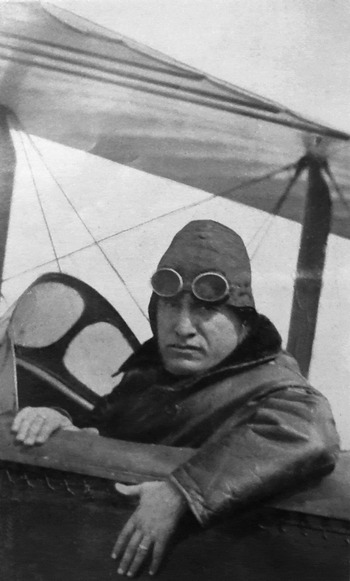
Thus there was no need, in Pavolini's text for Il deserto tentato, for specific names, specific subjectivities – the Aviators are everyman, or every fascist man. It is no contradiction that Casella's spiritual ‘mistero’ is played out entirely through the most mechanical, worldly, of technologies. And in this context, it may even not be too far-fetched to suggest that Il primo aviatore of Casella's work may have reminded audiences of Il primo pilota, Mussolini himself (see Fig. 3).Footnote 29
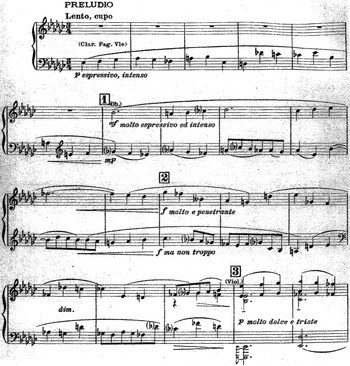
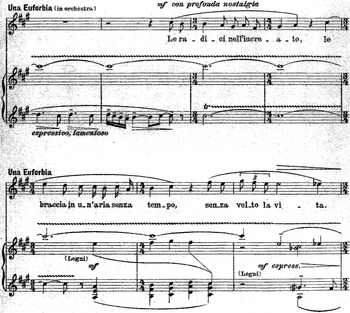
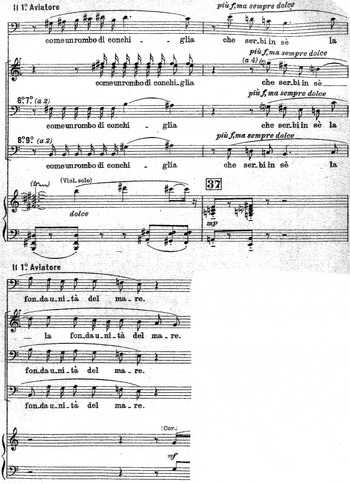
But what of the musical setting for these themes and images in Il deserto tentato? One aspect of the work is exemplified in the opening: the two bare, sinuous contrapuntal lines, conveying the sparseness of the landscape, circle around E♭ minor but clash in the dissonant harmony that characterizes the work (see Example 1). Modernity is also manifested rhythmically, as in the Euphorbia's first utterance (‘Le radici nell'increato’, see Example 2), over octaves and consecutive open fifths, a passage that exemplifies the extreme rhythmic flexibility that will characterize the work's solo vocal writing.
Mussolini, ‘Il primo pilota’.

Casella's Il deserto tentato, opening passages.

Rhythmic flexibility in Casella's Il deserto tentato.

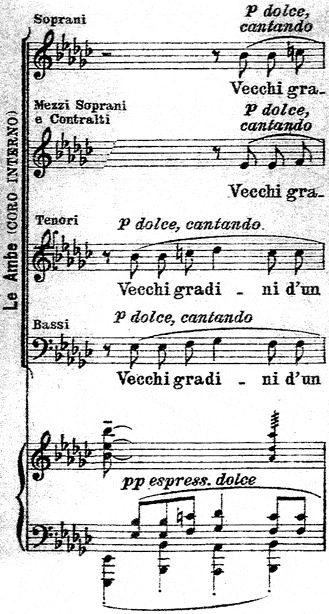
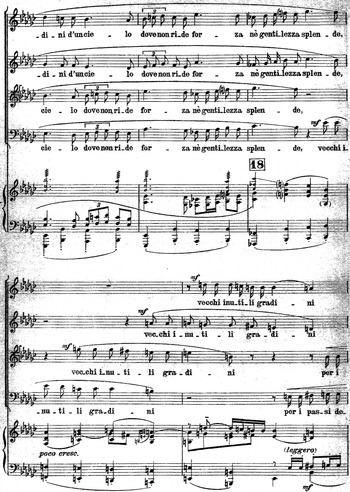
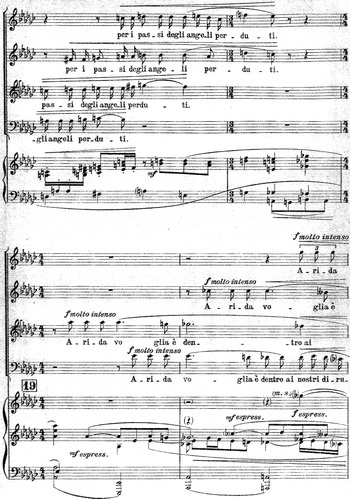
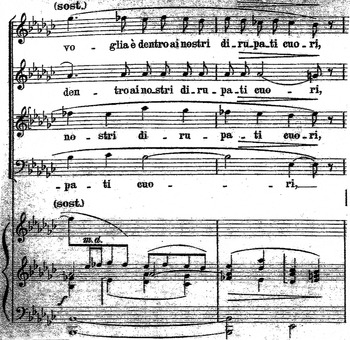
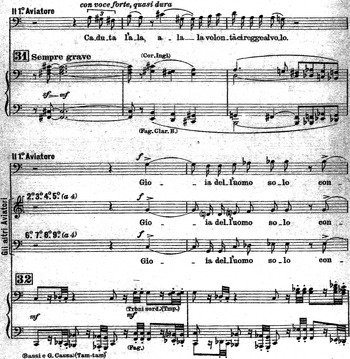
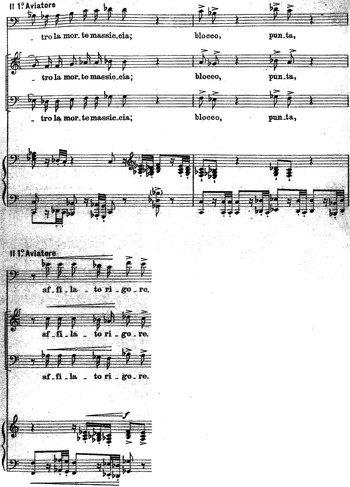
The opening of Il deserto tentato presents a musical world marked by modernity, but something very different occurs shortly afterward: a reference to the ancient past rather than the modern present. Le ambe, the mountains, begin a passage in imitation, first the upper voices imitating the lower ones (‘Vecchi gradini d'un cielo’), then the four voice groups breaking up for a varied series of points of imitation (‘Vecchi inutile gradini’, started by basses and imitated by tenors, altos and sopranos; ‘Arrida voglia è dentro’, started by tenors and imitated by basses, altos, and sopranos; see Example 3). This imitative choral work also permeates the music of the Aviators, as can be seen from their first entrance. After a first, lyric solo from Aviator 1, the other Aviators respond in rhythmic unison and homophonic texture (see Example 4). Resonating with echoes of nineteenth-century patriotic hymns, this coralità, as it was described by one contemporary critic, can be seen as a simple metaphor for mass identity, for unity of spirit and purpose – perhaps also, as Ivano Di Lillo has suggested, representing the anti-individualistic corporativismo advocated by Mussolini.Footnote 30 But the voices soon break into small points of imitation (always begun by the First Aviator and repeated by his companions; see Example 5).
Imitative entries in Il deserto tentato.

Continued

Continued

Continued

Casella's Il deserto tentato: rhythmic unison and homophonic texture for the “Aviators”.

Continued

Casella's Il deserto tentato: quasi-imitative entries for the “Aviators”.

Continued

Such imitative counterpoint had undergone a revival in early twentieth-century Italy as a compositional mode emblematic of a great musical past – that of ancient Italian vocal music, particularly of composers such as Palestrina and Monteverdi. Italian ‘neomadrigalism’, deriving from older fascinations – both Italian and more broadly European – with pre-Romantic music, extended through the work of many composers of the generazione dell'ottanta; it had been encouraged by the writings of such nationalist figures as Gabriele D'Annunzio, who for example in his 1900 Il fuoco lauded Monteverdi's ‘heroic soul, of purely Italian essence!’Footnote 31 Casella, in the victory scene of Il deserto tentato, seems to refer to one of Monteverdi's most famous manners, the anapestic rhythm typically used to depict the agitation of war (Rehearsal Number 114, page 66). The battle scene also very briefly employs hocket, and we hear typical Baroque word painting to depict the ‘densa tenebra’ (thick cloud) and ‘buio’ (dark) of the text (Rehearsal Number 87, page 48). The absence of individual voices in Casella's work also chimes with aspects of contemporary interpretation of Monteverdi's choral music, such as that of musicologist Guido Pannain, who commented that: ‘[In L'incoronazione di Poppea] the mass chorus is already a character and the action concludes with that magnificent finale which is a cry of love, an exuberant hymn of vital power, of healthy and strong joy’ (my italics).Footnote 32 The decision to incorporate historical compositional techniques was recognized by at least one contemporary reviewer, who explained to the readers of Corriere della sera the relationship between the work's styles and historical ones such as Gregorian chant and Monteverdi:
La letteratura musicale che contava già al suo attivo la magnifica fioritura di madrigali guerrieri, oratori sacri, cantate concertanti [sic] e azioni coreografiche di cui è superfluo citare gli illustri modelli […] ed i remoti saggi della Sacre rappresentazioni e dei Toscani Maggi […] quella letteratura ha certo favorito la concettosa ideazione del Deserto che sotto il vago titolo di mistero, d'entro l'arcana atmosfera del prodigio e con l'ausilio d'un allestimento scenico più chiassoso che originale, ha mostrato di trarre buon profitto dagli insegnamenti del passato, facendo leva, quanto all'ispirazione, sopra un ricordo storico che gonfia il petto d'ogni italiano. […] provengano esse [reminiscenze] dalla Roma di Gregorio, di Monteverdi, e di Respighi.Footnote 33
[The literature of music, which already includes the magnificent flowering of madrigals of war, sacred oratorios, concerted cantatas and choreographed scenes, the best examples of which need no mention … and the ancient essays of the Sacre rappresentazioni and of the Tuscan Maggi … this literature certainly has favoured the rich invention of Il deserto, which, under the indefinite title of mystery, within an arcane atmosphere of wonder and with a staging that is more gaudy than original, has drawn profitably from the lessons of the past, appealing, as far as its inspiration is concerned, to a historical memory that swells the breast of every Italian…. [reminiscences] come from the Rome of Gregory, from Monteverdi, from Respighi.]
Within Il deserto tentato, Casella's use of styles perceived to be historical has an illustrative function: it embodies the recurring theme of ‘giving’ the people a history, in this case embodied by the Italian musical past.Footnote 34 The combination of old and new musical elements reflects the scenario's presentation of ancient civilisation through the most modern means, that of aviation. But it can also be seen as a musical embodiment of the common contemporary desire to make the past present in daily fascist life, and ‘to create a modern aesthetic with visible roots in Italy's rich cultural pasts’.Footnote 35 This was an impulse witnessed in artwork, architecture and exhibitions, where the most modern techniques expressed allusions to the past – for example, in Dullio Torres's 1932 façade for the main pavilion of the Venice Biennale of International Art, which blended historical and contemporary references.Footnote 36 Casella himself, in an essay published in the Christian Science Monitor in October 1928, had outlined how the concept of musical ‘return’ paralleled others in Italian political life:
Italy of today … has numerous ‘returns’. First of all, the political return to the Roman state which now actually takes the form of a veritable cult through the wishes of Mussolini. Then, painters have ceased to be duped by the Parisian or German fashion and devote themselves to the study of Giotto, Piero della Francesca or Mantegna.
As for the musicians, they pursue a similar movement…. The study of the colossal Italian instrumental past of the sixteenth, seventeenth and eighteenth centuries has today become general in Italy.… But… the present concentration of Italy in the study of a glorious past has nothing in common with the fluctuations of a greater or less sincere fashion…. The cult of the national past today is part of the whole powerful Italian revival which is being manifested in politics as in every branch of scholarship, art, industry or commerce.Footnote 37
Ruth Ben-Ghiat and Mia Fuller have claimed that the colonies held a special place in this practice of combining ancient and modern, constituting ‘important templates for the elaboration of an Italian national image that evoked both Italy's modernity and its weighty historic and cultural patrimony’.Footnote 38 Thus in Il deserto tentato's musical style we have a classic example of the bringing together of ancient past and modern present that was a defining feature not only of fascism in general, but of colonial practice in particular.
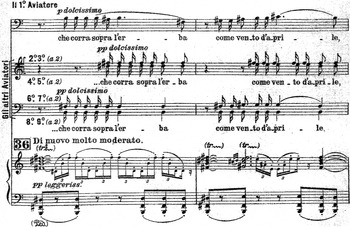
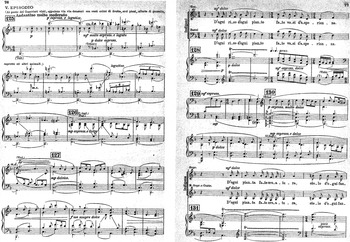
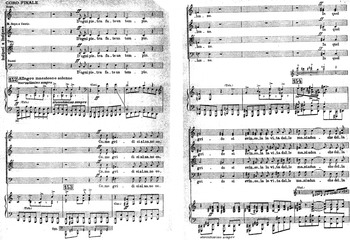
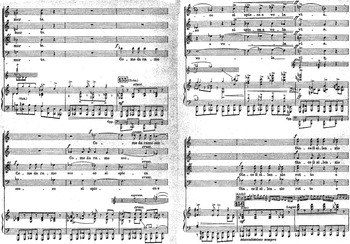
The music for the natives presents a different set of musical signifiers. Their opening in the Fifth Episode draws on compositional conventions that had long signified faraway pastoral landscapes: rhythmic arrangement in 68 metre and woodwind instrumental colour (see Example 6). The dissonance of this passage mirrors that of the very first scene's depiction of the Ethiopian landscape, as well as the use of trills, a figuration frequently used to convey ‘otherness’ in nineteenth-century ‘exotic’ opera. The natives are also differentiated from the Aviators in their lack of both harmony and counterpoint. In contrast with the Aviators' four-part harmony, the first phrases sung by the natives (see Example 6, Rehearsal Number 128) are less ‘developed’ unisons and octaves – the natives also do not get to generate their own text, but repeat words previously sung by the Aviators. Later, however, the natives branch out into harmony, and their final passages of music use the same kind of imitative polyphony heard by the Aviators earlier (see Example 7, Rehearsal Number 155). In other words, this population has undergone a musical transformation; they have been able to learn the unity and historic coralità expressed by their conquerors.
The opening of the Fifth Episode of Casella's Il deserto tentato: music for the “Indigenous Peoples”.

Casella's Il deserto tentato, final chorus.

Continued

La rimozione (conscia od inconscia) delle colpe coloniali e il mancato dibattito in Italia sul periodo dell'espansionismo imperialista consentivano la permanenza nel paese di ampie sacche di ignoranza, di disinformazione o di puntigliosa malafede, faticosamente contrastate da una storiografia progressista che sta compiendo, ma con troppo ritardo, una vasta opera di benefica controinformazione.
Angelo Del BocaFootnote 39[The repression (conscious and unconscious) of colonial guilt and the missing debate about the period of imperialist expansion in Italy has permitted the persistence in that country of a great deal of ignorance, of misinformation or obstinate bad faith, laboriously opposed by a progressive historiography that is providing, too belatedly, a large amount of beneficial counter-information.]
It is perhaps not surprising, given the abundance of fascist images in Il deserto, that during the post-war era the work has for the most part been banished from narratives of music history. In the 1950s, even the most sophisticated critics tried to distance the opera from Casella's other works. Massimo Mila, for example, in his 1958 survey of Casella's technique from 1901 to 1942, omitted the work entirely, emphasizing instead Casella's ‘liberating’ effect on Italian music of the period; and Gianandrea Gavazzeni, in the same year, went so far as to claim that in the work ‘there remain certain musical strengths, absolutely isolatable, autonomous, which have nothing at all to do with what is happening on the stage’.Footnote 40 Later accounts are frequently touched by an air of apology; John Waterhouse for example suggests that Casella ‘like so many other Italians of otherwise good judgment, fell under the spell of fascism’,Footnote 41 and Harvey Sachs argues that, ‘by adhering to what he saw as the most advanced musical and political movements of the day, [Casella] may have believed he was securing for himself a slice of historical authenticity, a right to artistic survival’.Footnote 42 The historiography of Casella's work, in other words, is characterized by the same missing debate and apologetics that have marked the broader discussion of Italian colonialism.
Yet, as Fiamma Nicolodi has pointed out, while Il deserto tentato certainly stands out in Casella's oeuvre in terms of its political content and imagery, its musical style shows many points of continuity with previous works.Footnote 43 Casella's prior compositional attitudes, as his critics had often complained, involved a wide range of techniques, including the modernist harmonies that characterize earlier works such as Undici pezzi infantili (1920) and the Concerto for two violins, viola and cello (1923–4), and which find obvious echoes in Il deserto tentato. Likewise, many of Casella's prior works referred to past genres and, as we have seen, the composer had long proposed, as had others, the revival and emulation of pre-Romantic works and styles.Footnote 44 During the 1930s, after the ‘Manifesto of Italian Musicians for the Traditions of Nineteenth-century Romantic Art’, Casella moved consistently towards larger orchestral forces, and began to experiment with stage works such as La donna serpente and Orfeo (March and September 1932 respectively). The stylistic features of Il deserto tentato, then, had strong connections to prior styles – a demonstration of how musical trends with much deeper roots were appropriated opportunistically to fascist purposes.
Considering Il deserto tentato not only in relation to what came before it, but also what came after it, suggests further layers of enquiry. The final years of Casella's career – those immediately following Il deserto tentato – are shrouded in the same opacity as the work itself. The few existing accounts of Casella's later career emphasise his long illness, the fact that he wrote a Missa pro pace and that he continued to try to bring the most modern musical works to Italy in the most difficult of circumstances. It is Casella's own granddaughter, Fiamma Nicolodi, who has provided most details of these final years: a grim tale of increasingly vicious attack by critics, on account of his internationalism, ‘communism’, and ‘Jewishness’ (concepts that were used increasingly in an interchangeable fashion). By late December 1937, for example, Casella was subject to attacks such as that by Francesco Santoliquido in Il tevere:
poco più di venti anni fa […] ci fu spedito da Parigi una Profeta, annunciatore di nuovi tempi. Costui non era altri che il Mo. Alfredo Casella, il quale non a caso veniva in Italia, ma ci veniva col preciso incarico di conquistare questo grande mercato musicale alla causa ebraica. […] È bene stabilire a questo proposito ed in maniera inequivocabile che Alfredo Casella e compagni non sono affatto dei novatori come essi tanto generosamente si definiscono da se, ma sono invece dei semplici e modesti imitatori di musicisti ebrei come Strawinsky, Honegger, Milhaud, ecc. […] Da questi musicisti deriva, come la figlia deriva dalla madre, la musica dei cosiddetti modernisti e novatori italiani. Musica senza patria! Musica che non può trovar posto nell'ardente clima nazionale, così gelosamente autarchico, creato in Italia dal Fascismo. […] Noi non vogliamo che ci venga inoculato il seme intellettuale ebraico e ci rifiutiamo di diventare, sia pure soltanto spiritualmente, dei bastardi.Footnote 45
[little more than twenty years ago … there was sent to us from Paris a Prophet, an announcer of new times. This was none other than Maestro Alfredo Casella, who came to Italy not by chance, but with the precise task of conquering this great musical market to the Jewish cause.… It is good to establish in this context and in an indisputable manner that Alfredo Casella and friends are not in the least innovators as they so generously describe themselves, but, rather, are simple and modest imitators of Jewish composers such as Stravinsky, Honegger, Milhaud, etc…. From these composers come, as a daughter comes from her mother, the music of the so-called modernists and Italian innovators. Music without nationhood! Music that can find no place in this bold national climate, so jealously autarchic, created in Italy by Fascism.… We do not want to be inoculated by the Jewish intellectual seed and we refuse to become, even if only spiritually, bastards.]
The later years were even worse: Casella was forced into intermittent hiding with his Jewish wife, fearing for both their lives.Footnote 46
What do Casella's later experiences have to do with Il deserto tentato and Italy's colonial ventures? While it is true that Italian racial policies – including its anti-Semitism – were legislated only in 1938, some historians of Jewish experience in Italy have discussed a more profound anti-Semitism prior to that point, and most agree that it was during the Ethiopian campaign that widespread attitudes were first formulated. In Michele Sarfatti's words, ‘In the course of the Ethiopian campaign Italy witnessed the beginning of the transition from the infringement of religious equality and the autonomy of Judaism (including the progressive removal of Jews from public positions), to the persecution of individual Jews and their rights’.Footnote 47 If colonialism and racial policy were different sides of the same coin, new readings of Il deserto tentato in the context of Casella's oeuvre may emerge. Did Casella, sensing the shift, use Il deserto tentato as a defensive move – a perfect patchwork of fascist colonial rhetoric – to mark his adherence to the party line? Was his colonial vision as intimately bound up with the history of race on the Italian peninsula as it was with events on Ethiopian soil? Is it possible that this troubling personal history has been forgotten in Italian musicology in a way that mirrors the collective rimozione of other elements of Italy's fascist past?Footnote 48
In the absence of biographical documentation, we may never be able to answer these questions satisfactorily. But potential interpretations are nevertheless inviting. Works such as Il deserto tentato, so long ignored, provide valuable avenues for understanding not only the nature of Italian fascist aesthetics, and how those aesthetics were related to prior, ‘non-totalitarian’ artistic trends, but also for understanding the ramifications of Italy's ‘memory wars’ in how we have approached music history. Recognising the implications of broader historiographical trends around Casella's music necessarily requires us, for example, to consider the extent to which other elements of the nation's music history have also been defined by the politicized historiographical priorities of the post-war period. Italian culture did not, after all, undergo a post-Mussolini ‘purge’; many of its institutions, artists, critics and leading figures were continuously active and influential throughout the fascist, wartime and post-war years. Writing a history of Italian twentieth-century music that incorporates and illuminates fascist activities as an integral part of mid- and late-century writers' and composers' lives and development is, of course, far beyond the scope of this paper. But the idea of a thick history of twentieth-century Italian music nevertheless beckons – a history that incorporates ‘fascist’ music to identify strands of continuity across the teens, ventennio and beyond. Such a history would challenge us to consider the possibility of an Italian twentieth century that is more cohesive, inflammatory, comprehensible and troubling than partial accounts; a history that may make sense not only of individual composers' works but of the century's longer narrative in both richer and more disturbing ways.