Introduction
Numerous threats to animal genetic resources for food and agriculture (AnGR) have been described in the literature. Relatively recent examples of publications focused on the analysis of threats include Rege (Reference Rege1999), Rege and Gibson (Reference Rege and Gibson2003), Tisdell, (Reference Tisdell2003), LPPS and Köhler-Rollefson (Reference Köhler-Rollefson2005), Gibson et al. (Reference Gibson, Gamage, Hanotte, Iñiguez, Maillard, Rischkowsky, Semambo and Toll2006) and FAO (Reference Rischkowsky and Pilling2007a, 2009a), but concerns over the loss of AnGR diversity and attempts to analyse the causes of such losses have been building for several decades (see Kubbinga, Hoffmann and Scherf, Reference Kubbinga, Hoffmann and Scherf2007).
In some cases, it has been possible to show that particular breedsFootnote 1 have been adversely affected by clearly identifiable events or processes (e.g. a disease outbreak, a new regulation or the spread of indiscriminate cross-breeding). In other cases, plausible arguments have been put forward based on the link between genetic diversity and the diversity of production systems and the roles and values of livestock within them: if the production systems that sustain diverse livestock populations disappear or are transformed, or if the uses to which animals are put (and the products obtained from them) become more homogenous, AnGR diversity is likely to be threatened. Such insights have given rise to some significant steps forward in efforts to safeguard AnGR diversity. For example, European Union legislation recognizes the potential threat to rare breeds posed by disease-control measures and allows for some, strictly controlled, exemptions (FAO, Reference Rischkowsky and Pilling2007a). However, in many respects the analysis of threats has remained at a basic level. Few attempts have been made to quantify, in any way, the impacts of the various threats, to analyse their temporal and spatial dynamics, or to account for their potential to act cumulatively or drive each other. At the same time, responses to threats have tended to be reactive in nature: i.e. the trigger for action (if there is any action) is not the existence of a threat but its observed consequences, usually a decline in the population size of one or more breeds. Moreover, lists of priority actions for improving the sustainability of AnGR management tend to offer little in terms of prioritization or targeting of the various options. Key questions that arise from these observations include whether, and how, strengthening the analysis of threats might contribute to more proactive, better-prioritized and better-targeted management, and what can be done to promote and facilitate such analysis?
What is a “threat”?
The term “threat” is widely used in the context of AnGR management. Many publications describe the status of AnGR (number of breeds at risk of extinction, etc.), then note that the situation is worrying, and then proceed to explain the situation in terms of “threats”. Other terms, such as “pressures” (LPPS and Köhler-Rollefson, Reference Köhler-Rollefson2005) or “causes of loss” (Tisdell, Reference Tisdell2003) are sometimes used in much the same context. By implication, threats are the factors that have caused breed populations to fall and (of even greater concern) “threaten” to drive them further towards extinction. The study of threats, thus, embraces both the history of breeds (some of which may already be extinct) and – to borrow a definition from the Oxford English Dictionary – “indications of impending evil” to breeds (OED, 2010). In the latter sense, a threat may not yet have had any actual impact on the threatened populations. Threats increase the probability that breeds will, in the future, decline towards extinction. However, this definition does not fully capture the sense in which the term is used in this paper. A “threat” is not merely a factor that increases risk. Rather, it is a generator, or potential generator, of change (negative change from the perspective of AnGR diversity).
Primary data sources
One constraint to the analysis of threats is a lack of raw data. The State of the World's Animal Genetic Resources for Food and Agriculture (SoW-AnGR) (FAO, Reference Rischkowsky and Pilling2007a) laments the lack of data upon which to base global analysis threats, and the Global Plan of Action for Animal Genetic Resources (GPA) (FAO, 2007b) calls for improved “characterization, inventory and monitoring” of “risks” to AnGR as a basis for improved understanding of these risks and improved decision-making in support of conservation and sustainable use (Strategic Priority Area 1). These broad goals beg several questions: What kinds of data are needed? What data are feasible to obtain? How can they be collected? How can they be made available to those who need them?
The straightforward answer to the third question above is that surveying and monitoring strategies for AnGR should include collection of data on the nature of threats and how they change over time. This might include building breedwise elements into ongoing monitoring of risks to livestock populations and production systems (e.g. disease or drought) as well as specific AnGR-focused surveys. At the time of writing this paper, guidelines on surveying and monitoring are being prepared by FAO as part of a series of publications intended to support countries in their implementation of the GPA (Woolliams, Pilling and Scherf, Reference Woolliams, Pilling and Scherf2010). This paper does not pursue the practicalities of surveying. However, a few points should be noted. Domesticated breeds or animal populations are continually under human observation, and conscious human decisions are among the most important influences on the dynamics of these populations (how their sizes and structures change). If a breed has declined, livestock keepers, at least, will have some knowledge of why this has occurred. Surveys are a means to tap into this knowledge and integrate it with information from other sources into a broader understanding, which can be drawn upon by all stakeholders whose decisions may affect the future of the respective populations or who wish to draw lessons to be applied elsewhere. Depending on whether, and how well, such processes have been conducted, the “knowledge” circulating among the wider AnGR stakeholder community may be a more or less accurate representation of the true forces affecting AnGR diversity. This caveat should be borne in mind whenever stakeholders, particularly those not closely involved in the management of the breeds and production systems under consideration, are canvassed for information on threats to AnGR.
As noted above, livestock keepers’ knowledge is not the only source of information that can be drawn upon as part of efforts to survey and monitor threats to particular breeds or production systems. If the geographical distribution of a breed has been established, and this distribution has been georeferenced electronically (FAO/WAAP, Reference Pilling, Rischkowsky and Scherf2008), it may become possible to overlay this with maps that show the distribution of factors that may threaten AnGR. A straightforward application of this approach would be to identify breed populations that lie within zones that are prone to natural disasters or disease outbreaks. It might also be applied to mappable proxies for economic drivers of change, such as access to markets; to the distribution of environmental problems, such as the degradation of rangelands; or to the distribution of land-use practices with the potential to disrupt livestock keeping. Mapping exercises could be extended to include predicted future trends: for example, the consequences of climate change. Other relevant sources of information include records and forecasts of consumer demand for livestock products, and trade and labour-market parameters. Policy-related threats can be investigated on the basis of relevant policy documents, accompanied, if possible, by studies of their implementation on the ground.
Global assessments
The outputs of a well-planned surveying and monitoring strategy are likely to be very valuable to stakeholders involved in planning the future management of the breeds and production systems from which the data have been collected. It is less clear how they should be integrated into wider analysis of the threats to AnGR – for example, at regional or global levels – or how such analyses should be taken forward if the basic breed- and production system-level data collection and analyses have not been implemented.
Global stakeholder surveys
The only attempts to undertake a comprehensive quantitative global analysis of threats to AnGR have been the surveys reported in the Background Study Paper prepared for the Twelfth Regular Session of the Commission on Genetic Resources for Food and Agriculture, held in October 2009 (FAO, 2009a). Respondents were asked to list up to five threats affecting the various production systems found in their regions and to list up to three threats affecting specific breeds (up to three breeds of the respondents’ choice from each of the following groups of species: poultry, large ruminants, small ruminants, pigs, equines and camelids). The main conclusion that can be drawn from these surveys is that stakeholders (at least those with access to FAO's e-mail discussion network DAD-Net) are in broad agreement with the literature cited above that AnGR are threatened by changes to production systems driven by economic and market factors and the availability of resources; that inappropriate policies contribute to the loss of diversity; that breed populations can sometimes be threatened by epidemics, by other disasters or by the measures implemented to deal with them; and that lack of awareness and lack of capacity contribute to threats or hamper responses. These are not negligible findings in terms of the light they shed on the consensus that exists among stakeholders regarding the nature of the challenges involved in promoting more sustainable management of AnGR. However, it is not clear whether the outcomes of these surveys have provided decision-makers with guidance that is more detailed or relevant than that which was already available in the SoW-AnGR and the GPA.
Potential use of the Domestic Animal Diversity Information System
Some consideration has been given to the idea of adding a new set of data-entry fields to the Domestic Animal Diversity Information System (DAD-IS) in order to allow National Coordinators for the Management of Animal Genetic Resources to record details of the threats faced by their countries’ breeds. This is an appealing proposal in terms of its potential for raising awareness of the threats facing particular breeds. However, it would not be straightforward to implement; nor would it necessarily provide data that would be particularly useful for improving the management of the threats identified.
The simplest objective for a large-scale exercise in gathering threats-related data from National Coordinators would be to record which national breed populations are affected by which threats. This could be done by providing a list of threats with options to tick “yes” or “no”, or by allowing open-ended “free-text” responses. The former type of question has generally been used in DAD-IS in order to facilitate language-independent data collection and analysis. The frequency with which particular threats are reported among particular groups of breeds (see examples in FAO, 2009a) might be interpreted as indicating the priority that should be given to the respective threats in the management of the respective populations. However, as the raw data would not show how severely breeds are affected by the various threats, the outcomes would be no more than indicative of the relative significance of the threats across the population as a whole. It might be possible to implement a system of ranking or scoring threats and perhaps weighting breeds according to their risk status. However, this would add substantially to the complexity of the data-entry process. A further complicating factor would be the need to ensure consistency in terms of the time periods being considered (descriptions of the past or predictions of the future).
Even asking data providers to signal the presence or absence of a set list of threats would require a carefully designed data-entry screen. Moreover, the list of threats would have to be sufficiently detailed to allow descriptions that are not merely generalizations relevant to almost all breeds, but not so long as to be intimidating to data providers. The categories would have to be interpretable unambiguously and consistently by the data providers and by potential users of the data. One option would be to devise a framework of categories and subcategories that would provide structure to the data-collection process and might be reflected in the subsequent analysis and discussion of the threats (see examples in FAO, 2009a).
Classifying and describing threats
The potential implementation of a “threats” module in DAD-IS and lessons learned from the above-described stakeholder surveys have raised the issue of classifying threats as a concrete problem. This paper owes its origin to these operational questions. The issue may, however, be of wider significance. Analysis, communication and planning always require phenomena to be grouped and labelled in some way.
Clearly, if threats are to be grouped into categories, this needs to be done on the basis of some shared properties. The objectives of facilitating analysis, communication and planning imply two distinct sets of properties that might be considered. On the one hand, it may be possible to identify properties that indicate the need for particular types of action to combat a threat, on the other it may be possible to identify properties that characterize the relationship of the threat to other threats and/or to the dynamics of the affected animal populations. In other words, the latter properties describe the position of the threat within a hypothesized framework of causality. To provide a more concrete example: the threat that there will be an outbreak of a transboundary disease that kills large numbers of animals could be characterized, according to the former perspective, by the need for action by animal health services; according to the second perspective, the epidemic threat might be characterized as being driven, inter alia, by increased international trade and, in turn, driving threats posed by culling measures or poorly planned restocking programmes; to take a step further, it might be concluded that the epidemics belong to a class of threats that have both direct and indirect impacts on AnGR.
The criteria and levels of detail that are appropriate for describing and classifying threats will depend on the objectives of the respective survey or analysis. For example, to learn that a breed “lacks competitiveness” may be useful from a management perspective in that it highlights the possible need for improved marketing of the breed's products or implementation of a breeding programme. However, it is not so useful if the objective is to understand how the breed has come to be threatened (and learn lessons from this). The breed's lack of competitiveness may have arisen because of a range of factors: competition may come from other breeds, crosses, species or production systems, or may come from imported products; consumer demands may have changed, as may the requirements of marketing and retailing chains. The availability and cost of the inputs required by different breeds and species may also be significant factors affecting competitiveness. A wider interpretation could include competition from non-livestock products and services or non-livestock livelihood activities. In this example, a change of perspective has required the single “threat” to be divided into ten or more subcategories, which in turn could operate in an enormous number of combinations.
A further point to emphasize with respect to classification frameworks is that they should not be treated as definitive. No list of threats will be able to account for all the specific situations that arise in “real-life” production systems. For example, the SoW-AnGR (FAO, Reference Rischkowsky and Pilling2007a) noted the potential for “apparently minor and innocuous” changes to have negative impacts on breeds, citing the example of the Icelandic Leadersheep, which declined because greater use of conserved forages reduced the significance of winter grazing in which the Leadersheep played an important role (Dýrmundsson, Reference Dýrmundsson2002).
Potential use of frameworks from the environmental field
Environmental problems, and threats to wild biodiversity, are often discussed in terms of the Driving Forces–Pressures–State–Impact–Response (DPSIR) framework (EEA, 2006) or its less-elaborate predecessor the Pressure–State–Response (PSR) framework (OECD, 1993). How relevant are these frameworks to AnGR and particularly to the question of classifying threats? Briefly to introduce the DPSIR framework: Driving forces “are the social, demographic and economic developments in societies and the corresponding changes in lifestyles, overall levels of consumption and production patterns” (EEA, 2007). Pressures “include the release of substances (emissions), physical and biological agents, the use of resources and the use of land. The pressures exerted by society are transported and transformed into a variety of natural processes which manifest themselves in changes in environmental conditions” (ibid.). The pressures affect the “state” of the environment (conditions of soil, water, biodiversity, etc.), which creates adverse “impacts” of various kinds (e.g. on human and ecosystem health or resource availability). The “impacts” generate “responses” on the part of society which can be directed towards any of the other four components of the framework.
The concept of driving forces or “drivers of change” has been used in the AnGR field to describe broad social, economic and environmental forces that lead to changes in the livestock sector that in turn may threaten AnGR diversity. The main forces discussed in these terms are changes in demand – driven in turn by factors such as economic growth, rising human population, increased purchasing power and urbanization; trade and globalization; technological developments; and environmental problems such as degradation of natural resources and the effects of climate change (FAO, Reference Rischkowsky and Pilling2007a; Seré et al., Reference Seré, van der Zijpp, Persely and Rege2008). However, these forces, for the most part, do not directly affect the demographics of livestock populations. Their effects are mediated by actions taken within the livestock sector: at the levels of policy-making, development intervention, or the individual livestock holding, breeding enterprise or livestock-keeping community. The DPSIR's “pressures” concept does not adapt easily to this context. Like much analysis of environmental problems, this element of the DPSIR framework assumes a “natural” world that is “pressured” as a consequence of human actions, either via incidental side-effects, such as the emission of polluting substances, or via the overuse of resources. In contrast, the genetic resources of domesticated species are dependent on human activity for their existence and are threatened more by under- than by overuse.
A more general criticism levelled at the DPSIR approach is that its “apparently deterministic ‘causal’ description inevitably down plays the uncertainty and multiple dimensions of causality inherent in complex environmental and socio-economic systems” (Maxim, Spangentberg and O'Connor, Reference Maxim, Spangentberg and O'Connor2009). Given the intricate set of relationships that exist between livestock populations, the production environment, the economics of livestock production and the breeding and husbandry decisions taken by humans, together with the potentially devastating, but “uncertain”, impacts of aberrant events such as epidemics, this criticism may be even more pertinent in the AnGR field. Indeed, the criticism could apply to any of the hierarchical threats framework that attempts to reflect patterns of cause and effect.
Another related framework – “Driving Forces–State–Response” – was developed specifically to take into account “the specific characteristics of agriculture and its relation to the environment” (OECD, 1999). Within this framework, there is no assumption of a hierarchy among the “driving forces”. They are simply divided into three groups or domains: “environmental”, “economic and social” and “farm inputs and outputs” (which include “management practices”). It is recognized that “agricultural activities can both produce beneficial impacts to enhance environmental quality” (ibid.) (emphasis in original). From here it is only a short step to a framework that recognizes the essential role of humans (particularly livestock keepers and breeders) in maintaining livestock diversity. Clearly, any analysis of threats needs to take these three domains into account. However, it is not clear whether focusing on each as a separate unit of analysis is any more useful than focusing on the production system as a whole. For example, to understand the threat from “rangeland degradation”, even at the herd level, requires that it be analysed in terms of the interactions between livestock husbandry and the “environment”. Its overall significance can only be understood taking “economic and social” factors into account – to which can be added policy factors – at both household and wider levels.
In conclusion, the DPSIR and similar frameworks cannot simply be adopted wholesale as frameworks for analysing threats to AnGR. The “driving forces” concept highlights the fact that many threats to AnGR are driven by developments outside the livestock sector itself. It is important to recognize the significance of these forces. However, it is also important to recognize that protecting AnGR diversity – promoting sustainable use and conservation – will largely depend on actions taken within the livestock sector (or at the interface between the livestock sector and fields such as land-use planning, rural development and wildlife conservation). This requires understanding of how the societal driving forces are transformed into more specific threats at the level of the production system and how the various stakeholders within the livestock sector can affect outcomes for AnGR.
A final (rather more positive) point to note about such frameworks, particularly the simpler PSR version, is that they underscore the need to monitor threats (pressures, driving forces, etc.), and responses (conservation and other management programmes) in addition to monitoring the state of AnGR (measures of diversity and risk status) (see, for example, MIRBSE, 2007). This is significant, for example, in the field of indicator development for AnGR (Martynuik, Pilling and Scherf, Reference Martynuik, Pilling and Scherf2010); separate indicators for each of the three components of the PSR framework may be required.
Relating threats to opportunities for action
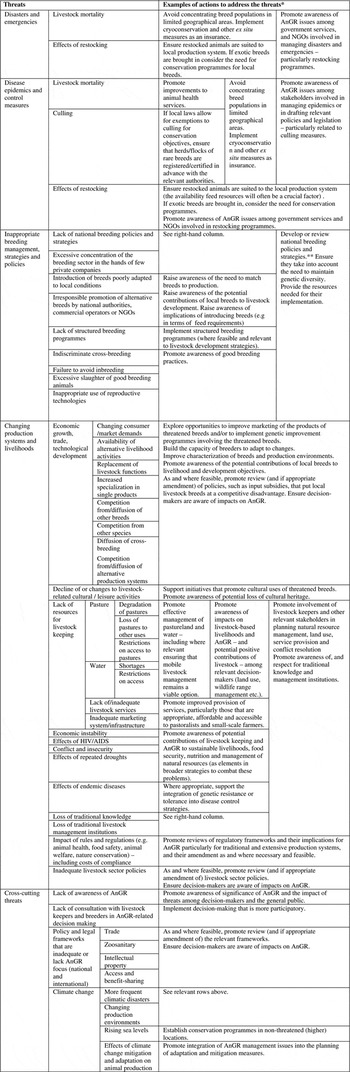
Different threats to AnGR present different challenges and different opportunities for action. They pose different technical and logistical problems. They involve different political challenges, and they require action from different groups of stakeholders. The discussion of threats in the SoW-AnGR (FAO, Reference Rischkowsky and Pilling2007a), although it did not specifically set out to establish a classification framework, reflected this orientation on opportunities for action. Three broad groups of threats were distinguished “livestock-sector trends: economic, social and policy factors”; “disasters and emergencies” and “epidemics and disease control measures” (ibid.). The latter two groups were dubbed “acute” threats. Among the “non-acute” threats, it was noted that some arise because of “policies and methods in the specific field of AnGR management” (more concretely, this means the management of breeding and the choice of breeds) rather than because of more general trends affecting livestock production systems. The two “acute” groups of threats plus the “breeding” threats loosely equate to three distinct, if overlapping, fields of intervention within which AnGR management activities can be implemented and three sets of stakeholder groups towards whom awareness-raising activities can be directed – options are briefly described in the following three paragraphs. Threats associated with more general livestock sector trends are described in the remaining paragraphs of this subsection. Table 1 illustrates the possibility of translating identified threats into opportunities for action. Note that these opportunities include both “hands-on” AnGR management actions (breeding programmes, marketing, conservation programmes, etc.) and awareness-raising activities targeted at particular groups.
Threats to animal genetic resources and potential actions to address them.

Acute threats may require the geographical distribution of breed populations to be addressed in order to reduce their vulnerability to devastating losses (ex situ conservation measures or other interventions to promote more widely dispersed use). Additionally, awareness of AnGR issues may need to be raised among the stakeholders responsible for implementing policies and programmes related to the management of disasters, emergencies and epidemics. Particular attention may need to be given to culling programmes and to post-disaster restocking programmes (FAO, 2006).
Threats associated with the management of animal breeding are, in contrast to many other threats, very much within the purview of “primary” AnGR stakeholders: planners of national breeding policies and strategies, government services and NGOs involved in livestock development, commercial suppliers of genetic material and livestock keepers themselves. These stakeholders, at least, should be interested in avoiding “inappropriate” activities that threaten AnGR diversity. In reality, however, it may not be clear what qualifies as “inappropriate”. In some circumstances, decisions that lead to decline in the population of particular breeds may be considered necessary in order to promote objectives such as increasing production levels and improving livelihoods. Most individual livestock keepers and breeders cannot simply adopt breeding strategies that promote diversity if these strategies do not provide competitive economic returns. National breeding policies that take into account the need to maintain genetic diversity are therefore essential.
Key pitfalls to be avoided in the management of animal breeding include the introduction of breeds that are poorly adapted to the production environments in which they are to be kept, indiscriminate or poorly planned cross-breeding, overuse of a restricted group of sires for breeding and overslaughter of high-quality breeding animals. Positive steps that can be taken include promoting awareness of good breeding practices and, where appropriate, the implementation of structured breeding programmes.
Beyond the immediate sphere of breeding management, a great range of interacting forces drive changes in livestock production systems and may threaten AnGR. Breeds are often threatened by forces that undermine two important prerequisites for their survival as functioning elements of production systems. First, it is necessary that some humans within or associated with the production system value the breeds sufficiently to maintain them. This normally requires that the breeds meet some livelihood, social or cultural function(s) and can compete with other potential means (if such exist) of meeting this/these functions. Second, the keepers of the breeds require access to the resources needed to maintain them. Many of the forces that undermine these prerequisites cannot be addressed directly through AnGR management activities. An additional dilemma involved in dealing with such forces is that sometimes the threat to AnGR is the “flipside” of broadly positive developments, such as increased availability of alternative products, services and livelihood opportunities.
AnGR-related concerns have little or no influence on policies in the spheres of general economic development, trade or technology. Within the agricultural and livestock sectors, decision-makers should be made aware of the consequences for AnGR diversity of policies that promote, for example, the spread of large-scale, high external input production. However, it cannot be assumed that eliminating such developments will, or should, be a policy objective. In such cases, the appropriate response may be to seek to adapt AnGR management to changing circumstances: for example, by seeking new ways of marketing the products and services provided by the threatened breed or establishing a breeding programme (FAO, 2010a, 2010b).
Among the resource-related threats, problems in ensuring that animals have sufficient feed and water are among the most prominent. There will often be potential to respond to these threats through improved management of rangeland or by ensuring equitable access to pastures and water resources (which might include addressing constraints affecting migration routes taken to reach the grazing resources in question). Other resource-related threats (e.g. shortages or high costs of non-pasture feed or other inputs) might be addressed through well-targeted development efforts, as might poor or absent livestock services (animal health, marketing, etc.).
The SoW-AnGR (FAO, Reference Rischkowsky and Pilling2007a) noted the existence of additional threats that it described as “higher-level” in the sense that they are significant drivers of change across several of the four above-described categories, while the reciprocal effects are less marked. (Given the multiple levels on which many threats operate, the term “cross-cutting” may be more appropriate than “higher-level”.) Climate change, for example, has the potential to drive gradual changes in production systems (e.g. affecting the availability of feed resources), to cause more frequent climatic disasters, and to increase the exposure of breed populations to unfamiliar epidemic diseases. Other cross-cutting threats include lack of awareness of the significance of AnGR among decision-makers and lack of consultation with livestock keepers and other relevant stakeholders (FAO, 2009a), both of which contribute to many threats that arise because of policy and management decisions.
Relating threats to their contexts
A breed's prospects for survival may depend not only on threats per se, but also on otherwise neutral aspects of the production system that make the breed more vulnerable. An example that has received increasing attention in recent years, particularly following the 2001 foot-and-mouth disease epidemic in the United Kingdom, is endemism (concentration of a breed population in a limited geographical area). Carson et al. (Reference Carson, Elliott, Groom, Winter and Bowles2009) show that substantial numbers of British sheep breeds are highly concentrated in their distributions (in 10 out of 12 breeds studied, 95 percent of the population was located within a radius of 65 km of the mean geographical centre of the breed's distribution).
The size and physical geography of the typical holding on which a breed is kept may also be significant. To take another example from the United Kingdom: During the years following the Second World War, British heavy horse breeds all faced the threat that their function was being replaced as a consequence of the mechanization of agriculture. However, the Suffolk Horse experienced a more precipitous decline than comparable breeds such as the Shire (reaching a critically low population size from which it has struggled to recover ever since). According to Open2.Net (2005) the reason that the Suffolk was particularly affected was because the large, flat, arable farms of its native East Anglia were easier to mechanize than farms in other parts of the country where other breeds predominated. In such circumstances, an effective and well-targeted strategy to promote conservation and sustainable use of AnGR requires not only recognition that a given class of breeds is affected by a given threat but also knowledge of how the threat plays out in different production environments and of how different breeds are distributed across these production environments.
The attitudes and objectives of individual livestock keepers may also be significant to how they respond to economic and social drivers of change. Gandini et al. (Reference Gandini, Díaz, Soini, Taina, Martín-Collado, Hiemstra, de Haas, Mäki-Tanila and Gandini2010), for example, identify seven subtypes among European cattle farmers keeping local breeds. The farmers are grouped first according to their main goals or orientation in livestock keeping and then subdivided according to their attitudes, degree of expertise, attitudes to quality, aesthetic values, degree of commitment to livestock production and degree of interest in processing and marketing. Some breeds are reported to be particularly linked to one group of farmers (ibid.). This suggests the possibility that the different breeds may be differently affected by the driving forces or threats that prevail generally in European cattle production and that differentiated development strategies may be needed to promote their sustainable utilization.
Describing the magnitude and dynamics of threats
The surveys reported by FAO (2009a) aimed at identifying not only whether or not particular threats affected particular production systems, regions, species or breeds but also to explore the dynamics of the threats identified. Clearly, devising some means of recording the dynamics of threats is an important objective. If presence alone is recorded, a major threat that is increasing in severity will remain indistinguishable from a minor threat that is declining in its severity. One of the lessons of the above-described Suffolk Horse story may be that breeds are particularly threatened when their production systems change rapidly. This would emphasize the significance of understanding the temporal dynamics of threats.
The respondents to the FAO (2009a) surveys were asked to describe threats in terms of their spatial scale, the speed with which their effects become evident, frequency of occurrence, expected future trend in their severity and their impact in terms of the proportion of the population that is expected to be lost. These questions were not easy to answer. Particularly problematic was the attempt to describe the proportional magnitudes of the effects of individual threats, which in reality do not usually act alone but interact, drive each other and act cumulatively.
Ideally it would be possible to calculate the probability that, in the presence or absence of particular threats, at a given time in the future the size of a given breed population will be within a given range. Other things being equal (costs, conservation priority of the breeds, etc.), priority would be given to threats with a high probability of rapidly diminishing the breed populations in question. An all-encompassing priority-setting model of this type is probably not feasible given the many interacting forces involved in driving population dynamics. Fortunately, such a model is not a sine qua non of better-focused and timelier interventions to address threats to AnGR. A more realistic scenario is that decision-makers will draw together information on the potential magnitude and dynamics of threats from a range of sources, which may include models of the impact of individual threats, previous experiences in the respective production system and elsewhere, and mapping exercises that relate breed distribution to the distribution of threats or other aspects of the production system. Among individual threats, it might be possible to build breedwise elements into epidemiological or agro-ecological models that predict the dynamics of livestock populations. Heffernan (Reference Heffernan2009) offers a model for the effects of cross-breeding following post-disaster restocking with non-native breeds. Another option, rather than trying to quantify the impacts of particular threats, is to quantify trends in the threats themselves, i.e. to treat the problem as one of devising indicators of “pressures” on AnGR diversity within a PSR framework.
Identifying production environments that are unfavourable to AnGR diversity
An alternative approach to explaining the decline of AnGR diversity is, rather than directly investigating the mechanisms involved, to use statistical methods to compare the characteristics (e.g. socio-economic and land-use factors) of locations where AnGR diversity has declined to the characteristics of locations where it has thrived (Hoffman, Reference Hoffman2010; Joost and Matasci, Reference Joost and Matasci2010). In this way, it may be possible to identify conditions that are particularly unfavourable for AnGR diversity. It is possible that this approach might contribute to early warning systems for AnGR. Areas that appear to be sliding towards an AnGR-unfavourable state might be identified and targeted for further investigation and, if necessary, interventions to promote sustainable use and conservation of the local AnGR. Good availability of both AnGR diversity data (population size and structure) and the other relevant data sets would be necessary in order to establish such a system.
Discussion
The most pressing need in the analysis of threats to AnGR is to build on the broad insights set out in publications such as the SoW-AnGR and the GPA in order to establish country- and production system-level strategies with which to address threats and promote the sustainable use, development and conservation of AnGR. This requires information on the nature and dynamics of the threats affecting the production systems concerned. Threats should, therefore, be one of the focuses of surveying and monitoring strategies for AnGR. It is essential that livestock keepers and other stakeholders with in-depth local knowledge be consulted as part of these surveys. Advantage should also be taken of the opportunities offered by georeferencing breed distributions and relating these to other georeferenced data sets, whether related to physical threats to the animals or to economic, social and environmental developments. Studies of events such as epidemics may provide indications of the magnitude and dynamics of the impacts that are to be expected when threats strike (Roper, Reference Roper2005; FAO, Reference Rischkowsky and Pilling2007a).
If a large-scale survey of stakeholder opinion is envisaged, it is important to be clear about the objectives of the exercise when designing the survey tools and analytical framework. In doing this, it is important to identify the target audience for the outputs of the proposed analyses and to consider whether, and how, the intended outputs may provide guidance that can promote more sustainable management of AnGR.
Collecting and analysing data on threats, and communicating the outcomes, may require threats to be grouped or classified. Frameworks should be applied with sufficient circumspection and flexibility to allow unexpected insights to be assimilated. If they are to provide useful new information, they must allow respondents to address a wide range of topics, while also encouraging them to provide answers that are more than platitudes. However, the tools used for data collection should not overburden the respondents.
In listing threats and grouping them into categories, it is important not to lose sight of the diversity of livestock production environments. No classification framework will be able to account for all the complex dynamics of livestock production systems and their effects on livestock populations. It should not be assumed that the same “threat” will have the same consequences everywhere. Breed histories may be useful in drawing attention to unusual threats or combinations of threats, or highlight the significance of interactions between threats and other aspects of the production system. It is unfortunate that relatively few case studies of breeds that have become extinct or that have suffered sharp falls in their populations have been written up and made easily available to interested stakeholders.
Acknowledgements
I am grateful to Irene Hoffmann, Beate Scherf and Paul Boettcher who provided helpful comments on earlier versions of this paper.