Introduction
After seceding from North Sudan in July of 2011 (following almost 60 years of civil war), South Sudan is the world’s newest country. Due to years of unrest, much of the country’s infrastructure is currently in the redevelopment stage, and a large proportion of the gross national product comes from foreign aid. The new nation is now one of the poorest in the world and has some of the worst health indicators. About 4.1 million people are food insecure (with 2.8 million targeted for food assistance), 1 and as of 2013, less than 20% of the population has access to health services. 2 As a result, South Sudan has some of the highest rates of malnutrition, maternal-child mortality, and communicable diseases, which are responsible for high levels of morbidity and mortality in the country.
Trauma is another significant health concern in South Sudan, with years of civil war and internal conflict resulting in a number of war victims and internally displaced people. Worldwide, trauma is one of the leading causes of morbidity and mortality, accounting for about 16% of the global disease burden.Reference Mock, Lormand, Goosen, Joshipura and Peden 3 This is worse in low- and middle-income countries (LMICs), which see a disparate proportion of trauma and account for approximately 90% of the total global injury burden.Reference Mock, Lormand, Goosen, Joshipura and Peden 3 A contributing factor to this disparity is the stark difference in trauma outcomes when comparing high-income countries (HICs) to LMICs. One study showed a mortality rate of approximately 36% in LMICs for patients with moderately severe injuries compared to six percent in HICs.Reference Mock, Adzotor, Conklin, Denno and Jurkovich 4 Similarly, another study comparing outcomes for severely injured adults in three cities at different economic levels showed mortality rates increased from 35% in the HIC to 55% in the middle-income country and 63% in the low-income environment.Reference Mock, Jurkovich, nii-Amon-Kotei, Arreola-Risa and Maier 5
In part to address the growing and disparate burden of trauma in LMICs, the World Health Assembly (Geneva, Switzerland) passed Resolution 60.22 in 2007. 6 This resolution highlights the importance of trauma care and the improvement of emergency health systems, even in LMICs. It also recognizes the significance of primary prevention as a vital way to reduce the global injury burden. It states that:
Additional efforts should be made globally to strengthen provision of trauma and emergency care so as to ensure timely and effective delivery to those who need it in the context of the overall health care system, and related health and health-promotion initiatives. 6
One way to achieve this goal is to improve health worker education at the most basic level. 6 , Reference Anderson, Suter, Mulligan, Bodiwala, Razzak and Mock 7
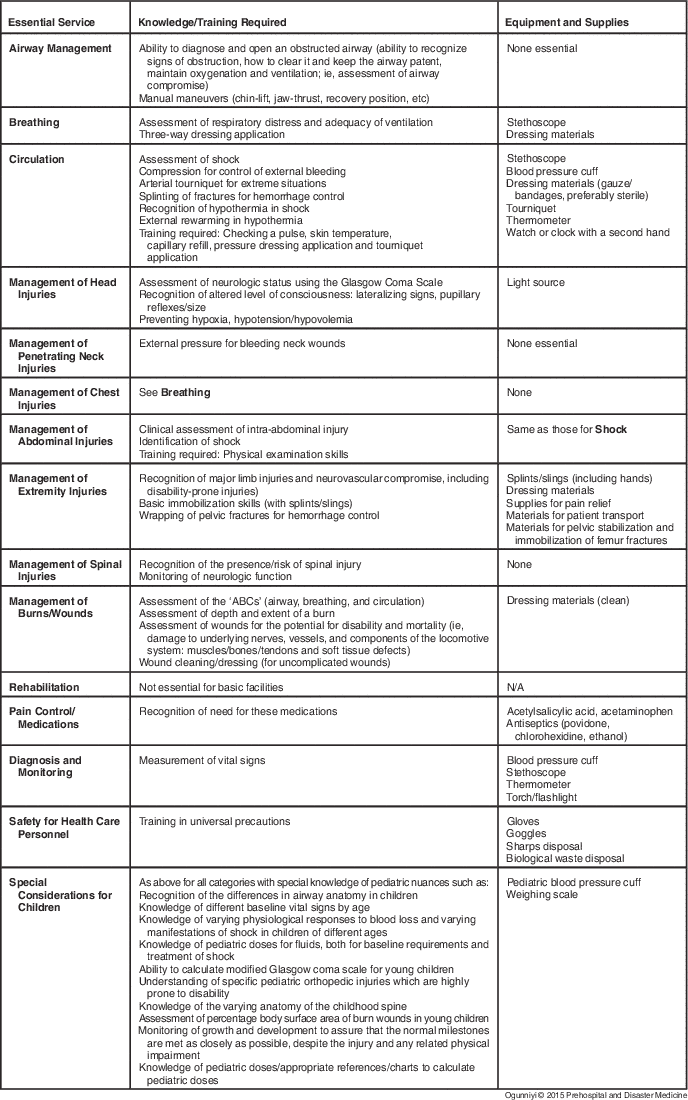
The World Health Organization (WHO; Geneva, Switzerland) Guidelines for Essential Trauma Care Reference Mock, Lormand, Goosen, Joshipura and Peden 3 outlines goals for injured patients, specifically addressing the proper management of life- and limb-threats that require immediate intervention. Since the capacity to achieve these goals varies by the type of health facility in question, the guidelines identify services and resources deemed as “essential” at each different facility level. The WHO trauma guidelines classify these facilities as:
-
1. Basic facilities, which are primary health facilities staffed by village health posts, clinics staffed by nurses and medical assistants, and clinics with doctors (Table 1);
-
2. General practitioner hospitals, including those with basic surgical capabilities;
-
3. Specialty hospitals, which include hospitals with general surgeons, hospitals with general surgeons and orthopedic surgeons, and hospitals with general surgeons, orthopedic surgeons, and other specialties; and
-
4. Tertiary Hospitals, which include tertiary care facilities with both a limited and a full range of specialties.Reference Mock, Lormand, Goosen, Joshipura and Peden 3
Essential Services for Basic Health Care Facilities

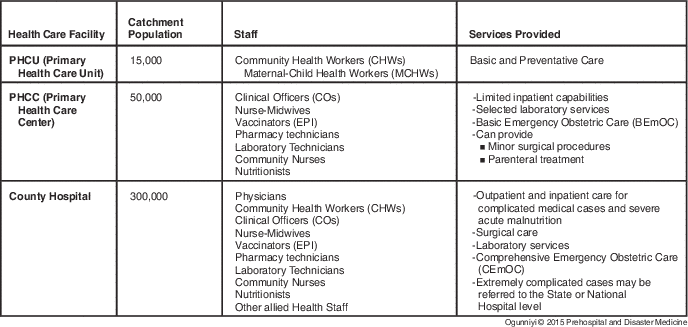
Due to a lack of trained physicians, and a geographic distribution placing 83% of people in rural areas, the South Sudan health system provides most of its trauma care at the basic facilities level, as defined by the WHO. The South Sudanese physician gap fits a pattern common to other LMICs; there are an estimated 50 surgeons for every 100,000 people in the US versus 0.5 for every 100,000 in Africa.Reference Mock, Arreola-Risa and Quansah 8 Because of the lack of trained physicians, many LMICs, including South Sudan, have instituted a system of non-physician clinicians to bridge the provider gap; this includes community health workers (CHWs) and clinical officers (COs). A recent study showed that over half (25) of the 47 sub-Saharan African countries included in the study incorporated the use of non-physician clinicians, particularly in rural practice.Reference Mullan and Frehywot 9 The health system in South Sudan relies heavily on these allied health workers for health care provision, based on its Basic Package of Health Services (Table 2).
Health System Structure in South SudanReference Ogunniyi 19

Most CHWs in South Sudan work through “basic facilities” and are on the front lines of caring for trauma patients. However, as observed in other LMICs, many of these allied health care workers have very limited training, particularly within the realm of trauma and emergency care. Studies in other LMICs have showed that the majority of the Emergency Medical Services personnel providing out-of-hospital care had no formal training, with a resulting high variability in practice between providers.Reference Mock, Arreola-Risa and Quansah 8
In 2012 through 2013, two authors (AO and MC) spent nine months educating health staff (CHWs, COs, and nurses) in rural South Sudan on the proper management of trauma victims and mass-casualty incidents through the nongovernmental organization, International Medical Corps (IMC; Los Angeles, California USA). The overall goal of the project was to reduce morbidity and mortality among the conflict-affected population in Akobo County. Jonglei state has a long history of inter-communal violence, particularly between the Luo Nuer and Murle ethnic groups who both have a record of cattle-raiding practices. Based on their pre-test scores, most course participants had minimal functional trauma knowledge. The authors, therefore, undertook this review of the overall South Sudan CHW training curriculum 10 to evaluate the degree to which it incorporates trauma education according to established guidelines from the WHO.
Methods
This study was a descriptive comparison of the most recent trauma care curriculum in South Sudan with the standard curriculum content established by the WHO. A literature search was performed using the Google Scholar (Google Corporation; Mountain View, California USA) and PubMed (National Center for Biotechnology Information at the US National Library of Medicine; Bethesda, Maryland USA) search engines, using the following terms to generate a list of articles on CHWs in South Sudan and other countries: village health workers training curriculum low income; community health workers training; community health workers training curriculum low income; community-based health care workers; village health workers training programs low income; and community health workers training curriculum third world. Articles focused on trauma management were identified using the terms: trauma; South Sudan; injury; developing; global; and low income. A grey literature search was also performed, including contacts from IMC.
The WHO Guidelines for Essential Trauma Care were obtained from the WHO web site and identified services deemed as essential at basic facilities for each different medical goal (Table 1). Mr. J Geno, the Monitoring and Evaluation Officer from IMC-South Sudan, provided the South Sudan CHW training curriculum, which was the standard curriculum in use from 2005 until 2010. One author (AO) then reviewed the curriculum, examining all modules to identify content relevant for the management of trauma patients (specifically looking for those highlighted in the WHO guidelines). All modules were reviewed, including those not directly pertaining to trauma/first aid, as the curriculum covered some concepts in different parts of the training curriculum. For instance, the curriculum covered key concepts in airway management under the “Respiratory System” module, while it discussed elements important in the management of shock in the module on the “Circulatory System.” Any additional recommendations specific to the curriculum, but not included in the guidelines, were also noted.
The authors determined the degree to which the South Sudan curriculum followed WHO guidelines using a point system: one point was assigned where all essential topics were covered, and partial credit was awarded (0.5 points) for concepts covered in limited detail. No credit was given to content covered in the curriculum but not deemed essential by guidelines. This point system was then used to determine the percentage of trauma content covered by category and as a whole. Any disagreements regarding this point system were resolved through discussions between two researchers (AO and MC). If they were unable to achieve a consensus, the third author (RD) served as the tiebreaker.
Results
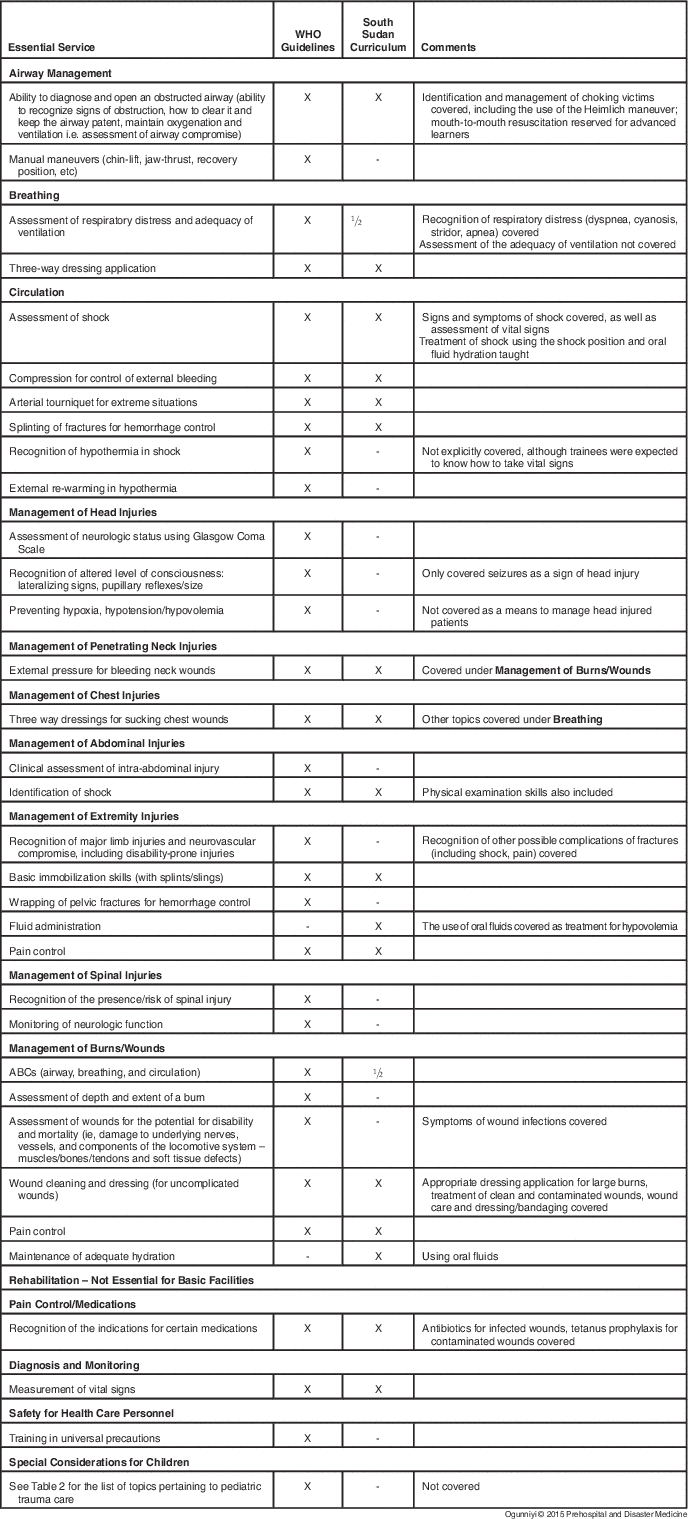
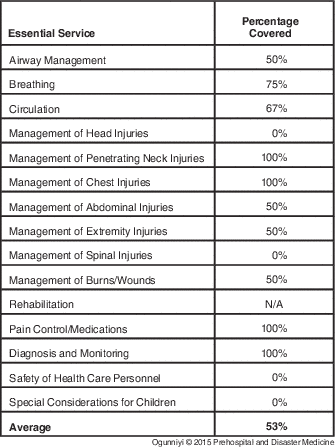
Table 3 provides the comparison between the WHO guidelines and the topics covered in the South Sudan training curriculum. The South Sudan curriculum included 53% of the material deemed essential by WHO trauma guidelines. The major deficiencies were in the management of head and spinal injuries, safety protocols for health care personnel, and in the management of pediatric patients.
Comparison of the Topics Covered Between the WHO Guidelines and the South Sudan CHW Training Curriculum

Abbreviations: CHW, community health worker; WHO, World Health Organization.
The curriculum did cover all the key concepts requisite for the treatment of penetrating neck injuries, chest injuries, proper patient monitoring, and the provision of adequate pain control. About half of the essential content required for the management of trauma airways, abdominal trauma, and extremity trauma was covered. Table 4 provides a breakdown of the amount of content covered by category.
Trauma Content Covered by Category

Additionally, the CHW curriculum advocated for certain interventions that were of unknown standard-of-care based on internationally recognized protocols. Specifically, the use of oral hydration in burn patients, and for those in shock, had limited supporting research and may be controversial in practice.
Discussion
Despite trauma being a significant cause of morbidity and mortality, trauma education for CHWs in the South Sudan training curriculum appears to be inadequate. The curriculum incorporates only about 50% of content deemed essential for basic providers, which indicates that CHWs in the country are likely ill prepared to manage trauma patients appropriately. The curriculum does cover a number of basic concepts, including splinting, hemorrhage control, identification of shock, and wound/burn care. However, it outlines these topics in limited detail. For instance, CHWs learn that seizures are indicative of neurologic injury, but do not learn other critical aspects of head injury management, particularly the use of specific protocols and methods to determine the level of alertness and the severity of injury.
When looking at actual practice, a recent study in Juba, South Sudan showed that the majority of traumatic injuries occurred because of road traffic collisions, with most of the victims sustaining short or long bone fractures (72%).Reference Lado 11 The remaining patients sustained head injuries (12%), pelvic fractures (8%), multiple rib fractures (6%), and spinal fractures (2%).Reference Lado 11 Based on this review of their training curriculum, South Sudanese CHWs would be able to adequately manage only those with isolated extremity injuries (72%), but would likely be ill equipped to manage the remaining 28% of patients with other injury patterns. The curriculum clearly lacks training on the management of head trauma (12%), pelvic fractures (8%), and spinal trauma (2%). The curriculum coverage of thoracic trauma with multiple rib fractures (6%) is less clear, since these patients can have varied presentations, but appears overlooked, especially for higher acuity presentations.
The curriculum also advocates for the use of oral hydration in burn patients, and for those in shock, which is contraindicated under internationally recognized protocols (eg, Advanced Trauma Life Support) that typically recommend keeping these patients nil per oris in case they need operative intervention. Unfortunately, the placement of intravenous lines, which is typical in international and advanced practice, is beyond the CHW scope of practice, and access to timely surgical support is also frequently uncertain. Under such restricted conditions, the authors unfortunately know of no evidence- or consensus-based guidelines to establish best-practice care. Although well-defined guidelines exist for HICs, this and other similar questions have no established answers in low resource settings. Expert consensus guidelines and research on trauma, specifically in LMICs, with an eye toward possible task shifting, would be very helpful to determine the most appropriate methods to manage these patients.
Of greater concern is the apparent disconnect between the classroom and the reality in the clinical setting. Although the CHWs were motivated and hardworking, the authors noted that most of the CHWs they interacted with were unable to transfer the principles outlined in their CHW curriculum to the management of actual patients. One potential reason could be that many South Sudanese CHWs have a lower level of education at baseline than CHWs in other countries. Their limited primary school education may limit the amount of advanced material they can study and retain. They may also have received poor initial training, which would have laid a poor foundation. Furthermore, evidence has shown that problems in understanding training manuals often lead to difficulties in following protocols; one suggestion is that on-the-job training might help overcome this problem.Reference Mullan and Frehywot 9
One potential way to improve retention and to ensure that trauma education is up-to-date is to require attendance at recertification courses on a set basis, similar to Continuing Medical Education (CME) courses in HICs. Although the authors were unable to find any official policy from South Sudan, various LMICs have implemented CME requirements for CHWs with some success. Examples include the Better and Systematic Team Training program used in Botswana,Reference Hanche-Olsen, Alemu, Viste, Wisborg and Hansen 12 a trauma continuing education program established in Ghana,Reference Mock, Quansah, Addae-Mensah and Donkor 13 and the Trauma Team Training course used in Uganda.Reference Mock, Lormand, Goosen, Joshipura and Peden 3 Other trauma CME courses are The National Trauma Management Course (NTMC) in India, the Primary Trauma Care (PTC) course used worldwide, and the Essential Surgical Skills (ESS) course in East Africa. Both the NTMC and the PTC course are 2-day courses focusing on initial trauma management, while the ESS course is a week-long course that covers a number of surgical problems, including trauma.Reference Hanche-Olsen, Alemu, Viste, Wisborg and Hansen 12 The caveat is that many of these courses are geared towards advanced health practitioners (doctors and nurses) with a baseline level of trauma knowledge, and might not be as applicable to those with minimal training.Reference Tchorz, Thomas and Jesudassan 14 - Reference Bergman, Deckelbaum and Lett 16 They would require significant modification in order to adapt them to this target audience.
Another major obstacle is the cost, which is often significant and possibly prohibitive in a setting such as South Sudan. As such, in places where CHWs provide the bulk of direct patient care, it might be more beneficial and cost-effective to incorporate the essential topics into initial CHW training programs, so they receive exposure to the key material from the onset. One successful training program specifically geared towards village health workers was implemented in Cambodia/Northern Iraq.Reference Husum, Gilbert and Wisborg 17 Participants were trained in first-responder care over a 3-year period, with the core group of 44 trainees going on to educate 2,800 layman village health responders. A total of 813 patients were managed through this system over the course of three years, with the mortality rate for trauma victims decreasing from 22.6% to 13.7%.Reference Husum, Gilbert and Wisborg 17
The availability of necessary resources on a routine basis is as important as comprehensive trauma education. This is often lacking in South Sudan, as well as in many similar LMICs. Not only do the resources need to be available, but they should also be accessible in a timely manner. Studies performed in similar LMICs reinforce the importance of physical infrastructure. One frequent finding is that although some clinics have adequate resources, they are frequently unavailable when necessary.Reference Mock, Nguyen, Quansah, Arreola-Risa, Viradia and Joshipura 18 In addition to resource allocation, proper administration, monitoring, and evaluation are other key facets of a robust trauma and emergency care system.
These findings have important policy implications for the government of South Sudan and those of other LMICs with similar CHW training programs. National governments have a critical role to play in the implementation of training programs and the development of health policies that recognize the importance of trauma care. The World Health Assembly Resolution 60.22 highlights the need “to ensure that appropriate core competencies are part of relevant health curricula and to promote continuing education for providers of trauma and emergency care.” 6 Only through such efforts can society “ensure that a core set of trauma and emergency care services are accessible to all people who need them.” 6
Limitations
The South Sudan CHW curriculum reviewed was in use from 2005 until 2010 (with a few trainees completing the course in early 2011, as they were enrolled before the release of the circular ending the program). Since then, there has been no uniform training curriculum in use. While many recent graduates from CHW programs have continued to use this curriculum, others may have received other training. This could explain some of the differences in practice patterns noted in the field.
In addition, South Sudan is a new country and its training programs may lag behind those in countries like India, Bangladesh, and Nepal, where CHW training programs have been in existence for years. Therefore, the findings here are not necessarily generalizable to other contexts.
Conclusion
The authors found that the most recent national South Sudan CHW training curriculum lacked the requisite content to provide adequately a basic level of trauma care. As such, it requires review and improvement before reinstatement in order to ensure that all of South Sudan’s citizens receive proper trauma and emergency care. Other LMICs may also wish to review their trauma training curricula to ensure they are meeting WHO guidelines and providing optimal care to their populace.