1. Introduction
Parallel robots and series robots are very different in terms of mechanism, kinematics, and dynamics and form a dual relationship in some aspects. Compared with serial robots, parallel robots have the advantages of larger load capacity, higher stiffness, higher precision, smaller motion inertia, better dynamic performance, and compact structure [Reference Eskandary, Belzile and Angeles1–Reference Kelaiaia3]. Therefore, the parallel robots can realize high-speed and high-precision movement of end-effector. The above advantages of parallel robots make parallel robots play an important role in precise positioning devices, assembly operations, energy equipment, medicine, and bioengineering [Reference Su, Cheng, Wang, Liang, Zheng and Zhang4–Reference Wu, Lin, Zhu, Tang, Jie and Zhou6], which makes many scholars carry out extensive and in-depth research on parallel robots.
During the motion process, the motion path and motion law of end-effector will affect the dynamic accuracy of mechanism, so it is necessary to study trajectory planning methods [Reference Chen and Liao7–Reference Zhang, Shang and Cong10]. Trajectory planning needs to plan a collision-free trajectory according to the work environment and operation tasks, including position, speed, acceleration, etc [Reference Qian, Bao, Zi and Zhu11]. According to the classification of operation tasks, trajectory planning can be divided into two categories [Reference Eskandary, Belzile and Angeles1]. One is the pick-and-place operation task, under which the robot needs to move from the starting point to the target point, and the purpose is to plan a trajectory from the initial pose to the desired pose. There is no constraint on the motion path between the starting pose and the desired pose, so there may exist multiple qualified trajectories under this operation task. The other is that the manipulator performs continuous motion tasks according to a specific trajectory, such as surface processing, welding, etc., under which the trajectory planning not only requires the determination of initial pose and desired pose, but also needs to ensure that it passes through some specific points. Under these circumstances, the purpose of trajectory planning is to solve the collision-free trajectory along a specific path point, while the pick-and-place operation can be regarded as a continuous motion path through any point in Cartesian space. In order to improve the robot motion performance, the trajectory planning methods can also be classified according to different optimization objectives and constraints for different operation tasks [Reference Savsani, Jhala and Savsani12–Reference Li and Shao14]. Bourbonnais et al. proposed a cubic spline stochastic optimization method to minimize cycle time for a pick-and-place task [Reference Bourbonnais, Bigras and Bonev15]. Kucuk proposed an optimal trajectory generation algorithm to generate minimum-time smooth motion trajectories for serial and parallel manipulators [9]. Zhang et al. presented a novel
 $s - \ddot s$
plane method to devise dynamically feasible point-to-point trajectories for a spatial cable-suspended parallel robot [Reference Zhang, Shang and Cong10], where
 $s$
is the path parameter. Pham et al. extended the classical time-optimal path parameterization algorithm for the redundantly actuated parallel robots and humanoid robots [Reference Pham and Stasse16]. Zimmermann et al. presented an optimization framework for grasp and motion planning, which simultaneously optimized motion trajectories, grasping locations, and other parameters such as the object pose during handover operations [Reference Zimmermann, Hakimifard, Zamora, Poranne and Coros17]. Sun et al. proposed a novel hybrid interpolation algorithm for trajectory planning, which can not only ensure the trajectory passes through all path points but also ensure the jerk is continuous [Reference Sun, Han, Zuo, Tian, Song and Li18]. Liu et al. presented the 4-3-3-4 degree polynomial interpolation to achieve trajectory planning for Delta robot to ensure control accuracy and increase productivity in intelligent packaging and proposed an improved particle swarm optimization algorithm to optimize trajectory running time of the 4-3-3-4 degree polynomial interpolation [Reference Liu, Cao, Qu and Cheng19].
Due to the high precision, high speed, and good dynamic performance of parallel Delta robots [Reference Borchert, Battistelli, Runge and Raatz20], Delta robots are widely used in food, electronics, biology, and other industries for pick-and-place, sorting, palletizing, assembly, and other operations [Reference Schreiber and Gosselin8, Reference Moghaddam and Nof21]. The pick-and-place operation is the basic step for parallel Delta robots to sort and assemble related assembly line products and is used to pick up and place the products according to the specified requirements to the desired position. This paper studies the trajectory planning method of pick-and-place operation for Delta robot. The pick-and-place operation trajectory is generally designed as a door-shaped trajectory, which can be divided into three parts: vertical section, horizontal section, and vertical section [Reference Choe, Puignavarro, Cichella, Xargay and Hovakimyan22]. The vertical and horizontal section are connected at right angles, which is not conducive to the continuous and smooth movement in robot joint space and easily causes the robot to produce shock, tremor, and other phenomena, which in turn affects the accuracy of pick-and-place operation for Delta robot [Reference Liang and Su23]. In order to make the pick-and-place operation run smoothly, smooth curves are often used to replace the right angle for turning transitions in the pick-and-place operation path. The common smooth curves include splines [Reference Suzuki, Usami and Maekawa24, Reference Hoek, Ploeg and Nijmeijer25], Bezier curves, and Lam
 $\acute{\rm{e}}$
curves. Pythagorean-Hodograph (PH) curves are a special form of curves based on Bezier curves. PH curves have many advantages, such as limited extremal curvature and rational algebraic expression of its offset equation. Moreover, the arc length of PH curves can be expressed as a polynomial [Reference Dong and Farouki26]. Due to the above advantages, it is widely applied in path planning [Reference Shao, Yan, Zhou and Zhu27], continuum robotics [Reference Singh, Amara, Melingui, Pathak and Merzouki28], highways, and railways design [Reference Zheng, Wang and Yang29], obstacle avoidance [Reference Giannelli, Mugnaini and Sestini30], and many other fields [Reference Moon and Farouki31]. Therefore, the PH curve is utilized in this paper for the trajectory planning of pick-and-place operation for Delta parallel robots.
In some practical applications, there may exist partitions or obstacles between the picking and placement position, so the pick-and-place operation preferably has vertical motion to avoid collision with partitions or obstacles in this scenario. There are also actual operation tasks where the picking and placement position are in different horizontal planes, which leads to different ascending and descending distances of the pick-and-place operation. Compared with the existing works on trajectory planning for Delta robots [Reference Su, Cheng, Wang, Liang, Zheng and Zhang4, Reference Liang and Su23], this paper considers these cases simultaneously. In this paper, a PH curve-based pick-and-place operation trajectory planning method for Delta parallel robot is proposed for the flexible control of pick-and-place operations to make the robot meet different requirements in various real scenarios. The main contributions are listed in the following.
1) Based on the actual requirements of obstacle avoidance and different pick-and-place heights, a pick-and-place operation path based on PH curve is constructed. And according to the geometric relationship of the pick-and-place operation path, a classification method of pick-and-place operations is presented.
2) A classification-based trajectory planning method is proposed, and in each case, the different polynomial motion laws adopted by the linear motion segment and the curved motion segment are solved.
3) The proposed method is easier to implement, which can not only realize the time optimal trajectory planning of pick-and-place operation, but also can realize the flexible control of pick-and-place operations at different pick-and-place heights to avoid collision with partitions or obstacles in any situation of industrial application.
The proposed method can not only be used in intelligent manufacturing fields such as rapid classification, palletizing, grasping, and warehousing, but its research route can also provide a reference for pick-and-place operation trajectory planning of intelligent vehicles in logistics system.
The rest of this article is as follows. Section 2 presents kinematics of Delta robot. Section 3 is devoted to design a classification-based trajectory planning method based on quintic PH curves, including trajectory planning and optimization. Section 4 presents some simulation and experiment results. Finally, the conclusion is given in Section 5.
2. Kinematics of Delta robot
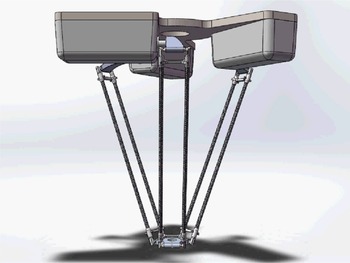
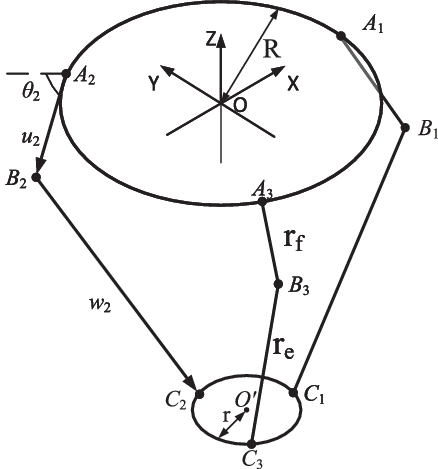
The Delta parallel mechanism is used in this paper, as shown in Fig. 1, and its simplified geometric diagram is shown in Fig. 2. The Delta parallel mechanism includes a fixed platform, a moving platform, three active drive arms, and three parallelogram-driven branches. It can be seen from Fig. 1 that three identical kinematic branches are symmetrically distributed to connect the fixed platform and the moving platform. Each kinematic branch contains an active drive arm and a driven arm with parallelogram structure. The active arms are driven to rotate by the servo motors and the reducers, and the motors and reducers corresponding to the three active arms are installed on the fixed platform. The active arms are connected with parallelogram structure through spherical joint, thereby realizing the translational motion of moving platform. The parallelogram structure in the kinematic branch determines the motion characteristics of the robot, which is generally translational motion with three degrees of freedom.
Structure diagram of Delta robot.

Simplified geometric diagram of Delta robot.

2.1. Position model
Referring to the coordinate system
 $OXYZ$
in Fig. 2, the position of
 $O'$
in this coordinate system
 $p ={(x,y,z)^{\rm{T}}}$
can be expressed as
 \begin{equation} p ={e_i} + {r_f}{u_i} + {r_e}{w_i} i = 1,2,3 \end{equation}
where
 $e_i$
represents the direction vector corresponding to the radius difference between the fixed platform and the moving platform in the
 $i$
-th kinematic branch, and
 ${e_i} = ({R - r)}{(\!\cos{\varphi _i} \sin{\varphi _i}\, 0 )^{\rm{T}}}$
.
 $R$
represents the distance from the coordinate origin
 $O$
to the connection point between the active arm and the fixed platform, and
 $r$
represents the distance from the coordinate
 $O'$
to the connection point between the slave arm and the moving platform.
 $\varphi _i$
represents the angle corresponding to the
 $i$
-th active arm, and
 ${\varphi _i} = \frac{{2\pi }}{3}i - \frac{2}{3}\pi, i = 1,2,3$
.
 $r_f$
and
 $r_e$
are the link length of the active arm and the slave arm, respectively,
 $u_i$
and
 $w_i$
represent the unit vector of the
 $i$
-th active arm and slave arm, and
 ${\theta _i}$
represents the rotation angle of the
 $i$
-th active arm.
 \begin{equation} {u_i} = \left ({\begin{array}{*{20}{c}}{\cos{\varphi _i}\cos{\theta _i}}\\[5pt] {\sin{\varphi _i}\cos{\theta _i}}\\[5pt] { -\!\sin{\theta _i}} \end{array}} \right ) \end{equation}
Rewriting Eq. (1) into the form where the term
 $w_i$
is on one side alone, we can get
 \begin{equation} {(p -{e_i} - {r_f}{u_i}{\rm{)}}^{\rm{T}}}(p -{e_i} - {r_f}{u_i}) = r_e^2 \end{equation}
Substituting Eq. (2) into the above formula, the following formula can be derived
 \begin{equation} \begin{aligned}{(x - (R -{r)\cos }{\varphi _i} -{r_{f}}\cos{\varphi _i}\cos{\theta _i}{\rm{)}}^2} + {(y - (R -{r)\sin }{\varphi _i} -{r_{f}}\sin{\varphi _i}\cos{\theta _i}{\rm{)}}^2} + {(z +{r_{f}}\sin{\theta _i}{\rm{)}}^2} = {r}_e^2 \end{aligned} \end{equation}
Simplifying Eq. (4), we can get
 \begin{equation} \begin{aligned} &2{r_{f}}(R -{r} - x{\rm{cos}}{\varphi _i} - y\sin{\varphi _i})\cos{\theta _i} + 2{r_{f}}z\sin{\theta _i}\\[5pt] &={r}_e^2 -{r}_{f}^2 -{x^2} -{y^2} -{z^2} -{(R - r)^2}+ 2(R - r)(x{\rm{cos}}{\varphi _i} + y\sin{\varphi _i}) \end{aligned} \end{equation}
If
 \begin{equation} \left \{ \begin{aligned} U& = 2{r_f}(R - r - x{\rm{cos}}{\varphi _i} - y\sin{\varphi _i})\\[5pt] V& = 2r_{f}z\\[5pt] W& = r_e^2 - r_f^2 -{x^2} -{y^2} -{z^2} -{(R - r)^2}+ 2(R - r)(x{\rm{cos}}{\varphi _i} + y\sin{\varphi _i}) \end{aligned} \right. \end{equation}
then we can get
 \begin{equation} {\theta _i} = 2\arctan \displaystyle \frac{{ - V \pm \sqrt{{V^2} +{U^2} -{W^2}} }}{{ - W - U}} \end{equation}
Combined with the mechanism assembly mode shown in Fig. 2, an appropriate
 $\theta _i$
can be solved to achieve precise control of Delta robot’s specified operation.
2.2. Velocity model
The velocity model is the mapping relationship between the velocity of the robot’s end-effector in Cartesian space, that is, the velocity of the moving platform coordinate
 $O'$
in the
 $OXYZ$
coordinate system, and the angular velocity of the active arm in the joint space.
The velocity equations can be obtained by differentiating the position equations. Therefore, by taking the derivative of Eq. (1), we can obtain
 \begin{equation} \dot p ={r_f}{\dot u_i} + {r_e}{\dot w_i} = {r_f}{\dot \theta _i}\left ({\begin{array}{*{20}{c}}{ -\!\cos{\varphi _i}\sin{\theta _i}}\\[5pt] { -\!\sin{\varphi _i}\sin{\theta _i}}\\[5pt] { -\!\cos{\theta _i}} \end{array}} \right ) + {r_e}{\dot w_i} \end{equation}
where
 $\dot p$
is the velocity vector of the end-effector
 $O'$
of the robot,
 $\dot \theta _i$
is the angular velocity of the
 $i$
-th active arm,
 $\dot w_i$
is the velocity vector of the vector
 $w_i$
of the
 $i$
-th slave arm in Fig. 2. Multiply both sides of Eq. (8) by
 $w_i^{\rm{T}}$
at the same time, we can get
 \begin{equation} {\dot \theta _i} = \frac{{w_i^{\rm{T}}\dot p}}{{{r_f}w_i^{\rm{T}}\left ({\begin{array}{*{20}{c}}{ -\!\cos{\varphi _i}\sin{\theta _i}}\\[5pt] { -\!\sin{\varphi _i}\sin{\theta _i}}\\[5pt] { -\!\cos{\theta _i}} \end{array}} \right )}} \end{equation}
Let the vector
 ${\psi } _i$
be
 $ ({\begin{array}{*{20}{c}}{\!-\!\cos{\varphi _i}\sin{\theta _i},}&{ -\!\sin{\varphi _i}\sin{\theta _i},}&{ -\!\cos{\theta _i}} \end{array}} )^{\rm{T}}$
, the above equation can be written as
 \begin{equation} {\dot \theta _i} = \displaystyle \frac{{w_i^{\rm{T}}\dot p}}{{{r_f}w_i^{\rm{T}}{{\psi } _i}}} \end{equation}
Writing the above equation in matrix form, we can get
 \begin{equation} \dot \theta = J_q^{ - 1}{J_x}\dot p = J\dot p \end{equation}
where
 \begin{equation} J = J_q^{ - 1}{J_x},{J_q} = \left [{\begin{array}{*{20}{c}}{{r_f}w_1^{\rm{T}}{{\psi } _1}}&{}&{}\\[5pt] {}&{{r_f}w_2^{\rm{T}}{{\psi } _2}}&{}\\[5pt] {}&{}&{{r_f}w_3^{\rm{T}}{{\psi } _3}} \end{array}} \right ],{J_x} = \left [{\begin{array}{*{20}{c}}{w_1^{\rm{T}}}\\[5pt] {w_2^{\rm{T}}}\\[5pt] {w_3^{\rm{T}}} \end{array}} \right ] \end{equation}
According to the kinematic position model (7),
 $\theta _i$
can be obtained, and then
 ${\psi } _i$
can be obtained. Once
 $\theta _i$
is obtained,
 $u_i$
in Fig. 2 can be obtained, and then
 $w_i$
can be obtained according to the following formula.
 \begin{equation} {w_i} = \displaystyle \frac{1}{{{r_e}}}(p -{e_i} - {r_f}{u_i}{\rm{)}} \end{equation}
Therefore, the joint space velocity can be obtained from Eq. (11).
3. Trajectory planning of a pick-and-place operation for Delta robot
3.1. Path planning
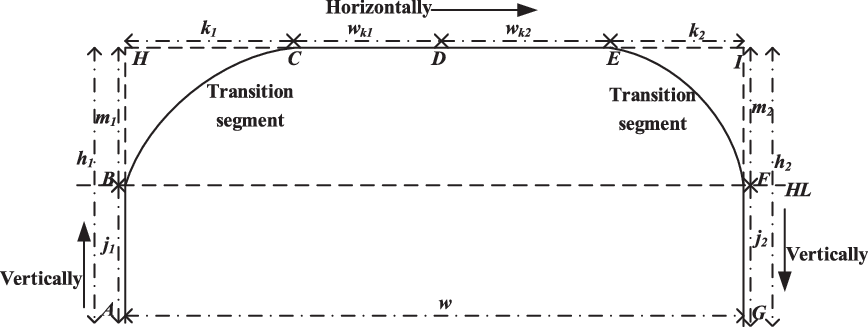
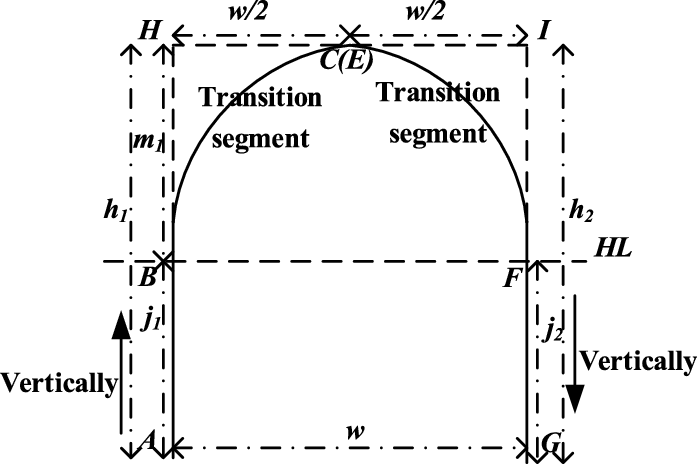
Delta robots are commonly used to perform pick-and-place operation in production lines. As shown in Fig. 3, the pick-and-place operation path is represented as
 $ABCDEFG$
. It includes two vertical segments
 $AB$
and
 $FG$
, two transition segments
 $BC$
and
 $EF$
, and a horizontal segment
 $CE$
[Reference Huang, Wang, Mei, Zhao and Chetwynd32]. In Fig. 3,
 $\lvert AG \rvert = w$
,
 $\lvert{HC} \rvert ={k_1}$
,
 $\lvert{EI} \rvert ={k_2}$
,
 $\lvert{HA} \rvert ={h_1}$
,
 $\lvert{IG} \rvert = {h_2}$
,
 $\lvert{HB} \rvert ={m_1}$
,
 $\lvert{IF} \rvert ={m_2}$
,
 $\lvert{BA} \rvert ={j_1}$
,
 $\lvert{FG} \rvert ={j_2}$
,
 $\lvert{CD} \rvert ={w_{k1}}$
,
 $\lvert{DE} \rvert ={w_{k2}}$
,
 $HL$
is a horizontal line, point
 $B$
is the intersection of
 $HL$
and
 $AH$
, point
 $F$
is the intersection of
 $HL$
and
 $IG$
. In practical applications, there may exist obstacles or partitions between the picking and placement position. So the pick-and-place operation trajectory needs to satisfy the specified height to avoid collision between the workpiece and obstacles [Reference Liu, Cao, Qu and Cheng19]. Therefore, the vertical movement of pick-and-place operation should be performed below the horizontal line
 $HL$
to avoid collision of objects with the obstacles or partitions. The horizontal line
 $HL$
is the horizontal line where the highest point of the partition is located. Thus,
 $j_1$
is the distance from point
 $A$
to the horizontal line
 $HL$
,
 $j_2$
is the distance from point
 $G$
to the horizontal line
 $HL$
.
Pick-and-place operation path.

Based on the unique properties of PH curves [Reference Dong and Farouki26], the transition segments
 $BC$
and
 $EF$
of the pick-and-place operation path shown in Fig. 3 are formed by quintic PH curves. The PH curves have some properties: endpoint position vector and tangent vector properties (i.e. the start and end points of the curve coincide with the start and end points of the control polygon; the direction of the tangent vector at the beginning and end of the curve is consistent with the direction of the first and last edges of the control polygon); convex hull (that is, the curve is in the convex hull formed by the control points; the convex hull is completely closed and can be expressed explicitly as a convex combination of control points); geometric invariance (that is, some geometric properties do not change with coordinate transformation). The PH curves also have the rational curvature, so the uniform distribution of the path curvature or the curvature constraint can be achieved, which is beneficial to the smooth and continuous motion of the robot. The transition segment
 $BC$
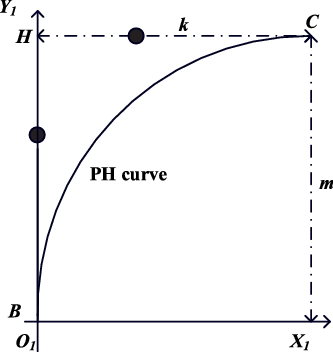
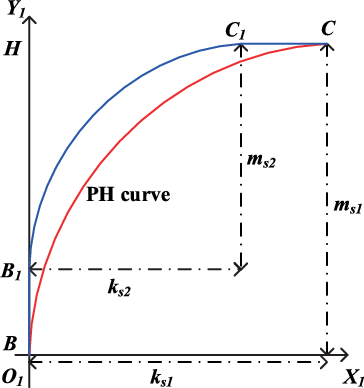
formed by the quintic PH curve can be shown in Fig. 4. The PH curve in Fig. 4 can be expressed as follows [Reference Su, Cheng, Wang, Liang, Zheng and Zhang4]
 \begin{equation} P(\gamma )=(x(\gamma ),y(\gamma ))=\sum _{i=0}^{n}\left(\substack{n \\[3pt] i}\right)P_{i}\gamma ^{i}(1-\gamma )^{n-i},\gamma \in [0,1] \end{equation}
where
 \begin{equation} \left \{ \begin{aligned} x(\gamma ) &= \frac{2}{5}({\mu _0}{v_2} +{\mu _2}{v_2}){\gamma ^5} -{\mu _0}{v_2}{\gamma ^4} + \frac{2}{3}{\mu _0}{v_2}{\gamma ^3}\\[5pt] y(\gamma ) &={\mu _0}^2\gamma{(1 - \gamma )^4} + 2{\mu _0}^2{\gamma ^2}{(1 - \gamma )^3}+ \left(2{\mu _0}^2 + \frac{2}{3}{\mu _0}{\mu _2}\right){\gamma ^3}{(1 - \gamma )^2}\\[5pt] &+ \left({\mu _0}^2 + \frac{1}{3}{\mu _0}{\mu _2}\right){\gamma ^4}(1 - \gamma ) + \left(\frac{1}{5}{\mu _0}^2 + \frac{1}{{15}}{\mu _0}{\mu _2}\right){\gamma ^5} \end{aligned} \right. \end{equation}
 \begin{equation} \left \{ \begin{aligned}{\mu _0} &= \sqrt{\frac{{5(35m + k - \sqrt{{m^2} +{k^2} + 70mk} )}}{{34}}} \\[5pt] {\mu _2} &= \sqrt{\frac{{5(m + 35k - \sqrt{{m^2} +{k^2} + 70mk} )}}{{68}}} \\[5pt] {v_2} &= \sqrt{\frac{{5(m + 35k - \sqrt{{m^2} +{k^2} + 70mk} )}}{{68}}} \end{aligned} \right. \end{equation}
 ${P_i} = ({x_i},{y_i})$
represents the control point of the PH curve,
 $i = 0\ldots n$
,
 $n$
represents the degree of the PH curve,
 $\gamma$
represents the curve parameter,
 $m$
and
 $k$
in (16) are shown in Fig. 4. By using the properties of endpoint tangent vector and convex hull of the PH curve, path planning for smooth path transition has been carried out.
The PH curve in pick-and-place operation path.

Then the formula for calculating the arc length of the PH curve corresponding to
 $\gamma$
is as follows [Reference Su, Cheng, Wang, Liang, Zheng and Zhang4]
 \begin{equation} \begin{aligned} l(\gamma ) &= ({\mu _0}^2 +{\rm{2}}{\mu _0}{\mu _2} +{\mu _2}^2 +{v_2}^2)\frac{{{\gamma ^5}}}{5} - ({\mu _0}^2 +{}{\mu _0}{\mu _2}){{\gamma ^4}} +(6{\mu _0}^2{\rm{ + 2}}{\mu _0}{\mu _2})\frac{{{\gamma ^3}}}{3} - 2{\mu _0}^2{{\gamma ^2}} +{\mu _0}^2\gamma \end{aligned} \end{equation}
Then the total arc length of the quintic PH curve in Fig. 4, that is, the arc length of the BC curve in Fig. 3, can be calculated as
 \begin{equation} \begin{aligned}{l_{PH}} &= l(1) = \frac{1}{5}{\mu _0}^2 + \frac{1}{{15}}{\mu _0}{\mu _2} + \frac{2}{5}{\mu _2}^2\\[5pt] &= m + k + \frac{1}{{17}}\left(m + k - \sqrt{{m^2} +{k^2} + 70mk} + \sqrt{\frac{{{m^2} +{k^2} + 36mk - (m + k)\sqrt{{m^2} +{k^2} + 70mk} }}{2}} \right) \end{aligned} \end{equation}
By using the property that the arc length of the PH curve can be expressed as a polynomial, the smooth transition of the path and the efficient calculation of the path points can be realized.
Therefore, the total length
 $l_{all}$
of the pick-and-place operation path in Fig. 3 can be calculated as

where
 $m_1$
,
 $k_1$
,
 $m_2$
, and
 $k_2$
are shown in Fig. 3.
In order to simplify the calculation and meet the real-time requirements, assuming
 $m_1$
equals
 $k_1$
,
 $m_2$
equals
 $k_2$
. When
 $m$
is equal to
 $k$
in Fig. 4, we can get the following equation.
 \begin{equation} \left \{ \begin{aligned}{\mu _0} &= \sqrt{\frac{{5(18m - 3\sqrt{2{m^2}} )}}{{17}}} \\[5pt] {\mu _2} &= \sqrt{\frac{{5(18m - 3\sqrt{2{m^2}} )}}{{34}}} \\[5pt] {v_2} &= \sqrt{\frac{{5(18m - 3\sqrt{2{m^2}} )}}{{34}}} \end{aligned} \right. \end{equation}
By using the symmetry and geometric invariance of PH curves properties, the trajectory planning of the pick-and-place operation can be simplified. According to the different operation scenarios of the Delta robot, the following two cases are divided to carry out trajectory planning of pick-and-place operation.
Case 1. When
 $w \ge{k_1} +{k_2} ={m_1} +{m_2}$
:
In order to obtain the pick-and-place operation path, it needs to determine
 $m_1$
and
 $m_2$
firstly. The shorter pick-and-place operation path is selected by comparing two different transition curves. As shown in Fig. 5, there are two different transition options. The first transition option is that the transition segment consists of the PH curve
 $BC$
, and the other scheme is that the transition segment consists of
 $B{B_1}$
, the PH curve
 ${B_1}{C_1}$
and
 ${C_1}C$
.
Two different transition curves in pick-and-place operation path.

The total length of the first transition option
 $l_1$
in Fig. 5 can be calculated as
 \begin{equation} {l_1} ={l_{BC}} = 2{m_{s1}} + \displaystyle \frac{1}{17}{m_{s1}}\left(2 - 6\sqrt{2} + \sqrt{19 - 6\sqrt{2}} \right) \end{equation}
The total length of the second transition option
 $l_2$
in Fig. 5 can be calculated as
 \begin{equation} \begin{aligned}{l_2} &={l_{B{B_1}}} +{l_{{B_1}{C_1}}} +{l_{{C_1}C}}\\[5pt] &= 2{m_{s1}} + \frac{1}{{17}}{m_{s2}}\left(2 - 6\sqrt 2 + \sqrt{19 - 6\sqrt 2 } \right) \end{aligned} \end{equation}
The difference between
 $l_1$
and
 $l_2$
can be calculated as
 \begin{equation} \begin{aligned}{l_1} -{l_2}& = 2{m_{s1}} + \frac{1}{{17}}{m_{s1}}\left(2 - 6\sqrt 2 + \sqrt{19 - 6\sqrt 2 } \right)- 2{m_{s1}} - \frac{1}{{17}}{m_{s2}}\left(2 - 6\sqrt 2 + \sqrt{19 - 6\sqrt 2 } \right)\\[5pt] &= \frac{1}{{17}}({m_{s1}} -{m_{s2}})\left(2 - 6\sqrt 2 + \sqrt{19 - 6\sqrt 2 } \right) \end{aligned} \end{equation}
From
 ${m_{s1}} -{m_{s2}} \gt 0$
and
 $2 - 6\sqrt 2 + \sqrt{19 - 6\sqrt 2 } \lt 0$
, we can get
 ${l_1} \lt{l_2}$
. Therefore, the first transition option in Fig. 5 is the shorter pick-and-place operation path.
Because total Cartesian trajectory length represents the workspace [Reference Savsani, Jhala and Savsani12],
 ${m_1} ={m_2} = BH = IF$
in Fig. 3 is used to obtain a small workspace. Then the total length of pick-and-place operation path in Case 1 can be simplified as
 \begin{equation} \begin{array}{l}{l_{all}} ={j_1} +{j_2} + w + \displaystyle \frac{2}{{17}}{m_1}\!\left(19 - 6\sqrt 2 + \sqrt{19 - 6\sqrt 2 } \right) \end{array} \end{equation}
Case 2. When
 $w \lt{m_1} + {m_2}$
:
In this case, the pick-and-place operation path is changed from Fig. 3 to Fig. 6. As shown in Fig. 6,
 $m$
of both two PH curves in Fig. 3 become
 $w / 2$
, the vertical movement distance changes from
 $j_1$
and
 $j_2$
shown in Fig. 3 to
 ${j_1} +{m_1} -{w / 2}$
and
 ${j_2} +{m_2} -{w / 2}$
. Then the total length of pick-and-place operation path in Case 2 can be simplified as
Pick-and-place operation path when
 $w \lt{m_1} +{m_2}$
.

 \begin{equation} \begin{array}{l}{l_{all}} ={j_1} +{j_2} +{m_1}+{m_2}- w + \displaystyle \frac{w}{{17}}\left(36 - 6\sqrt 2 + \sqrt{19 - 6\sqrt 2 } \right) \end{array} \end{equation}
3.2. Trajectory planning
Case 1. When
 $w \ge{k_1} + {k_2} ={m_1} + {m_2}$
:
A pick-and-place operation in Fig. 3 can be divided into the following phases.
Phase (1): The end-effector of the Delta robot moves from point
 $A$
to point
 $B$
in the vertical direction.
Phase (2): The end-effector of the Delta robot moves from point
 $B$
to point
 $C$
along the PH curve.
Phase (3): The end-effector of the Delta robot moves from point
 $C$
to point
 $D$
in the horizontal direction.
Phase (4): The end-effector of the Delta robot moves from point
 $D$
to point
 $E$
in the horizontal direction.
Phase (5): The end-effector of the Delta robot moves from point
 $E$
to point
 $F$
along the PH curve.
Phase (6): The end-effector of the Delta robot moves from point
 $F$
to point
 $G$
in the vertical direction.
The calculation of the polynomial motion law is simple, and its corresponding velocity and acceleration are easy to solve. If the order of the polynomial motion law is too high, the computation will increase, and if the order is too small, the constraint and continuity of velocity and acceleration cannot be guaranteed. In order to ensure smooth motion and short motion time, in phase (1), (3), (4), (6), the velocity of the end-effector in Cartesian space is specified as the polynomial motion law
 \begin{equation} {v_i}(\Phi _i ) ={v_{i0}} +{v_{i1}}{\Phi _i} +{v_{i2}}{{\Phi _i} ^2} +{v_{i3}}{{\Phi _i} ^3},i = 1,3,4,6 \end{equation}
where
 ${v_i}({\Phi _i})$
is the velocity of phase (
 $i$
),
 ${\Phi _i} ={{{t_i}} / {{T_i}}}$
and
 ${\Phi _i} \in [0,1]$
,
 $T_i$
is the total time in phase (
 $i$
) and
 $t_i$
is the current time in phase (
 $i$
). In the different phases as shown below,
 ${s_i}({\Phi _i})$
is the displacement of phase (
 $i$
), and
 ${v'_{\!\!i}}(\Phi _i )$
is the acceleration of phase (
 $i$
).
a. In phase (1), the boundary conditions are listed as follows
(27) \begin{equation} \begin{aligned}{v_1}(0) = 0,{v_1}(1) ={V_B},{v'_{\!\!1}}(0) = 0,{v'_{\!\!1}}(1) = 0,{s_1}(0) = 0,{s_1}(1) ={j_1} \end{aligned} \end{equation}

So we can get
 \begin{equation} \begin{aligned}{v_1}({\Phi _1}) &= 3{V_B}\Phi _{1}^{2} - 2{V_B}\Phi _{1}^{3}\\[5pt] {s_1}({\Phi _1}) &={V_B}{T_1}\!\left ({\Phi _{1}^{3} - 0.5\Phi _{1}^{4}} \right )\\[5pt] {T_1} &={{2{j_1}} / {{V_B}}} \end{aligned} \end{equation}
where
 $V_B$
is the velocity of point
 $B$
and point
 $C$
in Fig. 3.
b. In phase (3), the boundary conditions are as follows.
(29)
\begin{equation} \begin{aligned}{v_3}(0) ={V_B},{v_3}(1) ={V_{max }}, v'_{\!\!3}(0) = 0, v'_{\!\!3}(1) = 0,{s_3}(0) = 0,{s_3}(1) ={w_{k1}} \end{aligned} \end{equation}

So we can get
 \begin{equation} \begin{aligned}{v_3}({\Phi _3}) &={V_B} + 3\left ({{V_{\max }} -{V_B}} \right )\Phi _{3}^{2} + 2\left ({{V_B} -{V_{\max }}} \right )\Phi _{3}^{3}\\[5pt] {s_3}({\Phi _3}) &={T_3}\!\left ({{V_B}{\Phi _3} + \left ({{V_{\max }} -{V_B}} \right )\Phi _{3}^{3}} \right )+ 0.5{T_3}\!\left ({{V_B} -{V_{\max }}} \right )\Phi _{3}^{4}\\[5pt] {T_3} &={{\left ({2{w_{k1}}} \right )} / {\left ({{V_B} +{V_{\max }}} \right )}} \end{aligned} \end{equation}
where
 $V_{\max }$
is the velocity of point
 $D$
in Fig. 3.
c. In phase (4), the boundary conditions are as follows.
(31)
\begin{equation} \begin{aligned}{v_4}(0) ={V_{\max }},{v_4}(1) ={V_F}, v'_{\!\!4}(0) = 0, v'_{\!\!4}(1) = 0,{s_4}(0) = 0,{s_4}(1) ={w_{k2}} \end{aligned} \end{equation}

So we can get
 \begin{equation} \begin{aligned}{v_4}({\Phi _4}) &={V_{\max }} + 3\!\left ({{V_F} -{V_{\max }}} \right )\Phi _{4}^{2} + 2\!\left ({{V_{\max }} -{V_F}} \right )\Phi _{4}^{3}\\[5pt] {s_4}({\Phi _4}) &={T_4}\!\left ({{V_{\max }}{\Phi _4} + \left ({{V_F} -{V_{\max }}} \right )\Phi _{4}^{3}} \right )+ 0.5{T_4}\!\left ({{V_{\max }} -{V_F}} \right )\Phi _{4}^{4}\\[5pt] {T_4} &={{2{w_{k2}}} / {\left ({{V_F} +{V_{\max }}} \right )}} \end{aligned} \end{equation}
where
 $V_F$
is the velocity of point
 $E$
and point
 $F$
in Fig. 3.
d. In phase (6), the boundary conditions are as follows.
(33)
\begin{equation} \begin{aligned}{v_6}(0) ={V_F},{v_6}(1) = 0,{v'_{\!\!6}}(0) = 0,{v'_{\!\!6}}(1) = 0,{s_6}(0) = 0,{s_6}(1) ={j_2} \end{aligned} \end{equation}

So we can get
 \begin{equation} \begin{aligned}{v_6}({\Phi _6}) &={V_F} - 3{V_F}\Phi _{6}^{2} + 2{V_F}\Phi _{6}^{3}\\[5pt] {s_6}({\Phi _6}) &={T_6}\!\left ({{V_F}{\Phi _6} -{V_F}\Phi _{6}^{3} + 0.5{V_F}\Phi _{6}^{4}} \right )\\[5pt] {T_6} &={{2{j_2}} / {{V_F}}} \end{aligned} \end{equation}
In phase (2) and (5), the velocity of end-effector in Cartesian space is specified as the polynomial motion law
 \begin{equation} {v_i}({\Phi _i} ) ={v_{i0}} +{v_{i1}}{\Phi _i} +{v_{i2}}{{\Phi _i} ^2} +{v_{i3}}{{\Phi _i} ^3} +{v_{i4}}{{\Phi _i} ^4}, i = 2,5 \end{equation}
where
 ${v_i}({\Phi _i})$
is the velocity of phase (
 $i$
),
 ${\Phi _i} ={{{t_i}} / {{T_i}}}$
and
 ${\Phi _i} \in [0,1]$
,
 $T_i$
is the total time in phase (
 $i$
) and
 $t_i$
is the current time in phase (
 $i$
). In the different phases as shown below,
 ${s_i}({\Phi _i})$
is the displacement of phase (
 $i$
).
a. In phase (2), the boundary conditions are as follows.
(36)
\begin{equation} \begin{aligned}{v_2}(0) ={V_B},{v_2}(0.5) ={V_{{\textrm{mid}} 1}},{v_2}(1) ={V_B},{v'_{\!\!2}}(0) = 0,{v'_{\!\!2}}(1) = 0,{s_2}(0) = 0,{s_2}(1) ={l_{BC}} \end{aligned} \end{equation}

So we can get
 \begin{equation} \begin{aligned}{v_2}({\Phi _2}) &={V_B} + 16({V_{{\textrm{mid}} 1}} -{V_B})\Phi _{2}^{2}+ 32({V_B} -{V_{{\textrm{mid}} 1}})\Phi _{2}^{3} + 16({V_{{\textrm{mid}} 1}} -{V_B})\Phi _{2}^{4}\\[5pt] {s_2}({\Phi _2}) &={T_2}({V_B}{\Phi _2} + \frac{{16}}{3}({V_{{\textrm{mid}} 1}} -{V_B})\Phi _{2}^{3}+ 8({V_B} -{V_{{\textrm{mid}} 1}})\Phi _{2}^{4} + \frac{{16}}{5}({V_{{\textrm{mid}} 1}} -{V_B})\Phi _{2}^{5})\\[5pt] {l_{BC}} &={T_2}\left(\frac{7}{{15}}{V_B} + \frac{8}{{15}}{V_{{\textrm{mid}} 1}}\right) \end{aligned} \end{equation}
where
 $V_{{\textrm{mid}} 1}$
is the velocity at the midpoint of
 $BC$
curve in Fig. 3.
b. In phase (5), the boundary conditions are as follows.
(38)
\begin{equation} \begin{aligned}{v_5}(0) ={V_F},{v_5}(0.5) ={V_{{\textrm{m}}{\textrm{id}} 2}},{v_5}(1) ={V_F},{v'_{\!\!5}}(0) = 0,{v'_{\!\!5}}(1) = 0,{s_5}(0) = 0,{s_5}(1) ={l_{EF}} \end{aligned} \end{equation}

So we can get
 \begin{equation} \begin{aligned}{v_5}({\Phi _5}) &={V_F} + 16({V_{{\textrm{m}}{\textrm{id}} 2}} -{V_F})\Phi _{5}^{2}+ 32({V_F} -{V_{{\textrm{m}}{\textrm{id}} 2}})\Phi _{5}^{3} + 16({V_{{\textrm{m}}{\textrm{id}} 2}} -{V_F})\Phi _{5}^{4}\\[5pt] {s_5}({\Phi _5}) &={T_5}({V_F}{\Phi _5} + \frac{{16}}{3}({V_{{\textrm{m}}{\textrm{id}} 2}} -{V_F})\Phi _{5}^{3}+ 8({V_F} -{V_{{\textrm{m}}{\textrm{id}} 2}})\Phi _{5}^{4} + \frac{{16}}{5}({V_{{\textrm{m}}{\textrm{id}} 2}} -{V_F})\Phi _{5}^{5})\\[5pt] {l_{EF}} &={T_5}\!\left(\frac{7}{{15}}{V_F} + \frac{8}{{15}}{V_{{\textrm{m}}{\textrm{id}} 2}}\right) \end{aligned} \end{equation}
where
 $V_{{\textrm{m}}{\textrm{id}} 2}$
is the velocity at the midpoint of
 $EF$
curve in Fig. 3.
Case 2. When
 $w \lt{m_1} +{m_2}$
:
In Case 2, the pick-and-place operation path is changed from Fig. 3 to Fig. 6. The calculation method of phase (1), phase (6), phase (2), and phase (5) is the same as above. In this case, there is no phase (3) and phase (4). So we have
 ${V_B} ={V_F}$
.
a. In phase (1), we have
(40)
\begin{equation} \begin{aligned}{v_1}({\Phi _1}) &= 3{V_B}\Phi _{1}^{2} - 2{V_B}\Phi _{1}^{3}\\[5pt] {s_1}({\Phi _1}) &={V_B}{T_1}\!\left ({\Phi _{1}^{3} - 0.5\Phi _{1}^{4}} \right )\\[5pt] {T_1} &={{2({j_1} +{m_1} -{w / 2})} / {{V_B}}} \end{aligned} \end{equation}
b. In phase (2), the calculation method of
$s_2$
is the same as that of
$s_2$
in Case 1, except that
$m$
of PH curve shown in Fig. 4 is changed to
$w/2$
.c. In phase (5), the calculation method of
$s_5$
is the same as that of
$s_5$
in Case 1, except that
$m$
of PH curve shown in Fig. 4 is changed to
$w/2$
.d. In phase (6), we have
(41)
\begin{equation} \begin{aligned}{v_6}({\Phi _6}) &={V_F} - 3{V_F}\Phi _{6}^{2} + 2{V_F}\Phi _{6}^{3}\\[5pt] {s_6}({\Phi _6}) &={T_6}\!\left ({{V_F}{\Phi _6} -{V_F}\Phi _{6}^{3} + 0.5{V_F}\Phi _{6}^{4}} \right )\\[5pt] {T_6} &={{2({j_2} +{m_1} -{w / 2})} / {{V_F}}} \end{aligned} \end{equation}


3.3. Trajectory optimization
Case 1. The total time
 $T_{all}$
of pick-and-place operation in this case is as follows.
 \begin{equation} \begin{aligned}{T_{all}} &={{2{j_1}} / {{V_B}}} + \frac{{{l_{BC}}}}{{\left(\displaystyle \frac{7}{{15}}{V_B} + \displaystyle \frac{8}{{15}}{V_{{\textrm{mid}} 1}}\right)}}{{ + 2{w_{k1}}} / {\left ({{V_B} +{V_{\max }}} \right )}}\\[5pt] &+{{2{w_{k2}}} / {\left ({{V_F} +{V_{\max }}} \right )}} + \frac{{{l_{EF}}}}{{\left(\displaystyle \frac{7}{{15}}{V_F} + \displaystyle \frac{8}{{15}}{V_{{\textrm{mid}} 2}}\right)}} +{{2{j_2}} / {{V_F}}} \end{aligned} \end{equation}
The constraints are listed as follows.
 \begin{equation} \left \{ \begin{aligned} &{w_{k1}} +{w_{k2}} = w - 2{m_1} \ge 0\\[5pt] &{V_B} \le{V_{\max }}\\[5pt] &{V_F} \le{V_{\max }}\\[5pt] &{\theta _{i}}^{\min } \le{\theta _i} \le{\theta _i}^{\max },i = 1,2,3\\[5pt] &\dot \theta _i^{\min } \le{{\dot \theta }_i} \le \dot \theta _i^{\max },i = 1,2,3\\[5pt] &\ddot \theta _i^{\min } \le{{\ddot \theta }_i} \le \ddot \theta _i^{\max },i = 1,2,3 \end{aligned} \right. \end{equation}
where
 ${l_{BC}} ={l_{EF}} = 2{m_1} + \frac{1}{{17}}{m_1}(2 - 6\sqrt 2 + \sqrt{19 - 6\sqrt 2 } )$
. The constraints (43) can be established by using the kinematic model, that is, the position, velocity, and acceleration of the robot should be within the maximum and minimum position, velocity, and acceleration constraints of the motor.
From
 ${a_{1\max }} = \left \|{{a_1}({{0.5}})} \right \| = \frac{{3V_B^{2}}}{{4{j_1}}}$
and
 ${a_{6\max }} =\left \|{{a_6}({{0.5}})} \right \|= \frac{{3V_F^{2}}}{{4{j_2}}}$
, where
 $a_{i\max }$
is the maximum acceleration of phase (
 $i$
), we can get that once
 $j_1$
,
 $j_2$
,
 $a_{1\max }$
and
 $a_{6\max }$
are determined, then
 $V_B$
and
 $V_F$
can be calculated.
From
 ${a_{3\max }} =\left \|{{a_3}({{0.5}})} \right \| = \frac{{3(V_{\max }^{2} - V_B^{2})}}{{4{w_{k1}}}}$
,
 ${a_{4\max }} = \left \|{{a_4}({{0.5}})} \right \| = \frac{{3(V_{\max }^{2} - V_F^{2})}}{{4{w_{k2}}}}$
, and
 ${w_{k1}} +{w_{k2}} = w - 2{m_1}$
, we can get that if
 ${a_{3\max }} ={a_{4\max }}$
and
 $a_{3\max }$
are determined, then
 $V_{\max }$
,
 $w_{k1}$
and
 $w_{k2}$
can be calculated.
In phase (2), it is prescribed that the velocity
 $V_{{\textrm{m}}{\textrm{id}} 1}$
is a specified fraction
 $p_1$
of
 $V_B$
. In phase (5), it is prescribed that the velocity
 $V_{{\textrm{m}}{\textrm{id}} 2}$
is a specified fraction
 $p_2$
of
 $V_F$
.
Assume that
 ${a_{1\max }} ={a_{6\max }}$
,
 ${a_{3\max }} ={a_{4\max }}$
, therefore
 \begin{equation} \begin{aligned}{T_{all}} &= \sqrt{\frac{{3{j_1}}}{{{a_{1\max }}}}} + \sqrt{\frac{{3{j_2}}}{{{a_{1\max }}}}} + \frac{{ \displaystyle \frac{1}{{17}}{m_1}\left(36 - 6\sqrt 2 + \sqrt{19 - 6\sqrt 2 } \right)}}{{\left(\displaystyle \frac{7}{{15}} + \displaystyle \frac{8}{{15}}{p_1}\right)}}\sqrt{\frac{3}{{4{j_1}{a_{1\max }}}}} \\[5pt] &+ \frac{{2\left ({\displaystyle \frac{{\left ({{j_2} -{j_1}} \right ){a_{1\max }}}}{{2{a_{3\max }}}} + \displaystyle \frac{w}{2} -{m_1}} \right )}}{{\sqrt{\displaystyle \frac{{4{a_{1\max }}{\,j_1}}}{3}} + \sqrt{\displaystyle \frac{{4{a_{3\max }}}}{3}\left ({\displaystyle \frac{w}{2} -{m_1}} \right ) + \displaystyle \frac{{2{a_{1\max }}\left ({{j_1} +{j_2}} \right )}}{3}} }}\\[5pt] &+ \frac{{2\left({\displaystyle \frac{w}{2} -{m_1} - \displaystyle \frac{{\left ({{j_2} -{j_1}} \right ){a_{1\max }}}}{{2{a_{3\max }}}}} \right )}}{{\sqrt{\displaystyle \frac{{4{a_{1\max }}{\,j_2}}}{3}} + \sqrt{\displaystyle \frac{{4{a_{3\max }}}}{3}\left ({\displaystyle \frac{w}{2} -{m_1}} \right ) + \displaystyle \frac{{2{a_{1\max }}\left ({{j_1} +{j_2}} \right )}}{3}} }}\\[5pt] &+ \frac{{ \displaystyle \frac{1}{{17}}{m_1}\left(36 - 6\sqrt 2 + \sqrt{19 - 6\sqrt 2 } \right)}}{{\left(\displaystyle \frac{7}{{15}} + \displaystyle \frac{8}{{15}}{p_2}\right)}}\sqrt{\frac{3}{{4{j_2}{a_{1\max }}}}} \end{aligned} \end{equation}
Once the pick-and-place points are determined,
 $j_1$
,
 $j_2$
,
 $m_1$
, and
 $w$
are determined. Large acceleration will reduce the movement time, but may cause the dynamic performance of robot system to deteriorate. Usually the maximum acceleration is determined according to the servo system and the robot system performance, so
 $a_{1\max }$
and
 $a_{3\max }$
are usually set in advance. From Eq. (44) we can get, when
 $p_1$
increases,
 $T_{all}$
decreases, but the dynamic performance deteriorates.
 $p_2$
is similar to
 $p_1$
, so we assume
 ${p_1} ={p_2}$
. Therefore, with
 $p_1$
as the variable and Eq. (43) as the constraints,
 $T_{all}$
(44) is optimized. The method used to solve the problem is interior point method. As a result, we need to determine the optimal solution for
 $p_1$
. From Eq. (44) we can get, when
 $p_1$
increases,
 $T_{all}$
decreases, but the acceleration of robot system becomes larger, so the larger
 $p_1$
is within the allowable range of robot servo system, the smaller
 $T_{all}$
is.
Case 2. The total time
 $T_{all}$
of pick-and-place operation in this case is as follows.
 \begin{equation} \begin{aligned}{T_{all}} ={{2\!\left ({{j_1} +{m_1} -{w / 2}} \right )} / {{V_B}}} + \frac{{{l_{BC}}}}{{\left(\displaystyle \frac{7}{{15}}{V_B} + \displaystyle \frac{8}{{15}}{V_{{\textrm{mid}} 1}}\right)}} + \frac{{{l_{EF}}}}{{\left(\displaystyle \frac{7}{{15}}{V_B} + \displaystyle \frac{8}{{15}}{V_{{\textrm{mid}} 2}}\right)}} +{{2\left ({{j_2} +{m_1} -{w / 2}} \right )} / {{V_B}}} \end{aligned} \end{equation}
The constraints are listed as follows.
 \begin{equation} \left \{ \begin{aligned} &w \lt 2{m_1}\\[5pt] &\theta _i^{\min } \le{\theta _i} \le \theta _i^{\max },i = 1,2,3\\[5pt] &\dot \theta _i^{\min } \le{{\dot \theta }_i} \le \dot \theta _i^{\max },i = 1,2,3\\[5pt] &\ddot \theta _i^{\min } \le{{\ddot \theta }_i} \le \ddot \theta _i^{\max },i = 1,2,3 \end{aligned} \right. \end{equation}
where
 ${l_{BC}} ={l_{EF}} = 2{m_1} + \frac{1}{{17}}{m_1}(2 - 6\sqrt 2 + \sqrt{19 - 6\sqrt 2 } ) = w + \frac{w}{{34}}(2 - 6\sqrt 2 + \sqrt{19 - 6\sqrt 2 } )$
.
Therefore, the above formula can be transformed as follow.
 \begin{equation} \begin{aligned}{T_{all}} &= \frac{2}{{{V_B}}}\left ({{j_1} +{j_2} + 2{m_1} - w} \right )+ \frac{{\displaystyle \frac{w}{{17}}\left(36 - 6\sqrt 2 + \sqrt{19 - 6\sqrt 2 } \right)}}{{\left(\displaystyle \frac{7}{{15}} + \displaystyle \frac{8}{{15}}{p_1}\right){V_B}}}\\[5pt] &= \displaystyle \frac{2}{{\sqrt{\displaystyle \frac{{4{a_{1\max }}\left({j_1} +{m_1} - \displaystyle \frac{w}{2}\right)}}{3}} }}\left ({{j_1} +{j_2} + 2{m_1} - w} \right ) + \displaystyle \frac{{\displaystyle \frac{w}{{17}}\left(36 - 6\sqrt 2 + \sqrt{19 - 6\sqrt 2 } \right)}}{{\left(\displaystyle \frac{7}{{15}} + \displaystyle \frac{8}{{15}}{p_1}\right)\sqrt{\displaystyle \frac{{4{a_{1\max }}\left({j_1} +{m_1} - \displaystyle \frac{w}{2}\right)}}{3}} }} \end{aligned} \end{equation}
Once the pick-and-place points are determined,
 $j_1$
,
 $j_2$
and
 $w$
are determined. Therefore, with
 $p_1$
as the variable and Eq. (46) as the constraints,
 $T_{all}$
(47) is optimized. Interior point method is used to solve the problem. From Eq. (47) we can get, when
 $p_1$
increases,
 $T_{all}$
decreases, but the acceleration of robot system becomes larger, so the larger
 $p_1$
is within the allowable range of robot servo system, the smaller
 $T_{all}$
is. Then a feasible pick-and-place operation trajectory can be determined.
4. Simulation and experimental results
4.1. Simulation
According to the method proposed in this paper, the trajectory planning simulations are carried out for two different cases described in Section 3.
Case 1.
In this case, it is assumed that the pick-up point coordinates are
 $(\!-\!140\;{\rm{mm}}, 0, -780\;{\rm{mm}})$
, the placement point coordinates are
 $(140\;{\rm{mm}}, 0, -775\;{\rm{mm}})$
,
 $w = 280\;{\rm{mm}}$
, the horizontal line
 $HL$
is
 $z = -750\;{\rm{mm}}$
,
 $j_1 = 30\;{\rm{mm}}$
,
 $j_2 = 25\;{\rm{mm}}$
,
 $m_1 = 20\;{\rm{mm}}$
,
 ${a_{1\max }} = 15\;{\rm{m/}}{{\rm{s}}^2}$
,
 ${a_{3\max }} = 30\;{\rm{m/}}{{\rm{s}}^2}$
. We expect robots to achieve the same task but consume less energy, and less joint travel distance results in less energy consumed by the robot [Reference Savsani, Jhala and Savsani12]. So we define joint travel distance
 $F_{{\rm{joint}}}$
[Reference Savsani, Jhala and Savsani12]
 \begin{equation} {F_{{\rm{joint}}}} = \sum \limits _{i = 1}^3{\sum \limits _{j = 1}^n{\left \|{{\theta _{ij + 1}} -{\theta _{ij}}} \right \|} } \end{equation}
where
 $i$
represents the
 $i$
-th link, and
 $n$
represents the number of joint configurations from the initial to the final configuration in a pick-and-place operation cycle. We select the robot energy formulation expressed in [Reference Savsani, Jhala and Savsani12] since this robot energy formulation focuses on the description of energy in kinematics, and this paper focuses on trajectory planning. By applying the proposed method under
 ${p_1} = 0.5$
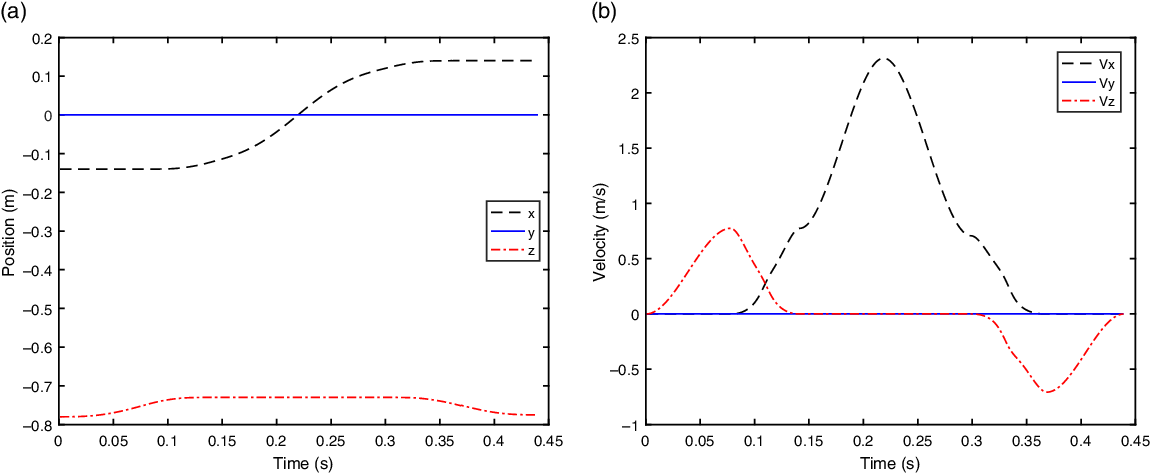
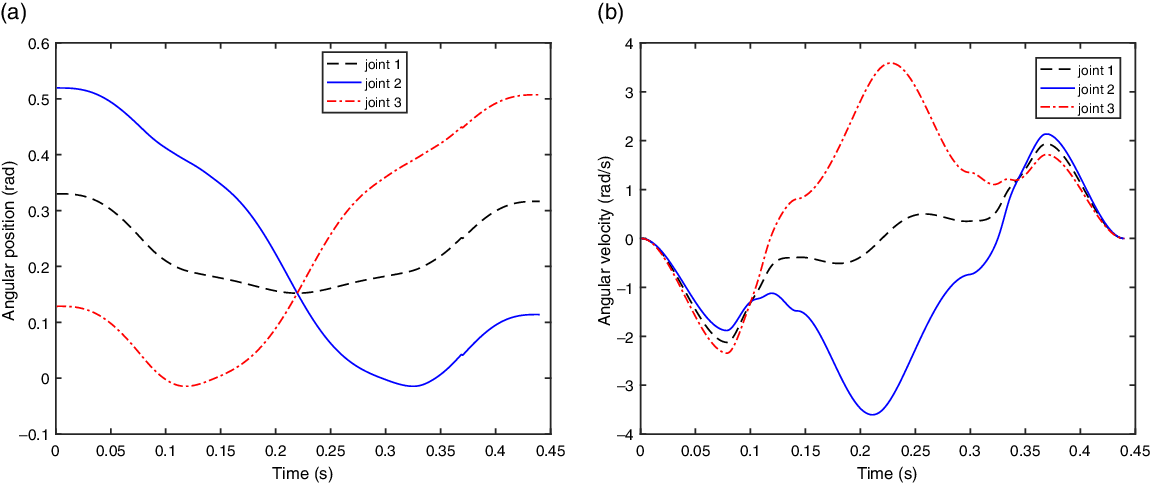
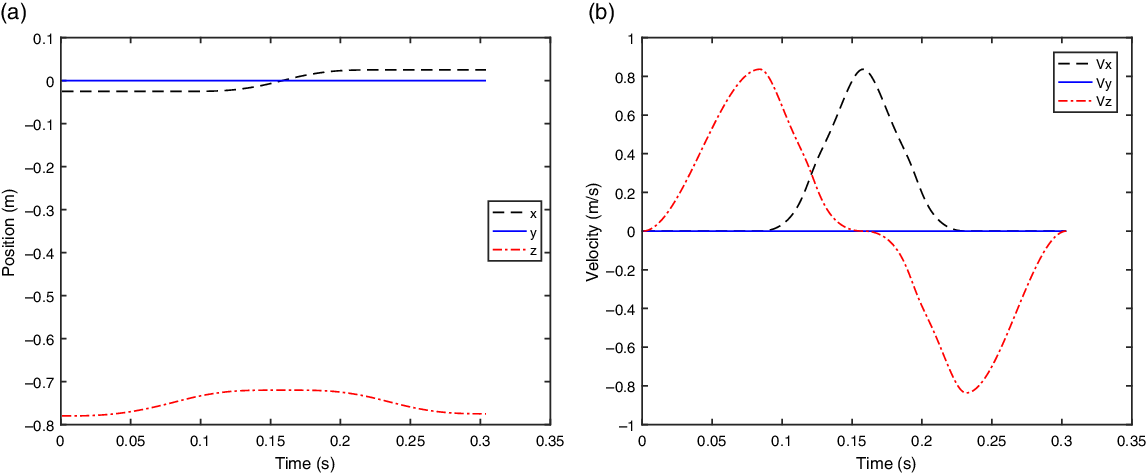
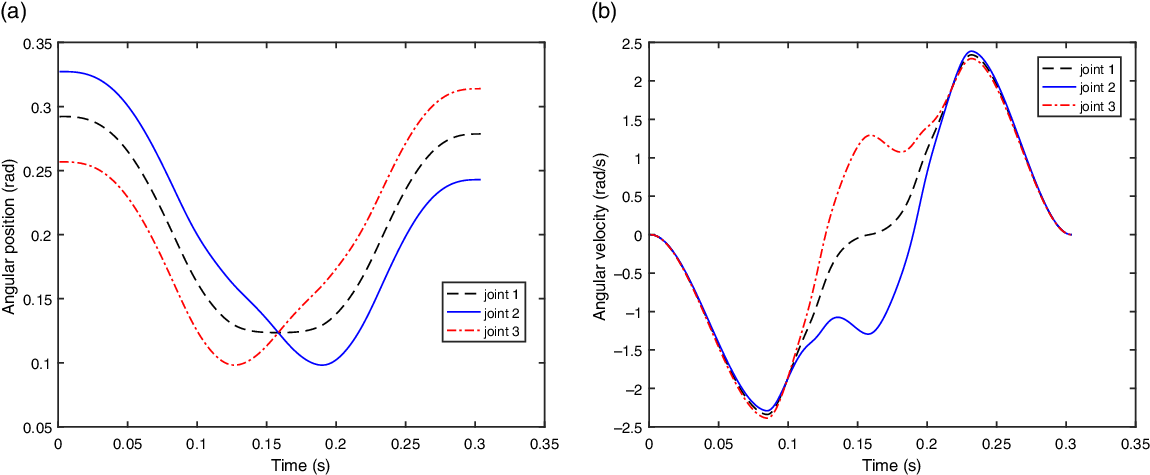
, the position of robot end-effector, the velocity of robot end-effector, the joint space position, and the joint space velocity in Case 1 are shown in Fig. 7 and 8. We also compared the simulation results under different
 $p_1$
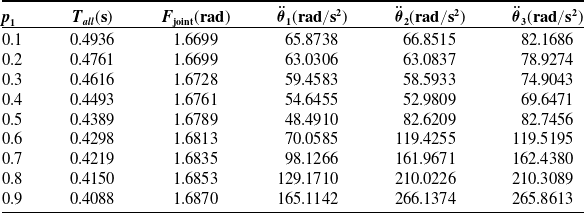
without considering the joint space position, velocity, acceleration and torque constraints, and the simulation results are shown in Table I. Through simulation, we can get that when
 $p_1$
increases,
 $T_{all}$
decreases,
 $F_{{\rm{joint}}}$
increases, and the joint space acceleration decreases first and then increases. For example, when
 $p_1$
is equal to
 $0.5$
,
 $T_{all}$
is
 $0.4389\;\rm{s}$
,
 $F_{{\rm{joint}}}$
is
 $1.6789\;\rm{rad}$
, and the accelerations of the three joints are 48.4910, 82.6209, 82.7456 rad/s2. When
 $p_1$
is equal to
 $0.9$
,
 $T_{all}$
is
 $0.4088\;\rm{s}$
, which is
 $6.9\%$
less than that when
 ${p_1}=0.5$
,
 $F_{{\rm{joint}}}$
is
 $1.6870\;\rm{rad}$
, which is
 $0.48\%$
higher than that when
 ${p_1}=0.5$
, and the accelerations of the three joints are 165.1142, 266.1374, 265.8613 rad/s2, which are
 $240.50\%$
,
 $222.12\%$
, and
 $221.30\%$
higher than that when
 ${p_1}=0.5$
. Therefore, in practical engineering tasks, we can determine
 $p_1$
that meets the joint space position, velocity, acceleration, and torque constraints to obtain a smaller motion cycle and better motion performance by using the interior point method.
Position and velocity of the robot end-effector in Cartesian space in Case 1. a) Position. b) Velocity.

Position and velocity of the robot in joint space in Case 1. a) Joint space position. b) Joint space velocity.

Case 2.
In this case, assume that the pick-up point coordinates are
 $(\!-\!25\;{\rm{mm}}, 0, -780\;{\rm{mm}})$
, the placement point coordinates are
 $(25{\;\rm{mm}}, 0, -775{\;\rm{mm}})$
,
 $w = 50{\;\rm{mm}}$
, the horizontal line
 $HL$
is
 $z = -750{\;\rm{mm}}$
,
 $j_1 = 30{\;\rm{mm}}$
,
 $j_2 = 25{\;\rm{mm}}$
,
 $m_1 = 30{\;\rm{mm}}$
,
 ${a_{1\max }} = 15{\;\rm{m/}}{{\rm{s}}^2}$
, then by applying the proposed method with
 ${p_1} =0.5$
, the position of robot end-effector, the velocity of robot end-effector, the joint space position, and the joint space velocity in Case 2 are shown in Fig. 9 and 10. In this case, we also compared the simulation results under different
 $p_1$
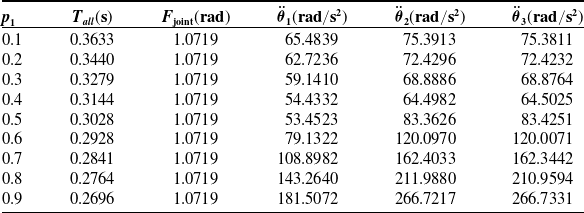
without considering the joint space position, velocity, acceleration, and torque constraints, and the simulation results are shown in Table II. From these simulation results, we can get that when
 $p_1$
increases,
 $T_{all}$
decreases,
 $F_{{\rm{joint}}}$
does not change much, and the joint space acceleration decreases first and then increases.
 $F_{{\rm{joint}}}$
does not change much because the motion range of robot in this case is not large. However, when
 $p_1$
reaches a certain size, the larger
 $p_1$
is, the larger the joint space acceleration is, which may affect the motion performance of robot. Therefore, in practical engineering tasks, the method proposed in this paper can select appropriate
 $p_1$
within the constraints so that the robot maintains a smaller motion cycle and better motion performance by using the interior point method.
Simulation results under different
 $p_1$
in Case 1.

Position and velocity of the robot end-effector in Cartesian space in Case 2. a) Position. b) Velocity.

Position and velocity of the robot in joint space in Case 2. a) Joint space position. b) Joint space velocity.

4.2. Experiment
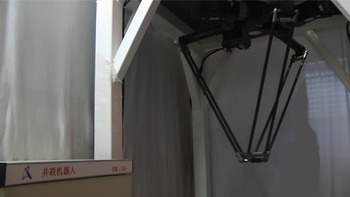
The effectiveness of the proposed method is verified by experiments. The Delta robot used in the experiments is shown in the Fig. 11.
 $R$
in Fig. 2 of the Delta robot used in the experiments is 150 mm,
 $r$
in Fig. 2 of the Delta robot used in the experiments is 51 mm,
 $r_f$
in Fig. 2 of the Delta robot used in the experiments is 325 mm, and
 $r_e$
in Fig. 2 of the Delta robot used in the experiments is 800 mm.
Simulation results under different
 $p_1$
in Case 2.

Delta robot for the experiments.

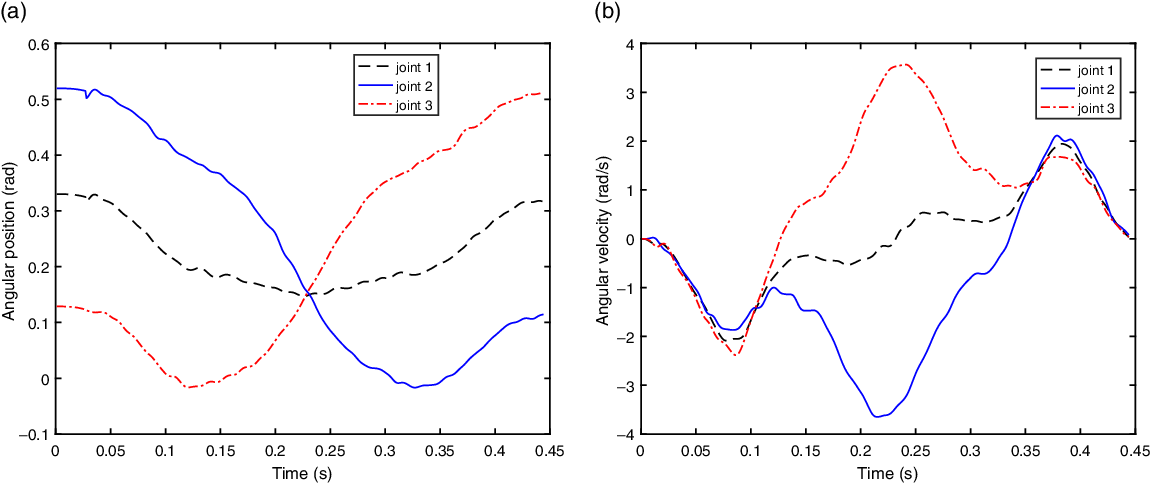
Case 1. The pick-up point and the placement point coordinates in the experiment are the same as the pick-up point and the placement point coordinates of Case 1 in the simulation. Assuming that the constraint condition is
 \begin{equation} \left \{ \begin{aligned} &{w_{k1}} +{w_{k2}} = w - 2{m_1} \ge 0\\[5pt] &{V_B} \le{V_{\max }}\\[5pt] &{V_F} \le{V_{\max }}\\[5pt] & -\!0.6({\rm{rad}}) \le{\theta _i} \le 0.6({\rm{rad}}),i = 1,2,3\\[5pt] & -\!4({\rm{rad/s}})\le{{\dot \theta }_i} \le 4({\rm{rad/s}}),i = 1,2,3\\[5pt] & -\!70({\rm{rad/}}{{\rm{s}}^2} )\le{{\ddot \theta }_i} \le 70({\rm{rad/}}{{\rm{s}}^2}),i = 1,2,3 \end{aligned} \right. \end{equation}
then the interior point method is used to optimize
 $T_{all}$
, and
 $p_1$
is solved to be 0.46. The joint space position and velocity in this case are shown in Fig. 12. The joint space information can be obtained by collecting motor driver signals. Fig. 12 shows that the Delta robot has good motion performance. The experimental results are consistent with the simulation results, which verifies the effectiveness of the proposed method.
Experimental results of position and velocity in joint space by proposed method in Case 1. a) Joint space position. b) Joint space velocity.

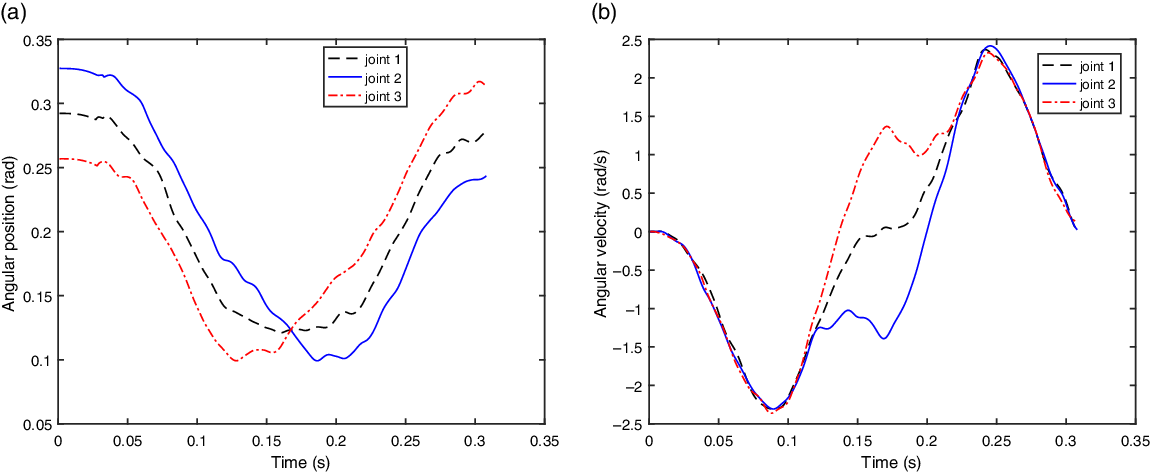
Case 2. The pick-up point and the placement point coordinates in the experiment are the same as the pick-up point and the placement point coordinates of Case 2 in the simulation. Assuming that the constraint condition is
 \begin{equation} \left \{ \begin{aligned} &w \lt 2{m_1}\\[5pt] & -\!0.4({\rm{rad}}) \le{\theta _i} \le 0.4({\rm{rad}}),i = 1,2,3\\[5pt] &-\!3({\rm{rad/s}})\le{{\dot \theta }_i} \le 3({\rm{rad/s}}),i = 1,2,3\\[5pt] &-\!70({\rm{rad/}}{{\rm{s}}^2})\le{{\ddot \theta }_i} \le 70({\rm{rad/}}{{\rm{s}}^2}),i = 1,2,3 \end{aligned} \right. \end{equation}
then the interior point method is used to optimize
 $T_{all}$
, and
 $p_1$
is solved to be 0.458. The joint space position and velocity in this case are shown in Fig. 13, which shows that the Delta robot has good motion performance. The experimental results are consistent with the simulation results, which verifies the effectiveness of the proposed method.
Experimental results of position and velocity in joint space by proposed method in Case 2. a) Joint space position. b) Joint space velocity.

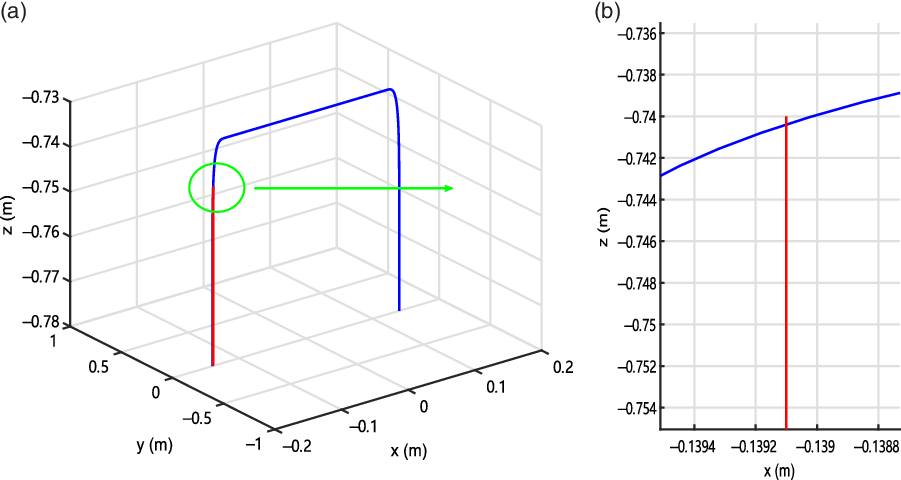
The path by using the trajectory planning method based on PH curves in [Reference Su, Cheng, Wang, Liang, Zheng and Zhang4]. (a) The entire path. (b) The local path.

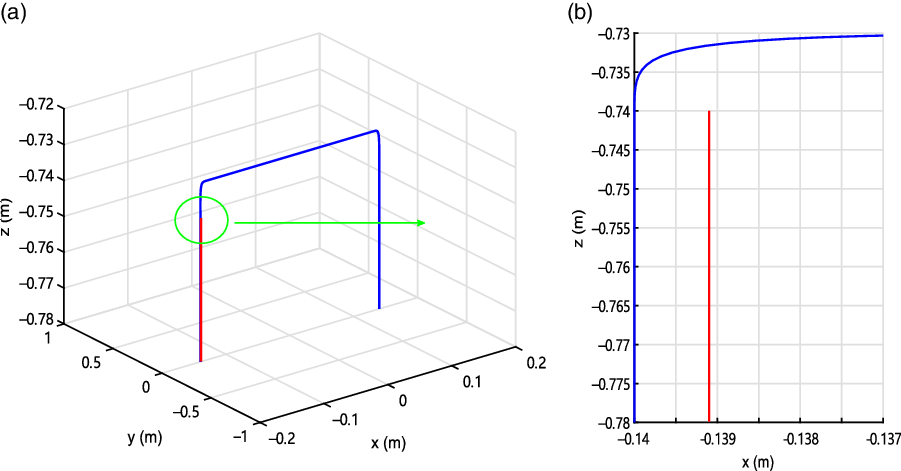
The path by using the trajectory planning method based on vertical and horizontal motion superposition in [Reference Su, Cheng, Wang, Liang, Zheng and Zhang4]. (a) The entire path. (b) The local path.

From the experimental results, we can get the conclusion that the proposed method can achieve the prescribed pick-and-place heights and have good motion characteristics. Experiments also verify that the proposed method is easier to implement and meets the real-time performance. This is due to the following reasons: 1) the kinematic model of the Delta robot is an analytical solution, and the calculation is fast and simple; 2) the polynomial motion law is simple and easy to solve; 3) the arc length of the PH curves can be expressed as a polynomial with parameters, which makes real-time interpolation possible; 4) Since each PH curve in the pick-and-place operation is symmetric, symmetry can be utilized to simplify the calculation to improve the computational efficiency; 5) In some cases, the calculation of the motion phase of the PH curve can be simplified, such as when the horizontal line
 $HL$
, the starting point height and the classification are the same in the two pick-and-place operations. All these techniques help to improve system’s real-time performance.
4.3. Discussion
The trajectory planning method in this article is compared with the trajectory planning methods for Delta robot in [Reference Su, Cheng, Wang, Liang, Zheng and Zhang4] and [Reference Liang and Su23]. The paper [Reference Su, Cheng, Wang, Liang, Zheng and Zhang4] focuses on the time optimization of the pick-and-place operation and does not consider the case that there may exist partitions or obstacles between the picking and placement position. Assume that the pick-up point coordinates are
 $(\!-\!140\;{\rm{mm}}, 0, -780\;{\rm{mm}})$
, the placement point coordinates are
 $(140\;{\rm{mm}}, 0, -780\;{\rm{mm}})$
,
 $w = 280\;{\rm{mm}}$
,
 ${h_1}={h_2} = 50\;{\rm{mm}}$
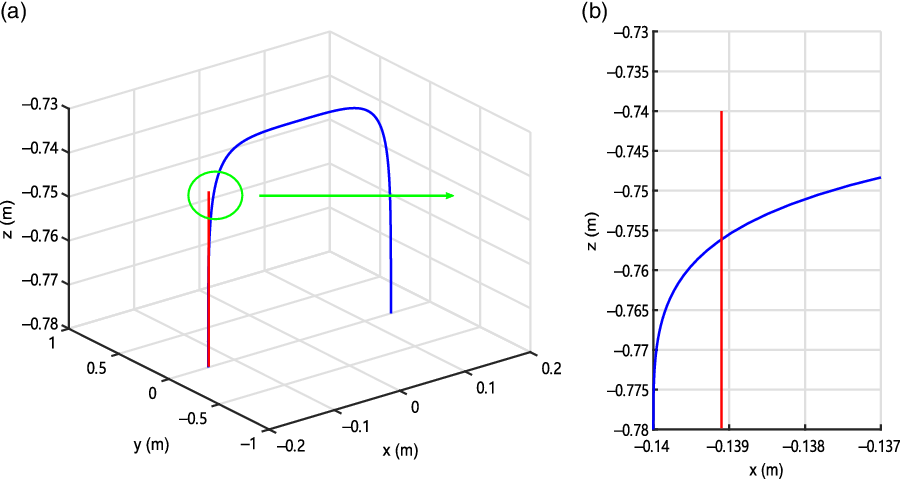
, the path obtained by applying the trajectory planning method in [Reference Su, Cheng, Wang, Liang, Zheng and Zhang4] is shown in Fig. 14, where the blue line represents the path. As can be seen from Fig. 14, if a partition with a height of
 $40\;{\rm{mm}}$
as shown by the red line in Fig. 14 is placed at
 $(\!-\!139.1\;{\rm{mm}}, 0, -780\;{\rm{mm}})$
, the path by using the trajectory planning method in [Reference Su, Cheng, Wang, Liang, Zheng and Zhang4] will collide with the partition. We also simulated the comparison method in [Reference Su, Cheng, Wang, Liang, Zheng and Zhang4] which is based on vertical and horizontal motion superposition, and the path is shown in Fig. 15. The path by using the comparison method in [Reference Su, Cheng, Wang, Liang, Zheng and Zhang4] is also collided with the partition. The path under the proposed method does not collide with the partition as shown in Fig. 16, which verifies the effectiveness of the proposed method for obstacle avoidance. The paper [Reference Liang and Su23] focuses on the trajectory planning of the pick-and-place operation with a prescribed geometrical constraint and does not consider the case that the horizontal distance is relatively short just like Case 2 in Section 3, and the case of pick-and-place operations at different pick-and-place heights, while this paper considers obstacle avoidance and different pick-and-place heights at the same time. All these comparisons verify the effectiveness of the proposed method in flexible control of pick-and-place operations at different pick-and-place heights to avoid collision with partitions or obstacles in any situation of industrial application.
The path by using the trajectory planning method proposed in this paper. (a) The entire path. (b) The local path.

5. Conclusions
Facing the actual requirements of obstacle avoidance and different pick-and-place heights, this paper proposes a PH curve-based pick-and-place operation trajectory planning method for Delta robot in various real scenarios for the flexible control of pick-and-place operations, so as to make the robot meet different requirements. According to the geometric relationship of pick-and-place operation path, trajectory planning for different situations is carried out, respectively, and trajectory optimization is carried out with the motion period as optimization objective. The proposed method is easier to implement, and at the same time satisfies the safety, optimization, mobility, and stability of the robot, that is, the proposed method realizes obstacle avoidance, optimal time, flexible control of the robot trajectory, and stable motion. Simulations and experiments verify the effectiveness of the proposed method. The proposed method can not only be used in intelligent manufacturing fields such as rapid classification, palletizing, grasping, and warehousing, but its research route can also provide a reference for trajectory planning of other robots. Our future work will focus on the PH curve based trajectory planning method in different scenarios to achieve imitation learning of parallel robot movement trajectories.
Author contributions
TS: methodology, software, and writing-original draft preparation. XL: conceptualization, visualization, and supervision. XZ: investigation. SL: validation, and formal analysis. TS and XZ: writing-review and editing. XL and TS: funding acquisition.
Financial support
The authors declare no competing interests. This work was supported in part by the National Key Research and Development Program of China under Grant 2020AAA0105800, in part by the R
 $\&$
D Program of Beijing Municipal Education Commission under Grant KM202110009009 and Grant KM202210009010, in part by the Natural Science Foundation of China under Grant 62003005, Grant 62103007, and Grant 62203442, in part by Natural Science Foundation of Beijing under Grant L202020, Grant L222058 and Grant 4204097, in part by China Postdoctoral Science Foundation under Grant 2021M693404, in part by the Yuyou Talent Support Project of North China University of Technology, in part by the open research fund of the State Key Laboratory for Management and Control of Complex Systems under Grant 20210103, in part by the Fundamental Research Funds for Beijing Municipal Universities.
Conflicts of interest
The authors declare no conflicts of interest exist.