INTRODUCTION
The incidence of many pathogens varies conspicuously from season to season (e.g. Altizer et al. Reference Altizer, Dobson, Hosseini, Hudson, Pascual and Rohani2006). In particular, for marine fish parasites, seasonality patterns were recorded in many species, although they seem to be absent in some others (Rohde, Reference Rohde1982). Seasonal occurrence may suggest periods during which epizootic outbreaks are likely to be favoured, guiding the identification of optimal moments for prophylactic measures in fish-culturing systems. So, this knowledge is extremely important in preventing economic losses for the fishermen and fish farm owners.
The European flounder, Platichthys flesus (Linnaeus, 1758) (Teleostei: Pleuronectidae), is a flatfish species of high commercial value in several European countries, where it represents a considerable portion of the total flatfish catches. Furthermore, it constitutes an important source of income for the emerging aquaculture industry of many such countries.
The infection of the European flounder by different metazoan ectoparasitic taxa has been characterized through several studies devoted to different geographical locations. These extend from the Norwegian Sea, in the north, to the far south as the Mediterranean Sea. In a recent study, the authors provided a review of the pertinent literature on the subject (Cavaleiro and Santos, Reference Cavaleiro and Santos2007). Some of the identified parasites may inflict severe pathological lesions to the host fish, which justifies a detailed study of their dynamics. Moreover, Lepeophtheirus pectoralis (Müller, 1777) (Copepoda: Caligidae), one of the most reported parasites of marine origin, has been associated with the occurrence of skin laceration, erosion and haemorrhaging, and fin erosion and destruction (Scott, Reference Scott1901; Mann, Reference Mann1970; Boxshall, Reference Boxshall1977). In intensive culturing systems, some of these lesions may become fairly extensive, since the fish are kept close together, a situation that favours opportunistic behaviour of parasites. Therefore, investing in prophylactic measures is mandatory for minimizing economic losses.
Although previous studies have already reported seasonal occurrences of European flounder's endoparasites, e.g., Cucullanellus minutus (Rudolphi, 1802) and Cucullanus heterochrous (Rudolphi, 1802) (Nematoda: Cucullanidae) (Sulgostowska et al. Reference Sulgostowska, Banaczyk and Grabda-Kazubska1987), as far as we are aware, no information is available on the seasonal occurrence of marine European flounder's ectoparasite infections. Indeed, all reported studies on flounder's ectoparasites either concern estuarine environments (van den Broek, Reference van den Broek1979; Schmidt et al. Reference Schmidt, Zander, Körting and Steinhagen2003) or the Baltic Sea (Chibani and Rokicki, Reference Chibani and Rokicki2004), which is known as the world's largest brackish water sea area (Leppäkoski et al. Reference Leppäkoski, Gollasch, Gruszka, Ojaveer, Olenin and Panov2002).
In this study, the seasonal occurrence of metazoan ectoparasites in marine European flounder is investigated for the first time. This provides a more complete knowledge of the flounder's metazoan ectoparasite richness and dynamics in the studied geographical area, i.e., the northern Portuguese coast.
MATERIALS AND METHODS
Fish sampling and parasitological examination
The present study was intended to investigate the seasonal occurrence of metazoan ectoparasites in marine European flounder.
During 1 year, i.e., from Summer 2005 to Spring 2006, fish caught via demersal bottom trawling in marine coastal waters off the northern Portuguese town of Matosinhos (41°10′N, 8°42′W) were collected seasonally at the city harbour. The sampling times could not be uniformly distributed along the year, as they depended on the availability of flounder at the harbour. Actually, they were set as follows: Summer 2005 – 2 September; Autumn 2005 – 17 November; Winter 2006 – 2 March; Spring 2006 – 23 May. The specimens (N=30 per season) were randomly collected, and then placed, individually, in plastic bags. They were brought to the laboratory, located in Porto's University campus, and kept frozen at −20°C until being examined for parasites.
During the survey, they were first measured for total body length, sexed and the weight of their gonads recorded. Following the Hutchinson's definition of ecological niche (Hutchinson, Reference Hutchinson1957), several locations on the flounder's body surface i.e. skin, fins, eyes and branchial, nasal and buccal cavities, were examined for metazoan ectoparasites under a stereoscopic microscope. The isolated parasite specimens were cleaned in 35% saline solution and fixed in 70% ethanol. Later, copepods were cleared for about 1 h in 90% lactic acid (Humes and Gooding, Reference Humes and Gooding1964).
Identification of parasites to the species level followed the identification keys in Kabata (Reference Kabata1979, Reference Kabata1992) for Copepoda, and Naylor (Reference Naylor1972) and Bruce (Reference Bruce1987) for Isopoda. Species identification of female gnathiid praniza was not possible because the keys found in the technical literature are exclusively based on the male's morphology. The stage of development was identified in accordance with Boxshall (Reference Boxshall1974a) and Heegaard (Reference Heegaard1947) for specimens of L. pectoralis and Acanthochondria cornuta, respectively. Sea water temperature values were obtained from the Physical Oceanography Distributed Active Archive Center (PO.DAAC) at the NASA Jet Propulsion Laboratory (NASA Jet Propulsion Laboratory, 2009), while the light intensity figures were acquired via the Portuguese Meteorology Institute website (Instituto de Metereologia – IP Portugal, 2009). According to the data presented in an European Environmental Agency's report (European Environmental Agency, 2008), salinity levels were assumed constant along the year, with values close to 35%.
Data analysis
As far as the fish characteristics are concerned, we started to compare fish lengths among sampling seasons. For that, the Kruskal-Wallis test was used, since the data did not follow a normal distribution, as proved by the Kolmogorov-Smirnov test (0·419⩽Z⩽1·266; P⩾0·081). The seasonal variations of females and males gonads weights were used to determine the flounder's spawning period and, thus, the migration timings between estuarine environments and the open sea, since no such information was available in the literature for fish of the Portuguese coast. Box-plots were used to depict the distribution of body length and gonads weight in the samples.
With respect to infection parameters, prevalence (%) and abundance were assessed in accordance to Bush et al. (Reference Bush, Lafferty, Lotz and Shostak1997) and used to express occurrence of parasites in the samples. Total abundance is the sum of all abundance values recorded for the 30 fish in each sampling season. Values corresponding to the total abundance of identified stages of development were also determined. Dependence of parasite abundance on fish body size i.e. total body length, and sex was evaluated using the Spearman's correlation test and the Mann-Whitney's U test, respectively. Besides this, the infection levels were analysed with respect to their seasonal variation during the sampled period. Tests of statistical difference were only performed for component parasitic species (Prevalence >10%) (Bush et al. Reference Bush, Aho and Kennedy1990), in all samples using the χ2-test (comparison between all samples) and the Fisher's exact test (pairwise sample comparisons) for prevalence, and the Kruskal-Wallis test (comparison between all samples) and the Mann-Whitney's U test (pairwise sample comparisons) for abundance. Evaluation of seasonal trends in parasite abundance was also conducted exclusively for the component species. It followed an r-squared for cubic fit regression analysis, the results of which served also to reveal the occurrence of infections at the infrapopulation level. Aggregation of component species among flounders was evaluated using the variance to mean abundance ratio (Poulin, Reference Poulin2007). All analyses, as well as the box-plots and the regression plots, were performed using version 16.0 of SPSS for Windows (SPSS Inc., Chicago, IL, USA). The results for the statistical tests were considered significant for P⩽0·05.
RESULTS
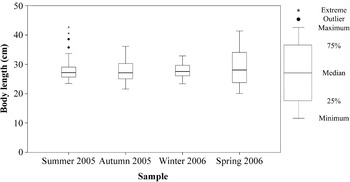
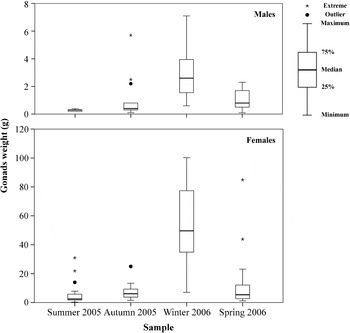
Fish body length varied between 20·1 and 42·7 cm (mean±s.d.=28·22±4·42 cm) and is depicted in the box-plot chart of Fig. 1. In each box-plot, the range identifies the values encompassing 95% of the recorded data, while the outliers and the extremes are located outside that range. No significant differences were found among sampling seasons when the analysis was made with respect to that fish characteristic (Kruskal-Wallis test: χ2=0·269; d.f.=3; P=0·966). The sex distribution in the 4 samples of flounder was as follows: 20 ♀♀, 10 ♂♂ (Summer 2005); 17 ♀♀, 13 ♂♂ (Autumn 2005); 11 ♀♀, 19 ♂♂ (Winter 2006); and 21 ♀♀, 9 ♂♂ (Spring 2006). Seasonal variations on gonads weight were found similar for females and males, although they were more pronounced in the case of females (Fig. 2). Moreover, weight values remained fairly constant throughout the year, except in Winter 2006, the season when considerably higher values were recorded.
Distributions of fish body size data (total length) concerning the 4 samples (Summer 2005, Autumn 2005, Winter 2006 and Spring 2006) of European flounder Platichthys flesus (Linnaeus, 1758) caught off Matosinhos, northern Portuguese coast.

Seasonal variations on females and males gonads weight concerning the 4 samples (Summer 2005, Autumn 2005, Winter 2006 and Spring 2006) of European flounder Platichthys flesus (Linnaeus, 1758) caught off Matosinhos, northern Portuguese coast.

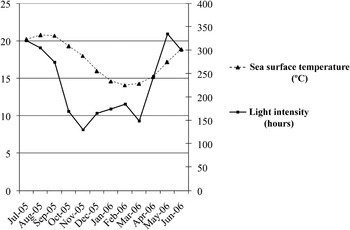
The recorded environmental data, i.e. sea surface temperature and light intensity, are presented in Fig. 3. This shows that both of these parameters varied along the sampled period, being considerably more expressive in late Summer 2005 and Spring 2006.
Monthly variations (from July 2005 till June 2006) in sea surface temperature and in light intensity levels off Matosinhos, northern Portuguese coast.

Parasites from 6 metazoan ectoparasitic taxa were identified. They included exclusively the following crustaceans: Caligus sp. Müller, Reference Möller1785 and Lepeophtheirus pectoralis (Müller, 1777) (Copepoda: Caligidae); Acanthochondria cornuta (Müller, 1776) (Copepoda: Chondracanthidae); Holobomolochus confusus (Stock, 1959) (Copepoda: Bomolochidae); Nerocila orbignyi (Guérin-Méneville, 1832) (Isopoda: Cymothoidae); and praniza larva (Isopoda: Gnathiidae).
L. pectoralis and A. cornuta were component parasitic species in all seasonal samples of flounder. The former occurred mainly on the fish's body skin and beneath the pectoral and pelvic fins, while the latter was mostly observed inside the gill cavities. Overall prevalence and abundance (mean±s.d.) levels were as follows: 80% and 8·8±10·1 parasites per host for L. pectoralis; and 86·7% and 21·6±23·0 parasites per host for A. cornuta. Association between abundance of component species and fish body size/sex was never found, either when samples were considered separately, or when all fish were pooled together in the same analysis (Spearman's correlation test for L. pectoralis: −0·180⩽r s⩽0·186, P⩾0·326 and for A. cornuta: 0·000⩽r s⩽0·306, P⩾0·100; Mann-Whitney's U test for L. pectoralis: 66·0⩽U⩽1 728, P⩾0·071 and for A. cornuta: 77·0⩽U⩽1 618, P⩾0·428).
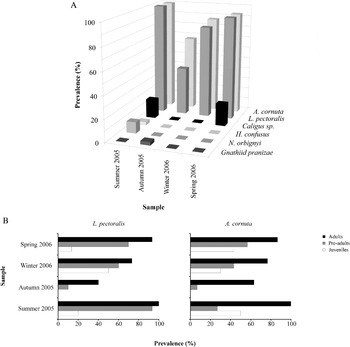
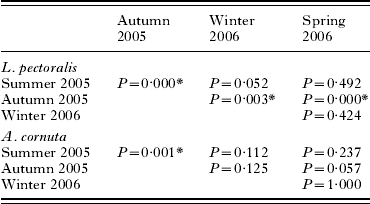
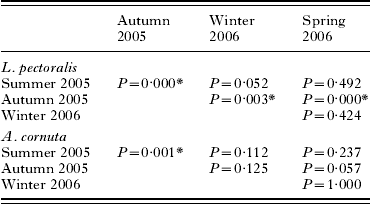
Concerning prevalence, the sample of Summer 2005 recorded the maximum possible level i.e. 100%, for both L. pectoralis and A. cornuta (Fig. 4A). The lowest levels were recorded for Autumn 2005: L. pectoralis: 43% and A. cornuta: 67%. Levels regarding the 4 seasons of sampling were found to present significant differences (χ2-test for L. pectoralis: χ2=36·250, d.f.=3, P=0·000 and for A. cornuta: χ2=14·460, d.f.=3, P=0·002). Consequently, pairwise comparisons were performed using the Fisher's exact test (Table 1). Such analyses revealed that the pair (Summer 2005 – Autumn 2005) was unique, as it presented significant differences in prevalence for both L. pectoralis and A. cornuta. Prevalence of Caligus sp. was more expressive in Summer 2005 (17%) and Spring 2006 (20%), while that of N. orbignyi showed a single peak in Summer 2005 (10%). Depending on the sampling season, prevalence values for all other identified taxa i.e. H. confusus and gnathiid pranizae were of 3% or 0%. For both L. pectoralis and A. cornuta, prevalence values recorded for adults were always more expressive than those regarding the other stages of development, i.e. pre-adults and juveniles, reaching their maximum values in Summer 2005 (Fig. 4B). Furthermore, as far as the adult life-cycle stage is concerned, seasonal variations in prevalence were found to be more noticeable for L. pectoralis. This was also verified for pre-adults and juveniles.
Seasonal prevalence levels (Summer 2005, Autumn 2005, Winter 2006 and Spring 2006) concerning: (A) the metazoan ectoparasitic taxa found infecting the European flounder Platichthys flesus (Linnaeus, 1758) off Matosinhos, northern Portuguese coast; (B) the life-cycle stages of the identified component parasitic species, i.e., L. pectoralis and A. cornuta.

Pairwise comparisons of prevalences (results of the Fisher's exact test) concerning the 4 seasonal samples (Summer 2005, Autumn 2005, Winter 2006 and Spring 2006) of European flounder Platichthys flesus (Linnaeus, 1758) caught off Matosinhos, northern Portuguese coast (* indicates significant results)
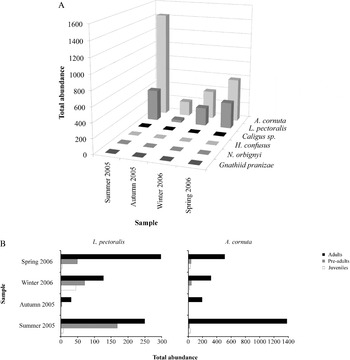
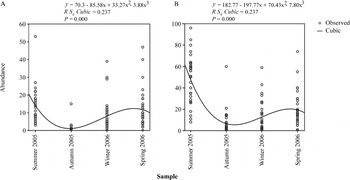
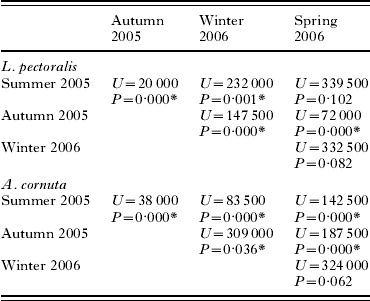
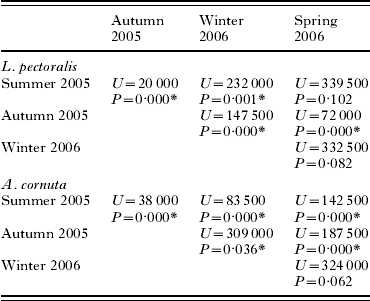
As shown in Fig. 5A, the seasonal variations of total abundance were found to be similar to those recorded for prevalence. The highest values were recorded in Summer 2005 for both L. pectoralis – 423 parasites – and A. cornuta – 1 429 parasites, while the lowest were found in Autumn 2005 – L. pectoralis – 34 parasites – and A. cornuta – 197 parasites. Because of the non-normality of abundance data in some of the samples, as revealed by the Kolmogorov-Smirnov test (L. pectoralis: 0·897⩽Z⩽1·930, 0·001⩽P⩽0·398; A. cornuta: 0·611⩽Z⩽1·572, 0·014⩽P⩽0·849), the Kruskal-Wallis test was used to compare abundance of component parasitic species among sampling seasons. Furthermore, similar to what was described for prevalence, it was found that the recorded abundance levels presented significant differences among the 4 sampling seasons (Kruskal-Wallis test for L. pectoralis: χ2=54·473, d.f.=3, P=0·000 and for A. cornuta: χ2=54·586, d.f.=3, P=0·000). The results for the pairwise comparisons (using a Mann-Whitney's U test) are presented in Table 2. In this case, only the pair (Winter 2006 – Spring 2006) did not present any significant difference in abundance levels. Adults of L. pectoralis and A. cornuta were always found to be dominant over the other life-cycle stages i.e. pre-adults and juveniles, reaching maximum levels in Spring 2006 for L. pectoralis and Summer 2005 for A. cornuta (Fig. 5B). In addition, in both cases, the total abundance was found to vary notoriously throughout the year. Occurrence of pre-adults and juveniles was more expressive and variable in the case of L. pectoralis. Seasonal trends of variation in abundance levels (component species only) are presented in the regression plots of Fig. 6A and B. Such plots show evident and synchronized trends for L. pectoralis and A. cornuta, with pronounced occurrences in Summer 2005. Moreover, they show clear evidence that, in most cases, the occurrence of both of these species was fairly expressive at the infrapopulation level. When present, parasitic taxa other than L. pectoralis and A. cornuta were always found to record rather low total abundance values (Caligus sp. – 5 specimens in Summer 2005 and 6 specimens in Spring 2006; N. orbignyi – 3 specimens in Summer 2005; H. confusus – 1 specimen in Summer 2005; gnathiid praniza – 1 specimen in Autumn 2005).
Seasonal total abundance levels (Summer 2005, Autumn 2005, Winter 2006 and Spring 2006) concerning: (A) the metazoan ectoparasitic taxa found infecting the European flounder Platichthys flesus (Linnaeus, 1758) off Matosinhos, northern Portuguese coast; (B) the life-cycle stages of the identified component parasitic species, i.e., L. pectoralis and A. cornuta.

Seasonal abundance trends of L. pectoralis (A) and A. cornuta (B) concerning the 4 samples (Summer 2005, Autumn 2005, Winter 2006 and Spring 2006) of European flounder Platichthys flesus (Linnaeus, 1758) caught off Matosinhos, northern Portuguese coast.

Pairwise comparisons of abundances (results of the Mann-Whitney's U test) concerning the 4 seasonal samples (Summer 2005, Autumn 2005, Winter 2006 and Spring 2006) of European flounder Platichthys flesus (Linnaeus, 1758) caught off Matosinhos, northern Portuguese coast (* indicates significant results)
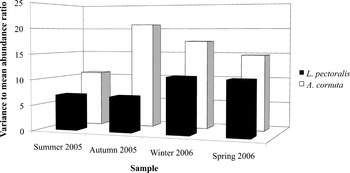
Although the mean abundance varied between sampling seasons, the variance was always greater than the mean. In fact, the variance to mean abundance ratio ranged from 6·9 to 10·9 for L. pectoralis and from 10·8 to 20·8 for A. cornuta (Fig. 7). This suggests that the populations of those 2 species were aggregated among flounders. The smallest aggregation levels were recorded in Summer 2005 and Autumn 2005 for L. pectoralis and in Summer 2005 for A. cornuta.
Seasonal variations on the variance to mean abundance ratio of L. pectoralis and A. cornuta concerning the 4 samples (Summer 2005, Autumn 2005, Winter 2006, Spring 2006) of European flounder Platichthys flesus (Linnaeus, 1758) caught off Matosinhos, northern Portuguese coast.

DISCUSSION
As far as richness is concerned, all 6 identified taxa of metazoan ectoparasites had already been recorded in previous surveys (see Cavaleiro and Santos, Reference Cavaleiro and Santos2007). However, Chibani and Rokicki (Reference Chibani and Rokicki2004) found a very distinct parasitofauna infecting the European flounder of the Gulf of Gdańsk, Baltic Sea. In that study, monogeneans i.e., Gyrodactylus unicopula (Glukhova, 1955) and G. flesi (Malmberg, 1957) (Monogenea: Gyrodactylidae), were recorded, contrary to parasitic crustaceans. Such a situation might reflect the different salinity conditions in the 2 environments. In fact, the Baltic Sea constitutes a very unique aquatic environment, as it is a semi-enclosed basin of about 415 000 km2 (European Science Foundation, 2007) separated from the North Sea and the north-eastern Atlantic Ocean by both geographical and ecological (e.g. coldness and low salinity) barriers (Leppäkoski et al. Reference Leppäkoski, Gollasch, Gruszka, Ojaveer, Olenin and Panov2002). Its area-averaged sea-surface temperature may vary from 5 to 10°C (European Science Foundation, 2007). In this study, the temperature values of the Atlantic were always higher than these. Thus, since temperature is generally accepted as the most important abiotic factor influencing the occurrence of parasites, including Copepoda (Kabata, Reference Kabata1981), the differences found for this environmental parameter may help to justify the variations recorded for parasitofauna. Additionally, salinity is also recognized as an important environmental factor limiting the distribution of many marine organisms in coastal waters (Gunter, Reference Gunter1961; Schmidt et al. Reference Schmidt, Zander, Körting and Steinhagen2003). Thus, since many ectoparasites (e.g. copepods) are known as stenohaline (e.g. Kabata, Reference Kabata1979; Knudsen and Sundnes, Reference Knudsen and Sundnes1998), being only capable of surviving in rather narrow ranges of high salt concentrations, it is probable that salinity also influenced the differences recorded in the parasitofauna. To support this hypothesis, it should be mentioned that, while studying stenohalinity of L. pectoralis and A. cornuta, Möller (Reference Möller1978) reported a lower capacity of survival in reduced salinity levels for both species.
According to the infection levels herein reported, we may conclude that the infection of the European flounder by L. pectoralis and A. cornuta is probably quite frequent in the northern Portuguese coast. Conversely, the low infection levels of Caligus sp., H. confusus, N. orbignyi and gnathiid praniza indicate that these species are probably rare in European flounder. Nevertheless, it is noteworthy that the infection by gnathiid praniza may be underestimated. In fact, when praniza larva infects teleost fishes, it remains attached just for a few hours, a period of time in which it feeds on the host's blood. Besides this, many species were found to leave their hosts just after their capture, while others only feed at night (Lester, Reference Lester and Rohde2005). Concerning N. orbignyi, the species has been frequently reported in fish of the northwest African shelf (Rokicki, Reference Rokicki1997). Still regarding the Portuguese coast, reports on infection of fish other than European flounder (Cavaleiro and Santos, Reference Cavaleiro and Santos2007) and Lusitanian toadfish Halobatrachus didactylus (Bloch and Schneider, 1801) (Marques et al. Reference Marques, Santos, Costa, Costa and Cabral2005) were not found in the literature. This may suggest that the parasite might not be so common in this geographical area, preferring warmer waters.
As far as the seasonality is concerned, we should first analyse the results of the statistical tests performed on fish sex and body size data, as these variables are sometimes concurrent inducers of prevalence and abundance variations beyond the seasonality itself. Indeed, one of the reasons generally accepted for explaining the increase in infection levels is that larger fish come into contact with bigger volumes of water, having larger binding surfaces, and more nutrients available. Besides this, it is sometimes observed that one of the sexes is more prone to infection than the other (Rohde, Reference Rohde1984). In this study, not only the fish presented no significant differences in body size among samples, as no relation was found between the recorded abundance levels and the fish body size or sex. Therefore, the differences found between the infection levels recorded along the sampling period should be attributed to seasonality. Indeed, both L. pectoralis and A. cornnta were previously suggested to have annual occurences in European flounder (van den Broek, Reference van den Broek1979) and in closely-related flatfish species i.e. the plaice Pleuronectes platessa (Linneaus, 1758) (Boxshall, Reference Boxshall1974b).
In this research, all the 6 identified parasitic taxa have been investigated for seasonal occurrence in marine European flounder. Nevertheless, only L. pectoralis and A. cornuta presented seasonality, as these were the only ones to show expressive occurrences in flounder along the sampled period. Moreover, in both of these species, infections reached significant maxima in prevalence and abundance in the summer season, showing concurrent behaviour throughout the sampled period. Such a situation might have been influenced by their monoxenous life cycles and direct modes of transmission. Besides this, the temperature and the light intensity levels may also have influenced the recorded trend, since they showed a similar evolution during the sampling period, with highest levels being recorded in late spring and summer. Moreover, as far as the light intensity is concerned, at least the copepodids of L. pectoralis seem to be positively phototactic (Boxshall, Reference Boxshall1976). Furthermore, durable changes in light intensity levels might be expected to directly impact the parasite's host-finding success, as they might influence its swimming performance. Thus, this may help to justify the increase of infection levels verified in the summer season.
It should be noted that previous studies in the literature already reported increases in infection levels of ectoparasitic crustaceans, copepods included, in the summer (Boxshall, Reference Boxshall1974b; Hogans and Trudeau, Reference Hogans and Trudeau1989; Rokicki and Strömberg, Reference Rokicki and Strömberg1991; Schram et al. Reference Schram, Knutsen, Heuch and Mo1998; Hakalahti and Valtonen, Reference Hakalahti and Valtonen2003; Costello, Reference Costello2006). Indeed, such increases were also noticed for some other ectoparasites and hosts, like Trichodina sp. (Oligohymenophorea: Trichodinidae), Diplectanum sp. (Monogenea: Diplectanidae) and Caligus spp. (Copepoda: Caligidae), found infecting the sea bass, Dicentrarchus labrax (Linnaeus, 1758), off the northern Portugal (Santos, Reference Santos1998).
The notorious decrease of infection levels recorded for autumn may also be considered as an indication that flounder may have recently migrated from lower salinity areas. Further, in the winter season, flounders probably entered the spawning period, as suggested by the notorious increase verified in both females and males gonads weight. So, the gradual increase of infection levels, recorded for winter and following seasons, may also indicate that the fish are now in a higher salinity environment, favourable for the life-cycle and survival of many parasitic copepods.
In estuarine environments, both L. pectoralis and A. cornuta were shown to exhibit a clear seasonal pattern. Indeed, in the course of a study on the parasites infecting the European flounder at 5 different locations in the German Bight, North Sea, with sampling campaigns performed only in the spring and autumn, Schmidt et al. (Reference Schmidt, Zander, Körting and Steinhagen2003) reported a marked seasonality for L. pectoralis. Moreover, the latter species was found to present significantly higher infection levels i.e. prevalence and intensity, in the autumn. This seasonal trend was comparatively less clear for A. cornuta, as it was only recorded in one of the sampling localities. In another study devoted to the temporal dynamics of the copepod infections in the European flounder of the Medway Estuary, North Sea, the trends of variation recorded for L. pectoralis and A. cornuta also differed markedly from the ones now reported (van den Broek, Reference van den Broek1979). In that study, the prevalence of both parasite species reached 100% between October and December (i.e. in autumn), while the minimum was recorded on April (i.e. in spring) for L. pectoralis (4·2%), and between February and June (i.e. in winter and spring) for A. cornuta (21·4%). Mean intensity was also found to exhibit seasonal variation, with maximum levels occurring in December (i.e. in autumn) for both L. pectoralis (≈9 parasites/fish) and A. cornuta (21 parasites/fish), and minimums occurring on April (i.e. in spring) for L. pectoralis (≈1 parasite/fish) and throughout the whole year for A. cornuta.
In summary, the ectoparasitofauna of European flounder in estuarine and marine environments is similar, the component species exhibiting seasonal variations in both environments. However, there is a clear difference in the seasonal pattern identified in the literature for estuarine flounder and the one now reported for the examined marine specimens.
One factor that may help to justify this difference is the disparate values of solar influx typical of the North Sea and the northern Portuguese coast. Indeed, such environmental parameter has been recognized as an important factor influencing the strong seasonality observed for parasites in northernmost regions of the Earth (Hemmingsen et al. Reference Hemmingsen, Lile and Halvorsen1995). In addition, the daily variations in salinity levels that are more pronounced in winter than in summer, and which are typically found in estuarine environments, may have also contributed to some extent, to the differences herein reported.
Besides the identification of ectoparasite species and the seasonality of their occurrence, this work further contributes to the characterization of the parasitofauna of marine European flounders by reporting the evolution of life-cycle stages and aggregation levels during the year.
Starting with the infection levels due to the various life-cycle stages, the recorded data indicate that the reproduction cycle of L. pectoralis and A. cornuta runs throughout the year. However, the infection levels due to pre-adults and adults, in summer, suggest that this season is more favourable for the occurrence of epizootic outbreaks of these 2 parasite species.
It was also in the summer that these component parasitic species presented a lower aggregation level. This situation might be explained by different factors acting together, including the host's higher susceptibility to infection, the greater exposure times to parasites or even the host's greater aggregation (Bandilla et al. Reference Bandilla, Hakalahti, Hudson and Valtonen2005; Poulin, Reference Poulin2007). The latter is particularly relevant in culturing systems, where fish are usually kept at high density.
In conclusion, the results reported in this work, and the correspondent discussion, provide clear evidence that summer is the period when epizooties of L. pectoralis and A. cornuta will be likely to be favoured in marine flounder. Therefore, it seems that, if prophylactic measures are considered as a possible means to avoid epizootic outbreaks caused by ectoparasites, these should preferably take place during the spring and summer if applied to flounder raised in marine water farms.
The authors would like to thank the Portuguese Science and Technology Foundation for F. Cavaleiro's grant, no. SFRH/BM/23063/2005, the 2 anonymous referees for their valuable suggestions and Professor J. Rokicki from Gdańsk's University for his help with the bibliography.