Goat research needs to progress rapidly to reach the level of knowledge of other species such as cattle or sheep, especially in milk production (Argüello, Reference Argüello2011). Many studies seek to implement management systems in dairy farms with extended milking intervals, or to minimise additional costs associated with extra milking if it is outweighed by the value of additional milk obtained as observed in dairy cows (Wall & McFadden, Reference Wall and McFadden2008). Milking is done twice daily (X2) in countries with high-yielding dairy goats (Capote et al. Reference Capote, Castro, Caja, Fernández, Morales-delaNuez and Argüello2009). However, dairy farmers want to reduce their labour requirements associated with milking, in order to devote time to other farm practices or to social activities (Komara et al. Reference Komara, Boutinaud, Ben Chedly, Guinard-Flament and Marnet2009). In this way, the practice of once daily milking (X1) is viewed with interest by dairy farmers. In contrast, thrice daily milking (X3) is a relatively novel management practice and it is not generally used in small ruminants, but in dairy cows it has emerged as an effective management tool for dairy farmers to increase milk production (Wall & McFadden, Reference Wall and McFadden2008).
Differences reported in previous studies in milk yield between X2 and X1 are 8–45% (Mocquot & Auran, Reference Mocquot and Auran1974; Capote et al. Reference Capote, Castro, Caja, Fernández, Morales-delaNuez and Argüello2009) and increases of 8–28% occurred when the goats were milked X3 instead of X2 (Henderson et al. Reference Henderson, Blatchford and Peaker1985; Boutinaud et al. Reference Boutinaud, Rousseau, Keisler and Jammes2003). The reported wide variation in milk yield due to milking frequency is a consequence of differences in breed, lactation stage, level of production, duration of X1, X2 or X3, and individual characteristics (Marnet & Komara, Reference Marnet and Komara2008). In addition, Silanikove et al. (Reference Silanikove, Leitner, Merin and Prosser2010) explained that high-yielding goats, such as Saanen, selected for high alveolar to cistern compartment ratio, are the most sensitive to changes in milking frequency. In contrast, moderate-yielding producing goats, as Majorera, may attain their genetic potential for milk yield in an X1 regimen owing to selection for high cistern capacity (Torres et al. Reference Torres, Castro, Hernández-Castellano, Argüello and Capote2013a).
The hypothesis of this research paper is that three milking frequencies might have minor effects on milk yield and chemical composition in dairy goats traditionally milked X1. In addition, no information regarding the influence of milking intervals on milk protein profile in dairy goats is available. Therefore, the objective of this study was to investigate the short term effects of three milking frequencies on milk yield, milk composition, somatic cell count (SCC) and milk protein profile in the Majorera breed.
Materials and methods
The experimental animal procedures were approved by the Ethical Committee of the Universidad de Las Palmas de Gran Canaria. A total of 12 Majorera goats were in their second parity with 48±4 d in milk at the beginning of the experiment. The goats used in the experiment were from the experimental farm of the Veterinary Faculty of this University. Kids were separated from their dams within 8 h of birth. The milking frequency before the start of the experimental period was once a day. During a 5-week period, goats were milked: once daily in weeks 1 and 5 (X1, at 9·00), twice daily in weeks 2 and 4 (X2, at 9·00 and 17·00), and thrice daily in week 3 (X3, at 9·00, 13·00 and 19·00). The animals had access to wheat straw ad libitum and a vitamin-mineral corrector. The supplement per goat was 800 g/d of alfalfa and 1200 g/d of a mix of maize, lucerne, and dehydrated beetroot, which met the nutritional requirements in accordance with the guidelines issued for lactating goats by Institut National de la Recherche Agronomique (INRA, Paris, France; Jarrige, Reference Jarrige1990). The amount of supplement did not differ according to milking frequency. Goats were milked in a double 12-stall parallel milking parlour (Alfa Laval Iberia SA, Madrid, Spain) equipped with recording jars (4 l±5%) and a low-line milk pipeline. Milking was performed at a vacuum pressure of 42 kPa, a pulsation rate of 90 pulses/min, and a pulsation ratio of 60/40, in accordance with Capote et al. (Reference Capote, Castro, Caja, Fernández, Morales-delaNuez and Argüello2009). The milking routine included machine milking and stripping milking, done by the operator to remove the remaining milk from the udder before cluster removal; and teat dipping in an iodine solution (P3-cide plus; Henkel Hygiene, Barcelona, Spain).
Milk recording and sampling were done twice a week. However, the last day of each week was taken into consideration for statistical analysis in order to get a better regulation/adaptation of cell activity respect to milking frequency. Milk yield (l/d) was calculated by adding milk volume at every milking by using the recording jars in the milking parlour. Milk samples (50 ml) were analysed immediately after collection at the a.m. milking to determine milk composition, SCC and milk protein profile. Fat, protein, lactose and total solids percentages were determined using a DMA2001 Milk Analyzer (Miris Inc., Uppsala, Sweden), and SCC using a DeLaval somatic cell counter (DeLaval International AB, Tumba, Sweden).
Milk proteins were separated by SDS-PAGE (12·5%) using a Bio-Rad slab electrophoresis unit (Bio-Rad Laboratories, Hercules CA, USA), based on the method of Laemmli (Reference Laemmli1970). Protein concentration of the milk was determined with the Quick Start™ Bradford Protein Assay (Bio-Rad Laboratories), using BSA as standard reference. Gels were loaded with a fixed protein level (40 μg) per line, and were run at 200 V for 6 h. After electrophoresis, gels were stained for 90 min using 10% acetic acid, 40% methanol and 0·05% (w/v) Coomassie Blue R-250 solution, and then were destained for 15 h using 10% acetic acid and 40% methanol solution. The gel images were scanned (Gel Doc EQ, Bio-Rad Laboratories) and the relative quantities of each band were determined by using the Quantity One software program (Bio-Rad Laboratories). Each sample was analysed on duplicate gels. Individual protein species were identified by comparing their relative mobilities with those of standard proteins (Precision Plus Protein™ Unstained Standards, Bio-Rad Laboratories).
Statistical analyses were performed by using SPSS 15.0 software (SPSS Inc., Chicago IL, USA). Repeated measures analysis of variance (ANOVA), with adjustments for non-sphericity (Greenhouse-Geisser correction), was applied to evaluate time-dependent milking frequency effects on milk yield and milk quality; followed by LSD post-hoc tests. Statistical differences were considered significant at P<0·05. Data are presented as least squares means.
Results and discussion
Milk yield increased by 26±10% (P<0·05) with increasing milking frequency from X1 to X2 (Table 1). This increase in Majorera goats, which are traditionally milked X1, was similar to the loss caused by X1 (compared with X2) in Saanen goats (26%) in late lactation reported by Boutinaud et al. (Reference Boutinaud, Rousseau, Keisler and Jammes2003) during a short treatment period (23 d). Subsequently, no significant differences in milk yield were obtained between X2 and X3. This result does not agree with those of Boutinaud et al. (Reference Boutinaud, Rousseau, Keisler and Jammes2003) who found significant increases (8%) in milk yield for goats milked X3 compared with X2. Finally, when the milking frequency was returned to X1, there was a recovery in milk yield to initial values (P>0·05). Previously, Capote et al. (Reference Capote, Castro, Caja, Fernández, Morales-delaNuez and Argüello2009) showed that the Tinerfeña goat breed, also generally milked X1, did not present significant increases from X1 to X2 (9%) at a high production level (>2·4 l/d); but moderate (1·9–2·4 l/d) and low (<1·9 l/d) production levels showed significant increases (25 and 20%, respectively) for 24 weeks of lactation, suggesting that lower difference between X1 and X2 in high-yielding goats is a consequence of a wider cisternal capacity which allows a continuous drop of alveolar milk to the cistern, reducing the feedback inhibitor process and the intramammary pressure. Otherwise, the absence of increase from X2 to X3 indicated that secretory activity of mammary cells was not modified at these frequencies in goats usually milked X1.
Milk yield, milk composition and somatic cell count (SCC) from dairy goats milked once daily (X1) twice daily (X2) and thrice daily (X3). Values are least squares means and SEM. Milk composition and SCC were determined on milk samples from a.m milking for X2 and X3 treatments

a–cMeans within the same row without a common different superscript are different (P<0·05)
Fat percentage increased significantly when switched from X1 to X2, then decreased from X2 to X3, and from X3 to X2 (P<0·05), whereas it did not show significant differences from X2 to X1 (Table 1). The higher milk fat content of X2 compared with X1 seems to be unrelated to the length of the preceding milking interval, which in X2 was 16 h and in X1 was 24 h. Thereby, McKusick et al. (Reference McKusick, Thomas, Berger and Marnet2002) in dairy ewes and Torres et al. (Reference Torres, Castro, Argüello and Capote2013b) in dairy goats explained that transfer of milk fat from the alveoli to the cistern occurs early during udder filling, and this transfer no longer takes place during later intervals. Capote et al. (Reference Capote, López, Caja, Peris, Argüello, Darmanin, Barillet and Zervas1999) found that goats milked X2 showed a significant increase in fat percentage compared with those animals milked X1, due to a higher proportion of alveolar milk removed by X2 which is richer in fat. However, a decline in milk fat fraction was observed when milking frequency was changed to X3 and then returned to X2. Some research in dairy ruminants studied the association of plasma cortisol levels with different factors that cause stress as related to milking (Hopster et al. Reference Hopster, Bruckmaier, Van der Werf, Korte, Macuhova, Korte-Bouws and van Reenen2002; Negrao et al. Reference Negrao, Porcionato, Passille and Rushen2004). Previously, Raskin et al. (Reference Raskin, Raskin and Baldwin1973) found that cortisol may produce a decrease in milk lipid formation from glucose and acetate. Therefore, more experiments will be necessary to study the relationship between very frequent milking and cortisol levels in goats usually milked X1.
Milking frequency did not affect milk protein percentages during the experimental period (P>0·05; Table 1). In contrast, Boutinaud et al. (Reference Boutinaud, Rousseau, Keisler and Jammes2003) showed a higher protein content in Saanen goats milked X1 compared with X2 and X3, which suggested a specific leakage of serum protein into milk after modification of the permeability of the mammary epithelium at longer milking intervals. Nevertheless, the ability to support the extended intervals between milking of some dairy goat breeds could be related to the capacity of the tight junctions to remain tight for a long period, without modification of secretion of milk components regulated by it (Marnet & Komara, Reference Marnet and Komara2008).
Similarly to protein percentages, lactose concentration was unaffected by the studied milking intervals (P>0·05; Table 1). This is in agreement with previous findings in Saanen (Henderson et al. Reference Henderson, Blatchford and Peaker1985) and Tinerfeña goats (Capote et al. Reference Capote, López, Caja, Peris, Argüello, Darmanin, Barillet and Zervas1999). In this way, Torres et al. (Reference Torres, Castro, Argüello and Capote2013b) reiterated the assertion that lactose is the lactic component least influenced by breeding and milking factors, indicating a similar performance of the synthetic activity of the mammary gland.
Total solids did not show significant differences from X1 to X2 (Table 1), and then it decreased from X2 to X3 (P<0·05). No corresponding results for X3 are available in dairy goats for comparison, but Capote et al. (Reference Capote, López, Caja, Peris, Argüello, Darmanin, Barillet and Zervas1999) and Salama et al. (Reference Salama, Such, Caja, Rovai, Casals, Albanell, Marín and Martí2003) reported significant differences in total solids percentages between X1 and X2 in dairy goats during an entire lactation. The milk total solids are a mixture of fat, protein, lactose and mineral matter. Thus, variations in these constituents can affect its concentration. In this case, milk fat was the most variable component among intervals, which in turn affected total solids percentages.
SCC values were unaffected by milking frequency when goats were milked X1, X2 and X3; but then it increased slightly when milking frequency was returned to X2 and X1 (Table 1). There is disagreement about the milking frequency effects on SCC. Some researchers have observed no effects of very frequent milking on SCC in cows (Klei et al. Reference Klei, Lynch, Barbano, Oltenacu, Lednor and Bandler1997) and ewes (de Bie et al. Reference de Bie, Berger and Thomas2000) in early lactation. Boutinaud et al. (Reference Boutinaud, Rousseau, Keisler and Jammes2003) showed in dairy goats that SCC tended to increase in X1, whereas it remained stable in X3, compared with X2. Likewise, Lakic et al. (Reference Lakic, Svennersten-Sjaunja, Norell, Dernfalk and Östensson2011) explained that prolonged milking intervals as well as short milking intervals influence milk SCC in cows. Kamote et al. (Reference Kamote, Holmes, Mackenzie, Holdaway and Wickham1994) suggested that the increase in SCC in dairy cows at extended milking intervals could be explained by a concentration effect. Paape et al. (Reference Paape, Poutrel, Contreras, Marco and Capuco2001) described those stressful events such as changes in the milking routine, to which goats are very sensitive, that may cause an increase in SCC even in the absence of an intramammary infection.
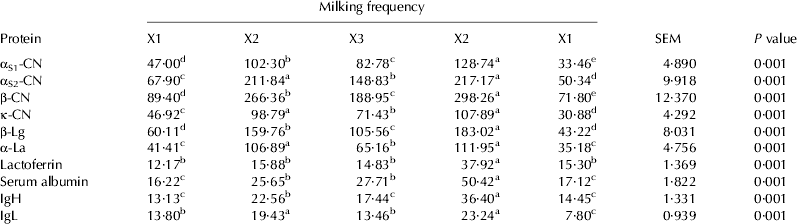
A densitometer protein distribution analysis is summarised in Table 2. Regarding caseins (αs1-CN, αs2-CN, β-CN, κ-CN), in the studied milking intervals, the β-CN bands showed the highest intensities, followed by αs2-CN and then αs1-CN and κ-CN. In general, caprine milk contains no or relatively little αs1-CN, whereas β-CN is the major protein (Tziboula-Clarke, Reference Tziboula-Clarke, Roginski, Fuquay and Fox2003). Some local dairy breeds, such as Majorera, represent a particular case where 60% of the alleles for the αs1-CN locus are of the high type (A and B; Jordana et al. Reference Jordana, Amills, Diaz, Angulo, Serradilla and Sanchez1996); therefore, αs1-CN is relatively abundant in milk from these animals. On average, αs1-CN in caprine milk varies from 0 to 25% of total caseins, depending on the animal genotype (Sánchez-Macías et al. Reference Sánchez-Macías, Morales-delaNuez, Moreno-Indias, Hernández-Castellano, Mendoza-Grimón, Castro and Argüello2011). In the present study, αs1-CN was about 15–19% of the total intact caseins in the studied milking intervals.
Densitometric values (intensity×millimetres) of SDS-PAGE protein bands in dairy goats milked milked once daily (X1) twice daily (X2) and thrice daily (X3). Values are least squares means with SEM. Protein profile was determined with milk samples from a.m. milking for X2 and X3 treatments

a–eMeans within the same row with different superscripts are different (P<0·05)
IgH, immunoglobulin G heavy-chain; IgL, immunoglobulin G light-chain
Quantitative analysis showed an increase in intensities of casein bands when switched from X1 to X2, and then these intensities decreased from X2 to X3. Subsequently, electrophoretic bands had an increase in intensity from X3 to X2 and a decrease from X2 to X1 (P<0·05). In contrast, Sorensen et al. (Reference Sorensen, Muir and Knight2001) found higher proportions of α-CN and β-CN and lower κ-CN for dairy cows milked X3 compared with others milked X2. The highest intensities of caseins for X2 and X3 could be explained by the experimental design, because protein profile was determined with milk samples from a.m. milking. Therefore, milk volume was lower at these intervals but the caseins synthesised remained and became more concentrated in the milk (Salama et al. Reference Salama, Such, Caja, Rovai, Casals, Albanell, Marín and Martí2003).
Regarding whey proteins [α-La, β-Lg, serum albumin (SA), lactoferrin (LF) and immunoglobulins (IgH and IgL)] in the studied milking intervals, the β-Lg bands showed the highest intensities, followed by α-La and SA. In general, whey protein bands exhibited a similar trend to caseins bands owing to the experimental design. Sorensen et al. (Reference Sorensen, Muir and Knight2001) indicated that α-La was not affected by milking frequency in dairy cows, but β-Lg was the major proportion in X3 with respect to X2.
In regard to SA, it has the same amino acid sequence as the blood serum molecule, and it is commonly believed that SA enters the milk by leaking through the epithelial tight junction from the systemic fluids at extended milkings. However, Shamay et al. (Reference Shamay, Homans, Fuerman, Levin, Barash, Silanikove and Mabjeesh2005) showed that SA is produced and secreted by epithelial cells into milk, indicating that it is part of the mammary gland innate immune system. In addition, Hernández-Castellano et al. (Reference Hernández-Castellano, Torres, Alavoine, Ruiz-Díaz, Argüello, Capote and Castro2011) found that high milking frequency affected the immunological milk parameters in Majorera goats, chiefly a decreased IgG concentration (immunosupression) presumably due to an increase in the cortisol excretion by adrenal glands, caused by animal stress.
The changes in milk protein profile in cows have been associated with differing proteolytic enzyme activities, such as plasmin, because the increase of milking frequency reduces the time that milk is stored in the udder, and the time to degrade the milk proteins is shorter (Sorensen et al. Reference Sorensen, Muir and Knight2001). Previously, Bastian (Reference Bastian1996) indicated that plasmin causes degradation of β-CN to γ-CN, which influences the milk quality for cheese production. However, Svennersten-Sjaunja et al. (Reference Svennersten-Sjaunja, Wiking, Edvardsson, Bavius, Larsen and Nielsen2007) reported a lower plasmin activity when milking frequency was increased in dairy cows, but proteolytic degradation of milk proteins was maintained. Therefore, more experiments will be necessary to evaluate the plasmin activity at different milking frequencies and its effects on degradation of milk proteins in dairy goats.
In conclusion, short-term changes of the normal milking frequency in goats traditionally milked X1 during early lactation can affect milk production as reflected in the marked increase in milk yield when milking frequency was increased from X1 to X2. However, the changes in milk quality, especially in the fat content and milk protein profile, calls for new studies on how the milking frequency affects the yield and quality of the cheeses, because the goat milk in Canary Islands is used mainly for cheese production. In addition, milk yield was not altered when goats were switched from X2 to X3, but the decrease in fat content requires further studies to elucidate the factors that cause this decline.
This research was supported by grant AGL 2006-08444/GAN from the Spanish Government. The authors thank A. Alavoine, G. Pons, V. Bissières and S. Cyrille from École Vetérinaire de Toulouse (France) for their technical assistance during the experiment.