Significant outcomes
-
∙ We found negative correlations between checking severity and white matter of left inferior frontal gyrus and middle temporal gyrus, and a positive correlation between ordering severity and right precuneus in fractional anisotropy (FA) in obsessive-compulsive disorder (OCD) patients.
-
∙ Our results support the hypothesis that the severities of the respective symptom dimensions are associated with different patterns of white matter alterations.
Limitations
-
∙ Our sample size might not have been large enough to detect robust correlations between the severities of symptom dimensions and diffusion tensor imaging (DTI) parameters.
-
∙ The majority of our patients were taking medications, and six of the 20 patients had major depression disorder, which may have affected our results.
Introduction
OCD is the fourth most common mental disorder, with its prevalence ranging between one and 4% (Reference Fullana, Mataix-Cols and Caspi1,Reference Leonard, Ale, Freeman, Garcia and Ng2). OCD has been considered one of the leading causes of life disturbance (Reference Michaud, McKenna and Begg3). The pathophysiology of this disorder has not been fully elucidated. Previous neuroimaging studies have implied that dysfunction of the cortico-striato-thalamo-cortical circuit serves as the neural basis for the pathophysiology of OCD (Reference Saxena4). Furthermore, recent whole brain analyses have provided evidence to implicate abnormalities in additional brain regions outside the circuit (Reference Del Casale, Kotzalidis and Rapinesi5–Reference Song, Jung and Jang9). Thus, widespread neural networks are considered to be involved in the pathophysiology of this disorder. Increasing numbers of DTI studies have reported evidence of white matter alterations in OCD patients (Reference Saxena4,Reference Menzies, Chamberlain, Laird, Thelen, Sahakian and Bullmore6,Reference Benedetti, Giacosa and Radaelli10–Reference Yoo, Jang and Shin17). Also, in the past five years, the investigation method has been changing from voxel-based morphometry (VBM) analysis to tract-based spatial statistics (TBSS), which improves the problem of registration and image smoothing for whole brain DTI data analysis (Reference Smith, Jenkinson and Johansen-Berg18). Although certain inconsistencies were reported, the most common regions of decreased FA in OCD patients compared to healthy controls (HC) were the cingulate bundle, corpus callosum, and anterior limb of the internal capsule (Reference Koch, Reess, Rus, Zimmer and Zaudig19).
The diversity of symptoms in OCD as well as comorbidities and medication are thought to be causes of the clinical heterogeniety of OCD. It is hypothesised that different symptoms are indeed mediated by distinct neural systems (Reference Koch, Wagner and Schachtzabel20,Reference Glahn, Prell, Grosskreutz, Peschel and Müller-Vahl21). Obsessive-Compulsive Inventory-Revised (OCI-R) was developed for the assessment of symptoms and their dimensions, providing the severity scores in six subscales (washing, checking, ordering, obsessing, hoarding, and neutralising), and it is able to differentiate well between OCD patients and individuals without OCD (Reference Foa, Huppert and Leiberg22). We therefore considered that the symptom dimensions of OCI-R could be valid in both clinical and non-clinical subjects (Reference Hajcak, Huppert, Simons and Foa23,Reference Zermatten, Van der Linden, Larøi and Ceschi24,Reference Huppert, Walther and Hajcak25). We regarded the score of OCI-R as a natural way for considering the symptoms as a spectrum from non-clinical to clinical, and we adopted it as a continuous variable for all subjects.
On the basis of previous findings, we hypothesised that the severities of the respective symptom dimensions are associated with different patterns of white matter alterations. Here, we investigated the relationship between the symptom dimensions assessed by OCI-R and white matter alterations using a well-validated TBSS analysis in order to better understand the pathophysiology of OCD.
Material and methods
Participants
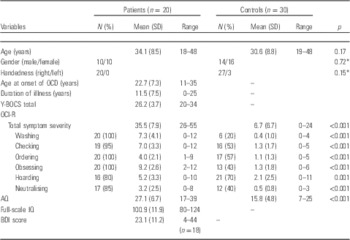
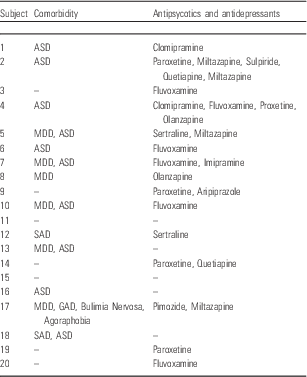
The subjects were 20 patients (10 females) with OCD and 30 HC (16 females) matched for age, sex, and handedness. Their demographic data are shown in Tables 1 and 2. Patients were recruited among outpatients of Chiba University Hospital, Japan, and were 18–48 years old. The OCD diagnosis of all patients was confirmed by trained interviewers according to the psychosis subsections of the Structured Clinical Interview for DSM-IV Axis I Disorders, Research Version, Patient Edition (SCID-I/P) (Reference First, Spitzer, Gibbon and Williams26). The Yale-Brown Obsessive-Compulsive Scale (Y-BOCS) (Reference Goodman, Price and Rasmussen27) was used for assessment of the severity of OCD and the Beck Depression Inventory (BDI) was used for examining depression tendency. Patients with a Y-BOCS score of 16 or higher and a total intelligence quotient (IQ) of 80 or higher as assessed by the Wechsler Adult Intelligence Scale (WAIS-III) (Reference Wechsler28) were included. Handedness was determined by Edinburgh Handedness Inventory (Reference Wechsler29). Patients with neurological disorders, schizophrenia category, substance dependence, organic brain disease, and severe physical disease were excluded. Five of the 20 patients were medication-free, and the other 15 were undergoing pharmacotherapy, with 13 taking serotonin reuptake inhibitors (12 selective serotonin reuptake inhibitors). Moreover, six were using antipsychotics at the time of DTI measurement. A total of 10 participants were diagnosed as autism spectrum disorder (ASD) (Table 2). All HC were recruited from the local community, and none had any psychiatric disorders as confirmed by Mini-International Neuropsychiatric Interview (Reference Sheehan, Lecrubier and Sheehan30). For HC, a total IQ score under 80 by Wechsler Adult Intelligence Scale-Revised (WAIS-R) (Reference Wechsler31) short form was used as an exclusion cut-off score. All participants were examined for the six symptom dimensions as measured by OCI-R (Reference Foa, Huppert and Leiberg22) and autistic tendency as measured by Autism Spectrum Quotient (AQ) (Reference Wakabayashi, Tojo, Baron-Cohen and Wheelwright32,Reference Wakabayashi, Baron-Cohen, Wheelwright and Tojo33) The Institutional Research and Ethics Committee of the Graduate School of Medicine, Chiba University, approved the study (No. 1330). Written informed consent was obtained from each subject before the assessments began. The trial was registered as UMIN000008765.
Clinical characteristics of patients with OCD and healthy control subjects

AQ, Autism Quotient; BDI, Beck Depression Inventory; IQ, intelligence quotient; OCI-R, Obsessive-Compulsive Inventory-Revised; Y-BOCS, Yale-Brown Obsessive-Compulsive Scale; SD, standard deviation.
* χ2 test.
Comorbidity and medication

ASD, autistic spectrum disorder; GAD, general anxiety disorder; MDD, major depression disorder; SAD, social anxiety disorder.
DTI acquisition
DTI data were acquired by 3T MRI equipped with a 32-channel phased-array head coil (Discovery MR750 3.0T; GE Healthcare, Waukesha, WI, USA). Images were corrected by single-shot echo-planar imaging with the following parameters: TE=61.1 ms, TR=8500 ms, matrix size=128×128, imaging resolution=1.875×1.875×2 mm3, band width=250 kHz, number of motion-probing gradient (MPG) directions=30, b-value=1000 s/mm2, number of acquisitions=2, acceleration factor=2.
Data analysis
FA images were processed using TBSS (Reference Smith, Jenkinson and Johansen-Berg18), part of Oxford Centre for Functional MRI of the Brain (FMRIB) Software Library (FSL) 5.0 (www.fmrib.ox.ac.uk/fsl/), to analyse the DTI data. Individual FA images were aligned into a common space using FMRIB’s Non-Linear Image Registration Tool (FNIRT) which uses a b-spline representation of the registration warp field. A mean FA image was created and thinned to create a mean FA skeleton, which represents the centres of all tracts common to the group. Each FA image was projected onto this skeleton. After that, FA, axial diffusivity (AD), radial diffusivity (RD), and mean diffusivity (MD) were aligned to the Montreal Neurological Institute template using the FNIRT tool for defining anatomical regions and region-of-interest (ROI) analysis.
Statistical analysis
Statistical analysis was conducted on skeletonised FA data. Voxel-wise permutation-based nonparametric inference was performed using Randomise in the FSL library (Reference Nichols and Holmes34). First, voxel-wise comparisons between the patients with OCD and HC groups were tested. Then, in a combined group of OCD patients and HC controlled for the use of diagnosis as covariates, correlations were tested with each of the six subscales of OCI-R as covariates of interest and the five remaining subscales and the diagnosis as nuisance covariates to define brain regions showing white matter alterations in specific symptom dimensions. All nonparametric permutation tests were performed with 5000 permutations with age, gender, unnormalised whole brain volume calculated with SIENAX, part of FSL, and AQ scores as additional nuisance covariates. In all, 50% of the OCD patients had comorbid ASD, based on the diagnosis with DSM-IV (Table 2). Several studies have reported the presence of comorbid ASD in OCD as a factor needing to be taken into account. Bejoret et al. identified autistic traits in 20% of subjects with OCD, and they reported that comorbid ASD produces a more severe and treatment-resistant form of OCD (Reference Bejerot, Nylander and Lindström35). We considered that our sample included a higher proportion of comorbid ASD than other reports (Reference Bejerot, Nylander and Lindström35,Reference Meier, Petersen, Schendel, Mattheisen, Mortensen and Mors36). We controlled the trait of ASD as a nuisance covariate. The significance level was set at p<0.05, threshold-free cluster enhancement (TFCE), correlated for multiple comparisons for group comparison and correlation analysis, and at p<0.01, TFCE, uncorrelated for multiple comparisons for defining ROI. The spatial extent threshold was set at 20 voxels. In ROI analysis, we calculated correlations between each score of symptom dimensions and the mean FA, AD, RD, and MD values in ROIs extracted from previous nonparametric permutations, individually, using SPSS version 22 (IBM Corp., Armonk, NY, USA). We conducted supplementary analysis in order to consider the influence of comorbid major depressive disorder (MDD). We calculated the partial correlations controlled for BDI score (n=18) and correlations by excluding OCD patients with comorbid MDD (n=14), separately. Subsequently, Fisher’s Z transformation analysis was performed to reveal significant differences in the correlation coefficients between the two groups. The anatomic location of each resulting cluster was determined using the MRI atlas of human white matter (Reference Oishi, Faria, van Zijl and Mori37).
Results
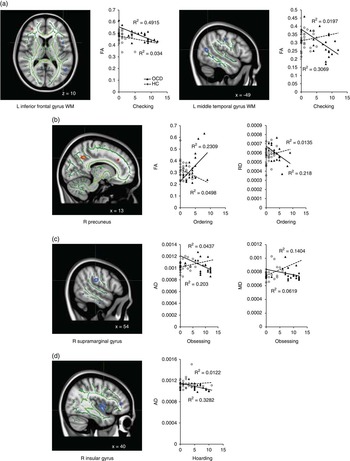
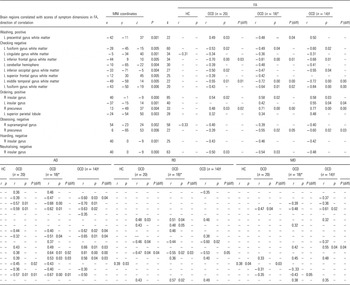
In group comparisons, no between-group differences for FA (p<0.05, TFCE, corrected for multiple comparisons) were observed. Brain regions presenting significant correlations between severities of symptom dimensions and FA (p<0.05, TFCE, corrected for multiple comparisons) could also not be found in any of the participants. However, 17 brain regions showing weak correlations between the severity of each symptom dimension and FA as a preliminary step towards ROI analysis were identified (p<0.01, TFCE, uncorrected for multiple comparisons, leftmost column in Table 3). ROI analysis was then performed. Subsequently, using the results of ROI analysis, we compared the correlation coefficients of AD, RD, and MD, in addition to FA, between the OCD and HC groups to determine the degree of the effect of each symptom dimension (Fig. 1 and Table 3). The results showed that three regions – left inferior frontal gyrus white matter and middle temporal gyrus white matter in checking severity, and right precuneus in ordering severity – had significant differences in correlation coefficients between the two groups in FA. In AD, right supramarginal gyrus in obsessing severity and right insular gyrus in hoarding severity showed significant differences in correlation coefficients between the two groups. In RD, right precuneus in ordering severity had a significant difference in correlation coefficients between the two groups, and in MD, right supramarginal gyrus in obsessing severity had a significant difference in correlation coefficients between the two groups.
White matter alterations correlated with symptom dimensions [p<0.01, threshold-free cluster enhancement (TFCE) uncorrelated for multiple comparisons, k≥20], indicating significant differences in the correlation coefficients between the obsessive-compulsive disorder (OCD) and healthy controls groups (p<0.05) and their scatter plots of diffusion tensor imaging parameters and symptom dimensions. (a) Significant differences in correlation coefficients of fractional diffusivity (FA) between the two groups were shown in left inferior frontal gyrus white matter and left middle temporal gyrus white matter in checking. (b) Significant differences in correlation coefficients of FA and radial diffusivity (RD) between the two groups were shown in precuneus in ordering. (c) Significant differences in correlation coefficients of axial diffusivity (AD) and mean diffusivity (MD) between the two groups were shown in supramarginal gyrus in obsessing. (d) Significant differences in correlation coefficients of AD between two groups were shown in insular gyrus in hoarding. Red-yellow colour indicates positive and light-blue colour indicates negative correlations. Units of AD, RD, and MD are mm2/s. Triangles and solid lines indicate OCD patients and circles and dotted lines indicate healthy controls. WM, white matter.

Brain regions correlated with scores of symptom dimensions in fractional diffusivity (FA) (p<0.01, threshold-free cluster enhancement uncorrected for multiple comparisons, k≥20) and correlation coefficients in the healthy controls (HC) and patients with obsessive-compulsive disorder (OCD) in multiple diffusion tensor imaging parameters [FA, axial diffusivity (AD), radial diffusivity (RD), and mean diffusivity (MD)

MNI, Montreal Neurological Institute; P (diff), difference in the p-value of correlation coefficients between OCD patients and HC; r, correlation coefficient; k, number of coefficient.
Weak correlation coefficients (−0.3 to 0.3) and p≥0.05 were discarded.
* Partial correlation correcting for Beck Depression Inventory score.
† OCD not comorbid with major depression disorder.
In supplementary analysis, in order to consider the influence of comorbid MDD, we also defined significant differences in correlation coefficients between the two groups in FA. We found that the number of brain regions indicating a significant difference in correlation coefficients was increased by excluding OCD patients with comorbid MDD (Table 3). In AD, we also observed that the number of the brain regions indicating a significant difference in correlation coefficients was obviously increased by excluding OCD patients with comorbid MDD. In RD we could not observe any difference in correlation coefficients between with and without comorbid MDD. In terms of MD, left insular gyrus in ordering severity showed a significant difference in correlation coefficients between the two groups (Fig. 1 and Table 3).
Discussion
In this study, we investigated the relationship between OCD symptom dimensions (washing, checking, ordering, obsessing, hoarding, and neutralising) and white matter alterations using TBSS analysis.
We defined the 17 brain regions that indicated weak correlation between the severities of symptom dimensions and FA in all six dimensions. These regions were different in each of the six symptom dimensions, and were located not only in the prefrontal regions involved in the cortico-striato-thalamo-cortical circuit but also in the parietal and temporal regions (leftmost column in Table 3). As Menzies et al. pointed out in their meta-analysis, there was widespread participation of a neural network outside orbitofrontal-striatal regions including the parietal, occipital, and temporal cortex and cerebellum (Reference Menzies, Chamberlain, Laird, Thelen, Sahakian and Bullmore6). Our results are compatible with the review.
Among the ROIs, which indicated weak correlation between the severities of symptom dimensions and FA, we detected three regions that showed significant differences of correlation coefficients between OCD patients and HC (Fig. 1a and b, Table 3). The correlation between checking severity and FA in left inferior frontal gyrus white matter was more negative in OCD patients than in HC. Broca’s area (Brodmann area 44) included in left inferior frontal gyrus is involved in various cognitive and perceptual tasks in addition to language comprehension. Recent neuroimaging studies showed the involvement of inferior frontal gyrus in selective response suppression in go/no-go tasks, which suggested its major role in the suppression of response tendencies (Reference Forstmann, Jahfari, Scholte, Wolfensteller, van den Wildenberg and Ridderinkhof38). The decrease of FA in left inferior frontal gyrus white matter might be characteristic in OCD patients with checking dimension (left side of Fig. 1a). In terms of the relation of checking severity and temporal gyrus, van den Heuvel et al. reported negative correlations between harm/checking dimensions and white matter volumes of bilateral temporal regions (Reference van den Heuvel, Remijnse and Mataix-Cols39). Recently, Li et al. reported that bilateral temporal white matter contributed to the distinction between OCD patients, with 20 of 28 patients being predominantly aggressive/checking, and HC (Reference Li, Huang and Tang40). Our finding is in line with their results (right side of Fig. 1a). In DTI studies, there was other evidence implicating temporal regions in OCD (Reference Yoo, Jang and Shin17). As possible explanations, patients with temporal lobe epilepsy (TLE) have a high prevalence of OCD symptoms and the elevations observed in certain subscales of OCI (doubting, checking, and hoarding) are manifestations of particular cognitive deficits often observed in patients with TLE and/or OCD (Reference Isaacs, Philbeck, Barr, Devinsky and Alper41). Considering the role of these two regions and the characteristics of checking dimension, it might be possible that dysfunction of them is involved in the pathophysiology of OCD patients with checking dimension.
In right precuneus, FA was positively, and RD was negatively correlated with ordering severity in OCD (Fig. 1b). This region plays a significant role in a diverse array of highly integrated functions that can no longer be regarded as a simple extension of the visuospatial processes subserved by the lateral parietal cortices (Reference Cavanna and Trimble42). Clinically, patients with ordering symptom as the main problem show excessive concern for the location and/or symmetry of things and their attention towards irrelevant details is increased. Previous DTI studies suggested that decreased FA with increased RD indicated significant changes in the myelination of white matter tracts (Reference Song, Sun, Ramsbottom, Chang, Russell and Cross43). Hyperactivity of the precuneus may reflect overactivity of visual processing and visual attention and the symptom of ordering due to increased white matter connectivity (Reference Nakamae, Narumoto and Shibata14,Reference Yoo, Jang and Shin17,Reference Li, Huang and Yang44).
We found negative correlations between obsessing severity and right supramarginal gyrus in AD and MD (Fig. 1c). Decreases in AD are considered to reflect disorganisation, damage or loss of axons, and decreased MD may be related to cell proliferation in neoplasia (Reference Alexander, Lee, Lazar and Field45). This region plays an important role in executing set-shifting affected in OCD (Reference Menzies, Chamberlain, Laird, Thelen, Sahakian and Bullmore6), and its grey matter volume was decreased in OCD patients (Reference Valente, Miguel and Castro46). Change in the microstructure of this region might cause for dysfunction in OCD patients.
On the other hand, in our analysis, negative and positive correlations in the right insular gyrus were observed in three dimensions (ordering, hoarding, and neutralising, Table 3 and Fig. 1d). Several studies have pointed out the role of the anterior insula, which processes a person’s sense of disgust towards both smells and the sight of contamination and mutilation. In social experience, it is involved in the processing of subjective feelings, empathy, and uncertainty (Reference Craig47,Reference Singer, Critchley and Preuschoff48). Song et al. also reported a distinct role of the insular cortex in the dimensional aspects of OCD (Reference Song, Jung and Jang9). They reported that abnormalities in the processing of disgust in the insular cortex seemed to be a general characteristic of OCD rather than a particular feature of the symptom dimensions. In cognitive behavioural therapy, an effective psychological therapy for OCD, the typical symptoms of OCD, such as the feelings of fear, disgust, and aversion caused by obsession, are neutralised by a compulsive act. This neutralising is reinforced by fear reduction, which leads to a vicious cycle of the exacerbation of symptoms (Reference Olatunji, Ebesutani, Haidt and Sawchuk49,Reference Williams, Farris and Turkheimer50). The identified common region, the insula, may be related to the maintaining of obsessive-compulsive symptoms from a cognitive behavioural point of view.
To date, there have been only two studies using DTI that have investigated the relationships between symptom dimensions and alterations in white matter (Reference Ha, Kang and Park13,Reference Koch, Wagner and Schachtzabel20). However, the subjects and methods were quite different. Ha et al. adopted only male patients as subjects, and they intentionally put each patient into one predominant symptom dimension using VBM analysis (Reference Ha, Kang and Park13). In their study, patients with a predominant aggressive/checking symptom dimension exhibited a significantly lower FA in left anterior cingulate white matter, whereas patients with a predominant contamination/cleaning symptom dimension showed a significantly higher FA in bilateral prefrontal white matter. Koch et al. carried out their study with TBSS using symptom dimensions assessed by OCI-R (Reference Koch, Wagner and Schachtzabel20). They applied each dimension individually with whole brain analysis and gained more information with RD and AD parameters. They found that FA is negatively correlated with ordering dimension mainly in the right inferior fronto-occipital fasciculus and right optic radiation and with obsessing dimension in the corpus callosum and cingulate bundle in OCD patients. The inconsistency between our result and that of Ha et al. could be due to their classification of subjects by their primary dimension and the adoption of VBM analysis. On the other hand, the lack of accordance between our result and that of Koch et al. might have resulted from the evaluation by the respective dimension or the absence of consideration of the whole brain volume and autistic trait as covariates. However, their and our data supported the notion that the severities of symptom dimensions are associated with different patterns of white matter alterations.
As supplementary analysis we investigated the influence of comorbid MDD. We evaluated the influence as being negligibly small in our main findings from the results (Fig. 1 and Table 3). In terms of FA and AD, the number of brain regions correlated with symptom dimensions in ROI was increased (Table 3). This supported our hypothesis, namely, that the severities of the respective symptom dimensions are associated with different patterns of white matter alterations, even more strongly.
In conclusion, we found significant differences in correlation coefficients between the checking severity and FA in two brain regions, left inferior frontal gyrus white matter and left middle temporal gyrus white matter in OCD patients compared with HC. We also found significant differences in correlation coefficients between ordering severity and right precuneus. Although our study was preliminary, it is suggested that the variation in profiles of symptom dimensions among OCD patients might be one of the main causes of the dispersions of the previous reports. This means that the symptom dimensions should be taken into account, not ignored, so as to elucidate the pathophysiology of OCD. Our study could support the hypothesis that the severities of symptom dimensions are associated with different patterns of white matter alterations.
Acknowledgement
Authors Contributions: M.Y. and Y.H. performed the majority of the experiments and analysed the data; Y.H. and A.N. designed and coordinated the research; K.N., K.I., C.S., and T.O. advised on data analysis; M.N., M.I. and E.S. recruited the participants; H.M. and J.M. conducted psychological testing; A.N. conducted clinical assessment; K.M. and Y.M. acquired DTI data; M.Y., Y.H. and A.N. wrote the paper. All authors approved the final manuscript.
Financial Support
This work was supported by JSPS KAKENHI Grant Number 23591733.
Conflicts of Interest
The authors report no conflicts of interest.
Ethical Standards
The authors assert that all procedures contributing to this work comply with the ethical standards of the relevant national and institutional committees on human experimentation and with the Helsinki Declaration of 1975, as revised in 2008.