


War has an immediate effect upon the attitude of mind of everyone who is brought into connection with it.Footnote 1
Abbott Lawrence Lowell, 1923President Bush's exceptional support following 9/11 has turned into near-record levels of disapproval. Why? The standard answer asserts that this unprecedented drop is the result of the Iraq War and its American casualties. The claim that wartime casualties lead to decreased approval represents such a common conjecture today in the news media and scholarly works that it requires neither reference nor justification. Nevertheless, the mechanism linking casualties to opinion remains opaque; knowledge of the micro foundations underlying this wartime reaction is weak, both theoretically and empirically.
The human costs of war affect a wide range of domestic political phenomena. Increasing casualties lead to both decreased national support (Gartner and Segura Reference Gartner and Segura1998; Mueller Reference Mueller1973) and individual approval (Gartner and Segura Reference Gartner and Segura2000) of a war and its leaders. Casualties influence elections in the house (Carson et al. Reference Carson, Jenkins, Rohde and Souva2001), senate (Gartner et al. Reference Gartner, Segura and Barratt2004, Gartner and Segura forthcoming), and presidency (Karol and Miguel Reference Karol and Miguel2007; Voeten and Brewer Reference Voeten and Brewer2006), and they affect leader tenure more broadly (Bueno de Mesquita et al. Reference Bueno de Mesquita, Smith, Siverson and Morrow2003). The relationship between casualties and approval represents a critical link in arguments about the democratic peace (Gartzke Reference Gartzke1998, Reference Gartzke2000; Kadera et al. Reference Kadera, Crescenzi and Shannon2003; Russett Reference Russett1990; Siverson Reference Siverson1995), diversionary theory arguments (Baum Reference Baum2002), and war outcome (Sullivan Reference Sullivan2006). Casualties alter the political debate (Gartner et al. Reference Gartner, Segura and Barratt2004), which is critical to understanding wartime politics (Berinsky Reference Berinsky2006; Schultz Reference Schultz2001; Zaller Reference Zaller1992). The link between casualties and public opinion represents the driving force for these domestic political effects (Gartzke Reference Gartzke2001), yet our knowledge of how this linkage operates remains inadequate (Boettcher and Cobb Reference Boettcher and Cobb2006; Feaver and Gelpi Reference Feaver and Gelpi2004). This represents a broader problem. Our understanding of politics assumes peace; we need to expand our theories to include wartime affairs (Brody Reference Brody1991; Jacobson and Kernell Reference Jacobson, Kernell, Kernell and Jacobson2004).
I develop a rational expectations theory in which wartime losses have both direct and contextual effects on public support for a conflict. Increasing recent casualties and rising casualty trends lead to decreased support—direct effects. At the same time, casualty patterns provide a contextual lens through which individuals interpret casualties—an indirect effect. Empirically, this project treads on new ground. Reexamining the same historical wartime surveys is unlikely to generate a better understanding of the micro-foundations of wartime behavior (Boettcher Reference Boettcher1995; Herman, Tetlock, and Visser Reference Herrmann K., Tetlock and Visser1999; Minitz et al. Reference Mintz, Redd and Vedlitz2006). Instead, I conduct six experiments, three on the Iraq War (two with national, representative samples) and three on hypothetical conflicts (using a new panel experiment design). Hazard and ordered logit analyses of almost 3,000 subjects strongly support the theory. I also examine additional claims about the influence of the probability of victory (Gelpi, Feaver, and Reitler Reference Gelpi, Feaver and Reifler2005), political knowledge (Herman, Tetlock, and Visser Reference Herrmann K., Tetlock and Visser1999; Kam Reference Kam2005), and individual characteristics on wartime support (Edwards and Swenson Reference Edwards and Swenson1997; Eichenburg Reference Eichenburg2003).
The late 1990s ushered in a new generation of scholarship on casualties and opinion that took off from where previous work, most notably Mueller Reference Mueller1973, had stopped. This research advanced down two paths. Some was historical, focusing on recent casualties and casualty trends (e.g., Gartner and Segura Reference Gartner and Segura1998). Its advantage was external validity; the cost was internal validity, as history limits the type of conflict patterns observed. Some was experimental, using hypothetical scenarios to study factors like success (e.g., Feaver and Gelpi Reference Feaver and Gelpi2004) and enemy losses (Boettcher and Cobb Reference Boettcher and Cobb2006). Its advantages were internal validity, but the weaknesses were external validity (due to the hypothetical scenarios) or underspecification (due to the research designs' inabilities to incorporate varied casualty patterns). This study unites these two lines of research and attempts to contribute to each by advancing our understanding of the role of recent casualties and casualty trends (and their interactions) in both a real war and hypothetical scenarios.
OUTLINE
First, I lay out the rational expectations theory of casualties and opinion and delineate the roles of recent casualties, casualty trends, and casualty contexts. Second, in an analysis of the Iraq War, I focus on the importance of casualty trends with both laboratory and national experiments. In addition, I compare the results generated by representative and convenience samples. Third, in three studies of hypothetical conflicts, I also examine the importance of casualty context. Finally, I touch on issues of internal and external validity, decision making, and Iraq War policy.
THE RATIONAL EXPECTATIONS THEORY OF CASUALTIES AND OPINION
The rational expectations theory of casualties and wartime support makes two major claims. First, wartime approval represents the result of an expected utility, cost–benefit calculation, where casualties represent the key (but not the only) cost. Some people will oppose or support a conflict regardless of casualties, but most determine their support by observing a war's results. As rational consumers, individuals weigh a war's anticipated costs and benefits (Gartner and Segura Reference Gartner and Segura2005; Gelpi, Feaver, and Reifter Reference Gelpi, Feaver and Reifler2005). Casualties are the most salient, visible, and systematic measure of a war's cost (Gartner and Segura Reference Gartner and Segura2000). As a result, in war, people pay special attention to casualties and attempt to estimate their future direction (they also look at other factors, such as economic costs—see Fordham Reference Fordham2006). If individuals' utility for estimated costs exceeds their estimated value of the benefits, they oppose the conflict.
Second, the rational expectations theory of casualties and opinion argues people update their beliefs about the expected costs and benefits of a conflict by consuming available information. I assume benefits are fixed. However, costs vary—in experience and therefore in estimation (Gelpi et al. [Reference Gelpi, Feaver and Reifler2005] might be said to argue that as experience varies so do estimates of the benefits, whereas they largely fix costs.) As various measures of casualties observed by people change, so do their estimates of a conflict's costs. The next task is to identify these different casualty measures and their role in influencing wartime opinion. I look at recent casualties, casualty trends, and casualty context.
Recent Casualties
Analyzing aggregate measures of approval in the Vietnam and Korean Wars, Mueller (Reference Mueller1973) found a strong correlation between logged cumulative casualties and national measures of support. Unfortunately, logging eliminates variation in the patterns of casualty accrual between wars, and cumulative casualties do not allow for differentiation across individuals.Footnote 2 Gartner and Segura resolved these issues by expanding the theory to include proximate casualties, finding that recent national losses influence mass opinion (Reference Gartner and Segura1998), recent local casualties affect individual attitudes (Reference Gartner and Segura2000), and recent state casualties influence both elite views and senate elections (Gartner et al. Reference Gartner, Segura and Barratt2004). Other research found recent casualties influence presidential elections (Karol and Miguel Reference Karol and Miguel2007). These studies make a compelling claim for the importance of recent casualties on wartime public opinion (see also Boettcher and Cobb Reference Boettcher and Cobb2006).
Casualty Trends
Casualty trends represent the rate of change of recent casualties, such as the slope of monthly losses. For example, trend information might compare this month's casualties to those of recent months. Why do we care about casualty trends? Previous studies suggest leaders respond to trends in their measures of wartime assessment. They are especially sensitive to changes in the rate of change of measures of wartime performance (Gartner Reference Gartner1997; Murray Reference Murray2001). For example, should a wartime indicator of antisubmarine warfare (ASW) progress, such as enemy submarines sunk, increase at an increasing rate, leaders who employ that indicator will see their ASW strategy as performing effectively. Conversely, should that indicator fall at an accelerating rate, these same decision makers will see their ASW strategy as failing (Gartner Reference Gartner1997). Does the public also respond to trends in wartime measures?
Historical studies suggest that casualty trends influence public attitudes and election results (Gartner and Segura Reference Gartner and Segura2000; Gartner et al. Reference Gartner, Segura and Barratt2004). Casualty trends influence individuals' estimates of the direction and magnitude of future losses. An increasing rate of wartime casualties provides different ex ante information about a conflict's likely ex post costs compared with other trends. However, these same studies are incomplete. Theoretically, they fail to identify fully the mechanism linking changes in casualties and approval. Empirically, their reliance on the Vietnam and Korean wars limits the range of casualty patterns observed in two ways. First, the surveys occur at uneven intervals, frequently in response to major events. Second, the authors claim casualty trends have varied effects, but can only examine patterns observed in Vietnam and Korea. These types of studies are thus constrained in their ability to analyze casualty trends and are not well suited for examining the next type of measure, casualty context.
Casualty Context
According to the rational expectations approach, people use available information and attempt to be “forward thinking” (MacKuen, Erickson, and Simon Reference MacKuen, Erickson and Stimson1992). In a conflict, individuals situate recent conflict information into their larger wartime context (Boettcher Reference Boettcher1995). Here, recent casualties represent the key conflict information, and the pattern of casualty accrual represents the context.
That trends influence interpretation of recent losses means that the impact of x number of casualties on individuals' probability of disapproval depends on the informational context in which the x personnel die. For example, that 100 Americans died last month means something completely different if the previous 2-month trend was 300, 200, and then 100, versus. 5, 10, and then 100. The meaning of a monthly casualty figure of 100 is thus relative to the wartime trend in which it is nested. If situated in a decreasing trend it will suggest a decreasing rate of casualty accrual and a different estimated casualty count than if it is part of an increasing trend. Casualty patterns provide a context through which individuals interpret recent casualties, similar to enemy casualties (Boettcher and Cobb Reference Boettcher and Cobb2006) and success (Gelpi, Feaver, and Reitler Reference Gelpi, Feaver and Reifler2005). Trends thus have a direct effect (increasing trends lead to decreasing support) and an indirect, or contextual effect (trends provide meaning to recent casualties). Note that this does not assume people know or estimate a war's duration, only that they use the information available to approximate future costs (Gartner and Segura Reference Gartner and Segura2005; Nisbett and Ross Reference Nisbett and Ross1980).
Hypotheses
Casualty patterns provide critical information that influences individuals' likelihood of supporting the use of force. This suggests the following hypotheses about how (1) casualty trends, (2) recent casualties, and (3) casualty contexts affect individual wartime support.
• H1. Holding the level of recent casualties constant, the direction of the trend in casualties is inversely related to the level of support for military action.
Thus, an increasing trend predicts lower support, whereas a decreasing trend predicts greater support.
• H2A. Holding the trend in casualties constant, the level of recent casualties is negatively related to the level of support for military action.
• H2B. Failure to hold casualty trend constant leads to results where recent casualties have no predictable effect.
Casualty patterns provide the context through which individuals interpret recent casualties. Without this context, here captured by trend, it is not clear what meaning individuals should ascribe to casualty levels. The last hypothesis is thus conceptual, not directional. I next employ six experiments to examine these arguments.
IRAQ WAR
I examine American attitudes on the Iraq War using both laboratory and national studies. Unlike a hypothetical experiment where recent casualties and casualty trends are manipulable, in a real war these factors are fixed. At the time of the two studies, from mid-October to mid-November 2006, about 2,800 Americans had died in the war in Iraq. In addition, October was an especially deadly month with 106 U.S. military killed in action (KIA), which followed the 72 American dead in September (the highest monthly figure in over 5 months). As a result, the studies occur in a period of increasing U.S. casualties.
Laboratory Experiment
I conducted the first study presented in the Political Science Experimental Laboratory at the University of California, Davis, between November 13 and November 17 2006. The 457 subjects are undergraduate students, primarily from Political Science and International Relations. Using computers, they answered questions individually and anonymously.
The study randomly assigned half of the subjects to a positive and half to a negative prompt about the future direction of the war in Iraq. The positive casualty trend treatment says that leaders think the worst is behind us and the situation is likely to improve, whereas the negative treatment says leaders think the costs are likely to get worse before they get better.Footnote 3 I create the variable Casualty Forecast, which is coded 1 if the subjects receive the positive; and 0, if they receive the negative casualty trend treatment. I anticipate those given the positive casualty trend prompt are likely to be more supportive of the war. Following the casualty treatment, individuals are asked to rank their support for the war in Iraq on a 5-point Likert scale, from 1 (strongly oppose) to 5 (strongly support), captured by the 5-category variable Support, which has a mean of 2.1 and a standard deviation of 1.2.
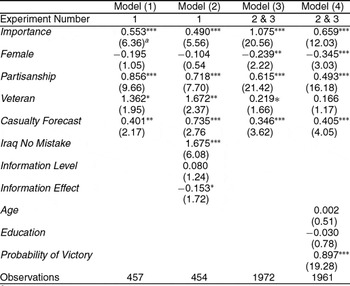
I ask a number of control questions. Importance of the objective (Importance) is measured from 1 (lowest) to 5 (highest) (mean 3.7). I anticipate those expressing a higher value for the objective are likely to be more supportive of the War. I create the variable Female (1 for women 57%, 0 for Men). I anticipate women are less likely to support conflict (Eichenburg Reference Eichenburg2003; Nincic and Nincic Reference Nincic and Nincic1995). I expect those identifying themselves as Republican are more likely, and Democrat less likely, to support the War, with Independents and undecided subjects falling in-between (Baum Reference Baum2002). The variable Partisanship ranges from 1 (very strong Democrat), 3 Independent and undecided, to 5 (very strong Republican) and has a mean of 2.2. All analyses were reanalyzed dropping undecided subjects and results are the same (not shown). Veteran is coded 1 for those identifying as a veteran of the armed forces and 0 otherwise. I expect veterans to be more supportive of the War (Feaver and Gelpi Reference Feaver and Gelpi2004). Model 1, Table 1, displays the ordered logit results (OLS or ANOVA would be inappropriate given the categorical nature of the dependent variable; all significance levels employ the more demanding two-tailed test).
The Iraq War, Ordered Logit Analyses

aTwo-tailed tests; absolute value of Z statistics in parentheses.
*Significant at 10%; **significant at 5%; *** significant at 1%.
Casualty Forecast operates in the anticipated direction and is highly significant. Subjects told casualties are projected to increase are less supportive of the Iraq War than those told the situation is expected to improve. Additionally, those who think the mission is important, Republicans, and veterans are more likely to support the War. Female is negative but statistically insignificant. Model fit is strong: the LR χ2(5) of 131 exceeds the .0001 level of significance and the Bayesian Information Criteria (BIC) is −1,728. The model explains 50% of the variance in the 5-value scale (Percent Predicted Correctly, PPC), which is 18% more than achieved by the modal value alone (Lamda Proportional Reduction of Error, PRE). PRE is a particularly important model fit measure for predicting opinion in an unpopular war.
Although the results are statistically robust, one might want to include additional factors. First, there is significant variation in subjects' political knowledge. Studies suggest this variation might influence support (Baum Reference Baum2003; Gordon and Segura Reference Gordon and Segura1997; Zaller Reference Zaller1992). I create the variable Information Level, which measures the number of days in the previous week the respondent claims to have read a regional or national newspaper and varies from 0 to 7 with a mean of 2.1. Research also suggests information levels should mitigate the impact of information-based, experimental manipulations (Herrmann, Tetlock, and Visser Reference Herrmann K., Tetlock and Visser1999; Kam Reference Kam2005). That is, those who know a lot about Iraq are going to be less affected by the suggestion that things are getting better or worse than those who know little about the War. As Kam puts it, “(t)he politically aware are less likely to be swayed by ‘easy cues’ and more likely to rely on an issue-relevant value in the formation of opinion. . .” (175). To test for the mitigating effect of knowledge, I interact Information Level and Casualty Forecast to create Information Effect. I anticipate Information Effect will be negative, decreasing the impact of Casualty Forecast on Support as levels of political knowledge increase.
Because many respondents hold strong beliefs about Iraq and the use of military force (Hetherington and Nelson Reference Hetherington and Nelson2003; see also Parker Reference Parker1995 and Sigelman and Conover Reference Sigelman and Conover1981), one might want to control for their views prior to the manipulation. This control would help to capture individuals' actual change in attitude toward the conflict brought about by variation in the casualty trend treatment. In order to assess their views before the casualty trend prompt, subjects are asked whether the Iraq War was a mistake. I create the variable Iraq No Mistake which is coded as (1) if the subject said invading Iraq was not a mistake (16.8%) and (0) otherwise. I expect Iraq No Mistake will have a positive effect on Support. One would anticipate there would be little variance to explain regarding support for the War after taking into account whether the subject believed the War was a mistake.
Model 2 in Table 1 shows results of an analysis adding Iraq No Mistake, Information Level and Information Effect to Model 1. Iraq No Mistake has a strong influence on Support in the anticipated direction. Information Level is insignificant, whereas Information Effect (the interaction of Information Level and Casualty Forecast) operates in the anticipated direction; the casualty treatment has less substantive impact on those who are more informed. These mixed results of the indirect and direct effects of information are similar to the findings of Herrmann, Tetlock, and Visser (Reference Herrmann K., Tetlock and Visser1999). Critically, even when taking prior views of the war and information levels into account, Casualty Forecast maintains a strong, statistically significant effect on support.
Experiment 1 brings the Iraq War into the laboratory. Given that the student subjects' cohort fights the war, the topic is especially salient to them. For example, half of the subjects say they know someone who served in the war, and over 6% say they know someone who died. On the other hand, young people's partisanship and foreign policy views may not be as firm as those of older adults. In addition, the sampling frame's homogeneity on education and age does not allow those factors to play an explanatory role. I next explore how a broader population responds to casualty trends.
National Experiment
The Iraq War instrument from the laboratory experiment was also included in two national experimental studies conducted by the Cooperative Congressional Election Study (CCES) between October 11 and November 1 2006.Footnote 4 Pooling the two national studiesFootnote 5 generates a representative sample of 2,000 respondents with fundamentally different demographic dynamics than the student sample. Their average age is 49 (and ranges from 88 to 18), 64% are married, 75% own their own home, and family income averages about $55,000. Education varies considerably, with 34% having no college and 7% having postgraduate work.
Some might anticipate the subjects in the national sample have more fixed views on the Iraq War compared to the student sample and are less susceptible to manipulation by the casualty trend treatment. Sears argues, “late adolescents and young adults tend to have less-crystallized social and political attitudes than do older people” (Reference Sears1986, 522). The national experiments thus present a more challenging test.
Results from the representative sample using the specification examined previously in Model 1 are shown as Model 3 in Table 1 (N is slightly less than 2,000 because of missing data). Casualty Forecast again operates in the predicted direction and is strongly significant; those receiving the treatment suggesting the situation is going to improve for the United States are more likely to support the Iraq War than those told future casualties will increase. Those who think the war is more important, identify more Republican, and veterans and males are also more likely to support the conflict. The model is extremely powerful with a LR χ2(5) of 1691, PPC of 61%, and PRE of 35%. The BIC of −10,996 suggests an extremely good model fit (Long Reference Long1997, 110–111). Ordered logit results are tricky to interpret. To capture the substantive effects of the variables, I calculate their average change in predicted probability.Footnote 6 The influence of Casualty Forecast on support exceeds the effects of both Female and Veteran.
I analyze two alternative specifications. First, a concern might be that the control variables drive the influence of the random treatment. Dropping all other variables, a bivariate ordered logit analysis of the effect of Casualty Forecast on Support leads to a coefficient of 0.23 that is highly significant (p<.001, Z score of 2.79, N = 1989). Thus, the effect of Casualty Forecast is not an artifact of model specification (for a discussion of the dangers of control variables, see Kadera and Mitchell Reference Kadera and Sara McLaughlin2005).
Second, some argue individuals' perceptions of success drive their conflict assessments (Eichenburg Reference Eichenburg2005; Gelpi, Feaver, and Reitler Reference Gelpi, Feaver and Reifler2005). Subjects were asked, prior to the casualty trend treatment, about the probability of the United States accomplishing its goals in Iraq. The variable Probability of Victory has a mean of 2.6 and is coded: 1, success is highly unlikely (39%); 2, unlikely (17%); 3, do not know (3%); 4, likely (28%); and 5, very likely (14%). In addition, it would be helpful to identify more clearly the roles that education and age play. The student subjects all have some college and most are young (99% are under 25), eliminating the ability to examine age and education. The national subject sample has significant variation on both dimensions.
An analysis adding Probability of Victory, Age, and Education Footnote 7 to the earlier specification is shown in Model 4 in Table 1. Probability of Victory is significant and positive; those who think victory is more probable for the United States are more likely to support the conflict. Casualty Forecast actually has a slightly stronger effect than in the earlier model. Looking at the average change in predicted probabilities, the effect of the casualty treatment in Model 4 is greater than that in Model 3. When controlling for probability of victory, Casualty Forecast has a substantive impact that not only exceeds gender and prior military experience, but also is now just below that of Partisanship and Importance. Neither Age nor Education is statistically significant, suggesting the lack of variation among those factors in the student sample may not be a significant concern. The model fit is again very impressive, with a BIC of −11,306 and LR χ2(8) of 2092***, PPC of 64%, and a PRE of 41%—the latter is especially remarkable given that 40% strongly oppose the War.
The estimates are highly robust. In additional diagnostic checks, I modified Model 4 by (1) replacing Age with a dummy variable capturing those under 25; (2) dropping Importance (which correlates with Victory); and (3) adding family income and home ownership status. In each case, results were the same (not shown).
In two national experiments with a combined representative sample of almost 2,000 individuals, those receiving the positive prompt on the trend of costs in Iraq were more likely to support the war than those receiving a gloomier forecast. The effect of the treatment exceeded well-known factors such as gender and veteran status. Iraq is a topic people hold strong views on (less than 4% of the subjects did not know what their level of support was). Yet, Casualty Forecast exerted a consistent effect.
This study provides a systematic test of two main competing explanations for wartime support: casualties and probability of victory. I find people respond to predicted changes in casualty trends even when taking into account their assessment of success. I also find some support for the argument that assessments of victory affect levels of approval (Gelpi, Feaver, and Reitler Reference Gelpi, Feaver and Reifler2005). Critically, because the question on success occurred prior to the casualty trend manipulation, we can be certain there is no relationship between the casualty manipulation and the estimates of winning (for a critique of the victory argument, see Berinsky and Druckman Reference Berinsky and Druckman2007).
Some scholars have expressed a concern about the reliance on student samples (Sears Reference Sears1986). Their main focus is on the threat to external validity posed by the sample frames (Druckman Reference Druckman2004; Lupia Reference Lupia2002). Comparing the results of identical analyses using convenience and representative samples shows strikingly similar results. Although the students were slightly less supportive of the War, the responses to the casualty treatment by student and nationally representative samples were virtually identical (and this minor variation may not reflect the populations as the studies occurred just before and after the 2006 midterm election). The difference in the average change in the predicted probability resulting from varying Casualty Forecast is almost zero, .0032.Footnote 8 The similar reactions in the two studies provide a strong vote of confidence for the utility of student convenience samples to study wartime public opinion.
How does an experimental design address issues of generalizability? “the concerned researcher intent on identifying limits to external generalizability should take Sear's first piece of advice seriously. . .and establish that the student sample is atypical from the general population in ways that are relevant to the study in question” (Kam Reference Kam2005, 176, italics in original). The inclusion of variables such as Education and Age in the analysis of the representative sample to isolate the factors that distinguish it from the convenience sample had no effect. Furthermore, the addition of controls addressing factors such as whether the war was a mistake, information levels, family income, and the likelihood of victory had no influence on the results. Conversely, Casualty Forecast, by itself, led to a highly significant change in Support. Thus, with or without controls, the national experimental results were largely identical to those generated in the laboratory. These findings support the view of Mintz, Redd, and Vedlitz that if “the real-world ‘equivalent’ of a student sample is the ‘public’ rather than the leader or the elite, then, with an appropriate research design, student experiments may actually tell us a great deal about the behavior of the public” (Reference Mintz, Redd and Vedlitz2006, 769). There are obviously differences between students and older adults. However, these differences consistently had little to no effect on subjects' reaction to experimental treatments on casualty trends.
There is more involved in external validity, however, than sample selection. Druckman recently wrote, “when making inferences from empirical research, scholars need to carefully consider the context under study—perhaps, to an even greater extent than the population” (Reference Druckman2004, 684). Although the Iraq War experiments vary more factors than standard studies, because they occur in a unique historical time period they are unable to manipulate the casualty context (or other factors such as divided government (Nicholson and Segura Reference Nicholson and Segura1999) or conflict diffusion (Kadera Reference Kadera1998)). That is, we cannot rerun Iraq War experiments conducted when 2,800 American military personnel died and reset the conditions so that the number of U.S. dead is 280 or 28,000. As a result, this approach cannot test hypotheses about the interactive effect of casualty trends and recent losses on support. To do that we need an alternative research design.
PANEL EXPERIMENTS
Historical studies, even if they employ experimental manipulations, are incapable of identifying the importance of casualty patterns, as they are unable to vary recent casualties and casualty trends independently. Additionally, the previous experiments could vary casualty forecasts, but not actual casualty experiences. Experimental analyses of a hypothetical military scenario provide a way to get a handle on the broader range of processes driving the casualties and opinion relationship. I develop a new type of research design called a panel experiment that combines an experiment and a panel study, and conduct three trials between fall 2004 and spring 2005.
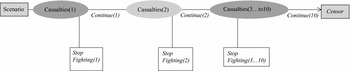
Subjects are presented with a hypothetical U.S. military action scenario. For example, one scenario reads: “Insurgents have taken over French Guiana, a small country in Latin America, and have threatened to kill the 1,000 Americans living and visiting there and to destroy the $100 million worth of US property located in the country. The US has begun a military intervention, deploying the 101st Air Mobile and 82nd Airborne divisions (approximately 30,000 troops), with the objective of defeating the insurgency and restoring the previous government.” Subjects then view newspaper-like reports (text and graph) of the resulting monthly and cumulative U.S. casualties. After each report, subjects choose whether the United States should continue to employ force. A “no” answer leads to exit questions and termination. A “yes” answer leads to another casualty report and opportunity to choose whether to support or oppose the operation. There are 10 potential panels. Continued support for the use of force following the tenth round automatically results in the exit procedure. Figure 1 shows a schematic of the panel experiment design.Footnote 9
Panel Experiment Design

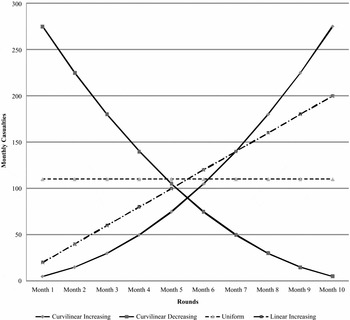
There are three unique aspects of the panel experiments. First, variation between subjects will not only consist of different answers (e.g., stop vs. continue the military intervention), but the time period at which the subject decides to terminate the action (e.g., choose to stop the intervention at time period 2 vs. 8). Second, the figures presented in the report depend on the subject's randomly assigned casualty group. Each group has a unique (to that experiment) casualty pattern—that is, each group provides subjects with a different casualty experience. Figure 2 illustrates the four casualty patterns in Experiment 6: curvilinear decreasing, uniform, linear increasing, and curvilinear increasing. Here, the cumulative totals for all four patterns are the same, but the initial values are quite different (the opposite largely occurs in Experiments 4 and 5). Third, some of the subjects will never choose to terminate the experiment. For them, in the language of the theory, the casualty levels they observe do not create a rational expectation of costs that exceeds their value of the objective.
Casualty Accrual Patterns, Experiment 4

Statistical analysis of the panel experiments thus requires a method that includes variation in the nature and time of support, varied casualty patterns, and subjects who never choose to end the intervention. To capture these conditions, I present Cox hazard analyses with interactive terms. The dependent variable is the duration of support for the U.S. intervention, ranging from 1 to 10. A failure occurs when the subject opposes the intervention. For example, if an individual ends support of the military action following the third report of casualties the case is coded as having a duration of 3. If the subject never chooses to oppose the U.S. intervention, the observation is right censored. The average duration of support is 4.2 with a standard deviation of 3.5. There are three experiments (4, 5, and 6) and two instruments (Experiments 5 and 6 are identical).
Monthly casualties range from 5 to 275 in Experiments 4 and 50 to 1,072 in Experiments 5 and 6. In Experiment 4, the four casualty patterns all start with different monthly rates and end with identical cumulative totals (1,100). The constant monthly casualty value is 110. In Experiments 5 and 6, three of the four casualty patterns begin with the same value (50), whereas the constant pattern reports 237 deaths per month and they all cumulate to different totals (minimum 2,300, maximum 2,600). Each instrument contains a Linear Increasing, Curvilinear Increasing, and Constant pattern. Experiment 4 has a Curvilinear Decreasing casualty accrual pattern, whereas Experiments 5 and 6 include two types of curvilinear increasing patterns (Curvilinear Increasing and Geometrically Increasing). Each casualty pattern is interacted with monthly casualties to create an interaction term that captures the casualty context.
The three experiments have a total of 543 subjects (304 in Experiment 4, 239 in Experiments 5 and 6). Importance of the objective is queried after presentation of the scenario and before casualty reports. Importance ranges from 1 (low) to 5 (high) and has a mean of 3.7. Fifty-six percent of the subjects are women. Republicans represent 25% and Democrats 55% of the subjects. I include the dummy variables Female, Republican, and Democrat to represent these conditions (1 = condition, 0 otherwise). Experiment 4 inquires about previous involvement with the armed forces: Veteran (1 yes, 0 no).
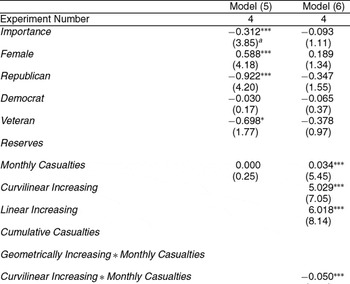
Cox hazard analysis results for the panel experiments are shown in Table 2. The excluded comparison group is Constant Casualties. I present the hazard ratios, the antilog of the coefficients (with two-tailed tests). A positive coefficient means an increase in the variable increases the hazard of failure—that is, decreases the time to observing the decision to withdraw. Negative values indicate the opposite, a decrease in the hazard and an increase in the duration of support.
Panel Experiments, Cox Hazard Analyses

aTwo-tailed tests; absolute value of Z statistics in parentheses
*Significant at 10%; ** significant at 5%; *** significant at 1%.
I begin with two examinations of Experiment 4. Model 6 shows the results of an analysis of monthly casualties and the control variables. All variables operate as anticipated. As Importance increases (approaches 5), the hazard of observing a failure (terminating the U.S. intervention) decreases. Men, veterans, and Republicans are less likely to end the military action. Independents and Democrats have similar hazard rates. However, the most important observation is that Monthly Casualties does not demonstrate statistically significant effects. As predicted, without the information provided by casualty context, recent casualties have no observable effect on support.
A specification adding casualty context (the patterns and their interactions with monthly casualties) is shown in Model 6. The results support all three hypotheses. The patterns with increasing casualty trends, Curvilinear Increasing and Linear Increasing, decrease the likelihood of continuing the intervention (H1).Footnote 10 An increase in Monthly Casualties increases the hazard of someone choosing to halt the military action (H2A). Casualty context is necessary for understanding how people respond to recent casualties (H2B). None of the individual characteristics, Importance, Female, Republican, and Veteran, exhibit statistically significant effects (although their signs are in the anticipated directions).
Two additional experiments were conducted. The instruments for Experiments 5 and 6 are identical. I pool them and include a dummy variable identifying the experiment. A number of changes push the robustness of the earlier results. First, the casualty values are higher, and unlike Experiment 4, the four patterns do not cumulate to the same total. Given the variation in total casualties, it is necessary to include cumulative casualties as an additional control variable (Gartner and Segura Reference Gartner and Segura1998). Second, two types of curvilinear increasing patterns are included (one with a constant second derivative [again called Curvilinear Increasing] and the other with an increasing second derivative [called Geometrically Increasing]). Third, the scenario is different. Finally, half of the subjects are randomly assigned to a scenario mentioning the president mobilized the National Guard and Reserve, whereas the other half receive no information on reserve forces: Reserves (1 included in the scenario, 0 not mentioned). It is anticipated that those told the reserves are mobilized are more likely to oppose involvement. Experiments 5 and 6 results are shown as Model 7 in Table 2.
The variable Monthly Casualties is strong and leads to an increase in the hazard of failing to support the intervention (and is insignificant without the interaction terms, not shown). Increasing casualty trends lead to an increased likelihood of ending the intervention. Cumulative Casualties is negatively correlated with the hazard of failure, reflecting the fact that duration and cumulative casualties are positively correlated (although the exact relationship varies by pattern). Reserve is insignificant. The lack of effect of reserve troops on support for military action is consistent with recent studies (Baum Reference Baum2002), but not with conventional wisdom. The controls do not perform strongly (although they again achieve significance in the intended direction if the casualty variables are dropped, not shown). A variable differentiating between Experiments 5 and 6 shows no effect (such as might have been due to history). The two patterns with curvilinear increasing casualty trends behave similarly.
Discussion
Three experiments with similar results about the role of casualty trends, levels, and context suggest robust relationships. These results strongly support the hypotheses: both higher monthly casualties and increasing casualty trends erode support for military action, and without the context provided by casualty patterns, monthly casualties lack clear meaning. These findings provide some of the first microlevel support for the rational expectations theory of casualties and approval.
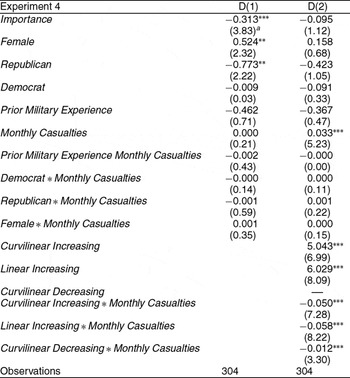
The findings suggest the casualty pattern experienced represents the central mechanism affecting attitudes. Perhaps, however, individual attributes drive responses to casualty levels? I conduct two diagnostic analyses on Experiment 4 using Cox hazard analysis (Models D1 and D2, shown in Table 3). First, in D1 I drop the casualty patterns and their interactions and include the individual characteristics, monthly casualties, and new variables that interact each of the individual characteristics with monthly casualties (e.g., Female*Monthly Casualties). Similar to the previous results, the individual characteristics are strong and in the anticipated direction, and the casualty-based variables fail to attain significance. In D2, I add the pattern and interactive variables. Again comparable to the earlier results, the pattern-based variables and monthly casualties now attain statistical significance and the individual characteristics along with their interactions have no effect. The results tell a consistent story: the key to people's reaction to monthly casualties is not the lenses provided by their individual characteristics but the contexts generated by their casualty experiences.
Diagnostics, Cox Hazard Analyses

aTwo-tailed tests; absolute value of Z statistics in parentheses.
*Significant at 10%; ** significant at 5%; *** significant at 1%.
I conduct a number of other diagnostic tests (results not shown). First, one might be concerned that the skew of the dependent variable (many people fail quickly) affects the estimates of the error terms. A robust Cox hazard analysis on the most skewed distribution, Experiments 5 and 6 lead to significance levels similar to those shown in Model 7 (with the exception of Republican which becomes significant). I also reanalyze the models with a Weibull distribution and obtain similar results. Finally, since it takes the subjects a while to observe casualty trends, I dropped the first two values of the dependent variable and reanalyzed the key models, and the central results hold.
CONCLUSION
The effect of recent losses on support depends on the wartime patterns that generated them. All casualties are not the same: “context matters” (Boettcher Reference Boettcher1995, 577). The results strongly support the rational expectations theory: recent casualties, casualty trends, and the interaction of the two influence public approval of a conflict. Six experiments using hypothetical military situations and the Iraq War, conducted in the field and laboratory, tell a similar story. Additional findings suggest that (1) individual characteristics have minimal effect on the casualty and opinion relationship, (2) information levels mitigate the influence of casualty trend signals, (3), the probability of victory is not a substitute for casualties, (4) students and older adults react similarly to casualty trends, (5) the mobilization of the reserves has no influence on support, and (6) a panel experiment is effective for analyzing wartime support.
All research designs represent trade-offs between internal and external validity. The goal is to use multiple methods to maximize confidence in the results by mitigating the weaknesses of each individual design. The studies of the hypothetical scenarios help to delineate better the micro-processes involved in the casualty–opinion nexus. The advantage of experiments based on artificial military situations is greater internal validity, allowing the manipulation of both recent casualties and casualty trends. The hypothetical scenarios assist in insuring the subjects have little prior information unaccounted for by either the randomization processes or the observed variables that might affect the treatments' influence. The concern is about external validity, that the scenarios represent artificial tests that lack real world applicability (Lupia Reference Lupia2002). In a real war, people bring a host of varied information, biases, and beliefs into their decisions on how to respond to casualties (Sears Reference Sears1986). This information would include domestic political factors (such as support for the party in power), levels of initial support, and expectations of costs and benefits. Although casualty treatments in the panel experiments are clear and manipulable in an easily interpretable manner, in an actual war, cues about costs are more ambiguous.
The Iraq War field experiments address these issues. The subjects bring their beliefs, biases, and views into the study. The larger political situation is known, and the treatment is more subtle. Controlling for information levels and previous views of the War helps to capture the independent effect of the casualty treatment. At the same time, because the study occurs during a real war, it is unable to manipulate recent casualties and casualty trend simultaneously. Thus, the strengths of the Iraq War and hypothetical scenario experiments compensate for each others' weaknesses. Together, these experiments form a package that makes compelling arguments about the importance of casualty patterns on individuals' wartime attitudes.
The similarities of the national level experimental results with those generated in the laboratory generate additional external validity for studies employing student convenience samples. Keep in mind: these studies follow the recommendation of Mintz, Redd, and Vedlitz (Reference Mintz, Redd and Vedlitz2006) and are not trying to replicate elite decision making. Rather, they attempt to approximate people's likely answers to surveys about their support, the most common way of establishing approval levels, making external validity claims less demanding and more easily met.
Like the research by Gelpi, Feaver, and Reifler (Reference Gelpi, Feaver and Reifler2005, 44), I assume “members of the public appear to be engaging in simple but clear calculations about the expected value of continuing to engage in armed conflict.” However, I disagree with their claim that casualties are not a key driving force behind updated views on the war. Similar to previous studies, these results find casualties play a major role in influencing individual attitudes. Less clear from previous work, however, are the multiple direct and indirect roles casualties play. Moreover, these effects persist when factors such as the likelihood of victory, information levels, and individual characteristics are taken into account.
Following the ascension to the National Security Council of scholar Pete Fever, much was made of how the Bush Administration increased its emphasis on winning, consistent with the work of Gelpi and Feaver (Shane Reference Shane2005). My results suggest leaders looking to increase a conflict's support should work to create decreasing casualty trends. Because political knowledge mitigated the effect of casualty trend information, the effects of unsubstantiated elite statements that costs will decrease remain unclear. Future research should examine how individuals deal with contrary elite and media signals about costs and victory.
For most people, support for a conflict is conditioned on expectations about key factors involving the outcome, direction, value, and costs of a conflict. War provides a variety of information people use to update their expectations about these factors. Critical are military fatalities—the most salient costs of war. The rational expectations theory of casualties finds that people consume information available to them and as a result, rely on a variety of casualty measures. Meaning requires context and casualty patterns provide the lens through which individuals interpret losses. Without this context, casualty figures are just numbers.



Comments
No Comments have been published for this article.