Implications
Several technologies are available to increase muscle growth in livestock species including the use of β-adrenergic agonists (βAA) and mutations of myostatin (Mstn). However, this is the first published study involving the use of βAA in Mstn null animals. We concluded that these two factors both increase muscle growth, decrease fat deposition and are completely additive suggesting that βAA and Mstn null mutations, both resulting in muscle hypertrophy, work through separate pathways. Other means that may exploit pathways similar to the Mstn null mutation are possible in addition to βAA to further increase muscle growth.
Introduction
Several strategies are available to alter muscle and fat growth in animals with the ultimate goal of increasing efficiency of livestock production. The use of β-adrenergic agonists (βAA) to increase muscle mass and decrease fat mass in several species is well established (Ricks et al., Reference Ricks, Baker and Dalrymple1984; Mersmann, Reference Mersmann1998; Beermann, Reference Beermann2002). Clenbuterol, although not approved for commercial use in livestock, increases muscle growth in mice and other species (Yang and McElligott, Reference Yang and McElligott1989). Another strategy to alter animal growth is to introduce mutations into the Mstn gene as occurs naturally in double-muscled cattle. These cattle exhibit striking increases in muscle growth and reductions in fat mass (Grobet et al., Reference Grobet, Royo Martin, Poncelet, Pirottin, Brouwers, Riquet, Schoeberlein, Dunner, Menissier and Massabanda1997; Kambadur et al., Reference Kambadur, Sharma, Smith and Bass1997; McPherron and Lee, Reference McPherron and Lee1997; Grobet et al., Reference Grobet, Poncelet, Royo, Brouwers, Pirottin, Michaux, Menissier, Zanotti, Dunner and Georges1998). Transgenic Mstn null mice can be used as a model for this effect as this species also exhibits increased muscularity and decreased fat deposition (McPherron et al., Reference McPherron, Lawler and Lee1997; McPherron and Lee, Reference McPherron and Lee2002). Furthermore, disruption of Mstn function is thought to confer resistance to several types of obesity development (McPherron and Lee, Reference McPherron and Lee2002; Zhao et al., Reference Zhao, Wall and Yang2005).
Although the results of Mstn disruption are similar to those of treatment with βAA, namely increased muscle deposition and decreased fat mass, the proposed mechanisms of each are quite different. Clenbuterol is a selective β-2 agonist (Hinkle et al., Reference Hinkle, Hodge, Cody, Sheldon, Kobilka and Isfort2002) and results in alterations in protein deposition possibly through changes in protein synthesis or degradation rates, but a specific mechanism is, as of yet, unclear. Clenbuterol has also been shown to reduce adipose tissue mass through apoptosis of adipocytes (Page et al., Reference Page, Hartzell, Li, Westby, Della-Fera, Azain, Pringle and Baile2004). In contrast to βAA, Mstn functions in cell-cycle regulation with the loss of Mstn function resulting in increased proliferation of embryonic and foetal myoblasts causing hyperplasia (Thomas et al., Reference Thomas, Langley, Berry, Sharma, Kirk, Bass and Kambadur2000) and greater activity in satellite cells contributing to increased hypertrophy (McCroskery et al., Reference McCroskery, Thomas, Maxwell, Sharma and Kambadur2003). Mechanisms behind the reduced adiposity of Mstn null mice and their resistance to obesity are less clear. It may simply be a result of increased energy needs of muscle tissue, thus reducing the energy available for fat deposition, or may result from altered adipocyte function due to the loss of Mstn activity.
Because of the disparate mechanisms of increased muscle and reduced fat growth from alteration of Mstn or the use of βAA, we hypothesized that the Mstn null mutation would not alter responsiveness to βAA treatment, although such an interaction has not previously been tested. It is possible, however, that increased muscle growth due to the loss of Mstn function is so extensive that further increases are not possible, and in this scenario, one would expect that Mstn null mice would be unresponsive to clenbuterol treatment. Simply put, muscles of Mstn null animals may have reached their maximal size and cannot grow any larger. To test this hypothesis, clenbuterol was administered to Mstn null and wild-type mice. Several measures of muscle mass and adiposity were used to determine the impact of clenbuterol treatment on muscle and fat growth in these mice.
Material and methods
Animals, observations and materials
Five-week-old male Mstn null (n = 24) and wild-type (n = 32) mice from an internal C57BL6/J colony were housed singly in solid-bottom cages and given ad libitum access to pelleted rodent chow (Teklad F6 rodent diet, Harlan, Indianapolis, IN, USA) and water. Ambient room temperature was maintained with a 12-h light/dark cycle. Mice received free access to either tap water (control) or tap water with 20 p.p.m. clenbuterol (Sigma-Aldrich, St Louis, MO, USA; item no. C5423) for 2 weeks. Body, food and water weights were all measured on days 1 (trial initiation), 8 and 15 (trial conclusion). Efficiency was calculated by dividing weight gain by food intake. Animals were killed on day 15 by CO2 asphyxiation and cervical dislocation. All animal procedures were approved by the University of Illinois Institutional Animal Care and Use Committee.
Dissection and proximate composition
A subset of mice (12 wild type and 10 Mstn null) were dissected to estimate muscle and fat deposition. Inguinal, retroperitoneal and epididymal fat pads were harvested and weighed. Skin, feet, head, tail and viscera were removed and the remaining carcass (i.e. empty carcass) was weighed. Tibialis anterior, triceps brachii, biceps femoris and gastrocnemius muscles were removed from the right side and weighed.
Proximate composition of empty carcass and viscera were determined on a subset of mice (20 wild type and 14 Mstn null) to estimate muscle and fat deposition. Empty carcasses and viscera were weighed, dried in a 60°C oven for at least 48 h, re-weighed and ground with a commercial coffee grinder (SmartGrind, Black and Decker, Towson, MD, USA). Ground samples were then dried to a constant weight in a 110°C oven. Lipid content was calculated by weight difference after extraction with 4 : 1 chloroform:methanol solution (Novakofski et al., Reference Novakofski, Park, Bechtel and McKeith1989). Crude protein content (nitrogen × 6.25) was determined by the combustion method (Association of Official Analytical Chemists (AOAC), 2000; method 990.03) with a Leco model FP2000 (Leco Corporation, St Joseph, MI, USA), using EDTA as an internal standard.
Statistical analysis
Statistical analyses were performed using SAS version 9.1 (SAS Institute Inc., Cary, NC, USA). Analysis of variance was used to determine the significance of genotype, clenbuterol treatment and their interaction, employing the mixed procedure of SAS. For body weight (BW), analysis included repeated measures with an autogressive variance/covariance structure. Data are presented as least squares means ± s.e.m. with P-values for the main effects of genotype, clenbuterol treatment and their interaction. Of particular interest is the interaction term as lack of significant interaction indicates that main effects are completely additive, and response to clenbuterol treatment is similar between the two genotypes.
Results
BW, food intake and efficiency, water intake and clenbuterol dose
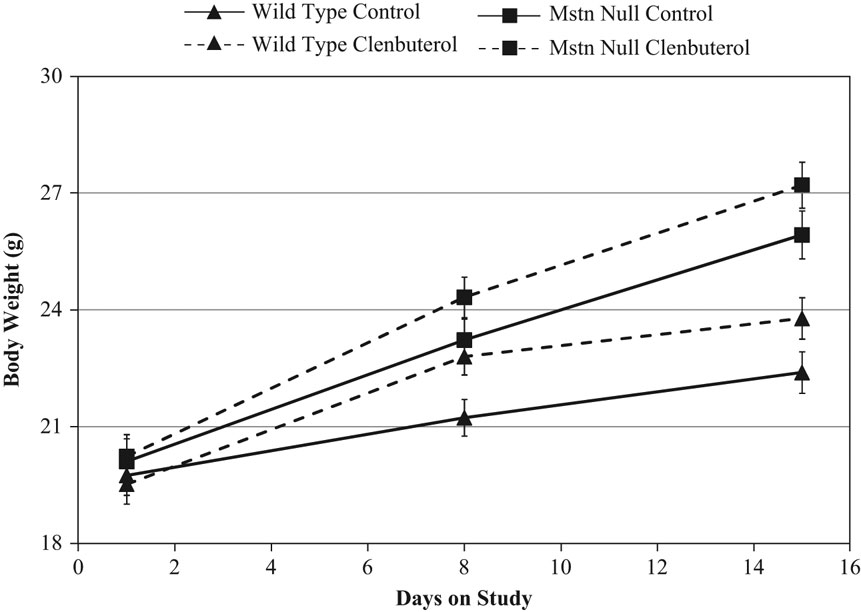
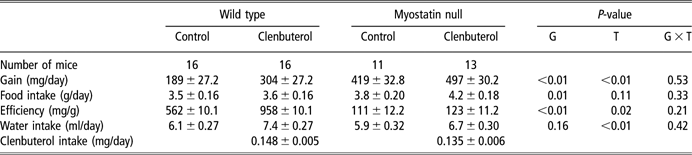
There were no differences in BW between the genotypes on day 1. After 7 days on trial, however, Mstn null mice were 1.8 g heavier (P < 0.01) than wild-type mice, and mice treated with clenbuterol were 1.3 g heavier (P = 0.01) than control (Figure 1). These effects continued until the end of the trial (day 15) when Mstn null mice were 3.5 g heavier (P < 0.01) than wild-type mice, and clenbuterol treatment increased (P = 0.02) BW by 1.3 g. There was no interaction (P > 0.64) between genotype and clenbuterol treatment for BW at any time point. Similarly, gain (mg/day) was higher (P < 0.01) in Mstn null mice compared with wild type and was increased (P < 0.01) by clenbuterol treatment (Table 1). Food intake (mg/day) was also higher (P = 0.01) in Mstn null compared with wild type but was not impacted by clenbuterol treatment (P = 0.11). Efficiency (gain : food), however, was higher (P < 0.01) in Mstn null mice compared with wild type and was also increased (P = 0.02) by clenbuterol treatment. There was no interaction of genotype and clenbuterol treatment for gain, food intake or efficiency (P > 0.21). Water intake was increased (P < 0.01) in clenbuterol-treated mice compared with control but was not impacted by genotype. Given the water intake of these mice, clenbuterol intake was estimated to be 0.148 mg/day for wild type and 0.135 mg/day for Mstn null mice.
Body weight during clenbuterol administration (dashed lines) to wild type (▴) and myostatin null (▪) mice with standard errors displayed.

Effects of genotype (G) and clenbuterol treatment (T) and their interaction (G × T) on daily gain, food intake, water consumption and clenbuterol dose of wild-type and myostatin null mice

Values are least squares means ± s.e.m. Efficiency was calculated by dividing weight gain by food intake. P-values are not provided for clenbuterol intake, as it was a numerical calculation based on water intake.
Proximate composition of carcass and viscera
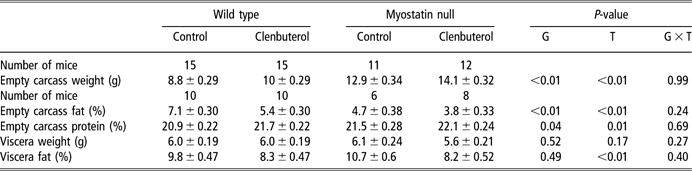
To establish the composition of increased BW in Mstn null mice and in mice treated with clenbuterol, proximate analyses of the empty carcass and the viscera were performed (Table 2). Empty carcass weight was approximately 4 g higher (P < 0.01) in Mstn null mice compared with wild type and was increased (P < 0.01) approximately by 1 g by clenbuterol treatment. There was no interaction of genotype and clenbuterol treatment for empty carcass weight (P = 0.99). Furthermore, indicative of increased muscle growth, protein content of empty carcasses was 0.5 percentage units higher (P = 0.04) in Mstn null mice compared with wild type, and was increased by 0.7 percentage units (P < 0.01) by clenbuterol treatment. Conversely, fat content of the empty carcass was 2 percentage units lower (P < 0.01) in Mstn null mice compared with wild type, and was decreased by 1.3 percentage units (P < 0.01) by clenbuterol treatment, indicative of lower fat deposition. Weight of viscera was not different between the treatment groups, but fat content of the viscera was decreased by 2 percentage units (P < 0.01) by clenbuterol treatment. For all proximate composition traits, there was no interaction of genotype and clenbuterol treatment (P > 0.24).
Effects of genotype (G) and clenbuterol treatment (T) and their interaction (G × T) on empty carcass weight and composition and viscera weight and composition of wild-type and myostatin null mice

Values are least squares means ± s.e.m. Empty carcass is carcass remaining after skin, head, tail, feet and viscera were removed.
Muscle and fat pad weights
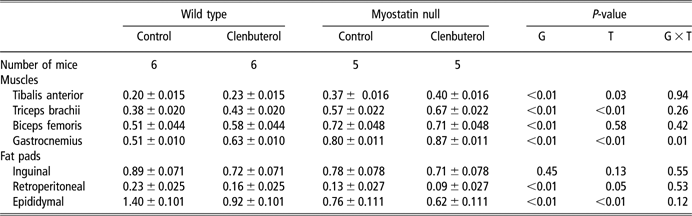
To further establish the concept of increased muscle and decreased fat deposition in Mstn null mice and mice treated with clenbuterol, several muscles and fat pads were dissected and weighed (Table 3); these data were normalized to day 15 BWs (Figure 1). Muscle weights of Mstn null mice were 1.5 to 2 times heavier (P < 0.01) than those of wild-type mice. Clenbuterol treatment also increased the weight of tibialis anterior, triceps brachii and gastrocnemius muscles (P < 0.05), but did not alter the weight of the bicep femoris. For the gastrocnemius, however, there was an interaction (P = 0.01) of genotype and clenbuterol treatment indicating a decreased response to clenbuterol treatment in Mstn null mice. In wild-type mice, gastrocnemius weight was increased by 0.12 percentage units (4.5 mg) whereas in Mstn null mice, it was increased by only 0.07 percentage units (2.8 mg).
Effects of genotype (G) and clenbuterol treatment (T) and their interaction (G × T) on muscle and fat pad weights (% of body weight) of wild-type and myostatin null mice

Values are least squares means ± s.e.m.
Inguinal fat pad weight was not altered by genotype or clenbuterol treatment. Retroperitoneal and epididymal fat pad weights were decreased by (P < 0.01) 0.08 and 0.47 percentage units, respectively, in Mstn null mice compared with wild type and were also reduced (P < 0.05) by clenbuterol treatment. The interaction of genotype and clenbuterol treatment was tending towards significance (P = 0.12) for the epididymal fat pad. Similar to the gastrocnemius muscle, Mstn null mice were not as responsive to clenbuterol as wild-type mice. Epididymal fat pad weight was decreased by 0.48 percentage units in wild-type mice, whereas it was only reduced by 0.14 percentage units in Mstn null mice.
Discussion
Both the Mstn null mutation and clenbuterol administration result in increased muscle mass and decreased fat mass in animals, including mice. Although phenotypic outcomes are similar, the mechanisms by which each factor impacts these tissues are quite different. Therefore, we hypothesized that Mstn null mice would respond to clenbuterol treatment similarly to wild-type mice. This interaction of βAA treatment and the loss of Mstn function have not previously been reported. Thus, it is imperative to establish whether the Mstn null mutation and clenbuterol treatment elicit mutually exclusive effects.
Disruption of Mstn functionality results in increased muscle mass, decreased adiposity and improved efficiency (McPherron and Lee, Reference McPherron and Lee1997; Szabo et al., Reference Szabo, Dallmann, Muller, Patthy, Soller and Varga1998; Yang et al., Reference Yang, Ratovitski, Brady, Solomon, Wells and Wall2001; McPherron and Lee, Reference McPherron and Lee2002; Mitchell and Wall, Reference Mitchell and Wall2007). Mstn null mice often exhibit muscle weights 1.5 to 2 times greater than their wild-type counterparts (McPherron et al., Reference McPherron, Lawler and Lee1997), whereas weights of individual fat pads are reduced (McPherron and Lee, Reference McPherron and Lee2002). In our experiment, the Mstn null mutation resulted in the expected phenotype. BW and empty carcass weight were both increased by 3.5 g and 4 g, respectively, in Mstn null mice compared with wild type. The majority of weight gain was either in muscle or bone tissue as indicated by the large increase in empty carcass weight. Although viscera weight was not reduced in Mstn null mice compared with wild type, it did constitute a smaller proportion of total body mass. This finding is similar to reports of smaller organ sizes in double-muscled cattle (Arthur, Reference Arthur1995), the mechanism of which is unclear.
Food intake was also increased in Mstn null mice compared with wild-type mice contrary to other reports (Lin et al., Reference Lin, Arnold, Della-Fera, Azain, Hartzell and Baile2002; McPherron and Lee, Reference McPherron and Lee2002). Compared with previous research, mice in our study seemed to consume less food overall. This may reflect slight site-to-site and strain-to-strain differences in Mstn null mice. However, efficiency (gain : food) was increased in Mstn null mice compared to wild type, indicating that although they consumed more food than their wild type counterparts, Mstn null mice were still more efficient at converting nutrients into body tissue. As others have shown increased weight gain in Mstn null mice, despite a lack of change in food intake, increased efficiency was expected. Muscle mass was increased in Mstn null mice compared with wild type. Weights of individual muscles were 1.5 to 2 times higher in Mstn null mice compared with wild type, similar to previous reports (McPherron et al., Reference McPherron, Lawler and Lee1997). Further evidence of increased muscularity in Mstn null mice included the 0.5 percentage unit increase in empty carcass protein percentage compared with wild type. Conversely, fat deposition was reduced by the Mstn null mutation. We observed a 2 percentage unit decrease in empty carcass fat percentage, and a reduction in fat pad weight of 33% to 38% in Mstn null compared with wild-type mice, similar to the findings of McPherron and Lee (Reference McPherron and Lee2002). There was no observed decrease in visceral fat content in Mstn null mice. From these data, we conclude that the loss of Mstn function increased muscularity and decreased adiposity as expected.
Clenbuterol treatment, similar to several other βAA, improves feed efficiency, increases protein accretion, and therefore muscle mass, and decreases fat mass (Ricks et al., Reference Ricks, Baker and Dalrymple1984, Yang and McElligott, Reference Yang and McElligott1989; Mersmann, Reference Mersmann1998; Beermann, Reference Beermann2002). As a selective β-2 agonist (Hinkle et al., Reference Hinkle, Hodge, Cody, Sheldon, Kobilka and Isfort2002), clenbuterol likely alters protein degradation (Reeds et al., Reference Reeds, Hay, Dorwood and Palmer1986; Yimlamai et al., Reference Yimlamai, Dodd, Borst and Park2005) to increase protein accretion, but may also alter protein synthetic rates. Alternatively, reductions in fat mass may result from energy repartitioning or direct effects on adipocyte apoptosis (Page et al., Reference Page, Hartzell, Li, Westby, Della-Fera, Azain, Pringle and Baile2004). In our experiment, clenbuterol treatment increased muscle deposition and reduced fat mass as expected. Body and empty carcass weights were increased by 1.3 g and 1 g, respectively, in clenbuterol-treated mice compared with control. The large proportion of BW gain retained in the empty carcass was indicative of increases in muscle and bone mass as opposed to increased visceral or fat mass. Previous reports have indicated that heart muscle weight is increased with clenbuterol treatment (Petrou et al., Reference Petrou, Wynne, Boheler and Yacoub1995; Cubria et al., Reference Cubria, Reguera, Balana-Fouce, Ordonez and Ordonez1998). Thus, we would have expected increased viscera weight, but in our study, viscera weight was unchanged by clenbuterol treatment. It is possible that cardiac hypertrophy occurred in our study, but was unnoticeable as the entire visceral mass, and not the heart alone, was weighed. Increased muscularity of clenbuterol-treated mice, as suggested by increased empty carcass weight, was also observed. Muscle weights of clenbuterol-treated mice were 1.2 times heavier than those of control mice. Clenbuterol treatment also resulted in a 0.7 percentage unit increase in empty carcass protein percentage. Furthermore, clenbuterol treatment reduced fat mass as expected. Fat pad weight was decreased by 23% to 25%, and empty carcass fat percentage was reduced by 1.3 percentage units. In contrast to the impact of the Mstn null mutation, visceral fat content was also lowered by clenbuterol treatment. Therefore, we conclude from these data that clenbuterol treatment increased muscle growth and decreased fat mass, similar to previous reports.
Given that results of both clenbuterol treatment and Mstn null mutation were as expected, we were able to determine the validity of our hypothesis that Mstn null mice respond similarly to wild-type mice to clenbuterol treatment. A lack of significant interaction between genotype and clenbuterol treatment would, therefore, validate our hypothesis. The only trait with a significant interaction was gastrocnemius weight. The increase in gastrocnemius muscle weight from clenbuterol treatment was less in Mstn null mice than in wild type. There was also a tendency for the decrease in epididymal fat with clenbuterol treatment to be less in Mstn null mice than in wild type. Thus, in these instances, it is possible that the phenotypic effect of the Mstn null mutation was so extreme (i.e. greatly increased weight of the gastrocnemius and reduced weight of the epididymal fat pad), that additional changes from clenbuterol treatment were minimal. However, both of these tissues did experience numerical changes in weight in Mstn null mice treated with clenbuterol, indicating that the capacity to respond was intact, but somewhat blunted. For all other traits measured, there was no significant interaction, indicating the effect of Mstn null mutation, and clenbuterol treatment was completely additive. Thus, Mstn null mice experienced increased muscle deposition and reduced fat mass due to clenbuterol treatment to the same extent as wild-type mice.
Given their diverse mechanisms of action, it is logical to conclude that βAA treatment and Mstn disruption would not interact. However, with identification of Mstn (McPherron et al., Reference McPherron, Lawler and Lee1997) and its association to the well-characterized double-muscling phenotype in cattle (Grobet et al., Reference Grobet, Royo Martin, Poncelet, Pirottin, Brouwers, Riquet, Schoeberlein, Dunner, Menissier and Massabanda1997; Kambadur et al., Reference Kambadur, Sharma, Smith and Bass1997; McPherron and Lee, Reference McPherron and Lee1997), the idea of a muscle chalone – an inhibitory molecule secreted by the muscle, which ultimately governed its size (Bullough, Reference Bullough1962 and Reference Bullough1965) – was revived (Lee and McPherron, Reference Lee and McPherron1999). If Mstn was this muscle chalone, the loss of its function to regulate the size of muscle independent of other factors would allow muscle to grow to its maximal possible size. The ‘doubling’ observed in mice and cattle lacking Mstn activity certainly seems to represent a type of maximal size that muscle could attain and unresponsiveness to other means of increasing muscle growth would be expected. The working hypothesis that Mstn was the elusive muscle chalone, however, has been disproven as supported by evidence from our study and others. Whereas the increase in muscle mass of Mstn null mice is large, there is now sufficient evidence to suggest that maximal muscle growth has not yet been attained. Mice with postnatal transgenic overexpression of Mstn propeptide fed high-fat diets exhibit increased muscle growth compared to similar transgenic mice fed lower-fat diets (Yang and Zhao, Reference Yang and Zhao2006). Furthermore, follistatin overexpression in Mstn null mice also results in increased muscle growth compared with normal Mstn null mice – nearly a quadrupling of muscle mass compared with wild-type mice (Lee, Reference Lee2007). Our study, in which Mstn null mice exhibited increased muscle growth following clenbuterol treatment, provides additional evidence contradicting the hypothesis that Mstn may serve as a muscle chalone and indicates that Mstn null mice respond to treatment with βAA similar to wild-type mice.