Significant outcomes
• Monoamine oxidase A-variable number tandem repeat (MAOA-uVNTR) low-activity alleles, considered ‘risk genes’ in environmental adversity especially in male subjects, are at the population level not associated with psychiatric disorders or aggressive behaviour.
• In contrast, MAOA-uVNTR low-activity alleles were associated with socio-economic success in terms of obtaining university education.
Limitations
• The reduced sample size because of the exclusion of heterozygous female subjects from the analysis.
• Teacher- and self-reported phenotype data.
• No correction for multiple comparisons.
Introduction
MAO-A is an enzyme predominantly found in catecholaminergic neurons, which oxidatively deaminate monoamine neurotransmitters. In humans, MAO-A activity is transcriptionally regulated by the MAOA gene located on Xp11.23–11.4 (Reference Shih, Chen and Ridd1). The study by Brunner et al. (Reference Brunner, Nelen, Breakefield, Ropers and van Oost2) on a large Dutch kindred implicated MAOA as the first candidate susceptibility gene for human aggression. Common genetic variation at the MAOA locus exists in the form of the functional 30 base-pair VNTR polymorphism present in 2, 3, 3.5, 4 or 5 copies (Reference Deckert, Catalano and Syagailo3). The alleles are characterised by differential transcriptional efficiency, with the 2-, 3- and 5-repeat alleles considered to be low activity, and the 3.5- and 4-repeat alleles considered high activity (Reference Sabol, Hu and Hamer4). At the neurophysiological level, MAOA low-activity variants are associated with lower cerebral activity in prefrontal areas, and increased functional connectivity between prefrontal cortex and amygdala regions (Reference Meyer-Lindenberg, Buckholtz and Kolachana5). In emotional memory and inhibitory control tasks, increased reactivity of amygdala and deficient activation within the cingulate region associated with increased impulsivity were found in MAOA low-activity allele carriers; however, the effects were evident in male subjects but not in female subjects (Reference Meyer-Lindenberg, Buckholtz and Kolachana5). The authors suggest that the synergistic impairment in cognitive and emotional neural regulatory mechanisms might render low MAOA male subjects at a risk of impulsive violent behaviour. Indeed, the low-activity alleles of the MAOA-uVNTR have been found to be related to aggressive and impulsive traits (Reference Huang, Cate, Battistuzzi, Oquendo, Brent and Mann6–Reference McDermott, Tingley, Cowden, Frazetto and Johnson8), antisocial behaviour (Reference Fowler, Langley and Rice9,Reference Beaver, Delisi, Vaughn and Barnes10), and are a risk factor for alcoholism (Reference Ducci, Enoch and Hodgkinson11,Reference Tikkanen, Ducci and Goldman12). However, there are also several findings of the opposite: in a non-clinical male sample, MAOA high-activity alleles were associated with higher self-reported impulsivity and aggressiveness (Reference Manuck, Flory and Ferrell13). Data from the association studies also suggest that genetic variation in the MAOA gene is linked to a general vulnerability to develop psychiatric disorders. The MAOA high-activity alleles have been related to increased risk for depression (Reference Schulze, Muller and Krauss14,Reference Rivera, Gutierrez and Molina15) and, according to a recent meta-analysis, also to an increased risk for panic disorder in female patients (Reference Reif, Weber and Domschke16). High-activity alleles of MAOA are also considered the risk alleles for attention deficit hyperactivity disorder (ADHD) (Reference Manor, Tyano and Mel17), but this was not confirmed in a meta-analysis, which found only non-significant and weak association between ADHD and high-activity alleles (Reference Gizer, Ficks and Waldman18).
In healthy young people, the effects of monoaminergic genes on impulsivity appear to be context dependent (Reference Stoltenberg, Christ and Highland19), and the MAOA low-activity alleles are associated with increased aggressive reactivity to provocation (Reference Kuepper, Grant, Wielpuetz and Hennig20). Further research has revealed that the functional variants of MAOA-uVNTR modulate the impact of environmental factors on aggression-related behavioural traits.
A reproducible gene × environment interaction involving the low-activity alleles of MAOA-uVNTR and childhood adversities for antisocial behaviours has been confirmed by meta-analysis (Reference Taylor and Kim-Cohen21) and in several more recent independent association studies (Reference Weder, Yang and Douglas-Palumberi22,Reference Fergusson, Boden, Horwood, Miller and Kennedy23). However, the effect sizes in these studies are small and there are also negative results: a recent study on 5249 children found childhood maltreatment to be associated with conduct problems among adolescent boys, with no observable main genetic or interaction effects for the MAOA gene (Reference Kieling, Hutz and Genro24). It may, however, be hypothesised that, even in subjects at genetic risk, the conduct problems and overt aggression may occur only if coping with life stress is poor and no clear options for self-actualisation are available. If otherwise, MAOA low-activity alleles might even be beneficial and this would help to explain their persistence in population. Indeed, there is evidence that MAOA low allele carriers are more inclined to accept gamble if net gain can be high, and are better in making optimal financial decisions under risk (Reference Frydman, Camerer, Bossaerts and Rangel25). In female subjects, the low-expression alleles of MAOA gene seem to predict higher self-reported happiness (Reference Chen, Pine and Ernst26).
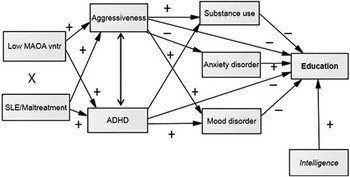
Recent research on gene–environment interaction highlights the possibility that some children are qualitatively differentially affected by their rearing experiences (Reference Caspi, McClay and Moffit27,Reference Kim-Cohen, Caspi and Taylor28). Male subjects with the MAOA low-activity alleles proved most antisocial in young adulthood when they experienced maltreatment in childhood, whereas individuals with the same MAOA allele scored lowest in antisocial behaviour if not exposed to maltreatment (Reference Caspi, McClay and Moffit27). In the study by Kim-Cohen et al. (Reference Kim-Cohen, Caspi and Taylor28), boys with the MAOA low-activity alleles had more ADHD symptoms when they had been victims of abuse, but fewer symptoms if they had not, compared with boys with MAOA high-activity alleles. Therefore, it seems that MAOA low-activity allele carriers benefit more from positive parenting and supportive environment than those with MAOA high-activity alleles. In addition, several sex and genotype interaction effects are observed in self-reports and behavioural tests across studies. Although most studies have shown that the MAOA high-activity alleles are associated with less aggressive behaviour in male subjects, this variant may be a risk factor for delinquency in female subjects who had experienced maltreatment (Reference Sjöberg, Nilsson, Wargelius, Leppert, Lindstrom and Oreland29,Reference Åslund, Nordquist, Comasco, Leppert, Oreland and Nilsson30). This is compatible with the reported sex differences in brain functions associated with aggression in relation to the MAOA genotype (Reference Meyer-Lindenberg, Buckholtz and Kolachana5). It is thus likely that the MAOA genotype has sex-dependent effects on behavioural outcomes, and in general population either type of alleles carries its own advantages over the life course. A person's socio-economic position that has major implications for mental health and general well-being is largely determined by education, occupational social class and income. Of those, educational level is generally acquired by early adulthood and it provides knowledge, skills and other non-material resources, as well as the formal qualifications required for the successful exploitation of employment opportunities in further life. The conceptual model for the study is presented in Fig. 1. We assume that the low-activity alleles of MAOA together with adverse environment will lead to aggressive and hyperactive behaviour in adolescence, which in turn increases the risk of substance-use and mood disorders in young adulthood, subsequently resulting in lower educational level.
The schematic representation of the current study concept.

Aims of the study
The aim of the present study was to investigate the relationship between the MAOA-uVNTR genotype and mental health in adolescence and young adulthood using a population representative sample and a longitudinal design, and the effect of genotype and psychiatric disorders in obtaining higher education.
Material and methods
Participants
The original sample of the European Youth Heart Study (1998/99), which was subsequently incorporated into the longitudinal Estonian Children Personality Behaviour and Health Study (ECPBHS), was used. The rationale for sample formation and procedure of data collection has been described in detail previously (Reference Harro, Eensoo and Kiive31,Reference Tomson, Merenäkk, Loit, Mäestu and Harro32). In the present analysis, data of the older cohort, aged 15.6 ± 0.6 years at the original sampling, were used. The original sample consisted of 593 subjects, 260 male and 333 female. Additional data were collected during the follow-ups in 2001 and in 2008 when the subjects were 18.3 ± 0.5 and 24.7 ± 0.7 years old, respectively. The study was conducted according to the protocol approved by Ethics Review Committee on Human Research of the University of Tartu, and all participants (and for minors also their parents) gave written informed consent.
Genotyping
Genomic DNA was isolated from venous blood samples. For genotyping, a 10 μl reaction mixture contained 30 ng genomic DNA, PCR buffer (MgCl2; 7% DMSO; 0.2 μM dNTP), 0.8 μM of each primer and 0.5 units Taq-DNA polymerase (Roche Diagnostics, Berlin, Germany). As a forward primer 5′-ACA GCC TGA CCG TGG AGA AG-3′ was used, and as a reverse primer, 5′-GAA CGG ACG ACG CTC CAT TCG GA-3′. PCR reactions were performed on a GeneAmp 9700® at the following profile: 94°C for 4 min, 45 × (94°C for 60 s, 61°C for 60 s, and 72°C for 90 s) and finally 72°C for 7 min. The PCR products were analysed by electrophoresis on a 3% agarose gel. DNA in agarose gel was visualised using SYBR® Safe DNA Gel Stain (Invitrogen TM, Carlsbad, California, USA) under UV light after being run for 1 h at 120 V. Buffer used was 0.5 M Tris-EDTA buffer. DNA bands representing the different genotypes were read from the gel and validated by another person from the gel photographs. According to Sabol et al., the 2-, 3- and 5-repeat alleles of MAOA were considered to be low activity, and the 3.5- and 4-repeat alleles were considered high activity. The MAOA-uVNTR polymorphism was genotyped in 382 subjects. As the MAOA-uVNTR polymorphism is X-linked, the Hardy–Weinberg equilibrium is reported for female subjects only (χ2 = 3.51; p > 0.05).
Stressful life events and family environment
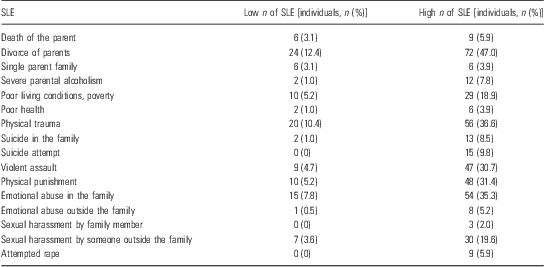
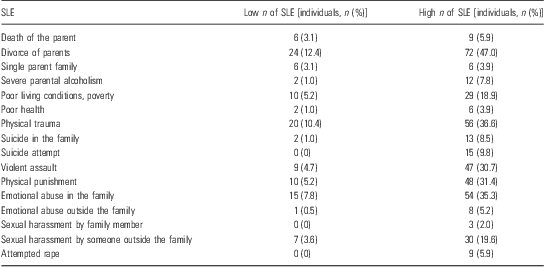
History of stressful life events was self-reported and the subjects were divided into low (56%) and high (44%) stressful life events exposure groups by using the median (three events) as a cut-off point. The list of adverse life events varied across measurement times and consisted of 10 to 17 stressful experiences (Reference Reif, Kiive and Kurrikoff33). The list of stressful life events and the number of individuals who have experienced the particular event in groups with low and high number of stressful life events is presented in Table 1.
The number and % of individuals who have experienced the particular SLE in the group with low number of SLEs (n = 193) vs. in the group with high number of SLEs (n = 153).
SLE, stressful life event.
Family relations were self-reported at age 18 with the Tartu Family Relationships Scale that consists of four subscales, combined to higher order scale Warmth (Closeness and Support) and Maltreatment (Neglect and Abuse) (Reference Kurrikoff, Lesch and Kiive34). On the basis of the median value of the warmth and maltreatment score, the participants were divided to form the groups with less (52%) and more maltreatment (48%) and less (49%) and more warmth (51%) in the family.
Education and mental abilities
School grades were self-reported at ages 15 and 18. Education was self-reported at age 25 and was categorised into two levels. The first group included the participants who had completed elementary, vocational or general secondary education, or had been studying at the university but were not graduated by age 25. The second group had completed university education with an academic degree by the age of 25. In Estonia, this means 3 + 2 years of studies, and graduation with the Master's degree. General mental abilities were assessed at age 25 by using the Raven Standard Progressive Matrices Test, sets C and D (Reference Raven, Raven and Court35).
Psychological measures
Ratings of ADHD symptoms and aggressiveness at ages 15 and 18 were reported by teachers using the 7-point Hyperactivity Scale and Swanson, Nolan and Pelham Questionnaire IV (SNAP-IV; described in Kiive et al.) (Reference Kiive, Kurrikoff, Mäestu and Harro36). At age 25, subjects filled in the World Health Organization Adult ADHD self-report scale (ASRS) symptom checklist (Reference Kessler, Adler and Ames37).
Psychiatric assessment
At age 25, the Mini-International Neuropsychiatric Interview (MINI.5.0.0) (Reference Sheehan, Lecrubier and Sheehan38) Estonian version (Reference Shlik, Aluoja and Kihl39) was used to screen for current and lifetime psychiatric disorders. MINI.5.0.0. is a structured psychiatric interview developed to diagnose DSM-IV and ICD-10 mental disorders. Diagnostic assessment was carried out by experienced clinical psychologists.
Data analysis
Non-parametric Wilcoxon Mann–Whitney rank sum test was used to test the main effect of the MAOA genotype on behavioural measures, as these variables were not normally distributed. Univariate general linear modelling was used when analysing the interaction effect of family relations, stressful life events and MAOA-uVNTR on behavioural measures and Raven Progressive Matrices score. χ2-test was used to assess the educational distribution and occurrence of psychiatric disorders by the age of 25 in participants with different MAOA genotypes. Path analyses (SPSS Amos) were performed to examine the direct effect of MAOA genotype and environmental conditions on behaviour, occurrence of psychiatric disorders and the indirect effect of behaviour and psychiatric disorders on educational attainment. Two analyses were performed consisting of a simple model examining the relationship between genotype, environmental variables and behavioural measures, and a full model examining the relationships among genotype, environment, behaviour, psychiatric disorders and education. The values of root mean square error of approximation (RMSEA) <0.08 and comparative fit index (CFI) >0.9 were considered as a satisfactory model fit. Logistic regression analysis was performed to examine the predictive value of MAOA genotype, Raven score and psychiatric disorders on educational attainment by the age of 25.
Heterozygote MAOA-uVNTR female subjects were excluded from the analysis because of the potential inactivation of one of the X chromosomes. In the statistical analysis, the conventional 5% level was used to assess the significance.
Results
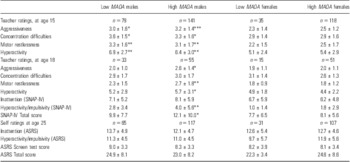
MAOA-uVNTR polymorphism had no main effect on aggressiveness or hyperactive and inattentive symptoms at any age. Data of teacher-evaluated and self-reported aggressive, inattentive and hyperactive behaviour in male and female subjects with different MAOA genotype are presented in Table 2.
Teacher-evaluated and self-reported inattentive–hyperactive behaviour (mean ± SD) by MAOA genotype in ECPBHS

ASRS, ADHD self-report scale; ECPBHS, Estonian Children Personality, Behaviour and Health Study; MAOA, monoamine oxidase A; SNAP-IV, Swanson, Nolan and Pelham Questionnaire IV.
*p < 0.05; **p < 0.005; ***p < 0.0001 different from females of respective age, same genotype.
Higher exposure to stressful life events was associated with increased concentration difficulties in 15-year-old adolescents [F(1,578) = 5.12, p = 0.02], and 3 years later at age 18 [F(1,287) = 12.88, p = 0.004]. In addition, at age 18, adolescents who reported more adverse life events were more aggressive and restless, F(1,287) = 12.41, p = 0.0005 and F(1,287) = 10.61, p = 0.001, respectively. Similarly, they had more inattentive [F(1,280) = 13.44, p = 0.003] and hyperactive/impulsive symptoms [F(1,280) = 4.57, p = 0.03] than adolescents with smaller number of stressful life events. This effect was also observed on self-ratings at age 25: subjects who reported higher number of stressful life events also reported higher number of inattentive and hyperactive/impulsive symptoms: F(1,533) = 21.05 and 28.56, respectively, p < 0.0001 (data not shown). Maltreatment in the family had significant impact on motor restlessness [F(1,271) = 6.45, p = 0.01] and concentration difficulties [F(1,271) = 7.23, p = 0.008] at age 18, and symptoms of inattention [F(1,265) = 6.76, p = 0.01]. However, the lack of warmth in the family had no significant influence on adolescent inattentive or hyperactive behaviour. No interaction effects of MAOA genotype and environment on aggressiveness or ADHD symptoms were observed (data not shown).
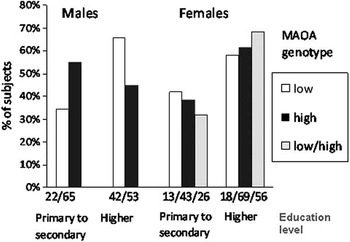
The proportion of male subjects with higher education at age 25 was significantly larger among those with MAOA low-activity alleles: 42 in 64 low MAOA subjects versus 53 in 118 high MAOA subjects: (χ2 = 7.13, df = 2, p = 0.008). No significant MAOA genotype effect on educational attainment was found in female subjects. The proportion of male and female subjects with different MAOA genotypes in higher and basic/secondary education groups is presented in Fig. 2.
The proportion of male and female subjects by MAOA genotype with primary to secondary versus higher education. Below columns show the number of subjects. MAOA, monoamine oxidase A.

MAOA genotype had no effect on school grades at age 15 or at age 18 [F(1,376) = 0.31, p = 0.86 and F(1,231) = 0.008, p = 0.93, respectively], nor on the score of Raven Progressive Matrices test: F(1,292) = 0.001, p = 0.97. The increased number of stressful life events (χ2 = 21.67, df = 2, p < 0.0001) and earlier maltreatment in the family (χ2 = 7.03, df = 2, p = 0.008) was associated with lower educational levels in females. In males, the number of stressful life events or relations in the family had no effect on the educational level at young adulthood.
A tendency towards higher prevalence of anxiety disorders in low MAOA subjects was found in male subjects: 11 in 60 versus 11 in 116 subjects (χ2 = 3.48, df = 2, p = 0.069). The prevalence of mood disorders, eating disorders and substance abuse was independent of MAOA genotype. The number of stressful life events or early maltreatment in the family had no effect on the occurrence of psychiatric disorders, and no interaction between the MAOA genotype and environment on mental disorders was observed.
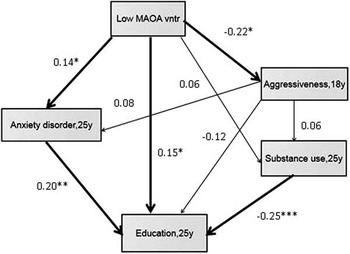
Next, path analyses were performed in male subjects to examine the relationship between MAOA genotype, stressful life events, family environment, aggressiveness, ADHD symptoms, psychiatric disorders and educational level. Each of the hypothesised mediators was first examined within a single mediator model. Significant mediators were then used for modelling the relationship between genotype, behaviour and education. Results of path analysis revealed significant associations between MAOA genotype, aggressiveness, anxiety disorder, substance-use disorder and education in male subjects, with a satisfactory fit to the proposed model (CFI = 0.95; RMSEA = 0.08). Figure 3 illustrates these results, with standardised β weights for all hypothesised paths. Unexpectedly, according to the model MAOA low-activity allele is associated with higher education both directly and through increasing probability for anxiety disorder, although the effects are quite modest (0.15 and 0.14, respectively).
Standardised path coefficients for predictors of education, *p < 0.05; **p < 0.01; ***p < 0.001.

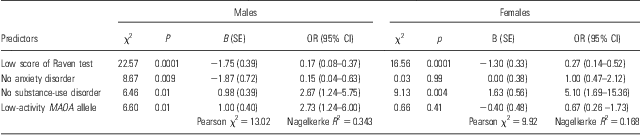
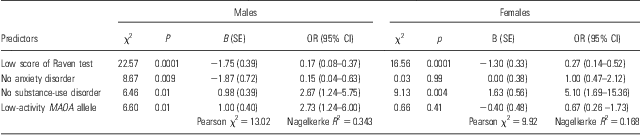
For comparison of factor effects in male and female subjects, logistic regression with Raven Progressive Matrices score, occurrence of anxiety and substance-use disorders and MAOA as predictors for the educational level was performed. It confirmed that MAOA low-activity alleles, higher mental abilities, anxiety disorders and absence of substance-use disorder were significant independent predictors for higher education in male subjects (Table 3). Also for female subjects, higher mental abilities and absence of substance-use disorder were significant predictors of higher educational attainment.
Logistic regression model for educational attainment: elementary/secondary education vs. university degree by the age of 25 years
MAOA, monoamine oxidase A.
Discussion
In the present study, the main goal was to examine the effects of the MAOA-uVNTR on mental health, especially aggressiveness and hyperactivity symptoms, and academic success. Opposite to what was expected, we found that MAOA low-activity alleles predict higher educational attainment in the male subjects, whereas no association was present in the female subjects.
MAOA genotype has no effect on general fluid intelligence; however, there are several reports of MAOA-uVNTR polymorphism affecting cognitive functioning, nevertheless with opposite directions of the effect. MAOA low-activity alleles have been associated with less efficient alerting and executive attention in healthy adult subjects (Reference Fossella, Sommer and Fan40). Brain imaging results and reaction time data indicate a more efficient handling of conflict (i.e. executive attention) in subjects with MAOA high-activity alleles compared with individuals with MAOA low-activity alleles (Reference Fan, Fossella, Sommer, Wu and Posner41,Reference Enge, Fleischhauer, Lesch, Reif and Strobel42). On the other hand, in the study on children with ADHD, Manor et al. (Reference Manor, Tyano and Mel17) found that children with MAOA high-activity alleles made more commission errors compared with those with MAOA low-activity alleles. However, these experimentally detected differences in cognitive functioning related to MAOA genotype are probably too small to affect such a complex endeavour like obtaining higher education.
The low-activity alleles of MAOA have also been associated with differences in limbic circuitry for emotion regulation and cognitive control. The study by Lee and Ham (Reference Lee and Ham43) reported that, in response to the sad and angry facial stimuli, participants with the MAOA low-activity alleles showed greater brain activity in the left amygdala and in the right anterior cingulate cortex and hippocampus, respectively. In addition, during perceptual task of matching of angry and fearful faces, increased brain activity in left amygdala was found in participants with low-activity alleles of the MAOA relative to MAOA high-activity allele carriers (Reference Meyer-Lindenberg, Buckholtz and Kolachana5). In addition, increased connectivity between amygdala and ventromedial prefrontal cortex was demonstrated in male subjects with MAOA low-activity alleles, and stronger coupling was associated with higher sensitivity to threat cues (Reference Buckholtz, Callicott and Kolachana44). The authors suggested that elevated serotonin and noradrenaline levels present in these individuals during development may alter the maturation of key nodes within the circuit of emotional arousal and regulation, resulting in less stable developmental framework. This less stable platform for affective responses in individuals carrying MAOA low-activity alleles may render them more susceptible to influence from environmental factors compared with those with MAOA high-activity alleles (Reference Buckholtz, Callicott and Kolachana44). Although upbringing in abusive environment might predispose male subjects with MAOA low-activity alleles towards aggression and violence in adulthood, it appears not always the case.
In our study, MAOA-uVNTR genotype had no independent or environmental interaction effect on teacher-rated aggressive behaviour or inattention/hyperactivity measured at different study waves. Instead, a tendency towards higher prevalence of anxiety disorders was found in male subjects with MAOA low-activity alleles than in those with MAOA high-activity alleles. Increased threat sensitivity, poor emotion control and enhanced fear memory in these subjects possibly caused by overactive amygdala reaction may thus contribute to anxiety-related traits in male subjects with MAOA low-activity alleles.
The present findings, however, suggest that MAOA low-activity alleles, higher mental abilities, occurrence of anxiety disorder and the absence of substance-use disorder are all increasing the probability of higher education in male subjects. Thus, the same common gene variant that has the potential to make individuals vulnerable to many kinds of stressors may offer them an advantage when it comes to benefiting from environmental support and enrichment or just the absence of adversity. This has already led to the proposal to consider such ‘vulnerability genes’ rather as ‘plasticity genes’, being associated with either positive or negative behavioural phenotypes in response to supportive versus non-supportive environments, respectively (Reference Elsky, Jonassaint, Pluess, Stanton, Brummett and Williams45). Our previous findings from the studies of the VNTR polymorphism in the promoter region of the alternative first exon 1f (ex1f) of the human neuronal nitric oxide synthase (NOS1 ex1f-VNTR) and impulsivity are in accordance with this concept of plasticity genes: in the absence of stressful life events and a positive emotional atmosphere within the family, the short allele of NOS1 ex1f-VNTR conveys a positive effect as it increases adaptive impulsivity (Reference Reif, Kiive and Kurrikoff33) and extraversion (Reference Kurrikoff, Lesch and Kiive34). Therefore, carrying a short allele of NOS1 ex1f-VNTR can be advantageous in positive environments, while it otherwise has negative sequelae (Reference Reif, Kiive and Kurrikoff33). Furthermore, we have recently demonstrated that young adults with the ‘risk’ s/s genotype of the serotonin transporter gene polymorphism (5-HTTLPR) are academically more successful (Reference Kiive and Harro46). The 5-HTTLPR is a functional polymorphism present in the promoter region of the 5-HTT gene, where a 44-bp insertion/deletion causes long (l) or short (s) alleles, whereby the long variant is coding a functionally more active transporter (Reference Lesch, Bengel and Heils47). The s allele of the 5-HTTLPR is related to increased amygdala reactivity to stimuli with negative affective valence (Reference Hariri, Mattay and Tessitore48), a frequent finding in depression and anxiety disorders. Similar to subjects with 5-HTTLPR ‘risk’ genotype, male subjects with MAOA low-activity alleles and with somewhat higher level of anxiety appear to strive towards higher education and by this means more stable socio-economic position.
The proposed theoretical model of gene–environment moderation of behaviour and subsequent life outcome was not confirmed. However, given that we have studied a sample representative of general population, the outcome is perfectly compatible with the plasticity gene concept. The impact of functional gene variants should be perceived by carriers early on, and this should lead to active alternative choices to bolster against adversities or take advantage of the strengths. Of course, consideration of gene variant carriers as agents in their environment would lead from the current gene × environment interaction model further to gene × environment × action interaction model (Reference Harro49,Reference Harro and Kiive50). In other words, humans are self-reflective creatures and able to make decisions that have an impact on the degree to which these risk genes are expressed (Reference Kendler51). Thus, one could hypothesise that the low MAOA allele is one of these cases where carriers compensate for higher vulnerability by making the active choices that eventually lead to more successful life outcomes. In a transition society with relatively high availability of university education (Reference Huisman, Santiagop, Högselius, Lemaitre and Thorm52), there is an obvious option to make.
Some limitations should be kept in mind while interpreting the results from this study. A possible genotyping error occurring in a few cases should be considered, as re-genotyping was not carried out. In the follow-up in 2001, teacher ratings of 18-year-old adolescents were available only for 75% participants. In addition, as it is not clear whether female subjects use both alleles of the MAOA, located on the X chromosome (Reference Carrel and Willard53), the heterozygous female subjects were excluded from the analysis, thus reducing the sample size. Using the median split values for life events may distort the analysis of true stress exposure, but this approach was compatible with the sample size to yield in groups of reasonable size, and has previously been satisfactory to detect the gene–environment interaction with functional gene variants in this sample (Reference Kurrikoff, Lesch and Kiive34,Reference Laas, Reif and Kiive54).
Conclusion
In a population representative sample of young subjects, the MAOA-uVNTR ‘risk genotype’ predicted more successful life outcome in male subjects as expressed in higher level of education.
Acknowledgements
This study was supported by grants from the Estonian Science Foundation (No. 8607 and 8622), the Estonian Ministry of Education and Science (No. 0180027) and the European Social Fund (Estonian Primus grant no. 3-8.2/60). The sources of funding had no further role in writing of this paper.
Authors’ Contributions
All the authors have contributed to study design, acquisition of data, analysis and interpretation of data and drafting of the manuscript.
Conflict of Interest
The authors declare no conflict of interest.