Introduction
Predaceous ladybirds (Coleoptera: Coccinellidae) prey upon vast numbers of phytophagous insect pests, namely aphids, aleyrodids, coccids, diaspids, etc. (Hodek and Honek, Reference Hodek and Honek1996; Dixon, Reference Dixon2000), and thus could be exploited as biocontrol agents of these pests. The seven-spotted ladybird Coccinella septempunctata Linnaeus is widely distributed and is a potential predator of the mustard aphid Lipaphis erysimi (Kalt.) (Omkar and Pervez, Reference Omkar and Pervez2002; Omkar and Srivastava, Reference Omkar and Srivastava2002, Reference Omkar and Srivastava2003a). However, prior to the release of predatory stages, a thorough understanding of their impact on the pest population is necessary, which can be estimated using functional response analysis (Holling, Reference Holling1959, Reference Holling1965). Functional responses are mainly of three types, i.e. linear (type I), curvilinear (type II) and sigmoidal (type III), indicating density-dependent, negative density-dependent and positive density-dependent prey mortality, respectively. The functional response of a predator to varying prey densities depends on the length of time that the prey is exposed, the rate of attack and the prey handling time required for each prey (Holling, Reference Holling1963). Inter-relationships between these variables are specified by Holling's disc equation (Holling, Reference Holling1959).
Type II response is largely revealed by ladybirds and shows negative density-dependent prey mortality (Omkar and Pervez, Reference Omkar and Pervez2004; Pervez and Omkar, Reference Pervez and Omkar2005). However, type III response has also been reported in ladybirds (Hassell et al., Reference Hassell, Lawton and Beddington1977). In a plethora of functional response studies, less attention has been paid to stage-specific responses. However, the shapes of functional responses should be compared as the instar progresses to the next stage. The objective of the present study was to compare the shapes and magnitude of functional responses of different predatory stages of C. septempunctata to two prey species, namely L. erysimi and Brevicoryne brassicae L., infesting mustard (Brassica campestris) and cabbage (Brassica oleracea Linnaeus) (both Cruciferae), respectively.
Materials and methods
Stock maintenance
The adults of C. septempunctata, collected from the fields of the university campus, Jammu, were brought to the laboratory. These were kept in pairs in Petri dishes (diameter 9 cm) lined with cardboard paper to serve as a substrate for egg laying. The eggs laid were transferred to other Petri dishes of the same size. On hatching, the neonates were placed on prey-infested potted plants in acrylic cages (45 × 45 × 45 cm3).
The culture of the aphid species L. erysimi and B. brassicae was done on mustard (Brassica campestris) and cabbage (Brassica oleracea) plants grown in pots each replicated 25 times at 21-day intervals during the winter of 2010 in the laboratory. Experimental plants were produced by planting seeds of mustard or transplanting cauliflower seedlings exhibiting uniform growth in 10 cm diameter clay pots prefilled with a 2:1:1 mixture of soil, peat and vermiculite. Seedlings were thinned to one per pot when the first leaf emerged through the coleoptiles in the majority of plants. Cohorts of specific stages of aphid prey were initiated by allowing winged females to lay on potted plants under a glass chimney for 24 h. The caged aphids were checked every few hours and neonate offspring deposited within the first 30 h were transferred to non-infested plants of mustard or cauliflower. The aphid species were maintained in synchronous parthenogenetic cultures on the terminal shoot of mustard and the inner tender leaves of cabbage at 20 °C and a light regime of 16 h light–8 h dark (16L–8D) (Sanco-134-2010). They were transferred onto a new type of culture plant of the respective host at least 3 weeks before the experiment commenced and the prey-infested plants were replaced as and when required.
The experimental procedure for functional responses consisted of 6 cm mustard leaf discs placed ventral side up (avoiding major veins on water-saturated cotton in 6 cm diameter Petri dishes). Coccinella septempunctata were placed individually into Petri dishes after allocating L. erysimi and B. brassicae at different densities, namely 20, 40, 60, 80, 100 and 150 aphids for the first and second instar larvae; 20, 50, 100, 150, 200 and 300 third instar aphids for the third and fourth instar larvae; and 50, 100, 200, 300 and 500 third instar aphids for 1 day for adult males and females, respectively, at 20 °C, 65–70% relative humidity and a photoperiod of 16L–8D for 24 h. The number of aphids consumed was recorded. Larval instars of the respective stage of the predator were used 24 h after they entered into the next stage. The experiment was replicated ten times simultaneously for each stage. We did not observe any mortality of the predator or prey throughout the experimental set-up. Prey consumed was not replaced during the experimental periods.
Data analysis
The shape of functional responses was determined using the logistic regression model (Juliano, Reference Juliano2001), which gives clear differences between the type II and type III responses (Trexler et al., Reference Trexler, Charles and Travis1988). The data were fitted to a polynomial function (equation (1)) that describes the relationship between the proportion of prey consumed (N e/N o) and the number of prey present (N o) using statistical software SAS, version 9.0 (PROC CATMOD):
 $$N _{e} = N _{o}\{1 - exp[( a ) T _{h} N _{e} - T ]\}, $$
where P 0, P 1, P 2 and P 3 are the intercept, linear, quadratic and cubic coefficients, respectively. These were estimated using the maximum likelihood method. If P 1>0 and P 2 < 0, the proportion of prey consumed is positive density dependent, confirming a type III functional response. If P 1 < 0, the proportion of prey consumed declines monotonically with the initial number of prey offered, describing a type II functional response (Juliano, Reference Juliano2001). Because the logistic regression analysis indicated a type II response for our data, further analysis was restricted to this. The functional response parameters were estimated using Roger's random predator equation (Rogers, Reference Rogers1972):
 $$N _{e} = N _{o}\{1 - exp[( a ) T _{h} N _{e} - T ]\}, $$
where N e is the number of prey killed; N o, the initial prey density; a, the coefficient of attack rate; T, the total duration of exposure; and T h, the handling time. This equation overcomes the prey depletion problem. The data were fitted to this equation to find out the attack rate a and the handling time (T h) using a non-linear least-squares method on the SAS version 9.0 (PROC NLIN Method) program given by Juliano (Reference Juliano2001). The PROC NLIN Method allows programming steps to be incorporated into the procedure, making it possible to use Newton's method to solve the implicit functions (with N e on both sides of expression) given in equation (2). Functional response curves of adult male and female ladybirds were compared by using the predicted values of prey consumption on the two prey species (L. erysimi and B. brassicae) employing the Wilcoxon rank-sum non-parametric test. Similarly, the predicted values of functional responses of each predatory stage to the two prey species were also compared using the Wilcoxon rank-sum non-parametric test on SAS, version 9.0.
Results
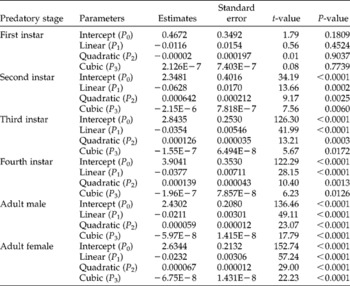
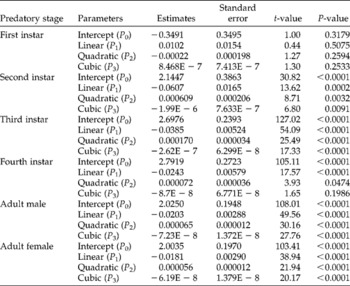
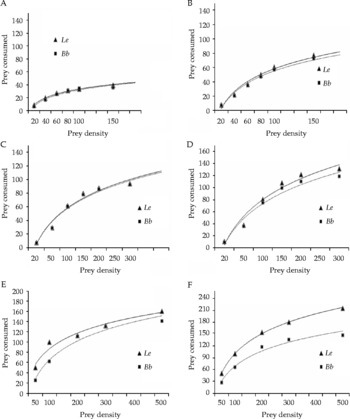
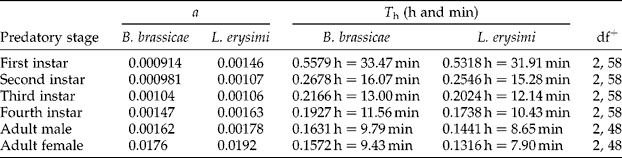
Tables 1 and 2 reveal the likelihood estimates from logistic regression (PROC CATMOD) of the proportion of prey eaten as a function of initial prey densities by different predatory stages of C. septempunctata on L. erysimi and B. brassicae, respectively. The linear estimates (P 0) were negative for all predatory stages, revealing a negative density dependence and thereby a type II functional response (Fig. 1A–F). Attack rate was greater with reduced handling time when L. erysimi was used as a prey compared with B. brassicae (Table 3). The functional responses of the first (Z = 0.52; P = 0.59), second (Z = 1.57; P = 0.11) and third instars (Z = 1.50; P = 0.11) were not statistically significant, whereas those of the fourth instar (Z = 2.0997; P < 0.05), adult males (Z = 2.00; P < 0.05) and adult females (Z = 4.10; P < 0.01) were statistically significant. The response curves using the predicted prey consumption values for adult males and females against L. erysimi (Z = − 1.98; P < 0.05) and B. brassicae (Z = − 2.01; P < 0.05) were statistically significant.
Maximum likelihood estimates from logistic regression (PROC CATMOD) of the proportion of prey eaten as a function of initial prey densities by different predatory stages of Coccinella septempunctata on Lipaphis erysimi

Maximum likelihood estimates from logistic regression (PROC CATMOD) of the proportion of prey eaten as a function of initial prey densities by different predatory stages of Coccinella septempunctata on Brevicoryne brassicae

Functional response curves of different predatory stages (A, first; B, second; C, third; D, fourth; E, adult males; and F, adult females) of Coccinella septempunctata against Lipaphis erysimi (Le) and Brevicoryne brassicae (Bb). The continuous and dotted lines are for the aphids Le and Bb, respectively (a colour version of this figure can be found online at journals.cambridge.org/jti).

Attack rate (a) and handling time (T h) at 95% confidence limit obtained by the least-squares method (PROC NLIN) for the different predatory stages on the two prey species
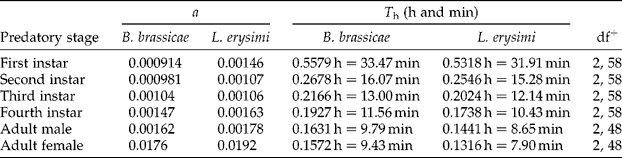
df, degree of freedom.
+ All parameters were significant at P < 0.001.
Discussion
The logistic regression for predatory stages of C. septempunctata had a significant linear parameter P 1 < 0 except for the first instar that fed on B. brassicae, and the proportion of prey consumed by all predatory stages declined with increasing prey densities. This suggests that all stages exhibited a type II response. This is common for most aphidophagous ladybirds (Hodek and Honek, Reference Hodek and Honek1996; Dixon, Reference Dixon2000; Omkar and Pervez, Reference Omkar and Pervez2004; Pervez and Omkar, Reference Pervez and Omkar2005) with few exceptions (Hodek et al., Reference Hodek, Chakrabarti and Rejmanek1984). Type II functional response has also been reported in ladybirds: Hippodamia variegata (Goeze) on the aphid Aphis fabae (Scopoli) (Jafari and Goldasteh, Reference Jafari and Goldasteh2009), adult C. septempunctata on L. erysimi (Omkar and Srivastava, Reference Omkar and Srivastava2003b), adult male Cheilomenes sulphurea (Olivier) on A. fabae Scopoli (Hodek et al., Reference Hodek, Chakrabarti and Rejmanek1984) and fourth instar and adult of Coleophora inaequalis F. on Toxoptera citridae Kirkaldy (Wang and Tsai, Reference Wang and Tsai2001). On the contrary, Hassell et al. (Reference Hassell, Lawton and Beddington1977) discussed a type III response at low densities of the first instars of B. brassicae.
The voracity of predatory stages measured in terms of the coefficient of attack rate and the handling time differed when exposed to the two prey species, which suggested that growing larval instars differ in their ability to respond to increasing prey densities. The values of the attack rate suggested that adult females were the most voracious followed by adult males, fourth, third, second and first instars, as also reported earlier (Brown, Reference Brown2004; Omkar and Mishra, Reference Omkar and Mishra2005; Ali and Rizvi, Reference Ali and Rizvi2007). The adult females process the prey faster than the other stages, as indicated by the differentials in handling times.
The functional response curves of each predatory stage were higher when females were searching and the preference was stronger for L. erysimi over B. brassicae. Thus, females are expected to oviposit more in L. erysimi colonies than in B. brassicae ones. Pratt et al. (Reference Pratt, Pope, Powell and Rossiter2008) showed that there are costs by feeding on B. brassicae that contain high levels of sinigrin, a secondary metabolite. The prey handling time was in the reverse order to that of the attack rate. The handling time of females and males was lower than those of the other stages, which is not in conformity with Omkar and Srivastava (Reference Omkar and Srivastava2003b) who reported that the fourth instar of C. septempunctata have more potential. However, Rhamhalinghan (Reference Rhamhalinghan1987) reported high aphid consumption by females, ascribed to their large body size and food requirements for ovarian development and egg laying (Lucas et al., Reference Lucas, Coderre and Vincent1997). The handling time estimate is the cumulative effect of time taken during capturing, killing, subduing and digesting the prey (Veeravel and Baskaran, Reference Veeravel and Baskaran1997). The differences in the attack rate coefficients and handling times of different predatory stages indicate that they respond differentially. The differences in parametric values might be due to the variation in size, voracity, satiation time, hunger levels, digestive ability, walking speed, etc. (Mills, Reference Mills1982; Omkar and Pervez, Reference Omkar and Pervez2004).
Thus, a significant variation in the estimates of handling times of a single predator feeding on different prey species indicates that any one of these integral components of the handling time might have been negatively affected when B. brassicae was used as a prey rather than L. erysimi, which resulted in a higher handling time of the former than the latter.
Thus, it could be concluded that all predatory stages of C. septempunctata confirmed a type II functional response and the prey L. erysimi was preferred over B. brassicae. Adult females were the most potential stage followed by adult males, fourth, third, second and first instars.
Acknowledgements
A.P. would like to thank the Department of Science and Technology for providing assistance through the SERC Young Scientist Research Project (SR/FT/L-093/2008).