Introduction
Ionizing radiation poses an intermittent threat to the Earth (Dartnell Reference Dartnell2011; Atri & Melott Reference Atri and Melott2013). Both supernovae and gamma-ray bursts (GRBs) may pose a threat at the level of mass extinction over geological timescales (Karam Reference Karam2002; Melott & Thomas Reference Melott and Thomas2011; Horvath & Galante Reference Horvath and Galante2012). Past consideration has focused on the danger from modification of atmospheric chemistry (Scalo & Wheeler Reference Scalo and Wheeler2002; Melott et al. Reference Melott2004). The GRB photons ionize and dissociate atmospheric constituents. The most important for this purpose is N2, which is highly stable and tightly bound. The influx of free N atoms and ions into the atmosphere results in reactions that can produce various oxides of nitrogen, which in turn catalyse the destruction of stratospheric ozone (O3) (Melott et al. Reference Atri, Melott and Thomas2010). The loss of O3 in turn greatly reduces the opacity of the atmosphere to Solar UVB radiation (Thomas et al. Reference Thomas2005a, Reference Thomasb; Ejzak et al. Reference Ejzak2007) – Cockell (Reference Cockell1998) has calculated that, in the absence of an O3 layer, the DNA-weighted UV irradiance would be several hundred times higher than it is at present, depending on the age of the Sun (today's Sun is hotter and emits more UV than was the case when life first formed). Since UVB is strongly absorbed by DNA and protein, it can damage the exposed biota (both microorganisms and multicellular, complex organisms) and can cause erythema (skin reddening and inflammation such as sunburn), can cause cancer in complex organisms, can damage plankton and other organisms exposed to sunlight and so forth. The end-Ordovician mass extinction has been proposed as a candidate for having a GRB as its initiator (Melott et al. Reference Melott2004) and the extinction rate as a function of latitude for that event was found to be consistent with a burst over the south pole (Melott & Thomas Reference Melott and Thomas2009).
Other dangers are possible, in particular secondary particles which will be created in the showers induced by high-energy photons. The purpose of this paper is to delineate the effect of these secondaries. This is an important check on past work, which has not included them.
Another approximation is that GRB jets have been assumed to be purely electromagnetic. Owing to intervening magnetic fields, it is not possible to detect a hadronic component (likely protons and other atomic nuclei) from the large intergalactic distances of observed GRBs. However, it is possible that significant emission of high-energy hadrons is possible and could strike the Earth if incident from within the Milky Way Galaxy (e.g. Dermer & Holmes Reference Dermer and Holmes2005). However, the non-detection of neutrinos coincident with GRBs by the IceCube experiment has set limits on the hadron entrainment (Gao et al. Reference Gao, Kashiyama and Meszaros2013 and references therein). Since only upper limits exist, it is not possible to definitively model secondaries from hadrons. If there are any future detections, it will be possible to approach this problem with existing software and data tables (Atri & Melott Reference Atri and Melott2011a, Reference Atri and Melottb).
Method
Since no two GRBs are identical, the choice of selecting a typical case of a galactic GRB becomes difficult. Since long GRBs, which last for ∼10 s, have softer spectra, the photon energies will not be sufficient enough to produce muons. Short GRBs, also known as short-hard bursts (SHBs) on the other hand last for ∼0.1 s and have harder spectra. A detailed review of a variety of observed GRBs with varying duration and spectra can be found in Band et al. (Reference Band1993). The expected rate of SHBs affecting the Earth is slightly higher than due to long GRBs (Melott & Thomas Reference Melott and Thomas2011). They are expected to produce photons of sufficient energy to produce muons. We use two cases of hard-spectrum GRBs and evaluate their terrestrial effects. We used the Band et al. (Reference Band1993) and GRB 120424A spectra (Augusto et al. Reference Augusto2013) for this work.
Based on the observation of a large number of GRBs, a phenomenological model was developed by Band et al. (Reference Band1993), which provides a fit to the observed gamma-ray spectra of a large number of GRBs. The energy of gamma-rays range from a few keV to ∼1 GeV in most cases, and can go up to ∼100 GeV in some rare extreme cases. For gamma-rays to undergo photonuclear interactions in the Earth's atmosphere and produce muons, which can be observed on the ground, the energy of gamma-rays should be ∼10 GeV and above. Muons can be produced by gamma rays of lesser energy, but since muons typically lose ∼2–4 GeV energy through interactions (Gaisser Reference Gaisser1991) until they reach the ground, the energy threshold becomes higher, and only higher energy photons will produce >2–4 GeV muons in substantial number. We will focus on GRBs that produce significant number of photons in the 10–100 GeV energy range that have the capability of producing secondary particles reaching the Earth's surface.
Gamma-ray spectra
Band spectrum: As discussed above, only SHBs are capable of producing GeV photons. Therefore, we took the Band spectrum (Band et al. Reference Band1993) for SHBs where the peak of the energy spectrum is highest, peaking at 187.5 MeV. It must be noted that SHBs are a subset of all GRBs and the peak of the energy spectrum is higher than usual. The spectral index in the 1–100 GeV range is −2.3. Our estimates are based on the fluence of photons received here, which is independent of the total energy/beaming angle interpretation. The spectrum was then normalized to obtain 100 kJ m−2 fluence at the top of the Earth's atmosphere. The number of photons in 1–10 and 10–100 GeV energy range were then computed based on the spectral index and fluence normalization. We obtained 6.29×10¹⁰ photons m−2 in the 1–10 GeV range and 2.99×10⁹ photons m−2 in the 10–100 GeV range for this spectrum after normalization.
GRB 120424A was observed with the MAXI/GSC instrument abroad the ISS where the prompt emission lasted for 34 s (Serino et al. Reference Serino2012). Muons were observed with the ground-based Tupi muon observatory with a significance of 6.2 standard deviations (Augusto et al. Reference Augusto2013). This suggests muon production by gamma rays of energies >10 GeV. Based on the muon data, the spectral index of −1.54 was found to be consistent for gamma-ray primaries >10 GeV.
Modelling gamma-ray interactions in the atmosphere
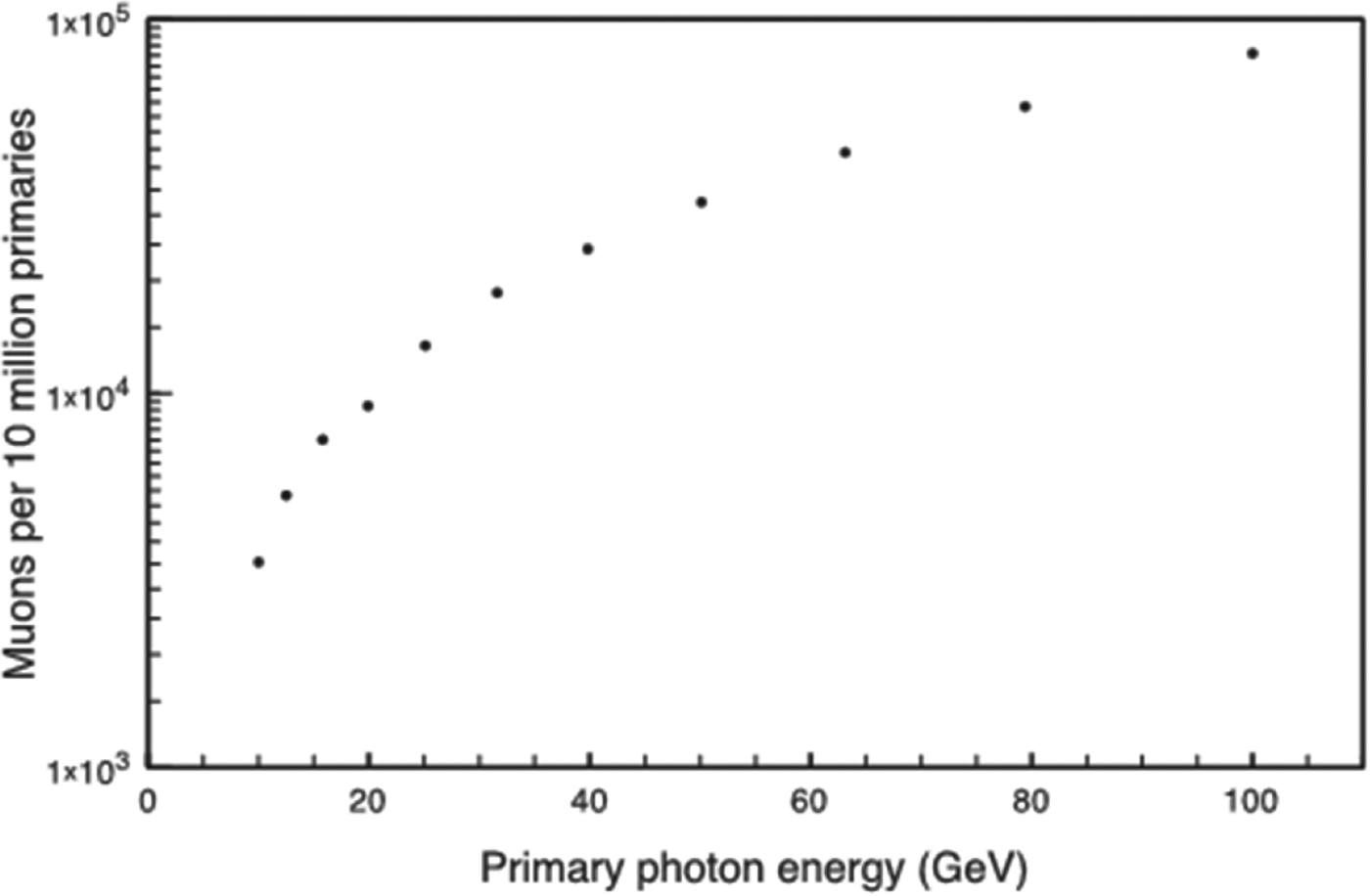
GeV gamma rays interact with the Earth's atmosphere and produce air showers. Air showers were modelled with the state of the art (Dieter Reference Dieter1998) CORSIKA model, a Monte Carlo code used extensively to model air showers and calibrated with experimental data with a variety of instruments worldwide. The code has already been shown to reproduce air shower data with great accuracy in some studies, including Usoskin & Gennady Reference Usoskin and Gennady2006; Atri et al. Reference Atri, Melott and Thomas2010; Atri & Melott Reference Atri and Melott2011a, Reference Atri and Melottb; and Overholt et al. Reference Overholt, Melott and Atri2013. We ran CORSIKA simulations with −2.3 spectral index of primary gamma rays to calculate the number of secondary muons at the surface per 107 photon primaries in 1–10 and 10–100 GeV energy ranges (Fig. 1). The energy cutoff for muons was set to 50 MeV, which is the lowest possible option available in CORSIKA. It is clear from Fig. 2 that such low energy muons were unable to reach the ground and therefore this energy cutoff does not affect our results.
Total number of muons at the ground level per 107 photon primaries as a function of photon energy.

Differential spectrum of muons at the ground level obtained from CORSIKA for Band 1993 case.
Results
Particle flux
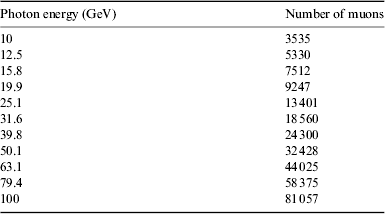
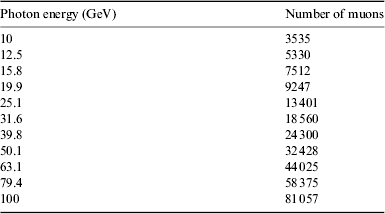
A total of 107 gamma-ray primaries with fixed energies were taken to be incident from random directions in the hemisphere away from the Earth, on top of the atmosphere. The energies are divided in logarithmic intervals in 10–100 GeV energy range. The hadronic interactions were modelled with the SIBYLL and FLUKA models. The total number of muons reaching the ground for each set of simulations is then calculated and displayed in form of a table (Table 1). As explained later in detail, there are total 0.0005% electrons and positrons, 0.000047% photons and no hadrons per primary reaching the ground. Therefore, only muons were taken into account in our calculations, and other particles were ignored.
Total number of muons on ground for 10 million primaries in each case
The primaries in the computations were incident with random angles from the top of the atmosphere. A GRB is effectively a point source, and would only produce muon secondaries on one side of the Earth. The results presented here are effectively averages over the side of the Earth facing the GRB. In general, the muon flux falls as cos2 of the primary incident angle, measured from the vertical. The flux at the place where the GRB is exactly vertical will be about 1.6 times higher than the average presented here; at 45° it will be about 0.8 times these values.
Photon of energies <10 GeV were not simulated because the entire range produce <1% of muons produced in the 10–100 GeV range, as shown below.
For the Band spectrum (Band et al. Reference Band1993), 72 muons in the 1–10 GeV energy range and 10 406 muons in the 10–100 GeV range were produced from 107 photons incident at the top of the atmosphere. In addition, in the 10–100 GeV range, 51 electrons and positrons and 47 photons were able to reach the ground from these 107 primaries. There were no hadrons reaching the ground, as expected.
We adjust the total fluence of our GRB to 100 kJ m−2, an amount likely to cause significant damage to terrestrial life every few hundred million years (Thomas et al. Reference Thomas2005b; Melott & Thomas Reference Melott and Thomas2011). For the normalized spectrum on top of the Earth's atmosphere at 100 kJ m−2, we obtain at ground level 4.53×10⁵ muons m−2 in the 1–10 GeV and 3.12×10⁶ muons m−2 in the 10–100 GeV range, for a total of 3.57×10⁶ muons m−2 from the Band case, with a spectral index of −2.3. For comparison, the average rate of background cosmic ray muons integrated over the hemisphere is 127 m−2 s−1. For a 1 s burst, the muon flux enhancement would be by a factor of: (3.57×10⁶)/127=2.81×104.
For GRB 120424A (Augusto et al. Reference Augusto2013), which is known to have produced muons on the ground, the reported observed rate was 1.78×10⁻⁷ erg cm−2 s−1 over 34 s, which equals 6.05×10⁻⁹ J m−2 fluence. Using a spectral index of −1.54 from the above reference, we computed the muon fluence on the surface to be 6×10⁻⁴ muons m−2 at the ground integrated over 10–100 GeV range. We then normalized it for a total fluence of 100 kJ m−2 (equivalent to moving it closer) and obtained 9.43×10⁹ muons m−2 in a period of 34 s. The muon rate therefore is 2.77×10⁸ m−2 s−1. The rate is about two orders of magnitude higher than the Band et al. case described above, due to the much harder spectrum and longer duration.
Biological radiation dose
Radiation dose is measured in units of Gray (Gy) and 1 Gy is equal to the deposition of 1 J energy kg−1 of absorber. Different types of radiation are more effective at causing biological damage so 1 Gy of absorbed dose can cause different levels of biological damage depending on the density of energy transferred to the organism and the resulting density of damage to DNA and to other biologically important molecules; this is reflected by assigning a relative biological effectiveness (RBE) to various kinds of radiation where the RBE is related to the density of biological damage caused by the radiation. Alpha radiation, for example, causes roughly 20 times as much biological damage as does gamma radiation per unit of energy deposition; because of this alpha radiation is assigned an RBE of 20.
We should also note that the concept of RBE can be difficult to implement for microscopic organisms that are irradiated by radiation with a very short range in the organism. For example, alpha particles have a range of only 5–10 μm in material with the density of water – a single alpha particle can only traverse one or two cells. Consider a bacterial mat exposed to alpha radiation – any bacteria that are more than one or two cells deep will be spared any irradiation at all, in spite of a cell immediately above might receive a high (possibly lethal) radiation dose. Similarly, one cell on the surface of such a mat might receive a high dose of radiation while its immediate neighbours emerge unscathed. This can make alpha dosimetry very challenging. However, because muons are much more penetrating than are alpha particles, we feel it is safe to make the assumption that radiation dose from muons is uniform throughout an organism of any reasonable size. In this, we treat muon radiation as being similar to x-ray and gamma radiation in its impact on an organism and in its dosimetry. Although muons are very penetrating, they can have major biological effects due to their potential production in large numbers.
The amount of biological damage caused by radiation is measured in units of effective dose – Sievert (Sv). Effective dose is the product of absorbed dose (Gy) and the RBE of the radiation in question. Thus, the deposition of 1 J kg−1 of gamma radiation (RBE=1) produces an effective dose of 1 Sv while depositing the same amount of energy via alpha radiation produces an effective dose of 20 Sv. The RBE of muons is about 0.8–1.0 across a wide range of energies (Micke et al. Reference Micke, Smith, Woodley and Mashke1964; Nelson Reference Nelson1966; Stevenson Reference Stevenson1983) so, for the sake of this work, the effective dose from muons (Sv) is approximately the same as the absorbed dose (Gy).
The biological impact of radiation exposure varies according to the dose and the organism exposed; higher doses are more damaging and simpler organisms (which typically have a smaller chromosome volume) tend to be more resistant to radiation damage than more complex organisms (UNSCEAR 1996). The time during which exposure occurs is also important and can also affect the biological impact; radiation exposure that occurs over a period of time that is shorter than the organism's ability to repair the induced biological damage (typically less than a day) will damage an organism while the same dose delivered over a longer period of time might leave an organism unscathed. In the case of exposure from a GRB the exposure occurs over a sufficiently short period of time that acute effects are possible if the radiation dose is sufficiently high.
The health effects of acute radiation exposure begin to occur at a dose of about 1 Sv (mild radiation sickness) for humans and the radiation exposure becomes fatal to humans at a dose of about 4–5 Sv, with 10 Sv being fatal to 100% of those exposed. Insects are known to be significantly more resistant to radiation than are mammals (the fatal dose for some insects is over 100 times as high as for humans), and microbes are more resistant still – D. radiodurans can survive exposure of up to 15 kSv of gamma or x-ray radiation. Other organisms fall between these extremes with regards to radiation resistance. Lower or more protracted radiation exposure might increase an organism's risk of developing cancer (in organisms sufficiently long-lived as to be susceptible to cancer) and can also induce germ-line mutations that might be able to affect rates of evolutionary change.
For this work, a cube of water 15 cm on each side was considered as the target material for modelling the biological radiation dose from secondary muons. Figure 2 shows the energy spectrum of muons at the ground level. The muon energy spectrum peaks ∼1 GeV and the flux sharply drops below 0.5 GeV. Since the stopping power of muons is a very slow function of energy, the average energy deposited by muons can be approximated by 2 MeV g−1 cm−2 in this energy range (Gaisser Reference Gaisser1991). The biological radiation dose is the product of the muon flux within 225 cm2 area, with 15 g cm−2 column density with 2 MeV energy g−1 and divided by 3.3375 kg of mass. This gives 1.14×10⁻⁷ Sv or 0.11 μSv radiation dose from the Band case. Similarly, for GRB 120424A, the total biological radiation dose is 3.02×10⁻⁴ Sv or 0.3 mSv. For comparison, the annual radiation dose limit for a terrestrial US worker is 50 mSv yr−1.
Discussion
We have computed the expected fluence of secondaries in air showers generated by short-hard GRBs. Long bursts are typically too spectrally soft to generate secondaries by photonuclear reactions. We find that the irradiation by secondaries (primarily muons) is not a significant source of biological radiation dose. Consequently, past focus on atmospheric O3 depletion and subsequent UVB damage is appropriate. However, should future detection of neutrinos coincident with GRB bursts indicate significant hadronic component in GRB beams, this conclusion will require further evaluation.
Acknowledgements
We thank Brian Thomas for helpful comments on the manuscript.