Introduction
Very different conclusions have been drawn about the association between hypertension and psychological morbidity, especially panic attacks, which are discrete episodes of fear or anxiety that reach a peak quickly and in which several somatic, autonomic or cognitive symptoms are experienced. Clinical observation suggests that panic attacks are associated with transient increases in blood pressure (BP)), perhaps through an increase in catecholamine release (White & Baker, Reference White and Baker1986; Wilkinson et al. Reference Wilkinson, Thompson, Lambert, Jennings, Schwarz and Jefferys1998). Several studies have also reported higher rates of panic attacks or panic disorder with hypertension (Weissman et al. Reference Weissman, Markowitz, Ouellette, Greenwald and Kahn1990; Davies et al. Reference Davies, Ghahramani, Jackson, Noble, Hardy, Hippisley-Cox, Yeo and Ramsay1999). However, these studies either used self-reported hypertension, which is prone to measurement bias (Weisman et al. Reference Weissman, Markowitz, Ouellette, Greenwald and Kahn1990), or did not adjust for confounders apart from age and sex (Davies et al. Reference Davies, Ghahramani, Jackson, Noble, Hardy, Hippisley-Cox, Yeo and Ramsay1999). Other studies have supported the link between hypertension and panic but these have been small and selected patients from secondary care (Noyes et al. Reference Noyes, Clancy, Crowe, Hoenk and Slymen1978; Katon, Reference Katon1984, Reference Katon1986) or were uncontrolled (Kaplan, Reference Kaplan1997). Overall, although these studies provide some clinical insight, their limitations mean that they do not provide robust evidence for a relationship between hypertension and panic.
Psychological morbidity is a broad term that includes depression, generalized anxiety disorder (GAD) and also panic, and all are associated with each other (Wittchen & Essau, Reference Wittchen and Essau1993). Whereas autonomic symptoms are prominent in panic attacks, GAD is characterized by pervasive worry, with restlessness and muscle tension. Perhaps it is not surprising that, in studies using hypertension as a dichotomous endpoint, all kinds of relationships have been reported. For instance, in some studies hypertension as a category was associated with measures of anxiety disorders distinct from panic (Markovitz et al. Reference Markovitz, Matthews, Wing, Kuller and Meilahn1991, Reference Markovitz, Matthews, Kannel, Cobb and D'Agostino1993; Jonas et al. Reference Jonas, Franks and Ingram1997; Paterniti et al. Reference Paterniti, Alperovitch, Ducimetiere, Dealberto, Lepine and Bisserbe1999; Perez et al. Reference Perez, Gutierrez, Vioque and Torres2001; Gafarov et al. Reference Gafarov, Gromova, Gagulin, Ekimova and Santrapinskiy2007), and with depression (Rabkin et al. Reference Rabkin, Charles and Kass1983; Barrett-Connor & Palinkas, Reference Barrett-Connor and Palinkas1994; Jonas et al. Reference Jonas, Franks and Ingram1997; Davidson et al. Reference Davidson, Jonas, Dixon and Markovitz2006; Patten et al. Reference Patten, Williams, Lavorato, Campbell, Eliasziw and Campbell2009), but in others no association with anxiety (Kahn et al. Reference Kahn, Medalie, Neufeld, Riss and Goldhurt1972; Sparrow et al. Reference Sparrow, Garvey, Rosner and Thomas1982; Shinn et al. Reference Shinn, Poston, Kimball, St Jeor and Foreyt2001) or depression (Paterniti et al. Reference Paterniti, Alperovitch, Ducimetiere, Dealberto, Lepine and Bisserbe1999; Shinn et al. Reference Shinn, Poston, Kimball, St Jeor and Foreyt2001; Wiehe et al. Reference Wiehe, Fuchs, Moreira, Moraes, Pereira and Gus2006) was found.
By contrast, large population-based studies, using continuous BP measures rather than a hypertension diagnosis, have reported associations between low BP and general psychological morbidity and related symptoms such as fatigue (Wessely et al. Reference Wessely, Nickson and Cox1990; Pilgrim et al. Reference Pilgrim, Stansfeld and Marmot1992), including the population-based Nord-Trøndelag health study (HUNT; Hildrum et al. Reference Hildrum, Mykletun, Stordal, Bjelland, Dahl and Holmen2007). Indeed, in some countries a syndrome of low BP, tiredness and anxiety is well recognized (Pemberton, Reference Pemberton1989). Measures of anxiety and depression have therefore been associated with both low and high BP. These contradictory results have yet to be reconciled. We previously stated a hypothesis that links hypertension to panic (Davies et al. Reference Davies, Esler and Nutt2010). Given the conflicting evidence from previous studies, the current study was planned to test the hypothesis that there is a non-linear relationship between systolic BP (SBP) and panic and an association of low BP with generalized anxiety and depression. We chose to study systolic rather than diastolic BP (DBP) as both the initial case reports of the association (White & Baker Reference White and Baker1986) and our own study examining the effect of serotonin manipulation on BP reactivity (Davies et al. Reference Davies, Hood, Argyropoulos, Morris, Bell, Witchel, Jackson, Nutt and Potokar2006) suggested a larger effect on SBP than DBP.
Method
We used data from HUNT 2, a cross-sectional study in which all individuals aged ⩾20 years residing in one county in central Norway were approached for participation in a general health study (www.ntnu.no/hunt/english). Invitations were sent to 92 936 eligible people and included a questionnaire and appointments for physical tests and blood samples. Information on age, place of residence and marital status were obtained from the National Population Registry. The Norwegian Data Inspectorate, the Regional Committee for Ethics in Medical Research and the HUNT Publication Review Board approved the protocols for HUNT 1, HUNT 2, and for this study. All participating subjects in HUNT 2 provided written consent. All residents who had BP measurement completed (n=64 871) were included in the present analyses.
Measures of panic, anxiety and depressive symptoms
Psychological morbidity was measured using the self-administered Hospital Anxiety and Depression Scale (HADS; Snaith & Zigmond, Reference Snaith and Zigmond1986). The HADS comprises 14 items each based on four-point Likert scales: seven items for anxiety symptoms and seven for depressive symptoms. The anxiety questions cover worry and tension, with one item asking about panic.
The following variables were used as outcome measures:
-
(a) Panic. We defined two binary variables: (1) ‘frequent panic’, respondents scoring 3 (panic feelings very often in the past week) compared to those scoring 2, 1 or 0 on the HADS panic item, and (2) ‘panic’, respondents scoring 3 or 2 on the HADS panic item (panic feelings very often or quite often in the past week) compared to those scoring 1 or 0.
-
(b) Generalized anxiety symptoms. This was achieved by adding the scores for six HADS-Anxiety items omitting the item referring to panic (maximum 18), and assigning the uppermost quartile to a score of 1 and the remainder to a score of zero. The upper quartile was defined at a score of 6/18, the 76th centile.
-
(c) Depressive symptoms. These were defined as being present in the upper quartile of the HADS depression score (maximum 21). A cut-off has not been determined in a Norwegian population and thus we preferred to define our outcome as the upper quartile, which here was at a score of 6/21, the 77th centile.
Measurement of BP
As described previously (Hildrum et al. Reference Hildrum, Mykletun, Stordal, Bjelland, Dahl and Holmen2007), BP was measured by a trained nurse at the beginning of the screening procedure using an arm cuff of appropriate size connected to a Dinamap 845Xt device (Langhammer et al. Reference Langhammer, Johnsen, Holmen, Gulsvik and Bjermer2000). BP was measured automatically at 1-min intervals, beginning when the participant had been seated for 2 min with the arm resting on a table. The mean of the second and third readings was used here.
Statistical analysis
Multivariate logistic regression was used (the ‘Logistic’ command in Stata 10; Long & Freese, Reference Long and Freese2006) to estimate odds ratios (ORs) for panic, generalized anxiety and depressive symptoms according to SBP. In addition to the SBP term, a quadratic term (SBP squared) was included in each regression model to test for a non-linear relationship.
Three logistic regression models were constructed for each outcome variable as follows:
-
(a) Crude model with only SBP and SBP squared as independent variables,
-
(b) Adjustment 1: model incorporating age, age squared, gender, smoking status, exercise, partner status, work status, education level, hyperthyroidism, total cholesterol, triglycerides, cancer, disability and headaches.
-
(c) Adjustment 2: model incorporating the variables listed in adjustment 1 and the following, which might lie on the causal pathway: use of antihypertensive medication, diabetes, history of myocardial infarction, history of angina, history of stroke and body mass index (BMI).
Missing data
A non-participant study has been performed in HUNT 2 and little difference in the prevalence of chronic somatic diseases and use of cardiovascular medication was reported between those who participated in this part of the HUNT study and a randomly selected sample of those who declined (Langhammer et al. Reference Langhammer, Johnsen, Holmen, Gulsvik and Bjermer2000). We approached the issue of missing data as a result of confounders by comparing the subjects with complete data for all variables, including confounders (n=43 541), with those who had exposure and outcome data but some missing data from one or more confounders (n=17 876). We further carried out a crude analysis in the complete case dataset to examine the possible impact of missing data. We adjusted for variables associated with missingness to ameliorate any bias as a result of data missing at random for the outcome (Carpenter et al. Reference Carpenter, Kenward and Vansteelandt2006).
Results
Description of sample
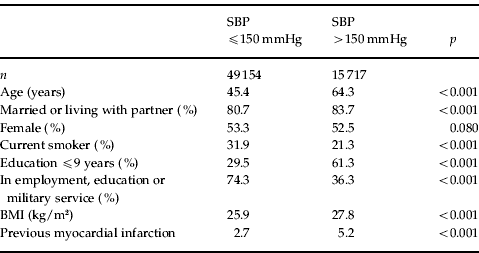
There were 64 871 respondents for whom data on SBP were recorded, amounting to 69.8% of those invited to participate. Of these, 15 717 [24.2%, 95% confidence interval (CI) 23.9–24.6] had SBP >150 mmHg (Table 1). Compared to those with SBP ⩽150 mmHg, respondents with SBP >150 mmHg were older, had greater BMI, had spent less time in education and were much less likely to be in employment, education or military service, and were less likely to be current cigarette smokers (Table 1).
Demographics of respondents with systolic blood pressure (SBP) ⩽150 mmHg and >150 mmHg (uppermost quartile)

BMI, Body mass index.
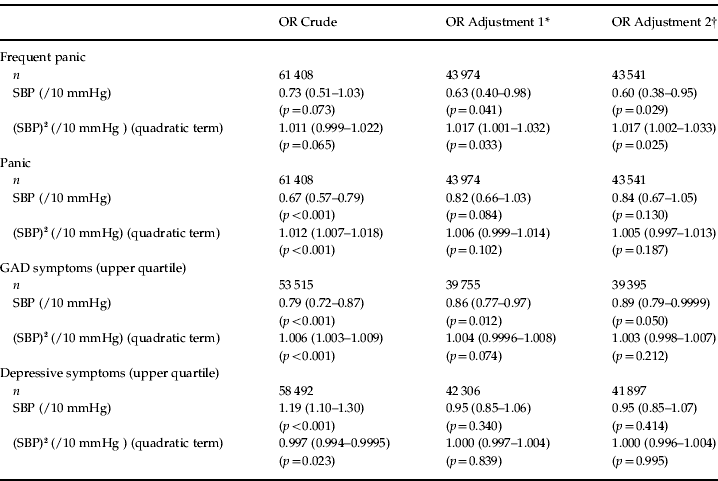
Association of SBP with psychological morbidity (Table 2)
Panic variables
Of 61 408 who completed the panic item, 493 participants (0.80%, 95% CI 0.73–0.87) reported ‘frequent panic’ and 2501 (4.07%, 95% CI 3.92–4.23) ‘panic’.
Odds ratios (ORs) and 95% confidence intervals (CIs) following logistic regression with dichotomous panic, generalized anxiety and depression variables referring to symptoms experience in the past week, for (i) crude calculation with only systolic blood pressure (SBP) and (SBP)2 as exposures, (ii) adding core confounders (adjustment 1) and (iii) adding core and extended confounders (adjustment 2)

* OR Adjustment 1 (core confounders): age, age squared, gender, smoking status, exercise, partner status, work status, education level, hyperthyroidism, total cholesterol, triglycerides, cancer, disability, headaches.
† OR Adjustment 2 (core and extended confounders): all confounders in adjustment 1, in addition to antihypertensive medication, diabetes, history of myocardial infarction, history of angina, history of stroke, body mass index (BMI).
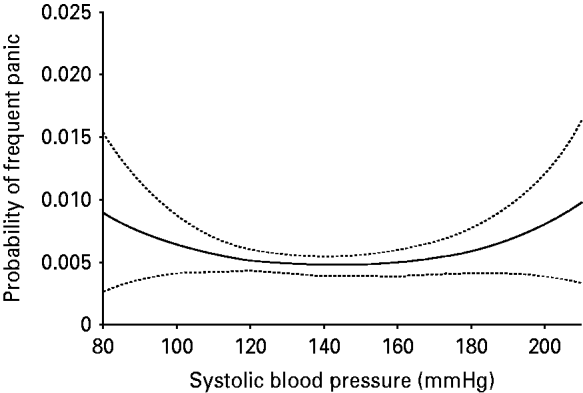
There was evidence for a non-linear relationship between ‘frequent panic’ and SBP, represented by a U-shaped curve with a local minimum score around 140–150 mmHg (Fig. 1). The y axis of the curve represents the probability of any individual with a given BP reporting frequent panic (i.e. the predicted proportion of individuals with that BP reporting frequent panic). When testing for the non-linear relationship, the quadratic term improved the fit of the model (likelihood ratio test, p=0.04). The associations became stronger as more potential confounding factors were added to the model. In numerical terms, the 5% of participants with an SBP >180 mmHg had an OR for frequent panic of 1.56 (95% CI 0.861–2.84) compared with the 30% of participants with BPs closest to the mean in the range 127–143 mmHg. The 5% with the lowest SBP (⩽108 mmHg) had an OR of 1.14 (95% CI 0.666–1.96) compared with the group with BP 127–143 mmHg.
Probability of frequent panic by systolic blood pressure (mmHg) after adjustment 1. Broken lines indicate 95% confidence limits.

The pattern of results for the association of panic and SBP was similar to that for ‘frequent panic’. However, these associations became weaker as more confounding factors were added. Nevertheless, in all cases the U-shaped curve was apparent with the minimum prevalence of panic at around 150 mmHg.
Generalized anxiety symptoms
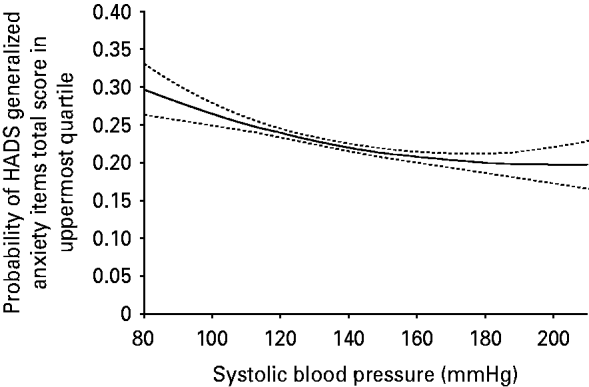
In the crude analysis there was evidence for a non-linear relationship between generalized anxiety symptoms and SBP but this weakened after adjustment. On inspection of the curves (Fig. 2), lower SBP was seen to be associated with an increased prevalence of generalized anxiety symptoms. There was no suggestion that higher SBP was associated with any increased prevalence up to an SBP of 200 mmHg.
Probability of Hospital Anxiety and Depression Scale (HADS) generalized anxiety symptoms by systolic blood pressure (mmHg) after adjustment 1. Broken lines indicate 95% confidence limits.

Depressive symptoms
The crude analysis showed a different pattern to those observed for the generalized anxiety and panic variables. Although SBP was associated with depressive symptoms in the unadjusted analysis and there was evidence of non-linearity, the curve was an inverted U shape. After adjustments, there was no evidence for a relationship between SBP and depressive symptoms.
Missing data
There were 61 408 participants who provided data for the unadjusted analysis between frequent panic and BP. The number was slightly different for the other psychological morbidity outcomes but we concentrate here on this comparison. Missing data for the confounding variables led to a reduction in observations with available data and for the fully adjusted model there were 43 541 observations in the complete case analysis. These individuals were compared to those with some missing data (n=17 867). In such a large sample, all of the confounding variables differed to a statistically significant level between the two groups (table available from authors). Those with missing data reported more illness, were younger, had a lower educational level and were less likely to be living with a partner.
All except one of the potential confounding variables was present in 94% or more of the 61 408 with both exposure and outcome data. The exception was the headache variable, which was present in 49 888 individuals (81.2%). We compared the unadjusted results for ‘frequent panic’ in the 61 408 with the complete case sample (n=43 541). In this analysis both SBP (OR 0.57, 95% CI 0.37–0.87, p=0.009) and the quadratic term (OR 1.020, 95% CI 1.05–1.034, p=0.007) were more strongly related to ‘frequent panic’ than in the original analysis [where the ORs were 0.73 (p=0.073) and 1.011 (p=0.065) respectively; Table 2], suggesting some bias attributable to missing data in the direction of strengthening the reported associations.
Discussion
We found that panic symptoms had a U-shaped relationship with SBP in this large cross-sectional study, such that both high and low SBPs were associated with an increased probability of panic symptoms relative to BPs in the middle of the range. For frequent panic, the U-shaped relationship became stronger as the number of potential confounding factors included increased. By contrast, there was evidence that only those with lower BP reported a higher prevalence of generalized anxiety symptoms and depression.
This study has some advantages over earlier studies. The sample size is large and, being population based, is representative of the general population, with a good response rate of 70%. Previous studies have often been of middle-aged and older men, sometimes in clinical settings, whereas our sample included both genders across the adult lifespan. A wide range of confounding variables, often lacking in previous studies, was available and this gives additional confidence in the results, although residual confounding cannot be ruled out.
Certain limitations must, however, be acknowledged. Our ascertainment of panic and generalized anxiety are only by the proxy measures available in the HADS questionnaire (the former relying upon a single question) and are therefore prone to measurement error. However, assuming that any error introduced in the measure is random in relation to BP, such random measurement error usually makes it more difficult to find a hypothesized association and should not reduce the validity of our findings. There remains a possibility that the public's perception of the word ‘panic’, or its Norwegian equivalent ‘panikk’, could differ from clinicians' understanding of panic symptoms or panic disorder.
Similarly, SBP was measured only at one time-point, albeit as the mean of two BP readings. The possibility that our findings are due to chance must also be considered, although our hypothesis about a non-linear relationship was formulated before performing these analyses so this should reduce the possibility of a type 1 error. There were some missing data introduced by including confounding variables, although our sensitivity analyses suggested this did not have a major influence on our findings. Although we were able to control for 16 potential confounding variables, we were unable to examine other possible confounders such as use of serotonin-promoting antidepressants. Finally, the cross-sectional design precludes investigation of any temporal relationships between BP and panic.
Our findings provide an explanation for the two separate strands of published literature on the relationship of hypertension and psychological morbidity. Studies undertaken in clinical settings have reported an association of high BP with panic and sometimes with other measures of anxiety, although all had important methodological limitations. The present study has therefore provided the most robust evidence to date of the association of high BP with panic. By contrast, studies that have examined the whole range of BP in the community have found that low BP is associated with measures of psychological morbidity. We suggest two reasons for this seemingly complicated picture. First, that there is a specific association between panic and high BP, but only in a population-based study with large numbers such as HUNT will individuals with the highest BPs be present in sufficient numbers to find the association between high BP and panic. Our second observation is that many studies that have reported an association between lower BP and psychological morbidity have not distinguished between general measures of psychological morbidity and panic. Our results demonstrate that different patterns of association are seen for panic and generalized anxiety with BP.
The association between low BP and general measures of psychological morbidity, including panic, has defied explanation (Wessely et al. Reference Wessely, Nickson and Cox1990; Pilgrim et al. Reference Pilgrim, Stansfeld and Marmot1992). The possibility there is parasympathetic activation in panic (Nutt, Reference Nutt1989) or that low BP could induce reflex tachycardia, which in turn leads to panic or anxiety symptoms (Rainey et al. Reference Rainey, Pohl, Williams, Knitter, Freedman and Ettedgui1984), might be relevant. Both the temporal relationship of psychological morbidity and low BP and the biology underlying this association deserve further study.
We previously proposed a biological explanation for the excess of panic attacks and panic disorder in hypertensive populations (Davies et al. Reference Davies, Lowry and Nutt2007) that involves autonomic dysfunction, as suggested by Grassi & Kiowski (Reference Grassi and Kiowski2002). Control mechanisms for both BP and panic symptoms converge in the brainstem and sympathetic activation mediated through the C1 cells of the rostral ventrolateral medulla may lead to hypertension and the sympathetic elements of panic. Reductions in the inhibitory activity of serotonergic neurons in the ventrolateral periaqueductal gray on C1 cells could account for the association between high BP and the autonomic components of panic disorder. Barton et al. (Reference Barton, Dawood, Lambert, Esler, Haikerwal, Brenchley, Socratous, Kaye, Schlaich, Hickie and Lambert2007) reported that, among patients with major depression, those who additionally had co-morbid panic disorder had elevated whole-body and cardiac sympathetic activity and this was abolished by treatment with selective serotonin reuptake inhibitors (SSRIs). Taken together, these findings could also explain how serotonin-promoting drugs treat panic disorder and may additionally be effective in reducing cardiovascular morbidity as has been suggested, although not confirmed, in depression following cardiovascular events (Glassman et al. Reference Glassman, O'Connor, Califf, Swedberg, Schwartz, Bigger, Krishnan, van Zyl, Swenson, Finkel, Landau, Shapiro, Pepine, Mardekian, Harrison, Barton and McIvor2002). It provides an explanation for evidence that SSRIs may help to control hypertension when co-morbid with panic disorder (Polyák, Reference Polyák2001). Transi-ently depleting serotonin also impairs control of the BP response to stress in panic disorder (Davies et al. Reference Davies, Hood, Argyropoulos, Morris, Bell, Witchel, Jackson, Nutt and Potokar2006). As autonomic symptoms are less prominent in GAD, the biological plausibility of the link between generalized anxiety symptoms and hypertension is weaker and that is reflected in the findings of this study, in which generalized anxiety symptoms were more common only in those with low BP.
Whatever the mechanisms of the association of high BP and panic at the right-hand end of the U-shaped curve delineated here, both panic disorder and hypertension are readily amenable to treatment through a range of medications and other strategies. Although many different factors contribute to hypertension, it is important for clinicians to be aware of the potential for co-morbidity of panic and high BP, so that patients presenting with either of these common problems can be screened and offered treatment for the other.
Acknowledgments
The Nord-Trøndelag Health Study (HUNT) is a collaboration between the HUNT Research Centre, Faculty of Medicine, Norwegian University of Science and Technology (NTNU, Verdal), the Norwegian Institute of Public Health, and the Nord-Trøndelag County Council. Data collection in HUNT 2 was a financial collaboration between the HUNT research centre at the Faculty of Medicine, Norwegian University of Science and Technology, the Norwegian Institute of Public Health, the Nord-Trøndelag County Council, and Levanger hospital.
Declaration of Interest
D.J.N. states that over the past 22 years he and his research group have received funding from every major pharmaceutical company with an interest in the psychiatric field. He has also received legal fees from companies, medical defense organizations and the British legal aid board in relation to court cases regarding the effects of psychotropic drugs. S.D. has undertaken speaking engagements for two pharmaceutical companies with fees being paid to the University of Bristol.