As long as the demon of practical reason twists and contorts archaeological inferences, the stratigraphic and behavioral structure of the past will remain the victim of warfare, greed, and other attributes of utilitarian models. If the demon is exorcised, what wonders will the deposits of prehistory hold? (Walker Reference Walker2002:173).
INTRODUCTION
Ever since Shakespeare (Reference Shakespeare1823:171) wrote the famous line, “All that glitters is not gold,” in his acclaimed comedy The Merchant of Venice, the phrase has been used to highlight the fact that things are not often what they seem. What Shakespeare most certainly did not know at the time is that his famous lines would be very applicable to the interpretation of archaeological data. In many ways, the epigraph by Walker (Reference Walker2002) above was alluding to a similar situation in his critique of archaeological interpretations of above-floor cultural deposits in the American Southwest. From our perspective, the significance of peri-abandonment, or so-called “problematic,” deposits in the Maya lowlands provides another excellent example of this situation. Subsequent to the Tikal Project's first (Coe Reference Coe1982:49; Moholy-Nagy Reference Moholy-Nagy1997:67) definition and description of “problematic deposits,” which include cultural remains that are often recovered above the floors of “prominent locations in monumental centers” (i.e., elite residences and adjacent to temple pyramids; Aimers et al. Reference Aimers, Hoggarth and Awe2020a), Maya archaeologists have proposed several functional explanations for these cultural remains. These include mundane activities such as evidence for rapid abandonment, de facto and squatter residential refuse, as well as those associated with ritual activities, such as feasting and termination events (see Aimers et al. [Reference Aimers, Hoggarth and Awe2020a] for a detailed discussion of these interpretations). Possibly the only thing that most interpretations of peri-abandonment deposits have in common is that they predominantly derive from single-site analyses of the deposits (Inomata and Webb Reference Inomata and Webb2003; Stanton and Magnoni Reference Stanton and Magnoni2008), and they rarely, if ever, take into consideration the shared contextual patterns and homogeneity of the cultural assemblages associated with these deposits.
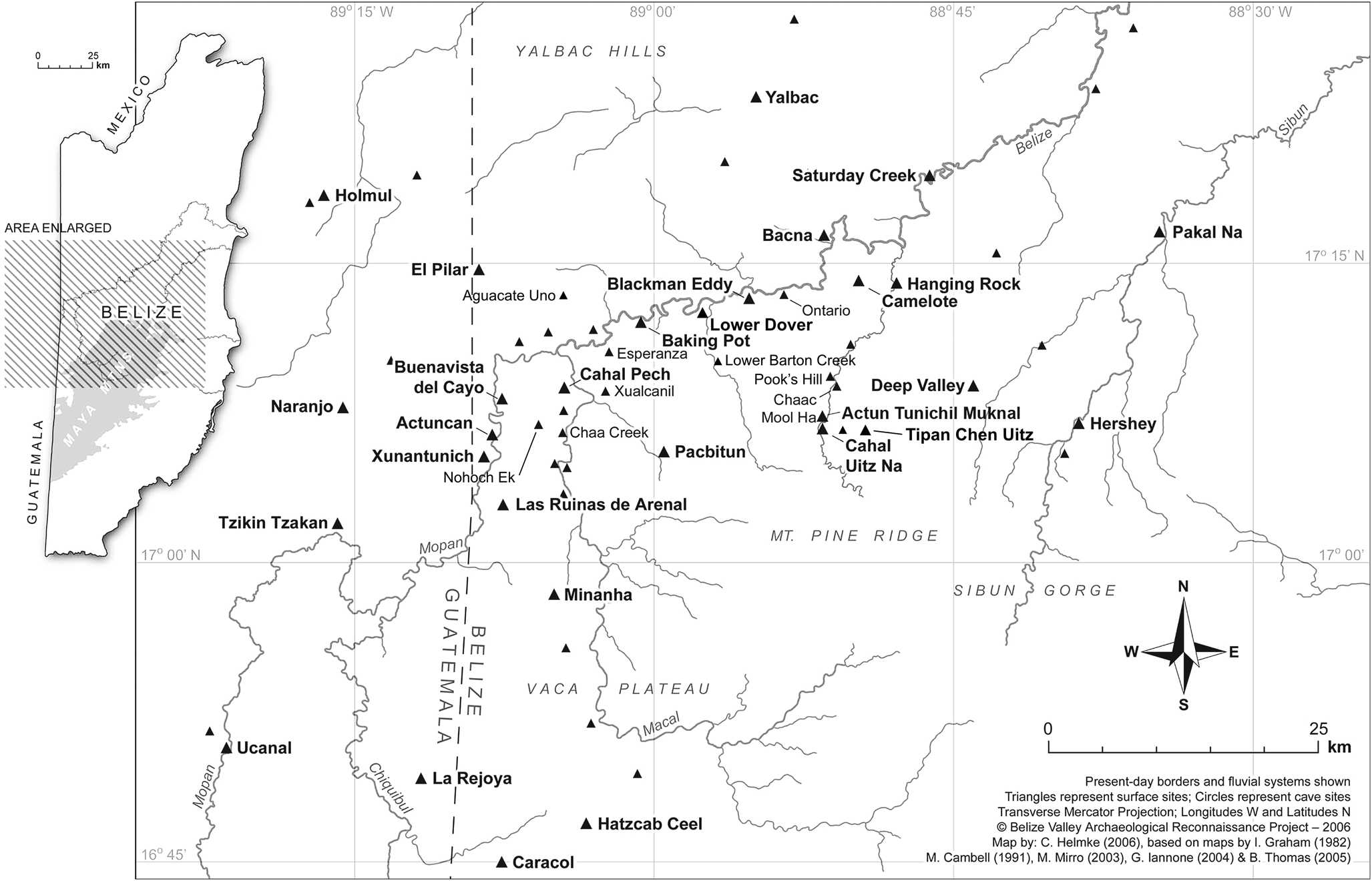
In this paper, we argue that the application of micro-stratigraphic excavation along with a regional and multidisciplinary approach is far more productive for understanding the archaeological record because of the simple fact that it allows us to detect meaningful patterns across time and space. In an effort to demonstrate the value of such an approach to the study of peri-abandonment deposits, we present here the results of our investigations at several surface sites in Western Belize and compare their associated assemblages with those discovered in caves, and in the cenote at Chichen Itza. This information should also take into consideration, and be compared with, the results of our more intensive work at Cahal Pech and Baking Pot (reported by Hoggarth et al. Reference Hoggarth, Britt Davis, Awe and Helmke2020), and with other deposits uncovered at the Belize Valley site of Aguacate Uno (Koenig Reference Koenig2014). Our regional study also compares peri-abandonment deposits at sites of varying sizes across Western Belize (Figure 1). These sites are broadly classified as large (tier 1), medium (tier 2), and small (tier 3) centers. While the first two designations generally describe major ceremonial centers with intensive public architecture (e.g., Caracol as tier 1 and Xunantunich as tier 2), we also describe similar patterns at minor centers (tier 3, e.g., Pook's Hill). The application of this scaled regional approach to the study of peri-abandonment deposits enables the researcher to identify patterned behavior within specific cultural contexts at sites of varying sizes, while at the same time allowing them to recognize site-specific differences and nuances across the political spectrum. As we note below, results of our study provide limited support for purely functional interpretations of peri-abandonment deposits. We argue, for example, that the presence of projectile points along with evidence for burning may not always be associated with such mundane activities as warfare (Chase and Chase Reference Chase, Chase, Kathryn Brown and Stanton2003; Inomata and Webb Reference Inomata and Webb2003). They can, instead, be equally associated with ritual events, much like those that were conducted at Chichen Itza (Coggins Reference Coggins1992; Tozzer Reference Tozzer1941) or in contemporary shrines in Chiapas and highland Guatemala (Palka Reference Palka2014).
Map indicating location of archaeological sites in the Belize River Valley. Map by Helmke.

In some ways, our concern with most functional interpretations of peri-abandonment deposits echoes those of Newman's (Reference Newman2015, Reference Newman2018) for the identification of some cultural deposits as evidence for termination events. She notes that some cultural assemblages are too often labelled as “termination deposits” without a careful analysis of the “life histories” of the objects contained in their assemblages. Newman (Reference Newman2018:836) adds that the examination of artifacts “not only individually or according to material class, but also in relation to other objects within a given assemblage,” can provide important “details of the use-life and depositional histories” of the objects. She argues that often artifacts can go “through cycles of use, reuse, and even discard prior to their final interment—a meaningful pre-depositional sequence that is overlooked when the assemblage is simply categorized as termination” (Newman Reference Newman2015:809). Applying this approach to her study of these types of deposits at El Zotz, Guatemala, Newman (Reference Newman2015, Reference Newman2018) concluded that the cultural remains in the deposits at that site were not smashed in situ during a termination ritual, but may have been kept as provisional discard (“items that have reached the end of one functional life but are stored for reuse in other forms”; Newman Reference Newman2018:831) until they were subsequently and purposely redeposited during termination events.
While we agree that some of the materials recovered in peri-abandonment deposits could indeed be associated with provisional discard that had been curated for later reuse in ritual deposits, there are three features that differentiate our study and assemblages from the study conducted by Newman at El Zotz. First, our study applies a regional approach rather than a single site analysis. Second, our deposits are predominantly located in collapsed architecture above buildings or plaza floors of sites that were abandoned or in the process of abandonment rather than in sealed contexts (cf. Awe et al. Reference Awe, Ebert, Hoggarth, Aimers, Douglas, Helmke and Stemp2020 on Cahal Pech). Third, the fact that we recover numerous complete objects (e.g., spindle whorls, musical instruments, chert bifaces, and complete skeletal remains, especially of children) in the peri-abandonment deposits in Western Belize more strongly suggests that these assemblages are related to propitiation rituals akin to those conducted by contact period and contemporary Maya at their sacred landscapes or pilgrimage destinations (Martínez Marín Reference Martínez Marín, King and Tejero1972; McGee Reference McGee1990, Reference McGee2005; Palka Reference Palka2014; Tozzer Reference Tozzer1941).
The literature on pilgrimages and propitiation rituals in Mesoamerica, particularly in the Maya area, is quite extensive (Brown Reference Brown2002; Kubler Reference Kubler and Benson1985; LaFarge Reference LaFarge1947; Martínez Marín Reference Martínez Marín, King and Tejero1972; McGee Reference McGee1990; Palka Reference Palka2014; Patel Reference Patel, Brady and Prufer2005, Reference Patel2012, Reference Patel2016; Ringle et al. Reference Ringle, Negrón and Bey1998; Thompson Reference Thompson1970; Tozzer Reference Tozzer1941; Vogt Reference Vogt1976). In view of the latter, and in an effort to provide the cultural context in which peri-abandonment deposits were made, we present here only a brief synthesis on the nature of Mesoamerican pilgrimages.
Almost all the studies noted above report that pilgrimages have a very long history in the Mesoamerican world, beginning in the Preclassic period and continuing into modern times. These studies further note that, although some sites such as Chichen Itza served as important regional pilgrimage centers, Mesoamericans also “identify several sacred places in and around their community…such as caves, mountains, and ancestral places” as important ritual or pilgrimage destinations (LaFarge Reference LaFarge1947:41; Martínez Marín Reference Martínez Marín, King and Tejero1972; Palka Reference Palka2014). Some examples of the latter include the pilgrimages conducted by the Lacandon to Yaxchilan and Lake Mensabak (McGee Reference McGee1990:57; Palka Reference Palka2014:), the Chamula Tzotzil's visits to shrine sites around their towns in Chiapas (Thompson Reference Thompson1970:74), or the rituals conducted at nearby caves and sacred places by the inhabitants of Santa Eulalia in the Cuchumatanes Mountains in Guatemala (LaFarge Reference LaFarge1947:120–130). Pilgrimage destinations can therefore “be locally important, visited by a small number of people, to internationally significant, drawing a large amount of patrons from adjoining or foreign lands” (Patel Reference Patel2012:74). Patel (Reference Patel2012:74) also adds that “pilgrimage sites can be visited by pilgrims year-round or only at certain times of the year,” and that pilgrimages can last weeks or be completed within a single day.
Although there appears to be a variety of reasons why cultures around the world conducted pilgrimages to sacred sites (Stoddard and Morinis Reference Stoddard and Morinis1997; Turner Reference Turner1974), Kubler (Reference Kubler and Benson1985:11) argues that Mesoamerican pilgrimages were/are primarily “collective endeavors for guaranteeing the continuity of the creation of the universe against catastrophic dissolution in an unstable world.” This is particularly manifested by increased ritual activity and pilgrimages to sacred landscapes during times of drought when pilgrims petition water and fertility deities for successful and bountiful harvests. LaFarge (Reference LaFarge1947:120–130) adds that, local “Prayermakers” will visit or make pilgrimages to sacred landscapes throughout the year, and especially during times of stress (e.g., drought), to conduct rituals, leave offerings, and pray for improved conditions. In other cases, Prayermakers are accompanied by elder males, or by various members of the community (Brown Reference Brown2002; LaFarge Reference LaFarge1947; McGee Reference McGee1990; Palka Reference Palka2014; Vogt Reference Vogt1976).
Recent pilgrimage studies by Mesoamerican scholars (Brown Reference Brown2002; Palka Reference Palka2014; Patel Reference Patel2012), as well as older ethnohistoric documents (e.g., Landa [Tozzer Reference Tozzer1941]), provide a list of cultural remains that are left as offerings during these ritual events at pilgrimage sites. At Cozumel island, for example, “the Maya offered copal and fruit and occasionally sacrificed birds, dogs, children, and adults to the idols” (Patel Reference Patel, Brady and Prufer2005:92). At Yaxchilan, the Lacandon leave “god pots” (incense burners) and other offerings, while at the Isla de Sacrificios in Veracruz, pilgrimage assemblages include “spindle whorls, figurines, whistles, flutes and ocarinas, pendants, incensarios, fine wares and copper bells” (Patel Reference Patel2012:231). Ringle et al. (Reference Ringle, Negrón and Bey1998:216) add that incensarios and fine orange ceramics (such as Pabellon Molded-carved and Plumbate wares) are typical in the Yucatan, while Brown (Reference Brown2002) notes that in Guatemala fragments of human remains, often the bones of ancestors exhumed from cemeteries, are redeposited at highland shrines. Significantly, all these types of cultural remains, including chert bifaces and stemmed points, are present in the pilgrimage assemblage recovered during the dredging of the cenote at Chichen Itza, as well as at the Western Belize sites we discuss below. This information should also take into consideration, and be compared with, the results of our more intensive work at Cahal Pech and Baking Pot (reported by Hoggarth et al. Reference Hoggarth, Britt Davis, Awe and Helmke2020), and with other deposits uncovered at the site of Aguacate Uno (Koenig Reference Koenig2014).
PERI-ABANDONMENT DEPOSITS AT TIER 1 AND 2 SITES
Xunantunich (Tier 2)
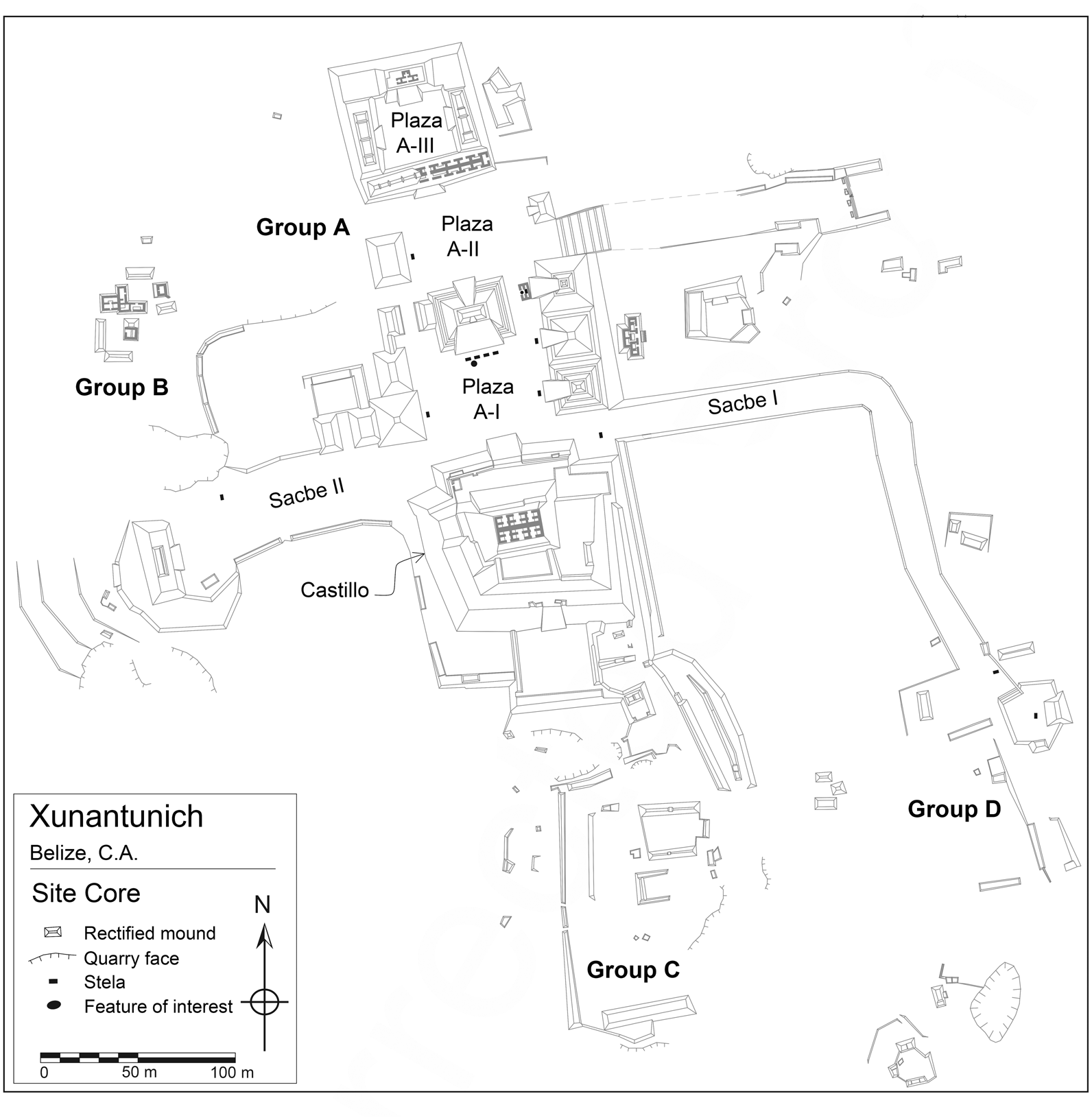
At the medium size, or tier 2, site of Xunantunich (Figure 2), peri-abandonment deposits and Terminal Classic activity are reported by several investigators at various loci in the site-core (Audet Reference Audet2006; Gann Reference Gann1925; MacKie Reference MacKie1961, Reference MacKie1985; Pendergast and Graham Reference Pendergast and Graham1981; Thompson Reference Thompson1942; Yaeger Reference Yaeger, LeCount and Yaeger2010). The first recorded case is that of an intrusive burial that Thomas Gann discovered at the summit of Structure A9 in the 1920s (Gann Reference Gann1925; Tilden et al. Reference Tilden, Slocum, Awe, Sullivan, Ebert, Burke, Hoggarth and Awe2017). Gann (Reference Gann1925:71) also recorded a fragmented stela in front of Structure A1 where “the Indians had erected a small altar consisting of a cedarwood cross with a small heap of stones around it.” Gann (Reference Gann1925:71) commented that the Maya who passed by the little pile of stones, often placed “upon it either a stone or a few flowers, saying an ‘Ave’ or ‘Pater’ as he does so.” The wooden cross noted by Gann was erected at the turn of the 1900s by Maya villagers from San José Succotz who continued to visit Xunantunich, which they regarded as a sacred site, to conduct propitiation rituals. The custom of erecting crosses at sacred landscapes is a well-established Maya tradition and one that has been well-documented by Vogt (Reference Vogt1969, Reference Vogt1976) in highland Chiapas.
Map of the Xunantunich site core. Map by Angela Keller (after Keller Reference Keller, LeCount and Yaeger2010:Figure 9.1)

In the 1960s, MacKie (Reference MacKie1961) also found peri-abandonment deposits associated with Structures A11 and A15 in the Xunantunich site-core. On Structure A15, in which he also found Terminal Classic burials, MacKie (Reference MacKie1961:218) noted that “deposits inside the building had accumulated on top of two vault blocks which were lying on the floor with a mass of other debris.” The latter observation clearly indicates that Structure A15 was already falling into disrepair when the deposits were placed in this building. It is apparent that MacKie (Reference MacKie1961:218) recognized this situation for he surmised that the depositional pattern and context of the deposits suggested “that Structure A-15 had been taken over by some of the local peasantry after its partial collapse.” In an effort to recover more data on these activities, the BVAR Project conducted further excavations of Structure A15 in 2002 and found additional deposits along the rear wall of the building. When combined with the considerable remains recovered by MacKie, it is almost inconceivable that these very large deposits, which were distributed within collapsed architecture in all the rooms and around the building, could be the accumulated garbage of people who were residing in the structure.
Subsequent excavations by Awe (Reference Awe2008) uncovered additional peri-abandonment deposits and Terminal Classic activity on, and adjacent to, Structure A4, at the base of Structure A13, and in an alleyway separating Structure A32 from the terraces rising to the summit of the palace acropolis known as the Castillo. The latter deposits contained several concentrations of broken pottery, animal remains, a fragment of a carved and inscribed stone panel (Helmke et al. Reference Helmke, Awe, Grube, LeCount and Yaeger2010:101–107), and fragments of modelled stucco. The ceramic vessels were all fragmented and most were between 30–50 percent complete. They were predominantly represented by large, Terminal Classic types including Mount Maloney Black bowls, Spanish Lookout-phase dishes and jars, and fragments of Pedregal Modeled censers. Like other deposits found at Xunantunich, those on the Castillo were discovered above collapsed architecture, and three to five centimeters above the plastered floor of the alleyway.
On Structure A4, the southern temple of the site's eastern triadic shrine, we discovered peri-abandonment deposits at the summit and base of the building (for details see Audet [Reference Audet2006:134–153]). Above the summit platform, we recovered a large fragment of decorated stucco, plus seven ceramic vessels, including five bowls and two ladle censers (Audet Reference Audet2006:138–139). The bowls were identified as Garbutt Creek Red and Mount Maloney Black types, and the ladle censers were identified as Belize Red types, both from the Terminal Classic Spanish Lookout complex. All of these cultural remains were located just below the modern ground surface and laying on a thin lens of dirt that had accumulated above the plastered surface of the platform. In front of the stucco fragments, we uncovered a 60-cm wide hole that had been cut into the floor of the platform, then refilled with soil, but never resurfaced. Inside the hole were four skulls and miscellaneous fragments of human remains that represented “at least one [complete] juvenile individual… and elements of five adults” (Audet Reference Audet2006:140). This pattern of deposition is similar to that in which we found an intrusive child burial (BU:A3-1) in the bench within Structure A3 at Cahal Pech (Awe et al. Reference Awe, Ebert, Hoggarth, Aimers, Douglas, Helmke and Stemp2020).
At the base and in front of Structure A4, we uncovered the low walls of two platforms that were clearly constructed after Structure A4 was no longer in use, and likely made with cut stones removed from several of the large epicentral buildings. One of our excavations within the walls of the platform uncovered a burial containing the remains of an adult male with a miniature, black-slipped vessel placed on his left ulna. The grave had penetrated the last three Plaza A floors, confirming its contemporaneity with the platform. To the north of Structure A4, we uncovered a low wall three courses high that extended from Structure A3 (the central temple of the triadic shrine) to Structure A1. The construction of the wall cut off access into Plaza A1 from Plaza A2 and the walls appear to have been constructed from stones that were ripped off from other epicentral buildings. The removal of stones from the facades of earlier buildings is a pattern typical of the Terminal Classic in the Belize Valley, and is readily evident at Cahal Pech and Xunantunich. On Structure A13, for example, all but the basal line of cut stones were removed from the entire southern wall of this palatial building. Along two sections of the wall, flanking either side of the stairway, even the bottom stones were removed and in the remaining gaps were placed an upside-down Cayo Unslipped bowl and a large chert biface.
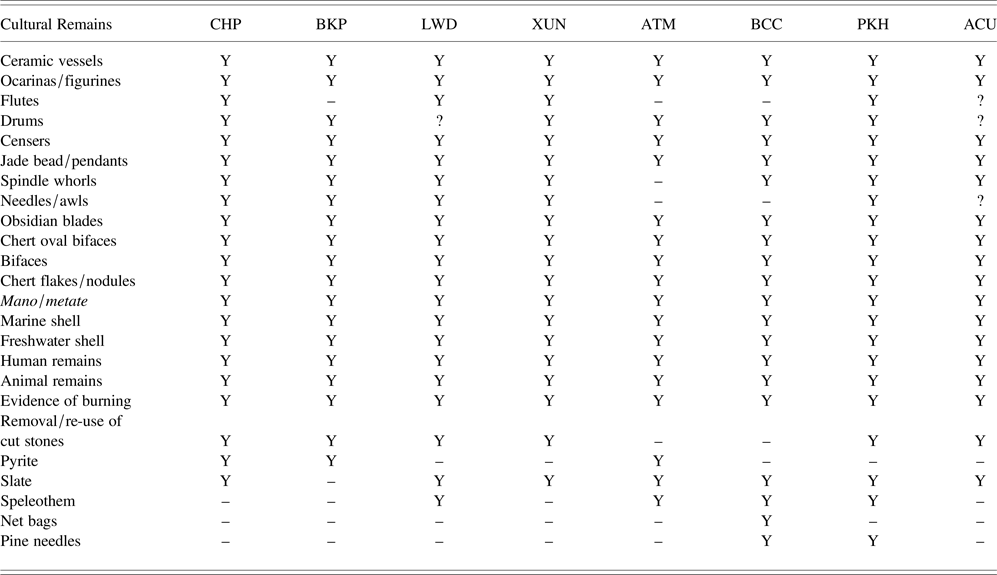
In the north palace group (Plaza AIII), particularly in Structure A11, both MacKie (Reference MacKie1961) and Yaeger (Reference Yaeger, LeCount and Yaeger2010) recorded evidence for Terminal Classic activity and peri-abandonment deposits. Remains associated with these activities included incised patolli boards on the floors of rooms, graffiti carved into the walls of the building, fragments of a carved stone panel, ceramics carpeting “the floors of Rooms 9 and 10,” and the remains of an adult male that was buried or covered over with marl in Room 11 (Yaeger Reference Yaeger, LeCount and Yaeger2010:151–157; see also Helmke et al. Reference Helmke, Awe, Grube, LeCount and Yaeger2010:99–101). According to Yaeger (Reference Yaeger, LeCount and Yaeger2010:151), the graffiti in Room 9 “includes a procession of anthropomorphic figures, one masked and another playing a drum.” He also notes that fragments of a ceramic drum were found “on the floor and in front of the procession scene” and concludes that the designs “may represent visions achieved during ritual trances undertaken in this very room” (Yaeger Reference Yaeger, LeCount and Yaeger2010:151). As we highlight in Table 1, ceramic drums are a common artifact form in peri-abandonment deposits in the Belize Valley. Ethnographic studies among Zinacantecos, the Lacandon, and other Mesoamerican groups (McGee Reference McGee1990; Palka Reference Palka2014; Vogt Reference Vogt1969) further note that music, especially that produced with drums and flutes, typically accompany processions and ritual performances at pilgrimage sites. Palka (Reference Palka2014:40) also notes that graffiti and other material culture are often carved and left by pilgrims at sacred landscapes. In contrast to Yaeger's conclusion, we, therefore, strongly suggest that the ceramic drum fragments and the graffiti in Room 9 of Structure A11 more likely reflect the type of ritual events described by Palka, and that the graffiti on the wall of Room 9 may actually be a visual representation and memorialization of just such an event. In regard to the skeletal remains in Room 11, Yaeger (Reference Yaeger, LeCount and Yaeger2010:157) concluded that it was likely associated with “the destruction of Structure A11” during “violent conflict and political transformation at the end of the Late Classic period” at Xunantunich. Here again, our interpretation differs with Yaeger's conclusion. As our regional study and other papers in this Special Section have noted, burials and the interment of sacrificial victims or incomplete skeletal remains are common in peri-abandonment deposits in highland Guatemala shrines (Brown Reference Brown2002:241), at Lacandon pilgrimage sites (McGee Reference McGee1990), and within sacred cave contexts (Awe et al. Reference Awe, Griffith, Gibbs, Brady and Prufer2005; Brady Reference Brady1989). If the skeletal remains in Structure A11 at Xunantunich were those of a person who was killed in a “violent conflict,” we would expect to find evidence for some type of blunt force trauma, and also need to explain why only one person in the palace complex met this violent fate.
Cultural remains recovered in peri-abandonment deposits at Cahal Pech (CHP), Baking Pot (BKP), Lower Dover (LWD), Xunantunich (XUN), Actun Tunichil Mucnal (ATM), Barton Creek Cave (BCC), Pook's Hill (PKH), and Aguacate Uno (ACU) in the Belize Valley.

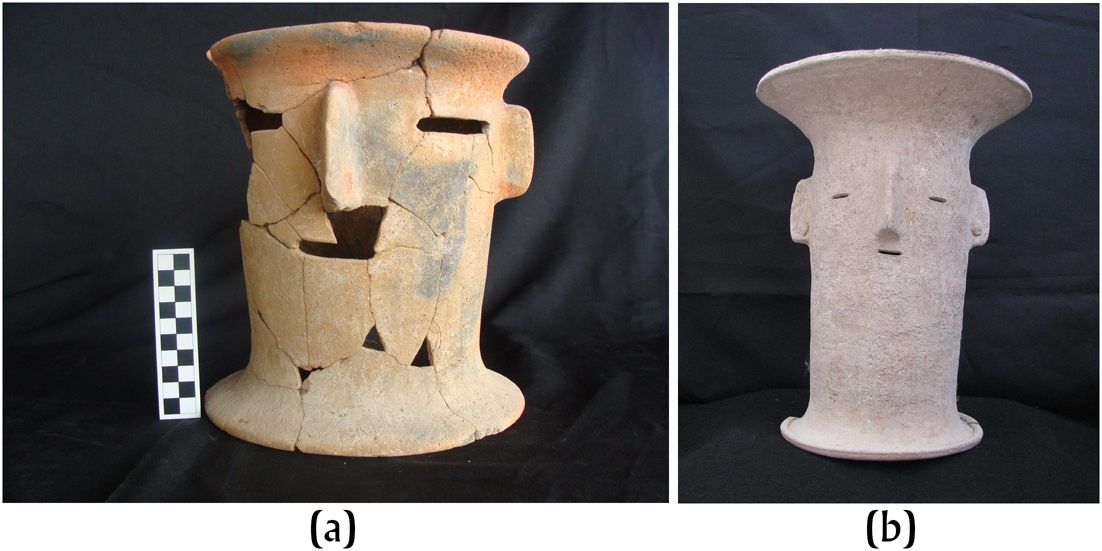
Thompson (Reference Thompson1942), Pendergast and Graham (Reference Pendergast and Graham1981), and more recently our BVAR Project (Burke et al. Reference Burke, Tappan, Wisner, Hoggarth and Awe2020) have also excavated peri-abandonment deposits in an elite palace complex known as Group B at Xunantunich. Thompson's (Reference Thompson1942) excavations in Structures B1 and B3 recovered figurines, spindle whorls, bifaces, grinding stones, animal remains, fragments of ceramic drums, incensarios, and large quantities of Terminal Classic monochrome and polychrome pottery. Pendergast and Graham's (1981) work in Group B consisted of salvage operations in Structure B5 after the mound had been vandalized by looters. Along the sides of Structure B5, they (Pendergast and Graham Reference Pendergast and Graham1981:17–18) found several, partially complete, censers, including a ladle type censer and two other effigy censers (Figure 3) that are almost identical to the effigy censer we discovered in the Structure H1 tomb (BU:H1-1) at Cahal Pech (Aimers and Awe Reference Aimers and Awe2020). Pendergast and Graham (Reference Pendergast and Graham1981:17) also uncovered the grave of an adult female a few centimeters from surface. The grave had penetrated the terminal floor of the building, but the latter had not been replastered. Accompanying the skeletal remains was a ceramic aerophone /flute that is identical to the one we found in an intrusive child burial (BU:A3-1) at Cahal Pech (Aimers et al. Reference Aimers and Awe2020b; Aimers and Awe Reference Aimers and Awe2020). Given the context of the burial and the style of the flute, Pendergast and Graham (Reference Pendergast and Graham1981:17) concluded that “the interment of this individual clearly postdates the primary use of the platform, and in fact cannot have taken place until most or all of the material encountered above the platform surface had accumulated following abandonment.”
Effigy censers discovered by (a) Pendergast and Graham in Group B deposits and (b) by Awe in Plaza H Tomb at Cahal Pech. Photographs by Awe.

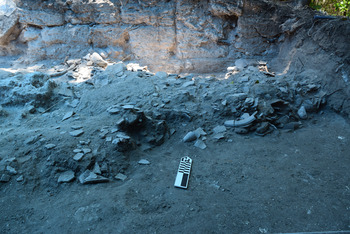
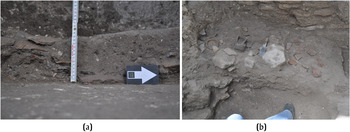
Our more recent investigations in Group B at Xunantunich have focused on Structures B1, B2, B3, and B4, and the small plaza they enclose. These investigations uncovered peri-abandonment deposits in every corner of the courtyard, and also on the south side of Structure B4 (Figure 4). As Burke et al. (Reference Burke, Tappan, Wisner, Hoggarth and Awe2020) report, the deposits were recovered above and between collapsed architecture, and contain considerable amounts of worked and unworked animal remains (Figures 5a and 5b). In Table 1, we also note that the cultural assemblage in the deposits at Xunantunich and in Group B, in particular, are identical to those from Cahal Pech and other Belize Valley sites. They include complete and fragmented ceramic vessels, spindle whorls, stemmed and unstemmed chert and obsidian bifaces, manos, obsidian blades and cores, modified and unmodified animal bones, plus the skeletal remains of several infants and adults, all discovered above the terminal plaza floor or inside of rooms. In one case, several whole vessels that were arranged in a cruciform pattern were uncovered just below the modern surface at the summit of a small platform. On a bench inside a room of another building was a large and complete turtle shell drum with suspension holes.
Peri-abandonment deposits in Group B at Xunantunich. Photograph by Awe.

(a) Photograph showing layer of soil matrix separating peri-abandonment deposits from plaster floor at Group B, Xunantunich (note base of ruler on plaza floor). (b) Photograph showing layer of soil matrix and collapsed architecture separating peri-abandonment deposits from plaster floor in front of Structure A3 at Xunantunich. Note assistant's feet at floor level. Photographs by Awe.

Caracol (Tier 1)
Chase and Chase (Reference Chase and Chase2000:73) discovered peri-abandonment deposits in at least 15 epicentral buildings and in nine residential groups in the site-core at Caracol, a large (tier 1) major center in Central Belize. Between 2001 and 2004, a Tourism Development Project (TDP) directed by Awe uncovered additional deposits associated with Structure A6, Structures B4 and B5, and in the Barrio Group. For descriptions of the peri-abandonment deposits excavated by the Caracol Project, particularly the artifact assemblages and their context of discovery, one can refer to several publications by Chase and Chase (Reference Chase, Chase and Houston1998, Reference Chase and Chase2000, Reference Chase, Chase, Kathryn Brown and Stanton2003, Reference Chase, Chase, Demarest, Rice and Rice2004, Reference Chase and Chase2020).
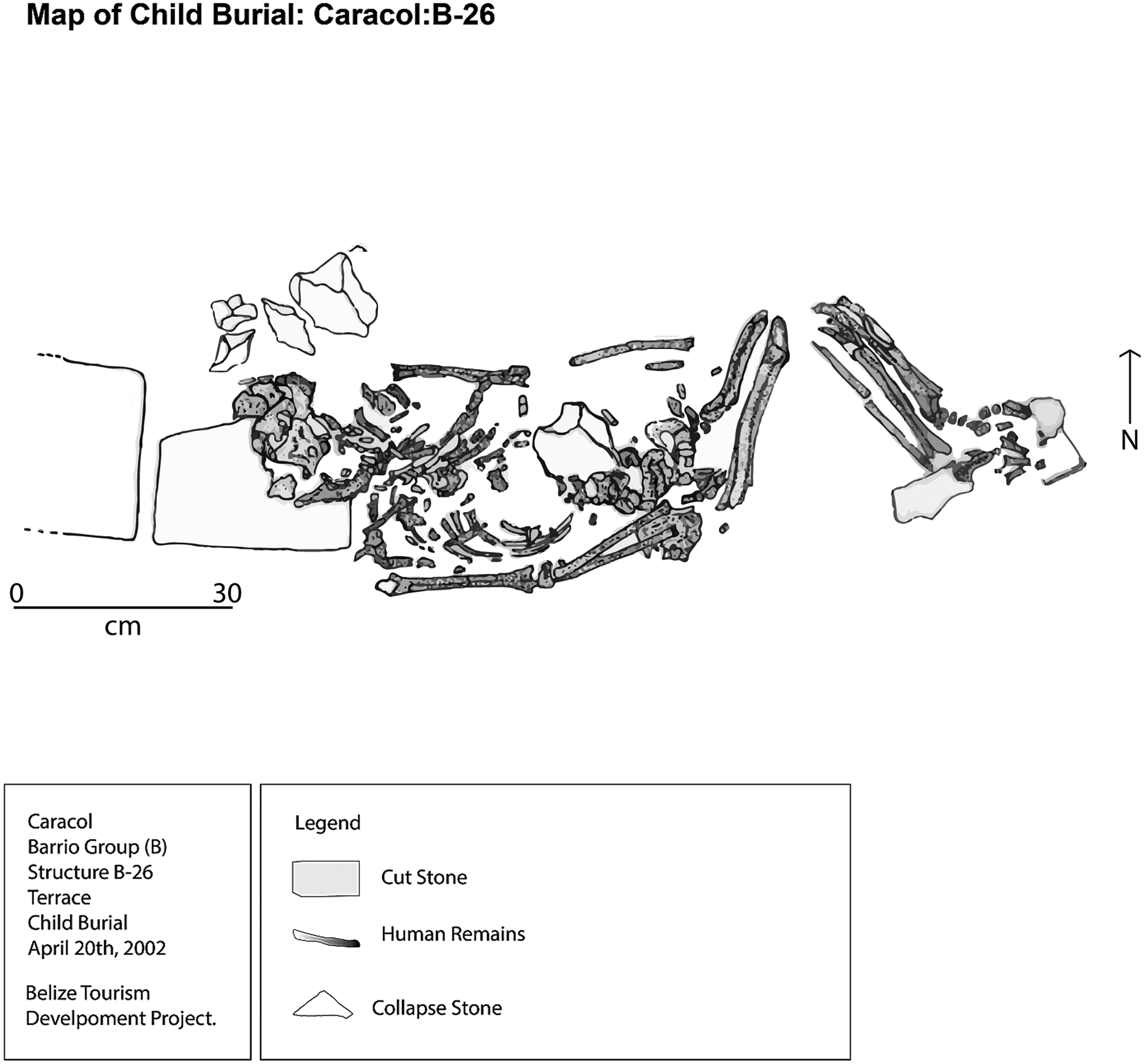
At the Barrio Group, a large palace complex located just east of the Caana acropolis and Plaza B, our TDP investigations uncovered peri-abandonment deposits in a narrow, tunnel-like, passageway that separates Structure B25 from Structure B26, and on the lowermost western terraces that flank the central stairway of Structure B6. The deposit in the passageway contained a large amount of broken pottery, including fragments of censers, chert flakes, animal remains, and fragments of manos and metates. On Structure B26, the northern structure of the Barrio Plaza, our excavations revealed the remains of a child (Figure 6) that had been placed on a partially collapsed terrace flanking the building's central stairway. The child's remains were covered by about 20 centimeters of soil and the remains were placed in an almost fetal position. The head and body of the child were resting on top of the facing stones of the terrace. Grave goods associated with the remains included an ocarina, a snuff bottle, obsidian and chert flakes, and fragments of a molded-carved vase. Just below the burial, we also recovered a small candelero and two carved olive shells (Olivella sp.). The context of the skeletal remains clearly indicates that the burial was either deposited sometime after Structure B26 had started to fall apart, or that part of the terrace wall was intentionally removed so that the burial could be placed in that location.
Child burial overlaying collapsed terrace of Structure B-26, Barrio Group, Caracol. Plan by Awe.

The remains of another child were found just below modern ground surface at the base of the southern wall of Structure B4. The individual was laid in a fetal position and covered with two large limestone blocks that were likely retrieved or removed from a collapsed building. Between the skeletal remains and the plaza floor was a thin lens of dirt that had accumulated on top of the plastered surface prior to the deposition of the child's remains. Encircling the latter were large amounts of broken pottery, a biface, a side-notched stone resembling a net sinker, and a variety of animal remains.
On Structure A6, the central pyramid of Caracol's E-Group, we discovered a concentration of broken pottery, including fragments of censers, and evidence of burning on the floor of an upper terrace flanking the stairway of the structure. The pottery and burned material covered a large hole that had been cut into the floor of the terrace. The hole had penetrated the terminal floor of the terrace, and was subsequently filled in with dirt, but not resealed with plaster. Within this intrusive hole was a cache containing fragmented remains of several individuals, including two adults, juveniles, and possibly a fetus. The skeletal remains were found amidst oxidized fragments of pyrite, a rectangular ceramic mirror back, 74 conch shell rings (some with inlays of jadeite), a spindle whorl, plus jadeite ear flares and beads. When we extended the excavations to the south of the hole, we also found the skeleton of a dog. Coincidentally, Chase and Chase (Reference Chase and Chase2000:69) also discovered “two large conch shell trumpets and a set of extremely large jadeite ear flares…in architectural collapse almost a meter above the floor of a rear room” at the summit of Structure A6.
Chase and Chase (Reference Chase and Chase2000), who previously interpreted peri-abandonment deposits as de facto refuse and evidence for rapid abandonment, report that these deposits are consistently found in epicentral palaces and temples at Caracol. They further note that most of the deposits are discovered “on the floors of buildings whose roofs had once been vaulted” (Chase and Chase Reference Chase and Chase2000:69). While we agree with the Chases that these deposits are predominantly discovered in and around monumental architecture in site-cores, we question their functional interpretation of the deposits. For example, the contexts and contents of the deposits at Caracol are almost identical to those of deposits that we have discovered at sites of every size across Western Belize. The same can be said for the contexts and contents of peri-abandonment deposits at sites in Peten, Guatemala, and in the Yucatan, Mexico. When examined against the archaeological correlates for warfare and pilgrimage events discussed by Aimers et al. (Reference Aimers, Hoggarth and Awe2020a), we also find that both the context and contents of the deposits at Caracol are more in line with those associated with ritual events at sacred landscapes. As we also note below, if all these deposits were associated with rapid abandonment due to invasion or military activity, we would have to assume that marauding armies attacked sites of all sizes in Western Belize, and then took the time to destroy similar sets of objects in similar contexts. In spite of this, it may be possible that some peri-abandonment deposits could be related to martial activities but, if this is the case, it still brings into question why the assemblages of the deposits, as well as their contexts, are so similar across the region and at sites of different sizes and political stature.
Altun Ha (Tier 2)
Both Pendergast (Reference Pendergast1979, Reference Pendergast1982, Reference Pendergast1990) and our TDP uncovered peri-abandonment deposits at Altun Ha, a medium-size major center (tier 2) in north Central Belize. Here again the deposits were predominantly found in the corners of buildings, along the stairside outsets of monumental architecture, and inside palace rooms. Outside the site-core, Pendergast (Reference Pendergast1979) also discovered deposits within elite residences in Zones C and E, contexts that are similar to Group B at Xunantunich and the Barrio Group at Caracol. While excavating and conserving Structure B4, known as the Temple of the Masonry Altars, we (the TDP) also uncovered peri-abandonment deposits along the flanks of the stairside outsets of this major temple. The contextual distribution of peri-abandonment deposits at Altun Ha, therefore, mirrors the pattern that we recorded at Cahal Pech, Baking Pot, Xunantunich, and Caracol. Cultural materials within the deposits at Altun Ha are also consistent with those found in the assemblages of Western Belize sites. They contain large amounts of pottery, including fragments of molded-carved vases, censers, ocarinas, and ceramic drums, plus chert implements (bifaces), obsidian blades, grinding stones, jadeite beads, and animal and human remains. Like the deposits found in Belize Valley sites, those at Altun Ha were also predominantly found just above the plastered floors of buildings, often separated from the latter by a distinct layer or lens of soil.
Baking Pot and Lower Dover (Tier 2)
Subsequent to the TDP, we continued our concerted effort to locate and investigate peri-abandonment deposits in the Belize River Valley. To that end, we purposely targeted those contexts where these deposits have consistently been found at other sites in Western Belize, we continued to apply microstratigraphic techniques in their excavation, and to conduct multidisciplinary analyses of the remains recovered in the deposits. For detailed results of our investigations at Baking Pot (a tier 2 major center), the reader should refer to the paper by Hoggarth et al. (Reference Hoggarth, Britt Davis, Awe and Helmke2020; see also Davis Reference Davis2018). Our study of the Lower Dover (tier 2 major center) remains are ongoing and are partly the subject of Romih's (Reference Romih2019) Master's thesis at Northern Arizona University. To summarize these investigations, we can confirm that the contexts of peri-abandonment deposits at both sites are consistent with those recorded at other centers in Western Belize. At Baking Pot, for example, they are found in and adjacent to a sweat bath, in the corners of Plaza B in Group B, at a terminus group, and in the Group B palace complex in the site-core. Some of the Baking Pot deposits were also found in various lens between discrete strata of collapse debris, suggesting sequential deposition of the remains at different times and during multiple events (Davis Reference Davis2018). The deposits at Baking Pot and Lower Dover also contained large amounts of ceramics, along with a similar non-ceramic cultural assemblage (Table 1; Burke et al. Reference Burke, Tappan, Wisner, Hoggarth and Awe2020; Hoggarth et al. Reference Hoggarth, Britt Davis, Awe and Helmke2020). Human remains in the deposits at both sites were also within burials, or represented by fragments of bone intermixed with other artifacts in the deposits. In addition to bowls and jars, ceramic artifacts included fragmented molded-carved vases, censers, polychrome vessels, ocarinas, figurines, and ceramic drums (Davis Reference Davis2018).
Deposits in Minor Centers (Tier 3): Pook's Hill and Nohoch Ek
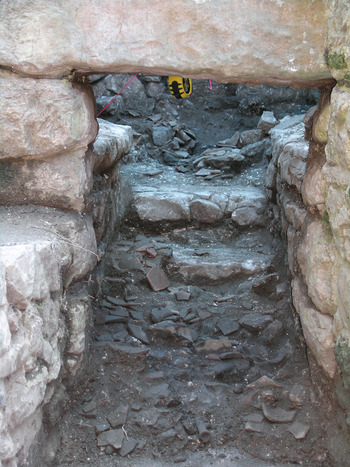
In contrast to the major sites discussed above, Nohoch Ek and Pook's Hill are minor centers (tier 3) with medium-sized plazuela groups. A description and interpretation of the deposits at Nohoch Ek, which is located approximately three kilometers south of Cahal Pech, is available in Taschek and Ball (Reference Taschek and Ball2003). The Pook's Hill site-core, located along the Roaring Creek tributary of the Belize River, has a small eastern shrine; several residential platforms on the northern, southern, and western perimeters of the central courtyard; and a sweat bath on the northwest corner of the courtyard (Figure 7). The sweat bath was well-built and its preserved dome ceiling represents the sole vaulted structure at the site. Pook's Hill was extensively excavated by Helmke between 1999 and 2005 as part of his dissertation research. During these investigations, Helmke (Reference Helmke2003) exposed several peri-abandonment deposits, which at the time were referred to as “terminal occupation debris.” These deposits were uncovered along the flanks of the stairway of the eastern shrine, as well as on either side of the principal axial stairs of the northern and western structures (Helmke Reference Helmke2003:124, Reference Helmke2006a:182–183). A particularly large concentration of peri-abandonment material was found in the northwestern corner of the courtyard, along the base of the structures, as well as partly chocking the sunken passage leading into the sweat bath and covering the steps on the interior of the latter (Helmke Reference Helmke2006b:79–80).
Peri-abandonment deposits in passage leading into the sweat bath at Pook's Hill. Photograph by Awe.

The deposits at Pook's Hill were located above terminal phase floors as well as abutting the basal courses of terraces and stairs, and were buried by collapsed architecture. Along the southeastern base of the western structure, another peri-abandonment deposit was found as a lens between discrete strata of collapse debris, indicating the formation of such deposits at successive times and in tandem with the partial collapse of the structures. All deposits contained large amounts of broken pottery; a high proportion of musical instruments (especially ceramic ocarinas, bone rasps, with turtle shell plastrons likely forming part of percussion instruments); a large number of animal remains (deer, peccary, dog, turkey, paca, agouti, armadillo, freshwater shell, including jute, and marine species such as parrotfish; Stanchly Reference Stanchly, Helmke and Awe2006); some singular objects such as spindle whorls and items of regalia (including isolated jade beads, and shell tinklers); several stone tools, including obsidian blades, chert bifaces, lanceolate/lenticular and stemmed chert points; and miniature ground stone bifaces, as well as manos, fragmentary metates, and an inkstone (Helmke Reference Helmke2001:53–63; Stemp et al. Reference Stemp, Helmke and Awe2010). Paleobotanical analyses of carbonized plant remains recovered from flotation samples revealed the presence of pine (Pinus sp.), carbonized squash rind fragments (Cucurbita sp.), carbonized maize kernels (Zea mays), and chili pepper seeds (Capsicum annuum; Morehart Reference Morehart, Helmke and Awe2007). These inclusions speak as to the original content of these peri-abandonment deposits as including organic materials and the remains of foodstuffs. Several of the deposits also contained fragments of human remains (tarsals, teeth, and other long bones), some of these partly articulated (including two feet and part of an arm) thrown in these commingled deposits. Significant among the ceramic remains were fragments of Terminal Classic molded-carved vases, including a complete and two partial vases (Helmke and Reents-Budet Reference Helmke and Reents-Budet2008).
The contexts of many deposits and their material wealth initially suggested that these may be the result of conspicuous consumption activities, such as rituals and feasting, with the deposits formed secondarily and subsequent to these activities (Helmke Reference Helmke2001:31–33). Given the presence of two partially completed architectural units on the eastern and northern structures and the presence of peri-abandonment deposits as lenses in collapse debris, we now suggest that these deposits formed as part of continued occupation and what may be labelled the protracted abandonment of the site, at a time when buildings were no longer being maintained and were already undergoing significant collapse.
COMPARISON OF PERI-ABANDONMENT ASSEMBLAGES AT SURFACE AND CAVE SITES IN WESTERN BELIZE
One of the striking observations that we made during our study of peri-abandonment deposits are that they share considerable parallels with deposits that our BVAR Project recorded in caves between 1997–2006. The latter study, which we conducted under the auspices of the Western Belize Regional Cave Project, investigated several caves in Western Belize, including: Actun Tunichil Mucnal (ATM), Laberinto de las Tarántulas (LTR), and Actun Nak Beh along Roaring Creek, as well as Barton Creek Cave (BCC) along the stream of the same name, and Chechem Ha Cave (CCH) in the Macal River Valley (Awe Reference Awe and Awe1998; Awe et al. Reference Awe, Griffith, Gibbs, Brady and Prufer2005; Helmke Reference Helmke2001; Mirro Reference Mirro2007; Morehart Reference Morehart2002; Moyes Reference Moyes2001, Reference Moyes2006; Owens Reference Owens2002).
Like peri-abandonment deposits at surface sites, cultural remains in caves are found above cave floors, generally concentrated in specific locations in cave chambers, and are typically associated with hearths and evidence of burning (Awe et al. Reference Awe, Griffith, Gibbs, Brady and Prufer2005; Helmke Reference Helmke2009; Moyes Reference Moyes2001). Cave deposits also predominantly contain ceramic remains that are broken, with many of the fragments either missing or deposited elsewhere. At ATM, for example, we found most of the fragments and two legs of a tripod vessel cached among broken speleothems in a small alcove. We discovered the third leg of the vessel several meters away, next to two bifaces (Helmke Reference Helmke2009:391, Figure 6.31g). In another example, we found approximately two thirds of a Molded-carved vase in a small alcove, but the remaining fragments were never located anywhere in the cave (Awe et al. Reference Awe, Griffith, Gibbs, Brady and Prufer2005; Helmke Reference Helmke2009:384, 387, Figure 6.29). Our frequency distribution analysis of the ceramics in ATM and other Western Belize caves further noted that Late-to-Terminal Classic pottery represents the majority of the ceramic remains in the caves (i.e., between 50 and 90 percent; see Helmke Reference Helmke2009). In some cases, such as ATM, BCC, and CCH cave, Terminal Classic ceramics not only predominate, but were the only types found in the deepest recesses of the caves (Moyes et al. Reference Moyes, Awe, Webster and Brooks2009).
What is particularly significant to this study is that cave assemblages are very similar in content to those of peri-abandonment deposits at surface sites. In his dissertation research at Naj Tunich, Guatemala, for example, Brady (Reference Brady1989) provided one of the first descriptions of a ritual cave assemblage. The list included ceramic vessels, manos, metates, obsidian blades, chert bifaces, weaving implements such as spindle whorls, needles and awls, and items of personal adornment. In Western Belize caves, ceramic remains predominantly contain bowls and jars, but also include musical instruments and molded-carved vases (Table 1; Awe et al. Reference Awe, Griffith, Gibbs, Brady and Prufer2005; Helmke Reference Helmke2009). Fragmented (i.e., terminated) manos and metates, spindle whorls, obsidian blades, and lanceolate bifaces are the most common ground stone and chipped stone tools. Polished stone objects are less common and generally represented by jade beads. Complete and partial human skeletons, especially skulls, are also present, and animal remains, especially freshwater and marine shells, are common.
In caves with good preservation, such as Barton Creek and Chechem Ha Caves, we found several food remains including “domesticates, such as maize (Zea mays), beans (Phaseolus vulgaris), squash (Cucurbita pepo and Cucurbita moschata), and chili peppers (Capsicum annuum), and the fruits of edible trees, particularly nance (Byrsonima crassifolia) and cohune palm (Attalea cohune)” (Morehart Reference Morehart2002:302–303). Feature 23 in Area C of Ledge 2 at BCC contained many of these remains mixed with the ash and charcoal from burned pine wood (Morehart Reference Morehart2002:198–203). Other deposits in this cave contained the remains of cotton textile, pine needles, spindle whorls, needles, awls, and fragments of ceramic drums and ocarinas (Mirro Reference Mirro2007; Morehart Reference Morehart2002; Owens Reference Owens2002). The pine needles were spread over the surface of a small chamber, reflecting a tradition typical to that observed at highland shrines in Guatemala and Chiapas (Vogt Reference Vogt1976). Residue analysis also revealed copal incense and starch grains, “morphologically similar to maize starch,” in miniature ceramic vessels, and in ceramic bowls and jars (Morehart Reference Morehart2002:173–175).
In other caves with good preservation, such as Actun Polbilche in the Sibun River Valley, Pendergast (Reference Pendergast1974) previously found the wooden shaft of a spear, plus bone needles and awls. He also found a wooden figurine, a deer antler, jadeite jewelry, obsidian, olive shell beads, and a variety of mammalian remains including deer and feline. The discovery of the wooden spear is particularly interesting because these types of objects are often associated with militarism or hunting and not something one would expect to find within a sacred cave context. It also brings to mind the more recent discovery of a Spanish sword that was cached in Rapier Cave in the Roaring Creek Valley (Awe and Helmke Reference Awe and Helmke2015, Reference Awe, Helmke, Hofman and Keehnen2019), and serves to demonstrate that objects normally associated with martial activities were also deposited in offerings at sacred landscapes by the ancient Maya (e.g., in the cenote at Chichen Itza).
COMPARISONS TO CULTURAL REMAINS RECOVERED FROM THE “CENOTE OF SACRIFICE” AT CHICHEN ITZA
The cultural remains from peri-abandonment deposits in the Belize Valley share close and particularly interesting parallels with the cultural remains that were dredged from the “Cenote of Sacrifice” at Chichen Itza. The cultural assemblage recovered from the cenote contained a diverse range of jade and metal jewelry, ground stone implements, awls, several spindle whorls, other weaving tools, plus human and animal remains (Coggins Reference Coggins1992). Chipped stone artifacts included various types of bifaces, bifacially flaked fragments and thinning flakes, plus obsidian blades, cores, and debitage. Animal remains consisted of marine and freshwater shells and worked and unmodified mammalian remains, including those of deer and felines.
The ceramic, wooden, and chipped stone artifacts in the Chichen cenote assemblage are particularly noteworthy for the implications they bear for the study of peri-abandonment deposits. Ceramic vessel forms from the cenote were predominantly represented by bowls, jars, incense burners, and a few figurines (Ball and Ladd Reference Ball, Ladd and Coggins1992:191–233). Interestingly, many of the bowls still contained copal and serve as a caveat for interpretations that generally associate these vessel forms with evidence for feasting activities. Among the 250 chipped stone artifacts, the majority are stemmed/tanged, side-notched, corner-notched, and lanceolate bifaces (Sheets et al. Reference Sheets, Ladd, Bathgate and Coggins1992:153). In several cases, some of the points were found still hafted in wooden handles (Coggins and Ladd Reference Coggins, Ladd and Coggins1992:262–263). Several others were likely originally hafted in the wooden shafts that were dredged from the well. Other wooden objects included a variety of well-preserved atlatls. In her usewear analysis of the bifaces, Sievert (Reference Sievert1992:87) noted that they had been previously used, and that their most identifiable functions included shooting, stabbing, and butchery. Similarly, based on their usewear analysis of the bifaces recovered in the peri-abandonment deposits at Cahal Pech, Stemp and Awe (Reference Stemp and Awe2020) determined that most had been used as projectiles points, with some evidence of contact with bone and possibly soft tissue. In most contexts, the bifaces, their wooden shafts, and the dart throwers recovered from the cenote at Chichen Itza would undoubtedly have been interpreted as being associated with military activity. Their deposition within the cenote, however, forces us to consider alternative functions for their final use. In the case of the cenote assemblage, that function is most likely ritual in nature, a situation similar to that noted by Awe and Helmke (Reference Awe and Helmke2015, Reference Awe, Helmke, Hofman and Keehnen2019) for a European sword deposited by the Maya in Rapier Cave in Western Belize, and by Stemp and Awe (Reference Stemp and Awe2020) for the chert projectile points from the peri-abandonment deposits at Cahal Pech.
ETHNOHISTORIC AND ETHNOGRAPHIC EVIDENCE FOR THE DEPOSITION OF CULTURAL REMAINS IN SACRED LANDSCAPES
In 1562, Diego de Landa reported that many Yucatec Maya continued to conduct rituals at sacred landscapes and pilgrimage sites, and that these rituals involved the worship of idols, the burning of incense, and the sacrifice of animals (Tozzer Reference Tozzer1941:76). Even more disconcerting to Landa was the fact that the Maya were still conducting human sacrifice, particularly of children, and throwing them, along with various types of offerings, in the “well” at Chichen Itza (Tozzer Reference Tozzer1941). López de Cogolludo (Reference López de Cogolludo1688:448–449) adds that near Mani, Landa found a cave where villagers had left offerings of deer and copal among several idols. Citing the sixteenth-century reports of Don Diego Quijada (Scholes and Adams Reference Scholes and Adams1938), Clendinnen (Reference Clendinnen2003:196) adds that, in the Yucatan, “the principal lords and ah-kines…made human sacrifices to god within the church of this village and in other places…killing infants and boys and girls, Indian men and women.” She further notes that during questioning Francisco Chuc of Sahcaba in 1562 confessed that, in addition to children, sacrifices at ancestral sites often included birds, pigs [peccary], and other animals (Clendinnen Reference Clendinnen2003:202–204). Further south in Belize, Gann (Reference Gann1971:157) noted that many of the items prepared and used in cha'cháak rain-bringing ceremonies were burned at the end of the ritual. Recall too that when Gann visited Xunantunich at the start of the 1900s, he found that Maya villagers often left offerings around the fragmented stela in front of Structure A1.
According to McGee (Reference McGee1990:57), the Lacandon make regular pilgrimages to sacred locations, such as caves and the site of Yaxchilan, to petition deities and ancestors for rain, bountiful harvests, and health. One of the activities conducted at the site during these rituals is the burning of rubber figurines and “incense in the buildings thought to be homes of various Lacandon gods” and ancestors. At the end of these rituals, the Lacandon leave many of the “god pots,” clay bowls, and edible and inedible offerings at the sites. In some cases, human remains are “arranged on the ground between the piles of bowls and god pots” (McGee Reference McGee1990:57). Among the implements used by the Lacandon in their rituals are rattles, conch shell trumpets, drums, flutes, and rubber figurines (McGee Reference McGee1990:45, 53).
Vogt's (Reference Vogt1969, Reference Vogt1976) ethnographic research recorded many parallels to Lacandon rituals among the Zinacantecos of highland Chiapas. Like the Lacandon, for example, the Zinacantecos make regular pilgrimages to sacred landscapes (Vogt Reference Vogt1969:595). In years of severe drought, one of the major rituals conducted during these pilgrimages is the rain-making ceremony (Vogt Reference Vogt1969:473). Interestingly, Vogt (Reference Vogt1969:399) noted that while music does not accompany several types of Zinacanteco ceremonies, it is an integral part of these “Rain-Making” ceremonies. In these cases, music is one of the most ritually important components of the ceremonies and is provided by “the flute and drum group, always consisting of one flute player and two drums” (Vogt Reference Vogt1969:399). Some rituals also involve the sacrifice or offering of chickens (Vogt Reference Vogt1969:461–462), and almost all rituals include offerings of alcohol, flowers, pine needles, and the burning of candles and incense (Vogt Reference Vogt1969:465).
Palka's (Reference Palka2014) more recent research on Maya pilgrimage to ritual landscapes provides an even richer source of information on contemporary Maya and Mesoamerican activities at sacred landscapes, and of the material remains that are commonly left at these sites. He (Palka Reference Palka2014:314–315) notes that across Mesoamerica, ritual landscapes and/or pilgrimage destinations include monumental architecture at Pre-Columbian sites, caves, mountains, cenotes, and “other sanctuaries.” Because “the essences responsible for providing rain, food, health, and life itself are concentrated in these ritual landscapes…these essences must be visited and propitiated for their life-giving properties to be released” (Palka Reference Palka2014:5). He adds that, “rites at shrines frequently concern fertility (human and agricultural), curing the sick, and control of rainfall,” and that pilgrimages are generally “carried out in times of crisis or periods of imbalance, including during droughts, conflicts, and when the need for curing arises.”
Important “signatures” of shrines include “votive offerings, sacrificial victims, pilgrim amulets, and special-context burials and caches in caves, altars, or shrine cemeteries.” So too are graffiti, art, “miniatures of daily objects,” and other artifacts such as “exotic stone objects…and domestic pottery and food storage items” (Palka Reference Palka2014:52–53). During rain petitioning rituals conducted at an abandoned Preclassic pyramid on an island in Lake Mensabak, the Lacandon also leave food offerings and god pots (incensarios) at the site (Palka Reference Palka2014:2). According to Palka (Reference Palka2005:266), “the site of Yaxchilan was littered with historic Lacandon incense burners and their fragments” in the early nineteenth century, “and early archaeologists found them inside temples, within the roof combs of structures, and alongside stone monuments” (cf. Charnay Reference Charnay, Gonino and Conant1887). Often, ritual practitioners remove small stones from the sites and take them back to animate the god pots in their village (Palka Reference Palka2014:1). In other cases, they “remove things from the walls and surrounding area of shrines to take home, including sand, dirt, rocks, water, and locally made pilgrims tokens” (Palka Reference Palka2014:1). If this practice actually began in ancient times, it could explain why many artifacts in peri-abandonment deposits are often incomplete, perhaps because of fragments taken away by ritual participants.
In northwestern Mesoamerica, the Huichol play music, dance, burn incense, and leave offerings to gods and ancestors on their visits to sacred sites. The offerings “include wood and clay figurines in the shapes of animals and humans, small ceremonial arrows, decorated gourd bowls, and woven disks” (Palka Reference Palka2014:61–62). Music is often played with flutes, rasps, and tinklers. In the case of central Mexico, ritual practitioners offer “incense, rubber, paper, food, bowls, precious stones, jewels, gourds, toys (juguetes, perhaps figurines or miniature objects), and sacrificial children to resident deities” (Palka Reference Palka2014:65; (also see Martínez Marín Reference Martínez Marín, King and Tejero1972). The pattern and contexts of these activities, and the similarities between the objects used in these offerings with those in the cultural assemblages of peri-abandonment deposits are both striking and apparent, and they likely reflect a tradition that extends far back in time, particularly to the Terminal Classic period when Maya civilization was in decline and reorganization.
DISCUSSION
Twenty years ago, Chase and Chase (Reference Chase and Chase2000:67) commented that “the identification of [peri-abandonment] deposits is not always a simple matter, nor is there an agreed upon methodology for interpreting such materials.” Just a year earlier, Harrison (Reference Harrison1999) noted that one of the problems with understanding these deposits was that few researchers had bothered to take the time to systematically analyze the material remains recovered in these deposits. We concur with both of these statements, but would add that other problems that compounded previous attempts to understand the significance of peri-abandonment deposits, and the behaviors associated with them, were that early approaches were almost all based on single-site analysis, they were not compared with coeval cave deposits, and they generally ignored the rich ethnohistoric and ethnographic evidence for similar activities. It is for these very reasons that we decided to apply a regional approach in our study, to employ microstratigraphic excavation techniques in our investigations, to conduct multidisciplinary analysis of the cultural remains (animal, human, ceramic, lithic, and paleobotanical remains), accelerator mass spectrometry (AMS) 14C dating of organic materials, and to incorporate ethnohistoric and ethnographic information in our interpretation of the deposits.
The results of our regional and comprehensive study indicate that the contexts of peri-abandonment deposits are similar at sites across Western Belize, that the cultural assemblages associated with them are, for the most part, consistent from site to site, and that they most certainly reflect patterned cultural behavior. In the case of context, our investigations confirmed that peri-abandonment deposits are almost always found in association with monumental domestic and nondomestic architecture, with causeway termini groups, and sometimes with sweat baths. Within site-cores, the deposits are particularly found in and around the stairs of temples and palaces, in rooms of masonry buildings and in narrow passageways. They are also often associated with evidence of burning.
The assemblage of cultural remains in peri-abandonment deposits predominantly contains ceramic objects. The latter includes large concentrations of mostly broken, but sometimes complete, ceramic vessels, especially bowls, jars, vases, and incense burners. Molded-carved vases are particularly conspicuous in these deposits and could even be considered as a diagnostic of peri-abandonment deposits in Western Belize (and also in the Yucatan; Ringle et al. Reference Ringle, Negrón and Bey1998). Other ceramic objects are represented by spindle whorls, figurines, ocarinas, drums, and flutes.
Chipped stone tools consist largely of chert bifaces, obsidian blades, and blade cores. Chert bifaces are represented by stemmed, side-, and corner-notched points, lanceolate/lenticular bifaces, and general utility bifaces. Obsidian blades, chert and obsidian flakes, and chert nodules may also be present. Polished stone objects are generally represented by fragments of pyrite, small smoothed pebbles, jadeite beads, and occasionally jadeite pendants. Ground stone tools, particularly manos, metates, and spindle whorls, are also a major component of these deposits.
Animal remains are often, but not always, numerous. Freshwater snails, especially Pachychilus sp., are common. Marine shell, either whole or modified into beads, pendants, adornments, and sometimes trumpets, are also present but less common. Deer remains, especially long bones and antlers, are fairly well represented in these assemblages. The same is true of smaller mammalian remains. In contrast, bones of large felines and crocodiles are less frequent. In some cases, animal bones are modified to serve as needles, awls, hair pins, tubes, rings, and rasps. Scattered, as well as partially and fully articulated, human remains are often, but not always, part of these assemblages. Sometimes they are found in formal burials, sometimes they are represented by isolated skulls and long bones, and sometimes they are only present in the form of fragmented and disarticulated remains that are mixed in with other cultural remains. The practice of intermixing human remains with peri-abandonment deposits is recorded in both the archaeological and ethnographic literature. In highland Guatemala, for example, Brown (Reference Brown2002:241) notes that “exhumed and re-interred human remains” are often deposited in pits at shrine sites. A similar tradition exists among the Lacandon (McGee Reference McGee1990:57), who place fragments of human remains among the offerings left at sacred landscapes. Besides our investigations in Western Belize, archaeological evidence for this practice has also been noted in the Peten and Northern Belize (Sullivan et al. Reference Sullivan, Hageman, Houk, Hughbanks, Valdez, Stanton and Magnoni2008:108).
In our opinion, an important misconception in the study of peri-abandonment deposits is that most of the cultural remains associated with them are automatically assumed to have only functioned as domestic utilitarian objects (Braswell et al. Reference Braswell, Gunn, Carrasco, Folan, Fletcher, López, Glascock, Demarest, Rice and Rice2004:171–175; Chase and Chase Reference Chase and Chase2000:72). At Calakmul, for example, Braswell et al. (Reference Braswell, Gunn, Carrasco, Folan, Fletcher, López, Glascock, Demarest, Rice and Rice2004:171) note that “significant quantities of artifacts were recovered from in situ floor contexts in three of the four structures. These include incense burners and other items used in rituals, but the majority of the artifacts are related to mundane domestic and economic activities.” Stemp et al. (Reference Stemp, Brown and Awe2019:306) caution, however, “what may seem like mundane, everyday household items can be imbued with further meaning through their inclusion in religious rituals in particular places at particular times.” Moyes and Awe (Reference Moyes, Awe, Moyes and Christenson2020) also suggest that when mundane objects are used in rituals, they may acquire polyvalent meanings. For example, a household jar used in water ceremonies in cave contexts is transformed from an ordinary utilitarian object to one with ritual significance (Moyes et al. Reference Moyes, Awe, Webster and Brooks2009). In view of this, Peterson (Reference Peterson2006:285) also warns that we should not “glibly refer to the presence or absence of a ‘ceremonial assemblage,’ for the latter are not easily distinguished from a utilitarian one.” This is particularly compounded in sacred landscapes such as caves, where most cultural remains are indistinguishable from utilitarian objects found at surface sites (Ishihara Reference Ishihara2008). We therefore need to be conscious that many artifacts “rarely function in the utilitarian, social, or ideological domain to the exclusion of others” (Hayden and Cannon Reference Hayden and Cannon1984:96). Walker (Reference Walker2002:159) adds that “presumptions of utility undervalue or obscure traces of past religious organization that structure archaeological strata.” Peterson (Reference Peterson2006:289) reminds us that the absence of “special ceremonial paraphernalia” in some contexts might also be “an indication of the relative wealth of the ritual participants.” This description fits the artifact assemblages of caves in Western Belize well. She also notes that in “Brown's (Reference Brown2002) ethnoarchaeological discussion of contemporary Tz'utujil, Kachiquel, and K'iche’ Maya community shrines… commoner rituals include everyday items that are used in a ceremonial context” (Peterson Reference Peterson2006:289).
We should further underscore that it is very unlikely that mundane objects were randomly selected for use in ritual events (see Moyes and Awe Reference Moyes, Awe, Moyes and Christenson2020). Let us, for example, examine the use of bowls, jars, spindle whorls, drums, flutes, and chert bifaces in caves and peri-abandonment deposits. These objects are among the most common artifact types present in peri-abandonment deposits in the Belize Valley and, unlike censers, they are normally associated with mundane activities. In the case of bowls and dishes, their preponderance in peri-abandonment and cave deposits often lead some researchers to suggest that they are associated with feasting activities (Brady and Peterson Reference Brady, Peterson and Fogelin2008; Clayton et al. Reference Clayton, Driver and Kosakowsky2005; Garber et al. Reference Garber, Brown, Hartman and James F.1998; Walker Reference Walker, Skibo, Walker and Nielson1995). Bowls and dishes, however, were not only used for eating or serving food. Recall that many of the unslipped vessels dredged from the cenote at Chichen Itza contained copal incense (Coggins Reference Coggins1992). In caves with good preservation of organic remains, we have also recovered several bowls, dishes, and jars that contained burned maize and cobs of maize, pine needles, and the remains of other domesticates (Morehart Reference Morehart, Prufer and Brady2005). Ethnographic sources (Palka Reference Palka2005, Reference Palka2014; Vogt Reference Vogt1976) further note that the Lacandon and Zinacantecos place both edible and non-edible offering in these vessels at pilgrimage sites. These examples provide unambiguous evidence that utilitarian vessels were often used to contain offerings in ritual contexts and that they are not only used in feasting events.
To accept the feasting hypothesis, we would also have to ignore the presence of pine needles, human remains, especially those of children, spindle whorls, complete projectile points, and jadeite jewelry that are common in peri-abandonment deposits. These objects are clearly out of place in a feasting setting. The fact that most animal bones in the deposits show no evidence of cut marks associated with feasting activities also lends little support to this interpretation (Burke et al. Reference Burke, Tappan, Wisner, Hoggarth and Awe2020). In spite of the latter, we do recognize that minor “feasting” events do accompany some rituals. In highland Guatemala, for instance, Brown (Reference Brown2002:221) notes that feasting commonly accompanies rituals at sacred sites and that they often occur at the end of ceremonies. The places where those participating in the rituals eat, however, are generally located in areas peripheral to ritual activity areas (see also Helmke Reference Helmke2009:363–369). Brown (Reference Brown2002:222) further notes that ritual areas are clearly distinguishable from feasting areas because they
…contain a wide variety of burned materials and residues including various flowers, fruits and other botanical remains, sacrificial animals or meat offerings, different types of libations, ceramic offering vessels, as well as non-local offerings acquired in markets and transported to the site. In contrast, cooking hearths are used for fires to heat food and thus, the burned remains consist primarily of charred wood fuels.
We should, therefore, not always assume that the presence of bowls, dishes, animal remains, and musical instruments equates to feasting events without careful and rigorous analysis of the material remains, contexts, and associations of the cultural assemblages contained in these deposits.
Like ceramic bowls, archaeologists also often associate spindle whorls, needles, and awls with profane rather than ritual activity. In their study of peri-abandonment deposits at Calakmul, for example, Braswell et al. (Reference Braswell, Gunn, Carrasco, Folan, Fletcher, López, Glascock, Demarest, Rice and Rice2004:173) suggest that “spindle whorls and obsidian blades found together in sets in Façade Rooms 34 and 58 indicate that these spaces may have been places where textiles were produced.” As we noted above, spindle whorls are consistently found in all peri-abandonment deposits in Western Belize, and they are also present in cave assemblages. At Naj Tunich Cave, for example, Brady (Reference Brady1989) noted that spindle whorls were part of weaving kits that included both needles and awls. The same is true in the cenote at Chichen Itza (Coggins and Shane Reference Coggins and Shane1984), and at Balankanche Cave. In the case of the latter, a total of 25 complete spindle whorls were found in association with 232 miniature manos and metates (Andrews Reference Andrews1970:45–52). On Ledge 2 in BCC, we also found spindle whorls in association with textile and yarn (Morehart Reference Morehart, Prufer and Brady2005). In highland Chiapas, the Maya believe that rain clouds are “formed in caves from cotton spun by the daughters of the mountain gods” (Vogt and Stuart Reference Vogt, Stuart, Brady and Prufer2005:177; see also Stemp et al. Reference Stemp, Brown and Awe2019). McAnany (Reference McAnany2010:213) notes that among the Maya “the original creators are referred to as makers, modelers, and weavers; these generative acts are recapitulated when humans craft goods. Because of the manner in which crafting transforms raw materials, such creative acts must be done carefully and with proper respect for earthly supernatural forces.” Brady (Reference Brady1989:332) adds that “in modern Maya mythology, an association between rain and weaving still exists. The earthlord's daughters living in his cave are thought to fluff cotton as is done in preparation for spinning. The earthlord transforms the cotton into rain clouds with his lightning.” It is, therefore, not surprising that the Maya associated cotton and weaving implements with rain and agricultural fertility, and why weaving kits were, and continue to be, an integral component of offerings presented to deities during rain-making ceremonies in sacred landscapes.
In the case of stemmed, side-, and corner-notched points, lanceolate/lenticular bifaces, and general utility bifaces, these objects are generally assumed to be related to warfare and military activity. We previously noted that numerous blades and bifaces were recovered during the dredging of the cenote at Chichen Itza, and that these implements were clearly thrown into the well as offerings during pilgrimages to this site. In almost all the caves in Western Belize, we have also found obsidian blades, chert general utility bifaces, and lanceolate/lenticular bifaces, particularly laurel leaf-shaped specimens. When discovered with evidence for burning at surface sites, there is often the misconception that these bifaces can only be associated with rapid abandonment during violent and wanton destruction of sites. In her study of caves in the Sibun River valley, Peterson (Reference Peterson2006:285) notes that
Fire is such an integral part of all Maya ritual that the K'iche’ Maya refer to ritual ceremonies as “burnings” (Cook Reference Cook and Gossen1986:139), the altars where rituals are held as “burning places” (Bunzel Reference Bunzel1952:431), and ritual specialists who conduct ceremonies as “burners” (Tedlock Reference Tedlock1982:59).
Today, the Lacandon Maya still burn their old incense burners at sacred sites “in order to de-animate them” (Peterson Reference Peterson2006:285). In Southern Belize, Gann (Reference Gann1971:157) noted that the items used during rain-petitioning ceremonies were subsequently burned to deactivate their power. If we assume that the association of various types of bifaces along with burned remains represents evidence for rapid abandonment and destruction, then we also need to explain why they are associated with other types of artifacts (e.g., spindle whorls and incense burners), copal, and other organic remains (e.g., pine needles and food).
In our analyses of peri-abandonment deposits, we also need to consider the fact that these features are found at sites of every political level. That is, we find them at major (tier 1), medium (tier 2), and minor (tier 3) centers. Another point for consideration is that peri-abandonment deposits almost always represent the final activities at all these sites prior to abandonment. If we assume that the deposits are associated with rapid abandonment during the destruction of all these sites, we need to determine who the attackers are, for what purposes are they attacking, why the attacks are directed to sites of all political levels, why they systematically destroy similar types of objects in similar contexts, and why the attackers simply leave after destroying, pillaging, and burning these various communities. This form of warfare flies in the face of Maya military traditions, and makes no economic sense whatsoever. Like all other Mesoamerican cultures, the Maya primarily engaged in wars to take captives, and to exact tribute from the vanquished (Aoyama and Graham Reference Aoyama and Graham2017).
Ocarinas, flutes, and fragments of ceramic and turtle shell drums are another set of artifacts that we regularly discover in peri-abandonment deposits. Several of the ethnographic studies discussed above, as well as the Bonampak and San Bartolo murals, provide considerable evidence for the use of these musical instruments in processions and ritual activities. The Proto-classic murals from San Bartolo, for example, depict the maize god playing a turtle carapace drum (Taube et al. Reference Taube, Saturno, Stuart and Hurst2010). Pohl (Reference Pohl, Leventhal and Kolata1983) also notes that turtles are often included in offerings related to rain ceremonies. Besides their obvious association with water, the beating of turtle carapace drums is associated with the sound of thunder and rain storms (Miller and Taube Reference Miller and Taube1993:174–175). Music also accompanies most Maya rituals, and, as we discussed above, these instruments are often left as offerings at the end of pilgrimage events to sacred landscapes.
Like in cave contexts, manos and metates are commonly found in peri-abandonment deposits. Because of their predominantly utilitarian character, their presence in the latter contexts is generally assumed to reflect mundane activities, or as evidence for de facto refuse or garbage. Ironically, when we find them in cave contexts, we generally associate them with agricultural fertility rituals. They were used for processing maize which was then offered (or fed) to the earth and rain deities who would in turn reciprocate with food for the community.
In summary, this brief review of some of the objects found in peri-abandonment deposits serves to demonstrate that, while many of these cultural remains are associated with daily mundane activities, they can also be associated with ritual activities at sacred landscapes. Cave assemblages, the cultural materials recovered in the cenote at Chichen Itza, and those identified by the ethnographic and ethnohistoric literature at pilgrimage sites clearly reflect this pattern. At Chichen Itza, for example, Ardren (Reference Ardren2011:141) notes that “into the Colonial period, pilgrims continued to visit the cenote to make offerings to the gods in times of crisis - during the period from 1561 to 1565, a total of fifty-five events with 114 human victims were recorded by Spanish priests” in the Yucatan (see also de Anda et al. Reference de Anda, Tiesler and Zabala2004; Scholes and Adams Reference Scholes and Adams1938). Two of these events “occurred at the great cenote of Chichen. The reasons given in the Spanish documents for continued child sacrifice include the impact of the great hurricane of 1561, petitions to ensure a sufficient harvest, divination of the will of the gods and prayers for the health of local Maya leaders” (Ardren Reference Ardren2011:141). Palka (Reference Palka2005:6, Reference Palka2014) further notes that pilgrimages and related rituals continue to be carried out at archaeological sites and sacred landscapes, and that the ceremonies are often “centered on the earth, rain, portals to the supernatural realm, and communication with deities.”
Like in early historic times, these rituals were either carried out by small groups of people still living at or around the sites, or by people still living in locations not too distant from the sites (Brown Reference Brown2002; Palka Reference Palka, Inomata and Webb2003). For the Belize Valley, this interpretation is based on the fact that strontium isotope analyses of Terminal Classic human remains recovered within intrusive burials at Cahal Pech have identified them as being local (Awe et al. Reference Awe, Ebert, Hoggarth, Aimers, Douglas, Helmke and Stemp2020). Lastly, our analysis of ceramics remains from peri-abandonment deposits, plus AMS 14C dating of associated charcoal, human, and animal remains which range from ca. cal a.d. 700 to 900 (Ebert et al. Reference Ebert, Hoggarth, Awe, Culleton and Kennett2019:Table 2), indicate that these events took place towards the end of the Terminal Classic period. This time frame coincides with a period of heightened stress in the lowland Maya world, when many cities were in decline or in the process of abandonment.
CONCLUSIONS
In his study of Southwestern cultural contexts, not unlike those of peri-abandonment deposits in the Maya lowlands, Walker (Reference Walker2002:173) cautioned against simple utilitarian models to describe the complex stratigraphic and behavior attributes of the archaeological record. Partly to test his model, and in an effort to better understand the significance of peri-abandonment deposits in the Maya lowlands, we decided to conduct the multidisciplinary and regional study we describe herein.
The results of our investigations indicate that, in Western Belize, peri-abandonment deposits are present at all sociopolitical levels across tier 1, tier 2 and tier 3 sites (e.g., Caracol, Cahal Pech, and Pook's Hill). These deposits are also similar to those we have recorded in local cave sites, and with those that have been recorded in sacred landscapes across Mesoamerica. Our study further indicates that peri-abandonment deposits in Western Belize generally share similar contextual and chronological distribution, discovered predominantly in temple complexes and elite palaces, in termini complexes, sweat baths, and in caves. For the most part, these peri-abandonment deposits also contain similar assemblages of cultural remains, they are often associated with evidence for burning, are often mixed with or covered by collapsed architecture, and predominantly date to the final stages of the Terminal Classic period. Given the preponderance of these shared characteristics, we argue that the deposits reflect very patterned behavior, and that this behavior is most likely associated with ritual activity during and after the abandonment of sites in the region.
Because we have evidence that sites like Cahal Pech and Pook's Hill were still occupied (albeit by very few people) at the time that peri-abandonment activities were taking place in the site-core (Awe et al. 2020), we argue here that neither the activities nor related cultural materials are associated with the rapid abandonment of these centers. Instead, based on the multiple lines of evidence we describe above, we suggest that these cultural remains were deposited at sites across the region by remnant populations still living at these centers (Lamoureux-St-Hilaire et al. Reference Lamoureux-St-Hilaire, Macrae, McCane, Parker and Iannone2015), or by local communities who conducted pilgrimages and/or propitiation rituals at the sacred places of their ancestors. That those involved are likely local is suggested by the strontium isotope analysis of the human remains we have recovered in both intrusive burials and deposits at the sites, and by the fact that the deposits mostly contain locally produced objects (Aimers and Awe Reference Aimers and Awe2020; Stemp and Awe Reference Stemp and Awe2020). This perspective also fits the general consensus that abandonment of Maya sites was not an overnight phenomenon, but rather a gradual, perhaps even protracted, process that took place over several years (Webster Reference Webster2002).
Finally, if we are to truly understand the nature of peri-abandonment deposits, it is critical that we take into serious consideration the fact that these deposits were not left in the various contexts that we discover them during the most normal of times. The Maya actually deposited these remains at a critical and stressful point in their history. The world as they previously knew it was coming apart, and it was undergoing considerable transformation during this Terminal Classic period. Peri-abandonment deposits, therefore, represent, for the most part, the tangible remains of the last, and perhaps desperate, ritual activities conducted at sites which, in the collective memory of the Maya, were still regarded as sacred landscapes and the home of their ancestors. These sites were subsequently abandoned, and they eventually became part of the very archaeological record that we study today, and which the Maya continue to visit to conduct propitiation rituals during times of imbalance in the world.
RESUMEN
El descubrimiento de restos culturales en o sobre los pisos de cuartos y patios en varios sitios mayas ha sido interpretado por algunos arqueólogos como “depósitos problemáticos,” desechos de ocupantes usurpadores, o evidencia de banquetes, rituales de terminación, rechazos de facto o de abandono rápido resultando de guerras. Las investigaciones realizadas por el Proyecto de Reconocimiento Arqueológico del Valle de Belice (BVAR) han registrado depósitos similares en varios sitios de superficie, así como de sitios subterráneos en el Belice occidental. Nuestros enfoques regionales, contextuales y metodológicos para estudiar estos depósitos, junto con información etnohistórica y etnográfica, brindan un apoyo limitado para la interpretación de estos restos como rechazo de facto o debido al abandono rápido. En cambio, estos depósitos son más probablemente el resultado de actividades de peri-abandono y/o peregrinaciones durante y después del abandono gradual de los sitios en el valle del río Belice.
ACKNOWLEDGMENTS
Archaeological investigations at Altun Ha, Cahal Pech, Caracol, and Xunantunich were conducted by Jaime Awe as part of the Tourism Development Project (TDP). Investigations at Baking Pot, Cahal Pech, Lower Dover, Pook's Hill, and Actun Tunichil Mucnal, Barton Creek Cave, and Chechem Ha Cave were conducted under the auspices of the Belize Valley Archaeological Reconnaissance (BVAR) Project and the Western Belize Regional Cave Project (WBRCP) directed by Jaime Awe and Julie Hoggarth. Funding for the TDP came from the Belize Ministry of Tourism and Culture. The research conducted by the WBRCP was funded by a Social Sciences and Humanities Research Council of Canada grant to Awe, and funding for research and additional conservation programs at Cahal Pech, Baking Pot, Lower Dover, and Xunantunich were generously provided by the Canadian Commission to UNESCO, the Gordon Childe Fund of the University of London, the Tilden Family Foundation, the Social Sciences and Humanities Research Council of Canada (Awe), and from the National Science Foundation (BCS-1460369, Hoggarth). We are particularly grateful to Douglas Tilden for assisting us with our research and conservation efforts in the Belize Valley, and to the many students, colleagues, and Belizean partners who have worked with us during the past 31 years of the BVAR Project. Last, but certainly not least, we extend our sincerest gratitude to the Belize Institute of Archaeology for their continued support of our ongoing investigations in Western Belize.