INTRODUCTION
The family Gobiesocidae is distributed worldwide in temperate and tropical seas and comprises 36 genera and 120 species (Froese & Pauly, Reference Froese and Pauly2010). They usually occur on rocky substrata or in coral reefs, mostly in shallow waters, even immediately below the low tide mark. Clingfish are characterized by the presence of modified pelvic fins that form an adhesive disc, a depressed head and body, an elongated body, absence of scales, a single dorsal fin and some other species-specific osteological characters (Fricke, Reference Fricke2006). Four genera and 31 species are known from the Tropical Eastern Pacific, including Tomicodon zebra (Jordan & Gilbert, Reference Jordan and Gilbert1882), the zebra clingfish or chupapiedra zebra (Nelson et al., Reference Nelson, Crossman, Espinosa Pérez, Findley, Gilbert, Lea and Williams2004), that has been reported from southern Baja California to southern Mexico (Robertson & Allen, Reference Robertson and Allen2008).
Tomicodon zebra is a carnivore that feeds on benthic worms, crustaceans, gastropods and zooplankton. This fish usually inhabits shallow reefs and rocky-reef shores close to the substratum and has the pelvic fins modified as an adhesive disc that avoid it being displaced by the tides (de la Cruz et al., Reference de la Cruz Agüero, Arellano Martínez, Cota and de la Cruz-Agüero1997; Robertson & Allen, Reference Robertson and Allen2008).
MATERIALS AND METHODS
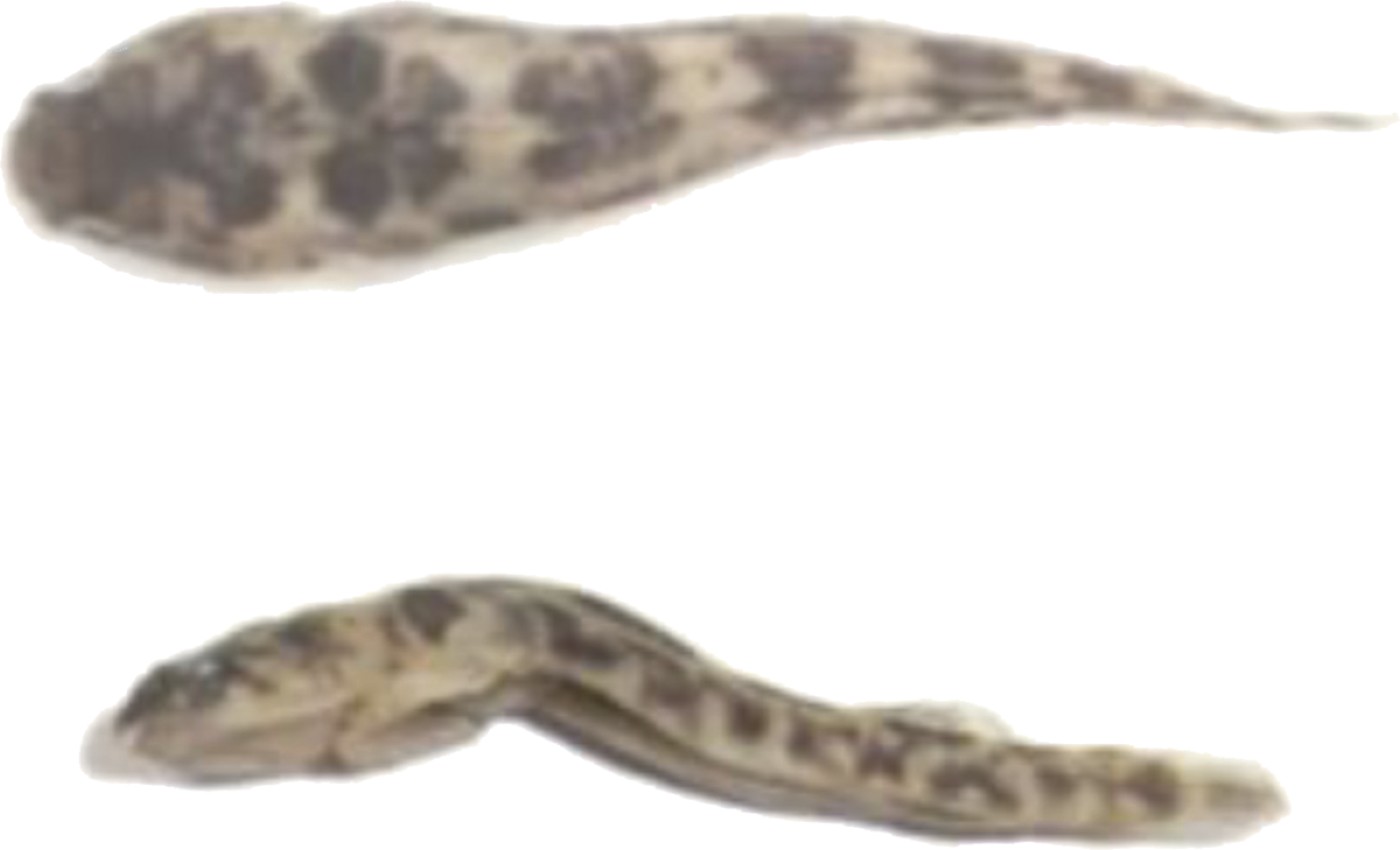
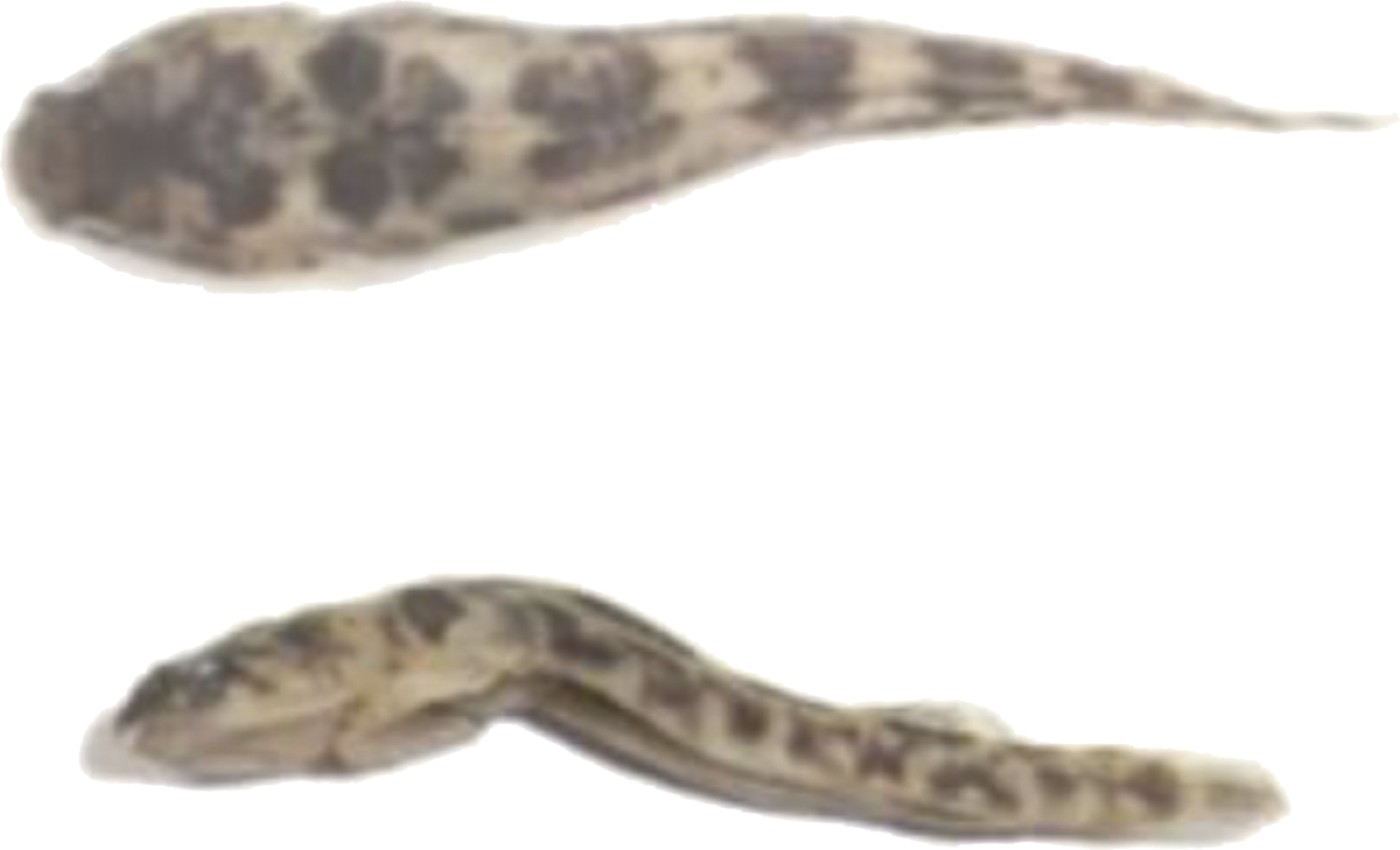
On 24 August 2009 four specimens of Tomicodon zebra (Figure 1) were collected using clove oil solution dissolved in 70% alcohol in a proportion of 2:8 as an anaesthetic (Griffiths, Reference Griffiths2000; Robertson & Smith-Vaniz, Reference Robertson and Smith-Vaniz2010), and hand nets in rock pools in the intertidal zone of El Pital, El Salvador (13°30′31″N 89°36′39″W). All the specimens were preserved in 70% ethanol solution and deposited in the Natural History Museum of El Salvador (MUHNES) under the registration number 40–381, and the Vertebrate Collection of the Biology School in the University of El Salvador.
Preserved fish of Tomicodon zebra deposited in the Natural History Museum of El Salvador (MUHNES) under registration number 40–381, and the Vertebrate Collection of the Biology School in the University of El Salvador, 27.1 mm of total length. Photograph: Saúl González-Murcia.
The specimens were identified to species-group level using the keys developed by Robertson & Allen (Reference Robertson and Allen2008) and then were confirmed by Philip A. Hastings professor and curator of Marine Vertebrates at the Scripps Institution of Oceanography, University of California, San Diego.
RESULTS
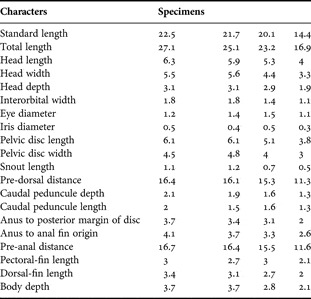
Total length (TL) for the specimens collected ranged from 16.9–27.1 mm. Meristic data of all four specimens are identical and as follows: dorsal-fin rays 7, anal-fin rays 6, caudal-fin rays 8. The anus is closer to the posterior margin of the pelvic disc than to the anal fin origin (Table 1). The colour in life and in preservative includes five dorsal black bars that are ‘hour glass’ shaped (Figure 1).
Morphometric values (mm) of the specimens collected in the rock pools of intertidal zone in El Salvador.

DISCUSSION
This is the first report of T. zebra from the Central American coast expanding the known distribution-range for the species. Tomicodon zebra is a small fish and its maximum TL is 60 mm (de la Cruz et al., 1997). The specimens captured in El Salvador could be considered as juveniles or sub-adults due to the fact their TL are in the range of 16.9–27.1 mm.
Tomicodon was distinguished from the genera Arcos, Gobiesox and Pherallodiscus by the number, shape and distribution of the papillae in the pelvic fins (adhesive disc). Within the genera the species T. abuelorum, T. eos, T. myersi and T. petersii are similar to T. zebra. Nevertheless the number of dorsal rays in the identified specimen of T. zebra (D: 7) are less than the dorsal rays present in T. abuelorum (D: 10–12) and T. eos (D: 8–9). Tomicodon myersi presents four black lines down from eye as a distinctive character. Tomicodon petersii presents a fine brown mesh and irregular bars on the body. Finally, the anus is closer to the anal fin than to the pelvic fins in T. abuelorum, T. eos, T. myersi and T. petersii but in T. zebra the anus is closer to the pelvic fins than to the anal fin.
The finding of these four specimens of T. zebra extends its known range from the south of Mexico to El Salvador, an extension of two latitudinal degrees or approximately 750 km. Thus this species is not confined to the Gulf of California and southern Mexico waters as previously thought. Nevertheless, we considered two hypotheses about the presence of T. zebra in El Salvador. This species may have been present in coastal El Salvador, but overlooked because of the lack of fish studies in the region or, alternatively, this species may be a recent arrival in El Salvador whose larvae may have been transported southward along the eastern Pacific coast by interactions of the Costa Rica Current and the West Mexican Current (Kessler, Reference Kessler2006).
ACKNOWLEDGEMENTS
We thank Philip Hastings for his taxonomic confirmation of T. zebra and for his contributions to improving this paper.