Introduction
Syndromic surveillance is used to monitor disease activity and detect early signals of outbreaks before laboratory confirmation and official reporting to public health authorities, thereby enabling timely responses and potentially reducing morbidity and mortality. Such systems have been extensively developed and implemented at local, regional, and national levels. Reference Henning1
However, no consensus exists regarding standardized case definitions for syndromic surveillance, and concerns remain regarding how such signals should be interpreted and operationalized in real-world surveillance settings. Reference Boender, Cai and Schranz2 In particular, balancing sensitivity and specificity represents a major challenge, as highly sensitive criteria may generate excessive alerts and increase the operational burden, whereas less sensitive criteria may fail to detect meaningful increases in respiratory infection activity. Reference Mandl, Overhage and Wagner3 Sensitivity and specificity describe surveillance characteristics, whereas positive and negative predictive values provide information on how positive and negative surveillance signals may be interpreted in practice.
In long-term care (LTC) facilities, respiratory infections are a major cause of morbidity and outbreaks. Reference Strausbaugh and Joseph4,Reference Falsey, Hennessey, Formica, Cox and Walsh5 Timely detection is essential for enabling prompt infection control interventions and limiting transmission, particularly in high-risk settings such as LTC facilities. Reference Smith, Bennett and Bradley6
Despite the increasing use of syndromic surveillance, evidence remains limited regarding practical approaches to monitoring respiratory infection activity in LTC facilities. To address this gap, we previously developed the Concurrent Approach for Respiratory Epidemiological Surveillance and Symptom Screening (CARES), a syndromic surveillance strategy that combines respiratory syndromic surveillance among patients with symptom screening of staff and visitors. Reference Takayama, Sakaki and Nishioka7 Previous studies have demonstrated the feasibility and potential effectiveness of CARES in supporting the prevention and control of respiratory infections in LTC facilities. Reference Takayama, Sakaki and Nishioka7,Reference Takayama, Aminaka and Sakaki8
This study focused on the CARES-derived respiratory syndromic surveillance criteria based on fever and key respiratory symptoms. Reference Takayama, Sakaki and Nishioka7 However, the surveillance characteristics of these criteria in relation to microbiologically confirmed respiratory infections remain insufficiently investigated.
Therefore, this study aimed to assess the surveillance characteristics of respiratory syndromic surveillance criteria and their usefulness for monitoring infection trends in LTC facilities.
Methods
Study design and patients
This retrospective observational study was conducted in two wards of an LTC facility for children and adults with severe motor and intellectual disabilities (total capacity, 110 beds) at Tenryu Hospital, National Hospital Organization, Japan. Most patients had severe functional impairment, and approximately 80% were unable to roll over independently, 15% required mechanical ventilation, and 40% received enteral nutrition via gastrostomy.
All inpatients who underwent multiplex respiratory pathogen testing using the FilmArray® Respiratory Panel 2.1 (bioMérieux, Salt Lake City, UT, USA) and/or quantitative antigen testing using Lumipulse® for SARS-CoV-2 and Flu A/B assay (Fujirebio, Tokyo, Japan) during the study period were eligible for inclusion.
The study period spanned from November 1, 2022, to December 31, 2025. Clinical data, including daily body temperature, respiratory symptoms, oxygen saturation, and microbiological test results, were retrospectively extracted from electronic medical records. This monitoring was part of routine inpatient care.
Case definition and surveillance criteria
The surveillance criteria were defined as a fever of ≥38.0°C lasting for at least 2 consecutive days, accompanied by at least one of the following respiratory symptoms: cough, oxygen saturation ≤93% or increased mucous secretions (sputum or nasal discharge).
The fever component was adapted from previously reported diagnostic criteria for recurrent pneumonia in children with severe cerebral palsy. Reference Veugelers, Calis and Penning9 The respiratory symptom components, including oxygen saturation, were selected based on established LTC surveillance definitions, particularly the modified McGeer criteria. Reference Stone, Ashraf and Calder10
Microbiological testing was routinely performed for patients with a body temperature of ≥37.5°C, regardless of the presence of respiratory symptoms, unless the attending physician considered testing clinically unnecessary. Because exceptions were made based on physician judgment, microbiological testing was not performed in all febrile patients, and the exact proportion of febrile patients who underwent testing could not be determined. Routine clinical and infection control practices incorporated microbiological results to guide patient management and infection control measures, including isolation and additional transmission-based precautions based on the identified pathogen. The ≥37.5°C threshold served as the clinical trigger for microbiological testing, whereas a fever ≥38.0°C lasting for at least 2 consecutive days was included as a component of the predefined surveillance criteria. For severe acute respiratory syndrome coronavirus 2 (SARS-CoV-2), microbiological confirmation was primarily based on multiplex polymerase chain reaction using the FilmArray® Respiratory Panel. However, during COVID-19 outbreaks at the LTC facility, quantitative antigen testing using the Lumipulse® SARS-CoV-2 Ag assay was frequently used as a screening test to identify infected patients and guide infection control measures in routine clinical practice. Therefore, positive results from this assay were also considered microbiologically confirmed infections.
Statistical analysis
Episodes were defined as testing events associated with a febrile period during hospitalization. When body temperature decreased to <37.9°C, subsequent tests performed within 7 days were considered part of the same episode. A new episode was defined only when fever recurred after at least 7 consecutive days without fever.
The primary analysis retrospectively assessed the surveillance characteristics of the syndromic surveillance criteria in relation to microbiological findings among tested episodes. Sensitivity, specificity, positive predictive value (PPV), negative predictive value (NPV), and positive and negative likelihood ratios (LR+ and LR−) were calculated. Because microbiological testing was performed as a part of routine clinical and infection control practice rather than according to a standardized protocol, these analyses were intended to characterize surveillance findings among tested episodes rather than formally validate the surveillance criteria against a standardized reference test.
For surveillance characteristics, 95% confidence intervals were calculated using exact binomial methods. In an exploratory analysis of weekly data, weekly counts of surveillance-positive and microbiologically confirmed infection episodes were aggregated across the two study wards. Using the Mann–Whitney U test, the numbers of microbiologically confirmed infection episodes were compared between weeks with ≥2 and 0–1 surveillance-positive episodes. A two-sided P value < .05 was considered statistically significant. Statistical analyses were conducted using SAS version 9.4 (SAS Institute Inc., Cary, NC, USA).
Ethical considerations
This study was performed in accordance with the Ethical Guidelines for Medical and Health Research Involving Human Subjects and received approval from the Institutional Review Board of the participating hospital (approval number: 2024-19). The requirement for informed consent was waived owing to the retrospective nature of the study, and an opt-out approach was implemented.
Results
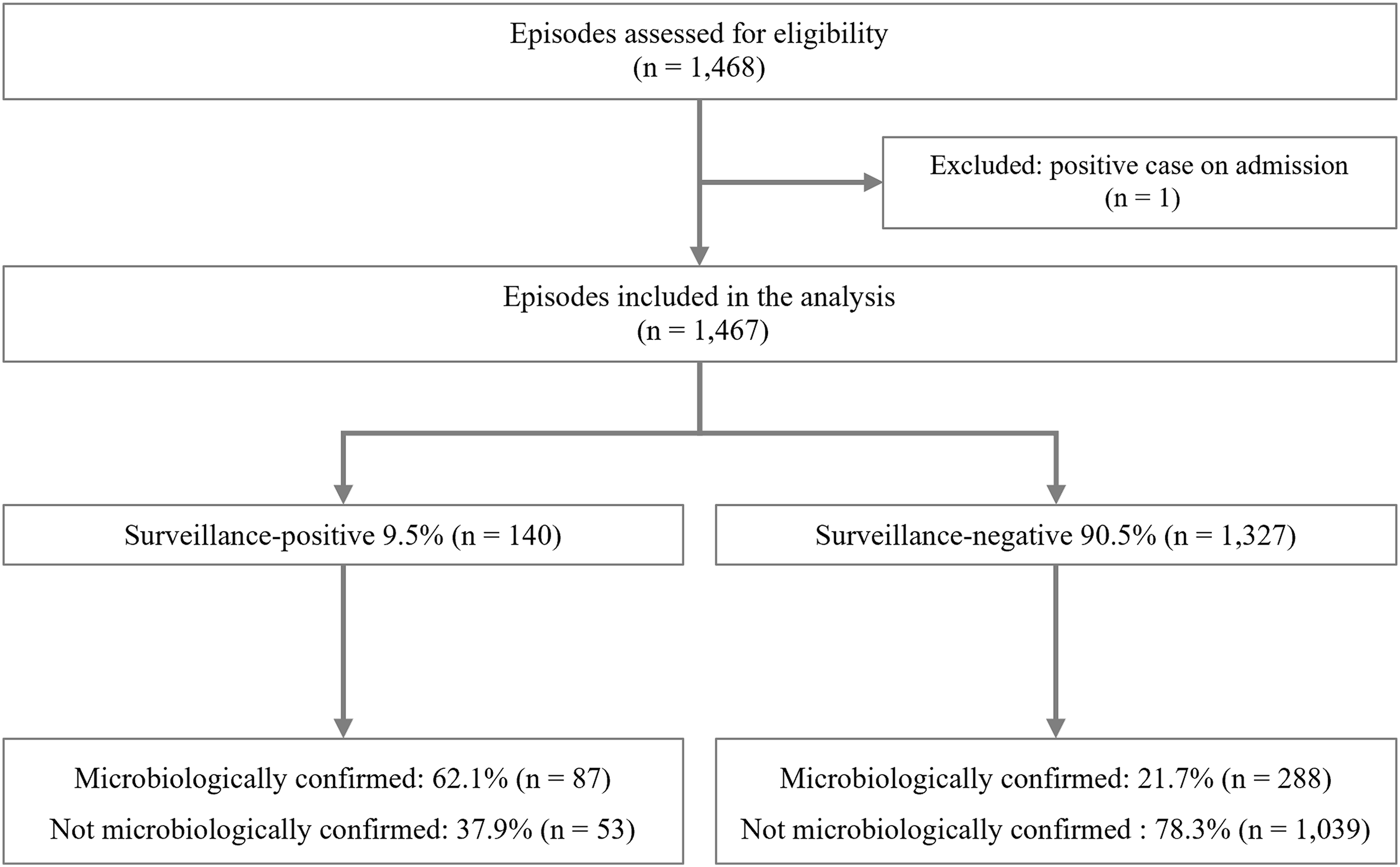
Overall, 1,468 episodes were evaluated for eligibility. One episode was excluded because of a positive microbiological result on admission, leaving 1,467 episodes for analysis. Among the 124 patients, 45 (36.3%) were aged <18 and 79 (63.7%) were aged ≥18 years. Of these patients, 98 (79.0%) experienced at least one infectious episode during the study period. Among affected patients, the median number of infectious episodes was 2 (mean, 3.8; standard deviation, 3.5; range, 1–17).
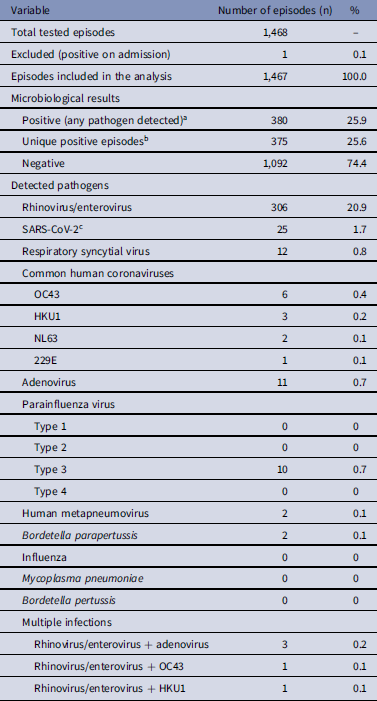
Of the 1,467 episodes analyzed, 375 (25.6%) were microbiologically confirmed. Rhinovirus/enterovirus (20.9%) was the most commonly detected pathogen, followed by SARS-CoV-2 (1.7%) and respiratory syncytial virus (0.8%). No pathogen was detected in 1,092 episodes (74.4%) (Table 1). Among patients aged <18 years, 230 of 816 episodes (28.2%) were microbiologically positive, compared with 145 of 651 episodes (22.3%) among those aged ≥18 years. Age-group comparisons were descriptive without formal statistical testing.
Microbiological results of the tested episodes using multiplex polymerase chain reaction and antigen assays

Table 1. Long description
The table presents microbiological results of tested episodes using multiplex polymerase chain reaction and antigen assays. It includes multiple rows and 3 columns. The columns are labeled ‘Variable’, ‘Number of episodes (n)’, and ‘%’. The table details the total tested episodes, excluded episodes, and episodes included in the analysis. It also lists microbiological results, detected pathogens, and multiple infections. Notable pathogens include rhinovirus/enterovirus, SARS-CoV-2, respiratory syncytial virus, and others. The table provides the number of episodes and corresponding percentages for each category.
aMultiple pathogens detected in one episode are counted separately in pathogen-specific analyses, resulting in 380 pathogen detections.
bFor episode-level analysis, episodes with multiple pathogens were counted as one microbiologically confirmed episode (n = 375).
cSARS-CoV-2 cases included those identified using quantitative antigen testing with the Lumipulse® SARS-CoV-2 Ag assay, which was used for screening as part of the routine infection control practice during COVID-19 outbreaks at the LTC facility.
Of the 1,467 episodes, 140 (9.5%) fulfilled the surveillance criteria, whereas 1,327 (90.5%) did not. Microbiologically confirmed infections were identified in 87 (62.1%) surveillance-positive episodes and 288 (21.7%) surveillance-negative episodes (Figure 1).
Flow diagram of evaluated episodes classified based on the CARES-derived surveillance criteria and microbiological results. CARES, Concurrent Approach for Respiratory Epidemiological Surveillance and Symptom Screening.

Figure 1. Long description
Flow diagram showing that 1,468 episodes were assessed for eligibility. One episode with a positive microbiological result on admission was excluded, leaving 1,467 episodes for analysis. These episodes were classified as surveillance-positive or surveillance-negative according to the CARES-derived surveillance criteria, and microbiologically confirmed infections are shown within each group.
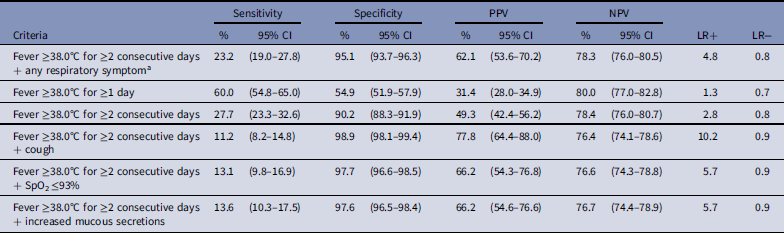
Among tested episodes, the surveillance criteria demonstrated low sensitivity but high specificity, with a sensitivity of 23.2% (95% CI, 19.0%–27.8%) and a specificity of 95.1% (95% CI, 93.7%–96.3%). The PPV was 62.1% (95% CI, 53.6%–70.2%), whereas the NPV was 78.3% (95% CI, 76.0%–80.5%). The LR+ and LR− were 4.8 and 0.8, respectively.
Among individual symptom combinations, fever with cough showed the highest specificity (98.9%) and PPV (77.8%), with an LR+ of 10.2; however, sensitivity remained low (11.2%). Overall, all symptom-based criteria showed consistently high specificity but limited sensitivity (Table 2).
Descriptive surveillance characteristics of the CARES-derived respiratory syndromic surveillance criteria among tested episodes

Table 2. Long description
The table presents data on the performance of various symptom-based criteria for respiratory syndromic surveillance. It includes six rows of criteria and six columns of metrics: Sensitivity, Specificity, PPV, NPV, LR+, and LR-. Each row lists the criteria, followed by the corresponding percentages and 95% confidence intervals for each metric. The criteria include combinations of fever, respiratory symptoms, cough, and other factors. Notable trends include high specificity and PPV for criteria involving fever with cough, but low sensitivity. The table aims to highlight the trade-offs between different symptom combinations in surveillance.
PPV, positive predictive value; NPV, negative predictive value; LR, likelihood ratio; CARES, Concurrent Approach for Respiratory Epidemiological Surveillance and Symptom Screening.
Analyses are based on 1,467 tested episodes (microbiologically positive, 375; microbiologically negative, 1,092).
aThe CARES-derived surveillance criterion was defined as fever ≥38.0°C for ≥2 consecutive days plus at least one respiratory symptom: cough, SpO2 ≤93%, or increased mucous secretions.
Secondary analysis excluding rhinovirus showed that sensitivity increased from 23.2% to 34.8%, whereas specificity decreased from 95.1% to 91.7%. The PPV decreased from 62.1% to 17.1%, whereas the NPV increased from 78.3% to 96.6%.
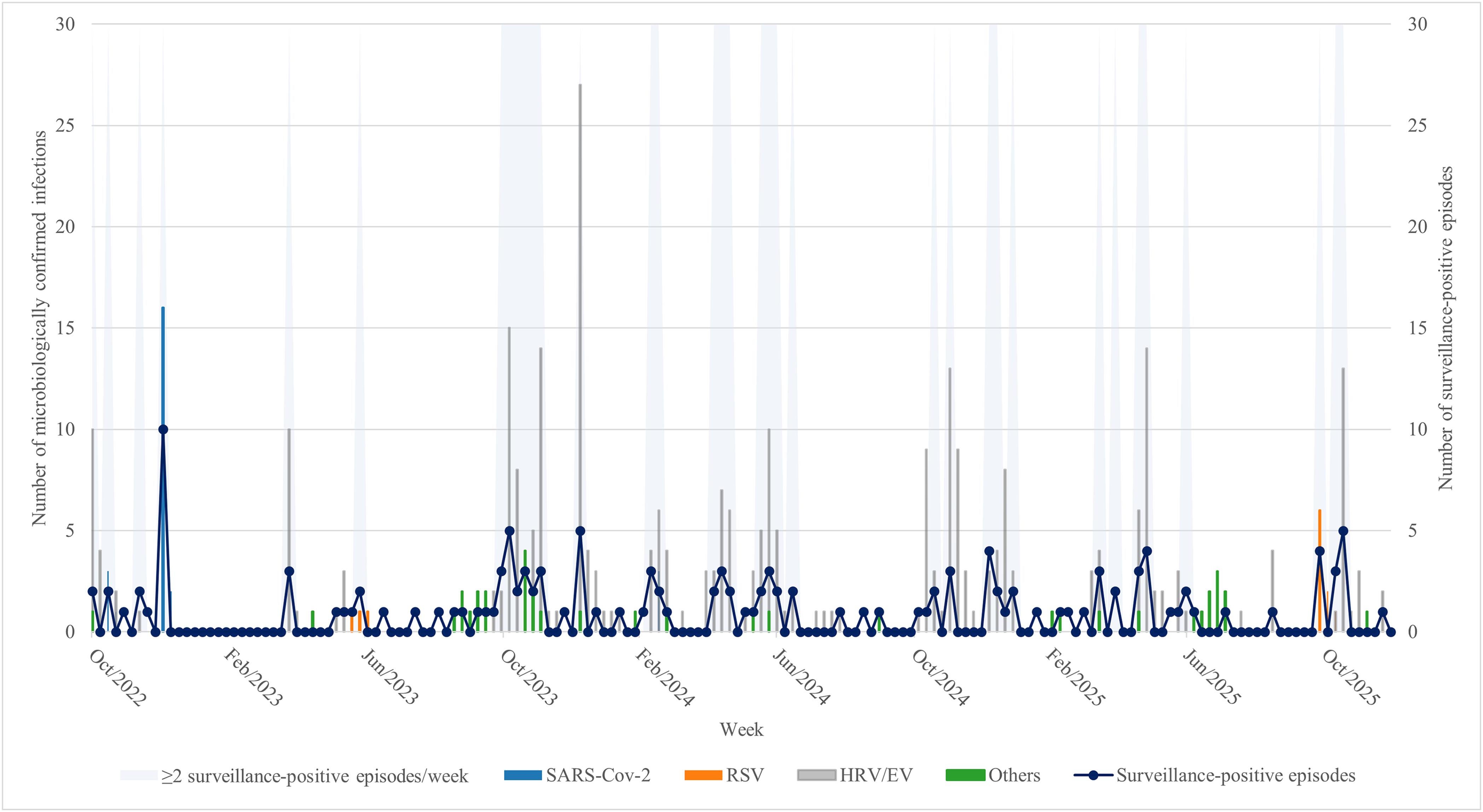
The temporal trends in microbiologically confirmed infections and surveillance-positive episodes are shown in Figure 2. Overall, surveillance-positive episodes fluctuated in parallel with microbiologically confirmed infections over time. Weeks with ≥2 surveillance-positive episodes had more microbiologically confirmed infection episodes than weeks with 0–1 episode (median, 5 [interquartile range, 3–11] vs. 0 [interquartile range, 0–1]; P <.001).
Weekly trends in CARES-derived surveillance-positive episodes and microbiologically confirmed infection episodes. CARES, Concurrent Approach for Respiratory Epidemiological Surveillance and Symptom Screening; HRV/EV, human rhinovirus/enterovirus; RSV, respiratory syncytial virus. Others indicates pathogens other than SARS-CoV-2, RSV, or HRV/EV.

Figure 2. Long description
Stacked bar chart and line graph showing weekly counts of microbiologically confirmed respiratory infections and surveillance-positive episodes. Stacked bars show confirmed infections by pathogen, and the line shows weekly counts of episodes meeting the CARES-derived surveillance criteria. Shaded areas indicate weeks with two or more surveillance-positive episodes. Weeks with two or more surveillance-positive episodes tended to coincide with increases in microbiologically confirmed respiratory infection activity.
Discussion
In this retrospective observational study, respiratory syndromic surveillance criteria showed high specificity and temporal concordance with microbiologically confirmed respiratory infection activity in LTC facilities.
However, sensitivity and specificity inherently involve a trade-off. Reference Mandl, Overhage and Wagner3 The low sensitivity (23.2%) and LR− (0.8) showed that the surveillance criteria are insufficient for ruling out microbiologically confirmed infections at the individual episode level. Although the NPV was 78.3%, approximately 21.7% of surveillance-negative episodes were microbiologically positive, further suggesting that a negative surveillance signal should not be interpreted as the absence of infection. By contrast, the high specificity (95.1%), PPV (62.1%), and LR+ (4.8) indicate that surveillance-positive episodes can serve as relatively specific signals of respiratory infection activity. Syndromic surveillance is intended to identify signals of increased infection activity rather than diagnose individual cases; such signals may support prompt infection control responses. Reference Henning1,Reference Mandl, Overhage and Wagner3 In this setting, high specificity is particularly valuable because it reduces false alarm episodes and may facilitate efficient allocation of limited resources. Reference Wagner, Tsui and Espino11
The temporal concordance between surveillance-positive episodes and microbiologically confirmed infections further supports the practical utility of the respiratory syndromic surveillance criteria. Weeks with ≥2 surveillance-positive episodes had more microbiologically confirmed infection episodes than weeks with 0–1 surveillance-positive episode, suggesting that the surveillance criteria can reflect increases in respiratory infection activity. Timely identification of such increases is a key function of syndromic surveillance and may facilitate prompt infection control responses. Reference Wagner, Tsui and Espino11 Syndromic surveillance may be particularly important in LTC facilities, where vulnerable populations are at increased risk of severe outcomes, and delays in intervention may lead to rapid transmission. Reference Strausbaugh and Joseph4,Reference Falsey, Hennessey, Formica, Cox and Walsh5 Although calendar-week boundaries do not necessarily correspond to the onset or duration of infection clusters, weekly aggregation provides a simple and interpretable time unit for routine surveillance, potentially facilitating the detection of changes in infection activity.
In the original CARES framework, even a single case meeting the criteria prompted consideration of further action; however, this approach was inherently ambiguous and may be challenging to implement. In this study, the observed association suggests that ≥2 weekly surveillance-positive episodes may serve as a simple operational signal for increased attention during routine surveillance.
The requirement of fever to persist for 2 consecutive days was intended to improve specificity by reducing the impact of transient body temperature fluctuations. Reducing the fever-duration requirement to ≥1 day increased sensitivity but substantially decreased specificity, indicating a trade-off between broader case detection and false-positive surveillance signals. As microbiological testing was triggered at ≥37.5°C, the analysis included microbiologically positive episodes that did not reach the ≥38.0°C fever threshold used in the surveillance criterion; these episodes may have contributed to the observed low sensitivity, whereas microbiologically negative episodes below the threshold likely contributed to the high specificity. We retained these episodes because respiratory infections may develop with lower-grade fever, and excluding them would prevent evaluation of the surveillance criterion among microbiologically confirmed infections with such presentations.
Rhinoviruses can be detectable for extended periods and may not always indicate active infection. Reference Peltola, Jartti and Putto-Laurila12 In the present study, excluding rhinovirus did not materially alter the overall pattern, as sensitivity remained low and specificity remained high. Although the PPV and NPV varied, differences in disease prevalence may have contributed to these changes.
This study had several limitations. First, observations may not be entirely independent, as multiple episodes could occur within the same patient. In this study, affected patients experienced a median of 2 (mean, 3.8; range, 1–17) infectious episodes, potentially introducing within-patient correlation; therefore, the findings should be interpreted at the episode level. Second, as microbiological testing was not consistently performed for all febrile patients, the surveillance characteristics were calculated only among tested episodes, and verification bias cannot be excluded. Furthermore, variation in microbiological testing methods may have introduced outcome misclassification; therefore, the findings should be interpreted as descriptive surveillance characteristics rather than as formal diagnostic validation against a uniform reference standard. Third, no influenza-positive episodes were identified during the study period. Although the clinical presentation of influenza generally aligns with the syndromic surveillance criteria assessed in this study, their performance for influenza could not be directly evaluated. The reason for the absence of influenza-positive episodes could not be determined, which may limit the generalizability of the findings to periods or settings with substantial influenza activity. Fourth, pathogens not included in the FilmArray Respiratory Panel were considered negative in this study, which may have led to an underestimation of true infection events. However, as shown in Figure 2, no substantial clusters of febrile episodes without corresponding microbiological confirmation were observed, suggesting that this limitation had a limited impact on the observed temporal patterns. Fifth, although the study population was at high risk for severe disease, the surveillance criteria were applied within a short period, namely, within 2 consecutive days of fever onset. Therefore, secondary complications, including pneumonia, were unlikely to substantially affect the symptom-based classification. Finally, this was a single-center study conducted in a specific population, potentially limiting the applicability of the findings to other settings.
Despite these limitations, this study provides evidence supporting the practical usefulness of syndromic surveillance for monitoring respiratory infection trends in LTC facilities. From a practical perspective, surveillance system implementation requires clear and actionable algorithms for triggering alerts. In real-world settings, healthcare workers often experience difficulty in conducting comprehensive risk assessments and therefore benefit from simple predefined criteria. The surveillance criteria were developed to promote objectivity and facilitate straightforward application, enabling consistent detection of respiratory infection activity in LTC facilities. Reference Takayama, Sakaki and Nishioka7
Although several surveillance systems, including influenza-like illness surveillance in the United States and respiratory surveillance programs in Europe, are designed to monitor respiratory infection trends at the national or regional level, 13,Reference Paolotti, Carnahan and Colizza14 such systems may not be sufficient to identify early increases in respiratory infection activity within individual LTC facilities. Respiratory syndromic surveillance can complement national and regional systems by providing timely local signals that may facilitate enhanced surveillance and infection control responses at the ward or facility level. In this context, the CARES-derived respiratory syndromic surveillance approach may offer a practical model for supporting surveillance in LTC settings.
This study suggests that simple, predefined respiratory syndromic surveillance signals may be useful for monitoring respiratory infection activity in LTC facilities. The surveillance criteria evaluated in this study showed high specificity as practical surveillance signals and captured temporal changes in microbiologically confirmed infections. These findings may help guide the development of practical surveillance approaches to facilitate timely infection control responses in vulnerable populations.
Acknowledgements
We thank Midori Nishioka, Mayumi Aminaka, Eiko Endo, and Haruyo Sakaki for their contributions to the development of the CARES framework. We also thank Enago (www.enago.jp) for English language editing.
Author contributions
Naoki Takayama: Conceptualization, Methodology, Validation, Formal Analysis, Investigation, Data Curation, Writing—Original Draft, Writing—Review and Editing, Visualization, and Funding Acquisition.
Atsushi Toyoda: Data Curation, Investigation, Project Administration, and Writing—Review and Editing.
Junji Ito: Data Curation and Writing—Review and Editing.
Masahiro Shirai: Project Administration and Writing—Review and Editing.
Yutaro Nakamura: Conceptualization, Project Administration, Supervision, and Writing—Review and Editing.
Financial support
This work is supported by the grants-in-aid from the Nakanishi Mutsuko Nursing Practice Research Fund. No grant number has been assigned.
Competing interests
All authors report no conflicts of interest relevant to this article.
Declaration of generative AI and AI-assisted technologies in the writing process
During the preparation of this study, the authors used ChatGPT (OpenAI, USA) to improve language clarity and refinement. After using this tool/service, the author(s) reviewed and edited the content as needed and take(s) full responsibility for the content of the publication.