Introduction
Concurrent chemoradiation (CCRT) is the standard of care in locally advanced head and neck cancer (LAHNC). The absolute benefit of CCRT is 6·5% at 5 years in head and neck cancer.Reference Pignon, le Maître, Maillard and Bourhis 1 Three-weekly cisplatin is the standard of in CCRT. The incidence of mucositis increases by twofold when 3-weekly CCRT is given.Reference Bernier, Domenge and Ozsahin 2 , Reference Cooper, Pajak and Forastiere 3 The acute mortality associated with CCRT is between 2 and 9·3% and majority of deaths are infection related.Reference Mirabile, Numico and Russi 4 Furthermore, there are no real alternative to CCRT. In a metanalysis by Gupta et al.,Reference Gupta, Kannan, Ghosh-Laskar and Agarwal 5 no form of altered fractionation compensated for lack of concurrent chemotherapy.
Though 3-weekly cisplatin is standard, modifications of CCRT schedule are made to decrease toxicity. Usage of low-dose weekly cisplatin and replacing cisplatin with carboplatin are practiced in clinics despite good evidence. Carboplatin was found to have inferior overall survival (OS) when compared with cisplatin.Reference Guan, Li and Zhang 6 Even though not proven in clinical trials, low-dose weekly cisplatin is widely used in clinics as proved by multiple institutional seriesReference Fayette, Molin and Lavergne 7 – Reference Gupta, Agarwal, Ghosh-Laskar, Parikh, D’Cruz and Dinshaw 9 and systematic review.Reference Guan, Zhang and Li 10 The only randomised controlled trial (RCT) conducted showed, better loco-regional control (LRC) despite being slightly more toxic with three weekly cisplatin compared with weekly schedule.Reference Noronha, Joshi and Patil 11 An alternate to 3-weekly cisplatin schedule is not available based on present literature, though weekly schedule is routinely practiced for perceived less toxicity.Reference Noronha, Joshi and Patil 11 Hence, we conducted the present study. The study aims to compare weekly versus 3-weekly CCRT in LAHNC in terms of compliance, toxicity and efficacy.
Materials and Methods
Study design and setting
The study was conducted in department of Radiation Oncology at St John’s Medical College and Hospital, Bengaluru, India. The study was conducted after Institute ethical clearance. All head and neck cancer patients treated with CCRT from January 2013 to June 2017 were eligible for the study. Disease had to be locally advanced (III, IVA and IVB) or early stage high risk requiring adjuvant CCRT. Patients were evaluated in multi-disciplinary tumour board. Patients received radiation therapy (RT) and chemotherapy as per standard guidelines and practice. A computed tomography (CT) or positron emission tomography (PET) imaging was performed after a thorough clinical and endoscopic evaluation. A biopsy or fine-needle aspiration cytology was performed before starting treatment. A pre-treatment baseline complete blood count, renal function test, liver function test, creatinine clearance and pure tone audiometry were done. The cancer staging was done according to American Joint Committee on Cancer (AJCC 7th edition, 2010).Reference Edge, Byrd, Compton, Fritz, Greene and Trotti 12 The data collection was done by reviewing the Radiotherapy review charts and follow-up records.
Treatment
A planning CT simulation was done after immobilisation with thermoplastic mask for all patients. Patients were treated either with intensity-modulated radiation therapy (IMRT) or three-dimensional conformal radiation therapy (3DCRT) technique with 6 MV photons. No patients were planned treatment with conventional simulator or two-dimensional planning. In adjuvant setting, CCRT was started within 6 weeks of surgery after adequate wound healing. A total dose of 54–66 Gy in postoperative setting and 66–70 Gy in radical setting was planned. The radiation therapy was given 5 days a week. The CCRT schedule was either weekly or 3-weekly, as per choice of treating medical oncologist. Between 2013 and 2015, all patients received 3-weekly schedule. By end of 2015, another medical oncologist was treating patient at our centre and the protocol was changed to weekly schedule as per his choice. For weekly schedule Cisplatin was given at a standard dose of 50 mg for all patients, and for 3-weekly schedule it was 100 mg/m2. Chemotherapy was not given after completion of radiation therapy. Hydration, anti-emetics and dose modifications were done according to department protocol.
Follow-up
All patients were reviewed at least twice a week during CCRT. After completion of scheduled treatment, patients were followed-up weekly until acute reactions subsided, then monthly until 3 months, 3 monthly until 2 years and then yearly. A repeat imaging (CT/PET CT scan) was conducted after 8–12 weeks of completing radiation therapy. Salvage surgery was planned when feasible.
Study outcome
Our primary objective was to find out if patients in weekly cisplatin arm were more compliant and experienced lesser toxicity than those receiving 3-weekly cisplatin. Toxicity grading was done with Common Terminology Criteria for Adverse Events, Version 4.03. More specifically mucositis which required morphine for pain control, IV hydration or nasogastric (NG) tube insertion for poor intake, IP admission or IV antibiotics were also labelled as grade 3. Dysphagia requiring NG tube insertion, IV hydration, morphine intake and IP admission for management of associated aspiration were labelled grade 3. Grade 3 pain was defined as any patient requiring morphine for treatment related pain. More than 20% weight loss from baseline or use of NG tube during treatment course was defined as grade 3 weight loss. For assessing compliance, median radiation dose received, duration of CCRT schedule, number of patients receiving planned radiation or chemotherapy and adequate cumulative dose of cisplatin was compared between the two groups. At least six doses of cisplatin in weekly arm and two cycles in 3-weekly arm, which was approximately equivalent to total cisplatin dose of 200 mg/m2 and was considered adequate for the present study.
Secondary objectives include compliance, LRC, disease-free survival (DFS) and OS. LRC was defined as no recurrence at local or regional nodal site. Time to loco-regional failure (LRF) was calculated from time of diagnosis to LRF. The time taken to LRF was taken zero if complete remission was not achieved after CCRT in definite setting. DFS was calculated from time of diagnosis to disease event, that is, recurrence (loco-regional or distal), second primary or death due to cancer. The OS is defined from time of diagnosis to death due to any cause.
Statistical analysis
The study population size was based on convenience sampling. Data were analysed using SPSS v.24 software. All categorical data were summarised using frequency and percentages and all continuous data were described with median and inter-quartile range (IQR) based on the distribution. Z-test for two proportions was used to compare the variables for compliance and toxicity. Kaplan–Meier method was used to plot LRC, DFS and OS. χ 2 test was used to compare 2-years LRC, DFS and OS between the two arms.
Results
Patient
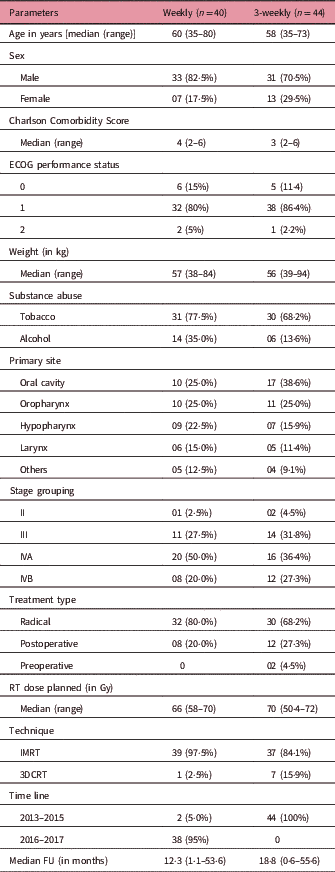
A total of 166 head and neck patients were treated. Eighty-four patients met the inclusion criterion after excluding; 67; no chemotherapy, 1; neo-adjuvant chemotherapy followed by radiation alone and 14; palliative radiation. Only two patients received neo-adjuvant chemotherapy followed by CCRT and 82 patients received only CCRT. Forty patients were in weekly arm and 44 in 3-weekly arm. Follow-up data were available for 82 (97·6%) patients. At time of analysis, 50 (59·5%) patients were alive and 34 (40·5%) patients were dead. The baseline characteristics of two groups are cited in Table 1.
Pre-treatment patient and tumour characteristics
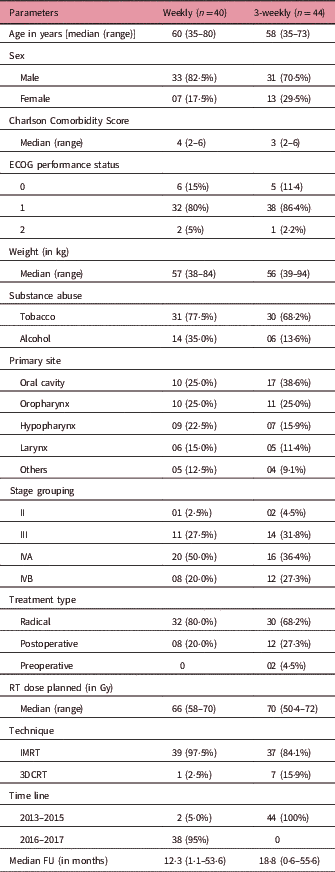
Note: Data presented as No. (%) unless otherwise specified.
Abbreviations: ECOG, Eastern Cooperative Oncology Group; IMRT, intensity-modulated radiation therapy; 3DCRT, three-dimensional conformal radiation therapy; FU, Follow-up; RT, Radiation therapy.
Compliance
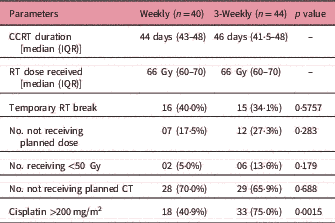
All patients received radiation therapy after custom made thermoplastic mask and CT simulation. Seventy-six (90·5%) patients received IMRT and rest eight 3DCRT. A total of 62 (73·8%) patients received CCRT with definitive intent, 20 (23·8%) in adjuvant setting and only 2 (2·4%) preoperatively. The median duration of CCRT was 45 days (41·5–48 days). The median dose received was 66 Gy (IQR, 60–70 Gy). The median duration of CCRT and radiation dose received were similar between two arms. The number of patients not receiving planned radiation dose were higher in 3-weekly arms than weekly arm, though not significant (p=0·283). The occurrence of temporary break in radiation therapy (≥2 days) was similar in both arms. All patients received at least 1 cycle of chemotherapy in either arms. The weekly arm received a median of five cycles of cisplatin and 3-weekly arm a median of two cycle. Fifty-six (66·7%) patients did not receive planned chemotherapy. The reason for not completing chemotherapy was toxicity (n=50) and refusal (n=6). There was no difference between the arms for not completing scheduled chemotherapy. The number of patients receiving 200 mg/m2 cisplatin was 33 (75%) in 3-weekly arm compared with 18 (40·9%) in weekly arm (p<0·0015) (Table 2). Only two patients in 3-weekly arm received neo-adjuvant chemotherapy.
Compliance
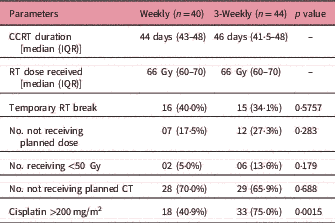
Note: Data presented as No. (%) unless otherwise specified.
Abbreviations: IQR, inter-quartile range; CT, computed tomography; RT, Radiation therapy.
Toxicity
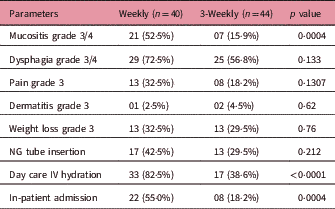
Acute toxicity was evaluated in all patients (Table 3). More patient in the weekly group [n=21 (52·5%)] developed grade ≥3 mucositis than the 3-weekly group [n=25 (56·8%)], which was statistically significant (p=0·0004). The incidence of grade ≥3 dysphagia, pain, dermatitis and weight loss were similar between the groups. The median weight loss was 4 kg (IQR, 2–6·8 kg) in weekly arm and 5 kg (IQR, 2–6·3 Kg) in the 3-weekly arm. Significantly more patients in the weekly arm required day care intravenous hydration and in-patient admission compared with 3-weekly arm (Table 3). Eleven patients (7 in weekly and 4 in 3-weekly) died due to sepsis during first 6 months of starting CCRT. Death due to combination of mucositis, dysphagia, dehydration, aspiration, neutropenia, infection and multi-organ failure was recorded together as sepsis. The incidence of late toxicities was low. Late grade ≥2 dysphagia and aspiration were recorded in 4 and 5 patients, respectively, and was similar between the two arms. Four patients had grade 2 xerostomia in the 3-weekly arm and none in the weekly arm. Three patients died of late aspiration pneumonia and one due to suicide in the 3-weekly arm, 6 months after starting therapy. No late non-cancer death was recorded in the weekly arm.
Acute toxicities and supportive care
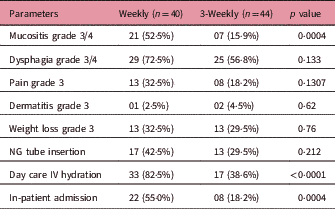
Note: Toxicity grading was done with Common Terminology Criteria for Adverse Events, Version 4.03.
Abbreviation: NG, Nasogastric.
Disease control and survival
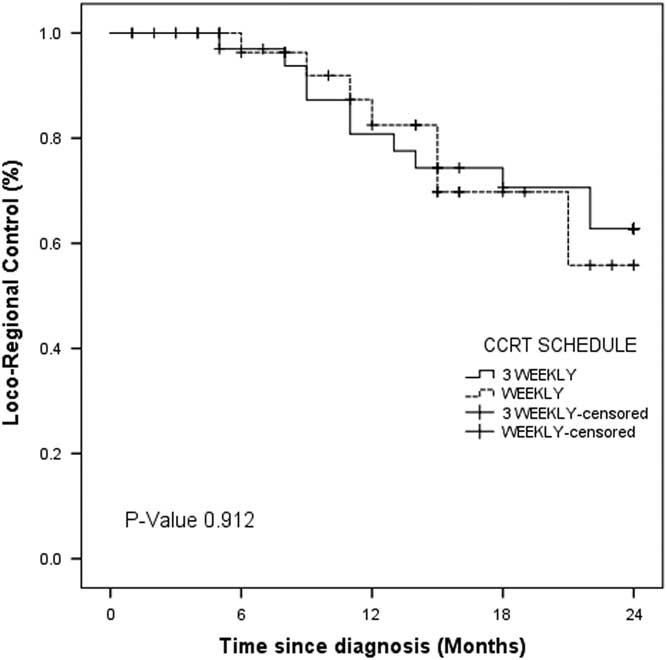
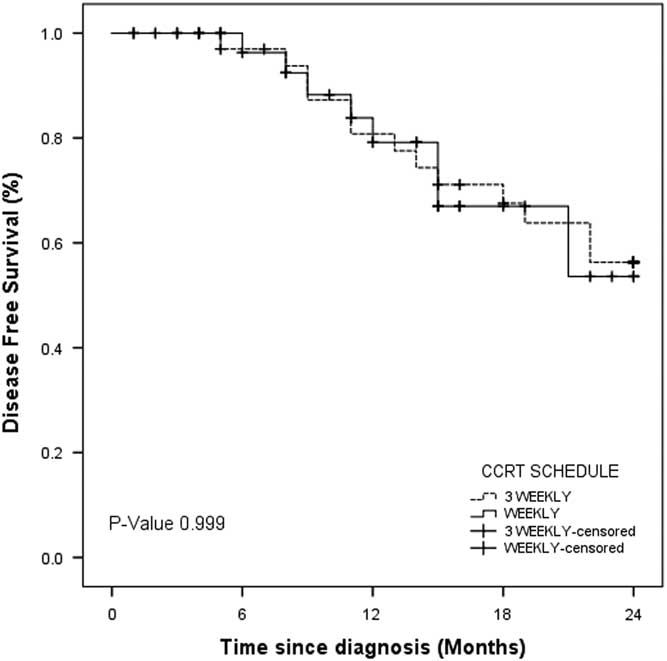
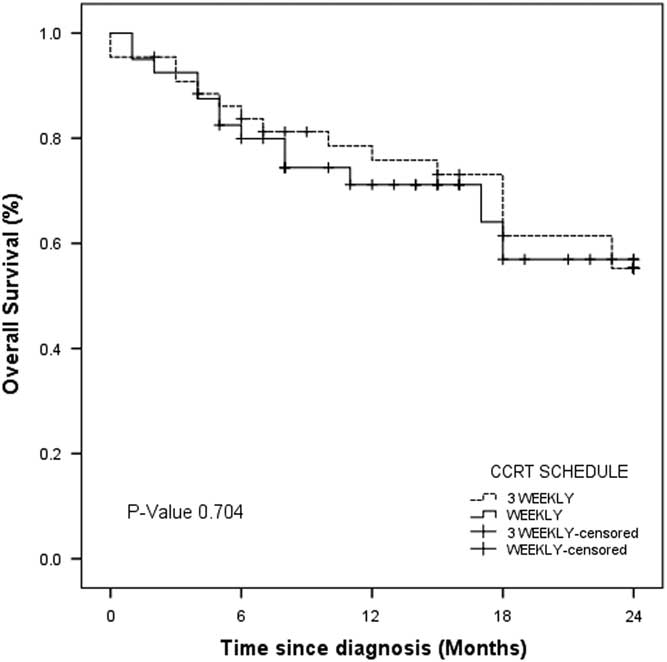
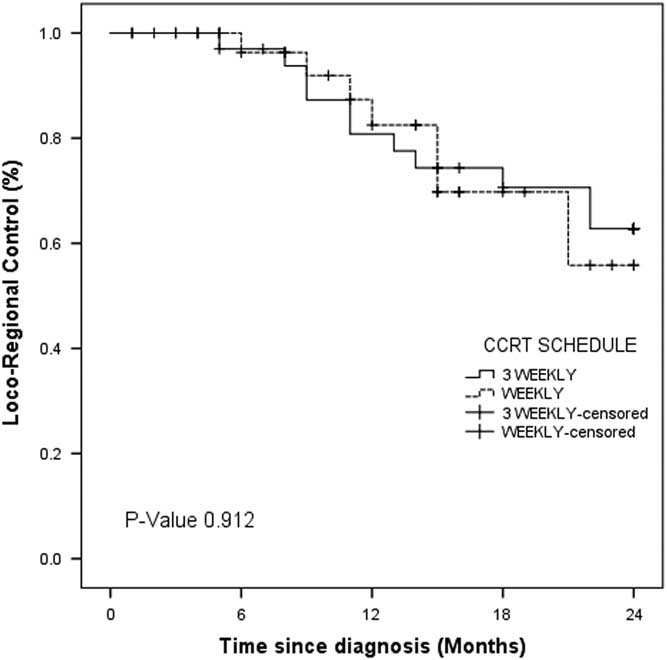
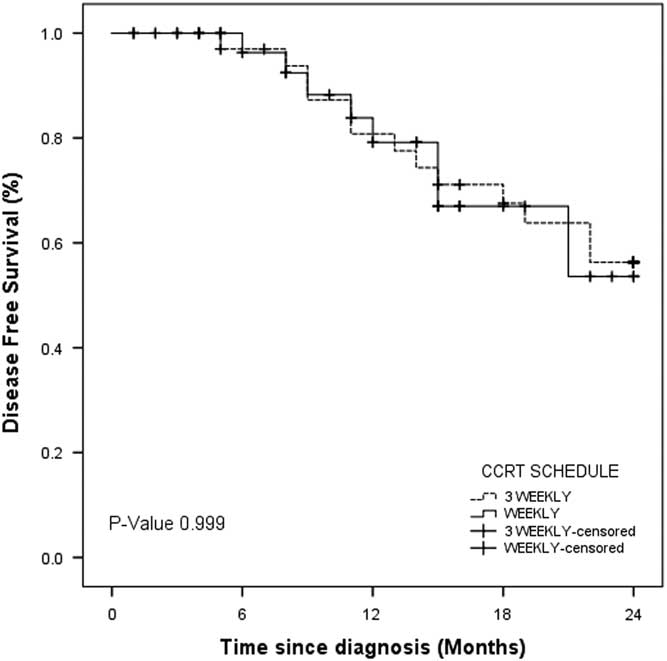
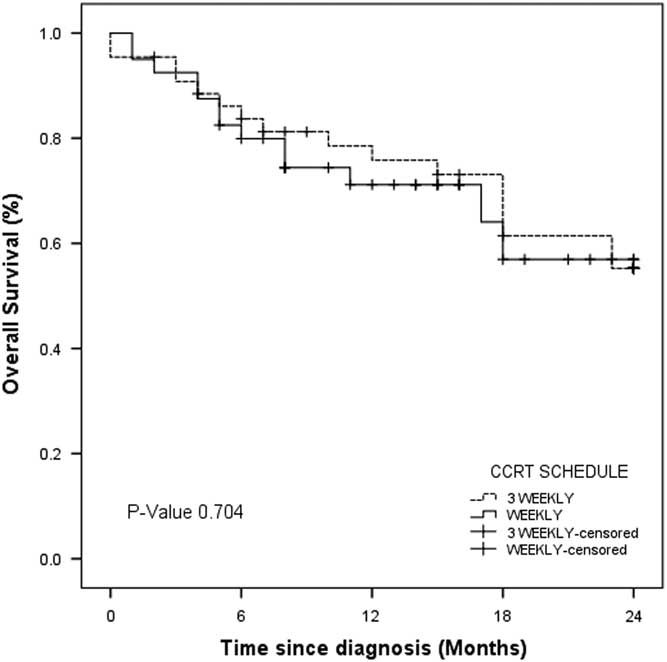
Disease assessment was done for 70 patients. Twelve patients died during the period of acute toxicities and two patients were lost to follow-up. Sixty (85·7%) patients achieved complete remission and ten (14·3%) had either partial response, stable disease or progressive disease. Thirty-four (40·5%) patients are alive and disease free, 16 (19%) are alive with either progressive disease, recurrence or a second primary and 34 (40·5%) patients were dead at last follow-up. At a median follow-up of surviving patients at 17 months (range, 2–55 months), the 2-year LRC was 70% in weekly arm and 61·4% in 3-weekly arm (p=0·406). The median time to LRF was not reached in either arms (Figure 1). Salvage surgery was advised for six patients but only four patients underwent surgery. Adjuvant re-irradiation was done in two patients (one received concurrent chemotherapy and died due to toxicity). The 2-year DFS was 67·5% in the weekly arm and 56·8% in the 3-weekly arm (p=0·314). The median time to DFS was not reached in either arms (Figure 2). Two patients developed a second primary, one carcinoma cervix in the 3-weekly arm and another carcinoma buccal mucosa in the weekly arm. Seven non-cancer deaths in the weekly arm were due to sepsis. In the 3-weekly arm, a total of nine non-cancer deaths were recorded (4 sepsis; 1 cardiac; 1 suicide and 3 late aspiration). The 2-year OS was 67·5% in the weekly arm and 61·4% in the 3-weekly arm (p=0·558). The median time to OS was not reached in either arms (Figure 3). A total of 18 cancer deaths were recorded, 12 in the 3-weekly arm and six in the weekly arm.
Two-year loco-regional control was 70% in weekly arm and 61·4% in 3-weekly arm (p=0·406). Abbreviations: CCRT, concurrent chemo-radiation.
Two-year disease-free survival was 67·5% in weekly arm and 56·8% in 3-weekly arm (p=0·314). Abbreviations: CCRT, concurrent chemo-radiation.
Two-year overall survival was 67·5% in weekly arm and 61·4% in 3-weekly arm (p=0·558). Abbreviations: CCRT, concurrent chemo-radiation.
Discussion
The weekly cisplatin arm was associated with more toxicity in terms of mucositis, day care and in-patient admissions for supportive care. The 3-weekly arm had received a higher cumulative dose of cisplatin. More patient in the 3-weekly arm did not receive planned radiation dose, though not statistically significant. Both arms had similar LRC and survival.
The study being undertaken retrospectively is a major limitation. All LAHNC patients receiving CCRT during the defined period were included in the study to eliminate selection bias. Patients in the 3-weekly arm were treated until 2015 and patients in the weekly arm in 2016 and after. The follow-up period was shorter in the weekly arm (Table 1). The study heavily relied on accurate record keeping. The bias in the recording of toxicity and increased admissions for supporting care in later years cannot be ruled out. This might have accounted for increased mucositis and supportive care in the weekly arm, including patients treated in 2016 and beyond. Analysis of haemato-toxicity, oto-toxicity, renal dysfunction and electrolyte imbalance could not be done retrospectively.
The only RCT which compared weekly versus a 3-weekly schedule, had a younger population (median age 44 years), 90% of patients had oral cavity cancer and had received postoperative CCRT.Reference Noronha, Joshi and Patil 11 The RCT showed superior local control with more toxicity in the 3-weekly arm. Our study population had a median age of 60 years, 80% patients received definitive CCRT and the weekly arm was associated with more toxicity with similar efficacy, in contrast to the RCT.Reference Noronha, Joshi and Patil 11 In a meta-analysis by Guan et al.,Reference Guan, Zhang and Li 10 the weekly group had more grade ≥3 mucositis in non-nasopharyngeal primary tumour patients and more chemotherapy delay/interrupt than the 3-weekly arm. We also report a higher incidence of grade ≥3 mucositis in weekly versus 3-weekly arm (52·5% versus 15·9%, p=0·0004). Rawat et al.,Reference Rawat, Srivastava and Ahlawat 13 reported weekly cisplatin (35 mg/m2) is less toxic and required less supportive care, which contrasts with the present study. The percentage of patients receiving cumulative cisplatin >200 mg/m2 was lower in the weekly arm compared with the 3-weekly arm in the present study (40·9 versus 75·0%, p=0·0015), which is similar as reported by Noronha et al.Reference Noronha, Joshi and Patil 11 More than one-fourth of patients in 3-weekly arm did not received planned RT dose, though median dose received were the same. The number of patients receiving less than 50 Gy was higher (13·6%) in the 3-weekly arm (p=0·179). In the present study, LRC, DFS and OS were similar in both arms. In a recent meta-analysis of 4,209 patients, the OS and response rates were the same between two the groups. In radical CCRT, the weekly arm patient group was more compliant and experienced less toxicity in terms of severe myelosuppression, nausea, vomiting and nephrotoxicity. In postoperative setting, both arms were equally compliant, and the weekly schedule had more grade 3/4 dysphagia and weight loss.Reference Szturz, Wouters and Kiyota 14 In an analysis of 7,219 patients, high-dose cisplatin (100 mg/m2 q 3-weekly) was associated with reduced incidence of death in stage III and IV head and neck cancer.Reference Chang, Yuan and Wu 15
Even though this study had a small sample size and was conducted in a single institute, all patient received contemporary radiation technique and a standard approach of concurrent chemotherapy (only two patient receiving neo-adjuvant chemotherapy). The study sample is a true representation of the real world and hence, the results are generalisable to the head and neck cancer population.
Conclusion
In conclusion, we report weekly and 3-weekly cisplatin schedules are equal in terms of compliance and efficacy in CCRT of LAHNC. The weekly schedule is associated with an increased incidence of grade 3 mucositis and admissions for supportive care.
Financial Support
None.
Conflicts of Interest
None.
Acknowledgements
The authors thank all the staff of department of Radiation Oncology and Medical Oncology.