Introduction
Nine days after the Supreme Court decided Roe v. Wade (1973), Representative John Zwach (R‐MN) proposed a constitutional amendment “to insure that due process and equal protection are afforded to an individual from the moment of conception” (Congressional Record 1973, 2898). Soon thereafter, dozens of Republican members of Congress (MCs) offered similar amendments, with the pattern lasting for more than a decade. Surely they did not expect to pass such a polarizing amendment by the super‐majorities required by the constitutional amendment process. Thus, what did these Republicans hope to accomplish? Besides the possibility of individual MCs pursuing personal or ideological preferences, or engaging in election‐based position taking (Mayhew Reference Mayhew1974), we offer a new interpretation: that post‐Roe attacks were part of a larger effort to use Court rulings to split the New Deal coalition along a new cleavage line, and to build a new, Republican, majority coalition. Furthermore, even after conservatives swept into power, Republicans still attacked on abortion, as well as other issues—in an effort, we hypothesize, to help consolidate the GOP's 1980 victories.
In introducing these claims (and others), we start our investigation at the intersection of the judicial politics and political party literatures. Examination of this crossroads suggests that the Court can hand down rulings that create inter‐ and intraparty tension. This tension provides opportunities for various actors to attack the Court in an effort to solidify their faction's standing within national coalitional politics. Exploring this claim, we use a new database (Nichols, Bridge, and Carrington Reference Nichols, Dave and Carrington2014) to guide case study analysis of the “mature” New Deal timeframe. While previous research lays out 422 Court‐curbing proposals from 1955–1984 (Clark Reference Clark2011), Nichols, Bridge, and Carrington's (2014) database uncovers an additional 1,497 previously unaccounted‐for attacks via attempts to amend the Constitution. We move beyond their exploratory account by providing the first in‐depth examination of the record of attacks. Using case study analysis, we draw on primary documents and secondary literature to investigate both the partisan and factional motivations for attacks, as well as the attacks’ impact on party politics.
In doing so, we also move beyond the attack literature's narrow focus on judicial independence. That is, we put forward the general hypothesis that attacks might have political implications beyond legislative‐judicial relations. Congressional members of the parties in government are not only concerned with trying to influence the Supreme Court; they are centrally engaged with, and transformed by, political obstacles and opportunities supplied by the Court. Specifically, as the Court advances increasingly fractious preferences, it gives varying political actors the impetus to assault the judiciary. We hypothesize that legislators can attack the Supreme Court in efforts to maintain coalitional cohesion, build a new majority, or consolidate recent victories. If true, then we might expect leadership of attacks to change as the Court strays into cross‐cutting issues that cleave one or both parties along factional lines. As such, the importance of attacks could extend beyond interbranch quarrels that rarely affect judicial independence; the study of attacks might also reveal how the Court impacts party system development.
Congressional Attacks on the Supreme Court
With insights from the historical/regime politics (Graber Reference Graber1993; Gillman Reference Gillman2002; Whittington Reference Whittington2007), strategic (Epstein and Knight Reference Epstein and Knight1997), and attitudinal (Segal and Cover Reference Segal and Cover1989; Segal and Spaeth Reference Segal and Spaeth2002) perspectives, the diverse US judicial politics literature draws strength from both its focus on how politics impacts the judiciary and its ability to explain how courts play a role in the policy‐making process. One subject that consistently draws the attention of judicial politics scholars is congressional attacks on the Supreme Court. Early (Warren Reference Warren1913; Culp Reference Culp1929) and ongoing (Nagel Reference Nagel1965; Rosenberg Reference Rosenberg1992) efforts within this literature have recorded when attacks have occurred. Tom Clark (Reference Clark2011) and Stephen Engel (Reference Engel2011) have continued this type of cataloging.
Overall, the literature tends to view congressional attacks from a Court‐centered perspective (Nagel Reference Nagel1965). Inquiries categorize the methods by which Congress attempts to stymie the Court, and the specific legal controversies that spark interbranch confrontation. This provides context and helps judicial politics scholars concentrate on the effect Court‐curbing efforts have had on judicial behavior and, hence, on judicial independence.Footnote 1 We, however, note that this is not the only framework for inquiry.
While taking stock of the effect of attacks on judicial independence, we endeavor to move beyond existing accounts and to explore other ways in which congressional attacks may be significant. Indeed, we note that previous research pays very little attention to who, specifically, attacks the Court. This earlier work therefore does not address the nonjudicially centered, political ramifications of Court‐curbing efforts—especially as they may concern party system development. Our research then might be thought of as following up on, and extending the possible impact of, congressional attacks on the Supreme Court.
By shifting from a Court‐centered perspective to a more holistic frame of analysis, we follow the lead of regime politics scholars (see Clayton and May Reference Clayton and May1999; Graber Reference Graber2005; Whittington Reference Whittington2005a; Gillman Reference Gillman2006a, Reference Gillman, Whittington, Keleman and Caldeira2007; Reference Barnes2008; Barnes Keck Reference Keck2007), while pushing their framework beyond its normal assumptions. In general, regime analysis examines courts historically vis‐à‐vis their political and institutional relationships with other political branches. To achieve an even wider perspective, we draw theory from the political party literature.
The most recent wave of party scholarship responds to John Aldrich's (Reference Aldrich1995) already classic formulation of political parties as endogenous institutional solutions to social choice and collective action problems. Recent research further stresses that parties are factional in character (DiSalvo Reference DiSalvo2012). As such, they function as coalitions, comprised of multiple factions—each with intense preferences on particular issues—and managed by politicians (Galvin Reference Galvin2009; Karol Reference Karol2009).
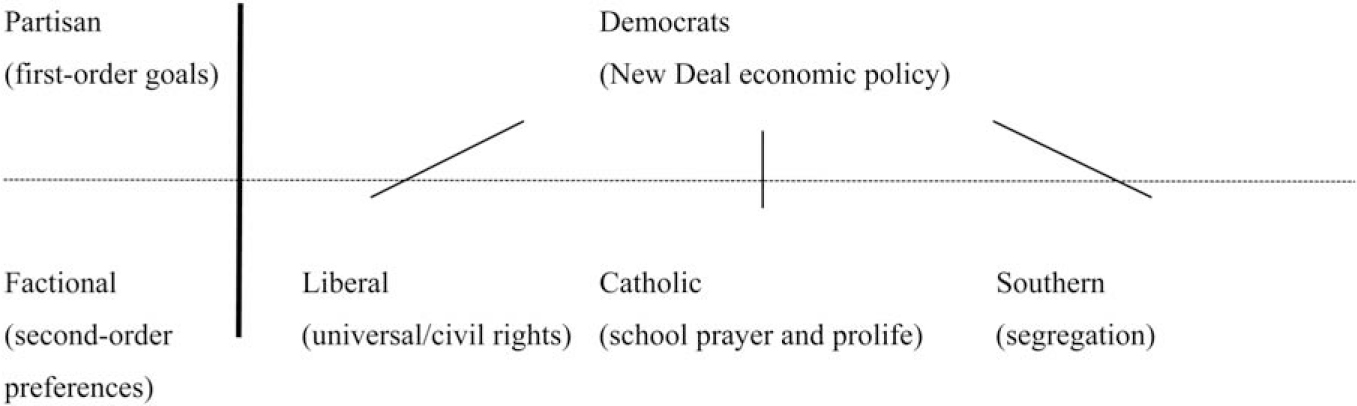
As Schattschneider (Reference Schattschneider1960) suggested long ago, parties are held together (as best they can) by managers who unite others around shared “first‐order” goals (Cook and Polsky Reference Cook and Polsky2005, 582). In a large and diverse republic, with effectively only two political parties, dominant alliances necessarily combine potential enemies (Schofield and Miller Reference Schofield and Miller2007). Under these conditions, US political parties reach narrow agreement over first‐order, coalition‐uniting goals. Because of the narrow intraparty consensus, political parties accomplish their first‐order goals rather rapidly (Nichols and Myers Reference Nichols and Myers2010; Polsky Reference Polsky2012). Afterward, entrepreneurial political actors drift toward fulfilling their own second‐order, factional preferences (Shiengate Reference Shiengate2003; Cook and Polsky Reference Cook and Polsky2005; Skowronek and Glassman Reference Stephen and Glassman2007). Using the example of the mature New Deal Democratic coalition, Figure 1 illustrates how partisan actors united on first‐order goals, but split on factional, second‐order preferences. To a large degree, all factions of the Democratic Party agreed on New Deal economic policy (the uniting first‐order goal). However, liberal Democrats disagreed with Catholic and southern Democrats on school prayer and abortion, and civil rights, respectively (the divisive second‐order preferences).
Definitions and Examples
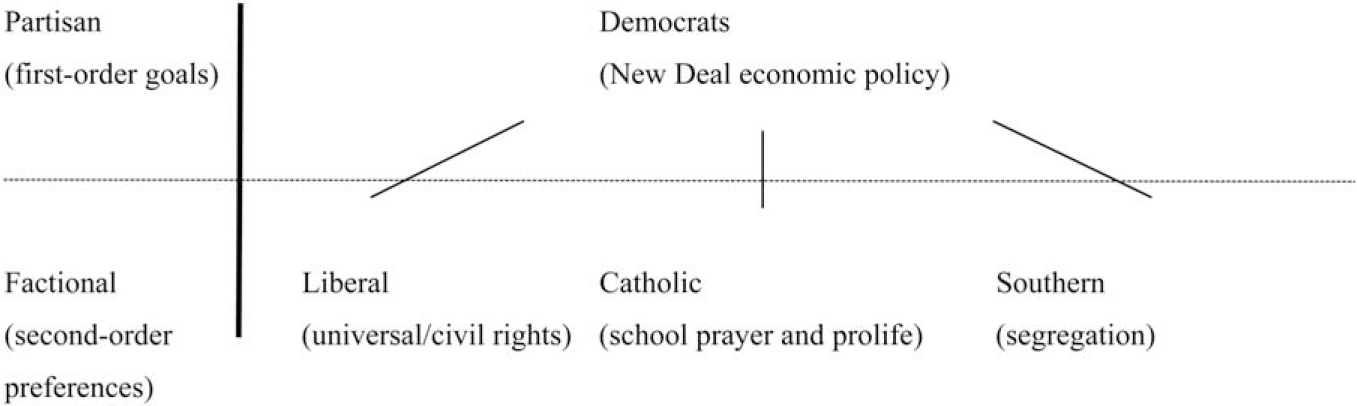
Political actors may achieve their more divisive second‐order factional aims via other governing institutions—the less publicly accountable the institution (such as the Court), perhaps, the better (Skowronek Reference Skowronek1982; Graber Reference Graber1993; Bensel Reference Bensel2000; Lovell Reference Lovell2003; Whittington Reference Whittington2005a; Lovell and Lemieux Reference Lovell and Lemieux2006; Lemieux and Lovell Reference Lemieux and Lovell2010). Therefore, we suggest that over time, members of the judiciary can advance the priorities of factions within the dominant national alliance. As enablers of narrow factions, courts, too, can pursue fractious, second‐order preferences supported by only some of the members of the majority coalition. When the Supreme Court does this, it can provoke intraparty resistance from affiliated MCs, as well as interparty attacks from members of the opposition.
Using a crucial new database, we examine the nearly constant record of congressional attacks on the Supreme Court. Whereas previous accounts focused almost exclusively on attacks via proposed legislation, the newer database (Nichols, Bridge, and Carrington 2014) includes all attacks via proposed constitutional amendment, as well as the legislative attacks documented by Clark (Reference Clark2011) and Engel (Reference Engel2011). Amassing nearly 1,500 uncounted and unstudied attacks, the newer database reveals, for the very first time, the shifting patterns of leadership and issue area of attacks, which allows for propositions about the coalitional implications of Court curbing.
This addition of new data suggests that the twentieth century's record of attacks on the Supreme Court finds additional importance outside the framework of interbranch struggles over judicial independence. In the end, we propose that the study of attacks may find additional relevance when we examine more than just the impact that Court‐curbing efforts have on judicial behavior. Such study gains further significance when interpreted to suggest that MCs use attacks to help manage coalitional affairs and drive party system development.
Implications and Expectations: Three Types of Attack
If presidents and MCs have both partisan affiliations and factional preferences, then we might expect the same of the justices appointed and confirmed by these actors. For the most part, we can expect the overtly political appointment process (Graber Reference Graber2006a; Epstein and Segal Reference Epstein and Segal2007) to make the Supreme Court a “part of the dominant national alliance” (Dahl Reference Dahl1957, 293). Taken further, with enough appointments, the Court could eventually come to be populated by the faction that leads the dominant national alliance (McMahon Reference McMahon2000, Reference McMahon2004, Reference McMahon2007; Whittington Reference Whittington2007). Some have described the Court as sharing the same narrow second‐order preferences as the “presidential wing” of the dominant national coalition (Adamany Reference Adamany, Campbell and Trilling1980; Graber Reference Graber1993, Reference Graber2006a, Reference Graber2008; Whittington 2005b, 2007Reference Whittington2000; Reference Whittington2007; Gillman Reference Gillman, Kahn and Kersch2006b). For instance, despite ideological, religious, and regional diversity within the New Deal coalition, compelling scholarship strongly indicates that the Court was populated predominately by justices sharing an affinity with Franklin Roosevelt's leading liberal faction (Powe Klarman Reference Klarman2004; McMahon Reference McMahon2004, Reference McMahon2007; Gillman Reference Gillman, Kahn and Kersch2006b).
That said, sometimes appointees to the Court do not always follow through on their appointers’ preferences (Segal, Timpone, and Howard Reference Segal, Timpone and Howard2000). As Henry Abraham (Reference Abraham1985, 70) comments: “There is a considerable element of unpredictability in the judicial appointing process.” For instance, after his term ended, Dwight Eisenhower famously quipped, “I made two mistakes and both of them are sitting on the Supreme Court” (Clark Reference Clark1995, 71). His two blunders—liberal Chief Justice Earl Warren and lifetime Democratic Party affiliate Associate Justice William Brennan—became the Warren Court's political and ideological leaders, respectively (Powe Reference Powe2000).Footnote 2
Regardless of whether appointees are predictable “presidential wing” stalwarts or unforeseen “presidential mistakes,” the fact remains that the Supreme Court decides cases involving second‐order preferences. In handing down opinions on these cases, it is possible that the Court can take a factional position, thereby pleasing some factions while displeasing others.
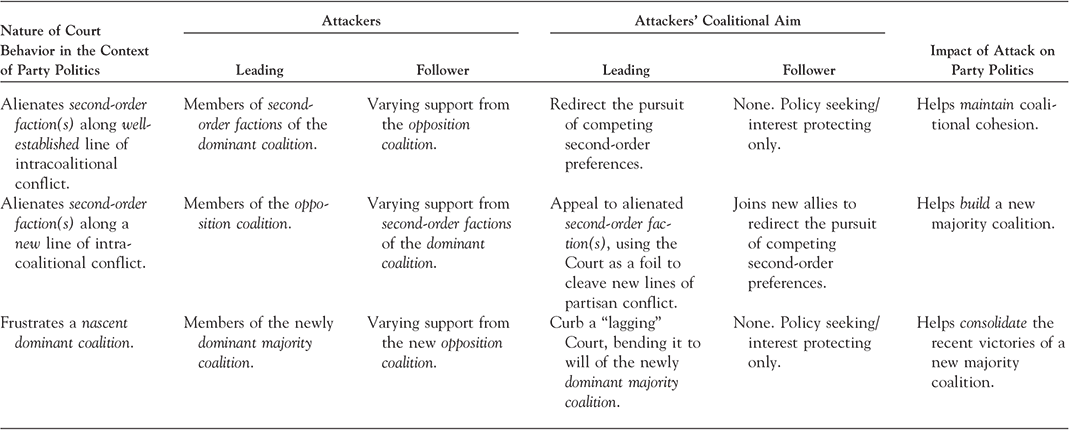
Given that factional preferences can find root in the judiciary, it then follows that second‐order Court decisions can provoke various forms of inter‐ and intraparty dispute. More specifically, we expect this conflict to vary, in time, with the evolving nature of Court decisions that prompt such attacks (Table 1, Column 1). We examine the understudied suggestion that an important way in which assaults can vary is in regard to which group leads the attacks (Table 1, Columns 2a–2b). Granted, Court‐curbing efforts can involve MCs protecting their personal, ideological, or election‐based interests (but see Nichols, Bridge, and Carrington 2014).Footnote 3 Still, we expect attacks to reflect factional interests, and for the goals of attackers to vary in relation to their greater coalitional aims (Table 1, Columns 3a–3b). We therefore hypothesize that attacks can affect more than Court behavior; they can also impact party politics, helping to maintain, build, or consolidate coalitions (Table 1, Column 4). Thus, we start to see the outlines of how legislative‐judicial relations may serve as a site upon which party system development occurs.
Three Types of Hypothesized Attack: When a Court Pursues Factional Second‐Order Preferences

| Nature of Court Behavior in the Context of Party Politics | Attackers | Attackers’ Coalitional Aim | |||
|---|---|---|---|---|---|
| Leading | Follower | Leading | Follower | Impact of Attack on Party Politics | |
| Alienates second‐order faction(s) along well‐established line of intracoalitional conflict. | Members of second‐order factions of the dominant coalition. | Varying support from the opposition coalition. | Redirect the pursuit of competing second‐order preferences. | None. Policy seeking/interest protecting only. | Helps maintain coalitional cohesion. |
| Alienates second‐order faction(s) along a new line of intracoalitional conflict. | Members of the opposition coalition. | Varying support from second‐order factions of the dominant coalition. | Appeal to alienated second‐order faction(s), using the Court as a foil to cleave new lines of partisan conflict. | Joins new allies to redirect the pursuit of competing second‐order preferences. | Helps build a new majority coalition. |
| Frustrates a nascent dominant coalition. | Members of the newly dominant majority coalition. | Varying support from the new opposition coalition. | Curb a “lagging” Court, bending it to will of the newly dominant majority coalition. | None. Policy seeking/interest protecting only. | Helps consolidate the recent victories of a new majority coalition. |
We expect the type of congressional attack on the Supreme Court to vary, over time, by the nature of the prompting decision, which group leads the assault, its coalitional aims, and the impact of the attack on party politics (see Table 1). We expect to find three types—attacks to (1) maintain coalitional cohesion, (2) build a new majority coalition, and (3) consolidate the victories of a new majority coalition.
Attacks to Maintain Coalitional Cohesion
If the Supreme Court alienates members of an affiliated, but second‐order, factional group (or groups) of the dominant coalition along well‐established lines of intracoalitional conflict, those members of the affiliated second‐order faction(s) should lead the attack (Table 1, Row 1). At the coalitional level, their assault should aim to redirect the Court away from pursuit of competing second‐order preferences. That is, attacks provide an unexplored benefit—that second‐order factions of the dominant coalition can use Court‐curbing measures to try to maintain coalitional cohesion.Footnote 4
Meanwhile, members of the opposition coalition may opportunistically follow in these attacks, especially when the Court's pursuit of leading factional goals directly threatens the opposition's own interests and policy preferences. Put differently, we should expect the opposition to contribute some (but not most) attacks on the Court because of politics and policy.
Attacks to Build a New Majority Coalition
If the Supreme Court alienates both the members of an affiliated, but second‐order, factional group (or groups) and the minority party along a potentially new dimension of intracoalitional conflict, members of the opposition coalition should lead the attack (Table 1, Row 2). Their assault should aim to appeal, across party lines, to members of second‐order factional groups of the dominant coalition who have been alienated by the Court. In doing so, the opposition seeks to use the Court as a foil to cleave new lines of partisan conflict.Footnote 5 That is, the opposition attacks can be used in an effort to sway second‐order factions of the dominant coalition to leave that coalition and build a new majority with the opposition.
Meanwhile, second‐order factional groups of the dominant coalition, who are offended by the Court, should follow the political opposition in attacking. They aim to redirect the Court from pursuing competing second‐order preferences. Their attacks differ from attacks to maintain coalitional cohesion in that MCs from second‐order factions of the dominant coalition are—effectively—following the opposition's lead. Under these conditions, we should expect the alienated second‐order factions of the dominant coalition to contribute some (but not most) attacks on the Court. Finally, depending on how incensed factions become, we might expect some within‐group variation with this type of attack, with second‐order factions entering or exiting the fray as the nature of conflict varies.
Attacks to Consolidate a New Majority Coalition
If the Supreme Court frustrates a newly dominant majority coalition, members of that coalition should lead the attack (Table 1, Row 3). These attacks are motivated by the Court's pursuit of goals that threaten the establishment of the emergent dominant majority coalition's interests. They differ from coalitional maintenance attacks in that they come from a party that has only recently ascended to majority status. That party's assault should aim to curb the behavior of an old guard Court “lagging” behind the elected branches, and not yet effectively staffed with regime affiliates (Dahl Reference Dahl1957; Funston Reference Funston1975; Adamany Reference Adamany, Campbell and Trilling1980; Lasser Reference Lasser1985; Gates Reference Gates1992; Whittington Reference Whittington2003). From a coalitional aspect, the leading attackers aim, in large part, to consolidate the victories of a newly elected majority coalition.
Meanwhile, some members of the freshly dethroned minority coalition should follow the opposition in attacking. However, these following attacks may be more driven by survival calculations of opposition coalition attackers, who join the assault primarily to signal to constituents that they are in rhythm with changing times. We should expect some MCs from the minority coalition, then, to contribute a few (but not most) attacks on the Court.
Determining Subperiods of Attack
Using case study analysis, we reinterpret the record of congressional attacks on the Supreme Court from 1955–1984. In selecting these years, we rely on previous literature, which suggests an era saturated with attacks (Rosenberg Reference Rosenberg1992; Clark Reference Clark2011; Engel Reference Engel2011; Nichols, Bridge, and Carrington 2014). Importantly, this timespan comes after the Court indicated its intention to shift from first‐order, coalition‐uniting goals to second‐order, coalition‐upsetting preferences.Footnote 6 This meets the conditions hypothesized as necessary to produce coalition‐maintaining and coalition‐building attacks. Also key, this time span includes the rise of a newly dominant Republican majority coalition in 1981 (Skowronek Reference Skowronek1993, Reference Skowronek2011; Crockett Reference Crockett2002, Reference Crockett2008 Reference Cook and Polsky2005; Cook and Polsky Nichols Reference Nichols2012; Bridge Reference Bridge2014), helping to meet the conditions hypothesized as necessary to produce consolidation attacks.Footnote 7
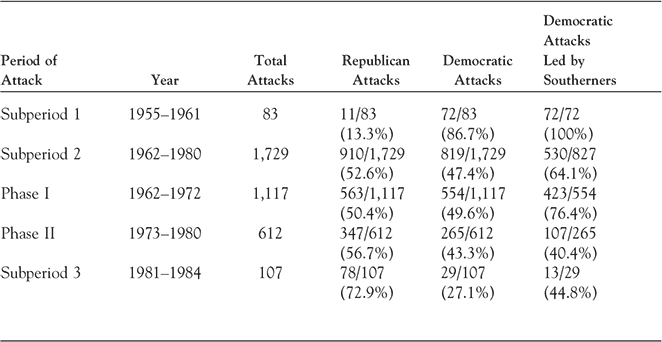
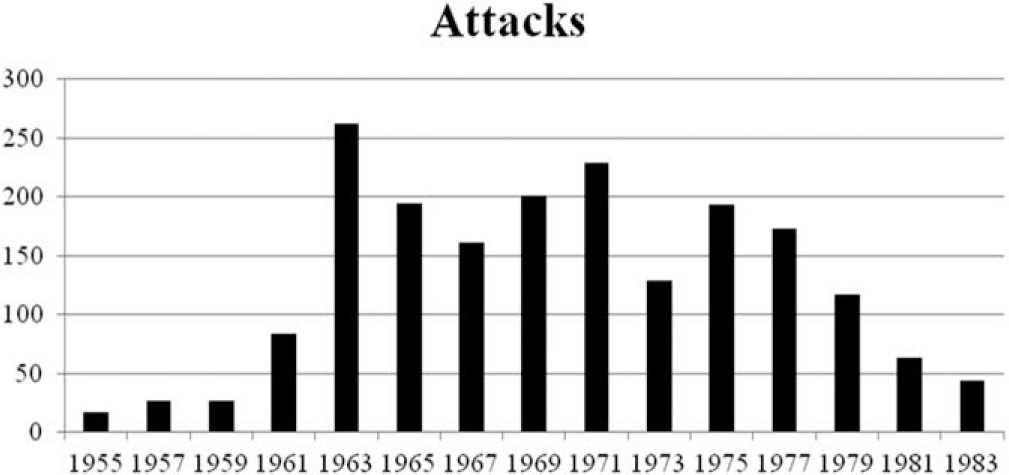
Overall, Congress introduced 1,919 Court‐curbing measures from 1955–1984 (Nichols, Bridge, and Carrington 2014).Footnote 8 Figure 2 displays the fluctuation in the number of attacks throughout the period. Since attacks occurred in every Congress, with no gap in what appears to be a continuous record, we identify breakpoints by tracking both the partisan and factional affiliation of the sponsoring attackers and their shifting coalitional aims. In cases with more than one sponsor, we use the lead sponsor—the MC who officially presented the proposal to Congress. By this measure, the data naturally break down into three qualitatively distinct subperiods (with the second subperiod having two separate phases; see Table 2).Footnote 9
Congressional Attacks 1955 (84th Congress)−1984 (98th Congress)
Adapted from Nichols, Bridge, and Carrington (2014)
Total Congressional Attacks by Party and Faction

| Period of Attack | Year | Total Attacks | Republican Attacks | Democratic Attacks | Democratic Attacks Led by Southerners |
|---|---|---|---|---|---|
| Subperiod 1 | 1955–1961 | 83 | 11/83 | 72/83 | 72/72 |
| (13.3%) | (86.7%) | (100%) | |||
| Subperiod 2 | 1962–1980 | 1,729 | 910/1,729 | 819/1,729 | 530/827 |
| (52.6%) | (47.4%) | (64.1%) | |||
| Phase I | 1962–1972 | 1,117 | 563/1,117 | 554/1,117 | 423/554 |
| (50.4%) | (49.6%) | (76.4%) | |||
| Phase II | 1973–1980 | 612 | 347/612 | 265/612 | 107/265 |
| (56.7%) | (43.3%) | (40.4%) | |||
| Subperiod 3 | 1981–1984 | 107 | 78/107 | 29/107 | 13/29 |
| (72.9%) | (27.1%) | (44.8%) |
Early in the era, from 1955–1961, Democrats led the attacks—proposing seventy‐two of eighty‐three (86.7 percent) of all Court‐curbing measures. Furthermore, southerners accounted for all seventy‐two Democratic attacks (100 percent). In the next subperiod, 1962–1980, Democratic‐led Court‐curbing measures dropped to 819 out of a total of 1,729 (47.4 percent). Importantly, there are two phases of attack during this subperiod. In Phase I, 1962–1972, Democrats led 554 out of 1,117 attacks (49.6 percent). Southerners still dominated Democratic attacks, but dropped from 100 percent to 76.4 percent (423 out of 554). This changes in Phase II of this subperiod, 1973–1980, as southerners stop leading Democratic efforts, contributing only 107 out of 265 (40.4 percent) of all Democratic attacks from 1973–1980. Additionally, in Phase II, Republicans still led a slight majority (56.7 percent) of all attacks. However, in the last subperiod of attacks, 1981–1984, Republicans asserted unquestioned leadership, leading seventy‐eight out of 107 total Court‐curbing efforts (72.9 percent). Of the twenty‐nine Democratic attacks, only thirteen (44.8 percent) came from southern Democrats.Footnote 10
Table 2 clearly confirms that leadership of congressional attacks on the Supreme Court varied. Sometimes, elements of the Democratic majority contributed more attacks; other times, the Republican opposition did. There were times when southern Democrats led 100 percent of their party's attacks; other times, they accounted for a far lesser percentage. Beyond this, however, the raw data are mute, suggesting little about either the reasons for, or the implications of, the shifting patterns of attack. For this, detailed case study analysis is needed.
We provide this analysis to examine the unique expectations identified in Table 1. By drawing on primary documents (e.g., Congressional Record, party platforms) and secondary literature, we examine our proposition of how attacks vary across time. Specifically, we seek to explore three questions in each subperiod: (1) What was the nature of the landmark Court decision(s) that prompted attack in context to party politics? (2) What were the coalitional aims of leading and following attackers? and (3) In looking beyond whether the Court was effectively curbed, did the attacks help accomplish the coalitional aims of leading attackers and spur party system development? In what follows, we offer a new interpretation of the “mature” New Deal era that views Court curbing as an important, and overlooked, mechanism of party system development.
1955–1961
On May 17, 1954, a unanimous Court announced Brown v. Board of Education, striking down the “separate but equal” doctrine. The mostly cordial relationship between the Court and congressional Democratic majorities, in existence since 1937's “switch in time that saved nine,” turned hostile. To uncover why this decision—coupled with the 1950s communist casesFootnote 11 —may have prompted a specific type of attack, it is first necessary to understand the context of party politics better.
The Nature of Court Behavior in the Context of Party Politics
By 1954, the New Deal coalition had been in power for twenty‐two years. For eighteen of those years, the Democrats had maintained unified control of government, with the solid South acting as an almost impregnable congressional stronghold for the coalition that Franklin Roosevelt built. This did not, however, mean that southerners led the coalition. On the contrary, northern liberal interests stood as the primary faction. By 1954, the liberal faction had controlled the party long enough to have completed most of the coalition's shared, first‐order goals.
As others (Gerring Reference Gerring1998; McMahon Reference McMahon2000, Reference McMahon2004) convincingly demonstrate, by the 1950s, liberals had already begun using Democratic control of government to fulfill their own second‐order factional preferences. The official reorientation from “populist” to “universalistic” (Gerring Reference Gerring1998, 18) ideology (favored by the liberal faction) reveals itself when comparing changes in language between the 1948 and 1952 party platforms. The 1948 platform did call for efforts “to eradicate all racial, religious and economic discrimination” (Democratic Party Platform 1948). However, the 1952 platform reprioritized the effort by adding concrete, national means of achieving these now higher priority ends. The 1952 platform demanded “Federal action” including the Justice Department taking “an important part in successfully arguing in the courts for the elimination of many illegal discriminations” (Democratic Party Platform 1952). Furthermore, the platform in 1948 repeatedly addressed the need to fight “Communist aggression,” and keep unions “free from communistic influences.” In 1952, the party tempered the language, referencing communism only in regard to Korea.
The Brown ruling, as well as the period's communism decisions regarding civil liberties, can therefore be understood as the judicial enactment of the long‐contentious, second‐order preferences of the liberal faction of the Democratic Party. Regardless of the normative allure of the Court's move to desegregate schools and defend free speech, these decisions shifted the Court away from pursuing coalition‐unifying, first‐order economic goals. Unsurprisingly, this alienated southern members of the New Deal coalition along well‐established lines of intracoalitional conflict, and eventually, encouraged other anticommunist MCs to attack the Court. It thus prompted Court‐curbing measures led by the southern, second‐order factional members of the dominant coalition.
Coalitional Aims of Leading Attackers
In 1955, southern Democrats began introducing Court‐curbing bills that targeted Brown. These measures sought to impact Court behavior, aiming to do something to the effect of what H.R. 3769 stated: “to prohibit the courts of the United States … from deciding or considering any matter drawing in question the administration by the several states of their respective education systems” (Congressional Record 1955, 801; see also 1011, 3701, 1016). However, we put forward that these Court‐curbing measures may have helped southern Democrats to manage their coalition.
To express the political motivations of southern Democratic attackers, it is important to highlight that unity within the diverse New Deal coalition long rested on completion of shared, first‐order, economic goals. The Democratic Party—which combined support from labor unions, racial and ethnic minorities, northern liberals, and the white South (Sundquist Reference Sundquist1983)—was held together by its focus on the class‐based theme of promoting the people's interests by expanding government services throughout the polity. When the Court pursued this agenda (e.g., buttressing the New Deal in NLRB v. Jones & Laughlin Steel [1937] and West Coast Hotel v. Parrish [1937]), factions of the Democratic coalition—be they liberals, southerners, or the like—could, for the most part, unite in support.
Second‐order preferences not shared by the whole coalition, such as the liberal faction's universalistic vision of racial equality or freedom of speech, had to be de‐prioritized to maintain coalitional cohesion. When these fractious preferences were not subordinated, intracoalitional tensions flared (Klarman Reference Klarman2004; Feinstein and Schickler Reference Feinstein and Schickler2008; Jenkins, Peck, and Weaver Reference Jenkins, Peck and Weaver2010). Such was the case with the Costigan‐Wagner Anti‐Lynching Bill in 1934, Truman's proposed civil rights agenda of 1948 that lead to the Dixiecrat revolt, and the Civil Rights Act of 1957. These events demonstrate the possibility of nonjudicial policymakers transgressing divisive intracoalitional fault lines (e.g., race), prompting a backlash by alienated second‐order factions of the dominant coalition (e.g., southern Democrats). Congressional attacks on the Supreme Court during this subperiod seem to have been part of that backlash. Although second‐order factional members of the dominant majority probably used Court curbing to advance their personal, ideological, and electoral interests, we also hypothesize that these attacks might have helped maintain coalitional cohesion.Footnote 12
Beyond Judicial Independence: Attacks’ Impact on Party Politics
Received wisdom suggests that this subperiod's attacks threatened judicial independence because they were semisuccessful in influencing the Court's behavior (Rosenberg Reference Rosenberg1992). Although the judiciary did not back off its position on racial equality, the attacks did seem to cause the Court to slow its pace of advance. Furthermore, attacks are credited with causing the Court to switch its position on the subperiod's communism cases. In this, it is essential to note that southern Democrats not only opposed desegregation and communism individually, but also in combination, with many southerners seeing ideological, if not organizational, links between the two (Solomon Reference Solomon1998; Woods Reference Woods2004). For instance, in introducing a Court‐curbing amendment, Senator Eastland said “the origin of the doctrines [of Brown] can be traced to Karl Marx.” In the 1950s witch‐hunt style, Eastland then exhaustively linked the “so‐called modern authorities on psychology cited by the Court” to communist activity (Congressional Record 1955, 7119–24). This dual concern—communism and desegregation—prompted southern Democrats to attack the Court voraciously.
Nevertheless, it was not until Republicans joined the communism attacks that the Court began reversing itself. Although individual Republicans may or may not have drawn the same ideological or organizational links, many were happy to follow southern‐Democrat‐led attacks on communism. To Republicans, the singular policy issue seemed to be the main focus. For instance, after the first procommunism decisions, Chief Justice Warren asked Eisenhower what he would do with the communists in the United States. Eisenhower responded, “I would kill the SOBs” (Warren Reference Warren1977, 6). Given these sentiments, it appears that Republicans needed no coalitional reason to attack; they were simply acting on their anticommunist preferences. Indeed, with the help of Republicans, six southern‐Democratic‐sponsored bills attacking the Court passed the House. Several nearly passed the Senate, too (Rosenberg Reference Rosenberg1992). With a cross‐partisan congressional majority potentially forming against the Court, these attacks caught the attention of some justices—especially Felix Frankfurter, who in reversing himself led the Court back to supporting the government in communism cases (Powe Reference Powe2000).
From a Court‐centered perspective, we might conclude that Court attacks were somewhat effective during this subperiod, and some judicial independence (on the communism issue) was lost. Yet, we suggest there was an added significance. At the very least, Court‐curbing efforts helped southern Democrats maintain coalitional cohesion. Indeed, by trying to redirect the Supreme Court away from pursuing liberal second‐order preferences, attacks contributed to the political effort to slow the implementation of Brown, and obstruct the federal government from desegregating “with all deliberate speed.” In fact, it took ten years until Congress passed legislation that even began to make measurable gains in integrating the South (Rosenberg Reference Rosenberg1991). Thus, the attacks ultimately may have helped keep southerners in the Democratic fold for many years after Brown.
1962–1980
As the Court became involved in cases that touched on deeply held religious values, a divisive new line of cleavage began to emerge, prompting MCs from both parties to attack the judiciary. During this very long subperiod, some Democrats again disagreed with other members of their coalition on the pursuit of competing second‐order preferences (as in the 1950s). Importantly, though, Republicans led a slight majority of the attacks, perhaps aiming in part to use the Court as a foil upon which to help them build a new majority coalition. Republican leaders (e.g., Pat Buchanan, Barry Goldwater, Ronald Reagan) consciously and publicly acknowledged the Republican Party's desire “to combine the two major segments of contemporary American conservatism (i.e., social and economic conservatives) into one political effective whole” (Reagan Reference Reagan1977). We propose that attacks, then, might have served as one mechanism (among others, such as platform changes, presidential and congressional position taking, etc.) to help attract traditionalist Catholics and southerners who otherwise voted Democratic. Put differently, we hypothesize that attacks sought to contribute to the building of what Richard Nixon (Reference Nixon1969) termed “the great silent majority.”
This very long subperiod of attacks breaks down into two phases. Phase I, 1962–1972, follows the liberal faction gaining dominance over the Democratic congressional delegation and Supreme Court. Here, the Court's decisions on school prayer prompted the most attacks. Phase II, 1973–1980, follows the liberal faction winning control of the presidential nomination process, after which the Court's decision on the even more salient issue of abortion took center stage.Footnote 13
The Nature of Court Behavior in the Context of Party Politics
As with southern Democrats, Catholics were an integral part of the New Deal coalition. By 1956, Catholics accounted for a third of all Democratic votes for president. In 1960, this group gave John F. Kennedy almost half of all the votes he received. Still, even with the elevation of the first Catholic to the Oval Office, the liberal faction continued to dominate the coalition, especially at the party‐in‐government level (Powe Reference Powe2000; Gillman Reference Gillman, Kahn and Kersch2006b; Feinstein and Schickler Reference Feinstein and Schickler2008).
Indeed, in 1952, liberals had captured the Democratic Party platform‐writing process (Gerring Reference Gerring1998). By 1958, the Republican Party suffered tremendous midterm losses in the Northeast and Midwest, where liberals such as Senators Edmund Muskie (D‐ME) and Eugene McCarthy (D‐MN) claimed new seats. By 1960, liberals had gained clear control over the Democratic Party's congressional delegation. Liberals further extended their power over the Democratic coalition by nominating liberal Supreme Court justices (e.g., Goldberg, Fortas, Marshall). In both the 1960s and 1970s, as the liberal faction gained more dominance over the Democratic Party (Powe Reference Powe2000; Gillman Reference Gillman, Kahn and Kersch2006b; Feinstein and Schickler Reference Feinstein and Schickler2008), the Supreme Court made decisions that advanced this faction's second‐order preferences.
Thus, the striking down of school prayer in Engel v. Vitale (1962) and Roe v. Wade's (1973) limited right to abortion decision can both be understood as judicial enactments of the second‐order preferences of the dominant liberal faction (Powe Reference Powe2000). This alienated Catholic and southern Democrats, and provided Republicans the opportunity to woo them. The difference between the Engel and Roe phases of this subperiod lie in the relative salience (to Catholics) of school prayer and abortion. No doubt Engel was significant, inspiring 646 total attacks, but to Catholics, school prayer simply was not as politically charged as abortion, which struck—and continues to strike—a deeper chord of conflict. As a result, not only did Republicans lead attacks on the Court from 1962–1980, but nonsouthern Democrats, representing states with large Catholic populations (see Pew Forum 2007), began to attack with greater frequency.
Coalitional Aims of Leading Attackers
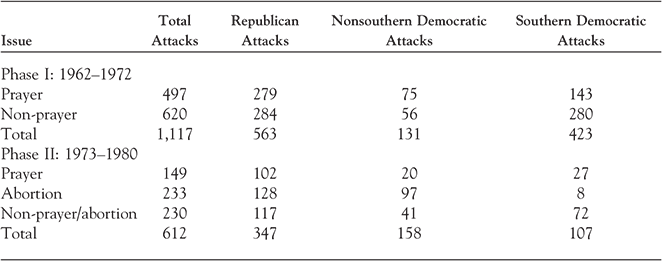
On the very day the Court issued Engel, Catholic MC Frank Becker (R‐NY) offered the first amendatory attack against the ruling. Over the next four months, the Court was attacked fifty‐eight times on school prayer, and seventy times overall—an unprecedented volume that nearly equaled the total number of all attacks from 1955–1960. Also, uniquely, Republicans led the attack. Over the next ten years, southern‐Democratic‐led attacks dropped from 100 percent to 76.4 percent of the party's overall total. Southern Democrats still maintained a steady stream of attacks across an array of issues, seemingly taking any opportunity to attack the Court.Footnote 14 Meanwhile, nonsouthern Democratic attacks were much more focused, as 57.3 percent (75 of 131) of them during this phase targeted the values cleavage, attempting to curb the Court on school prayer (Table 3). As with Brown, the Court had transgressed intracoalitional fault lines by pursuing the second‐order preferences of the liberal faction. Unlike Brown, nonsouthern Democratic MCs representing large Catholic constituencies now joined southern Democrats in attacking the Court (Powe Reference Powe2000, 182–93).
Subperiod 2 Attacks by Issue

| Issue | Total Attacks | Republican Attacks | Nonsouthern Democratic Attacks | Southern Democratic Attacks |
|---|---|---|---|---|
| Phase I: 1962–1972 | ||||
| Prayer | 497 | 279 | 75 | 143 |
| Non‐prayer | 620 | 284 | 56 | 280 |
| Total | 1,117 | 563 | 131 | 423 |
| Phase II: 1973–1980 | ||||
| Prayer | 149 | 102 | 20 | 27 |
| Abortion | 233 | 128 | 97 | 8 |
| Non‐prayer/abortion | 230 | 117 | 41 | 72 |
| Total | 612 | 347 | 158 | 107 |
During the 1962–1972 phase, Republicans contributed more than half (563 of 1,117) of all attacks and, likewise, more than half (279 of 497) of all attacks on school prayer (see Table 3). For certain, many of these attacks can be understood as Court‐curbing efforts in support of personal and ideological preferences and in defense of established interests with electoral sway. Yet, we propose that Republican‐led attacks during this phase served an additional, party‐building, aim. Postwar conservative intellectuals pointed out that the “backlash against liberal social policies erupted first, outside the South, in Catholic ethnic neighborhoods” (Gottfried Reference Gottfried1992, 35). Given the discontent shown by these constituencies, some intellectuals encouraged the Republican Party to construct a “populist conservative” coalition in order to regain majority status (Nash Reference Nash1976). One author refers to the effort as building “a new unity … which placed Protestants and Catholics in the same camp against ‘secular’ forces” (Miles Reference Miles1980, 256).
Though the strategy measurably succeeded in the 1970s (culminating in the 1980 election), efforts to attract Catholics began in the 1960s—especially with the school prayer issue. For instance, during the 1964 campaign, presidential candidate Barry Goldwater asked: “Is this the time in our nation's history for our federal government to ban Almighty God from our school rooms?” (Williams Reference Williams2010, 75). Shortly after, the Nixon administration combined the well‐known “Southern Strategy” (Phillips Reference Phillips1969; Boyd Reference Boyd1970; Aistrup Reference Aistrup1996; Black and Black Reference Black and Black2002) with the effort to bring Catholic and ethnic voters into the Republican fold. For instance, Nixon staffer Pat Buchanan's “Assault Book” laid out how to attack the Democratic Party on “Catholic/ethnic” concerns, including religion in schools (Greenhouse and Siegel Reference Greenhouse and Siegel2010, 215). In another internal Nixon administration memo entitled “Dividing the Democrats,” one strategist wrote: “Favoritism toward things Catholic is good politics” (Greenhouse and Siegel Reference Greenhouse and Siegel2010, 310). By amplifying the latent resentment between traditionalist and liberal factions of the New Deal coalition, the GOP could attract Catholic, ethnic, blue‐collar, and southern voters (Phillips Reference Phillips1969, Reference Phillips1972; Reference Rieder, Fraser and Gerstle1989; Rieder Mason Reference Mason2004; Mason and Morgan Reference Mason and Morgan2013). Thus, we introduce the possibility that Republican‐led attacks on school prayer—while partly driven by policy preferences—might also be viewed as part of a larger appeal to alienated second‐order factional groups of the New Deal coalition, namely, Catholics and southerners.
Attacks during the 1973–1980 phase played out similarly, with the qualification that abortion shook the religious fault line much more violently with Catholics than school prayer, thereby giving Republicans a better chance to build a new majority coalition. After Roe, Republicans continued to lead attacks (347 of 612). Just as important, deeply alienated, nonsouthern, Catholic‐representing Democrats increased their Court‐curbing activities. Not only did nonsoutherners account for 59.6 percent of all Democratic attacks during this phase, they also launched a surprising 97 of 105 (92.3 percent) Democratic abortion‐focused attacks (see Table 3).Footnote 15 Both these trends represent a dramatic shift from the first subperiod, when southerners led all Democratic attacks, and the Court had not disturbed the religious fault line by ruling on school prayer or abortion.
The 1973–1980 Republican attacks, in combination with other efforts, can also be seen as part of the emergence of an overarching limited government vision. Comments from Republican MCs during the debate on Court curbing reveal that the reasoning behind abortion attacks was not just due to prolife preferences, but also due to concerns of limited government. For example, Representative Earl Landgrebe (R‐IN) charged: “The Supreme Court has overstepped the bounds of the Constitution, and its decision in Roe against Wade is unconstitutional” (Congressional Record 1973, 34988). We do not claim that ideological arguments against Roe caused later changes in the GOP's principled tone, but they certainly seem to fall in line with Ronald Reagan's (Reference Reagan1981) expression of the culmination of these efforts: “Government is not the solution to our problem; government is the problem.” In sum, we hypothesize that post‐Roe Republicans used Court attacks—along with other mechanisms, such as platform changes—to help illuminate a new governing philosophy with which to transform the “great silent majority” (Nixon Reference Nixon1969) into the dominant party coalition.
Beyond Judicial Independence: Attacks’ Impact on Party Politics
The attacks of 1962–1980 did not reverse Engel or Roe. In Phase I, the attacks largely “fell on deaf ears” (Rieder Reference Rieder, Fraser and Gerstle1989, 248). MCs launched over 1,000 attacks from 1962–1972, and yet the Court continued to develop jurisprudence based on liberal second‐order preferences (e.g., 1963's Abington v. Schempp). Additionally, if post‐Roe attacks influenced judicial behavior, then it only occurred at the margins.Footnote 16 If the purpose of examining attacks from a Court‐centered view is to gauge their impact on judicial independence, then it would seem that these Court‐curbing efforts accomplished very little measurable change. However, from a broader point of view, Court‐curbing efforts during this timeframe might be seen as playing a role in party politics. Specifically, Republicans might have used attacks as one mechanism, among others, to help spur party development.
While the first phase (1962–1972) of Republican attacks during this subperiod did not instantly build a new majority coalition, we put forth the possibility that it contributed, in previously unrealized ways, to the slow‐motion breakup of the New Deal coalition. Indeed, by the 1970s, the Republican Party had made measurable inroads with Catholics and southerners. Catholics went from providing Republicans 9 percent of their coalitional support in 1960, to 15 percent in 1964, and 22 percent in 1972 (Manza and Brooks Reference Manza and Brooks1999). Similarly, Republicans made clear inroads with southerners during this phase, going from holding less than 10 percent of southern House seats in 1962 to over 30 percent in 1972 (Black and Black Reference Black and Black2002). We hypothesize that attacks on the Court were part of the overall mechanism that contributed to these Republican gains.
After Roe, Republicans gained even more Democratic converts. This happened at both the elite and mass levels. For example, John Jarman (OK) served in the House as a Democrat for twenty‐four years before switching to the Republican Party in 1975 because the Democratic Caucus had “force[d] their Liberal views on this Congress” (United Press International 1975). In addition to Reagan himself, many of the men and women who became Reagan‐era leaders in the GOP started off as Democrats. Elizabeth Dole, Phil Gramm, and Condoleezza Rice all switched after 1973. Meanwhile, at the electoral level, Republicans kept their gains with Catholics, as the Democratic share of the Catholic vote dropped below 50 percent for the first time in 1972. By 1984, Republicans claimed 61 percent of Catholic votes. The GOP also made gains in the South. By 1980, Republicans captured their highest percentage of southern House seats since Reconstruction (36 percent), and amassed a majority of southern electoral votes for president—a trend that still holds.
In final analysis, we suggest that Court curbing was a previously understudied, and possibly significant, factor that contributed to late twentieth‐century party development. The post‐Roe attacks succeeded more than those that followed Engel because they better helped to redefine the scope of conflict in society (Schattschneider Reference Schattschneider1960; Sundquist Reference Sundquist1983). That is, the Republican response (including Court attacks) to abortion played a key role in helping articulate a governing philosophy that could peel traditionalists away from the Democratic coalition while uniting them with fiscal conservatives. By attacking on abortion, congressional Republicans expanded their beachhead in the South and seriously challenged for Catholic and blue‐collar “Reagan Democrats.” Although it took time to percolate, the new alignment of preferences put the Republican Party in a position where it could win both the White House and Senate, as well as eventually contending for outright control of the House. Along with other efforts, 1962–1980 attacks very well could have contributed to Republicans shifting the cleavage line, and ultimately winning national majorities.
1981–1984
January 5, 1981, marked the beginning of a new period in legislative‐judicial relations. On this day, the Ninety‐Seventh Congress met. Unlike every other previous Congress in this study, Democrats did not control the Senate. As such, while the contentious interbranch relationship prevailing since Engel and Roe continued, it now operated under different circumstances. To account for this period's qualitatively different type of attacks, we again must understand the nature of Court‐curbing efforts within the context of party politics.
The Nature of Court Behavior in the Context of Party Politics
By 1980, Democrats had dominated national politics for forty‐eight years. Although Republicans had been competitive for the presidency since 1952, they had not won a majority in either chamber of Congress since then. With the Ninety‐Seventh Congress, Republicans gained outright control of the Senate for the first time in twenty‐six years. Moreover, they won the White House with a president who was so popular that he ran ahead of (i.e., claimed a higher percentage of the two‐party vote) many Democratic Representatives in their own House districts (Schick Reference Schick and Ornstein1982). In part, this allowed Reagan to convince enough Democrats in the House to help him prevail in his “Budget Battle” of 1981 (Pfiffner Reference Pfiffner and Pfiffner1986). Scholars later recognized this as a critical step in the way Republicans fundamentally reordered the terms of “governmental commitments” and “established interests” (Skowronek Reference Skowronek1993, 411). Thus, when Republican MCs overwhelmingly began dominating attacks against the Court over an array of issues in the early 1980s, they did so—in the wake of Reagan's election and “reconstructive” efforts (Skowronek Reference Skowronek1993, Reference Skowronek2011; Crockett Reference Crockett2002, Reference Crockett2008 Reference Cook and Polsky2005; Cook and Polsky Nichols Reference Nichols2015)—as members of a new, albeit thin, majority.
Soon after gaining effective control over government, Republicans continued their attacks. As with the other subperiods examined, the Court should be seen as continuing to advance the second‐order preferences of the New Deal coalition's liberal faction.Footnote 17 However, the political context in which the Supreme Court operated had changed. By continuing on as before in the face of a newly dominant majority coalition, the Court now played the role of “lagging” defender of electorally outdated constitutional understandings (Dahl Reference Dahl1957; Funston Reference Funston1975; Adamany Reference Adamany, Campbell and Trilling1980; Lasser Reference Lasser1985; Gates Reference Gates1992; Whittington Reference Whittington2003). As with the early New Deal era (1933–1937), such circumstances led to a vigorous assault led by members of the new majority.
Coalitional Aims of Leading Attackers
As expected, Republicans led the assault. From 1981–1984, Republicans led 78 of 107 total attacks against the Court (Table 2). These Court‐curbing efforts aligned with the Reagan administration's detailed set of guidelines for “Constitutional Litigation” (across a broad range of issues, including affirmative action, federalism, and abortion). This period's attacks were motivated by the feeling, later enunciated by Attorney General Edwin Meese III, that liberal judicial supremacy “was, and is, at war with the Constitution” (Ostrow Reference Ostrow1986). At the very least, Republicans attacked to try to bend an out of step, “old guard” judiciary to their will. We also propose that early Reagan‐era Court‐curbing helped consolidate recent Republican victories.
Granted, some Democrats joined in Court‐curbing efforts, adding twenty‐nine attacks. While difficult to discern the exact aim of Democratic attackers during this period, it appears that coalitional concerns were not as important as more electoral‐based motivations. Indeed, in light of the 1980 election, it may be most accurate to characterize Democratic following attacks as either sincere expressions of personal prolife policy preferences or election‐based position‐taking (Mayhew Reference Mayhew1974) signals to constituents by anxious legislators affiliated with the wrong side of the conservative “Reagan Revolution.” Whatever the exact motivation, southern Democrats launched only thirteen attacks (12.1 percent of all attacks during the period)—a far cry from 1955–1961, when this group contributed 86.7 percent of all Court‐curbing measures (Table 2).
Whereas the 1962–1980 attacks were more narrowly Republican led, the 1980s attacks were overwhelmingly driven by the GOP, which sought to assert its newfound dominance. Indeed, Republican attacks of the early 1980s continued to chip away at the issues (e.g., school prayer and abortion) that had enabled the GOP to first build a majority coalition. The 1981–1984 attacks reinforced the new limited government philosophy that conservatives had been shaping for decades. By 1981, the Republican Party finally articulated that philosophy in explicit terms, with the 1980 GOP platform including a section on “Big Government,” which spelled out its overarching governing philosophy: “to de‐emphasize big bureaucracies … [and] restor[e] the strength of smaller communities” (Republican Platform 1980). In sum, we suggest the possibility that congressional attacks in 1981–1984 may have helped conservatives consolidate a narrow, but effective, Republican realignment.
Beyond Judicial Independence: Attacks’ Impact on Party Politics
From a Court‐centered viewpoint, this subperiod may not look different than the 1970s. Yet a more holistic view not only observes the degree to which Republican‐dominated attacks changed after 1980, but also suggests that the coalitional impact of the Reagan‐era attacks was different. Newly ascendant conservatives did not use the Court as a foil to construct a new majority. After the 1980 victories, Republicans instead used attacks to consolidate their newly won authority. If true, then these attacks now intended, as the 1980 platform generally spelled out, to reverse “Democratic Party domination of the body politic over the last forty‐seven years [which] has produced a central government of vastly expanded size, scope, and rigidity” (Republican Platform 1980).
Conclusion
In reinterpreting the record of all Court‐curbing proposals (including constitutional amendments) during the mature New Deal era, we propose that congressional attacks on the Supreme Court can go beyond challenging judicial independence. Attacks might have implications beyond interbranch tension and the legislature's attempt to rein in an ideologically opposed Court by altering judicial behavior. And while MCs’ personal, ideological, and/or electoral commitments certainly motivate some attacks, they nevertheless could be driven by coalitional concerns as well. As such, attacks can also affect party system development. In this final section, we conclude with brief thoughts about the applicability and limits of our findings.
The main contribution is the notion that congressional attacks can serve previously unrecognized functions—they can help maintain coalitional cohesion, build a new majority, and consolidate recent victories. While the regime politics approach assumes that the Court's actions will almost always benefit the regime (but see Graber Reference Graber1993, Reference Graber2006b), we point out that the judiciary can also undermine the coalitional foundations upon which a dominant regime is built. When the Court advances second‐order preferences, it can generate new dimensions of intracoalitional conflict within the dominant coalition. This can divide the majority and provide some affiliated factions with incentive to attack. More importantly, it can give members of the minority party an opening to use the Court as a foil—against which dissatisfied, second‐order factions of the majority can be cleaved away and united with the minority party.
If the Court follows the narrow preferences of the primary faction (Adamany Reference Adamany, Campbell and Trilling1980; Graber Reference Graber1993, Reference Graber2006a, Reference Graber2008; Whittington Reference Whittington2005b Reference Whittington2007; Gillman Reference Gillman, Kahn and Kersch2006b), then it may (over time) be especially susceptible to acting in ways that drive second‐order factions of the majority to unite with the opposition party against its judgments. In fact, we would argue that Ronald Reagan's winning coalition—which included many southerners and Catholics—can be conceived of, in part, as an electoral solution to the problem of a Supreme Court that refused to abide by the wishes of a “silent majority” (Nixon Reference Nixon1969). To be certain, Republicans marketed their campaign for dominance as such. We therefore suggest that attacks in the mature New Deal era may have played an unrecognized part in fostering party system development. To borrow the phrase of developmental scholars, we hypothesize that party system development takes place on the site (Orren and Skowronek Reference Orren and Skowronek2005) of legislative‐judicial relations. Herein, attacks can serve as one of the mechanisms through which coalitional change is initially opposed and eventually wrought.
While it is outside the scope of this article to speculate about the frequency of such a phenomenon, our study suggests exploring how often second‐order Court rulings and subsequent attacks (from both parties) affect party system development. Of course, attacks are not the only site of this development.Footnote 18 And while we refrain from assigning any relative weight to the role of attacks, we do put forward Court‐curbing efforts as an almost completely overlooked piece of the developmental puzzle. In this vein, we offer a new hypothesis worthy of more systematic study: that Court curbing can help maintain dominance, build majorities, and consolidate power.
Put simply, our study suggests that a second‐order‐preference‐pursuing Supreme Court can serve as an engine of change in US political development. The Court may occasionally undermine affiliated regimes by making second‐order decisions that congressional attacks are unable to curb, but that open new dimensions of inter‐ and intracoalitional cleavage. Political entrepreneurs then have an opening to attempt to curb the Court via realignment of the electorate, suggesting that the Court's ability to maintain judicial independence in the face of attack can, ironically, destabilize the majority coalition affiliated with the Court. If true, then attacks may play an important role in other eras as well.