1. INTRODUCTION
The interaction of intense radiation and charged particles with solid surfaces is an intensively investigated field (Pikuz et al., Reference Pikuz, Chefonov, Gasilov, Komarov, Ovchinnikov, Skobelev, Ashitkov, Agranat, Zigler and Faenov2010; Kumar & Verma, Reference Kumar and Verma2011; Zhu et al., Reference Zhu, Zhang, Tang and Lei2011). The underlying physical processes are of great interest not only for basic research, but also for technological applications such as material modifications, X-rays source devices, radiation physics, chemistry, biology, plasma-wall interactions, and surface analysis as well (Lucio et al., Reference Lucio, Gavin and Dubois2006; Bajales et al., Reference Bajales, Cristina, Mendoza, Baragola, Goldberg and Ferrón2008; Hoffmann et al., Reference Hoffmann, Blazevic, Ni, Rosmej, Roth, Tahir, Tauschwitz, Udrea, Varentsov, Weyrich and Maron2005, Reference Hoffmann, Blazevic, Korostiy, Ni, Pikuz, Rosmej, Roth, Tahir, Udrea, Varentsov, Weyrich, Sharkov and Maron2007; Kudo et al., Reference Kudo, Sakai and Ichinokawa2000; Rosmej et al., Reference Rosmej, Pikuz, Korostiy, Blazevic, Brambrink, Fertman, Mutin, Efremov, Pikuz, Faenov, Loboda, Golubev and Hoffmann2005). We will here concentrate on the effect of secondary electron emission (SEE) from surfaces under ion bombardment. This effect has been extensively studied during several decades because of its fundamental and technological importance. Secondary electron emission from surface is commonly ascribed to two different mechanisms, the potential emission process (PE) (Hagstrum, Reference Hagstrum1954) and the kinetic emission process (KE) (Baragiola, Reference Baragiola1994). However, separation of the relative contribution of potential and kinetic processes to the total electron emission is not an easy task. Several attempts have been made previously (Lemell et al., Reference Lemell, Stöckl, Burgdörfer, Betz, Winter and Aumayr1998). Hughes et al. (Reference Hughes, Burgdörfer, Folkerts, Havener, Overbury, Robinson, Zehner, Zeijlmans Van Emmichoven and Meyer1993) attempted to separate PE and KE via coincidence measurements of electron emission and the angular distribution of scattered projectiles, Stöckl et al. (Reference Stöckl, Suta, Ditroi, Winter and Aumayr2004), or to subtract the KE contribution from measurements of grazing scattering (incident angle < 4°) of Ar ions from LiF (001) surface. Lederer et al. (Reference Lederer, Maass, Blauth, Winter and Aumayr2003) studied the threshold behavior of KE by measuring the yield for neutral projectile impact on Al surface.
In this paper, we present experimental results for electron emission yield of Neq+(q = 2, 4, 6, 8) impacting on Si at normal incidence. The mechanism of electron emission is investigated as a function of charge state and we discuss how charge states impact the relative importance of potential electron emission (PEE) versus kinetic electron emission (KEE).
2. EXPERIMENTAL SETUP
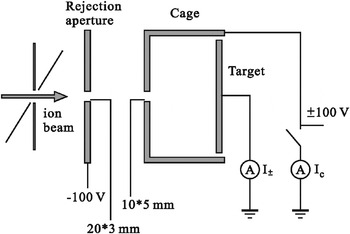
The highly charged ions used for this experiment were produced by 14.5GHz electron cyclotron resonance ion source (ECRIS) at the Heavy Ion Research Facility in Lanzhou (HIRFL) (Zhao et al., Reference Zhao, Xiao, Xu, Zhao, Xia, Jin, Ma, Liu, Yang, Zhang, Wang, Li, Zhao, Zhan, Xu, Zhao, LI and Chen2009). Figure 1 shows the recently constructed experimental setup for secondary electron yield measurements.
Schematic diagram of the experimental setup used for measuring the total electron yield.

It consists of three major parts namely, an adjustable beam collimator, a rejection aperture (20 mm × 3 mm) and a cage. The beam defining collimator serves to prevent the incoming ions from directly impacting the rejection aperture and has a diameter of 2 mm. The cage that is operated with a voltage of ±100 V surrounds the target in order to collect or to suppress electrons emitted from the target. The cage has an aperture of 10 mm × 5 mm for ion beam entrance, through which the incident ion beam is collimated down to 2 mm in diameter, before it is able to reach the target surface. A rejection electrode at a potential of −100V is placed before the cage that prevents electrons from escaping and thus further enhances the electron collection efficiency. The current at the target is measured with a pico-ampere meter. When applying +100V to the cage with respect to the target, the total current I + that is measured at the target consists of two components, the current of incoming ions I i and the current of emitted electrons I e.

For −100V applied to the cage leads to a target current I − that is equal to the incoming ion current.

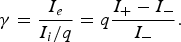
Therefore, the total electron yield is given as
Highly charged ion beam, with ion current in the range of 50–400 nA, were focused and collimated to a diameter of 3 mm. The target was mechanically polished and placed perpendicular to the ion-beam direction. The pressure in the target chamber was maintained at about 10−10 mbar. In order to obtain the required clean surface, a self-sputtering process was performed using Ar+ ions. During the cleaning process, the surface condition was checked by measuring the electron yield at intervals and the experiment was started after achieving a stable electron yield.
3. RESULTS AND DISCUSSION
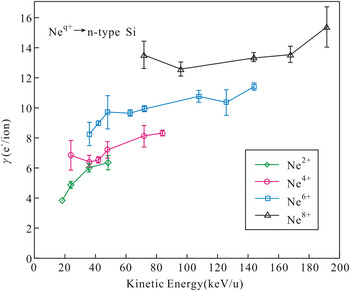
Figure 2 represents total electron yield as a function of projectile kinetic energy for Neq+(q = 2, 4, 6, 8) impact on n-type Si in the normal incident case results show that the total electron yield increases as the projectile kinetic energy and charge state q increase.
(Color online) Total electron yield as a function of projectile kinetic energy for Neq+(q = 2, 4, 6, 8) impact on n-type Si in the normal incident case.

Total yield γ is divided into two parts, one is kinetic electron yield γKE , and the other is potential electron yield γPE. γKE almost vanishes at velocities v below “classical” KE threshold velocity v th (Baragiola et al., Reference Baragiola, Alonso and Oliva Florio1979). When v > v th, there is an approximate linear relationship between γKE and v th (Hughes et al., Reference Hughes, Burgdörfer, Folkerts, Havener, Overbury, Robinson, Zehner, Zeijlmans Van Emmichoven and Meyer1993; Vana et al., Reference Vana, Kurz, Winter and Aumayr1995):

where Θ (v − v th )is a step function starting at the KE threshold velocity v th. According to Baragiola et al. (Reference Baragiola, Alonso and Oliva Florio1979),

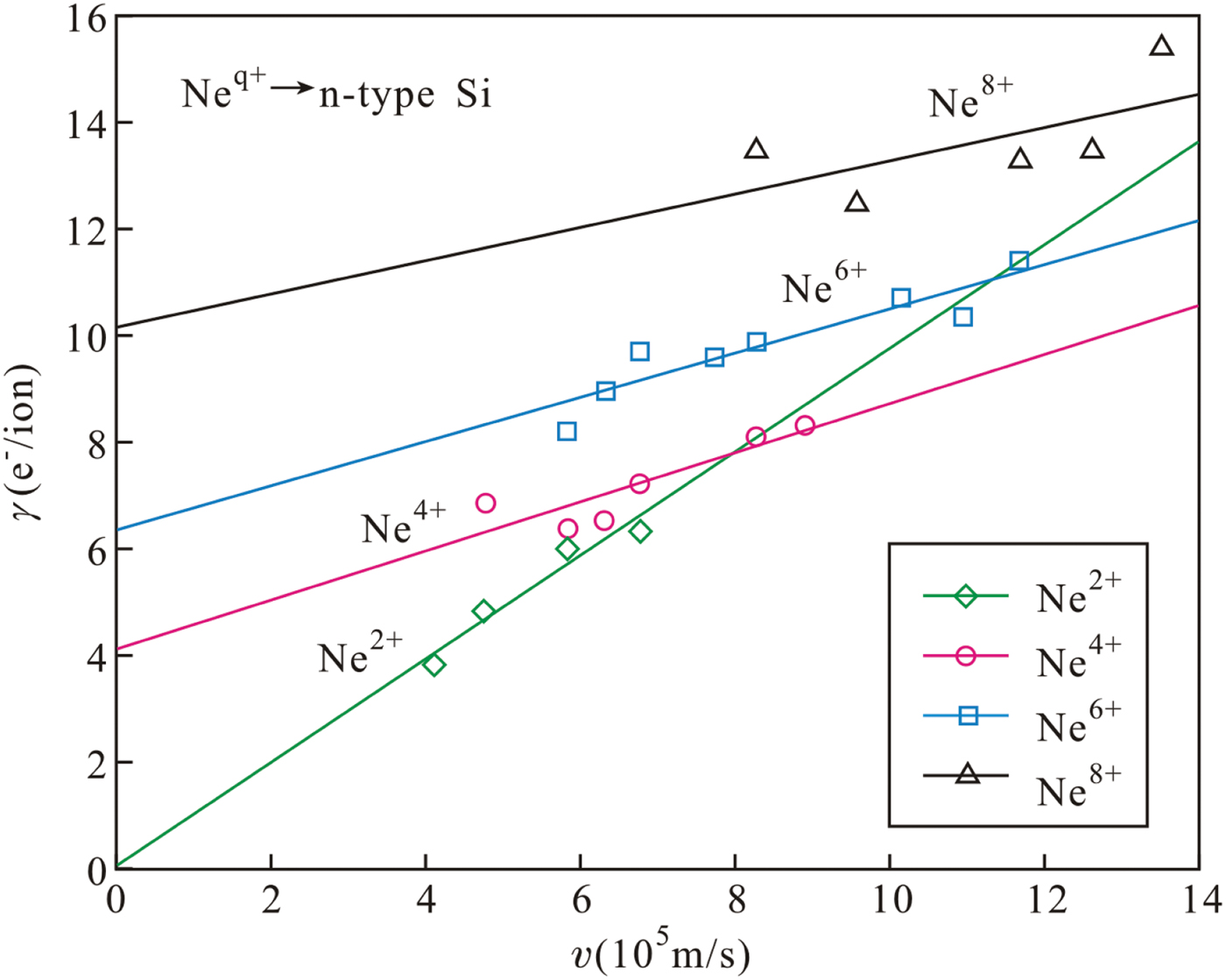
where W φ = 4.85 eV, E F = 12.43 eV for the target n-type Si (Michaelson, Reference Michaelson1977), then we get that νth = 1.87 × 10⁵ m/s. In Figure 3, total electron yield as a function of v is shown with a linear least-squares fit to the data. The fit variance is 0.6%, 7.3%, 4.8%, and 8.2% for q = 2,4,6,8, respectively.
(Color online) Total electron yield as a function of projectile velocity, the solid lines are linear least-squares fits to the experiment data points.

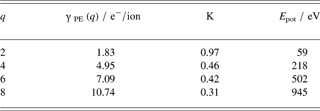
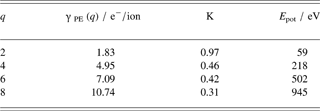
If subtracting the potential yield γPE from the total electron yield γ, we will get the kinetic electron yield which will be equal to zero when v = v th (Baragiola, Reference Baragiola1994). Therefore when v = v th, the potential electron yield γPE, listed in Table 1, is equal to the total electron yield γ.
Potential electron yield, k and E pot for various q
Potential electron yield consists of two parts, one is inversely proportional to  and the other is a velocity-independent value γ∞ (Kurz et al., Reference Kurz, Aumayr, Lemell, Töglhofer and Winter1993, Reference Kurz, Töglhofer, Winter and Aumayr1992).

where c 1 is a constant. Kinetic electron emission does not yield more than 0.5 electron/ion at projectile velocity ν below 2 × 10⁵m/s (Lakits et al., Reference Lakits, Aumayr, Heim and Winter1990; Winter et al., Reference Winter, Aumayr and Lakits1991). Electron emission measurement for impact of projectile with ν between 1 × 10⁴ m/s and 1.5 × 10⁵ m/s by Kurz et al. (Reference Kurz, Aumayr, Lemell, Töglhofer and Winter1993, Reference Kurz, Töglhofer, Winter and Aumayr1992) proposes that yield (almost potential electron) first decrease gradually and then level off towards γ∞. We therefore assume that the first term of Eq. (6) is negligible small for evolution of γPE when v even higher than v th thus yield

Through linear fitting the data of γPE and q in Table 1, the relation between γPE and q can be shown by Eq. (8), the fit variance is 0.2%.

That means the potential electron yield γPE is proportional to ion charged state and γPE is independent of the projectile velocity. The linear increase of the contributions γ∞ with q is agreement with the arguments put forward by Stöckl et al. (Reference Stöckl, Suta, Ditroi, Winter and Aumayr2004) and Kurz et al. (Reference Kurz, Töglhofer, Winter and Aumayr1992) for Arq+-Xeq+-Hgq+ impacting on Au-LiF-CaF2. All these processes require a minimum potential energy of at least twice the binding energy W ϕ of the highest occupied state of the solid. The maximum possible number of electrons n max emitted via PE is therefore given by (Stöckl et al., Reference Stöckl, Suta, Ditroi, Winter and Aumayr2004)

where the E pot is the potential energy of projectile, which is listed in Table 1 for q = 2, 4, 6, 8, respectively.
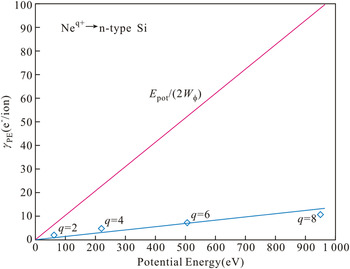
In Figure 4, the potential electron yield γPE is compared to maximum possible number of electrons n max, result shows that γPE is much smaller than n max, i.e., not all of the potential energy is used for electron emission. The result is sharp contrast to the result of grazing impact of multiply charged Ar Ions on a LiF(001) surface (Stöckl et al., Reference Stöckl, Suta, Ditroi, Winter and Aumayr2004) which shows that a practically all of the available potential energy is used for electron emission during grazing scattering. However, in case of normal impact, our result is consistent with Vana et al. (Reference Vana, Kurz, Winter and Aumayr1995). Part of the potential energy can be used to emit electron because of non-complete deexcitation and incomplete neutralization. It is found in our experiment that, the fraction of potential energy which is used for electron emission is about 30%, 21%, 14%, 11% for q = 2, 4, 6, 8, respectively, and the projectile velocity almost does not affect the potential electron yield.
(Color online) Pure potential electron emission contribution as a function of available potential energy compared to model predictions under normal impact

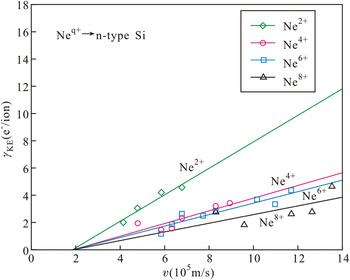
In Figure 3, shifting down the yield-velocity curves for each q and making them intersect exactly at threshold velocity v th, we get the kinetic electron yield γKE curves as a function of velocity in Fig.5.
In Figure 5, the results show that γKE increases linearly with projectile velocity and γKE is smaller for higher charge state at the same impact velocity. Meanwhile, both Figure 5 and Table 1 show that the value of k in Eq. (4) is tends to be smaller when q increases, i.e., charge state can restrain kinetic electron emission (KEE). Similar results were obtained in the experiment of impacting Neq+ on Au surface by Vana et al. (Reference Vana, Kurz, Winter and Aumayr1995). Our results are not contradictory with the conclusion (Baragiola et al., Reference Baragiola, Alonso and Oliva Florio1979; Schou, Reference Schou1980) that the higher the observed energy loss, the higher will be the kinetic electron yield, due to electron vacancies occurring on the solid surface for neutralization during the approach of the ion to the surface. Higher charge state of projectile can induce more such vacancies, thus there may be many holes at the same site. On the one hand, the holes can reduce the collision velocity of projectile and decrease the energy loss of projectile interacting with surface consequently. On the other hand, because of potential barrier of holes acting on electron, the escape capability of kinetic emission electron decreases. Due to these two reasons, the kinetic electron emission decreases with the increasing of charge state, which can be used to explain “trampoline effect” (Wirtz et al., Reference Wirtz, Reinhold, Lemell and Burgdörfer2003; Briand et al., Reference Briand, Thuriez, Giardino, Borsoni, Froment, Eddrief and Sebenne1996). For slow projectiles and normal incidence, the ionic motion depends sensitively on the interplay between image acceleration toward the surface and repulsion by an ensemble of positive holes charges in the surface. The repulsive interaction between the holes and the projectile can become stronger than the attractive self-image force and eventually lead to the backscattering of a still multiply charged ion high above the surface without touching it.
(Color online) The kinetic electron yield γKE for impact of Neq+(q = 2, 4, 6, 8) on Si surface, through deducing γPE in Figure 3.

So we can express kinetic electron yield as the sum of two parts, one is relevant with charge state and the other is independent of the charge state.

Where the γKE0 is the kinetic electron yield for neutral projectile, F(q) is a function of q to be named Charge Restrain Factor (CRF), obviously F(0) = 0. Figure 5 shows that the kinetic electron yield is proportional to projectile velocity, so the relation between change state q and projectile velocity v can be used to reflect the relation between change state q and kinetic electron yield γKE. If we assume that there are relatively stable holes on the surface, the repulsive force the holes act on the projectile and projectile velocity are along the normal direction of the surface and there are only single holes interact with projectile, the repulsive force can be given by
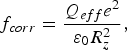
where ɛ0 is the permittivity of vacuum, R z is the distance between projectile and solid surface, and Q eff is the effective charge of projectile while interacting with holes, which is an R z-related parameter and decreases with decreasing R z. The potential electron emission induced by incoming ions, that is the incoming ions capture electrons and lose their positive charges, occurs when R z reaches a critical distance z c, depending on the charge state q of incident ions and the work function of target ϕ.

Assuming the charges carried with incident ions are released completely when R z reaches z f and proportional to R z ranging from z c to z f. Thus Q eff can be given by

We only consider kinetic energy change caused by f corr, because the kinetic energy loss in other ways is not caused by holes directly, then


where M P is projectile mass, m u is nucleon mass, Z P is atomic number of projectile. The reduction of kinetic electron yield caused by charge state can be given by

Then

where βq is a parameter and is independent of the charge state q. From Eq. (17), we can easily conclude that F(q) as a function of q increases with the charge state q. Meanwhile, at the same state, the larger of the atomic number of projectile Z P, the harder for the charge state to improve the projectile velocity, so F(q) is inversely proportional to Z P. Finally, the smaller of z c, the longer of projectile stays in high charge state, so the larger repulsive force the holes act on projectile, this is consist with that F(q) becomes larger with the decrease of z c. In conclusion, the expression of F(q) in Eq. (17) is reasonable. Then the γKE is given by

The relation between γKE and q is given successfully. From Eq. (18), it can be easily found that if the second term in the right side is big enough, γKE will be smaller than zero. This case is called “trampoline effect”, and the critical condition for trampoline effect is γKE = 0.
4. CONCLUSION
Experimental results of impacting Neq+(q = 2, 4, 6, 8) on Si at normal incidence are reported and electron emission yield has been discussed systematically. The results show that the potential electron yield γPE is proportional to ion charge state and γPE is independent of the projectile velocity, where the fit variance is 0.2%. The kinetic electron yieldγKE increases linearly with projectile velocity. Meanwhile, we find charge state can restrain kinetic electron emission. Finally, we give the expression of the “CRF” F(q) based on “single-hole without hopping” hypothesis. And the relation between γKE and q is given successfully, which is also a basis for judging whether “trampoline effect” exists.
ACKNOWLEDGMENTS
Helpful contributions from Professor Dieter H.H Hoffmann are sincerely acknowledged. We also acknowledge technical support from the group of the 320 kV HCI platform at IMP-Lanzhou. This work was supported by the NSFC project in China (Grant Nos.11075125, 11075135, 11075192) and partially supported by the WTZ project (Grant No. 1390).