Introduction
For many years the study of agricultural growth was dominated by the analysis of inputs and outputs. Land, capital and labour were seen as the parameters for analysis of the agronomic process. More recently, new approaches to the field have uncovered a fourth production factor, which is knowledge (Uekötter, Reference Uekötter2010). Cognitive aspects were explored as one of the drivers of agricultural modernisation, and theoretical contributions stressed the importance of institutions that stimulate the use and transfer of knowledge (Mokyr, Reference Mokyr2004; Reference Mokyr2016). For example, accounting systems at the level of an individual firm have been the subject of recent research (Giraudeau, Reference Giraudeau2017; Lampe and Sharp, Reference Lampe and Sharp2017). Institutes of knowledge-based growth are being studied on the basis of, for example, educational facilities (Vivier, Reference Vivier2008) and agronomists and extension services (Flückiger, Reference Flückiger, Moser and Varley2013). Put simply, these contributions situate the production and use of agricultural knowledge in the rural realm. However, the Industrial Revolution influenced the agricultural domain through its transfer of technological, chemical and managerial knowledge. Agrarian and industrial atmospheres became intertwined in an agrarian-industrial knowledge society (Auderset, Bächi and Moser, Reference Auderset, Bächi, Moser, Brodbeck, Ineichen and Schibli2012). This concept refers to an epistemic community of agronomists, farmers, labourers, journalists, scientists, etc., which, in a complex and multifaceted communication process, aggregated ‘agrarian’ and ‘industrial’ ways of thinking and working from the 1850s to the 1950s. Starting from these conceptual considerations, and with the goal of broadening historiography on rural knowledge, this article investigates the interaction between farmers and industrial entrepreneurs in their collective efforts for knowledge-based growth.
The Dutch-Frisian dairy sector is a suitable case study for the further exploration of the agrarian-industrial knowledge society. Farmers and dairy companies in Friesland developed a system for knowledge-based growth from the end of the nineteenth century, which was quite early. Friesland was not the only region to develop such a system. But in a national as well as in an international perspective (Ashton, Reference Ashton1956) the pervasive nature of this system is remarkable. Our comparison between Friesland and the other Dutch provinces reveals considerable differences between regions. We will scrutinise the system that provided knowledge about the components of milk from 1895. The introduction of artificial insemination (AI) around 1950 marks the end year of our analysis. This technique enabled breeders to use the semen of one bull to fertilise a much larger number of cows. AI changed the rules of the game fundamentally and requires a study of its own.
Between 1895 and about 1950, the Frisians succeeded in increasing the fat percentages considerably. Other regions followed: it is only at a later date that the state intervened here, in order to achieve what civil society was not achieving spontaneously. This difference underscores the importance of non-state actors in progressive dairy regions – an aspect that connects to recent contribution in the historiography of agricultural development (Beltrán, Reference Beltrán2012). Why was Friesland different? How and why occurred progress here suddenly, while other regions lagged behind? Which differences were crucial in fostering productivity change and which were not? These questions shall be answered by examining the cooperation between farmers, intermediary organisations, and dairy companies.
Several sub-questions help us to approach this central question. First, we discuss the use of dairy knowledge around 1900 in general, and present the Dutch-Frisian case in more detail. Next, we present regional data gathered from dairy company reports, among other sources, and answer the sub-questions: when, where and how much did the fat content of milk in the Netherlands change after 1895? In the third section, we explore the influence of dairy factories on the strategic use of information regarding fat percentages. In the fourth section, we look at how farmers in the progressive areas managed to increase the physical productivity of cows. How did the institutions and modes of work change? Inspired by ideas on ‘induced institutional change’ (Ruttan and Hayami, Reference Ruttan and Hayami1984) we examine the behaviour of people, which reveals the changes in farm management, corporations and organisations. In the fifth and last section, we draw some conclusions from our regional and comparative perspective.
1. Useful dairy knowledge around 1900
The biological innovation of cows started several decades before the industrialisation of the dairy sector. Orland (Reference Orland, Schrepfer and Scranton2003) explored practices of agricultural modernisation from the late eighteenth century onwards. She scrutinised the practices of ‘producing’ high-yielding cows, a process that was driven by ‘a new culture of competition, measurement, selection, and predictability’ (Orland, Reference Orland, Schrepfer and Scranton2003: 169). After the introduction of cream separator machines in 1879 the dairy sector became industrialised, resulting in a new phase within this competitive culture. Research on the Danish dairy industry analysed the impact of new technologies, and illustrated the importance of new institutions such as cooperatives (Henriksen, McLaughlin and Sharp, Reference Henriksen, McLaughlin and Sharp2015; Lampe and Sharp, Reference Lampe and Sharp2017). The production and dissemination of knowledge about cows, and the biological aspects that could result in the quantitative and qualitative advancement of milk, became institutionalised too (Mahlerwein, Reference Mahlerwein2016: 142–6). Universities, schools and consultants, among others, were mediators between biological theories and agricultural practices. A recent article from Hernández Adell and Pujol-Andreu (Reference Hernández Adell and Pujol-Andreu2016: 194–7) provides a useful overview of innovation in dairy cow breeds in Central and Northern Europe. Farmers as well as specialists embraced the instrument of inbreeding instead of systematic and large-scale experimentations, which were seen as unrealistic: ‘animals were expensive, costly to maintain and slow to produce offspring’ (Hernández Adell and Pujol-Andreu, Reference Hernández Adell and Pujol-Andreu2016: 194). Herd book societies played a pivotal role in improving the process of inbreeding. Registration and the collection of data became a crucial tool, which delivered an evidence-based way of producing better cows.
How does this general picture relate to the Dutch-Frisian dairy sector? Before 1880, milk production in the Netherlands was high and often took place on specialised farms. In the classical dairying areas of the Netherlands there had been a slow process of rule of thumb selection of good milk cows for centuries, which had led to a breed of Frisian/Holland milk cows with remarkably high yields of milk. As a consequence of high total production, consumption of milk and dairy was extremely high too (Knibbe, Reference Knibbe2007). The cows in the dairy provinces of Holland and Friesland were especially known as excellent producers (Bieleman, Reference Bieleman, Segers, Bieleman and Buyst2009). After 1880, dairy production in the Netherlands started to move from farms to factories. This process began in the highly specialised clay soil dairy areas in North Holland and Friesland. After 1893, small-scale technology became available and less specialised areas in the south and east of the Netherlands rapidly followed.
Especially for butter factories, milkfat was the most important constituent of the milk. To prevent farmers from diluting the milk but also to ensure a fair pricing system – as fat percentages differed from one farm to another – factories started to estimate fat (Knibbe, Reference Knibbe1993: 140–9). The most important driver of milk measurement systems, however, was the urgency to improve the quality of butter. Production and exports of margarine threatened the market position of Frisian ‘real’ butter. Moreover, in the 1890s Danish high quality butter took over the leading position of the Dutch and Frisians on the English market (Molema, Reference Molema2017: 99–100). Frisians were well aware of this, moreover because the English market was fundamental to their commercial success in the eighteenth and nineteenth centuries. Study visits to Scandinavia were organised, where Frisian farmers and farmers’ sons saw how systematic measurement and quality control systems drove the success of their competitors. Diversity in the condition of butter was now seen as a problem, and the solution was partly seen in the foundation of a Frisian control station by the Frisian Society of Agriculture in 1901. Milk, as raw material, should be improved as well in order to enhance productivity and quality. Apart from the control stations, which were supervised by the state in 1904, government policies on food were modest. It would take to the end of the 1920s before the Dutch government started to control the quality of milk used in factories and direct consumption (Veraart, Reference Veraart and Lintsen2018). However, the whole process surrounding these policies and its effectivity is not clear yet, since the Netherlands misses a study comparable to that of Atkins (Reference Atkins2010) for Britain.
Dairy factories took the lead in producing a more uniform product. The first companies were exploited by private entrepreneurs. After 1886 cooperatives rapidly took hold and even started to dominate the scene during the twentieth century, except for the consumption milk areas in Holland and in the Gouda cheese district (Van Zanden, Reference Zanden1986). Despite the advantages of dairy factories, their establishment took some persuasion. Experts, teachers and even owners of private factories gave lectures in the local tavern to explain the advantages of mechanised production to local farmers. These gatherings often led to the establishment of a cooperative society and the raising of seed capital from the available farmers (Wiersma, Reference Wiersma1959). It is remarkable how often, just as in the case of cooperative banks, a local schoolteacher or notary stepped in to provide some help with more complicated legal or economic administration. Members as well as managers of the dairy factories soon became aware of the compelling economies of scale of factory production, while ever more modern machines became available. In 1898, more than hundred dairy companies were already founded in Friesland.Footnote 1External developments also contributed to the increase of scale. Transporting milk to the factory was one of the main bottlenecks of early factory production. The rapid improvement of the road system, which on the local level was often strongly stimulated and even financed by these dairy factories, which contributed to the centralisation of dairy production (Oosterwijk, Reference Oosterwijk1989). Yearly reports of cooperative factories contain a lot of information on the price and quantity but, tellingly, also the quality of milk. Prices were important, but so was quality.Footnote 2
Dairying was not the only thing to change. Farm management was altered, too. In 1907, a cooperative dairy factory in Achlum, Friesland used modern fermentation tests to obtain per farm information on the bacterial quality of milk. It appeared that (bad) quality was mostly farm specific. After additional on-farm investigation it turned out that low-quality milk often came from farms where old-fashioned wooden buckets were used. This led to an advice ‘which could not be ignored’ to replace these buckets with seamless metal buckets.Footnote 3 One year later, the members of the cooperation voted for a 0.1 cent or about 5 per cent milk price fine for farmers who still supplied low quality milk. Significantly, such actions might have become necessary because of the growth of factory production itself. In his prizewinning treatise on the influence of dairy factories on Frisian agriculture, J. M. Dijkstra explicitly states that the shift of farm dairy production (which requires very high standards of hygiene) to factories led to a slow process of deteriorating hygiene standards on farms (Dijkstra, Reference Dijkstra1934: 145–51). This process foreshadowed responses in the form of modern supply chain management, which not just integrates companies in the supply chain by market prices and contracts but also by more direct means of control.
Changes were not restricted to production of dairy and milk. Farmers also managed, in cooperation with herd books, agricultural extension services, dairy factories and milk control societies, to ‘improve’ their cows (Theunissen, Reference Theunissen2008). Yields as well as fat content of milk increased. The yearly reports of, again, the cooperative dairy factory in Achlum enable us to calculate modern economic growth. In 1914, the forty-five best cows yielded on average 5.780 kgs of milk with a fat content of 3.5 per cent. In 1957 this had increased to 6.550 kgs of milk with 4.3 per cent of fat.Footnote 4 This means an increase of 40 per cent of total production of fat per cow and about 10 per cent of production of solids (fat, protein, lactose) per kg. Around 1910, Frisian/Holland cows were assumed to be milk cows par excellence (Theunissen, Reference Theunissen2008). This means that the 1914 Achlum cows were ‘the cream of the crop’ – and even these could rapidly be improved.
2. Increasing fat percentages
The basic variable that farmers tried to influence was fat content of milk, that is, the percentage of fat in one litre of milk. We have to make a distinction between three aspects: total milk yield, total yield of butterfat, and the percentage of fat. The percentage of fat in milk differs between cows and is highly heritable, which was also known at the time (Politiek, Reference Politiek1957: see especially his list of references). Remarkably, the influence of feed on fat content is limited. Based on data-collection in Friesland, an agricultural expert stated in 1956 that an increase in the level of feeding raises the milk yield, but it had ‘no effect on butterfat percentage’ (El-Shimy, Reference El-Shimy1956: 54). And while citing studies with the same results, dating back to 1904, he concluded: ‘This gives another evidence that fat % is more governed by heredity’ (ibidem).
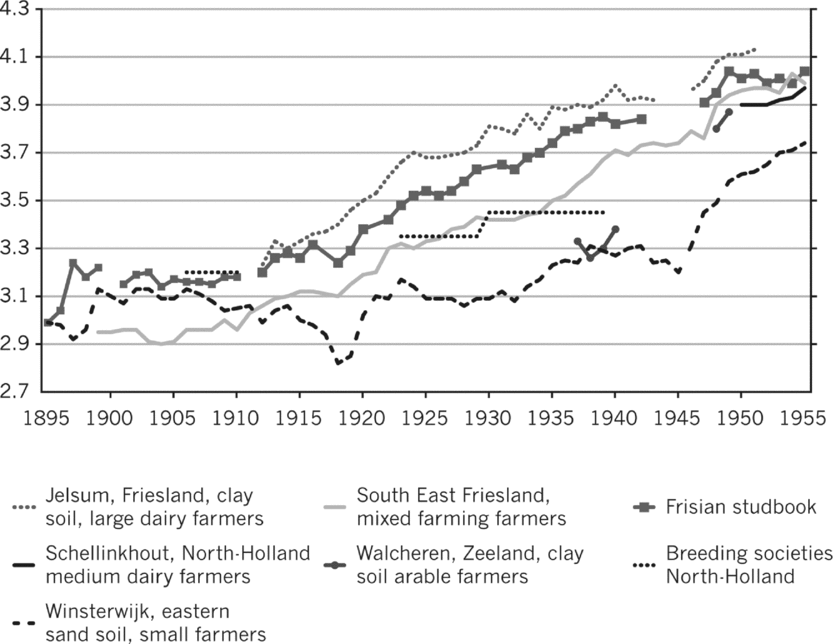
The lack of a significant relation between feed and fat is also clear from data covering 1914–18. During the First World War, milk yield per cow declined considerably because of feeding problems, but fat content again hardly changed (Knibbe, Reference Knibbe1993). Our data of individual factories (Figure 1) shows the same pattern: average fat content of four factories fell from 3.2 per cent in 1914 to 3.14 per cent in 1918. In the Second World War the studbook data show a hiatus, but average fat content for two factories dropped from 3.49 to 3.47 per cent, while yields dropped considerably (Knibbe, Reference Knibbe1998). Modern research, however, shows that feeding cows with saturated fats (mainly animal fats) can increase fat content by up to 0.3 per cent (Hoefman, Reference Hoefman2017). But in the period under consideration it was highly uncommon to use animal fats in the feed of cows.
Regional percentages of fat contents in the milk of cows.

This does not mean that fat content per individual cow did not change. As was well known at the time, fat content of milk falls after the first days of a lactation period, and gradually increases thereafter (Politiek, Reference Politiek1957: 28). Other individual and circumstantial elements also play a role. When a cow is milked, the first pint has a much lower fat content than the last pint. With regard to our data, such changes averaged out as the data are mainly yearly averages calculated by average data from the two-weekly milk estimates. Remarkably, even in years with a severe outbreak of foot-and-mouth disease (1912, 1921, 1937 and 1938), fat content did not change. Farm management aimed at productive cows yielded considerable results.
Except for the data of Frisian Studbook, which was administered by the Frisian Cattle Herd Book Society, the data on fat percentages (Figure 1) were based on measurements of milk delivered to factories. Typically, every delivery of milk to the factory was sampled and tested in the factory laboratory, which ensured that measurements were accurate. In the long run, the regional differences in cattle farming and dairying disappeared in the Netherlands. However, around 1880 large differences between regions still existed. Regional paths to the quite homogenous situation of the present were quite different, surely when we look at innovative behaviour. Around 1811, extensive parts of North Holland, South Holland, as well as of Friesland were characterised by a high density of cows per hectare as well as by relatively large and specialised dairy farms (Bieleman, Reference Bieleman2002). This specialisation was enabled by large imports of grains that dated back many centuries, arable production was absent in these areas. Around 1850 a breed of cows with high yields of milk with a relatively low fat content had evolved in this area.
After 1880, especially, North Holland and Friesland took the lead in improving the breed. Dairy producers took a great advantage in rising fat percentages, because it enabled them to make more and better butter, as well as low- and medium-fat cheese. The area around and above Gouda, where many farmers produced full-fat cheese, did not take part as a higher fat content of milk was detrimental to the quality of their cheeses. On the sand soils of the west and east, small farmers with just a few cows produced lower-grade butter. Once the technique of hand-powered mechanical decreaming became available, these farmers would eagerly jump on the mechanisation bandwagon. The input side of their farms became more capital intensive through the use of concentrates. After around 1890, cooperative banks and cooperative purchasing societies spread like wildfire in these regions (Knibbe, Reference Knibbe1993). However, this article will show that it took decades before they started to improve their breed of cows.
Figure 1 shows the regional development of fat content of milk in the Netherlands, and reveals increasing regional disparities and remarkable historical discontinuities. After about 1910, large and specialised dairy farmers managed a fast and large increase of fat content. This becomes evident from three Frisian companies (in Marssum, Jelsum and Achlum); a dairy company in the province of North Holland (Schellinkhout), as well as the data from Frisian studbook cows and breeding societies in North Holland. But fat content of milk delivered to the ‘Winterswijk’ factory by small dairy farmers from the eastern sand soils, lagged for decades. One notices that these dairy farmers on the sandy soils often had three to five milk cows – contrary to the fifteen or twenty-five of the Frisian and North Holland farmers. Stocks of cattle from dairy farmers on the south-eastern Frisian sandy soils were modest too. These farmers delivered their milk to factories that merged, eventually, into the Zuid-Oosthoek company. Fat percentages on the Zuid-Oosthoek also lagged behind, but for a much shorter time.
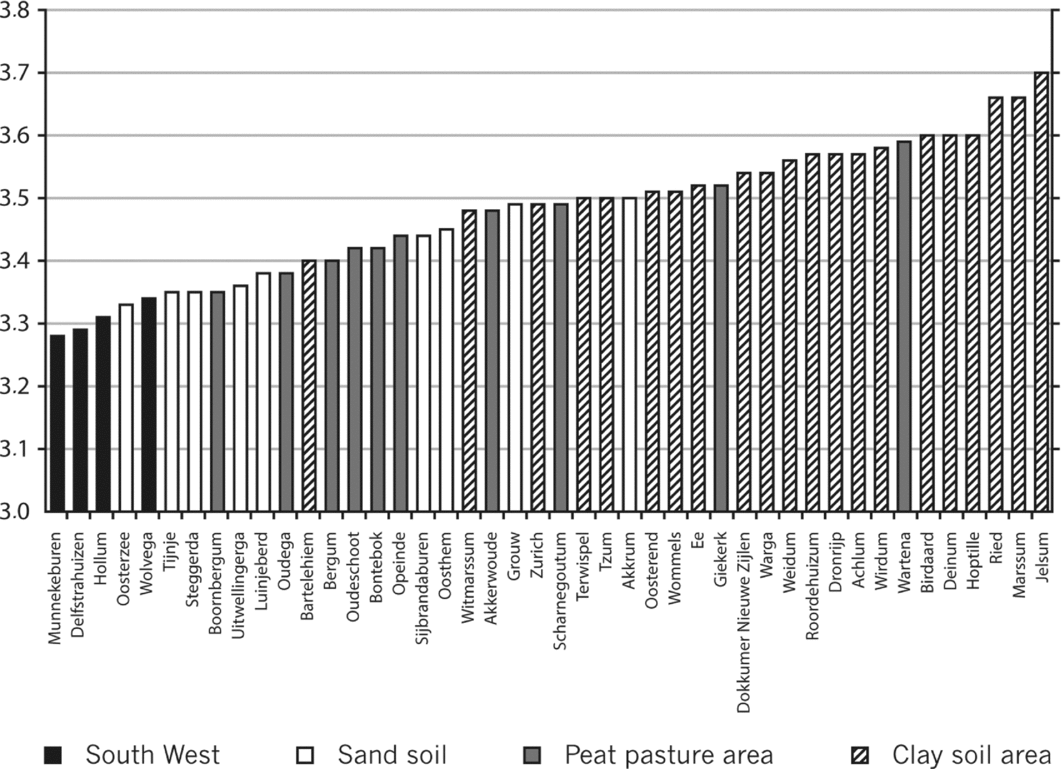
Are the data in Figure 1 representative? Figure 2 shows data from all cooperative factories in Friesland in 1934.Footnote 5 Factories with the lowest fat content concentrated in the outer, often badly drained south-west of Friesland. The six factories with highest fat content were all located in the ‘classical’ clay soil dairy area, just like most of the other factories with high-fat milk. The factories in between were from either the eastern sandy soils or the Fens in the middle of the province. As we can see, the data tally well with the time series of Figure 1. It is remarkable that even the factories with milk with the lowest fat content in Friesland had higher percentages than the factories of Winterswijk and Walcheren.
Fat percentages from forty-four factories in Friesland, 1934.

To summarise, from about 1900, specialised farmers using modern methods of management, organisation and measurement, managed to increase fat content of their animals. Despite this example and the existence of factories in these areas, smaller farmers in less specialised areas lagged, sometimes for several decades. Although it is beyond the scope of this article, it has to be noticed that the rise of fat percentages stagnated after about 1950 and Frisians lost their lead to farmers from North Holland. Why was this? Relations between biological innovation and productivity are complicated, for one thing because of the ‘Red Queen’ problem (Omstead and Rhodes, Reference Omstead and Rhodes2002). This metaphor refers to a personage in Alice in Wonderland, who had to run forward in order to stay in the same place. In a similar way, farmers were forced to breed new cows in order to prevent a decline of productivity caused by the unintended consequences of previous innovations. Use of feedcakes had enabled higher cow densities, which made herds more vulnerable to foot-and-mouth disease and Bovine Tuberculosis. Theunissen (Reference Theunissen2008) analysed the responses of farmers and breeders to these concerns, and stressed that robustness as well as aesthetic criteria became as important as milk yields and fat percentages. Artificial insemination (AI) provided a technology that helped to select excellent bulls with the help of these broader criteria. AI societies in the Netherlands rose from 40 in 1946 to 151 in 1950, while membership rose from 3,600 farmers to 49,000 farmers in 1950 and 79,000 in 1952 (Adrichem Boogaert, Reference Adrichem Boogaert1971). The new cows that were bred from the 1940 onwards became more robust, but after 1955 at the expense of increasing milk yields and fat percentages.
3. Emerging organisations
In the second half of the nineteenth century, agricultural schools were founded in several places of Europe (Vivier, Reference Vivier2008; Harwoord, 2005). Educational institutions had to spread new, scientific knowledge among farmers. In Friesland, a dairy school was opened in 1889 by the Frisian Society of Agriculture and Cattle Breeding (Molema, Reference Molema2016). Milk testing soon became important in the curriculum. However, the diffusion of knowledge about techniques for the improvement of cows was for the greater part stimulated by dairy consultancy. Johannes Mesdag had been the official dairy consultant in Friesland since 1892 and was successor of the first dairy consultant, Karel van der Zande, who had been appointed three years earlier. Both men were appointed by the Frisian Society for Agriculture and Cattle Breeding. Their salaries were subsidised by the provincial government, thus reflecting political ideologies at the time: economic policies should be initiated by entrepreneurs and actors from the civil society, and the state could offer some financial support. Mesdag introduced a systematic way of milk control. His first and preliminary results for fat percentages per cow were discussed in the provincial newspaper.Footnote 6 After these first results, the Frisian Studbook started a larger experiment together with Mesdag, covering the entire stock of cows of a total of nine farms around Marssum. This experiment took place between 1896 (one farmer) and 1899 (eight farmers, one widow farmer stopped). The results were thus convincing that in 1899 farmers of the dairy cooperation in Kimswerd had already established their own ‘cattle control society’, which used such methods to make more purposeful breeding possible (Adrichem Boogaert, Reference Adrichem Boogaert1971: 106).
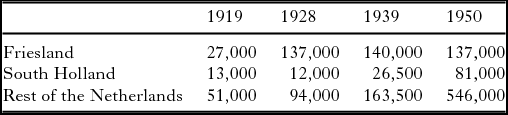
Within decades, production data per cow were known for a clear majority of all Frisian milk cows. As milk was estimated on a bi-weekly basis for about eleven months a year, this meant that every year about three million estimates were made. Table 1 shows the number cows controlled by a milk control society in parts of the Netherlands. It is clear that, especially in the decades before 1930, Friesland took the lead. In 1928 more than half of the controlled cows were in Friesland. Comparing this with the international data of Ashton (Reference Ashton1956) shows that Dutch developments were quite early and, especially, extensive.
Number of cows under the control of milk control societies in the Netherlands.

Source: Adrichem Boogaert (1971: 111–13).
Dairy production shifted to the factory but ‘scientific management’ methods, characterised by repeated detailed measurements of production and productivity, shifted to the farms as well. There were, of course, problems. As late as 1898 the Leeuwarder Courant published an article that stated that farmers in Stiens (a medium-sized village north of Leeuwarden, Friesland) had voted that their cooperative would not pay for milk based on fat content, as they considered the measurement techniques unreliable.Footnote 7 And three years later, in 1901, the Schager Courant ran an article that stated that a dairy advisor in North Holland, Dr Schey, who had been installed in the autumn of 1900, only had had three customers in his first three months of work.Footnote 8 Farmers were highly surprised when a dairy farmer and Dr Schey showed in 1902 that one whey barrel of milk with a high casein and fat content delivered one kg cheese more than a comparable amount of milk with a low content of fat and casein (Van der Wiel, Reference Wiel2011). And the journalist who wrote the piece about Stiens showed that even rather inexperienced students of the dairy school were able to use that fat measurement equipment, with very stable results. Progress was the name of the game and Frisian farmers knew how to play it.
Measurement of fat was not entirely new, nor restricted to large factories. The earliest use of scientific data on fat for management and commercial purposes in the Netherlands we could find was in Arnhem in 1887 (Lankveld, Reference Lankveld2009: 235). The owner of this factory was G. H. Beer, a former army pharmacist. In a leaflet dating from 1887, Beer already stated that farmers had to deliver milk from healthy cows, produced in a hygienic way. Moreover, ‘dry matter . . . had to be at least 11.5% and fat content at least 2.8%’. In 1895 Jan Truijen, a politician and agricultural innovator in the southern province of Limburg, spurred competition among farmers. Daily lists with the amounts and fat content of milk delivered to small-scale dairy companies in Brabant and Limburg inspired a kind of contest between the members of these cooperatives.Footnote 9 The equipment needed to estimate fat content was part of the standard machinery delivered by the producer of the cream centrifuges (Croesen, 1931: 96). Not just fat but also bacterial quality was measured and somewhat later, around 1905, the general quality of milk also became part of the pricing system quite often.
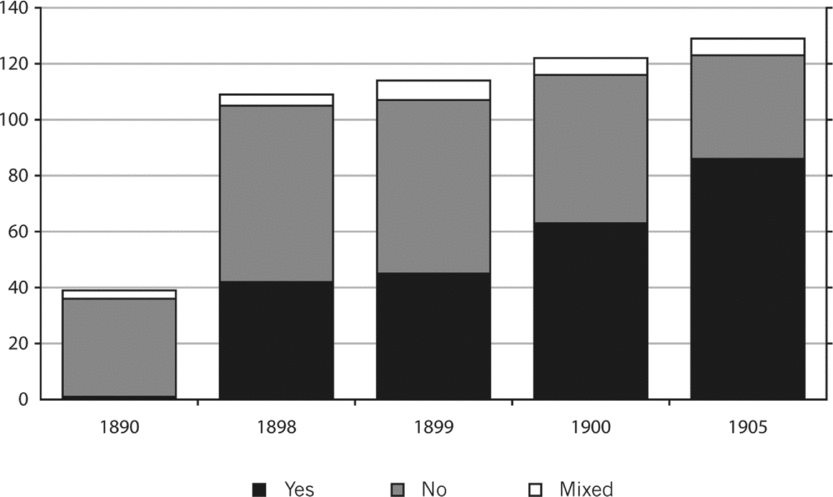
Precise and frequent measurement – the hallmark of the Taylorist ‘scientific management’ systems of the day – was introduced almost overnight into Dutch dairy production. Even thermometers had been seen as a rarity only years before. In 1892, the new, simpler and cheaper Gerber fat measurement method became available, which meant that larger-scale use became possible. Clearly, this opportunity was seized by Frisian farmers and dairy factories (Molema, Reference Molema2017; Zwart, 1960: 218). Data for other provinces are lacking, but in Friesland a rapidly increasing number of dairy factories not only measured fat content of milk deliveries, but also used it as the basis for their pricing system (Figure 3). Factories used fat content for pricing to ensure a ‘just’ system of payment and partly to prevent dilution of milk. Of course, this information provided farmers with an incentive to increase fat content.
Number of dairy factories using fat as their main pricing mechanism.

Increasingly, farmers, especially in the specialised dairy areas in Friesland, started to use detailed information on per cow measurements. They were often stimulated by herd book organisations, like the Frisian Cattle Herd Book Society (founded in 1879). Agricultural teachers, the dairy consultant and (cooperative) factories also started to use systematic information on fat content of milk to enable more purposeful breeding. These endeavours soon turned out to be highly successful: fat content increased fast. This success was not the only example of ‘scientific farm management’. Quality of milk was another, though quantitatively less important, variable (Dijkstra, Reference Dijkstra1934: 57). Fat was measured by employees of either factories or milk control societies. Milk controllers visited farms, generally on a bi-weekly basis, to take milk samples. It did require reasonable numeracy as well as some specialised education if only because people wanted to be able to compare the outcomes, which led to a rapid standardisation of the exact method (Adrichem Bogaert, 1971: 107–09). Thanks to modern measurement, fat content therefore provides us (and, back then, the farmers) with a robust, reasonably precise and significant variable to investigate the success (or otherwise) of efforts to introduce modern measurement into a market-orientated and specialised, but otherwise quite traditional kind of farming.
4. Managing data on the farm
How was the information on per cow measurement used? As stated, the Frisian Cattle Herd Book initiated a larger scale per cow fat measurement experiment in 1896. The data are still available.Footnote 10 Another set of data from a slightly later date contains data on individual cows belonging to the twenty members of the ‘Dairy Control Society Hartwerd’.Footnote 11 The accounts of the progressive Frisian farmer Jan Timmer also survived while publications of the herd book enable us to compare fat content of mothers and daughters of ‘preferred’ bulls from the Frisian Cattle Herd Book. These data enable us to investigate not only if, but also to some extent how, farmers managed to increase fat content. Table 2 shows some statistics of the Marssum and Hartwerd data.
Yields and fat percentages of herds in Marssum and Hartwerd.

Source: Tresoar, Archive of the Frisian Cattle Herd Book, 93.49-371: Results of the tests with regard to estimating fat in Marssum; Tresoar, Archive of the Milkcontrol Society ‘De Verwachting’, Hartwert, 93.24-34: Annual accounts and minutes of the annual meeting.
Both villages were located in the clay soil dairy area of Friesland. These farms were part of the same population of relatively large specialised dairy farms. The somewhat higher milk yield of the Hartwerd cows might be explained by the increasing use of feed cakes.Footnote 12 Farm size as measured by the number of milk cows was normal for this area as well as for dairy areas in North Holland, but quite large in a national perspective (calves and heifers are not included). Average production was quite high but fat content was, as far as we know, not exceptional in any way. The explicit aim of these measurements was to test if fat content of milk had a strong hereditary content, so as to obtain information to improve the breed.
This was possible by simple selection as between-cow variability of fat content was high. The first experiments of Mesdag mentioned above showed surprisingly large differences in fat content of milk of individual cows, ranging between 2.07 per cent and 3.42 per cent, which meant that the ‘best’ cow produced milk that had almost 50 per cent more fat that the milk of the ‘worst’ cow. The Marssum and the Hartwerd data show the same variability. The best cows of the Marssum and Hartwerd farmers produced milk with 3.7 per cent fat. There were, however, also cows with fat percentages of 2.4 and even 2.1 per cent. Aside from such information, the sources also contain valuable information on how farmers used this intelligence.
To explain this, some information on cows is necessary. Older cows (say from four to nine years old) have much higher yields than younger cows, though fat percentages hardly change over the lifetime of a cow. For this reason, the Hartwerd data distinguish between ‘Enter rieren’ (two-year-old cows which had given birth for the first time), ‘Twenter rieren’ (three-year-old cows) and older cows. The society was founded in 1907, which means that this was the first year in which farmers became informed about yields and fat contents of their cows. This must have enabled them in 1907 to select one-year-old calves from mothers with milk with a high fat content. Our data are from 1909 and these calves, which could already have been purposefully selected, would have been twenter rieren in 1909 (the year when the data were assembled). The same holds to a higher degree for young calves, born in 1907. These would have been ‘enter rieren’ in 1909. The original source does not provide data for all 550 cows but only for about 200 ‘productive’ as well as ‘unproductive’ cows, that is, twenter rieren and enter rieren.Footnote 13 These data show that the difference between average fat content of good and bad cows was 0.8 per cent but for enter and twentier rieren only 0.2 per cent. Twenter rieren and enter rieren declined from 0.8 per cent to 0.2 per cent. This is consistent with the idea that information on fat content of milk of mothers was used to select calves from productive cows.
A somewhat comparable test can be performed for the cows from farms around Marssum (all farms were members of the dairy factory). These data not only consist of the bi-weekly measurement of production of milk and fat but also show which cows were kept or sold off.Footnote 14 A total of forty-one cows were sold. A number of thirty-two within this group of forty-one cows had a lower than average fat content for the farm on which they were kept. We can construct a hypothetical binomial distribution assuming that fat content did not influence the decisions of farmers about keeping or selling in any way. If this were true, it would have been probable that sold cows as often had fat yields above average as below average. Now, if thirty-one cows with a yield below the average are acceptable, what is the sampling probability that out of forty-one attempts one will obtain thirty-two ‘heads’ or more? According to the probability tables, this has a 0 per cent chance of occurring (with a z-value of 3.7 per cent). This is consistent with the idea that farmers did use, again right from the start, information on fat content to decide which cows to sell at the end of the season. As dairy companies increasingly used fat content as a basis for the price of milk, farmers of course also had quite an incentive to do this.
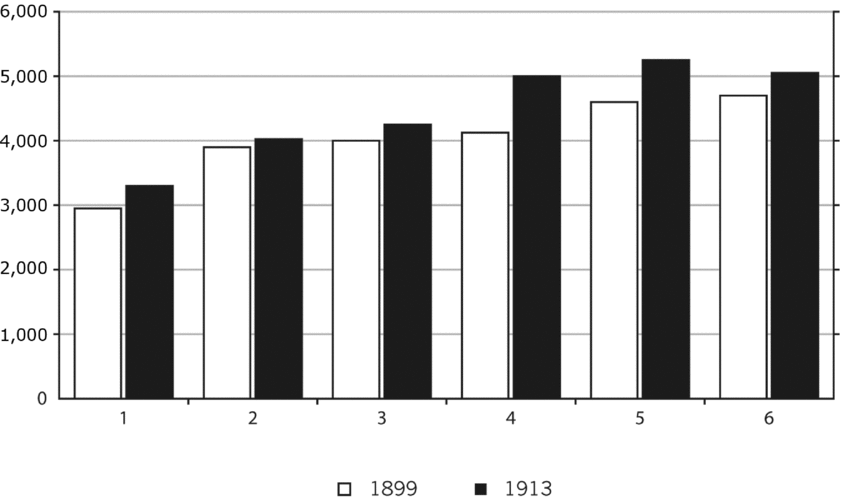
The information above does not show somewhat longer-term information about how an individual farmer (or his widow as in one of the Marssum cases) used ‘scientific management’ data to improve his or her cows. We do have such information for Jan Timmer (1869–1923), who established a milk control society connected to the Kimswerd dairy factory in 1899. His notebooks have been saved and show that, to good avail, he used modern administrative methods and management to improve his animals. Figure 4 shows impressive progress.
Increase of production per lactation on Jan Timmers farm (1899/1913).

The new measurement methods were quickly introduced into Frisian farming but although farmers played an active role. The introduction of these methods was crucially dependent on the availability of outside knowledge and methods. The farmers themselves, however, seem to have had little problems with adapting farm management to these new data. However, fat was not the only important variable and individual farmers and milk control societies were not the only players. At the time it was already remarked that one-dimensional breeding aimed at improving yields encompassed the risk of not improving but weakening the breed. This was also stated in the popular press, but even in the 1909 yearly report of the control society ‘Hartwerd’ we can find a sentence like: ‘the increased amount of milk will take so much more feed from the animal body, that an animal in the end will be less profitable than it superficially seems’.Footnote 15
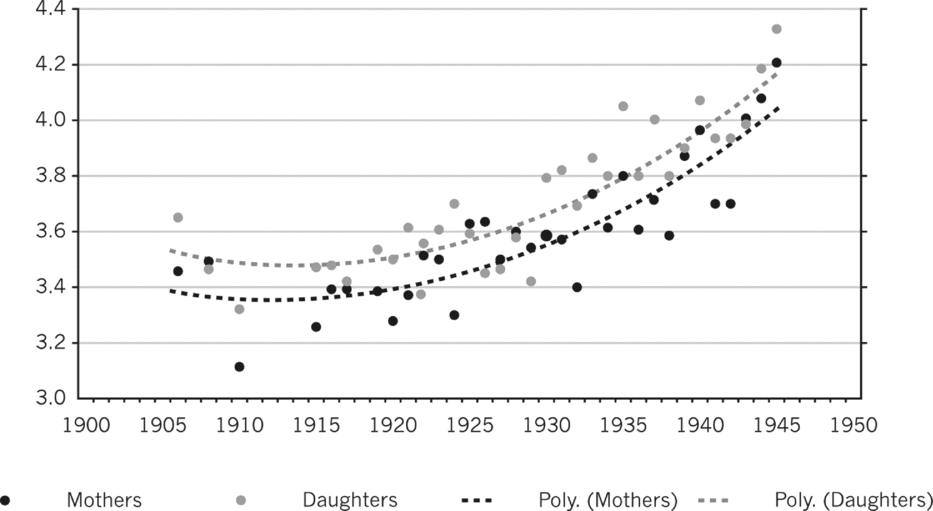
The Frisian Cattle Herd Book Society, which instigated the Marssum experiment, was quick to act upon such ideas. They kept selecting on yield and fat and not without success. Daughters of ‘preferred’ bulls quite consistently yielded milk with a higher fat content than that of their mothers (Figure 5). On the other hand, ‘preferred’ bulls could only reach this status when they also scored high on a whole array of mainly external variables, like their horns, heads, the quality of the udders of their daughters, the rather vague but all important aspect of ‘nobility’ as well as gait, the quality of the coat and so on (Zwart, 1960: 134–51). This system was dynamic as new aspects were added, like ‘milkability’, which estimated how easy it was to milk a cow with a machine (Adrichem Boogaert, Reference Adrichem Boogaert1971: 306). We even see a somewhat belated influence of the long-known Mendelian laws about inherited diseases and characteristics, as it was mentioned that some bulls might have a recessive inheritable disease. Also, some of the more overt insignificant external heritable characteristics, like the presence of small black spots, were excluded. But the basic elements of the system of assessment stayed in place. Fat was far from the only criterion, though Dijkstra states that control societies often had a more singular focus on fat than the studbook (Dijkstra, Reference Dijkstra1934).
Milkfat percentages from mothers and daughters of preferred bulls (1905–45).

5. Regional comparison
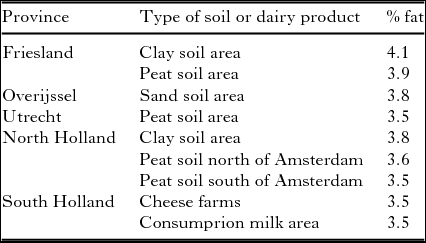
The story thus far seems to be a sterling example of ‘induced institutional change’: Frisian farmers invested in institutions (factories, control societies, herd books, etc.), which enhanced market and non-market coordination and market outcomes. But did other regions fare as well? It was only in the 1930s, when the government took a more active role, that developments outside Friesland and North Holland became more dynamic (Figure 1). A somewhat comparable development can be witnessed when we look at the regional fat content of milk in 1950/51 in the typical dairy districts (Table 3).
Average milkfat percentages for different regions (1950/1951).

Source: Liberg (Reference Liberg1954: 12).
As we can see, as late as 1950 there were still some differences between regions when it came to fat content. Frisian farmers clearly showed to increase fat content, as well as yields. By organising themselves, they were able to use modern technologies to manage breeding. Yet the question is: why did other farmers lag behind? To an extent, incentives played a role, as in the case of cheese and fresh milk farmers. It was only since 1940 that the fresh milk farmers in Holland were paid according to fat content, while the Gouda cheese farmers did not need milk with a high fat content. But that is not the whole story. In many areas the government had to break an organisational gridlock. In 1936, a journal in the province of South Holland published an article about milk quality control around Leiden.Footnote 16 The article stated that, in 1934, only 28 per cent of farmers used seamless metal buckets but that the new government system of milk quality control had increased this to 70 per cent in 1935. Moreover, 140 farmers ran the risk of not being allowed any more to deliver milk for consumption. This was almost three decades after the Achlum farmers disposed of their wooden buckets.
This shows a very visible government hand, yet the Great Depression had forced the Dutch government to subsidise milk prices by no less than 40 per cent.Footnote 17 This explains why the government was able to impose quality controls. However, it remains a mystery why relatively small and cheap, but all-important technological changes such as seamless metal buckets had not been adopted decades earlier by fresh milk farmers. The same can be said for the development of fat content. Increasing fat content required solving coordination and management problems, like establishing control societies and deciding who had to pay for the costs of milk control. In Friesland these problems were solved in the first decade of the twentieth century. But on a national scale it took until 1943 before the government established rules solving these problems, basically shifting the financial burden to consumers of milk. An extreme example is Walcheren, a part of Zeeland in the south-west of the Netherlands. In September and October 1944 the allied forces bombed the coastal levees of Walcheren as German artillery located near these levees disabled allied ships entering Antwerp Harbor. As a consequence, large parts of Walcheren were inundated for over six months to a year, which of course led to the annihilation of cattle. Restocking took place using first-class animals from Holland and Friesland, which explains the sudden rise in fat content (see Figure 1).
However, this leads to the question of why farmers or the Walcheren cooperative factory had not purchased some breeding cattle before. That could easily have been financed by the factory, and might have increased fat content in a few years from 3.2 per cent to 3.6 per cent or so. In 1931, the factory did start to pay according to fat content and this almost overnight increased fat content from around 3.0 to around 3.2 per cent. After that, further progress was stalled. As knowledge about the effect of control societies and the higher fat content of milk from Frisian cows was well known, this stays a mystery. Even in a country whose property rights, language and educational levels were as homogenous as the Netherlands, sometimes ‘civil society’ (farmers, private and cooperative companies, societies, a whole hoard of associations, the local elite) would induce innovation, while in other areas the government had to break the stalemate or even take a leading role in coordinating all the efforts.
Conclusion
Data gathered from farmers, dairy companies, herd books and milk control societies in the Netherlands uncovers notable geographical differences in processes of knowledge-based growth. This article questioned these differences: how can it be that places like Friesland managed to create a culture of knowledge-based growth from the end of the nineteenth century onwards, while in other places this was not the case? Why was Friesland in a Dutch regional perspective different? The answer to these questions starts with the agricultural tradition embedded in this Dutch province. Frisian dairy farmers specialised in the production of butter that was sold on the Dutch and English markets. Butter substitutes like margarine and fierce competition from Denmark provoked a process of innovation. Organisations from the civil society, especially the Frisian Society for Agriculture and Cattle, helped farmers and new dairy factories in their need for more knowledge. They appointed a dairy counsellor who passed technical and organisational knowledge about, among other things, fat measurement techniques. Dairy companies helped to convince farmers of the necessity for milk measurement. On the basis of the pre-industrial dairy sector, a modern industry quickly expanded after 1880. Employees of the companies or milk societies that were founded by farmers themselves, took care of the measurement procedures. In 1900, half of the more than 120 dairy factories paid their farmers on the basis of fat, thus creating a direct incentive for biological selection of cows.
Evidently, the agrarian-industrial knowledge society has interesting regional dimensions. Cooperation between farmers, emerging dairy companies and civil society actors within highly specialised regions is the noteworthy mechanism. In less specialised areas with smaller farms, the government sometimes had to break deadlocks. Further research on the organisation and implementation of milk measurement systems must be recommended. Moreover, other knowledge-based techniques that improved dairy farming during the twentieth century, such as the control of animal diseases, are most probably subject to the same regional differences. Instead of taking uniform and national growth paths, we must be more sensitive to the innovative regions that set the example. Research on the agricultural-industrial knowledge societies also needs a comparative approach, in which the similarities and differences between countries and regions are researched.
Acknowledgements
We would like to thank Roelof Veeningen, volunteer at the Fryske Akademy, for helping us collect the data, Jos Lankveld for sharing his data, and Rik van der Laan for improving the styling of our Figures. We are also grateful to those who commentated on preliminary versions of this article during the annual conference of the N. W. Posthumus Institute, April 2017 in Nijmegen, and the Rural History Conference, Leuven, September 2017. The anonymous reviewers helped to improve the article as well.