A large and growing body of evidence is documenting an increased incidence and severity of a wide range of natural disasters, including infectious disease outbreaks, epidemics, and pandemics (collectively referred to here as bioevents). Caused by emerging, reemerging, and novel pathogens, these result in significant global morbidity and mortality.Reference Jones, Patel and Levy 1 , Reference Morse 2 In the last few decades alone, over 80 bioevents caused by these agents have been identified, including West Nile, Hantavirus, severe acute respiratory syndrome (SARS), pandemic H1N1 influenza (pH1N1), Middle East respiratory syndrome (MERS), chikungunya virus, Ebola, and Zika. 3 , 4 Even measles and other childhood diseases long considered under control are reemerging as threats to public health. 5 The increased occurrence of bioevents is attributed to a wide range of factors including climate change, population growth, low vaccination rates, overuse of antibiotics, encroachment into wildlife habitats, altered ecosystems and vector range, increased global travel, increasing frequency and severity of meteorological natural disasters, and increased migration of human populations due to social unrest. 6 There is also an increasing risk of bioevents related to purposeful or accidental spread of biohazardous, bioengineered, or weaponized pathogens. There are more than 1400 high-level biosafety labs worldwide with the necessary capacity and capability for handling potentially lethal infectious disease agents, an increase of more than 10% in just a 2-year period.Reference Arkin 7
Effective control of lethal bioevents is dependent on the swift mobilization of the public health and health care sectors as well as the cooperation of the general public. For instance, in the early stages of bioevents, before effective vaccines are available, community members may be advised to comply with certain nonpharmacologic countermeasures, as recommended by the World Health Organization and the Centers for Disease Control and Prevention (CDC). 8 , 9 Predicting community members’ response to these measures and understanding the drivers of the response is important for public health planning purposes as this information can shape both policy recommendations and risk communication strategies. The countermeasures include a wide range of behaviors, including increased hand washing and use of sanitizing hand gels, avoidance of close contact with others (shaking hands, hugging, kissing, and sharing food and drinks), increased respiratory etiquette (covering coughs), and social distancing (avoiding crowds and public places). In certain circumstances, the public may be asked to submit to temperature monitoring (eg, at airports), be advised to wear face masks when out in public, or be asked to stay home from school or work if symptoms appear. Occasionally, home isolation or home quarantine is recommended. In the United States, most of these behaviors are largely unfamiliar to the general public.
Adherence with these preventive behaviors may be considered in terms of protective health theories. Relatively new scholarship is attempting to draw parallels between drivers of preventive health behaviors (eg, smoking cessation, weight loss) and the complex set of behaviors required for disaster preparedness. Constructs and variables (eg, risk perception, self-efficacy, outcomes expectancy) that are well defined in various protective health theories are increasingly being applied to help predict disaster preparedness behaviors. Studies thus far, however, have mainly focused on geologic or climatologic disasters and comparable studies focused on bioevents are extremely sparse.
Previous reviews of research exploring behavioral theories with respect to emergency public health measures rarely included studies of US populations (with most focused on Asian populations). Most of the studies assessed in earlier reviews also tended to focus solely on pandemic vaccine uptake.Reference Ejeta, Ardalan and Paton 10 - Reference Bults, Beaujean, Richardus and Voeten 13 The psychosocial factors found influential in prior reviews included perceived susceptibility (risk perception), perceived severity, perceived benefits, and perceived barriers. However, interpretation of the studies previously reviewed was noted to be difficult due to lack of generalizability, small sample sizes, and low response rates. Further, these earlier studies were generally not theory based and highly heterogeneous in terms of their conceptualization. Thus, these earlier reviews served to highlight the gaps in our knowledge regarding the psychosocial factors that influence community adherence to emergency public health measures. The lack of information on the psychosocial influences of adherence in the United States is concerning, as without this information, the development and implementation of effective public health prevention strategies, including risk communication, may be challenging.
In an effort to address this knowledge gap, we conducted a review of adherence studies conducted on US populations to determine the role, if any, of psychosocial factors on adherence. The goal of this review was to identify potentially modifiable risk factors for nonadherence, thereby informing the development of effective risk reduction strategies.
METHODS
Search Strategy and Inclusion Criteria
This review was informed by Preferred Reporting Items for Systematic Reviews and Meta-Analyses (PRISMA) quality guidelines.Reference Moher, Liberati, Tetzlaff and Altman 14 The first step in the review involved a literature search for articles published in the PubMed (National Library of Medicine), Embase (Elsevier), and Web of Science (Thomson Reuters) databases using key words that were linked (“AND,” “OR”), including “infection control,” “influenza,” “prevention and control,” “H1N1,” “human/transmission,” “pandemics/prevention & control,” “health knowledge, attitudes, practice,” “SARS,” “quarantine psychology,” “compliance,” and “health behavior.” The next step was to identify and exclude duplicate articles. Inclusion eligibility criteria were then applied, which included the following: (1) US human sample, (2) published between 2000 and 2015, (3) peer-reviewed with free full text, (4) quantitative design and analyses, (5) reported in English, (6) reported on adherence to at least 2 emergency public health measures, and (7) assessed at least 1 psychosocial construct (with or without providing tests of association). Articles identified from prior reviews and by using the “Similar Article” function in PubMed were also added to the search.
Study Selection
A total of 153 abstracts were assessed for inclusion eligibility. Based on this, 141 articles were excluded and 3 additional articles were identified through forward searching, resulting in 15 articles remaining for full-text review. Of these, 6 were excluded for the following reasons: psychosocial constructs not assessed, study limited to only one behavior (eg, vaccination), sample focused on first-response employees rather than the general public, and review studies (which were ineligible because they were primarily focused on non-US populations or pH1N1 vaccination behaviors). A final total of 9 articles meeting the review criteria were then assessed in terms of emergency public heath behaviors and psychosocial factors potentially influencing adherence.
RESULTS
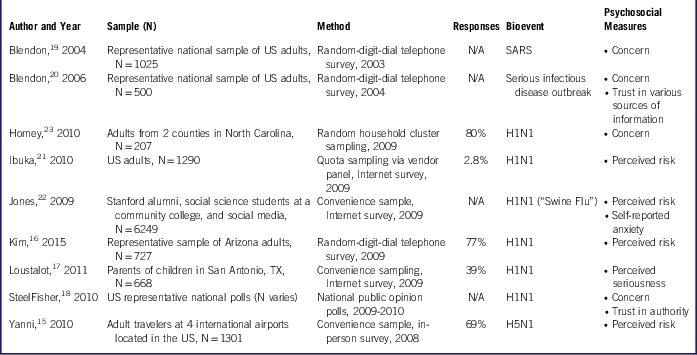
The characteristics of the review articles are summarized in Table 1. Four studies used random-digit-dial sampling to obtain representative samples of US community members. Three used convenience sampling, one used cluster sampling of households, and one used quota sampling via a vendor panel. Response rates ranged from a low of 2.8% to a high of 80%. All used a cross-sectional design, except one; Yanni et alReference Yanni, Marano and Han 15 assessed the behaviors of travelers to Asia using a pre/post design. The studies collected data by use of various modalities, including telephone survey, Internet-based survey, and in-person survey. Two studies assessed “intentions” to adhere, 4 measured actual adherence behaviors, 2 measured both, and 1 study measured attitudes toward adherence. Six studies explored adherence in the context of pandemic influenza (although this was variously referred to as swine flu, novel type A influenza, and pandemic influenza), one study focused on H5N1 (avian influenza), one on SARS, and one on a hypothetical “serious” outbreak.
Characteristics of Reviewed StudiesFootnote a

a Abbreviation: SARS, severe acute respiratory syndrome.
A wide range of behaviors were studied; these were sorted into 2 major categories: (1) self-protective behaviors: increased personal hygiene such as hand washing and use of hand gels, wearing face masks, avoiding close contact with ill people, seeking information and professional advice, taking antiviral pharmaceuticals, social distancing (avoiding crowds and public places), and vaccination and (2) protecting others: staying at home when ill, agreeing to public temperature screening when entering public places such as airports, and adhering to home quarantine or isolation. Note that some adherence behaviors are both self-protective and protective of others, for example, avoidance of hand shaking and vaccination.
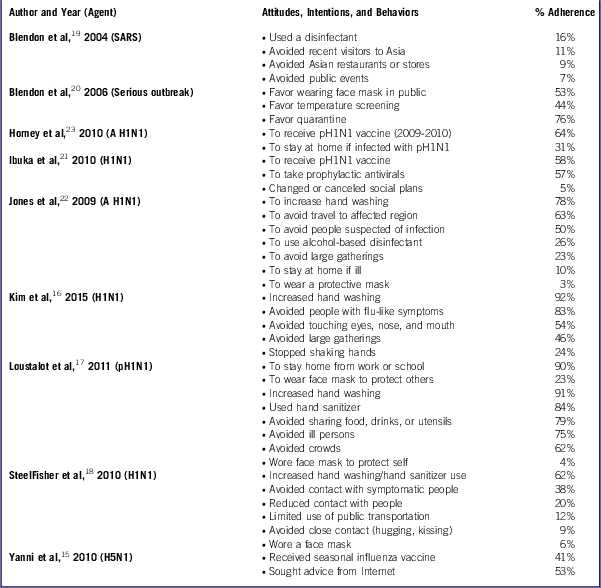
Explicit theoretical models were not tested in any of these studies, and across all studies only the following 4 psychosocial variables (typically measured using a single item) were assessed: perception of risk (perceived likelihood of infection), perceived seriousness, concern regarding infection, and perceived trust (in government officials and other sources of information). While all studies in this review reported on the proportion of the sample that endorsed certain psychosocial variables, several did not provide data on statistical tests of association between these variables and adherence behaviors. Table 2 summarizes the study findings, which are discussed below.
Adherence Attitudes, Intentions, and BehaviorsFootnote a

a Abbreviation: SARS, severe acute respiratory syndrome.
Self-Protective Behaviors and Association With Psychosocial Factors
Self-protective behavior was the focus of several of the studies in this review. In one study, by Kim at al, which surveyed members of the general public living in Arizona during the peak of the 2009 pH1N1 outbreak (pre-vaccine), increased hand washing was commonly reported (92%), as was avoidance of close contact with anyone with flu-like symptoms (83%). Other behaviors were less prevalent; for instance, few respondents avoided shaking hands (24%) or limiting close contact (hugging and kissing) with relatives (14%).Reference Kim, Zhong, Jehn and Walsh 16 The researchers examined the correlation between personal hygiene behaviors and psychosocial factors and found that personally knowing someone who was infected with pH1N1 was positively (albeit weakly) correlated with perceived likelihood of infection transmission (r=0.19, P<0.01), as well as with concern about contagion (r=0.08, P<0.05). Concern, in turn, was correlated with increased hand washing (r =0.13, P<0.01).Reference Kim, Zhong, Jehn and Walsh 16
Personal hygiene was also the focus of a 2011 study by Loustalot et al,Reference Loustalot, Silk and Gaither 17 which was conducted shortly after cases of pH1N1 were identified among students attending a large high school in San Antonio, Texas. Parents of the high school students were surveyed to ascertain household transmission rates and to assess the adoption of nonpharmaceutical interventions to limit spread. Very high rates of hygienic behaviors such as hand washing (91%), use of hand sanitizers (84%), and avoidance of sharing of food, drink, or utensils (79%) were noted. They found that high perceived seriousness of pH1N1 infection was significantly associated with increased handwashing (P<0.01); avoidance of ill persons (P=0.01); avoidance of sharing food, drinks, or utensils (P=0.02); avoidance of crowds (P<0.01); staying at home if ill (P<0.01); and wearing a face mask to protect others (P=0.02).Reference Loustalot, Silk and Gaither 17 Increased hand washing (62%) was also reported in the SteelFisher et al study of national poll data, and similar to the Kim et al study, few respondents stopped shaking hands (12%) or avoided close contact (9%).Reference SteelFisher, Blendon, Bekheit and Lubell 18
Wearing face masks in public, even during a serious bioevent, is not typically recommended in the United States, and the CDC did not recommend this during the 2009-2010 H1N1 outbreak. 24 However, the CDC did recommend the use of face masks (as tolerated) for household members infected with pH1N1 and for people caring for an infected family member. Six studies in this review examined intentions or behaviors regarding wearing face masks during a bioevent, with rates varying from a low of 4% for actually wearing a face maskReference Loustalot, Silk and Gaither 17 to a high of 26% for purchasing (but not wearing) a face mask.Reference Kim, Zhong, Jehn and Walsh 16 While only 4% of the parents in the Loustalot et al study reported wearing a face mask to protect themselves, 23% said they would consider wearing one to protect others.
In the United States, another rarely recommended emergency public health measure is social distancing (eg, avoidance of public places, public transportation and public events). Studies that explored this measure found varying rates of adherence. For example, in the Kim at al study in Arizona, which took place during the height of pH1N1, 46% of respondents reported that they avoided public places.Reference Kim, Zhong, Jehn and Walsh 16 An even higher proportion (62%) of respondents in the study by Loustalot et alReference Loustalot, Silk and Gaither 17 similarly avoided crowds. In contrast, a study examining the dynamics of risk perceptions and precautionary behavior in travelers to Asian countries during the peak of H5N1 found that while 65% of participants thought they were at risk of infection because of their planned travel, only 5% altered their social plans and few avoided poultry markets, rural areas, or large crowds. Interestingly, reports of flu-like illness during or within 7 days of return from Asia was common among this sample; on the post-travel survey (N=337, response rate=56%), 43% of travelers reported at least one flu-like symptom, with 3% meeting the definition of influenza-like illness.Reference Yanni, Marano and Han 15 In the 2010 pH1N1 study by SteelFisher et al, the authors found that 14% of their sample stayed away from malls, 13% limited air travel, 12% limited use of public transportation, 6% reduced attendance at places of worship, and 6% avoided family events, including funerals.Reference SteelFisher, Blendon, Bekheit and Lubell 18
Data on “seeking out information” (a behavior) and “trusted sources” (a psychosocial construct) of information was reported in several studies. In a 2004 report by Blendon et al,Reference Blendon, Benson, DesRoches and Weldon 19 8% of respondents reported that they had consulted a website for information on outbreaks. In the 2006 study by Blendon et al,Reference Blendon, DesRoches, Cetron, Benson, Meinhardt and Pollard 20 a large proportion (78%) indicated that their most trusted source of information regarding a serious bioevent was a health care professional, followed by family member or friend (52%), public health officials (40%), and newspapers/television (27%) (this study did not provide the Internet as an option). In the study by Yanni et al,Reference Yanni, Marano and Han 15 which was conducted in 2008, a sizeable proportion of travelers sought out information on avian influenza on the Internet (53%), most typically a health website or the CDC website, or from their primary care practitioner (50%). Other sources of information included travel medical specialists (20%), friends and relatives (18%), and travel agents (7%). In the Ibuka et alReference Ibuka, Chapman, Meyers, Li and Galvani 21 2010 study on H1N1, respondents reported that they first learned about the pH1N1 pandemic via television (66%), Internet (18%), or radio (8%). The authors also noted that Google search spikes for “pandemic” were noted in April 2009, at the start of the pandemic, although within 2 weeks this dropped to prepandemic levels. Finally, in a study by Jones et al,Reference Jones and Salathe 22 the authors found that participants with high scores on a “protection index” composite score that accounted for all of the precautionary behaviors that they studied were statistically more likely to report obtaining high levels of information from the Internet, television, and health officials, compared to those reporting lower levels on the protection index composite score.
During novel bioevents, new vaccines may become available to the public. Three studies in this review examined intentions to receive a vaccine during pandemic influenza. A study by Horney et alReference Horney, Moore, Davis and MacDonald 23 on intentions to receive the H1N1 vaccine was conducted in the fall 2009 as part of North Carolina’s public health pandemic preparedness planning. They found that a fairly large proportion (64%) of respondents intended to receive the pandemic vaccine when available and that this was significantly associated (P<0.05) with high levels of concern regarding the disease and past receipt of seasonal influenza vaccine. In another study where vaccine was assessed, Ibuka et alReference Ibuka, Chapman, Meyers, Li and Galvani 21 noted that 58% of their sample intended to receive the vaccine and that 57% were willing to use antiviral medication. They also found that as the outbreak unfolded, media reports peaked and then declined (as measured by the authors), and perceived likelihood of infection increased while interest in taking preventive pharmaceuticals declined. In SteelFisher et al’sReference SteelFisher, Blendon, Bekheit and Lubell 18 study of the public’s response to pH1N1, roughly half of the population intended to be vaccinated. In the Yanni et alReference Yanni, Marano and Han 15 study, which was focused on seasonal influenza vaccine and not pH1N1 vaccine, seasonal influenza vaccination was examined in the context of the H5N1 avian influenza virus outbreaks occurring in Asia, and self-reported uptake for the seasonal influenza vaccine was relatively high, at 41%. The reasons for lack of uptake in several of these studies were similar and centered around safety concerns, limited availability and cost, fear of side effects, doubts about the efficacy of vaccine, distrust of government officials, fear of needles, and a belief that the vaccine may cause the disease.
Protecting Others
Three studies examined intentions toward staying at home if sick and potentially infectious, with varying results. Loustalot et alReference Loustalot, Silk and Gaither 17 noted that a very high proportion (90%) of respondents intended to stay home if they became ill, whereas in the Horney et alReference Horney, Moore, Davis and MacDonald 23 study, only 31% of the respondents who worked outside the home full or part-time were willing to stay at home. In the study by Jones et al,Reference Jones and Salathe 22 even fewer, less than 10%, would stay home from work or school if ill.
Only one study, by Blendon et al,Reference Blendon, DesRoches, Cetron, Benson, Meinhardt and Pollard 20 asked respondents about their attitudes regarding temperature screening at public places. They found that 44% of respondents were in favor of this strategy; however, this declined to 23% when asked if they would still favor this if lack of compliance resulted in arrest.
As an emergency public health measure, quarantine (ie, the separation and restriction of the movement of people exposed to a contagious disease), 25 was assessed in only one study in our review. Blendon et alReference Blendon, DesRoches, Cetron, Benson, Meinhardt and Pollard 20 found that 76% of respondents were supportive of quarantining people suspected of exposure during a serious bioevent. However, support for quarantine decreased to 42% if refusal to comply with quarantine orders resulted in arrest. The authors also found that certain forms of monitoring of quarantine compliance, such as wearing electronic bracelets, stationing guards outside the quarantine area, or video monitoring, were generally not well received. However, respondents were generally in favor of daily health checks by a public health nurse (84%) or periodic telephone monitoring (74%) to ensure compliance with quarantine orders. Compared to the 3 other national samples assessed in the 2006 study by Blendon et alReference Blendon, DesRoches, Cetron, Benson, Meinhardt and Pollard 20 (Hong Kong, Singapore, and Taiwan), Americans were much less likely to support quarantine measures.
DISCUSSION
Research is lacking on the psychosocial factors that influence precautionary behaviors in the context of a bioevent. Our review identified only 9 eligible studies aimed at understanding the US public’s intentions and behaviors regarding emergency public health measures. Because of the high degree of variability across the studies, definitive statements regarding this issue cannot be made. Nevertheless, we can discern some patterns. For instance, increased handwashing and use of hand gels appeared to be the most acceptable public health measure. We also noted that pH1N1 vaccine uptake intentions were quite high in these studies, all of which had collected data before the vaccine was readily available. On average, 50% of the study populations intended to receive the vaccine. State-level data in the United States, however, indicated that actual pH1N1 coverage was much lower, ranging from a low of 9% (Mississippi) to a high of 34% (South Dakota).Reference Davila-Payan, Swann and Wortley 26 This discrepancy highlights the challenge of using intentions rather than actual behaviors when assessing preventive health behaviors. A behavior that seemed to have a moderate degree of endorsement was the avoidance of crowds. While this seemed relatively well accepted, limiting one’s use of public transportation, as reported by one study,Reference SteelFisher, Blendon, Bekheit and Lubell 18 was very low and probably a reflection of the fact that for many people this is the only means of transportation.
Two behaviors that seemed to have low levels of support from the general public included wearing face masks and staying home when ill. While it seems to make complete sense that people would want to stay at home when they are feeling poorly, studies have shown that Americans are hesitant to do so, mainly for fear that it would jeopardize their employment.Reference Blake, Blendon and Viswanath 27 Face masks were also not well received. This may be explained by the fact that these are generally not recommended by the CDC for use among the public because they are not seen as particularly efficacious. Also, because face masks are so rarely worn in the US, wearing these might be stigmatizing and therefore potentially unacceptable to many people. Temperature screening was not in practice in the US for SARS or pH1N1, and therefore there was no history of this practice at the time these studies were conducted. However, studies conducted in Australia, where temperature screening was enforced during the pH1N1, found that it was not a particularly efficient means of identifying potentially ill people and furthermore it was costly, because professional nurses were hired to monitor the screenings at each airport.Reference Priest, Duncan, Jennings and Baker 28 More recently, during the 2013-16 Ebola outbreak, the US did implement temperature screening; under the auspices of the CDC, passengers arriving from West African countries underwent temperature screening at 5 US airports, and this seems to have been well tolerated by passengers. 29
The studies in this review generally did not assess quarantine. However, based on Blendon’s 2006 study, enthusiasm for this and any other behavior that is mandated rather than recommended is not likely to be well accepted by the US public.
Given these limited findings, what, if anything, can be done to encourage behaviors that may help to limit the spread of contagion during a bioevent? It seems prudent to encourage the development and maintenance of basic personal hygiene habits: to wash hands frequently or use hand gels, to avoid people who are ill and to stay home when feeling ill, and to take the seasonal influenza vaccine and other recommended vaccines. These habits can help prevent illness from many common diseases, and, importantly, these same habits can also be helpful in stopping the spread of disease during bioevents. The health care and public health systems can help to further encourage and support these behaviors, thereby helping to promote a culture of health in general and specifically during times of crisis. Furthermore, national policy is needed to address the issue of competing priorities, such as staying home when ill vs loss of wages or loss of job due to absenteeism. This issue has been thoughtfully addressed by Blake et al,Reference Blake, Blendon and Viswanath 27 and further discussion on how best to support paid sick leave for all workers is urgently needed.
The literature included in this study had several limitations. Nonrepresentative sampling, low response rates, and geographic and demographic variations could have contributed to biased samples and lack of generalizability of findings. A wide range of behaviors was studied, with definitions, measures, and results varying greatly. The lack of uniformity with respect to the measures was problematic; to our knowledge, no questions were asked the same way across any of the studies. The results of these articles were also difficult to compare and contrast due to a high degree of temporal variability in survey administration (some studies were conducted during the height of outbreaks; others were strictly hypothetical and predated the outbreaks). Adherence questions were sometimes asked in terms of intentions, others in terms of actual behaviors. Although intentions are a strong predictor of actual behaviors,Reference Ajzen 30 this may not be the case for these types of protective behaviors as they are so rarely warranted. In addition, the benefits of some of these behaviors are to protect others and not the individual (eg, staying home if ill or exhibiting symptoms), thus making it difficult to predict. Study methodology varied; while most studies used cross-sectional designs, sample recruitment varied. Some studies sampled local populations, whereas others used representative population samples. Furthermore, the cross-sectional design precludes the ability to determine causality. We also noted that behaviors were measured in these studies by using self-report and participants may have provided socially desirable responses.
Although the psychosocial (scale) measures used in these studies were novel, to our knowledge, the psychometric properties of these new measures were not assessed. Clearly, well-defined and validated measures (both behavioral and psychosocial constructs) are needed and research should be directed toward developing standardized, psychometrically valid measures. Statistical analyses of association between psychosocial measures and behaviors were limited in these studies and none tested health behavior theories. This was unfortunate, because this would have been helpful in terms of predicting behaviors. Theoretically driven studies on this issue are needed to help elucidate the factors that predict these types of complex protective behaviors.
CONCLUSIONS
This review underscores the gaps in our knowledge regarding adherence and the factors that predict adherence to emergency public health measures. Information on the risk and risk factors for nonadherence is essential for developing and implementing effective public health strategies to reduce risk of spread. A full understanding of the drivers of these behaviors is needed so that we can effectively mitigate and prepare for these types of events, as they are increasing in both frequency and severity. Precautionary actions of community members that are taken during the early stages of bioevents can help to protect oneself and others, thereby helping to reduce reliance on limited health care and public health resources during bioevents. This in turn will help support community resiliency, which has been defined as “the sustained ability of a community to utilize available resources to respond to, withstand, and recover from adverse situations.” 31
Acknowledgments
LMG was supported by Cooperative Agreement Number 2U50/OH009739 and 5U50/OH009739 from the National Institute for Occupational Safety and Health (NIOSH) of the Centers for Disease Control and Prevention (CDC); U50/ATU272750 from the Agency for Toxic Substances and Disease Registry (ATSDR), CDC, which included support from the National Center for Environmental Health, CDC; and by the New York City Department of Health and Mental Hygiene (NYC DOHMH). Its contents are solely the responsibility of the authors and do not necessarily represent the official views of NIOSH-CDC or the Department of Health and Human Services.
Author Contributions
RRG and AFC conceptualized the study. AFC conducted the initial literature reviews that guided this manuscript. EMN and QZ conducted additional literature reviews and designed all tables. QZ finalized the MESH terms that were used and RRG created the inclusion and exclusion criteria. RRG and LMG drafted and edited the manuscript. All authors read and approved the final manuscript.
Conflict of Interest
The authors report no conflicts of interest.