Work toward a new edition of the Diagnostic and Statistical Manual of Mental Disorders (5th ed., DSM-V) is well underway. Proposed changes to the conceptualization of personality disorders (PDs), which are classified on Axis II, include substantial revisions to the current categorical system. Utilization of a dimensional approach is being given serious attention. Before such a fundamental change takes place, numerous factors must be considered, including implications for personality pathology across the life span. In this paper, we present evidence that supports the unifying features of a dimensional system and argue that these features would rectify numerous problems that plague the current system, focusing on problems associated with measuring personality pathology in younger and older age groups. To begin, we review the basic features of dimensional models of personality and specifically discuss present proposals for classifying PDs in DSM-V. Next, we conduct a comprehensive review of current evidence for the development of PDs in early life, including longitudinal studies of PDs, critical developmental periods for PDs, and clinical presentation of PDs in younger age groups. We highlight the importance of two concepts from the developmental psychopathology framework in interpreting this review: (a) emphasizing the importance of normal development as a necessary context for better understanding the development of psychopathology, and (b) the ideas that a given risk factor may lead to different outcomes in individuals (multifinality) and multiple developmental pathways may exist leading to the same outcomes (equifinality; Cicchetti & Rogosch, Reference Cicchetti and Rogosch1996). Finally, we review issues surrounding PDs in later life, including concerns and suggested approaches for measurement and assessment of personality in older age groups.
Hierarchical Trait Models
Normal personality in children and adults
Perhaps the most common approach to characterizing individual differences is the use of traits. Traits are often conceptualized as measurable aspects of characteristic patterns in thinking, feeling and behaving. Traits are thought to be pervasive across time and situation, and to predict future behavior. Researchers studying younger populations have historically focused on temperamental traits, whereas trait theory as applied to adult populations has frequently described personality traits (Shiner & Caspi, Reference Shiner and Caspi2003; Tackett, Reference Tackett2006). The gap between temperament and personality trait research has been narrowed, but historically these literatures have proceeded largely in parallel. Temperament theorists typically place greater emphasis on traits with biological origins that are present very early in life, developing later into personality traits throughout development (Tackett, Reference Tackett2006).
Arguably the most commonly used model of normal-range personality traits is the five-factor model (FFM; see Goldberg, Reference Goldberg1993). The FFM describes five broad domains that capture individual differences in personality: neuroticism, extraversion, agreeableness, conscientiousness, and openness to experience. Neuroticism reflects tendencies toward depression, anxiety, and stress reactivity; extraversion reflects gregariousness, social dominance, and tendencies toward positive emotions; agreeableness reflects tendencies toward empathy and affiliation; conscientiousness reflects tendencies toward orderliness and achievement motivation; openness to experience reflects tendencies to try new things, toward curiosity, and imagination. The most common temperament model is made up of three broad domains: negative affectivity, extraversion/surgency, and effortful control (Rothbart, Ahadi, Hershey, & Fisher, Reference Rothbart, Ahadi, Hershey and Fisher2001).
The first two traits in these models (neuroticism/negative affectivity and extraversion/extraversion-surgency) are largely analogous. The third temperamental trait, effortful control, has been hypothesized to break down into conscientious inhibition (i.e., conscientiousness) and interpersonal inhibition (i.e., agreeableness) across development. Recent structural investigations have shown three and FFMs to be hierarchically related in both child (Tackett, Krueger, Iacono, & McGue, Reference Tackett, Krueger, Iacono and McGue2008) and adult (Markon, Krueger, & Watson, Reference Markon, Krueger and Watson2005; Tackett, Quilty, Sellbom, Rector, & Bagby, Reference Tackett, Quilty, Sellbom, Rector and Bagby2008) populations. Specifically, three factor structures emerge at a higher level of the hierarchy, but when additional factors are extracted, effortful control/constraint breaks down into agreeableness and conscientiousness while openness splits off from extraversion (Markon et al., Reference Markon, Krueger and Watson2005). This provides empirical connections between major factorial models and suggests they need not be conceptualized as mutually exclusive of one another. This work also suggests analogous links between major models of temperament and personality, although such connections have yet to be fully realized in empirical investigations.
The three-factor model and FFM just described summarize covariation at the higher order level. That is, these traits summarize a large number of specific behaviors. Most models of temperament and personality also include lower order traits, sometimes called facets, which are more narrowly defined summaries of characteristics. For example, sadness and fear are more specific scales indexing the broader temperament domain of negative affectivity in the Child Behavior Questionnaire (Rothbart et al., Reference Rothbart, Ahadi, Hershey and Fisher2001). Convergence on which are the most necessary and useful lower order traits to study is lacking even within the adult literature, and most certainly this convergence is lacking between researchers studying different age groups (Tackett, Reference Tackett2006). Despite this fragmentation, lower order traits may offer better predictive validity for psychopathology categories (Reynolds & Clark, Reference Reynolds and Clark2001). These are issues that remain to be explored empirically. Researchers must continue to move forward toward better consensus on the hierarchical structure of temperament and personality traits (Shiner & Caspi, Reference Shiner and Caspi2003).
Personality pathology in children and adults
Dimensional models of personality pathology have been used quite extensively with adults. These models often measure a four-factor structure including introversion, compulsivity, emotion dysregulation, and antagonism (e.g., Livesley, Reference Livesley2005). Other models of maladaptive personality traits in adults include a fifth factor, representing psychoticism or peculiarity (Harkness, McNulty, & Ben-Porath, Reference Harkness, McNulty and Ben-Porath1995; Tackett, Silberschmidt, Krueger, & Sponheim, Reference Tackett, Silberschmidt, Krueger and Sponheim2008; Watson, Clark, & Chmielewski, Reference Watson, Clark and Chmielewski2008). Primary dimensional models of personality pathology also show many points of convergence (Markon et al., Reference Markon, Krueger and Watson2005; Widiger & Simonsen, Reference Widiger and Simonsen2005). By contrast, dimensional approaches to pathological personality in children are in the early stages of development. The most promising advance in this area is the Dimensional Personality Symptom Item Pool (DIPSI; De Clercq, De Fruyt, & Mervielde, Reference De Clercq, De Fruyt and Mervielde2003; De Clercq, De Fruyt, & Widiger, Reference De Clercq, De Fruyt and Widiger2009). The DIPSI is a psychometrically strong assessment tool that measures a four factor structure of maladaptive higher order traits that are largely analogous to the four factor model for adults: emotional instability, introversion, compulsivity, and disagreeableness.
Toward DSM-V: A Tripartite System of Dimensions, Prototypes, and a PD Diagnosis
In contrast to the literature just described, DSM-IV-TR (American Psychiatric Association [APA], 2000) describes personality as a set of categorical diagnoses. The creation of the Axis II PDs in DSM-III (APA, 1980), and its retention in DSM-III-R (APA, 1987) and DSM-IV, resulted in increased clinical and research interest in PDs (Blashfield & Intoccia, Reference Blashfield and Intoccia2000). Yet, work with existing PD concepts has revealed that the conceptualization of PDs in the modern DSMs has significant limitations. Most of these limitations can be traced to the idea that PDs are categorical and categorically distinct. The imposition of a categorical conceptualization of PDs results in extensive comorbidity among PDs, symptom overlap, heterogeneous presentations within putatively homogenous categories, and unreliable application of category labels (Clark, Reference Clark2007; Jablensky, Reference Jablensky2002; Livesley, Reference Livesley, Phillips, First and Pincus2003; Millon, Reference Millon2002; Tyrer, Reference Tyrer2007). In reviewing the state of the PD field as represented by the categorical approach, First et al. (Reference First, Bell, Cuthbert, Krystal, Malison, Offord, Kupfer, First and Regier2002, p. 124) described “notable dissatisfaction with the current conceptualization and definition of the DSM-IV-TR.”
Based on this assessment, we see that the task facing the Personality and Personality Disorders Work Group for DSM-V is therefore far from trivial. One of the authors of this paper (R.F.K.) is a member of this work group, and parts of this paper represent some of his thinking about directions the work group may pursue as it works toward DSM-V. This paper does not, however, represent any official position of the work group, nor is it possible to predict exactly how DSM-V will develop at this point.
With those caveats in place it is possible to sketch some considerations for how PD conceptualization might be enhanced in the transition from DSM-IV to DSM-V. A first issue concerns the link between PD and personality traits. It is clear that personality features of existing DSM PD concepts can be well captured using personality trait models (Costa & Widiger, Reference Costa and Widiger2001). It also is clear that various dimensional models of personality can be integrated in a principled manner (Widiger & Simonsen, Reference Widiger and Simonsen2005). To date, there have been many calls for replacing the DSM-IV categorical PD system with a dimensional trait system. For example, this was the topic of an official meeting held to discuss key research directions leading up to DSM-V (Widiger, Simonsen, Sirovatka, & Regier, Reference Widiger, Simonsen, Sirovatka and Regier2006).
Nevertheless, determining the exact process of moving from the categorical system of DSM-IV to a fully dimensional system remains difficult. There are at least two issues that would be faced in working with a dimensional system clinically. First, how should clinicians apply dimensions in conceptualizing individual patients? Second, how do dimensions provide guidance regarding the appropriateness of characterizing a patient as personality disordered? To accommodate these issues while still allowing for the clear conceptual advantages of a dimensional approach, a system synthesizing dimensional and categorical aspects might be considered (Krueger, Skodol, Livesley, Shrout, & Huang, Reference Krueger, Skodol, Livesley, Shrout and Huang2007).
A key feature of such a synthesis is realizing that “dimensional” and “categorical” approaches are not incompatible when they are recast as referring to “variable-centered” and “person-centered” approaches to understanding personality. These concepts have a rich history in personality psychology (see, e.g., Block, Reference Block1971), and they also have clear relevance in reconciling dimensional and categorical conceptualizations of psychiatric diagnosis. Specifically, much personality research is variable centered. This research focuses on understanding how dimensions of personality variation are organized empirically, typically using factor analytic approaches. Once a variable space is defined, one can then ask: how are specific persons' personalities arranged in that space? This latter question is person centered, and it presupposes a variable-centered understanding of personality. That is, we need to first know the dimensions on which people differ, then we can work to understand how to apply those dimensions as descriptions of specific persons. The former variable-centered task is akin to the dimensional approach to conceptualizing PD, whereas the latter person-centered approach is more akin to thinking in terms of traditional PD categories. The key point is that one can reconcile the conceptual advantages of a dimensional system with the need to apply those dimensions to specific patients (i.e., categorization of specific patents) by realizing that these are actually part of the same endeavor.
To realize the goal of a concomitant variable-centered and person-centered system, the polythetic categories of DSM-IV-TR Axis II could be replaced by prototype, person-centered concepts described in terms of an empirically based, dimensional trait system. This would be much more efficient than the extensive and overlapping criteria of DSM-IV-TR. DSM-IV-TR PDs are conceptualized in terms of 78 descriptive criteria (not counting ancillary criteria such as those included for exclusionary purposes). Rather than using 78 criteria to define 10 categories, a smaller set of empirically based dimensions can be used to define a set of clinically salient prototypes. Consider, for example, a system consisting of a small number of broad trait domains and finer-grained facet-level personality dimensions within each of these domains. A prototype would consist of a facet level configuration, with facets drawn from multiple domains. As just one example, a “borderline” prototype might be defined by a combination of facets such as high emotional dysregulation, low impulse control, and high cognitive dysregulation.
Other prototypes could be defined as other combinations of the same core set of facet dimensions. Of importance, this approach would also solve the problem of PD not otherwise specified, which is a frequently used category in clinical practice (Verhuel, Bartak, & Widiger, Reference Verheul, Bartak and Widiger2007). If a clinician encounters a patient who is not a good match to any defined prototype, that patient can be “otherwise specified” by having the clinician record the patient's salient personality facet elevations.
An empirically based dimensional model plus prototypes is not sufficient; a third component is needed for a complete system. The missing element is a definition of PD. PD is not the same as the concept of personality per se (Livesley & Jang, Reference Livesley and Jang2000). Although every human being has a personality, not all human beings have a PD. The conceptual distinction between personality and PD is clear and the challenge lies in operationalizing that distinction. Moreover, the relationship between personality and PD is continuous, and the extent of PD pathology present can also be well conceptualized in dimensional terms (Verheul et al., Reference Verheul, Helene, Berghout, Dolan, Busschbach and van der Kroft2008).
Our view is that a distinction between traits and PD can be drawn. Specifically PD can be understood as the extent to which a person shows a deficit in self-other conceptualization that leads to an inability to pursue goals appropriate to their stage of life. That is, PD adds the concept of disorder, above and beyond personality per se. Adaptive self-other conceptualization is understood here to refer to the ability of the person to think about themselves and other people in a nuanced manner. Deficits in self-other conceptualization are apparent when a person thinks of him or herself, as well as others, in terms of being, for example, “all good,” or “all bad,” or these extreme and inflexible ways of thinking about self and other vacillate in an unpredictable manner. In DSM-V, these characteristics of PD could be spelled out explicitly, as criteria for an overall dimension of personality pathology. A threshold could then be set on this dimension, to provide for a diagnosis of PD.
The distinction between traits and disorder can be clarified by adding two additional elements to the model (Livesley & Jang, Reference Livesley and Jang2000; Verhuel et al., 2008). One involves consideration of cognitive perspectives regarding the self and others (Fonagy & Bateman, Reference Fonagy and Bateman2008). The other is concerned with the interpersonal context in which behavior is expressed.
Successful adaptation to the social world depends on mental processes that determine knowledge of ourselves and other people (Baumeister, Reference Baumeister, Hogan, Johnson and Briggs1997; Kihlstrom & Hastie, Reference Kihlstrom, Hastie, Hogan, Johnson and Briggs1997; Westen & Heim, Reference Westen, Heim, Leary and Tangney2003). Distortions of these mechanisms are associated with PDs. For example, one central issue involves our image of ourselves. When a person is able to maintain a realistic and stable image of herself, she can plan, negotiate, and evaluate her relationships with other people. Self-image is also intimately connected to mood states. If a person vacillates between unrealistically positive and negative views of herself, her mood will swing dramatically. A person may also need constant reassurance from others and be too dependent on their opinions as a means of maintaining self-esteem. Perhaps even more damaging is a pattern in which people see themselves as socially inept or inferior to other people.
Relationships can also be severely disturbed if a person misperceives the motives and abilities of other people. Paranoid beliefs are one example. Unreasonable fears of being abandoned, criticized, or rejected also involve distorted perception of others' intentions. Working effectively in a group of people requires realistic appraisal of the talents and abilities of others. To cooperate with other people, we must be able to appreciate their competence. People with PDs often experience interpersonal problems because they misperceive other people in many different ways (as being threatening, uncaring, or incompetent).
Many elements of social interaction also depend on being able to evaluate the nature of our relationships with other people and then to make accurate judgments about appropriate and inappropriate behaviors. A successful relationship with a sexual partner involves knowing when intimacy is expected and when it should be avoided. Some people with PDs experience persistent problems in social distance (either becoming too intimate or maintaining too much distance from others). Finally, another important element of interpersonal perception is the ability to empathize with others: to anticipate and decipher their emotional reactions and use that knowledge to guide our own behavior. Taken together, deficits in the ability to understand oneself and others represent an important element of PDs that goes beyond variations in temperament and personality traits.
The second qualification that must be made about the development and persistence of individual differences in temperament and personality involves flexibility. Extreme variations in personality traits may not be evident in all situations. Some important personality features may be expressed only under certain challenging circumstances that require or facilitate a particular response (Caspi & Moffitt, Reference Caspi and Moffitt1993; Downey & Feldman, Reference Downey and Feldman1996; Morf & Rhodewalt, Reference Morf and Rhodewalt2001). Most people are able to adapt their behavior to the demands of a situation. People with PDs often make their own interpersonal problems worse because they are rigid and inflexible, unable to adapt to social challenges (Westen & Heim, Reference Westen, Heim, Leary and Tangney2003).
We argue that personality becomes disordered when maladaptive variations in certain personality traits (or facets) are combined with problems in interpersonal perception, which then serves to make the person's behavior increasingly rigid and inflexible.
In sum, a tripartite system might be considered for DSM-V, consisting of (a) an empirically based personality trait model, (b) a series of prototypes (combinations of traits that can be used to describe specific patients), and (c) a dimension of PD pathology along with a threshold for defining PD per se. This system could have a number of advantages over the PD system of DSM-IV. For example, empirically based traits can be applied to any patient, setting aside the extent to which a PD is present (e.g., perfectionistic traits can be used to conceptualize personality features present in a patient with eating pathology). Prototypes can help the busy clinician apply a rich trait system to specific patients by articulating the way traits can combine in some persons to exemplify a specific and salient clinical pattern (e.g., a borderline or psychopathic configuration of traits). Finally, a general definition of PD helps to sharpen the distinction between personality (which can be a useful construct in numerous clinical situations) and PD per se, where PD is understood as severe self–other pathology, warranting a more intensive treatment approach.
If a system of the sort described here were adopted for DSM-V, it could potentially be quite useful in framing future research. Although some might consider it ideal to have the system for DSM-V “fully developed” by the time the manual is published (currently slated for 2012), limitations of both resources and time mean that there likely will be many unanswered questions about the system that ultimately finds its way into the DSM-V. Challenging, questioning, and elaborating the DSM should be viewed as a positive development in our view. A notable problem that has emerged at least since DSM-III in 1980 is that the DSM is not treated as a living document. For example, researchers often make DSM diagnoses with precise reliance on DSM criteria, and proceed to study the correlates of those diagnoses, as opposed to pursuing research designed to challenge and empirically evaluate those criteria, or for that matter the basic conceptual scheme of the DSM. This has the unfortunate effect of reifying entities that are more accurately characterized as provisional and in need of further conceptual refinement. We turn now to describe the state of the literature and future directions for research on PD from a life span perspective.
Pathological Personality in Children and Adolescents
Natural history: Longitudinal studies of PD predictors
A number of risk factors in childhood have been highlighted as potentially relevant to the development of PDs, consistent with the concept of equifinality. Studies have demonstrated an increased risk for PDs in individuals who suffered physical, sexual, or verbal abuse or neglect in childhood (Cohen, Crawford, Johnson, & Kasen, Reference Cohen, Crawford, Johnson and Kasen2005; Guzder, Paris, Zelkowitz, & Marchessault, Reference Guzder, Paris, Zelkowitz and Marchessault1996; Johnson et al., Reference Johnson, Cohen, Smailes, Skodol, Brown and Oldham2001; Raine, Reference Raine2006; Skodol et al., Reference Skodol, Gunderson, Shea, McGlashan, Morey and Sanislow2005; Zanarini, Frankenburg, Hennen, Reich, & Silk, Reference Zanarini, Frankenburg, Hennen, Reich and Silk2005), although the magnitude of these effects may be reduced when other risk factors are simultaneously taken into account (Cohen, Crawford, et al., Reference Cohen, Chen, Kasen, Johnson, Crawford and Gordon2005). Mal/adaptive parenting following an abuse experience is a likely mediating variable of outcome, along with preexisting vulnerability factors (Fonagy & Bateman, Reference Fonagy and Bateman2008). Personality profiles of maltreated children in early childhood were lower in agreeableness, conscientiousness, openness to experience, and higher in neuroticism than a control group of children (Rogosch & Cicchetti, Reference Rogosch and Cicchetti2004). Furthermore, they maintained this deviant group profile over a 3-year period. Taken together, these findings suggest that early abuse experiences often lead to maladaptive personality change.
Other early risk factors for the subsequent development of PDs include low socioeconomic status, being raised by a single parent, parental conflict, and parental illness and death (Cohen, Crawford, et al., Reference Cohen, Chen, Kasen, Johnson, Crawford and Gordon2005). Parenting variables such as low closeness to parents and maternal overcontrol have also been associated with future PD development (Cohen, Crawford, et al., Reference Cohen, Chen, Kasen, Johnson, Crawford and Gordon2005; Levy, Reference Levy2005). Parental psychopathology has been associated with the development of a variety of PDs in offspring (Guzder et al., Reference Guzder, Paris, Zelkowitz and Marchessault1996; Levy, Reference Levy2005; Trull, Reference Trull2001). Parental substance abuse and criminal history specifically differentiated a group of preadolescent children with borderline PD (BPD) symptoms from a comparison group of referred children without BPD (Guzder et al., Reference Guzder, Paris, Zelkowitz and Marchessault1996). A host of neurodevelopmental influences including birth complications, prenatal stress, and early nutrition have been implicated in the subsequent development of schizotypal features (Raine, Reference Raine2006).
Childhood and adolescent psychopathology has been implicated in the development of PDs (Cohen, Crawford, et al., Reference Cohen, Chen, Kasen, Johnson, Crawford and Gordon2005). Early disruptive behavior and depressive disorders have been shown to be strong long-term predictors across the three PD clusters (Bernstein, Cohen, Skodol, Bezirganian, & Brook, Reference Bernstein, Cohen, Skodol, Bezirganian and Brook1996; Cohen, Chen, et al., Reference Cohen, Chen, Kasen, Johnson, Crawford and Gordon2005; Kasen et al., Reference Kasen, Cohen, Skodol, Johnson, Smailes and Brook2001; Lewinsohn, Rohde, Seeley, & Klein, Reference Lewinsohn, Rohde, Seeley and Klein1997), whereas childhood anxiety disorders increased risk for later paranoid or obsessive–compulsive PDs (OCPDs) in one study (Kasen et al., Reference Kasen, Cohen, Skodol, Johnson, Smailes and Brook2001). Other researchers found that child anxiety disorders retrospectively recalled, but not childhood depression, showed gender-specific patterns of risk for PDs that functioned to increase risk for suicidal attempts (Rudd, Joiner, & Rumzek, Reference Rudd, Joiner and Rumzek2004). Specifically, childhood anxiety disorders increased risk for histrionic and paranoid traits in women but in men increased risk for Cluster A, Cluster C, and borderline features. One study found that, although both disruptive behavior and emotional disorders increased risk for PDs, the risk was much greater for earlier disruptive behavior disorders (Rey, Morris-Yates, Singh, Andrews, & Stewart, Reference Rey, Morris-Yates, Singh, Andrews and Stewart1995).
Early temperamental traits may predispose individuals to developing PDs (Paris, Reference Paris2003; Raine, Reference Raine2006). For example, temperamental traits reflecting low fearfulness and inhibition and high sociality at age 3 significantly predicted psychopathy scores in adulthood (Glenn, Raine, Venables, & Mednick, Reference Glenn, Raine, Venables and Mednick2007). Adults with BPD report greater mood reactivity and lower frustration tolerance in childhood (Zanarini et al., Reference Zanarini, Frankenburg, Hennen, Reich and Silk2005). Adult avoidant PD was associated with reduced popularity and extracurricular activities in childhood (Skodol et al., Reference Skodol, Siever, Livesley, Gunderson, Pfohl and Widiger2002). Other risk factors include low IQ, social isolation, and health and academic problems (Cohen, Crawford, et al., Reference Cohen, Chen, Kasen, Johnson, Crawford and Gordon2005).
Children and adolescents who exhibited early PD traits were at greater risk for impairment across an array of indices, including social and academic indices, number of police contacts, and available health and financial resources (Bernstein et al., Reference Bernstein, Cohen, Velez, Schwab-Stone, Siever and Shinsato1993; Chen, Cohen, Kasen, & Johnson, Reference Chen, Cohen, Kasen and Johnson2006; Zelkowitz et al., Reference Zelkowitz, Paris, Guzder, Feldman, Roy and Rosval2007). In addition, PDs in early life may account for later impairment above and beyond early Axis I disorders (Chen et al., Reference Chen, Cohen, Kasen and Johnson2006; Trull, Reference Trull2001). Research has demonstrated that Cluster A and B disorders in adolescence increase the odds for violent and criminal behavior in adulthood, whereas adolescent Cluster C disorders do not, potentially implying a great role for aggressive tendencies in Cluster A and B symptoms (Cohen, Crawford, et al., Reference Cohen, Chen, Kasen, Johnson, Crawford and Gordon2005; Skodol et al., Reference Skodol, Siever, Livesley, Gunderson, Pfohl and Widiger2002). Similarly, childhood and adolescent psychopathy prospectively predict antisocial behavior (Piatigorsky & Hinshaw, Reference Piatigorsky and Hinshaw2004; Salekin, Rosenbaum, & Lee, Reference Salekin, Rosenbaum and Lee2008). Adolescent PDs in all clusters increase risk for Axis I disorders after controlling for earlier Axis I problems (Johnson et al., Reference Johnson, Cohen, Skodol, Oldham, Kasen and Brook1999; Raine, Reference Raine2006). However, in one study, adolescent Cluster C disorders were the only ones that predicted future suicidal ideation and suicide attempts (Cohen, Crawford, et al., Reference Cohen, Chen, Kasen, Johnson, Crawford and Gordon2005). Adolescents diagnosed with PDs are also at greater risk for later drug use and psychiatric hospitalization (Levy et al., Reference Levy, Becker, Grilo, Mattanah, Garnet and Quinlan1999).
Natural history: Critical periods in the development of PDs
PDs have often been conceptualized as a particularly immutable form of psychopathology, very resistant to change over time. Recent research has suggested that this is an extreme interpretation of the course of PDs, and in fact, PDs likely show a dynamic pattern of change across time (Tyrer, Reference Tyrer2005). The notion of dynamic trajectories emphasizes the importance of identifying critical periods of PD development to better understand the course of personality pathology and potential life periods when prevention and intervention might be most fruitful. Attention to normal development across these periods is essential to interpreting potentially maladaptive changes as well.
Early life
Historical conceptualizations of PDs have often included the assumption that PD characteristics are rooted in very early life (Paris, Reference Paris2003; Tyrer, Reference Tyrer2007) despite the inherent assumption in the current DSM-IV conceptualization that they do not emerge until adulthood (Crawford, Cohen, & Brook, Reference Crawford, Cohen and Brook2001a). Attachment is one construct emerging from research in infancy and early childhood that has been frequently linked with PDs (Crawford et al., Reference Crawford, Shaver, Cohen, Pilkonis, Gillath and Kasen2006; Raine, Reference Raine2006; Weston & Riolo, Reference Weston and Riolo2007). It has been hypothesized that abnormal attachment relationships with a primary caregiver may be mirrored in later maladaptive relationships (Sroufe, Carlson, Levy, & Egeland, Reference Sroufe, Carlson, Levy and Egeland1999). Stress and trauma during critical developmental periods early in life may also have indirect effects on the development of PDs via resulting abnormalities in brain structure and function (Raine, Reference Raine2006; Skodol et al., Reference Skodol, Siever, Livesley, Gunderson, Pfohl and Widiger2002).
The very early years between birth and age 2 have been highlighted as a potential critical period for attachment formation. For example, Anglin, Cohen, and Chen (Reference Anglin, Cohen and Chen2008) reported that extended maternal separation during this period predicted later schizotypal PD symptoms, but not extended separation in late childhood, and this effect was only found for children with an angry temperament. Similar findings have emerged linking early parental separation with the subsequent development of BPD, although these results have been mixed (Levy, Reference Levy2005; Reich & Zanarini, Reference Reich and Zanarini2001). The development and maintenance of social relationships is both a major focus of attachment theory and a primary area of deficit in PDs (Crick, Murray-Close, & Woods, Reference Crick, Murray-Close and Woods2005). Attachment theory as an explanatory framework has probably been developed most extensively for BPD (see Bradley & Westen, Reference Bradley and Westen2005; Levy, Reference Levy2005). Mothers of children who later develop BPD symptoms are more likely to show disrupted communication patterns (Levy, Reference Levy2005). Adolescent girls with borderline features had significantly higher rates of disrupted attachment than a comparison sample of adolescent girls with other psychiatric problems (Ludolph et al., Reference Ludolph, Westen, Misle, Jackson, Wixom and Wiss1990).
Other important constructs that develop early in life are emotion regulation and self-control (Crick et al., Reference Crick, Murray-Close and Woods2005). Emotion regulation is an important component in current conceptualizations of BPD. Fonagy and Bateman (Reference Fonagy and Bateman2008) suggested that disrupted attachment in early life fails to provide adequate opportunities for appropriate development of emotion regulation and self-control, potentially setting a child on a path at risk for developing BPD. Alternatively, others have suggested that a temperamental style reflecting high stress reactivity may represent a vulnerability to problematic attachment, which then interact to increase risk for BPD (Gunderson & Lyons-Ruth, Reference Gunderson and Lyons-Ruth2008). Similarly, temperamental displays of severe stress may interact with the temperament of the caregiver (e.g., if the caregiver is depressed or anxious) to increase the likelihood of negative or neglectful parenting, further interfering with development of self-regulation and social interaction (Gunderson & Lyons-Ruth, Reference Gunderson and Lyons-Ruth2008; Levy, Reference Levy2005). Adults diagnosed with BPD retrospectively reported greater problems with emotion regulation in childhood compared to adults with other PDs (Reich & Zanarini, Reference Reich and Zanarini2001).
Middle childhood to early adolescence
One important task that is particularly salient in adolescent development is identity consolidation (Crawford, Cohen, Johnson, Sneed, & Brook, Reference Crawford, Cohen, Johnson, Sneed and Brook2004). Success in this task is relevant to the development of Cluster B PDs, which are often associated with identity diffusion or fragmentation (Fonagy & Bateman, Reference Fonagy and Bateman2008). Crawford et al. (Reference Crawford, Cohen, Johnson, Sneed and Brook2004) found that decreases in Cluster B symptoms across adolescence were associated with increased well-being, which they interpreted as indirect support for greater success in identity consolidation. Preadolescence has been proposed as an ideal time to measure the emergence of narcissistic traits, as the typical overestimation of self-competence tends to extinguish around age 10 (Thomaes, Bushman, Stegge, & Olthof, Reference Thomaes, Bushman, Stegge and Olthof2008). This has also been suggested as a critical period for potential intervention such that self-views may still be more malleable than in later adolescence (Thomaes, Bushman, et al., Reference Thomaes, Bushman, Stegge and Olthof2008; Washburn, McMahon, King, Reinecke, & Silver, Reference Washburn, McMahon, King, Reinecke and Silver2004).
The changing nature of social relationships in early adolescence brings potential for common stressors during this period. For example, the experience of shame increases in late childhood and early adolescence with development of greater self-consciousness and may interact with narcissistic traits to produce maladaptive outcomes, such as aggressive behavior (Thomaes, Bushman, et al., Reference Thomaes, Bushman, Stegge and Olthof2008). Social communication skills also undergo major maturation during middle childhood, which has been identified as a critical period for the development of communication impairments seen in schizotypal PD (Caplan, Reference Caplan1994). Measures relying on verbal responses show substantial decrease in illogical thinking and loose associations after age 7, suggestive of normative patterns in early childhood.
It has been argued that cases of early and severe onset of conduct disorder demand greater need of proper diagnosis, as cases with an early onset may be most likely to go on to meet criteria for antisocial PD (Moffitt, Caspi, Harrington, & Milne, Reference Moffitt, Caspi, Harrington and Milne2002; Paris, Reference Paris2008). Conduct disorder symptoms reflecting violent behavior place youth at greater risk for a later diagnosis of antisocial PD (Gelhorn, Sakai, Price, & Crowley, Reference Gelhorn, Sakai, Price and Crowley2007). Some PD researchers have called for stable conduct disorder in childhood to be classified as a PD (Cohen, Crawford, et al., Reference Cohen, Chen, Kasen, Johnson, Crawford and Gordon2005). Longitudinal studies support evidence for potential multifinality of severe disruptive behavior disorders, for example, differentiating individuals who continue manifesting antisociality as an adult from those who develop outcomes related to social isolation and avoidance (Rutter, Kim-Cohen, & Maughan, Reference Rutter, Kim-Cohen and Maughan2006). Externalizing symptoms in midadolescence predicted Cluster B symptoms in early adulthood, but only in girls (Crawford, Cohen, & Brook, Reference Crawford, Cohen and Brook2001b). Given gender ratios for antisocial behavior in adulthood, it is important to understand whether externalizing behaviors in adolescence represent an example of multifinality across gender, with early behaviors developing into different outcomes for boys and girls (Guzder et al., Reference Guzder, Paris, Zelkowitz and Marchessault1996).
It has been hypothesized that socioeconomic risk factors may not play a role in the initiation of psychopathic traits in children, because the effect of such stressors is inconsistent with the decreased emotional responsivity evidenced in psychopathic features (Blair, Peschardt, Budhani, Mitchell, & Pine, Reference Blair, Peschardt, Budhani, Mitchell and Pine2006). However, availability of such resources may play a substantial role in the manifestation of antisocial behaviors in children with psychopathic traits by influencing the motivation to engage in antisocial strategies and the opportunity to utilize more prosocial strategies in achieving one's goals (Blair et al., Reference Blair, Peschardt, Budhani, Mitchell and Pine2006). One longitudinal study found that boys who were low in psychopathic features in early adolescence were more likely to develop psychopathic features by early adulthood if they had delinquent peers, had suffered higher levels of corporal punishment, and came from poorer families (Lynam, Loeber, & Stouthamer-Loeber, Reference Lynam, Loeber and Stouthamer-Loeber2008).
Beginning in early adolescence, stability of PD symptoms remains consistently moderate over time, and comparable to stability of such symptoms through adulthood (Cohen, Crawford, et al., Reference Cohen, Chen, Kasen, Johnson, Crawford and Gordon2005; Johnson et al., Reference Johnson, Cohen, Kasen, Skodol, Hamagami and Brook2000; Raine, Reference Raine2006; Salekin et al., Reference Salekin, Rosenbaum and Lee2008), with stability of meeting criteria for a PD diagnosis expectedly lower (Bernstein et al., Reference Bernstein, Cohen, Velez, Schwab-Stone, Siever and Shinsato1993; Levy et al., Reference Levy, Becker, Grilo, Mattanah, Garnet and Quinlan1999). In the realm of Cluster A symptoms, Cohen, Crawford, et al. (Reference Cohen, Chen, Kasen, Johnson, Crawford and Gordon2005) found that paranoid symptoms were the most stable through adolescence. Cluster B symptoms were found to be more stable than either internalizing or externalizing symptoms (both representing Axis I conditions) across adolescence (Crawford et al., Reference Crawford, Cohen and Brook2001a). One study found the stability of psychopathic traits from mid to late adolescence to be primarily accounted for by genetic factors (Forsman, Lichtenstein, Andershed, & Larsson, Reference Forsman, Lichtenstein, Andershed and Larsson2008).
Late adolescence to early adulthood
Another potential critical point in PD development is the transition into adulthood. As Clark (Reference Clark2005) noted, a review of several major longitudinal studies of PDs revealed the transition to early adulthood as a point at which individuals with maladaptive personality traits become substantially more deviant from average. Certainly, a potential environmental covariate during this transition is leaving the family home and establishing an independent adult life. Common impairments, such as maladaptive relational patterns, may hamper the transition into the adult role (Cohen, Chen, et al., Reference Cohen, Chen, Kasen, Johnson, Crawford and Gordon2005; Johnson, Chen, & Cohen, Reference Johnson, Chen and Cohen2004). This change in deviancy may also represent a change in the meaning of PD symptoms over time (Cohen, Crawford, et al., Reference Cohen, Chen, Kasen, Johnson, Crawford and Gordon2005). Another important life task in this developmental period is establishing long-term intimate relationships. Crawford et al. (Reference Crawford, Cohen, Johnson, Sneed and Brook2004) found an inverse relationship in females between Cluster B symptoms and intimacy that was much stronger in late adolescence than in early adolescence. This suggests that, as intimacy becomes more important in late adolescence, problems in this domain are more likely to be correlated with Cluster B features, at least in females.
Cohen, Crawford, et al. (Reference Cohen, Chen, Kasen, Johnson, Crawford and Gordon2005) found the greatest delay in adaptive functioning in this transitional period to occur in individuals who exhibited high levels of Cluster A symptoms in adolescence, consistent with the emergence of severe psychosis in early adulthood. Individuals with high levels of Cluster A symptoms in adolescence were at higher risk for early parenthood, an example of a nonnormative pattern of role development that is not necessarily delayed (Cohen, Chen, et al., Reference Cohen, Chen, Kasen, Johnson, Crawford and Gordon2005). Other work has shown that heavy cannabis use during this developmental period, but not light use or heavy use in adulthood, increases risk for a later schizophrenia diagnosis (Rutter et al., Reference Rutter, Kim-Cohen and Maughan2006). These findings suggest potential susceptibility of brain development to heavy drug use during this critical period.
Natural history: Remaining concerns
A dimensional approach to PD traits can easily account for many of these issues (e.g., changing stability and diagnostic status, interaction with environmental circumstances) according to a diathesis or vulnerability perspective (Tyrer, Reference Tyrer2007). Specifically, personality represents an underlying diathesis that interacts with the environment and developmental change to produce varying behavioral manifestations across the life span. These variations may often reflect changes in degree, which a dimensional system would be better equipped to document.
A common concern that is raised regarding early diagnosis of PDs is the potential for stigmatization or iatrogenic effects (e.g., Chanen & McCutcheon, Reference Chanen and McCutcheon2008; Silk, Reference Silk2008). The question about diagnosis brings with it the need for demonstrated utility of such categorization, such as facilitation of effective treatment (Mulder, Reference Mulder2008; Silk, Reference Silk2008). In addition, it is possible that diagnostic labels may not apply equally well over time (Mulder, Reference Mulder2008). A dimensional approach may help ameliorate early stigmatizing effects by allowing identification of children at potential risk for later problems without unnecessarily labeling them as personality disordered (Tyrer, Reference Tyrer2005).
An important issue to address in a life span perspective on PDs is the notion of normative changes across development. That is, behaviors that are considered developmentally appropriate at one age may actually be considered maladaptive at another age (Cohen, Reference Cohen2005). It is also important to differentiate developmentally incongruent psychological manifestations that may represent a delayed developmental trajectory from those representing an underlying psychopathology (Caplan, Reference Caplan1994; Mulder, Reference Mulder2008). This marks an enormous advantage of moving toward a dimensional system, which will much more easily allow age-specific approaches to normalizing traits (Cohen, Reference Cohen2005). In some cases, a shift in symptoms over time is not necessarily indicative of reduced impairment, as negative consequences may still result in cases where the individual no longer meets the diagnostic threshold (Levy et al., Reference Levy, Becker, Grilo, Mattanah, Garnet and Quinlan1999; Paris, Reference Paris2008). The possibility of heterotypic continuity in personality pathology suggests that symptom manifestations may change over time even when the underlying latent trait is stable (Crick et al., Reference Crick, Murray-Close and Woods2005). Conversely, certain developmental periods such as adolescence are likely to bring a host of stressors for many individuals. PD features during such times of stress may not reflect an underlying personality dysfunction but merely the stressful context of adolescence (Levy et al., Reference Levy, Becker, Grilo, Mattanah, Garnet and Quinlan1999; Miller, Muehlenkamp, & Jacobson, Reference Miller, Muehlenkamp and Jacobson2008).
Clinical presentation
Adolescent inpatients with a PD are significantly more impaired than adolescent inpatients without a PD (Levy et al., Reference Levy, Becker, Grilo, Mattanah, Garnet and Quinlan1999). Many studies reviewed here utilized DSM criteria for PDs in assessing these constructs in younger age groups. Analyses of internal consistency and criterion overlap produced primarily similar findings in adolescent and adult patients, although internal consistency and discriminant validity were a bit lower in the adolescent group (Becker et al., Reference Becker, Grilo, Morey, Walker, Edell and McGlashan1999). An investigation of gender differences in adolescent PDs found that adolescent females had higher rates of BPDs, adolescent males had higher rates of narcissistic PDs, and Cluster A and C disorders showed no gender differences in adolescence (Grilo et al., Reference Grilo, Becker, Fehon, Walker, Edell and McGlashan1996). Another study found delinquent adolescent girls to score higher on self-harm and intimacy problems, whereas delinquent adolescent boys scored higher on suspiciousness and social avoidance (Krischer, Sevecke, Lehmkuhl, & Pukrop, Reference Krischer, Sevecke, Lehmkuhl and Pukrop2007). Rates of PD prevalence in adolescent and young adult samples are strikingly similar, particularly for Cluster A and B disorders (Grilo et al., Reference Grilo, McGlashan, Quinlan, Walker, Greenfeld and Edell1998), although dimensional assessments suggest higher mean levels in adolescents (Krischer et al., Reference Krischer, Sevecke, Lehmkuhl and Pukrop2007).
Cluster A disorders
A small sample of offspring of mothers with schizophrenia revealed that the most common schizophrenia spectrum symptoms emerging in childhood and adolescence were an absence of close friends, constricted affect, odd speech, and suspiciousness (Carlson & Fish, Reference Carlson and Fish2005). It has been suggested that the earlier developmental variants of schizophrenia spectrum disorders are less likely to present with prominent hallucinations and delusions (Carlson & Fish, Reference Carlson and Fish2005). Earlier onset of negative symptoms is also consistent with the broader schizophrenia literature, although limitations on measuring positive symptoms in younger populations represent a potential confound.
Children with schizoid features were differentiated from a psychiatrically referred control group by greater language delays, unusual fantasies, and being described as “loners” (Wolff, Reference Wolff1991). Researchers have noted substantial overlap in manifest symptoms of schizoid PD and Asperger disorder, including significant social and communicative impairment (Carlson & Fish, Reference Carlson and Fish2005; Cohen, Crawford, et al., Reference Cohen, Chen, Kasen, Johnson, Crawford and Gordon2005; Weston & Riolo, Reference Weston and Riolo2007). A potentially important distinction may lie in determining the motivations and intent behind social impairment, such that feelings of social isolation may be more connected to Cluster A symptoms whereas ambivalence or indifference about social connections are more connected with autism spectrum disorders (Carlson & Fish, Reference Carlson and Fish2005). Similarly, research findings of early paranoia and interpersonal difficulties have been suggested as an important differentiation between early schizophrenia spectrum traits and bipolar features (Rutter et al., Reference Rutter, Kim-Cohen and Maughan2006).
Research has found evidence for disorganized and unconventional verbal responses, discourse deficits, and disrupted attention that differentiate children with schizotypal features from children who are depressed and normal controls (Caplan, Reference Caplan1994). Adolescents with schizotypal PD showed larger deficits in executive functioning relative to adolescents with other diagnoses or controls, and these deficits were particularly linked to negative symptoms (Diforio, Walker, & Kestler, Reference Diforio, Walker and Kestler2000). Positive schizotypal features in adolescence have been linked to paranormal beliefs (Hergovich, Schott, & Arendasy, Reference Hergovich, Schott and Arendasy2008). One study utilizing a community sample found greater prevalence of negative schizotypal symptoms in boys and greater prevalence of positive schizotypal symptoms in girls (Fonesca-Pedrero, Lemos-Giraldez, Muniz, Garcia-Cueto, & Campillo-Alvarez, Reference Fonseca-Pedrero, Lemos-Giraldez, Muniz, Garcia-Cueto and Campillo-Alvarez2008).
Cluster B disorders
Cluster B symptoms appear to be strongly related to both internalizing and externalizing symptoms in boys and girls across adolescence, although the link to internalizing is stronger in girls (Crawford et al., Reference Crawford, Cohen and Brook2001b; Krischer et al., Reference Krischer, Sevecke, Lehmkuhl and Pukrop2007). Rates of suicidality are also closely linked to Cluster B features in adolescents (Brent et al., Reference Brent, Johnson, Perper, Connolly, Bridge and Bartle1994). One study factor analyzed symptoms of borderline, histrionic, and narcissistic PDs in a sample of incarcerated girls and found a three factor structure that the authors labeled dramatic, vulnerable, and erratic (Burnette, South, & Reppucci, Reference Burnette, South and Reppucci2007). All three factors were substantially linked to overt aggression and delinquency, but the vulnerable factor showed strong associations across different types of internalizing problems whereas only the dramatic factor was connected to relational aggression.
Narcissistic traits in childhood have been linked to later delinquent behavior even after controlling for a number of potential covariates (e.g., earlier antisocial behavior and impulsivity; Barry, Frick, & Killian, Reference Barry, Frick and Killian2003; Barry, Frick, Adler, & Grafeman, Reference Barry, Frick, Adler and Grafeman2007) paralleling work that has linked narcissism to aggression in adults. One issue that has been raised regarding the presentation of narcissistic traits in younger age groups is the distinction from high self-esteem, although early work has found narcissism to be linked to low self-esteem or to be unrelated in earlier age groups (Barry et al., Reference Barry, Frick and Killian2003; Barry, Thompson, et al., Reference Barry, Thompson, Barry, Lochman, Adler and Hill2007; Thomaes, Stegge, Bushman, Olthof, & Denissen, Reference Thomaes, Stegge, Bushman, Olthof and Denissen2008). One distinction that has been offered between the two is that narcissistic children appear to be motivated by agentic motives whereas children with high self-esteem are motivated by communal motives (Thomaes, Stegge, et al., Reference Thomaes, Stegge, Bushman, Olthof and Denissen2008). It has been suggested that the relationship between narcissism and self-esteem may change over time, from the inverse relationship seen in childhood to the positive association seen in adults (Barry, Grafeman, Adler, & Pickard, Reference Barry, Grafeman, Adler and Pickard2007). Children and adolescents high in narcissistic traits tend to be high in psychopathic traits as well (Barry, Barry, Deming, & Lochman, Reference Barry, Barry, Deming and Lochman2008; Thomaes, Stegge, et al., Reference Thomaes, Stegge, Bushman, Olthof and Denissen2008) and are more likely to exhibit both proactive and reactive aggression (Barry, Thompson, et al., Reference Barry, Thompson, Barry, Lochman, Adler and Hill2007; Washburn et al., Reference Washburn, McMahon, King, Reinecke and Silver2004) as well as both overt and relational aggression (Barry, Grafeman, et al., Reference Barry, Grafeman, Adler and Pickard2007). In addition, one study found exhibitionist aspects of narcissism to predict internalizing symptoms in a sample of early adolescents (Washburn et al., Reference Washburn, McMahon, King, Reinecke and Silver2004).
BPD probably has received the most attention regarding the potential translation to children and adolescents. Miller and colleagues (Reference Miller, Muehlenkamp and Jacobson2008) provided a recent and updated review of this issue, concluding that BPD in adolescence is reliable, valid, and empirically supported. Childhood conceptualizations of BPD have included features such as maladaptive interpersonal functioning, impulsivity, excessive anxiety, and disturbed reality testing (Becker, McGlashan, & Grilo, Reference Becker, McGlashan and Grilo2006; Reich & Zanarini, Reference Reich and Zanarini2001). Decreased P300 amplitude, a psychophysiological marker that has been linked to other disorders characterized by disinhibition such as conduct disorder, differentiated adolescents with borderline features from adolescents without borderline features (Houston, Bauer, & Hesselbrock, Reference Houston, Bauer and Hesselbrock2004). Additional manifestations noted in adolescence include ragefulness and an inclination to be overwhelmed by emotion (Reich & Zanarini, Reference Reich and Zanarini2001), which has been linked with self-harm behaviors (Crowell et al., Reference Crowell, Beauchaine, McCauley, Smith, Stevens and Sylvers2005). Marked problems in interpersonal functioning such as relational aggression may be early indicators of borderline features (Crick et al., Reference Crick, Murray-Close and Woods2005; Rogosch & Cicchetti, Reference Rogosch and Cicchetti2005). In addition, attentional problems have been linked to BPD such that attentional processing deficits may represent an early manifestation of BPD vulnerability (Posner et al., Reference Posner, Rothbart, Vizueta, Thomas, Levy and Fossella2003; Rogosch & Cicchetti, Reference Rogosch and Cicchetti2005; Zelkowitz et al., Reference Zelkowitz, Paris, Guzder, Feldman, Roy and Rosval2007). Geiger and Crick (Reference Geiger, Crick, Ingram and Price2001) worked from a developmental psychopathology approach to identify five childhood indicators thought to reflect difficulty in successfully negotiating childhood developmental tasks: social–cognitive biases toward hostility and paranoia, unstable and extreme emotions, inappropriately close relationships, impulsivity, and a disrupted sense of self. Furthermore, these features were moderately stable over a short time period in childhood and were more prevalent in girls than in boys (Crick et al., Reference Crick, Murray-Close and Woods2005).
Similar to findings with adults, borderline traits appear to be related to both internalizing and externalizing symptoms (Becker et al., Reference Becker, McGlashan and Grilo2006; Zelkowitz et al., Reference Zelkowitz, Paris, Guzder, Feldman, Roy and Rosval2007). Preadolescent children classified as BPD were more likely to have a comorbid diagnosis of posttraumatic stress disorder than a comparison group of referred children who did not present with BPD (Guzder et al., Reference Guzder, Paris, Zelkowitz and Marchessault1996). Adolescent conduct disorder has been demonstrated to be highly comorbid with BPD, particularly in girls (Eppright, Kashani, Robison, & Reid, Reference Eppright, Kashani, Robison and Reid1993). Structural analyses of BPD features in adolescence supported a four factor structure: suicidality/emptiness, affective instability, interpersonal instability, and impulsivity (Becker et al., Reference Becker, McGlashan and Grilo2006), which differed somewhat from structural analyses with adults. Adolescents with BPD showed greater problems with adaptive functioning and higher rates of Axis I comorbidity than adolescents with other PDs and adolescents with no PDs (Chanen, Jovev, & Jackson, Reference Chanen, Jovev and Jackson2007). Adolescents with BPD had greater risk for contracting sexually transmitted infections and other health problems (Chanen et al., Reference Chanen, Jovev and Jackson2007).
Early manifestations of antisocial PD have been studied less frequently because of the DSM-IV requirement that early conduct disorder must be present before age 15 and thus, both childhood and adult manifestations are presumed to be necessary for a diagnosis. The assumption of this designation is that conduct disorder is an early manifestation of antisocial PD and, certainly, early antisocial behavior predicts later antisocial behavior (Lynam, Reference Lynam1996). One study found that 75% of incarcerated adolescents with conduct disorder also met criteria for antisocial PD, suggesting substantial overlap in the constructs rather than a true developmental progression (Eppright et al., Reference Eppright, Kashani, Robison and Reid1993). Further, this sample ranged from age 11 to 18, yet the overlap between conduct disorder and antisocial PD was consistent across all these ages. Children with early conduct disorder and comborbid attention-deficit/hyperactivity disorder may be at particularly great risk for problematic antisocial behavior and psychopathic features later in life (Lynam, Reference Lynam1996; Piatigorsky & Hinshaw, Reference Piatigorsky and Hinshaw2004).
A growing literature has focused on presentation and measurement of psychopathic traits in childhood and adolescence (e.g., Frick, Bodin, & Barry, Reference Frick, Bodin and Barry2000). This work has provided strong evidence that the factor structure and item functioning of psychopathy scales in younger age groups is very similar to that in adults (Salekin et al., Reference Salekin, Rosenbaum and Lee2008). This supports the idea of continuity in measurement of the construct across age groups. The use of instrumental aggression is a core feature of psychopathy in both children and adults (Blair et al., Reference Blair, Peschardt, Budhani, Mitchell and Pine2006). In addition, researchers have found prevalence rates to be similar in younger and older age groups, speaking against concerns that psychopathic traits may be developmentally inflated in adolescence (Salekin et al., Reference Salekin, Rosenbaum and Lee2008). Connections between psychopathic features and personality in childhood and adolescence have paralleled those established in adults (Lynam et al., Reference Lynam, Caspi, Moffitt, Raine, Loeber and Stouthamer-Loeber2005; Salekin, Leistico, Trobst, Schrum, & Lochman, Reference Salekin, Leistico, Trobst, Schrum and Lochman2005). Specifically, early psychopathic traits have been connected to low agreeableness, low conscientiousness, and high neuroticism, dominance, and coldness. Some differences in presentation have also been noted, with adolescent psychopathy linked to higher anxiety and some performance deviations from adult research (Salekin et al., Reference Salekin, Rosenbaum and Lee2008). Although some work has found children with elevated psychopathic traits to show a normative number of friendships, they were more likely to perceive conflict in those relationships than the friendship partner, implicating the potential role of social–cognitive processing biases (Muñoz, Kerr, & Besic, Reference Muñoz, Kerr and Besic2008). This research also found that friendship exerted a protective influence against delinquent behavior in children with psychopathic features.
Cluster C disorders
Compared to the already sparse literature on early manifestations of Cluster A and Cluster B features in early life, there is even less research on early Cluster C traits. Questions have been raised regarding the potential lack of differentiation between social phobia, which tends to onset in adolescence, and avoidant PD (Rettew, Reference Rettew2000). One study collected retrospective reports of potential childhood antecedents in adults with avoidant PD (Rettew et al., Reference Rettew, Zanarini, Yen, Grilo, Skodol and Shea2003). Adults with avoidant PD reported less involvement in athletics and hobbies and less popularity in childhood and adolescence compared to adults with no PD and to adults with other PDs. Adults with avoidant PDs also reported fewer positive relationships with adults in childhood and adolescence and more impaired social skills in their parents and caregivers when compared to adults with other PDs.
Personality in Later Life
As discussed earlier, almost without exception, conversations regarding changes to the PD diagnostic criteria have focused on making a transition from a categorical to a dimensional classification system (e.g., Krueger, Markon, Patrick, & Iacono, Reference Krueger, Markon, Patrick and Iacono2005; Widiger & Clark, Reference Widiger and Clark2000). One issue that these current discussions have largely ignored is the suitability of the criteria for measuring personality in later life (Agronin & Maletta, Reference Agronin and Maletta2000). The absence of any consideration of the later life context is significant, because even if a dimensional shift is made, there will be continued psychometric and conceptual problems if the criteria do not closely consider the presentation of personality in later life.
Measurement issues
Perhaps the most fundamental psychometric and conceptual issues in the later life literature center around the poor face validity of the PD criteria. For example, the criterion for avoidant PD, “Avoids occupational activities . . .” may have poor face validity for assessing personality pathology in a retiree (Segal, Coolidge, & Rosowsky, Reference Segal, Coolidge and Rosowsky2006). Even a retired older adult with a significant amount of avoidance would be unlikely to endorse this feature. If this criterion were dimensionally scored, say on a scale from 1 to 5, it still would have limited face validity for use with older adults. The criterion for schizoid PD, “Neither enjoys nor experiences sexual relations,” is another example of an item that may contain measurement bias across age groups. It is plausible that older adults would endorse this feature because age-associated social or physiological forces may make sexual relations unlikely or difficult (Zweig, Reference Zweig2008). Hence, endorsement of this item by an older adult may not reflect his or her schizoid pathology. Even if this item is scored dimensionally, the problems with face validity remain.
These problems with face validity are fundamental and may have cascading effects on other psychometric properties, including content validity, criterion validity, internal reliability, utility, and so on. As an example, consider the effects of poor face validity on content validity, which refers to the ability of a set of items to measure all aspects of a particular phenomenon. In any item set, such as the eight items for OCPD, the items should each measure a feature of the obsessive–compulsive personality. These eight PD criteria seem to do this for younger adults. But a problem arises when this set of items is applied to older adults. Three of these items, when applied to older adults, may measure some aspect of aging in lieu of OCPD. If indeed these items do capture something other than OCPD for older adults, then the likelihood that the remaining five items sample the obsessive–compulsive features adequately is diminished for this population. In this way, the poor face validity of a few of items can have a significant influence on the content validity the entire scale. Poor face validity will have similar negative consequences for most types of reliability and validity.
Conceptual issues
The problems with face validity for these criteria have been documented and confirmed (Agronin, Reference Agronin2007; Agronin & Maletta, Reference Agronin and Maletta2000; Balsis, Woods, Gleason, & Oltmanns, Reference Balsis, Gleason, Woods and Oltmanns2007; Segal et al., Reference Segal, Coolidge and Rosowsky2006). At a very basic level, the psychometric implication of these findings is that older and younger adults with the same amount of PD pathology have different probabilities of endorsing particular items. However, at a broader level, these findings do more than raise questions about the metric equivalence of the current PD criteria across age groups. They also call into question theories and commonly held beliefs that are based on a flawed measurement system.
Relatively few studies have addressed the prevalence of PDs over the life span. Some cross-sectional studies of community-based samples indicate that the prevalence of PDs drops from approximately 20% in younger adults to nearly 10% in older adults (e.g., Ames & Molinari, Reference Ames and Molinari1994). This trend may reflect a measurement artifact. The apparent lower amount of personality pathology in older adults might indicate that personality problems present themselves differently in later life and hence are less frequently detected using diagnostic criteria that were not designed for older people (Mroczek, Hurt, & Berman, Reference Mroczek, Hurt, Berman, Rosowsky, Abrams and Zweig1999).
The few thorough longitudinal studies that do exist are consistent with these cross-sectional data and suggest that young adults who exhibit severe personality dysfunction experience significant improvement as they get older (see Paris, Reference Paris2002, Reference Paris2003; Paris, Brown, & Nowlis, Reference Paris, Brown and Nowlis1987). Although some PDs appear to remit over time, it is unclear whether the appearance of remission is rooted in measurement artifact or whether it reflects true personality change. For example, a longitudinal study by Black, Baumgard, and Bell (Reference Black, Baumgard and Bell1995) examined 21 antisocial older men who met a diagnosis of antisocial PD as younger adults. Of these 21 men, only two met the criteria when older. On the surface, these data appear to show that antisocial PD in these individuals decreased over time. However, according to the researchers' qualitative observations about participants who did not meet diagnostic threshold, these individuals continued to be poor spouses, inadequate workers, unreliable friends, and had a host of other interpersonal and functional problems. So it is possible that although these participants failed to meet the criteria, they continued to experience enough personality pathology to warrant a diagnosis. Indeed, the authors interpreted the empirical and qualitative data to suggest that, “ASPD is chronic and is associated with ongoing psychiatric, medical, and social problems” (p. 130). These findings support the idea that the observed data may misrepresent the true prevalence of PD pathology in older adults.
Personality traits in later life
The later life trait literature is somewhat more established than the PD literature, but it too may be rooted in data with fundamental psychometric challenges. In the trait literature, there is continuing debate as to whether trait personality is stable or variable over the life course (e.g., Costa & McCrae, Reference Costa and McCrae2006; Roberts, Walton, & Viechtbauer, Reference Roberts, Walton and Viechtbauer2006). The debate is critical to understanding and interpreting the same general pattern of data obtained from both cross-sectional and longitudinal personality studies (e.g., Roberts & DelVecchio, Reference Roberts and DelVecchio2000). On the one hand, these data are interpreted by some as nearly uniform. They are cited as evidence that trait personality is generally stable across age, typically with only slight decreases in neuroticism, extraversion, and openness; and slight increases in agreeableness and conscientiousness (e.g., Costa et al., Reference Costa, McCrae, Zonderman, Barbano, Lebowitz and Larson1986; Costa & McCrae, Reference Costa and McCrae1986, Reference Costa and McCrae1988; Terracciano, McCrae, Brant, & Costa, Reference Terracciano, McCrae, Brant and Costa2005). On the other hand, these same differences found in cross-sectional and longitudinal studies are interpreted by others as indicating more substantial change (Roberts & DelVecchio, Reference Roberts and DelVecchio2000). Among other compelling arguments, Roberts and DelVecchio point to the fact that many of these differences represent as much as a standard deviation of change. Effect sizes that are as large as one standard deviation are not small by most standards in the social sciences. In recent years, two meta-analyses that examined both mean level change (Roberts et al., Reference Roberts, Walton and Viechtbauer2006) and rank-order change (Roberts & DelVecchio, Reference Roberts and DelVecchio2000) have been interpreted as supporting this latter interpretation that personality changes substantially.
Thus, the existing trait data can be interpreted either as support for the view that trait personality is largely stable over the life span or support for the view that trait personality changes considerably over the life span. In addition, there is disagreement over the mechanism that gives rise to the observed pattern of data. For example, Costa and colleagues suggest that stability of trait personality is because of the fact that their measure, Neuroticism–Extroversion–Openness (NEO, and its various forms), accurately captures the neurological underpinnings that give rise to personality traits (e.g., McCrae et al., Reference McCrae, Costa, Ostendorf, Angleitner, Hrebickova and Avia2000). They suggest that the underlying neurobiology remains relatively stable after very young adulthood and, hence, so do the resultant observed scores on the NEO. Although this view has explanatory value, it alone offers little explanation to account for the differences in trait personality that are consistently observed between younger and older adults. An alternative perspective suggests that trait personality should change across the life span, relative to the degree that personality is influenced by the environmental context (Lewis, Reference Lewis2001), which does change substantially across broad age groups. These changes are seen across many life domains: social, occupational, financial, physiological, and so forth. The obvious limitation to this view, in turn, is that it does not speak to the substantial degree to which observed scores are generally stable over time. It is perhaps important to note that very similar trends (both the presence of remarkable stability and systematic change) in the later life trait personality literature are found with other measures (e.g., Field & Millsap, Reference Field and Millsap1991).
Personality traits in later life: A novel interpretation
In this review, we present analyses that illustrate a new theoretical interpretation of this pattern of data: the slight differences in observed trait personality scores partly result from measurement artifact. This hypothesis offers an account for the general similarity of trait personality across younger and older age groups, and it offers an explanation for the small but consistently found observed differences. Some have argued that latent trait personality should be similar across age groups because the underlying neurobiology is generally the same across groups. Although the latent personality may be similar, the presentation of that personality may differ because it is shaped not just by neurobiology but also by contextual factors, and these contextual factors differ dramatically across the two groups. Taken together, these forces (the similar neurobiology and the differing contexts) may partly counteract each other and in the end lead to slight and consistent observed score net differences across age groups (e.g., Roberts & Caspi, Reference Roberts and Caspi2001).
As an example of how these two forces would operate to give rise to the observed data, consider an older adult who has the same level of latent neuroticism in later life as he had when he was a young adult. His expressed neuroticism might be slightly lower in later life because the expression of neuroticism is tied to social or occupational stressors, and in later life this older adult may have fewer social contacts and may no longer be employed. In other words, he would appear less neurotic in later life simply because the environmental forces eliciting his anxiety have diminished. Yet the latent level of neuroticism, which may be grounded in a stable neurobiology, need not have changed at all. Although his observed scores may differ across two different assessments (early and later life), these differing values may actually correspond to nearly identical levels of latent trait personality.
This example raises the need to determine the relationship between observed scores and underlying latent trait personality, which can be explored by employing a statistical framework known as item response theory. The latent trait in personality research is a dimension of personality, such as the classic dimensions of neuroticism or extraversion. Here we use item response theory models to examine dimensions of personality derived from the NEO. We focus on the NEO because of all the trait personality measures, it is the one with the broadest application in later life personality research. Deriving these latent dimensions from NEO subscales requires the use of a statistical model known as Samejima's graded response model (Reference Samejima1969). This model allows for the identification of a latent continuum from individual test items while simultaneously comparing raw scores on these items at differing levels of the derived latent continuum.
This methodology can be employed to determine whether the same latent, or true, levels of trait personality as measured by the NEO are associated with similar or different observed scores across younger and older age groups. The prediction is that observed scores across the spectrum of latent trait personality will be largely similar across age groups because the NEO is assumed to genuinely reflect largely stable latent neurobiological processes that give rise to personality traits. At the same time, there should be slight predictable differences secondary to environmental changes that occur concomitantly with aging. If the lower observed values in neuroticism, extraversion, and openness for older adults are driven by measurement artifact (perhaps because of environmental change), then similar latent levels of neuroticism, extraversion, and openness should be associated with lower observed scores in later life. In addition, if the reported higher levels in agreeableness and conscientiousness for older adults likewise reflect measurement artifact, then similar latent levels of agreeableness and conscientiousness should be associated with higher observed scores in later life.
Participants for these analyses were younger (n = 608) and older (n = 501) adults. Younger adults were 71% female and, on average, aged 20.60 years (SD = 3.39 years). Older adults were 63% female and, on average, aged 76.61 years (SD = 6.53 years). Younger adults were included if they were at least 18 years old. The cutoff separating older from younger adults was age 65 years, because this age is commonly used as a point of demarcation.
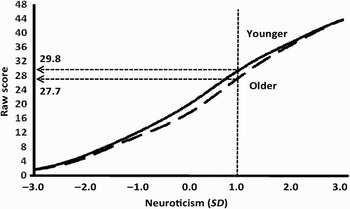
For each personality dimension the 12-item characteristic curves were combined to produce a scale (or test) characteristic curve. For the test characteristic curves the abscissa remained the same and ranged from −4.0 to +4.0, but the ordinate changed to reflect the range of scores on the scale (in this case the range of scores is 0–48). It is this level of analysis, the scale level that was of particular interest. The NEO Five-Factor Inventory (NEO-FFI; Costa & McCrae, Reference Costa and McCrae1992) scales are commonly applied at the scale level in both younger and older adult research. As such, obtaining a more precise understanding of how they function across age groups remains paramount.
Across younger and older age groups, a familiar pattern of mean values for each of the five personality dimensions emerged. When compared with younger adults (n = 608), older adults (n = 501) had lower levels of neuroticism, t (1107) = 13.78, p < .001, extraversion, t (1107) = 2.052, p < .05, and openness, t (1107) = 10.474, p < .001. In contrast, when compared with younger adults, older adults had higher levels of agreeableness, t (1107) = 7.15, p < .001, and conscientiousness, t (1107) = 8.39, p < .001.
The curves in Figure 1 depict the relationship between raw scores and latent levels of neuroticism across age group. There are several noteworthy trends to highlight in this figure. First, both curves increase progressively, suggesting that persons (younger or older) with low levels of neuroticism are unlikely to endorse many neuroticism items strongly. At the same time, persons with high levels of neuroticism are likely to endorse the neuroticism items strongly. Persons with −2.5 SD of neuroticism have an expected probability of receiving an approximate 3 on this 0- to 48-point scale. Meanwhile, persons with +2.5 SD of latent neuroticism are expected to score close to 40. This same basic trend held across all five dimensions. Greater levels of latent personality were associated with a higher likelihood of receiving higher scores on these scales. Second, the older and younger adult curves differ to some extent, suggesting that this subscale functions slightly differently across age groups. At 1.00 SD of neuroticism, for example, younger adults were expected to score 29.80, whereas older adults were expected to score 27.70, 2.10 points lower than the younger adults (a statistically significant difference as judged by confidence intervals). The average difference between younger and older age groups across all five subscales was 0.96, but these differences differed slightly by personality dimension. The average differences were 0.98 for neuroticism, 1.18 for extraversion, 1.13 for openness, 0.59 for agreeableness, and 0.94 for conscientiousness (all differences were judged to be statistically significant by confidence intervals).
Neuroticism test characteristic curves for younger and older adults.

One point should be noted regarding these differences across personality dimensions. These differences tended to occur at different levels of theta. Some occurred near the mean of theta, where the scores of more people in the population are expected. Other differences occurred at the extremes where only the scores of a few people in the population are expected. The expected influence of these differences given their varying locations along theta may have additive effects at the scale level. Average differences between 0 and 1 SD can be weighted by the proportion of expected individuals in a normal distribution, 34.1%. Each successive standard deviation can be weighted similarly. Average differences between 1 and 2 SD can be weighted by 13.6%, between 2 and 3 can be weighted by 2.1%, and between 3 and 4 can be weighted by 0.1%. After the values between each standard deviation are averaged and weighted, the direction of the average weighted differences (positive and negative) can be combined by simply averaging them. When considering these weights, one discovers that in normal distributions of older adults and younger adults with equivalent latent trait personality, older adults are expected to score 0.82 points lower on the neuroticism scale, 1.28 points lower on the extraversion scale, 0.84 points lower on the openness scale, 0.25 points higher on the agreeableness scale, and 0.49 points higher on the conscientiousness scale. These under- and overestimations are very consistent with both the direction of differences (decreases in neuroticism, extraversion, and openness; increases in agreeableness and conscientiousness) and size of the differences (small) documented in many NEO-FFI and NEO Personality Inventory, Revised (NEO-PI-R; Costa & McCrae, Reference Costa and McCrae1992) studies.
The growing debate about the stability or change of trait personality is rooted in observed data values as measured by the NEO. The present analyses revealed systematic measurement bias that seems to fit well with the small but consistent observed differences found in both cross sectional and longitudinal data. Observed values tend to show that neuroticism, extraversion, and openness are slightly lower in older adults but that agreeableness and conscientiousness are slightly higher in older adults (e.g., Costa et al., Reference Costa, McCrae, Zonderman, Barbano, Lebowitz and Larson1986; Costa & McCrae, Reference Costa and McCrae1986, Reference Costa and McCrae1988; Terracciano et al., Reference Terracciano, McCrae, Brant and Costa2005). The present findings suggest that even these slight differences may be the result of measurement artifact. Neuroticism, extraversion, and openness may be slightly underestimated in later life, because older adults with the same latent levels of neuroticism, extraversion, and openness as younger adults are expected to score slightly lower on average. Meanwhile, agreeableness and conscientiousness may be slightly overestimated, because older adults with the same latent level of agreeableness and conscientiousness as younger adults are expected to score slightly higher on average. Taken together, one might conclude that latent trait personality may be even more similar across age groups than previously thought. At the same time, the small differences that do exist may be taken to reflect situational or contextual factors that influence the presentation of this same latent personality.
A theoretical framework for assessing PDs and personality traits in later life
A context-dependent view of personality can illuminate the underlying reasons for the apparent measurement artifact between older and younger adults. Consider that the same personality presents differently in different contexts (Mischel, Reference Mischel1969, Reference Mischel2004), and that later life represents a unique social, occupational, financial, physiological, and cognitive context. It follows, then, that older and younger adults with the same PD pathology or degree of a particular personality trait may respond differently to measures written to assess personality in a younger adult context. The same personality in later life may present differently than it does in younger adulthood, and hence it may remain mischaracterized by items that were written to measure personality in a younger adult context.
The majority of developmental literature that has addressed the context-dependent presentation of personality has focused on childhood and adolescent personalities. The changing contexts and sequence of developmental stages experienced in childhood is known to influence the presentation of personality. This phenomenon has been described as heterotypic continuity (Kagan, Reference Kagan and Goslin1969), the idea that the outward expression of personality can change, although the internal structure of the personality remains stable. As an example, consider the concept of latent aggression applied to developmental stages of adolescence (for a similar illustration, see Mrozcek et al., Reference Mroczek, Hurt, Berman, Rosowsky, Abrams and Zweig1999). A 5-year-old child may express aggression by throwing toys, an 8-year-old may injure animals such as pets, and a 16-year-old may bully classmates. The idea is that these different behaviors may be functionally equivalent (Mussen, Conger, Kagan, & Huston, Reference Mussen, Conger, Kagan and Huston1990) and may stem from the same latent trait of aggression.
Heterotypic continuity traditionally is considered to be more prevalent and apparent in very early life (compared to younger adulthood) because of the succession of rapid changes (Caspi & Bem, Reference Caspi, Bem and Pervin1990; Kagan, Reference Kagan and Goslin1969) that take place at very young ages. However, it is important to consider that a similar number of rapid changes, obstacles, and varied contexts can be found in later life (Whitbourne, Reference Whitbourne2005). Some of these changes and obstacles include loss of friends and family; increased frailty; compromised health; diminished strength; changes in income; changes in family and social roles; and other social, economic, cognitive, and physiological changes (Sadavoy, Reference Sadavoy1987, Reference Sadavoy1996; Whitbourne, Reference Whitbourne2005). These may also influence the presentation of personality and can help explain why assessment measures should be adjusted to accommodate these changing contexts.
Many findings regarding PDs in later life can be viewed through the lens of the context specific view of personality. For example, Rosowsky and Gurian (Reference Rosowsky and Gurian1992) found that a group of older adults did not meet DSM-III-R criteria for BPD, but they were judged to have significant degrees of BPD pathology by their clinicians. The researchers argued that the inconsistency was because of a lack of age-specific DSM criteria. Although the criteria could not identify the older adults with BPD, clinicians could readily determine that these older adults had personality features sufficient to warrant such a diagnosis. Findings from this study underscore the importance for a PD diagnostic system that can account for the later life context.
Age-specific measurement system
An age-specific measurement system may be able to accommodate these empirical findings and theoretical issues. Agronin and Maletta (Reference Agronin and Maletta2000) offer two different ways to create an age-specific measurement system. The first approach is to create a new geriatric subclassification of PDs by empirically examining a large sample of older individuals with maladaptive personality traits. Implementing a variety of measures, one could conceivably derive new PD categories. Item response theory and/or factor analytic techniques might help accomplish this endeavor. A more basic approach might be to simply modify the existing criteria to reflect age-related changes in context. For example, an item written about the work context could be modified to become an item about volunteerism. Initially, this method would rely heavily on clinical intuition. Eventually, however, with iterative testing and revisions, a good subset of criteria for older adults could be established.
An alternative approach would be to mirror some of the procedures that have been used to develop age-specific diagnostic measures for use with children. Westen and colleagues (Shedler & Westen, Reference Shedler and Westen1998) have been refining DSM PD criteria through the development of the Shedler–Westen Assessment Procedure, which is a prototype-matching approach that tracks PD pathology in adults. A recent study, consistent with the context dependent view of personality, confirmed the need for such a measure in adolescents. A sample of adolescents was given the Shedler–Westen Assessment Procedure for Adolescents. Using a Q analysis, empirical groupings of PDs were derived that were similar to but not identical to adult diagnoses (Westen & Heim, Reference Westen, Heim, Leary and Tangney2003). These differential findings across age groups suggest that the presentation of PD pathology in adolescents may be age specific. Although there may be empirical and practical problems with a Q-analysis approach (Wood, Garb, Nezworski, & Koren, Reference Wood, Garb, Nezworski and Koren2007), the general techniques employed by Westen and Shedler could be applied to develop a measure for use with older adults. This would involve several steps that may include soliciting descriptions of PD pathology from clinicians who work with personality-disordered older adults, using these clinical descriptions to create a PD pathology assessment tool for use with older adults, identifying via Q analysis which items are the most important for measuring PD pathology in later life, and establishing the psychometric properties of the instrument.
Two age-specific measures were recently created, but both fall short of an ideal classification system. One consists of a categorical measure that very broadly assesses PD pathology (van Alphen, Engelen, Kuin, Hoijtink, & Derksen, Reference van Alphen, Engelen, Kuin, Hoijtink and Derksen2006). This measure consists of 16 items scored yes or no. Seven items cover habitual behavior. Another nine cover biographical information. Strengths of this measure include its usability and length (which is short). Limitations include its apparent lack of breadth and it conceptually inconsistent scoring system. Although the phenomena of interest likely exist along several associated dimensions, this measure assesses each feature categorically and does not concentrate on gradations of personality (i.e., adaptive to maladaptive).
A second measure that was developed is a hybrid PD scale (Balsis & Cooper, Reference Balsis and Cooper2009). The goal during item creation in this measure was to improve upon the current diagnostic criteria, many of which poorly capture PD pathology when applied to older adults. This measure sought better indicators of the PDs as they present in later life. Of 100 items (10 for each PD) written specifically for older adults on the basis of clinician experiences, 37 worked better than some of the current diagnostic criteria. On average, 3 or 4 new items per PD replaced less than optimally functioning items. Overall, clinicians favored some DSM items over others and some novel items over certain DSM items.
Replacing some of the psychometrically underperforming items with these new items increased the face validity and content validity of the diagnostic sets. New items were added that reflect the aging context, and old items were removed that were biased in terms of the older adult context. It is perhaps not surprising that diagnostic sets with less than ideal face and content validity have poor psychometric properties when applied to later life. The current research found that replacing underperforming DSM items with items written specifically to measure PD pathology in later life improved the internal consistency (in this case represented by coefficient alpha) of the scales in this later life sample. Strengths of this measure include its incremental improvement over the DSM classification system for use with older adults. Limitations include other limitations typically associated with the DSM.
Age neutral measurement system
Although an age-specific measurement system may work well to assess PD pathology in older adults, it might be less useful for an investigator who wishes to study PD pathology longitudinally into later life or cross-sectionally among younger and older participants (Balsis, Gleason, Woods, & Oltmanns, Reference Balsis, Gleason, Woods and Oltmanns2007). A longitudinal study would require that the researcher switch from a younger adult measure to an older adult measure midstream, thereby introducing a confound to comparisons between the two groups. Meanwhile, a cross-sectional study would require the researcher to assess PD pathology with one measure in the younger group and a different measure in the older group. Again, this change in measures and groups could compromise the ability to understand personality changes across the two groups.
An age-neutral measurement system may alleviate these problems (Mroczek et al., Reference Mroczek, Hurt, Berman, Rosowsky, Abrams and Zweig1999). In principle, an age neutral measure would work equivalently well across all age groups. The benefits of such a system include an ability to compare scores across age groups and over time without concern for age-associated measurement artifact. Such a system would enable investigators to study the natural course of personality and build age-related personality theory. It also would enable clinicians to feel confident about their assessments, without having to adjust items to assess their older clients (Zweig, Reference Zweig2008).
There have been at least two personality measures created with the goal of age neutrality. The NEO (Costa & McCrae, Reference Costa and McCrae1992) and its various forms is one of those measures. Many researchers who study later life personality support its use for two reasons: (a) it uses a dimensional instead of a categorical approach for measuring a dimensional phenomenon, personality, and (b) it closely considered older adults during its development. Although the NEO was developed with the goal of age neutrality, there are valid concerns about simply using the NEO as a replacement for the DSM personality system. Most notably, this measure was designed to assess “normal” or typical personality. Therefore, a reasonable question to ask is whether it can accurately measure “abnormal” or atypical personality, such as the PD pathology described in the DSM. In 1994, investigators proposed that the NEO-PI-R indeed could measure PD pathology (Widiger, Trull, Clarkin, Sanderson, & Costa, Reference Widiger, Trull, Clarkin, Sanderson, Costa, Costa and Widiger2002). Although there is a growing consensus that the NEO can be used to represent PD pathology, the literature is not fully developed, and most of this research is based on younger adult samples. No research to date indicates whether this measure works equally well for younger and older adults with PD pathology.
The later life context was closely considered when the NEO was created (e.g., Costa & McCrae, Reference Costa and McCrae1986; McCrae & Costa, Reference McCrae and Costa1987; Costa et al., Reference Costa, McCrae, Zonderman, Barbano, Lebowitz and Larson1986), so one might hypothesize that it should work equally well across younger and older age groups. The previously mentioned analysis showed that a 60-item short form of the NEO does not work equivalently well for younger and older age groups. Results indicated that a younger adult and an older adult with the same degree of a particular latent personality trait (ranging from −4.0 to + 4.0 SD) have similar anticipated scores on the relevant NEO-FFM subscale. For instance, a younger adult with 2.0 SD of latent neuroticism would be expected to score on average about a 37.4 on the neuroticism scale. An older adult with the same amount of neuroticism would be expected to score on average about a 36.6 on that same scale. Whether this difference of approximately one point is significant remains an open empirical question. A similar pattern of results was observed across all five dimensions and at all levels of latent personality, suggesting that the NEO is not metrically equivalent across these age groups.
Additional concerns remain regarding whether the NEO is clinically useful among diverse groups of older adults with varying degrees of PD pathology. Such issues surrounding the NEO's clinical utility remain to be explored empirically. The psychometric evidence that does exist suggests that the NEO can represent the DSM criteria to some degree and has the potential to function relatively well across younger and older age groups. Still, the NEO may not be the best or the only long-term solution to the DSM Axis II challenges. For now, though, it may serve as a model for the development of a replacement measure in that it measures personality dimensionally and at least closely considered the later life context in its development.
Another example of a measure that considered the context of later life is the Personality Assessment Inventory (PAI; Morey, Reference Morey1991). Like the NEO, the PAI has both dimensional item scales and dimensional subscales. In addition, older adults were closely considered during its development. However, the PAI differs from the NEO in that during its development, Morey identified and eliminated items that contained measurement bias across age groups. As Morey (Reference Morey2003, p. 8) eloquently put it,
… a test that is intended to measure a psychological construct should not be measuring a demographic variable, such as gender, age, or race. This does not mean that items on psychological tests should never be correlated with age, or gender, or race. However, the magnitude of any such correlations should not exceed the overlap of the demographic feature with the construct.
The ways in which the NEO and the PAI dealt with the context of later life serve as a template for how the new DSM system should consider the context of later life. If an ideal system is to be truly age neutral, it should theoretically (like the NEO) consider the later life context during the item generation and selection phase and it should also use techniques such as item response theory to empirically select items appropriate for all age groups (like the PAI). Only those items that contain no measurement bias across age groups should be considered.
Going forward, studies are needed to develop better measures so that we as a field can more fully understand the prevalence, course, and influence of personality in later life. Before these studies can be conducted, however, there is a fundamental need to create an optimal measurement system. Earlier in this chapter, the tripartite measurement system was described as an optimal system. That system would work well for measuring personality in later life as long as the items and scales that make up that system are age neutral. To ensure that items are indeed age neutral, we need to follow two simple but key steps. First, we need to generate many items and administer them to people of all ages from both community and clinical samples. In the same image of the NEO, these items should be created while considering all life stages, and in the same image of the PAI, these items should be systematically evaluated for measurement artifact across age groups. Second, from this larger set, those items that function equivalently should be retained. Once a set of age neutral items have been retained, the factor structure of the items should be evaluated, and those items most relevant for the measure should be selected. If this tripartite system is going to work equivalently well for members of all age groups, then it should measure only personality and personality pathology, not a demographic variable such as age.
Conclusions
As of this writing, DSM-V is scheduled to be published in 2012. This review shows that a substantial research base exists to aid in the movement to a system that better integrates dimensional and categorical elements, and is sensitive to developmental considerations. The field has the tools needed to model and understand the impact of development on the expression of personality and personality pathology. The challenge will be to apply those tools in a comprehensive fashion in a short amount of time. With this in mind, any system adopted for DSM-V is likely to be provisional. In many ways, the most exciting development would be to articulate a new system for DSM-V that moves the field forward by building on recent developments, while also clearly pointing toward a next generation of questions and refinements.