Chicago asked in 1893 for the first time the question whether the American people knew where they were driving.
—Henry AdamsFootnote 1The settler makes history and is conscious of making it.
—Frantz FanonFootnote 2Night is falling in the city. Holiday shoppers bustle down the sidewalk, some pausing to gaze at a colorful billboard publicizing the delights of an upcoming exposition. A few crafty rats scamper along a tall wooden fence, stalked by a sinister ratcatcher of the Dickensian mold. Children frolic, fight, and tease one another in front of the fence, the familiar syncopated strains of Tchaikovsky's Nutcracker overture underscoring their exuberant street play. This is not, however, the early 1800s Germany of the upper-class Stahlbaum family. It's 1892 Chicago. In the Joffrey Ballet's 2016 production of The Nutcracker, the story of Clara Stahlbaum's innocent Christmas Eve dalliances with an anthropomorphic nutcracker and their journey to the Land of Sweets becomes the story of Marie, the daughter of a Polish immigrant single mother, whose fantasyland is the future Chicago World's Fair. Marie's mother, we learn, is a hired artist working on the fair's sculptures. Marie, Fritz, and their mother inhabit a wooden shack in the heart of the construction site, surrounded by the skeletal structures that will become the White City's buildings. Drosselmeyer is now “The Great Impresario,” a character of vision and magnetism inspired by the fair's Director of Works Daniel H. Burnham, and Marie's working-class mother transforms in the second act into the embodiment of the fair's golden Statue of the Republic, a less saccharine substitute for the Sugar Plum Fairy. The mutual affection of Mother and The Great Impresario spans both acts, and though the ballet leaves unclear the outcome of their budding romance, in it young Marie sees the promise of her American dream: a contented nuclear family.
When the Joffrey Ballet's artistic director Ashley Wheater set about to create the “new American Nutcracker,” the World's Columbian Exposition beckoned to him from Chicago's nineteenth-century past.Footnote 3 Wheater tasked choreographer Christopher Wheeldon and book writer Brian Selznick with reconceiving the ballet, a risky venture given that the Robert Joffrey–choreographed Nutcracker (1987) had long been considered the definitive US American adaptation. What resulted from their collaborations, as well as those with designers and dancers, was a Nutcracker that relocates the dreams of an adolescent girl from the grand drawing room of an elite family to the temporary dwelling of working-class immigrants. The Christmas Eve gathering, now in Marie's mother's cozy shack, brings together a group of 1892 Chicago's most important workers: the laborers charged with building the World's Columbian Exposition. Here, at a celebratory potluck dinner, guests munch on Polish foods and join in eastern European folk dances, Old World traditions performed in New World contexts. For Chicago Tribune critic Chris Jones, Marie's working-class immigrant status legitimates the ballet's wish fulfillment premise: “And thus [Marie dancer Amanda] Assucena, who metaphorically embodies here so many of the dreams of ordinary Chicagoans in what remains an immigrant's city, can dance with her heart and body into this fusion of hope and desire without ever seeming indulgent or jaded.”Footnote 4
In foregrounding the experiences of the fairgrounds’ immigrant workers, Joffrey's “new American Nutcracker” valorizes not the exposition's white-collar heavyweights but the contingent, blue-collar employees whose physical bodies actualized the iconic spectacle. It also suggests, as does this essay, that the workers’ efforts contributed to the fair's abundant theatricality. Recent studies by Rosalyn R. LaPier, David R. M. Beck, and David Silkenat give overdue focus to the many workers who lived and labored at the fairgrounds, augmenting the vast catalog of scholarship on the fair's officials, investors, architects, agents, and performers.Footnote 5 As a historian of nineteenth-century popular performance, I am drawn to the Columbian Exposition worksite because it was, for all intents and purposes, a profit-generating venue that presented work as entertainment.
Like other world's fairs, the exposition was capitalistic enterprise hitched to a commemorative, aggrandizing theme. And though, as Michel-Rolph Trouillot notes, the fair's intellectual aspirations were uneven at best, it embraced the quadricentennial of Columbus's “discovery” of the Americas as a straightforward signifier of racial and economic power.Footnote 6 A durable patina of settler-colonial confidence, therefore, glossed the fair's assemblage of exhibits and experiences, even as capital recovery motivated nearly every decision made by fair officials and concessioners. In this essay, I suggest that the exposition's expansionist spectacle began not on opening day, but with the breaking of ground at the Jackson Park worksite. Indeed, the worksite did more than prepare physical spaces to accommodate the exposition's imperialist performances; it itself performed the quadricentennial's central myth—that racial whiteness and settler-colonialism fulfilled the promise of the “New World,” not its Indigenous inhabitants—through the dynamic forms of human labor it encompassed. After summarizing the exposition's inconsistent representation of workers and work during its six-month run, I present the Jackson Park worksite as a multifocal performance space that seeded the fair's white supremacist messaging while elongating its profit window. Throughout the worksite, diverse modes of labor (theatrical, manual, biological) converged in a preview of the exposition's multipronged purposes (earnings, entertainment, edification). I then focus on how prefair work became spectacularized by examining two conspicuous demonstrations of labor: the construction of the White City by a primarily Euro-American workforce and the Eskimo Village's daily performances of Inuit life. By opening the worksite as a for-profit tourist destination, fair officials legitimized the visitors’ desires to view its repertoire of manual, artistic, and domestic labor as entertainment. I briefly consider how the 1893 Columbian Exposition's colossal archive preserves or omits such labors as part of its historical narrative before revisiting the new Nutcracker and the workers it memorializes.
Part of my aim in studying the fairgrounds’ labor spectacles is to illuminate the gendering and racializing of working bodies by officials, visitors, and journalists alike.Footnote 7 World's Fair scholars have sought to expose the erasure of women and Black Americans from the 1893 exposition, and theatre historians have helped to reconstruct the cultural performances that filled the Midway Plaisance, dotted the White City, and enlivened Buffalo Bill's Wild West Show just outside the fairgrounds. I would like to extend these historiographical efforts back to the fair's bustling worksite, where visitors paid to watch Inuit families, Japanese carpenters, European immigrant sculptors, Black janitors, and white college-age security guards work—and sometimes live—in Jackson Park. It is there that the fair's performance of industrialized, settler-colonialist progress began.
Displaying, Hiding, and Dividing Labor at the 1893 Exposition
For its many champions, the World's Columbian Exposition of 1893 was a startling manifestation of the United States’ industrial, economic, and cultural ingenuity: a grand, utopic spectacle built against all odds to the delight of millions of domestic and foreign visitors. Its detractors, both Gilded Age and beyond, adopted a far less adulatory narrative: the exposition's pristine veneer failed to disguise the colonialist agenda undergirding nearly every aspect of the “White” City, a consumerist space of exploitation, essentialism, and neglect. Rather than consigning the Chicago World's Fair to an either–or fallacy, historians including Rosemarie K. Bank, Melissa Dabakis, Christopher Robert Reed, and Melissa Rinehart have recently attempted to replot the fair on more contested grounds.Footnote 8 As Bank asserts, the World's Columbian Exposition was a heterotopic and heterochronic site of contrasts.Footnote 9 The ornate and organized White City manifested a profusion of primarily Euro-American artifacts, artworks, and inventions, while the Midway Plaisance offered a carnivalesque thoroughfare of ethnographic villages, “exotic” cuisines, sideshows, cooch dancers, panoramas, and amusement rides like the Captive Balloon and the Ferris Wheel. In its potent melding of the material with the ephemeral, the educational with the sensational, and the nostalgic with the futuristic, the fair elaborated on the distinctive ways of working, performing, consuming, and spectating popularized at earlier expositions in London, Paris, and Philadelphia.
Together the White City and the adjacent Midway employed a veritable army of builders, painters, cashiers, waiters, ticket takers, lecturers, musicians, dancers, drivers, groundskeepers, cleaners, ride operators, police officers (the Columbian Guard), firefighters, Rolling Chair Guides, and medical personnel during the exposition's official run in Jackson Park. “[T]he Chicago World's Fair became a magnet of the unemployed” directly before and during the Panic of 1893. Estimates suggest between twenty-five thousand and forty thousand people labored at the exposition, a good number of whom worked excessive hours in strenuous (and in some cases life-threatening) conditions.Footnote 10 As David Silkenat evidences, “tramps” (itinerant laborers) made up a large portion of this temporary workforce, having traveled to Chicago in droves using the nation's thriving rail system, and white male college students could be recruited at their campuses to serve as Columbian Guards or Rolling Chair Guides. Black male college students were also recruited as Rolling Chair Guides, but were blocked from serving on the police force; Black working-class men comprised the janitorial staff and other positions of manual labor, including construction and groundskeeping.Footnote 11 Women employees (predominantly but not exclusively white) carried out a range of acceptable duties: creating murals and sculptures, serving refreshments, making and selling souvenirs, providing secretarial support, and performing at various venues. Each day of the official exposition, bootblacks polished shoes in the choicest lavatory blocks, ride operators loaded thrill seekers into the Ferris Wheel's massive cars, Navajo women wove sheep's wool blankets, and bartenders quenched thirsts at Conrad Seipp's Brewing Company.Footnote 12 From 1891 to 1893, Jackson Park was abuzz with work.
And yet the Chicago World's Fair's reputation as a Gilded Age wonderland was built not upon people, but things. To that end, organizers concealed or carefully curated for public consumption the human labor required to power the White City and its contiguous sites of entertainment. With some exceptions, the material displays that filled the fair's cavernous buildings often stood unmediated but for accompanying placards of text or guidebooks, and the public debuts of Wrigley's gum, Cracker Jack, the zipper, Aunt Jemima's pancakes, and the motorized walkway at the fair garnered more attention than the products’ inventors. Fyodor Dostoyevsky's castigatory observation of the 1851 Crystal Palace Exhibition in London, that it was “the epitome of soulless materialism,” could have easily been describing its Chicago successor.Footnote 13 Visitors’ letters and diaries suggest those who experienced the fair similarly prioritized its material exhibitions over its human employees. Twenty-seven-year-old visitor Annie Finette Lynch, for example, wrote to her younger sister Bertha of seeing items as diverse as carriages, train cars, canoes, fishing tackle, fountains, potted plants, decorative china, tapestries, and fireworks, but mentioned people (or human approximations) only twice: one of these was a “life like figure of a man lying dead on a road” as part of France's display on detective work, and the others were “dignified Indian waiters in their cool, clean linen tunics and turbans” who served her party tea in the East Indian Building.Footnote 14
The spatial and cultural divides separating the White City and the Midway further shaped public perceptions of the fair's resources, commodities, and workforce. If the hegemonic White City honored ideas and materials, associating Western societies with intellectualism and industry, the Midway's exhibits (representing countries from Asia, Africa, Oceania, Europe, and North America) promoted experiential, sensorial engagements with its inhabitants and their social practices. Official and unofficial guidebooks, including those produced by Rand, McNally & Co., Harper's, and the exposition itself, reflect this discrepancy in describing the fair's manifold wonders.Footnote 15 Whereas authors provided adulatory, pages-long itemizations of the White City's material exhibits and architectural flourishes (as one might expect of a guide to a museum of priceless antiquities), they tended to describe Midway exhibits one of two ways: with cursory or disinterested summaries of each building and attraction, or with colorful, flâneuresque accounts that centralized the narrator's encounters with ostensibly foreign bodies, smells, sights, and sounds.Footnote 16 Though this imbalance of coverage certainly reflects the official prejudices of the World's Columbian Exposition, it is probable that the Midway's experiential “products” were not as easily inventoried by white American journalists. (It might also be that visitors purchasing foods, handicrafts, and keepsakes at non-Western attractions typically engaged with foreign or Indigenous workers to do so, tying the thing bought to the personal interaction it precipitated.) “Hailed as the ‘great object lesson’ in anthropology by leading anthropologists,” notes world's fairs historian Robert W. Rydell of the 1893 Midway, “[it] provided visitors with ethnological, scientific sanction for the American view of the nonwhite world as barbaric and childlike and gave a scientific basis to the racial blueprint for building a utopia.”Footnote 17 Considered together, the White City and the Midway Plaisance substantiated a false dichotomy about global labors: Westerners made the best things, non-Westerners staged uncommon encounters. As such, the microcosmic fair spatially and materially replicated for nineteenth-century tourists what Frantz Fanon later argues in The Wretched of the Earth (1961):
The colonial world is a world divided into compartments. . . . The zone where the natives live is not complementary to the zone inhabited by the settlers. The two zones are opposed, but not in the service of a higher unity. Obedient to the rules of pure Aristotelian logic, they both follow the principle of reciprocal exclusivity. No conciliation is possible, for of the two terms, one is superfluous.Footnote 18
While the Midway's cultural displays exploited “authentic” performances of exoticized bodies-at-work and bodies-at-play, the White City's optics as a privileged space of discovery, innovation, and drive partly depended upon what Rosemarie K. Bank calls the “sundering of work from workers.” As Bank argues in a recent essay situating the 1893 World's Fair within Chicago's labor history, the exposition was “itself a performance of labor,” one that “simultaneously valorized and erased work.”Footnote 19 Valuing material goods over the humans that produced them (or, similarly, valuating human labor by the quantity of goods produced) was not a particularly new concept, as Karl Marx declared decades prior to the exposition. Laborers there may have been, but at least some of the exposition's capital lay in its spectacle of material production without the explicit intervention of humans, a paradoxical but magical deception forged in the Industrial Age.
Metal, Paint, Mud, and Men: Building Spectacle at Jackson Park
Thousands of workers, some of them skilled laborers, were hired to raise the exposition's alabaster buildings and exotic faux marketplaces, build its network of infrastructures, and landscape almost seven hundred acres of marshland.Footnote 20 The Works Department hired union and nonunion workers—a highly publicized sticking point in industrial-era Chicago, site of the deadly 1886 Haymarket Square labor riot, sustained periods of organized strikes, and a majority immigrant workforce.Footnote 21 The massive construction project to install the exposition seven miles south of Chicago's Loop attracted worldwide attention in the months preceding its opening. Tensions lingered between cities, architecture firms, and bidding financiers after Chicago was selected to host the exposition in 1890, and the public was eager to see if the Midwestern city would make good on its promises. Director of Works Burnham, famed landscape artist Frederick Law Olmsted, and the exposition's Board of Architects conceived of the site's memorable layout, with the White City hugging the shoreline of Lake Michigan and the Midway Plaisance extending in a narrow strip of land to the west. The centerpiece of the fair's design was the Court of Honor, a string of colossal neoclassical buildings surrounding the Grand Basin and interspersed with Beaux-Arts sculptures. Jackson Park's marshes partly inspired Olmsted's series of lagoons and waterways, which together offered visitors picturesque views, cooler temperatures, and aquatic transportation in the form of gondolas and “omnibus” boats. The fair's buildings boasted over five million square feet of total indoor exhibition space, and the grounds were reported to be four times the size of previous world's fairs.Footnote 22 The fairgrounds required a vast infrastructure of roads, transportation systems, and utilities, including electricity supplied by the Westinghouse Electric Company using the technology of Nikola Tesla. (The illumination of the White City by Tesla's AC polyphase generators and upward of a hundred thousand incandescent bulbs would be a defining visual element of the exposition. For one enchanted commentator, “Night was the magician of the Fair.”)Footnote 23 Ticket kiosks, concession stands, restrooms, phone stations, and other ancillary structures were situated throughout the landscaped grounds for the convenience of visitors.
On 11 February 1891, Italian immigrants hired by Chicago's McArthur Brothers began digging drainage ditches, the first work done on the Jackson Park site;Footnote 24 the fair's dedication ceremony would take place in October of 1892, with 1 May 1893 marking its opening day. While the fair's official six-month tenure was largely unencumbered by overt displays of manual labor, the converse was true for its construction site. In a multipart retrospective on the fair's construction, 1894's The Book of the Builders, Burnham and coauthor Francis Davis Millet depict the inchoate worksite as an immediate curiosity: “The general public interest in the work, stimulated as it was by the incipient labor troubles, made Jackson Park a popular place of public resort, and not less than twenty-five thousand people visited the grounds on several successive Sundays. Even on week-days the crowds of spectators often seriously interfered with the work of the surveyors.”Footnote 25 Eager to pay down some of the fair's mounting debts by capitalizing on the public's desire for all things World's Fair, Burnham later began charging twenty-five cents to those wishing to enter the fairgrounds early and watch construction, a fee half the cost of the future general admission.Footnote 26 Thousands of visitors a week took Burnham up on his offer. It was possible to enter without paying, of course; diplomats and city officials were admitted free of charge, and lax gatekeepers allowed some visitors to sneak inside. As Mrs. Mark Stevens offered in her detailed reminiscences of the exposition: “Before the gates opened for the Fair, the keepers were not really particular, for often we asked them if they were not inclined to look in an opposite direction from us. One always replied: ‘It is not necessary, as I have dreadful spells of blindness, and one of them has just come on.’”Footnote 27
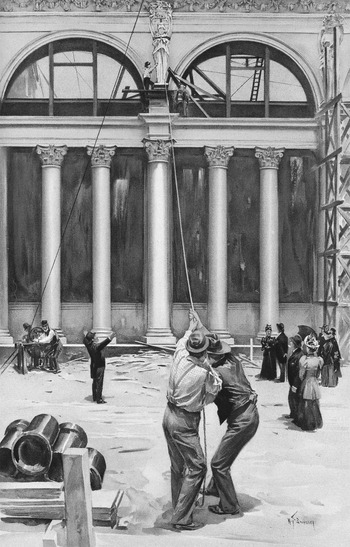
Coy gatecrashers notwithstanding, the Jackson Park worksite generated revenue by trafficking in dueling spectacles: the spectacle of industry and the spectacle of embodied work. A good portion of the site's wonders were things: the superabundant stacks of lumber, the massive steel trusses, the dredging equipment, the rail tracks snaking through the fairgrounds. However, it was the workers’ interactions with these objects, their “dances with things,” that actualized the site's dynamic exhibition of work, with its profusion of noises, smells, and gestures.Footnote 28 Those who entered the construction site witnessed a performance of physical labor that was both monotonous and constantly in flux: union and nonunion workers (under varying levels of supervision) digging, building, paving, wiring, painting, sculpting, and planting, not to mention taking lunch, latrine, and cigarette breaks. If illustrations like W. T. Smedley's “Setting a Statue on Agricultural Building” (Fig. 1) are to be believed, spectators felt little obligation to watch from a safe distance.
William Thomas Smedley, “Setting a Statue on Agricultural Building,” 1894, lithograph, 13 7/8 × 8 15/16 in., the David and Alfred Smart Museum of Art, the University of Chicago; purchase, the Paul and Miriam Kirkley Fund for Acquisitions. Image © 2021 courtesy of the David and Alfred Smart Museum of Art, the University of Chicago.

The exposition's motives for opening the construction site to visitors are evident in the Official Guide to the Grounds and Buildings of the World's Columbian Exposition during Construction, issued by its Department of Publicity and Promotion. Dated October 1892, no doubt to coincide with the exposition's dedication ceremonies that month, the forty-two-page booklet cost the purchaser ten cents.Footnote 29 Like some later guides to the fair's official run, the Guide to the Grounds and Buildings traces several walking tours based on the visitor's point of entrance. The implication was clear: to witness all the wonders of the construction site or mark the workers’ progress, visitors would need to return. In presenting the fairgrounds as a multifocus venue for observing spectacular work—one that was well worth a quarter—fair officials promised an ever-evolving bill of entertainments that echoed the programmatic patterns of the nation's other popular performance forms, including circus and vaudeville. As visitors walked along muddy pathways, climbed staircases to rooftops, or slipped into artists’ workshops to witness an array of transitory “acts” of labor, a modern promenade theatre materialized.
The period's journalists, photographers, and visitors documented what awaited those who entered the construction site. “Seeing is believing,” promised journalist Henry M. Hunt of the fairgrounds in January 1893, “and the latchstring is on the outside.”Footnote 30 Photographer C. D. Arnold, who was commissioned with the formidable task of visually chronicling the exposition's every development, not only tracked the physical transformation of Jackson Park through his photographs; he also captured droves of laborers and artisans in front of, on top of, and within the site's half-built structures and statuary.Footnote 31 Female artisans are visible in several interior shots, standing near sculptures in progress. A Black laborer, too, appears among a group of workers in an Arnold photograph, reminding viewers that the prefair's labor pool was not exclusively white. “Although the exposition's hierarchy of labour excluded African-American men as painters,” Bridget R. Cooks notes, “they were part of the construction team, together with white men, that cleared and prepared the grounds for the erection of buildings and created the extensive ornamental plasterwork on the rooftops and friezes of the neo-classical exhibition buildings.”Footnote 32 Still, Arnold's image catalog presents the construction site as an overwhelmingly masculine and largely white domain.
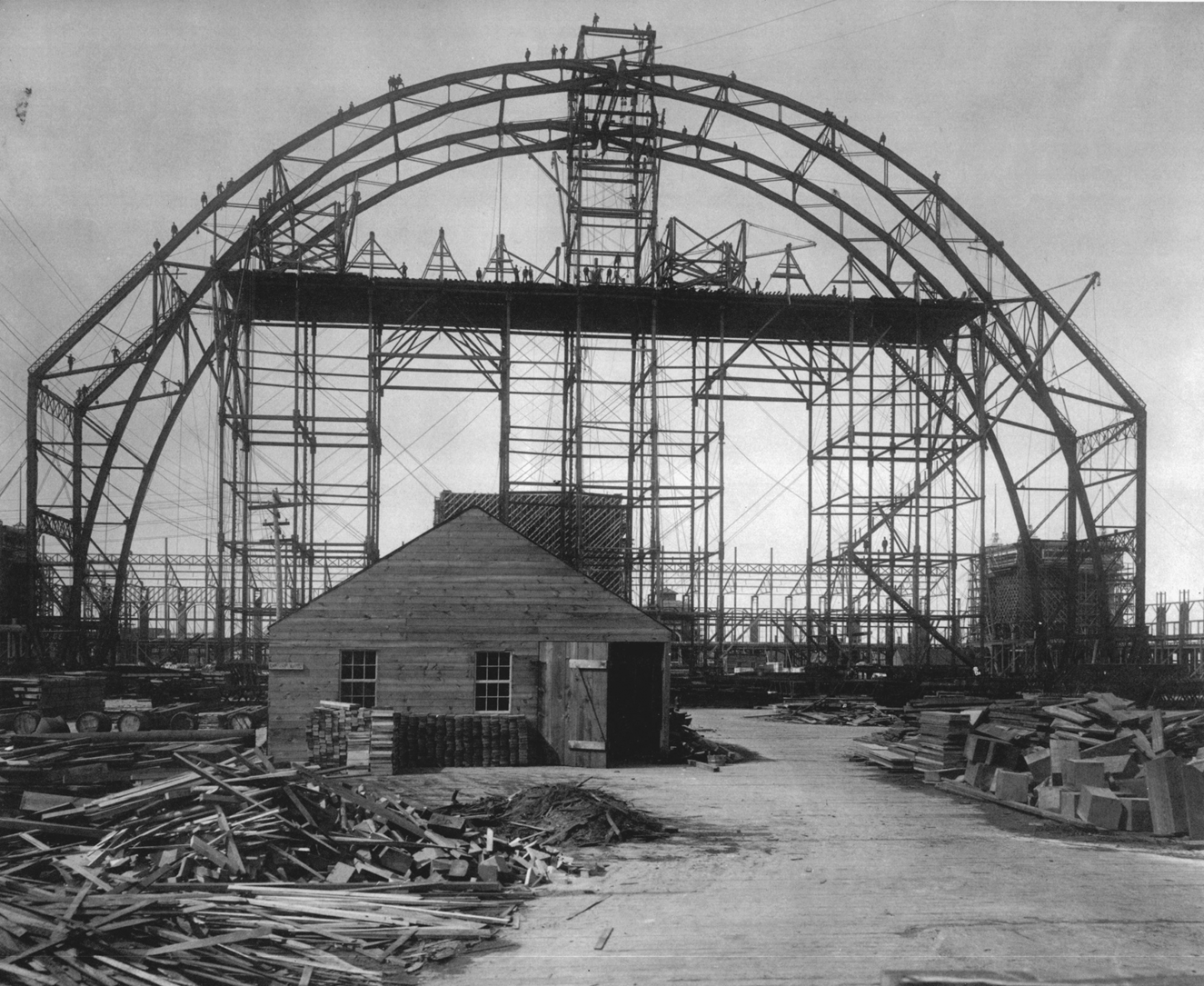
It is unsurprising that a great number of Arnold's human subjects appear posed, given that 1890s photographic technology required relative stillness in order to produce clearly defined images. In such compositions, men perch on giant steel trusses (Fig. 2), sit in rows on massive pipes, and stand arrested in friezes of site-specific activities: chiseling a sculpture's surface, or taking aim with an electric painting machine's hose. Other photographs feature the blurred arms and legs of bodies in motion, as men pull ropes and apply staff (a plaster mixture that resembles stone when dry) to exterior walls. Unlike Arnold's posed subjects, the workers suspended in action by the camera do not directly engage with the viewer—likely a more accurate representation of the spectators’ fairgrounds encounters.
Workmen atop the steel trusses of the Manufactures and Liberal Arts Building, 1892. Photo by author of print in C. D. Arnold photographic collection, 1892–1901, Department of Drawings and Archives, Avery Architectural & Fine Arts Library, Columbia University.

Following the Great Chicago Fire of 1871, the city underwent a building boom. For Chicagoans who passed by worksites on a regular basis, the hustle and bustle of a construction site presumably held little novelty. But the Jackson Park worksite—massive, variform, culturally momentous, and fleeting—was different. As the footprint of a future World's Fair, Jackson Park was already framed as a cornucopian site of entertainment; when paying visitors entered the developing fairgrounds, they found the spectacle underway. Norman Bolotin and Christine Laing affirm that worksite visitors “could see hundreds of workers literally crawling over the immense frameworks of buildings that climbed hundreds of feet into the sky. They could glimpse a building full of architects and artists adding ornamentation or sculptors creating beautiful statuary and bas-reliefs. . . . [They could see] landscape architects supervising plans for outdoor displays of foliage and flowers.”Footnote 33 Much like the period's traveling circuses, the worksite's evanescent nature and bustling preparations built anticipation for the main event.
The regular presence of architects, designers, and other overseers made manifest the hierarchies structuring the fair's workforce, as well as signaled the Euro-American prioritization of intellectual over manual labor, even in sites dominated by physical work. According to a laudatory paragraph in the Official Directory of the World's Columbian Exposition, the division of the labor force (and the repetitive nature of the laborers’ work) ensured that “each man had grown to know his duty intimately.”Footnote 34 In a suitably theatrical description of one collaborative feat, the Official Directory depicted the pecking order as crucial to the precision and efficiency of the construction apparatus:
From some lofty perch the foreman of a gang would conduct his men somewhat after the manner of the leader of an orchestra. Whenever he fell short of the mark he would shout his order to an assistant half-way down, on the opposite side of the span, and the latter would give fuller instruction to another assistant on the floor. After each move all eyes would turn to the directing mind aloft.Footnote 35
That the construction site was itself an entertainment venue was not lost on visitors. The fairgrounds offered a “dress rehearsal of the wonders of the White City,” wrote Henry M. Hunt; “many and many an hour of pleasure and profit is to be found within the miles of board fence.”Footnote 36 Journalist Julian Ralph described the worksite in similarly theatrical terms:
It is not true that the grounds of our Columbian Exposition in Jackson Park, Chicago, have for months been more interesting than they will be when the Fair is thrown open to the world. And yet they have presented a fascinating study during all the stages of the preparation for the great display; a scene so peculiar that no public exhibition except the completed Fair can exceed it in interest. To have been there and to have watched the construction of the Exhibition palaces is to have enjoyed a great surprise and an unique pleasure. The 3000 spectators on week-days, and the 10,000 who have paid their quarter-dollars at the gates on Sundays, will alone be able to boast, when they see the Columbian show itself, that they have enjoyed the full spectacle. They will have seen the earliest and most peculiar exhibit—the mode and progress of construction.Footnote 37
For Ralph, to enter Jackson Park was to become a privileged spectator, one uniquely capable of appreciating the exposition's architectural and aesthetic achievements (and boasting of them to the less fortunate). Speaking at the exposition's dedication ceremony, Grover Cleveland's Vice President, Levi P. Morton, likened the workers to conjuring magicians, expressing amazement at the “spectacle . . . presented to us here! As we gazed upon these magnificent erections . . . when we consider their beauty and rapidity of realization, that would seem to be evoked by a wizard's touch of Aladdin's lamp, praise for the organization and accomplishment, for the architect and builder, for the artist and the artisan, may not now detain me, for in the years to come, in the mouths of all men, it will be unstinted.”Footnote 38 If, as Peter Hales asserts, the narrative of early construction for the Chicago World's Fair was “rough nature improved by the hand of man, turned from wilderness toward park, and from desolation toward civility,” then Jackson Park's laborers were positioned as civilizers, tamers, and manufacturers of aesthetic beauty and structural majesty.Footnote 39
This performance of industrialized progress, not surprisingly, was also a performance of primarily white masculine labor, one that reinforced the notion that non-Indigenous, Western men were innately and by design the architects of civilization. When Japanese laborers arrived in early 1893 to erect the Hō-ō-den (Phoenix Palace) on the fair's Wooded Island, this racial premise became reified for ethnocentric American observers. Despite Olmsted's decree that nothing man-made aggress the tranquillity of the lagoon-encircled Wooded Island, he eventually approved of situating Japan's national pavilion within the island's “poetic” landscape; a hunter's cabin was built on a smaller island nearby.Footnote 40 According to Ellen P. Conant, through its participation in the 1893 exposition, the Meiji government aspired to educate Westerners on Japan's history, values, and ambitions, to confirm Japan's status as a US ally, and to resist the prejudicial depictions of Asian countries so prevalent at world's fairs. “The Japanese were ostensibly more highly regarded [than the Chinese],” notes Conant, “credited with intelligence and ingenuity for their apparent ability to reconcile their pre-industrial culture with American-type industrial growth.”Footnote 41 The Hō-ō-den's placement seemed to physicalize Japan's perceived reputation as a bridge of East and West, past and present. Standing not among the fair's neoclassical behemoths or Native living structures, but alone on the centrally located and naturally landscaped Wooded Island, the Hō-ō-den could be accessed by boats or footbridges from the eastern and western sides of the fairgrounds. Regarded as the “Yankees of the East,” the Japanese were nevertheless expected to be “pacific and deferential” to the United States. “It was precisely this subservient role and image that Japan was determined to shuck” at the fair.Footnote 42
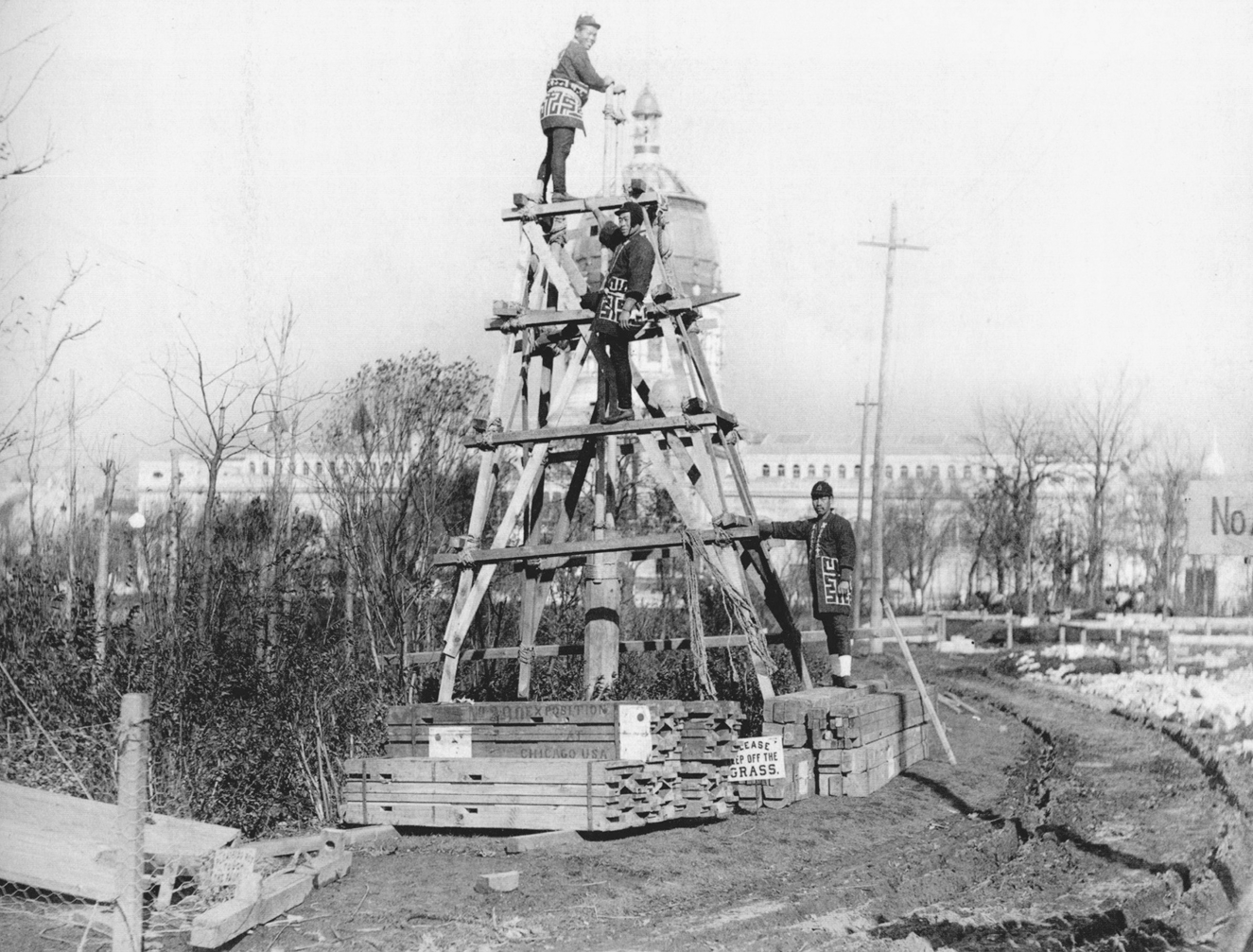
The Hō-ō-den was built by the firm of Ōkura Kihachirō, whose men arrived to “erect these prefabricated buildings and attracted as much attention as they had at Philadelphia” (Fig. 3).Footnote 43 The men were master carpenters, trained “not only as craftsmen, but as design professionals and the equivalent of structural engineers.”Footnote 44 As the pavilion's building materials had already been cut and fitted in Japan by a much larger workforce, a crew of only twenty-four traveled to Chicago to assemble the structure. Dressed in matching happi jackets with “trade insignia indicating their esteemed status,” the men set to work realizing the plans of architect Kuru Masamichi.Footnote 45 This spectacle of work, of a small, uniformed team of foreign builders laboring among the thousands of Euro-American workmen, drew curious and sometimes disruptive onlookers. Historians’ descriptions of the men's worksite behavior vary. Whereas Bruce Richardson depicts the carpenters as “labor[ing] quietly and intently in stark contrast to the frantic construction taking place just across the lagoon,” Catherine Yeh and her cocurators of the online project Asia at the World's Fairs report that the men “talked and chanted songs energetically and happily during the construction.”Footnote 46
Constructing Japanese Pavilion Hō-ō-den at World's Columbian Exposition, Chicago, c. 1892. “Three Men on Homemade Wooden ‘Pile Driver.’” Photograph by C. D. Arnold. Collection of the Library of Congress, 1892.

Regardless of their perceived conduct, the Japanese workmen inspired decidedly different language in period accounts than was applied to the majority white workforce. Commentator Halsey C. Ives labeled the master carpenters ‘a little band of merry workman’; he later remarked that as workers on the Manufactures and Liberal Arts Building raised four-hundred-foot-long iron arches, “a company of odd, merry and industrious Japanese artisans made their appearance in Chicago, with innumerable packages and timbers” and a “little wooden pile-driver” with a force of only a hundred pounds.Footnote 47 Equipped with cheerful dispositions and quaint technologies, insinuated such writers, the Japanese artisans’ diligent efforts lacked the landscape-altering magic of their Euro-American counterparts. Furthermore, descriptions of “odd,” “little,” and “merry” Japanese workers deployed orientalist tropes of the feminized, childlike East and the masculinized, patrician West. Later, the syndicated and serialized column “World's Fair Gossip” characterized the Hō-ō-den's dedication ceremony of 31 March 1893 as “impressive” and “curious.”Footnote 48 As officials from Japan's delegation spoke, the pavilion's builders stood in front of their handiwork:
The event was celebrated in the true Oriental fashion. . . . The Japanese workmen were ranged in line before the temple and during the exercises sang their native song, a very weird, and it must be confessed, unmusical refrain, yet peculiarly suited to the occasion. The whole affair betokened the spirit of international fraternity, for which it may be said these people are noted.Footnote 49
Such accounts recognized the carpenters as cultural ambassadors, performing Japanese work and ceremonial customs on foreign land for a primarily American audience.
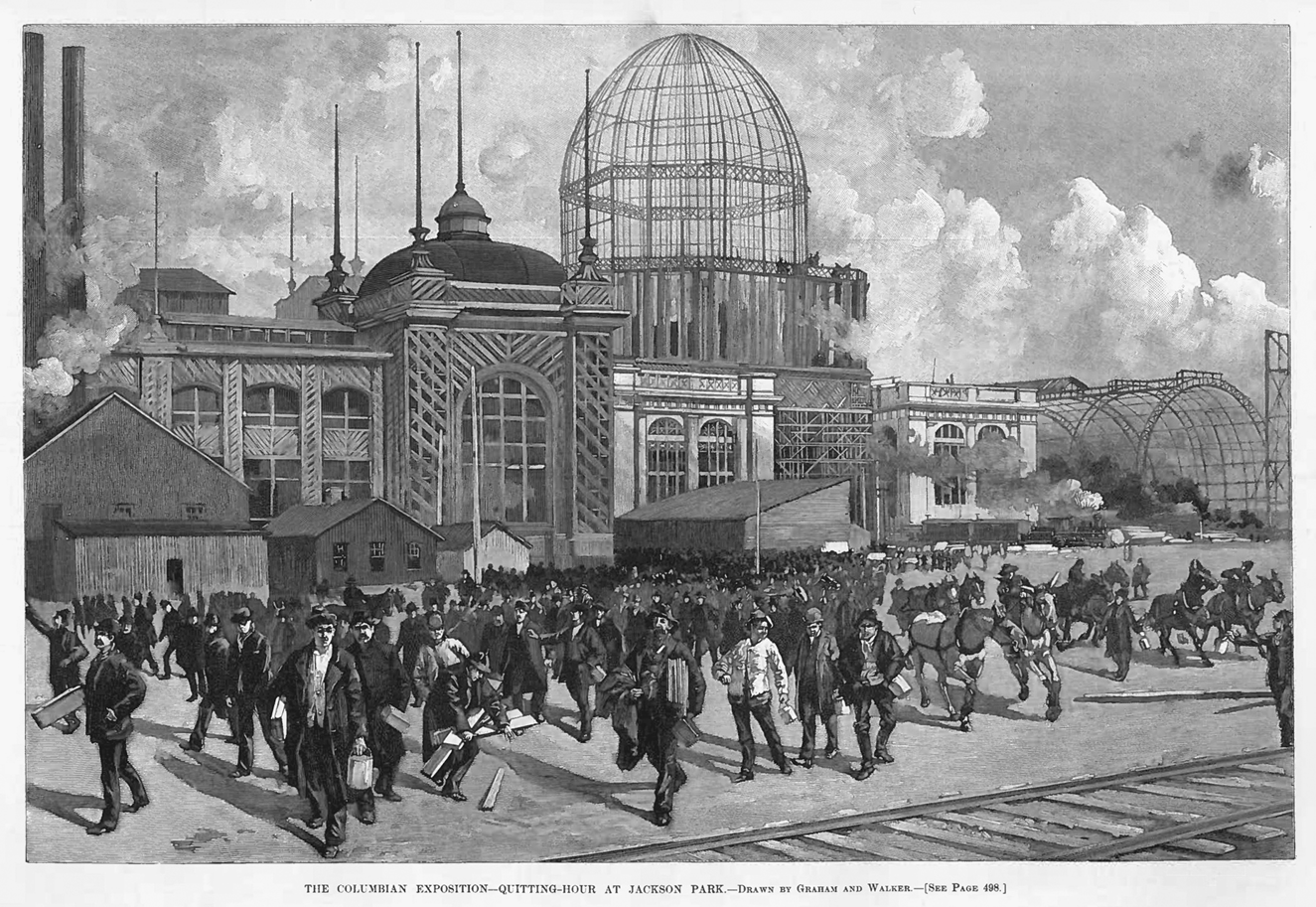
A modest building project involving a small onsite crew and no electrified tools, the Japanese pavilion appeared to reinforce—if only optically—the modern, transformative power of Jackson Park's Euro-American workforce. Indeed, the exposition's settler-colonial narrative found solid footing at the construction site, where visitors watched as energetic throngs of predominantly white men, both “native”-born and immigrant, denatured wild marshlands to raise an elite, utopic civilization (Fig. 4). Delayed by accidents, inclement weather, and budget shortfalls, the fair's realization was no easy feat, but it symbolized for millions the skill and indefatigability of American workers at a crucial moment. Chicago in the 1890s was a city battered by economic downturns, high unemployment, volatile labor relations, and the corrosive effects of post-Reconstruction racism; moreover, the Gilded Age United States, in which epic booms and devastating busts rattled even the securest of Americans, was struggling through an identity crisis. Of the era's sociocultural anxieties, historian Alexander Rose writes: “The American ‘character’ was disappearing before their very eyes, a victim of mass immigration, uncertainty, and financial panics.”Footnote 50 If, as Shari M. Huhndorf submits, the “visions staged at Chicago . . . promised observers a more stable future in which middle-class white Americans would retain their dominance at home and wield more power abroad,” the fair's construction forged the frameworks for these visions.Footnote 51
“The Columbian Exposition—Quitting-Hour at Jackson Park.” Drawing by Charles S. Graham and Dart T. Walker, from Harper's Weekly, 21 May 1892. Author's collection.

Staging Native Work: Domestic and Reproductive Labor at the “Eskimo Village”
On the outskirts of the White City, far from the Court of Honor, another conspicuous display of human labor began nearly six months before the fair's official opening. The spectacle that awaited paying visitors to the newly established “Eskimo Village”Footnote 52 was of a different scale than the fairgrounds’ congested, noisy, and hypermasculine construction site. But the village, too, was an active site of labor, where Inuit families performed arctic Indigenous life for paying audiences. Like the Midway Plaisance's international attractions, the commercial Eskimo Village promised to introduce visitors to unfamiliar customs and peoples, but its White City location, in the very northwest tip of the exposition grounds, subtly conveyed to fairgoers that it would perhaps edify more than divert. Two entrances to the White City—one of which was the closest to the South Park train station—flanked the village, furnishing the remote attraction with foot traffic. The Eskimo Village was one of only three attractions in the White City (along with the Japanese teahouse and the cliff dwellers exhibit) to charge additional admissions fees of twenty-five cents; it made nearly six times the money of the Midway's American Indian Village, due in part to its advanced opening.Footnote 53 Much of the village's revenue never made it to the Inuit families.
Although Eskimo Villages (Esquimau[x] in French) were staples of stateside expositions before and after Chicago, presentations of American indigeneity plugged directly and deliberately into the 1893 Exposition's colonialist narrative. Indeed, as historian L. G. Moses contends, the fair curated the American Indian “image” by offering both static anthropological displays and living exhibits in the form of ethnographic villages or encampments:
[At the fair, visitors] could marvel at both the observers and the observed: the adventurer-anthropologists who brought back from the field trophies of their scholarly pursuits, laying them out in such a fashion as to confirm evolutionary progress and the superiority of white-skinned peoples; and the American Indians at work or play, those living anachronisms whose societies verged on extinction.Footnote 54
Colonialism's symbolic unboundedness at the fairgrounds drew condemnations from notable Native leaders, including Rain-in-the-Face (Hunkpapa Lakota) and Simon Pokagon (Pokagon Band of the Potawatomi), the latter of whom stated in no uncertain terms: “In behalf of my people, the American Indians, I hereby declare to you, the pale-faced race that has usurped our lands and homes, that we have no spirit to celebrate with you the great Columbian Fair now being held in this Chicago city, the wonder of the world.”Footnote 55 Furthermore, as Melissa Rinehart's research enumerates, a number of the fair's Native employees engaged in open acts of resistance, including the Inuit performers’ well-publicized legal battle over living conditions and pay, their partial disbandment, and the creation of a second Eskimo Village outside the gates.Footnote 56 Still, the fair supplied temporary jobs for hundreds of American Indians, not just in ethnographic villages, but as recruiting agents, traveling collectors of Native objects, exhibit curators, and security guards; Native children performed at the Bureau of Indian Affairs’ assimilationist Indian school exhibit.Footnote 57
Much has been written about the performers of the popular ethnographic villages, so I provide only a bit of context here. Although Frederic Ward Putnam's Anthropology Department oversaw the vast majority of the living exhibits, private agents and fair promoters negotiated the terms of employment with individual families or tribal communities, rather than adopting a boilerplate contract that standardized practices. Perhaps not surprisingly, then, reports of transportation and living conditions, performance expectations, clothing requirements, hours, pay, and policies on personal behavior paint an inconsistent picture of living exhibit labor. In addition to staging daily life, selling handicrafts, demonstrating cultural customs, and interacting with fairgoers, villagers periodically performed in commemorative fairground spectacles, such as a reenactment of Columbus's arrival on Guanahani (now San Salvador, the Bahamas) in which American Indian villagers played the Taíno.Footnote 58 As Rosemarie K. Bank articulates, those employed in living exhibits possessed “the dual natures of all performers: personhood and character . . . even the quotidian activities the Indians performed became a ‘show,’ a representation of the activities presented.”Footnote 59 The thin boundary between self and performer proved especially porous at the Eskimo Village, where Inuit women carried, bore, and nurtured infants under the intrusive gaze of fairgoers.
The Inuit journey to Jackson Park began in Labrador, Canada, where agents from the Arctic World's American Exposition Company recruited twelve families to populate the commercial exhibit. Records suggest that between fifty-seven and fifty-nine people and thirty-five dogs traveled south on the schooner Evelena, landing in Boston on 14 October 1892 and then proceeding to Chicago.Footnote 60 “They have brought with them their own reindeer, snow shoes, and sleds, and everything essential to a complete furnishing of their village, and will carry on their native domestic life, as they are in families,” reported one newspaper.Footnote 61 The Boston Globe marked the families’ arrival in far more derogatory terms, noting that the “queer looking” Inuit peered down from the ship's railings “with their eyes protruding from their flat, flabby faces.”Footnote 62 The majority of the families hailed from “established settlements near Moravian missions” and trade outposts in Labrador and “thus were familiar with Euroamerican practices and spoke English; the other two families,” writes Curtis M. Hinsley, “were deliberately recruited from farther north and had had much less contact [with non-Indigenous peoples].”Footnote 63 As Jim Zwick notes in his history of Inuit performers in the United States, “[t]he spectrum represented, from the ‘heathen aborigines’ to the ‘partially civilized’ of the commercial and missionary outposts, was intentional.”Footnote 64 Six years after the Dawes Act dissolved tribal land rights in a bid to assimilate Native Americans and facilitate Western expansion, “spectrums” of Indigenous representation at the fair assured fairgoers that assimilation, one of several colonialist solutions to the “Indian Problem,” worked.Footnote 65
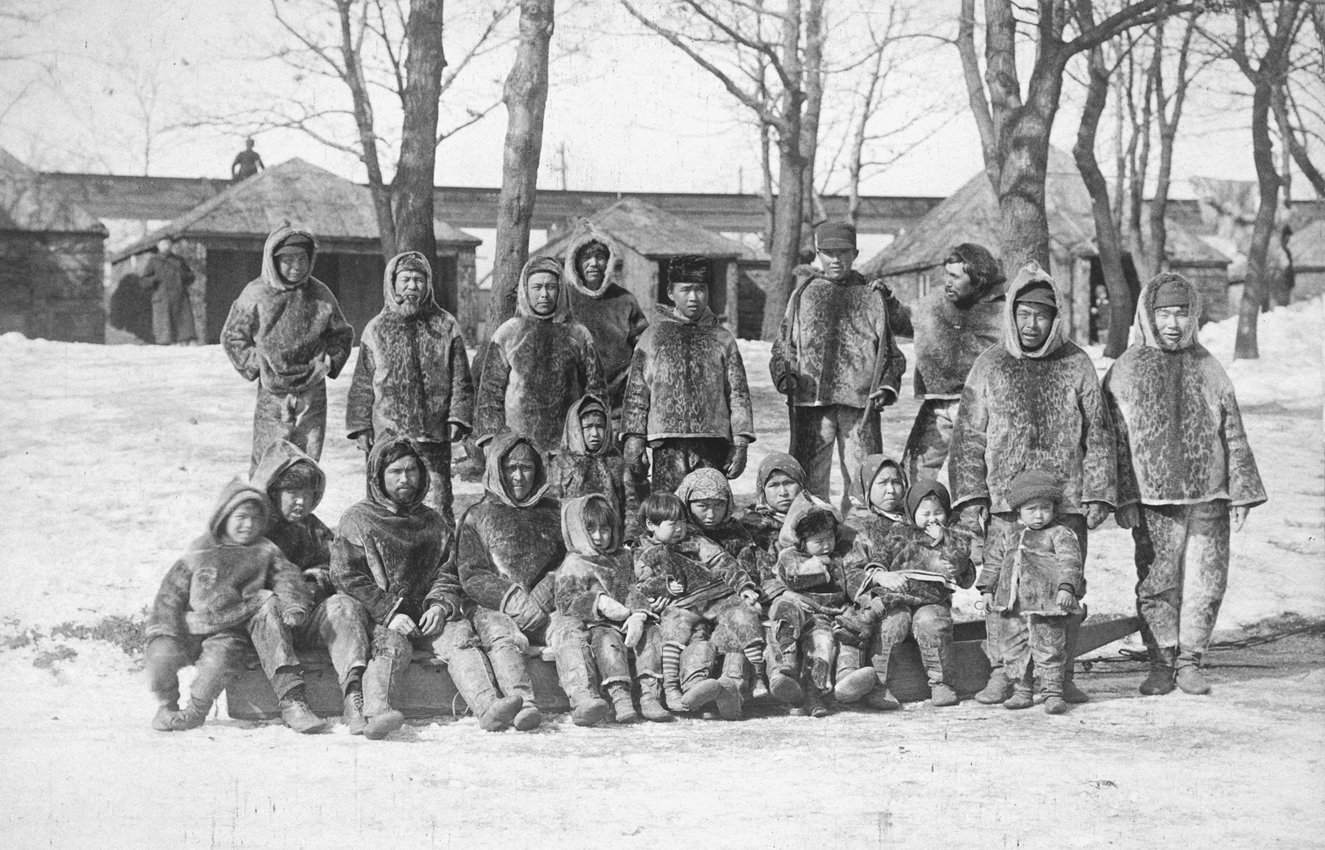
The Inuit arrived in Chicago on 17 October and by the end of the month had built their village at Jackson Park: twelve huts and a Moravian chapel. Agents arranged the families’ advanced arrival to provide time for acclimation and to avoid the Arctic's most dangerous seafaring season. However, almost immediately concessioners began charging admission to the village; the exhibition of Native work began. A high board fence with two openings encircled the village: one allowed Inuit to move across the lagoon (either by canoe or sled, depending on the weather) to “drum up trade when business [was] dull”; the other admitted “the victim whose curiosity ha[d] been screwed up to the 25 cent point,” according to one dissatisfied early visitor.Footnote 66 Once through the outer fence, visitors could explore the village grounds or gain entry into huts to watch the families at work and play (Fig. 5). Throughout winter 1892, visitors observed adult villagers dog sledding, cracking whips, smoking pipes, tending to young ones, and carving trinkets out of bones, among other activities. Children assisted their elders in daily tasks and played on the frozen pond.
“Esquimaux Villagers.” Photograph by C. D. Arnold. University of Chicago Photographic Archive [apf3-00028], Hanna Holborn Gray Special Collections Research Center, University of Chicago Library.

Whereas embodiments of Euro-American masculinity defined the fairgrounds’ construction site, the maternal and domestic work of Indigenous women proved central to the prefair Eskimo Village, with three babies arriving in the Inuit's first month in Chicago and a fourth in January. Like the famed incubator babies of the early twentieth-century world's fairs, the Inuit babies were at times marketed as signs of a shared humanity, of experiences common to all races and cultures. At other times, the popular press portrayed them as fledgling specimens of a peculiar and disadvantaged population, none more so than Columbia Susan Manak. Nearly seven months’ pregnant with her fourth child when she arrived in Chicago, Susan (or Sarah or Sally) Manak gave birth to a girl on 29 October, according to official records, though newspapers reported the date as 1 November.Footnote 67 The two-months’ premature Columbia (her name an explicit homage to the fair's colonizer-namesake) was dubbed the official baby of the World's Columbian Exposition. Celebrations enlivened the Eskimo Village, with spectators invited to witness the festivities; one such visitor reported that even the dogs were treated to a special meal in Columbia's honor. P. M. Daniels, president of the Arctic World's American Exposition Company, sensed a “lucrative opportunity” and encouraged local well-wishers to “visit and gift the baby and mother.”Footnote 68 Newspapers published conflicting reports of Columbia's appearance and health, calling her both “fat and blue-eyed” and “very frail.”Footnote 69 One fair administrator expressed his displeasure in Columbia's aboriginal parentage, remarking: “It was a pity an American child couldn't have had the honor of being the first born on the fair grounds.”Footnote 70 The fact that Inuit were likely the only mothers birthing at the fairgrounds seemed to evade him.
Perhaps because of her prematurity, Columbia died at between one week and ten days old. As the Chicago Inter Ocean reported in a primitivizing obituary, Columbia was “First in Life and Death”: “The little one was frail from her birth. As soon as the parents realized that she was dead they struck up a weird sort of a hymn in their native language, in which they were joined by several friends.”Footnote 71 The Manaks held a private funeral service in their tent, officiated by an Episcopal clergyman, before little Columbia was transported and buried at the nearby Oak Woods Cemetery. The fairgrounds stayed open for visitors; the removal of Columbia's body from the White City, then, was in all likelihood witnessed by the public. It remains difficult to link Columbia's premature birth and death medically with Manak's difficult journey to Chicago or the Eskimo Village's inadequate living conditions; regardless, within the Chicago World's Fair, a purpose-built playground for promoting pseudoscientific colonialist ideologies to thousands, the public passing of Columbia potentially signaled an Indigenous people's expected decline in an age of rapid modernization. A Chicago Tribune obituary for Columbia gently correlated her premature death with the future demise of her entire tribe: “True, for part of the year there will be frost and snow above her grave, but all the long summer there will be green grass, and waving trees, and sweet flowers—so her grave, as her short life, will be different from the last resting-place of her race—the Esquimaux of Labrador.”Footnote 72
Soon the other Inuit babies made their entrances, including Christopher Columbus Tuktootsina, Kotuktooka (Evelina Cooper), and Nancy Helene Columbia Palmer, Columbia Manak's successor as the official “World's Fair Baby” and a future career performer. Promoters advertised the babies as a must-see attraction, and visitors to the prefair village witnessed the work of actively caregiving mothers, who customarily kept to the huts in the winter months. Recounted a visitor in Washington, DC's National Tribune:
[O]ne woman carried her baby in a seal-skin pouch on her back, but little Christopher [Columbus] was in a little hammock sound asleep. He will be worth a million dollars before the Fair is over, as everyone gives him money for his name. In the last hut we visited there was a young-looking woman sitting by a little wooden cradle. She could speak our language very well, so we had quite a chat. . . . Her name was Esther.Footnote 73
“[T]o see [the Inuit] in their native costumes, with their natural surroundings,” attested the author of his January 1893 visit, was “fully worth $5.”Footnote 74 But another prefair tourist, a thirty-year-old white woman, was largely underwhelmed by the village's denizens. Tired of watching the “men lounging around and smoking their pipes,” she sought out the village's women in one of the huts. She found them wanting in appearance and as parents and housekeepers. After glibly criticizing the huts’ size, smell, and condition, the visitor denounced Inuit personal hygiene: “I saw also a washing tub sitting on a stool with about two gallons of very dirty water in it, the only indication I had that washing had been entered upon their program of life.” Stepping outside of the hut, the visitor contemplated whether the villagers “really had any intelligence, any aspirations, any soul” as Inuit women attempted to hock fur pocketbooks for quarters and sell access to additional huts for pennies.Footnote 75
Given the prominence of white supremacist theories of Native parturition and maternalism circulating in the 1890s, it is probable that tourists regarded Inuit childbearing women as not just culturally different from white women, but biologically distinctive. By 1892, much of what was believed about how Native women birthed babies came from white anthropologists, natural scientists, missionaries, traders, and adventurers who recorded their observations of Indigenous life in North America, Australia, Africa, and the Pacific Islands, to name the most frequently surveyed. According to eighteenth- and nineteenth-century travelogues, childbirth within aboriginal cultures was not the harrowing, stressful affair it was within white European and American societies. Travelers purported witnessing mothers squatting casually in fields to deliver their infants and then, following the briefest of unattended recoveries, resume normal physical activities with newborns wrapped to their bodies. “The savage women are never sick at confinement,” wrote one eighteenth-century French Canadian official; “when they have just given birth they go to wash their child in the water and do not discontinue doing the housework as usual.”Footnote 76 Such stories were, at least in part, “confirmed” by the visibility of the fair's Inuit childbearing women, who remained in the village for labor and delivery and participated in postpartum exhibitions of their World's Fair babies. Furthermore, among the most prevalent theories of race-based variations in childbirth—adopted within the burgeoning field of obstetrics and gynecology—was that Native women labored relatively pain-free and with few complications, a direct contrast to the agonizing labors suffered by bourgeois and elite women of European heritage. In “Making a Fur Coat: Women, the Labouring Body, and Working-Class History,” Joan Stangster confirms that to Euro-Canadians, “Inuit women's bodies were . . . more robust, closer to nature, and able to endure a measure of pain and physical labour that white women could not, a cultural construction that obscured the material and social basis of women's work.”Footnote 77 A captioned photograph of a mother and her baby (Francisca Examiner Deer, named through a San Francisco Examiner baby-naming contest), taken at the California Midwinter International Exposition, concretizes such assumptions and positions the Inuit postpartum mother as desirous of a curious white audience:
The photograph herewith is of an Esquimaux woman and her four-day-old infant, born in the village of her people at the Midwinter Fair. A peculiarity among uncivilized people is the fact that maternity is accompanied by neither pain nor weakness, hence it is no matter of surprise that this woman was able to receive visitors and show her wee babe in swaddling clothes, appreciative as she was of the acute desire upon the part of white people to see infants of uncivilized mothers, and their willingness to pay well for the privilege. This desire she turned to good profit, by holding a levee for curious visitors through all hours of the day. The skirt and dress hanging on the inner walls of the cabin were gifts to the woman, who retains them as hut decorations, rather than subject them to the uses of wear.Footnote 78
Whether Inuit childbearers, recruited along with their husbands, children, and extended family members to populate Eskimo Villages, were “appreciative” of prolonged colonialist attention is debatable. Certainly, they marginally profited from being exhibited as domestic laborers; because visitors presented financial and material gifts directly to mother and child, such income ostensibly circumvented the village's acquisitive managers. But exoticism, fetishism, and ethical questions of agency and consent cling to the fair's living exhibits, troubling historical readings of “performed” Indigenous motherhood in particular. In a counterfeit village devised to reify ethnocentric biases against “uncivilized” cultures, the Inuit worked in public, their very presence—and modes of subsisting, childrearing, communicating, and trading—confirming the righteousness of colonization. If, within the fair's myth of progress, the Jackson Park construction workers were necessary to help industrialized nations thrive, the work performed by the Inuit epitomized a community-based culture ill-matched for modernity and the aspirational century to come.
Fair Workers in the Archive
When visitors handed over their quarters to witness White City buildings rise or the World's Fair Baby nestled in her mother's arms, unique forms of performance and spectatorship transpired. In analyzing the Jackson Park fairgrounds as a performance site, I am purposely troubling a number of assumptions we deploy to define the categories “work” and “performance.” First, both explode the notion that labor divisions (paid–unpaid, white–blue collar, intellectual–manual, skilled–unskilled, masculine–feminine) are unambiguous and discrete. Elaborating on Russell Muirhead's expansive definition of work as “endlessly differentiated,” theatre historians Elizabeth A. Osborne and Christine Woodworth have recently urged for “a broader . . . more amorphous understanding of the concept of ‘work’ . . . [that] encompasses paid and unpaid labor, the application of embodied effort over time in the creation of a product or service (and, indeed, the product itself), and the ways in which labor constitutes countless identities.”Footnote 79 Construction workers scaled mammoth structures, hauled equipment, and moved earth in an embodied spectacle of industrial labor, while villagers staged unpaid domestic work and simulated trade, travel, and cultural customs within a for-profit setting. Furthermore, the steady arrival and exhibition of Inuit “World's Fair” babies encouraged visitors to contemplate the reproductive work and biological fitness of Indigenous bodies, a process haunted by the public anatomizations of racialized Others like Sara Baartman. Second, the particular impermanence of these workers’ products unavoidably contours historiographical readings of the Jackson Park labor spectacles. Although theatrical work, often hidden from public view, culminates in and is evaluated through an observable but ephemeral performance, the majority of other labor enterprises (especially those in manufacturing, technology, transportation, and housing) are judged by the stability and durability of what they produce. In the case of the White City construction workers, their early erasure from the fair's panoramic landscape was necessary to sustain the mirage of a utopic metropolis, of a grand city rising from the marshland of Chicago and then collapsing back into it. The White City was always destined to crumble. Like other World's Fairs before it, its structures were designed and built to be temporary: the builders set out to create a temporary city, and that they accomplished. By 1896 the “monumental buildings of the 1893 World's Columbian Exposition had all but disappeared from the landscape of Jackson Park,” leveled by vandalism, fires, salvage companies, and neglect.Footnote 80 Similarly, the Eskimo Village and the performances of labor it showcased disappeared with the fair's closing. But the “public” deaths of several young Inuit (to disease as well as premature birth complications) marked a different kind of disappearance, one that reporters hinted could be the natural consequence of biological inferiority.Footnote 81
As rides were dismantled and shops shuttered in November 1893, the exposition's many employees vacated the grounds in waves, including those who populated the ethnographic villages of the White City and the Midway.Footnote 82 Some villagers returned home, while a select few remained in Chicago. Still others signed on with touring companies or were coerced by entertainment agencies to continue working as “exotic” talent for living exhibits, with a number of the Columbian Exposition's Inuit villagers reappearing at the 1894 California Midwinter International Exposition and the 1909 Alaskan–Yukon–Pacific Exposition. When the fair ended in late 1893, the archive began. This preservation process, of course, reflected the priorities of exposition administrators, as well as the dominant US American culture. Although the construction workers’ performances had been captured for posterity by commissioned photographers and recorded in guidebooks, speeches, newspapers, and visitors’ journals, their names and individual stories are largely lost to history, unlike the oft-named men (and women) who planned, financed, and orchestrated the fair. In a validation of his work in the notoriously materialistic Gilded Age, then, the manual laborer is preserved in image and text as a body-at-work: no more, no less. With some notable exceptions, the World's Fair archive largely speaks of and for employees of the Native villages and international pavilions. As Diana Taylor has articulated, the archive's foundational Eurocentricism ensures that, in a meticulous process of remembering and forgetting, its record of transcultural encounters benefits the colonizer: “The West has forgotten about the many parts of the world that elude its explanatory grasp. Yet, it remembers the need to cement the centrality of its position as the West by creating and freezing the non-West as always other, ‘foreign,’ and unknowable.”Footnote 83 Still, despite this relentless colonizing force, the humanity of the fair's Native workers is detectible even in the most patronizing texts or fragmentary images. If we look closely enough, for example, we discover Susan (but called Sarah) Manak in “Searching for the Cinderella,” a Chicago Tribune fluff piece covering a citywide contest. The “good natured little woman with a broad beaming smile” was, according to the writer, the most “interesting candidate” among Chicago's women to try on the slipper.Footnote 84 In a brief acknowledgment of Manak's labor (and loss) at the White City, the piece noted she was mourning her infant daughter Columbia at the time of her shoe fitting. The slipper, incidentally, was too small.
• • •
In the second act of the Joffrey's “new” Nutcracker, Marie's dreams transport her to the completed fair. The ethnic dances, once performed in the Land of Sweets, now take place on fittingly exoticizing stages: the international pavilions of the Midway Plaisance and the adjacent Buffalo Bill's Wild West show, with the latter hosting a rodeo-inspired retooling of the Russian candy cane dance led by Buffalo Bill Cody himself. Although the casting of majority white dancers in Eastern—and edible—identities (Chinese tea, Arabian coffee) remains problematic, resituating the ethnic dances at the Midway explicitly acknowledges the historic spectacularizing of bodies of color for Anglo-American audiences, both at the fair and in decades of national and international Nutcrackers.Footnote 85 In many ways, then, the Joffrey's Nutcracker does what the Chicago World's Fair archive only partially achieves: it renders visible and consequential not just working bodies—of Chicago's “native-born” and immigrant laborers, the Midway's imported performers, and the Joffrey dancers—but working people, people who cannot be summarily divided into the constitutive parts of body, mind, and soul. Surrogates of the fair's historic laborers, once commodified and then obscured by the exposition's administrators, now occupy perennial spaces in the US American ballet repertoire. Suspended between the invention and realization of the World's Columbian Exposition, the Nutcracker's Christmas Eve revelers clasp hands, synchronize their footfalls, and form a circle of dancing bodies, a whirring engine not of workaday labor but of cultural remembering, community building, and joy.
Meredith Conti is an assistant professor of theatre at the University at Buffalo, SUNY and a historian of nineteenth-century performance and popular culture. She is the author of Playing Sick: Performances of Illness in the Age of Victorian Medicine (Routledge, 2018) and is working toward a new monograph, Gunpowder Plots: A Cultural History of Firearms and the US American Theatre. Her scholarship has appeared in Theatre Journal, Theatre Topics, Journal of American Drama and Theatre, and Studies in Musical Theatre, among others. With Kevin J. Wetmore Jr., she is editing a volume of essays entitled Theatre and the Macabre, forthcoming from University of Wales Press.