Despite its legitimate and recurring claim to be ‘the largest voluntary political youth movement in the world’ (sometimes adding for good Cold War measure, ‘the free world’), the Young Conservatives (YCs) were subject to much ridicule.Footnote 1 In ‘The blood donor’, broadcast on BBC television in 1961, Tony Hancock craved:
To do one unselfish act, with no thought of profit or gain is the duty of every human being – something for the benefit of the country as a whole. What should it be…? Become a blood donor or join the Young Conservatives. But as I'm not looking for a wife and I cannot play table tennis, here I am.Footnote 2
Through the 1960s, the YCs were thus popularly disregarded. BBC TV's That was the week that was satirized the YCs as puppets of the party leaders. Impact, the YC national journal (1964–9) felt this ‘was all very funny’, but ‘the tragedy remains that this is the way in which most people think of the Young Conservatives’. Although it vowed to ‘give the lie to this dancing puppet image and get around … to representing the vigorous and progressive youth of our generation’, by 1967 it found the ‘unhappy truth is that we can still be effectively satirized as an effete social club catering only for political lightweights’.Footnote 3
Historians have been equally as dismissive. Studies of youth culture have focused on cutting-edge sub-cultures or youth ‘problems’, rather than the more conformist YCs. The YCs' social dimension placed it outside the métier of political historians and orthodox definitions of ‘the political’. Its social character has not been as alluring to policy- and election-minded historians as it was to aspiring politicians and partner-seeking middle classes at the time. The YCs, this article seeks to show, can redraw, subvert indeed, the history of youth as much as the norms of political history. That the YCs have fallen between the preoccupations of both social and political history explains their absence from recent studies of this period.Footnote 4
Yet the question of youth was rarely absent from politicians' minds, since around 7 per cent of the electorate at each general election was made up of new young voters. And interest was accentuated in this period by anxieties over ‘youth culture’ and the voting age reduction to eighteen in 1969. Peaking in 1949 at 160,000 members, although with unofficial estimates including members aged under twenty-one as high as 600,000, the YCs were part of Conservatism's public image.Footnote 5 The YCs hint that, in the 1950s, this image was more youthful than the Edwardian stereotype, and decidedly so by contrast with the aged party of the 1990s, dubbed a ‘gerontocratic rump’ by David Jarvis.Footnote 6 If sometimes joked about in the 1960s, the YCs were a dynamic presence in the 1950s. Opponents estimated that in 1955 ‘more young men and women under 30 voted Tory and worked actively for the Tories this time than in any election since the war’. The Conservative youth section was relaunched as the YCs late in 1944 and they were a key part of the organizational review that followed the 1945 election defeat. They were not only a revival of predecessors like the Junior Imperial League, but in a long Conservative tradition of largely social organizations that built electoral support. Pugh describes the late Victorian Primrose League as a ‘genuinely popular organization’, whose role in the ‘political socialization’ of voters came by ‘embedding the Conservative cause into the routine social life of many communities’ via a ‘vast array of social activities’, lending it a ‘degree of immunity from the vagaries of political issues and policies’.Footnote 7 The same might be said – although Pugh does not – of the YCs. The YCs' associational culture and social reputation was its key as a political resource. It recruited effectively by offering a mode of political affiliation for the un-political, in what such success hints was a relatively apolitical culture. The YCs forged party political identities, but also the partly political identity of middle-class voters.
Despite decline from their membership peak in the late 1940s, the YCs retained a significant competitive advantage. By 1965, one third smaller than at its peak, it had double the number of Labour Party Young Socialist (YS) branches and each branch (averaging eighty members) double the members. Even the Young Britons, the organization for those younger than the YCs' starting age of fifteen, formed in 1925 to counter Socialist Sunday Schools and re-started in 1947, reached 8,000 members in 1956 (at which point there was no official Labour youth movement).Footnote 8 Nevertheless the YCs' influence cannot be read just from the quantity of its members and its social presence was most apparent in the late 1950s. After The Macleod report into the YCs' falling membership, debate ensued about whether a smaller membership of greater political quality was needed, and the ratio of social to political activity needed adjusting.
The world being excavated here is lost in that it was succeeded by a smaller, ideologically motivated youth cadre in the 1970s. By 1978, when South Hendon YCs posed for Saatchi's ‘Labour isn't working’ poster, membership was 27,000 and during the 1980s they were matched in size by the more transparently political Conservative students. The two generations of Young Conservatism are encapsulated in the style of two internal histories: Holroyd-Doveton's antiquarian, rose-tinted, anecdotal amble through his time in the 1950s' and 1960s' YCs and Evans's more schematic analysis of the 1970s and after, befitting of a libertarian sectary.Footnote 9 Those of the 1980s were ‘libertarian louts’, according to Stephen Howe, and, despite their pretensions, ‘know-nothings’. The Federation of Conservative Students that prevailed in this image of young Tories (the YCs remained ‘wet’) was disbanded in 1986. In Jo-Anne Nadler's witty recall, they were a species of what comedian Harry Enfield lampooned as ‘Tory Boy’: acne-strewn, ambitious geeks, and abrasive ideologists, pillorying CND and the GLC, distributing CIA leaflets in Red Square and sectarian – ‘blue trots’, she dubs them. The relatively few women in it were ‘more likely to pay homage to Hayek than dance around their handbags’. Nadler's Wimbledon YCs were more sedate: a ‘throwback to the social clubs of the 1950s … hardly political at all and definitely not ideological – rather what the Tory party itself had been before the advent of Thatcherism’.Footnote 10
Ewen Green has challenged this notion that Conservatism was not best understood ideologically before Thatcher. Green accepted that, as Michael Oakeshott argued, Conservatives thought they had ‘not a creed or a doctrine, but a disposition’, but argued that this was nonetheless ‘indicative of a particular view of the world, in which being “non-ideological”, “atheoretical”, or even “apolitical” were intrinsic parts of adhering to Conservatism’. This de-politicizing urge – or declaring ‘the end of ideology’ as Daniel Bell did (in what would have been an apt slogan for the YCs) – was a political act. Green is anxious that historians should not uncritically replicate the rupture that Thatcherism is assumed to mark. A graphic illustration is how Conservative historians have tended to obscure or neglect ideology and Labour historians have craved it. Contradictory as it seems, Conservative appeal has often been explained by its lack of apparent ideology and Labourism's shortcomings by the same absence of ideology. Instead, as Leon Epstein described, that Tories were ‘said to reject rationalistic and a priori doctrine’, were ‘tireless in disclaiming the type of ideological prepossession considered the curse of socialism’, and prized ‘values regarded as “given” in the British political inheritance’, requires investigation.Footnote 11
Tempting as it is to ascribe the YCs' neglect in historical accounts to its being simply social, this would be to ignore the varied opinion behind its pliant public face that Catherine Ellis has identified in its 1960–6 policy groups.Footnote 12 Equally, to dismiss the YCs as simply social is to ignore the purpose and effect of this social dimension. YCs' values, social life, and practices disclose as much to historians as formal political pronouncements and are just as imperative to deducing, as this article undertakes, the public perception and internal culture of the YCs. Indeed since YCs, in particular, were apt to regard their politics as an instinctive mode of living and thinking, tilling this social terrain is essential to understand the political, as much as social, meaning of the YCs.
Such an approach avoids some propensity in political history to privilege certain sources and a received set of parameters. One model for this approach is Raphael Samuel's evocation of the ‘Lost world of British Communism’: a vivid, nostalgic portrait, transcribing a political way of life as it passed away. Charged with Samuel's own participation, it articulated a sense of political belonging that, whilst not unrelated to social being (class, gender), was far from determined by it. As such, it has been claimed as one of the ‘founding texts’ of the ‘new political history’.Footnote 13 Samuel's study might seem to have little application to young Conservatism, since by contrast with British Communists the notoriously sociable YCs revelled in an apolitical style. But Samuel offered a method of exploring the world of the politically affiliated, from ideology to the rituals of branch meetings and how such identities inflected their everyday behaviour and outlooks that is eminently applicable to historians exploring the world the YCs inhabited. Samuel's quasi-anthropological approach drew on deliberately diverse sources: novels, family life, and the detritus of political life, besides political historians' regular fare. Traditional sources – policy, leaders, and elections – were used to explore the cultural history and symbolic meanings of politics and the mentalities of participants. Collapsing boundaries between political and cultural history enables the very category of ‘the political’ to be interrogated. Indeed, by this approach, not in content, but in form – close knit families, relative powerlessness, aping betters – the sub-cultures of British Communism and Young Conservatism could resemble each other.
Moreover, Samuel's approach attends to some criticism of Conservative historiography. This maintains it has focused too readily on national leadership, institutions, on ‘high’, not popular, Toryism, and, by dint of this, on the mobilization, rather than on the construction, ideology, and appeal of Conservative support. In short, it worked within an orthodox conception of ‘politics’.Footnote 14 Even more innovative recent works – by Green, Martin Francis, Mark Jarvis, and Philip Williamson – centre on party elites.Footnote 15 Histories of popular Conservatism scarcely mention the YCs or else, in David Jarvis's work, construe them chiefly in terms of a gendered appeal.Footnote 16 Besides the YCs' own contemporary significance, then, this article exploits them to explore historiography, youth, and political culture. It outlines key aspects of YC internal culture, debates about the impact of social change on YC fortunes, and the balance of political and social activities resulting from The Macleod report and then locates the YCs in terms of conservative, and the wider political, culture.
I
For Philip Abrams and Alan Little, the YCs offered ‘organized gregariousness for the children of the middle class’ and tapped into ‘the culture of the suburbs’. Their politics were as semi-detached. Angela Povey, a receptionist, regular council candidate, and Birmingham YC vice-chair by 1969 explained: ‘a number of young people join tennis clubs – I joined the Young Conservatives’.Footnote 17 The style in local YC publications was light and carefree, affecting an everyday sociability. Jennifer Titchmarsh, a secretary, was profiled in Looking Right as ‘Ginny Jen’ whose likes were ‘chips with everything (including boys)’ and ‘boys with everything’. Branch reports bantered about canvassing escapades, alluded to excess at social events and occasionally to ‘all night drinking, smoking and telling dirty stories with those nasty YC boys’. This style was further cultivated in light-hearted titles for when discussion did turn to politics proper (with a certain politics secreted in the wit). Templedown YCs debated whether ‘Peking is the chink in the iron curtain’ in 1961 and the Filey holiday weekend 1958 promised YCs not ‘immature political theorists’ but ‘politics with a smile’; a talk by a pharmacist, ‘we dispense with accuracy’; and debated the motion that ‘a greater contribution has been made by Marks and Spencer than by Marx and Spencer’.Footnote 18 The philosophy espoused by Buff Orpington, ‘life is a funny proposition, but why worry? Join the YCs and be assured of a happy evening’, neatly echoed Oakeshott's view that to be Conservative was to prefer ‘present laughter to utopian bliss’.Footnote 19
In rare moments when YCs did outline a worldview, they professed ‘a duty to God, the queen, my country’, but that beyond this, ‘the philosophy underlying a political party often is hidden’. Conservatives were apt to think of themselves, as Viscount Hailsham (Quintin Hogg) paraphrased Oakeshott, practising ‘not so much a philosophy … as an attitude’.Footnote 20 Peter Walker, YC national chairman 1958–60 and president of the National Advisory Committee in 1968, was one such personification. According to a fellow MP, Walker was ‘the archetypal YC … successful, energetic, confident’ and ‘aggressively non-intellectual’. For the more policy-minded, the Bow Group grew to 800 members by 1960.Footnote 21
‘Young Conservatism is built on themes of leadership, responsibility and service’, Abrams and Little deduced, ‘and not on issues of policy’. ‘Most members remain almost a-political’, but embodied and identified with a ‘compact of feeling for the nation … the established order … not the politics of party conflict’. Birmingham's Looking Right outlined in 1959 how the YCs provided ‘entertainment and friends’, the ‘chance of becoming knowledgeable in the nation's problems’ and to ‘play a useful part in the life of the city’.Footnote 22 The same ethos was apparent in the Young Britons, which adopted the slogan ‘Learning to serve’ in 1955 and encouraged students in public speaking, hobbies, and education. It insisted a ‘portrait of the queen should be displayed at all branch meetings and the national anthem … sung’, but equally ‘emphasized that party politics play no part whatsoever in our organization’ and that a Conservative ‘does not just believe in the party but believes in the country’ and building the ‘citizens of the future’. Young Britons' games ranged from sports to handicrafts to quizzes on ‘Trade winds and Empire products’ and ‘how many litter baskets are there in the public park?’, although any ‘obvious propaganda of the games is dropped in practice’. The effect was to ‘associate the Conservative Party with loyal, patriotic, nationalist and imperialist sentiment' and, as crucially, ‘with fun and games’. In both the Young Britons and YCs, Jennings found, there was ‘no emphasis on party policies’. If there was more to life than politics, there was also more to politics than party. YCs contrived to wear their politics lightly. This was exaggerated by the YCs' lack of formal political responsibility and deferential sense that they should be seen but not heard.Footnote 23
In this vein, YC language avoided the potentially conflictual terminologies of opponents. Courses at the party's Swinton College encouraged YC leaders to recruit ‘all types, age groups, occupations – for want of a better word – classes’. As a commentator in the YCs' national paper (1954–8) Rightway saw it: ‘this word, short and bitter, never mentioned in front of the children and whispered only among close friends, has become a secret disease … the offender? Class.’ Politics was ideally a rather discrete sphere and discreet business – much as Geoffrey Beaman, a Conservative trade unionist and YC advisory committee member explained that the state should leave trade unions to bargain collectively and trade unions should stay out of politics.Footnote 24 Swinton College principal, Reginald Northam, told students that ‘conservatism is not a dogma but a way of life. Conservatives should show how hard they are prepared to fight for their values by the way they demonstrate them in private life. Politics should be a personal challenge and a crusade’, although Eldon Griffiths MP clarified that ‘this does not mean parading like some latterday CND’. CND were the YCs' chief competitor in youth politics in the late 1950s (and again in the 1980s) with a social and political appeal, if the antithesis of the YCs' demure style.Footnote 25
Rather, YCs stressed a service ethic and how ‘youth and dignity are not incompatible’, exemplified by (future MP and Europhile) Geoffrey Rippon, who became mayor of Surbiton at the age of twenty-six. The most obvious way in which YCs converted private into public practice was through family values, a key aspect of YCs' socialization. Nadler recalls her YC mother was ‘a typical Conservative’ since she ‘did not consider herself especially political’. Nadler took her parents' ‘seldom stated politics as a way of life’, and amongst ‘the political messages implicit in her upbringing’ was that Labour meant ‘Politics with a capital P’. The YCs were family- and home-centred: a Birmingham membership survey found that 67 per cent lived with parents in 1969. Amongst these was Stella Knight, who was ‘a YC as much by heredity as by conviction’, since her parents had met in the Junior Imperial league.Footnote 26
In the YC family, schisms were to be avoided, especially if envenomed by personal ambition. In David Walder's fictional account of Conservative branch life, when one prospective candidate, Inglis, posed an awkward question to a rival, ‘the YCs turned and looked at Inglis as one who had asked a hostile question’, frowning disapproval. YC leaders were ‘encouraged to cultivate authority’, and in turn to display loyalty to party leaders. This disposition towards figures at the top fostered the YCs' docility. This was manifest in YCs' reverence for elders and tendency to act as if ‘embryonic elder statesman’ by ‘affecting mannerisms such as the cleaning of his glasses, the deliberate cough, and the “umming” and “ahing” that he imagines are part of politics’. It entailed the prospect, so one YC modernizer in the 1960s depicted, of encountering a ‘succession of little Quintin Hoggs, little Mr. Marples, and even little Sir Edward Boyles’ at YC rallies, and was ‘useless as far as any original thinking is concerned’.Footnote 27
Ellis found that when YCs thought in the 1960–66 Policy Groups set up by Rab Butler, they thought much like their elders. On the welfare state and the individual in society, they accepted state involvement if the agencies of civil society were ineffective. This was significant – because as Green argues a preference for an organic civil society (rather than one politicized by state involvement) linked libertarian and paternalist Conservatisms and also for the YCs' practical role before and after its ‘politicization’.Footnote 28
Life in the YCs seemed one long round of endless balls. Diaries brimmed with dances, fêtes, factory visits, tennis or yard of ale contests, or beach parties. The ball was the highlight, invariably graced by an MP, dignitary, or aristocratic sponsor, providing the prized opportunity in ‘middle-class circles of mingling with the upper crust of local society’. Sub-committees planned their balls to the tiniest detail, like East Midlands YCs' insistence that the raffle should be drawn ‘out of the ballroom in order not to interrupt the dancing’. Its 1963 summer fête, held at Swithland Hall by courtesy of the earl of Lanesborough, had fifty special constables and the St John's Ambulance in attendance, and was signposted by the RAC. YC branches ran sideshows including, aptly for budding politicians, Balderton YCs' ‘greasy pole’. Extravagant advertising was undertaken in the Sunday Express and Sun for South Buckinghamshire's Ball at London Airport in 1966. Large attendances were needed to break even: in 1967, Preston needed 850 attendees to cover the hire of the Top Rank Ballroom (which loaned its ‘bunny girls’ to run the Tombola), and succeeded in attracting 1,300.Footnote 29
Elaborate planning was lavished on events from balls to table tennis tournaments, which became integral to the YCs' appeal. As Holroyd-Doveton recalls, the YCs ‘provided a complete social life’. A 1956 South Kensington survey found 83 per cent of members joined for social reasons. The glamour and scale of these events made them fixtures in the local season, just as it led opponents to feel ‘the YCs are a bally-hoo social group bent upon enjoying themselves at parties’.Footnote 30
If not in the Conservative Club, YCs assembled in local hotels or pubs, being less inhibited by drink than the left. Certainly at its outset in the 1940s, it offered social opportunities that were, so Abrams and Little have it, ‘difficult to find elsewhere’ in the suburbs. Its pitch was different to rougher urban working-class clubs or dowdy church halls, although such worlds could meet, since the Honorary Treasurer of the Central Council of Birmingham YCs in the 1960s, Kenneth Johnson, had, for example, also been chair of the Methodist Association of Youth Clubs. Nor were all events glamorous. Beetle drives were a YC staple: nothing to do with pop music or cars, but a dice game in which competitors drew sections of the insect. Others recalled that the YCs' appeal was that, compared with church groups, scouts, or Round Table, it was gender-mixed and without uniform. What the YCs practised and offered was a togetherness and sense of social belonging. ‘I was on my own’, ‘most of the people I liked seemed to belong’, ‘I joined for the tennis’ were among reasons given to Abrams and Little in 1965. If the YCs ingratiated themselves to local civil society and received unofficial support from local business, hotels, Rotary Clubs, the Women's Institute, or Young Farmers in rural areas, they were also a vehicle for assimilation into the national culture. Nadler tells how her father, a Jewish–Polish émigré, found at the Kensington YCs' Christmas dance in 1949 that ‘standing there amid the music and the chatter he did not feel like an alien’.Footnote 31
One could ‘live’ within the YCs, although this was a more outgoing, less self-referential world than many political groups. By 1965, Colchester YCs ran their own club, three hockey, two table tennis and football, tennis, and bridge teams, organized its own holidays to Majorca, and – confounding the usual merger of business and pleasure – a ‘purely political’ Blue Group. There was no uniform, apart from the Young Britons’ ‘dominion armbands’, which were downgraded to badges in 1962. As Elizabeth Wilson recalled, by the late 1960s, however, dress sense was a means of distinguishing YCs – particularly the male garb of ‘cavalry twills and paisley cravats’, by turns modern and traditional – from other activists. And a corporate style could be acquired in the form of YC scarves, blazer badges, ties (with crested badge and regional variations), transfers, car badges, key fobs, and windscreen slips.Footnote 32
YCs were also avid motorists, forever participating in rallies and treasure hunts. Publications were peppered with details of how to soup-up a pre-war Austin; reports on the Monte Carlo rally, by 1953 runner-up, Ian Appleyard; and celebrations of queues, contrasted to those during rationing, at the British Motor Show.Footnote 33 In the car, Conservatives saw evidence of a rising standard of living and sense of freedom and were more likely than Labour activists to own one. No campaign was easier to rally the more politicized post-Macleod YCs behind than Peter Walker's ‘Kill the Transport Bill’ in 1968. The National Advisory Committee discussed offering preferential motor insurance terms to YCs. Cars were also a resource for mobilizing the electorate. In Bristol in 1964, for example, the cars owned by YCs and students were identified as a factor in holding the city's North West seat.Footnote 34
Birmingham YCs boasted the only RAC-affiliated political motor club in Britain, which was formed in 1954 and based at Edgbaston's Green Park hotel. By all accounts the Club was purely social, although it was also an effective vehicle for YC membership since, as car buff and later lord mayor of Birmingham (and son of a prominent local Conservative), Peter Barwell, found, one had to be a YC to join. Even in mock driving tests and economy rallies, fun was the watchword, but the Club also served as a ‘flying squad’ at elections, ferrying voters and candidates around. Rallies were organized with typical precision: with marshals, RAC listings, and its own magazine, The Innovator. The RAC affiliation was necessary to use and signpost public roads, but also highlights how the YCs' social activity embedded it with organizations in civil society.Footnote 35
Birmingham was especially notable in this regard. Looking Right carried up to eighty adverts in a fifty-eight-page journal, which was witness to its affinities with local businesses, like the senior party. A glossy, professional production, it had impressed Harold Macmillan. Other components of Birmingham's YC culture included a drama group, the Chamberlain Players, and a Guy Fawkes bonfire party, the first of its kind in post-war Birmingham, which was attended by thousands in Small Heath. There was also a YC investment club. Aided by the Wider Share Ownership Council and a local stockbroker, this aimed to invest for YCs, their friends, and parents and dispel ‘the myth that the stock exchange is a rich man's playground’.Footnote 36
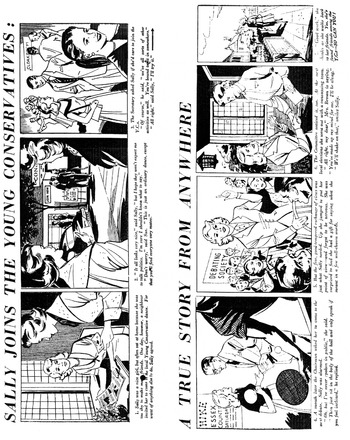
As Impact irreverently observed in 1965, there were a good many ‘constituencies where the executive and branch committees read like an imperial general staff's veterans parade’. Demobbed officers had helped the YCs advance at its outset. As with other areas of YC life, recruiting was undertaken with a military precision that belied the YCs' easy-going manner. Courses at Swinton, which were attended by up to 3,000 YCs annually, detailed how, since ‘the personal touch is the only effective way’ to recruit, it was advisable to meet potential recruits before meetings ‘as many young people are shy’. Emphasis was placed on recruiting a ‘cross-section’ of the local community and to this end, besides attending church on Sundays, a strategy of ‘raiding other organisations’ was recommended. Tennis clubs, youth groups, amateur dramatic societies were targeted. Thereafter, as the national vice-chair, Marcus Fox, told a 1958 leadership course, the perennial problem was how to make politics interesting. Student role-plays at Swinton included devising methods to raise the political quota in socially minded branches.Footnote 37 The process – as the cartoon-strip ‘Sally joins the YCs’ in Rightway in 1956 showed (Fig. 1) – was one of low-key political education and socialization, reminiscent of Conservative approaches to new women voters in the 1920s.Footnote 38
‘Sally joins the Young Conservatives’, Rightway (Oct. 1956).

The social side of YC life should not be interpreted as anything other than integral to a well-drilled political machine. The rigmarole of planning a dance or jumble sale provided vital training in skills of lasting political use. As Layton-Henry noted, the ‘sacrifice of leisure time’ for YC activities was ‘part of a recognized apprenticeship’ on the political ladder. And the YCs were the training ground for eleven members of the Macmillan and Home governments and upwards of 600 local councillors and some ninety MPs (all male) by 1970.Footnote 39
In 1967 David Walder MP saw YCs as the ‘essence of the middle middle class’, in both ‘mini-skirted giggly branches and more senior waist-coated branches with over-age chairman’. Walder's observations of Conservative branch life were insightful. In Walder's novel, The short list, Rupert Inglis of the ‘Stepney Group’ fights Netherford East with the support of the YCs and an aristocratic backer and against suspicions of his donnish philosophizing, his dog ‘Chamberlain’, and his lack of a wife. The novel features a canvassing encounter with an ex-YC who confesses she had been ‘quite active until I had my first baby’. YCs were resolutely middle class – in Birmingham, for example, two-thirds lived in owner-occupied properties.Footnote 40
Gradations within the middle class were acutely observed by YCs: ranked by parents' jobs, property, and education. In Birmingham, Edgbaston YCs ‘thought of themselves as the cream’: educated privately and living in the detached homes of directors, solicitors, and medical consultants. Hall Green Primrose Young Unionists were the progeny of teachers, local government officers, shopkeepers, lived in 1930s semi-detached houses and were schooled at the direct-grant King Edward's. Whatever deference there was to wealth or breeding, the YCs offered the politically ambitious minority an apprenticeship with local councillors and MPs. The YCs were a tool and emblem of social mobility, a place to be seen and mix. ‘For the ambitious young clerk or salesman, an entrée to his community's Conservative clubhouse’ was judged by Epstein to mark a sizeable ‘step on the road to well-being’. Walker found Gloucester YCs a means of establishing business and social contacts; others recalled it as a ‘stepping stone in my life’. By contrast, Abrams and Little found YS members comparatively unbothered by being ‘well off’, ‘getting on’, or ‘personal relationships’.Footnote 41
A proto-typical YC was to be found in Colin Grant, chair of South-East Essex YCs in the mid-1960s. Interviewed ‘in a Rayleigh local’, the retail furnishing director confided his middling tastes: his favourite drink, a dry martini; his favourite music, Andy Williams; his favourite authors, Nevil Shute and Ian Fleming. He disliked jazz, traffic jams, and Beatniks' scruffiness. With a dash of snobbery he related how having attended Rayleigh primary school his ‘mother heard the new language I had learnt’ and he was sent to boarding school. ‘Most people believe I am only interested in making money’, but he assured his interviewer that he also liked cars and found ‘women very interesting’.Footnote 42
Gender was salient, albeit subconsciously, in YC life. Since membership was equal – 52 per cent were male in Birmingham's 1969 survey – few contemporaries commented on it. But YCs inhabited a world in which a gendered division of labour was taken for granted. Sampled from 1960s branch programmes, men comprised 88 per cent of branch chairs and 85 per cent of treasurers, but more than 90 per cent of social secretaries were women. Impact's board discussed that they were all male in 1964 and to redress the balance opted for the journalist (and later popular historian and editor of History Today) Juliet Gardiner, who was not even a YC. Lynda Chalker became chairman (sic) of the Greater London YCs (GLYCs) in 1969, but all other national chairs were men. At the ‘Action '67’ rally in the Festival Hall one regional organizer, Elizabeth Steele, a solicitor and later a judge, was female. The rest – an insurance broker, three chartered accountants, a management trainee, teacher, stockbroker, surveyor, engineer, and cooper – were male.Footnote 43
There was a barely concealed misogyny to much of this. In Roundabout Rushcliffe one contributor held forth on ‘birdwatching’, warning of the pitfalls of the scrubber bird, dolly bird, and married bird and explaining his ‘own particular favourite’ was ‘the YC bird, conservative by name if not by nature’ and the uses of a car for such ornithology. Promiscuity was tempered by warnings of the ‘subterranean mother-in-law blues’, but in Lowestoft a typical YC's diary apparently ran, ‘Monday-choosy-Wendy-Thursday-Heidi-Saturday-Cindy’.Footnote 44 Jarvis's suggestion that the ‘numerical predominance of women in the YCs was regularly exploited’ is less sure-footed than his assertion that ‘glamour’ was a large part of the YCs' appeal. Rightway reckoned that ‘a prerequisite for the success of any revue is a supply of attractive young ladies’, and reviewed Ilford YCs as ‘well off in this particular form of talent’.Footnote 45
This was a world that was attentive to women, but via a male gaze – as Campbell argues, women's substantial presence in the party was organized around patriarchal norms of ‘the acceptable face of femininity’ in society. Conservative policy addressed women voters in a range of identities, but in internal party culture they were, by-and-large, powerless. Their contributions to local efforts received gallant thanks, but were taken for granted: a state of responsibility without power, in common with the YCs, who nevertheless reproduced their parent party's gendered culture.Footnote 46 For the YCs' vice chair in Birmingham, Angela Povey, political education was ‘all very well for the male members of the branch, the ladies need time to absorb and digest’, but the fact that YC women internalized these attitudes grated with Gardiner. ‘The little woman in the sweet pea hat’ who tittered ‘oh me, I'm just not political’ was dealing a ‘death blow’ to ‘our equality’ she argued. Citing ‘considerable discrimination against women at candidate selection meetings’, Gardiner believed women could be their ‘own worst enemies’.Footnote 47
Yet, a Times profile in 1964 argued that the YCs had a continued appeal to women. Future MP Julian Critchley's mother considered the YCs ‘to contain “much the nicest class of girl”’ compared with other political parties in Hampstead. Critchley recalls ‘much titillation, little consummation’, much tennis, little canvassing, and ‘gentle political indoctrination’ – ‘we were not encouraged to think’, again paralleling the experience of Conservative women, ‘it was not our pens that were wanted but our feet’. Sources attested to the prospect of meeting partners at the YCs. A West Midlands YC was also a member of Labour, Co-op and church youth groups, but the YCs had girls and cars and ‘girls were the attraction rather than politics at that time’. He duly met his wife at the YCs. This was a world ‘couched in the language of rugby club bars’, in which the ‘fair hair and blue eyes’ of girls at YC dances were noted and ‘women drivers’ bemoaned.Footnote 48
The morally conservative parts of the party overlooked the sexual subtext to YC life. Rushcliffe YC parties were ‘like sex, they cannot be described, only experienced’. Helen Seaman, a North Ealing delegate wondered in 1965, ‘why is YC Conference synonymous with orgy in the eyes of all but the delegates?’ The ratio of five boys to each girl at Butlins had apparently prompted the question ‘who did you get off with?’ ‘Gossips had to get going so that the YCs did not lose their Tony Hancock image. Everyone knows that the YCs don't play ping-pong!’ Indeed – one YC infamously strip-teased in 1965. She resigned as Chesham YCs' chair, but was re-elected. Just as controversially (if depicting what many thought), the cover of Crossbow that discussed the YCs in 1967 pictured a semi-clad woman with a glass of wine.Footnote 49
For Miss YC beauty contests, adjudicators, including MPs, used criterion of: poise and deportment, dress-sense, beauty, charm, personality, and intelligence. Entrants for 1966 Miss GLYC included Cheam's Virginia Howell, whose ambition was ‘to have three children and a mink-lined bathroom, what else?’ Miss YC 1968, Gosforth's Karen Murphy, embraced summer-of-love themes like ‘make love not war’, but only, she added, explaining her support for the US in Vietnam, ‘if everyone agrees’. Her case that ‘fifty years of electoral equality have not put women level with men in politics’, was hardly feminism, rather it was ‘because women find it difficult to be rational amongst administrative complexity – anyway she would much rather be ruled by a strong man than a stubborn and misguided woman!’ Looking Right's pin-ups of Miss Birmingham YC competitors became less formal as the 1960s proceeded. The 1966 contest was described as a ‘concours d'elegance’ in which the bodywork, paintwork, and chassis of the competitors was whittled down to the final ‘high performance models’. The car analogy was given regular outings, with car buff Barwell described as ‘going into production’ for his first baby, with his wife, a former Miss Birmingham YC from 1960.Footnote 50
Other political parties had beauty contests, but not on the scale of the YCs. They could boast a Miss Great Britain, Leila Williams, originally of Wolverhampton but by 1959 of South Kensington YCs, and one of the original presenters of BBC TV's Blue Peter from 1958 to 1962. Williams appeared at the Royal Festival Hall YC National Rally addressed by Macmillan in 1959 alongside the reigning Miss YC to illustrate the YCs' mix of ‘brains with beauty’. When the Empire games were held in Cardiff in 1958, Miss Empire Games was a YC, of whom Rightway saw fit to remark: ‘she is not only a member, but takes an active interest in politics’. Some made a career of beauty pageants – the cover of Autumn 1957's Rightway featured Barbara Hellaby of Asbourne YCs who was Miss Derbyshire Young Farmer 1955–6 and Dairy Princess for Derbyshire, 1957–8.Footnote 51
Miss YC was not uncontroversial. Some areas resisted selecting entrants for the national contest, although there were as many as forty-seven in London in 1963.Footnote 52 Nor was Miss YC always pliable. Miss YC 1963, Margaret Fundell from Cardiff, rejected insistences that she should speak at conference. Although the YC National Advisory Committee abandoned the national competition in 1967, this was reversed a month later, but by 1972 the competition was ended.Footnote 53 YC gender traditionalism limited recruitment through the 1960s of professional women. However, occasional profiles of more aspiring types, YC women with careers in the press and ITV, were apparent. The YCs were hardly immune to trends in youth culture. Trend told readers in 1966 that for ‘the single girl who chooses not to marry, a good time can now be had’. Gardiner reviewed fashion and women's magazines and men's fashion and toiletries demanded Ealing North YCs' interest.Footnote 54
II
Modernity and change was always something of a mixed blessing for YCs. Tony Bowers, elected Birmingham YC chair in 1969, sported a goatee beard, but was always pictured in a tie – smartness of attire was preferred.Footnote 55 Ealing North saw in the Birmingham Bullring the perils of planners' ‘brave new world’ fantasies, compared with the ‘genuine’ appeal of the nearby Punjabi market. A 1965 report on ‘Birmingham's new citizens’ recognized problems of housing and education and how immigrants posed a challenge to YCs' ambitions to represent all society. Many were sympathetic Common Marketeers, as a relatively well-off group of young people who holidayed in Europe, which for some involved an experience of a ‘camaraderie [that] … knows no international or racial barriers’. Close ties were maintained with the pro-Common Market Conservative and Christian Democratic Youth Community and exchanges undertaken with the German Christian Democrats.Footnote 56 Not that more imperial visions of the nation were hard to locate. In Rushcliffe, Roger Neal sustained a tirade against crime and VD-prone ‘coloured people’ and on how the Commonwealth in 1966, unlike the Common Market, was yet to achieve its peak. The ‘political honesty’ of the racist victor in the 1964 Smethwick election, Peter Griffiths, was applauded in Essex's Trend and, by the later 1960s, Enoch Powell was popular amongst YCs.Footnote 57
YCs' sense of tradition demanded deference to elders, but they were not unduly haunted by the party's past. Amongst its characteristic dispositions, in Oakeshott's taxonomy of conservatism, was a preference for ‘the familiar to the unknown … the near to the distant’.Footnote 58 Not that the past was hard to find. In Birmingham, as one of their number recalled, the YCs were ‘still in thrall to Joe Chamberlain’, and known as Young Unionists, as they were in Scotland to 1965. YC attempts to make politics ‘fun’, and their belief that it was not such a rational business, if at odds with its decorousness, were manifest in nostalgia for heckling. Area speakers' competitions in the early 1950s appointed an ‘official heckler’; anti-Suez war meetings were disturbed and YCs would be ‘strategically placed’ at election opponents' meetings. A recruiting campaign in Birmingham in 1965 culminated in a motorcade and speeches in Chamberlain Square, where one speaker, so the YC organizer and Looking Right editor, Tony Shaw, enthused, dealt with heckling for over an hour.Footnote 59
In the public imagination and for mocking critics, the YCs were a ‘middle-class marriage bureau’, a phrase in common currency by the 1950s. Gabriel Almond and Sidney Verba's measurement of partisanship through attitudes of parents to children's marital choices found Conservatives more concerned about party affiliation than Labour, if indifferent by European standards. As Iris Harvey put it, the YCs were a ‘breeding ground’ of conservatism.Footnote 60 It was a sign of conviviality, but was double-edged since The Macleod report found the ‘young marrieds’ were most prone to cease YC activity. As Geoffrey Johnson-Smith, the party vice chair saw it, that ‘the YCs have so many attractive people that they want to marry one another says a great deal for the quality of the membership’. There was no official discouragement of ‘marrying out’, but the notion of ‘partners’ was frowned upon. Marriage was celebrated. When the Athertons became the youngest married YCs in the Nottingham area in September 1965, they were rewarded with a clock from Lord Belton. Barely a branch report went by without some nuptial notice: there were, for instance, nine in six months in Rushcliffe in 1966. It was quite an occasion when Looking Right announced in July 1967 that, ‘strangely … there are no marriages or engagements to report’.Footnote 61
YCs hardly had a monopoly on social allure, but its cachet was more enduring and as even opponents attested was located in greater social acumen, rather than larger budgets. As Samuel recalled, the Conservatives were ‘the party of people … who had cars … who dressed up … carried themselves with poise’. In 1955 the Young Communist League's Challenge warned the left ‘should not scorn to learn from the … colourful and attractive methods of the Young Conservatives’, and by 1968 was copying Crossbow's semi-clad YC image in the hope of aiding recruitment.Footnote 62
Some studies noted the left's comparatively limited social skills and resources, but more common was to dismiss the YCs, as Hugh Gaitskell did, as ‘nothing more than a glorified dancing club’. Labour's youth movements tended to be ultra-political, with a more serious conception of political activity. Jennings noted how in 1960 that ‘as the Labour Party might put it, flag-waving and drum-beating are childish pursuits’ and that, therefore, even though it was ‘slightly humorous to find the Conservative Central office running boys and girls clubs, it would be downright hilarious to ask Transport House to do it’.Footnote 63 There were YC activities that were more acceptable in the unofficial culture of party life, but it seemed more laissez-faire than the left. One YS member reported to Gosling in 1961 that ‘she would have to join the Young Conservatives if she was to continue her sailing without being victimised’. Sailing was booming, but no longer such an elite pastime; and one that under Heath was tacked to the Tory image. The YCs' success, so Gosling saw it, was that it was ‘run by the young people for the young people’. As The Times saw it in 1959, the YCs combined ‘politics with fun and zest’ and a faith that young people were ‘willing to serve’.Footnote 64
The key point, as John Vaizey argued in the Observer just after the 1959 election, was that the left had no conduit to bring ‘decent non-political people and party zealots’ together in a climate other than formal political meetings. However:
the Conservatives have created such a bridge for themselves. It is usual on the left to sneer at the Young Conservatives. They hold dances and tennis parties and rarely pass resolutions. But in a few years they have created among young people in the suburbs a genuine sense of shared values and assumptions, which has led to really effective political action.Footnote 65
A modern feature of this lost world was its image consciousness. There were constant exhortations that ‘our sales talk must be big and effective’, as much in hand-written, cyclostyled local magazines – the glue of YC associations – as Birmingham's benchmark, Looking Right.Footnote 66 Their titles denoted YCs' endeavour to be forward-looking – Progress, Trend, Blue Horizon, The Whip (Three-Line Whip from 1959 to prevent misprints as ‘whig’) or the popular Enterprise (of both Spalding and Southend YCs).
Impact announced itself as the YCs' national magazine in 1964, tempting advertisers with the ‘opportunity of reaching thousands of today's most important spenders – the affluent 16–24 age group’. With a print run of 10,000, there were efforts to attract subscriptions from schools, libraries, and newsagents. Marketing executives told Impact of the parity of consumers and voters, the commodity-like qualities of candidates and how a traditional fête might be ‘out of touch’. Business-like efficiency was rewarded nationally from 1955 by the Finsberg ‘National Efficiency’ trophy, which was not a reprise of turn-of-the-century politics, but named after YC chairman, Geoffrey Finsberg. In Birmingham, minute books were kept in good order by the prospect that in the event of an efficiency contest tie, they were a deciding factor.Footnote 67
According to Abrams and Little, the YCs were modelled ‘on an advertiser's image of modern business leadership … bland and professional’, encouraging the diplomatic language that distinguished the YCs from the 1980s' sectaries. This was the ‘politics of [the] managerial revolution’ since YC leaders advanced through business rather than politics where ‘the pay is so bad’, but imported such values to the party. The YCs were the subject of national Conservative TV and radio broadcasts early in 1961. Others feared this obsession with Public Relations not only derived from but exacerbated the YCs' passivity and low levels of participation and could denude their role as foot soldiers or ‘unhidden persuaders’.Footnote 68
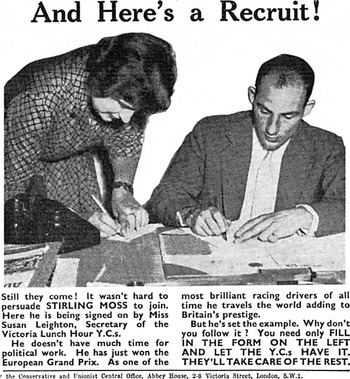
In the later 1950s, the YCs won endorsements from high-profile celebrities and sports stars. The former included actress Shirley Eaton, later famed for her role in the Bond film, Goldfinger, but who also starred in three Carry On films. Amongst sport stars, cricketers were most numerous: Robin Marler, captain of Sussex and Arundel YC chair; Yorkshire's Jimmy Binks; Hampshire's Colin Ingleby-Mackenzie of Portsmouth YCs, Colin Cowdrey, captain of England and Kent (Petts Wood YCs) and test batsman Tom Graveney, described as ‘amongst Bristol's keenest and most hard-working conservatives’ (and with Cowdrey and Marlar, later a chairman of the MCC). F. J. Parker, the British high hurdle record holder was a Sheen YC. Boxing YCs included: Terry Spinks (a gold medallist at the 1956 Olympics), a West Ham YC, and Malcolm Collins, the British Flyweight champion and Cardiff West YC. Other sporty YCs included Angela Buxton, the first post-war English Wimbledon finalist, and Douglas Baker, England rugby union player and member of Hampstead YCs. Most exposure was given to racing driver Stirling Moss signing up in 1956 to the Victoria Lunch Hour YCs, since ‘he doesn't have much time for political work’. Moss's input was minimal and in an epitaph to the YCs' incidental footprint, confessed, ‘I do not have any memories of the Young Conservatives, even though it is true I was a YC.’ But such endorsements served to project a youthful image and affiliate the Tories with sporting success in the 1950s (see Fig. 2).Footnote 69
Stirling Moss joins the YCs, Rightway (Oct. 1956).

A southern skew and absence of more working-class sports such as football or rugby league was noteworthy here. So too was how such endorsements faded in the early 1960s in tandem with the fortunes of the government. The YCs' self-confidence survived the traumas of Suez in 1956 and sales of its various regalia, blazer badges, and so forth, peaked in 1959. Although Ted Dexter, England cricket captain, Conservative candidate in 1964, and a throwback to the amateur ethos, wrote in Impact, and Pat Pocock of Surrey was honorary secretary of the South East YCs in 1961.Footnote 70
Sometimes the social aspect of YC life trumped the political. Hornsey YC cricketers disaffiliated. In Walder's Netherford the calm routine was disturbed by a by-election:
active YCs, very good women's organization, whist drives going very well. Holding our own on the Council, our sausage suppers and bingo evenings are the envy of Tory constituencies and along comes this bloody by-election and spoils it all…just when we were going to have our annual fête.Footnote 71
And the social aspect could get out of hand. After a weekend school at Butlin's Ocean Hotel in Saltdean in 1954 ‘the bad behaviour of YCs’ was ‘the subject of comment and complaint, at the hotel and by local residents’, and adjudged ‘inimical to the prestige of the Conservative Party’. At Buxton in 1966 for a YC holiday weekend many felt the ‘food and accommodation at the Spa Hotel were deplorable’. A certain ‘togetherness was probably strengthened by prevailing circumstances’, but the ‘ravishing’ women and a party that only stopped at 4 a.m. were no compensation for the fact that the ‘place was littered up with some local scruffs’, that the bar ran out of gin, and Roger Neal had his car spotlights stolen. For all their inclusive claims, some elements attracted to YC events were unwelcome. At Hayes and Keston's 1958 ‘February Fandango’ at the Royal Bell Hotel, the presence was noted of two teddy boys and their ‘disgust’ that the bar closed early, although ‘no trouble was made’. By the ‘March Hare Hop’ at Keston Village Hall, three teds were present, although it was unclear whether this was ‘regrettable’ because they ‘glowered’ at the YCs, were admitted for free, or bagged seats by the radiator.Footnote 72
III
The social–political balance in YC life was a source of constant debate. In 1960, Butler instituted policy groups, to link the YCs to the main party and boost their political content. In 1965, Iain Macleod's Report addressed the decline in YC membership. There was confusion over precise figures and trends in membership, but in 1963 it stood at half the 1949 level and fell by 30 per cent to 58,344 by the end of 1964. It could nonetheless still claim to outrank the Young Republican or Democrat organizations in the USA.Footnote 73
The Macleod report aimed to enlarge the YCs' political activities and restore its social prominence. It noted that social change since the YCs' launch in the 1940s – affluence, education, housing, popular culture – had impacted on those aged under thirty. It proposed a more diverse branch structure and targeting a membership of half a million, envisaged ‘a more flexible, informal and yet more politically-conscious youth movement’ in the belief that ‘youth will not be attracted to a movement that provides only social entertainment’. Simultaneously with Macleod, the Young Britons were wound up. The threat of Socialist Sunday Schools had receded (there were only twelve by 1965), but the ‘rival claims of homework … sport, TV, youth clubs and pop groups’, had reduced membership to 526.Footnote 74
Demographic change perturbed Conservatives – not only that their appeal appeared to be receding as the post-war baby boom came of YC age in the mid-1960s, but also trends like earlier marriage – paradoxically given the YCs' ‘marriage bureau’ reputation. It was seen as good in itself, but there remained the problem of keeping married YCs active. In Birmingham 77 per cent of YCs were single, its 1969 survey found, and there was often a vacuum between novices and more careerist, party hack elder YCs. Addressing the Conservative psephology group in 1960, Mark Abrams thought ‘neither party seemed to have appreciated the trend towards earlier marriage’, and they thought in terms of teenagers rather than those with family or career responsibilities. YC policy groups did consider issues like mortgage rates, and in Colchester a baby-sitting service run by women in the senior Association freed time for young marrieds to canvass. Macleod proposed ‘supper clubs’ meeting monthly ‘in people's homes, in restaurants, hotels or clubs’ and at which ‘informality should be the key note’. In short, the dinner party might rival the ball in YC life.Footnote 75
Discussing Macleod, East Midlands YCs concurred that the need was for a ‘mass movement with some appeal to keen political brains’. The political spurs for joining that had been such a boost at the YCs' inception in the second half of the 1940s had diminished during the Conservative government and it was felt YCs should ‘concentrate on making our views heard rather than defending the Conservative party’. This ‘did not mean we should be completely political’, but ‘should stop apologising for being a political movement’.Footnote 76
YCs also asked if ‘in an affluent age people can find enough social entertainment without joining the Young Conservatives’, and most reasoned that they ‘simply cannot compete … with the professional pastime makers’. Although Essex's Trend reckoned popular culture was a recruiting sergeant: ‘many of the go ahead young people of today are clamouring for something more to occupy their leisure than just television, the cinema and other “canned” entertainments’. Either way, Impact concluded that ‘the political work of the Young Conservatives [was] being hidden from … potential members’. A new member from a comprehensive school in 1965 agreed. Interested in jazz, drama, and banning arms sales to South Africa, he reported being told on joining the YCs: ‘don't worry we talk about everything here except politics’. He thought YC ‘girls … never had a political thought in their life’ and were ‘constantly talking about settling down, getting married’, and YCs on the whole were ‘young in age, but old and stolid in their ideas’.Footnote 77
There was much at stake in the reception of The Macleod report. It offers historians a vantage from which to dissect Young Conservatism as it voluntarily ditched its traditional codes and before it was trumped by Thatcherite tendencies, just as Samuel's deconstruction of British Communism was written as it began to splinter before the collapse of Soviet Communism. It signalled the end of the YCs' preference for displacing formal politics and the conditions in which it could achieve this. It is important to note that not only did established YC culture resist and persist after Macleod, but that there were continuities in the proposed content of YC life after 1965 – it was more repackaged than reinvented. Macleod's uneven application was testimony to the vibrancy of inherited local YC culture and uncertainties over membership targets and an age limit of thirty-five, despite office holders being capped to thirty. Some remained convinced that a period of Labour government would revive interest, whilst others believed higher education expansion had depleted the YCs' social and generational base. According to Macleod, however, ‘the tendency for YC branches to demonstrate a very unintellectual approach towards politics’ accounted ‘for their inability to attract university graduates’. In this demographic analysis, universities were effectively competition for the YCs. Comparatively few Conservatives went through higher education, Seyd, Whiteley, and Richardson noted in the mid-1990s and, whether self-made or having inherited wealth, were inclined to be ‘suspicious of modern educational trends’.Footnote 78
Macleod also challenged entrenched YC culture. That ‘in the public imagination “Young Conservative” means a half-baked, if not half-naked socialite who organizes successful dances and the occasional not so successful merry whoop down the council estate at election times’, ‘Geordie’ told ‘Basil’ in 1967, in a mock north–south debate, was a product of the YCs' dominance by safe, southern constituencies. Their complacency meant that ‘Conservatism gets forgotten’. Forgotten too were the northern Area YCs, who had no cabinet-level speaker between 1952 and 1965. For Walder the YCs were a misnomer by 1967, a category requiring ‘inverted commas’: neither notably young nor Conservative, identity was ‘social for the non-political’ and ‘insignificant for the political’.Footnote 79
Surveys for Central Office in 1966 revealed – besides how seriously the party took them – continuity in perceptions of the YCs, necessitating an ‘Action '67’ campaign to press on with Macleod's proposed change. Opponents saw the YCs as an opportunity to ‘enjoy yourself … no word of politics is ever mentioned’. A Young Liberal thought the YCs ‘people who have lots of money and plenty of time’. Conservative voters agreed: YCs were not as ‘earnest or dedicated as socialists’, if ‘steadier … not always shooting their mouths off’. Even the respondent who felt they were ‘snobbish’ admitted it was ‘a good association to find a girlfriend’. In terms of joining, one respondent explained that he ‘would join if I found my social life depleting’. This tallied with a larger survey that found one quarter believed ‘people joined the YCs only if they are rather lonely’; the same proportion who thought it ‘primarily a political organization’. Many more believed people joined ‘because their parents want them to’ or ‘to meet important people and make business contacts’. The ‘potential’ for YC growth, it was optimistically reckoned, lay in the large majority of working-class respondents that thought the YCs ‘with it’ not ‘square’.Footnote 80
The heavy social quotient of YC programmes rendered them sensitive to changes in this sphere. Backing The Macleod report, Edward Lear, Birmingham YC chair, complained that premises used by YCs were often ‘the same drab, uncomfortable schoolroom they used 20 years ago’. Gummer agreed: ‘young people are richer, more sophisticated … yet the YCs still provide them with a fare which we first served up in the days of austerity’. Alan Haslehust, who had been an ICI commercial assistant before becoming YC national chairman in 1966, argued the YCs needed to match modern youth's tastes for skiing or more lavish balls.Footnote 81
So the idea that social activities were eroding the political point of the YCs and that renewal rested on the quality, rather than quantity, of recruits was not unchallenged after 1965. With membership still falling, the National Advisory Committee expressed concern three years later at the declining standard of social events. The popularity of a local disco in Lowestoft in 1969 prompted some YCs to propose they ‘take advantage … of entertainment which could provide an immense source of revenue’. Branches with social reputations remained convinced YCs ought to offer a primarily social menu. In Birmingham, Povey countered talk of politics proper: ‘Politics – nothing was further from my mind when I joined the Young Conservatives … I was going to meet a group of friends and even if I found the meeting itself rather a bore, there was always the drink and chat afterwards.’ But even here there were difficulties in maintaining Looking Right, and the Motor Club struggled with falling participation as members moved out of the city.Footnote 82 It was not that YC-style social activities died out – marriage rates after all peaked in 1971 – but that competition in provision marginalized the YCs.
Macleod also renewed the traditional YC ethos of service before party, bolstering voluntary activity in church or local authority. In 1962, Macleod had called YCs ‘to service – not because you are Tories but because you are citizens’.Footnote 83 In ‘Action '67’ a focus on community service as a demonstration of YCs' use emerged. YCs should ‘exist to stir such people into a more active contribution to society’, to convert ‘good friends and neighbours’ into ‘excellent citizens’. Activities could range from the Voluntary Services Organization (set up under Macmillan) to campaigning on the local environment. The qualities of likely recruits figured in Conservative calculations here:
bearing in mind the type of people most likely to join a political organization…was an appeal stressing a social and general interest approach losing out?…This would be a ludicrous situation: trying to shield that we were political when it was the thought of our not being sufficiently political which was keeping people away from us…These people have a desire to do something positive with their time. They revolt against the idea of being mere spectators in society. They want to be doers.
YCs marched for Oxfam (Gosforth), tidied local gardens (Middlesbrough), or recycled silver paper (Birmingham's Harborne YCs, copying Blue Peter's 1964 guide dog appeal). Here the YCs were repackaging their usual civic-service ethic and citizenship activities in a more political language. The YCs became socially useful rather than party animals, then, in the belief that ‘political organisations will only ever interest a small percentage of the community’ or that, as South Buckinghamshire reported, ‘the reliable members … the best organizers, are those who are politically interested’, not the ‘more volatile social branch’.Footnote 84
The East Midlands area chairman, Peter Le Bosquet, endorsed this aim ‘to provide a medium through which younger people can play a full part in the affairs of their local community and the country by involvement in public life and by service to their fellow citizens’. YCs' associations with ‘hunt balls and BBQs’ contrasted with CND and Oxfam who had ‘gained the support of young people because underlying them is the idealism which many people desire – war on want – repugnance of universal violence’. ‘One could hardly associate the YCs with this kind of idealism’, and this explained ‘why we have failed the serious-minded youth of this country and we are facing a situation where many branches are nothing more than glorified youth clubs’. A Birmingham YC invoked the Salvation Army's slogan, ‘For God's sake care’, to critique the carefree YCs. ‘We Young Conservatives sitting in our dream world of dances, cheese and wine parties and jumble sales’, Fowkes despaired, ‘have the cheek to sneer at long-haired university students who protest about everything.’ ‘At least they are doing something’, whilst YCs ‘have debates on nearly every subject except politics’, then ‘recoil into our own social world’ where everything is ‘jolly good’. To Fowkes it seemed imperative to ‘make our own policy independent of the senior members … let's not conform’.Footnote 85
Yet despite the official preference for a more political focus, the YCs were grudging about the reduction in voting age to eighteen in 1969. Objections ranged from questioning teenagers' maturity to discontent that the age for candidates was not similarly lowered. A real fear was that new voters were ‘more uncommitted than ever before and less likely to accept guidance from their parents or propaganda from any political party’. The age reduction also seemed to make a case for a volume, rather than quality, of members – just 1 per cent of voters newly eligible to vote in Birmingham in 1969 were YCs. London rebels argued that falling membership was a consequence of YCs' lack of status within the Conservative Party, which was refuted by YC leaders, who argued that it was smaller, but more influential. In Birmingham, a contemporary political language was deployed, but the view remained that size was a prerequisite of effectiveness: ‘for any pressure group and I feel sure that this is what we would like to be classified as, to be effective, it must have strength in numbers in order to have its voice heard’.Footnote 86
Efforts at a more serious image could nevertheless falter. In 1969, ‘50 well-fed, well-housed Young Conservatives spent a weekend in a stately home’, and it did not seem to strike Hugh Holland of the National Advisory Committee as paradoxical that they were ‘discussing the problems of homelessness’, watched Cathy come home, and addressed by the director of Shelter, Des Wilson. The difficulty for the YCs was to disturb its traditional, lingering disposition against excess political thought – or, as another YC urged, that ‘politics, unlike charity, requires people to think before caring’.Footnote 87 Gardiner felt that too many YCs had the ‘prejudices of middle age’ – unable to differentiate ‘between drug-taking – a very serious problem – and the permissive society, which is a blanket name for a lot of things that have recently made our lives fuller, more colourful’, especially for those simply escaping the ‘grey monotony of their jobs’. Her career as a YC journalist ended when she reached conclusions about Charles Reich's The greening of America that were too favourable for Conservatism's tentative environmentalism. An authoritarian edge was also apparent. At the 1967 YC conference, for example, Gummer blamed the permissive society for social problems, and those of a more clement mind on the drugs issue were out-voted in 1968. The danger here, Lynda Chalker surmised, was that ‘we are considered old-fashioned’. In other ways, the YCs seemed in tune. Pirate radio animated YCs, allowing them to defend the free market, support youth culture, and critique as state killjoys the government's attempts to ban them.Footnote 88
Not that YC life was bereft of politics before The Macleod report, however much those who saw the earlier generation as practising ‘pale pink’ policies under Macmillan came to the fore. For those anxious to root them out, paternalist, authoritarian, and libertarian strains were all present, below the quiescent surface politics of the YCs, who were no more homogeneous than their elders on issues like Europe. When it was decided to join the Common Market in 1961, Central Office warned the ‘61' Group’ of Northern Home Counties YCs that there were appropriate channels for opposing entry. Some YC leaders were involved in the Anti-Common Market League, but at party leaders' behest, the YC rank-and-file heckled anti-Europe speakers at the 1961 party conference.Footnote 89 The most consistent politics was anti-socialism: the ‘claim of one set of men to dictate how the rest shall fashion their lives’. Scaremongering by YCs was common – that, for example, Labour would abolish cricket. In 1967 Impact's Robert Worley built an identikit socialist from personal adverts in the New Statesman that party lawyers deemed libelous and was not published, much to the disappointment of the editor, Gummer.Footnote 90
As often YCs echoed their opponents, sharing in the fortunes of party politics as a whole, bemoaning apathy amongst YCs and non-YCs alike. The ‘coffee bar generation’ of Colin Wilson and John Osborne were denounced – ‘these people are not the don't knows, they are the don't cares’ – but the YCs opened their own coffee house as early as 1956 in Croydon.Footnote 91 By the late 1960s ‘teach-ins’ proved a popular innovation, although in YC-style East Midlands held theirs in 1968 at the Grand Hotel, Leicester. In 1968 the three main parties' youth wings united to ‘fight world poverty’. As presented by the liberal Impact, some YCs shared student radical alienation from ‘the comfortable materialism and intellectual limitations of suburbia’. A YC national chair, Terence Wray, did join Labour over the issue of Rhodesian independence in 1967.Footnote 92
An unintended consequence of a more political YC movement was, however, less readiness to exhibit loyalty to party authorities, whether for reasons of political belief or because it unleashed personal ambitions. Eric Chalker's campaign in London to boost YC influence was the first time YC elections had slates of candidates and ‘open political campaigning’. GLYC rebels grouped around Democratory, which cast itself as the ‘voice of protest representing 12000 YCs in London alone’ and ‘the million or so young people in London who are so frustrated by the lying incompetence of one major party and the inertia of the other that emigration seems the only way out’. This outspoken stance, critical of party bureaucracy, stage-managed conferences, and quashing of YC opinion coincided with Enoch Powell's presidency of the YCs from 1966. GLYCs' opposition to the Miss YC contests was a desire for ‘proper’ politics, not a feminist gesture.Footnote 93Set the party free, produced for the 1969 party conference, combined Powell's critique of the leadership with Chalker's proposals for inner-party democracy (which it compared to the Freemasons), a desire for the YCs to assert themselves as policy-makers and a foreword from Macleod. Powell's and Macleod's presence in the shifting tenor of the YCs after 1965 was significant: both were figures whose technical intellect, Green explains, could put them at odds with Conservatism's preference for a more unflappable, sceptical style.Footnote 94
The London revolt was decisive and significant, but YC dissent surfaced in moderate quarters, disturbed party leaders, and was further legitimized by the unexpected number of YCs who became councillors in 1968 after extensive Tory gains in local elections. The Party chairman warned Heath in 1967 that ‘the YC leadership is often more interested in cutting a political or public dash than in developing the movement’. The opinion of rebels like Chalker was matched by criticism of Heath by Alan Haslehurst. When he stepped down as YC chairman in 1969, Haslehurst told Heath that the YCs were under extremist control. A ‘Bolshie’ YC that ‘could prove politically embarrassing’ saw Heath welcome an election moratorium, facilitate a parliamentary–YC liaison committee and the Chelmer Committee to review party democracy in 1970.Footnote 95
IV
What, then, do the YCs tell historians about Conservatism and the wider political culture? McKibbin argues that ‘apolitical sociability’ came to characterize social networks and personal relations, particularly amongst the middle classes in England in the 1930s. Differences of politics, sex, or religion were negotiated by humour or deferred, as associational life aimed to cultivate an environment that was ‘notionally unpolitical’. Rotary and Lions clubs burgeoned, as in southern England did ratepayers' associations, under whose non-partisan banner Conservatives regularly campaigned locally. Aided by such institutions, a ‘definition of Conservatism as “non-political”’ emerged and this enabled it to seem ‘common sense’, whereas Labour, ‘dragged “politics” into everything’ and emphasized ‘conflict instead of good humour’. For McKibbin this ‘apolitical set of silent assumptions’, could entail ‘a taboo on talking politics at home’ or only ‘according to well understood conventions’ in public', but ‘were, in practice, deeply political’. Conservatives neither naturally exuded nor benefited from this style. They had to adapt their harder imperial edge into a more inclusive, parochial style to incorporate liberal nonconformist networks and ensure the new associational organizations were ‘ineluctably drawn into the wider network of the Conservative Party’.Footnote 96
McKibbin's account tallies with Light's interest in how (lower case) conservatism related to the Conservative Party. That it was ‘the least articulate level of conservatism’, buried in private attitudes and emotional dispositions, gave it an intangible ‘taken-for-granted’ quality that accounted both for its pervasive influence and for the difficulties and dearth of analysis of it. It needed a political history that took into account cultural history or ‘structures of feeling’. It was also a product of Conservatism's reticence to articulate itself ideologically or propensity to be ‘indifferent to Politics at large’. With its ‘throttled emotion’, Light regarded conservatism as an ‘emotional economy rather than, though it might accompany, specific views on the economy of the state’. Light avers ‘conservatism likes to see itself … as a politics which eschews politicking; a system of beliefs and values without systemization; an organic and inevitable way to be: socialists and radicals are those who … terfere” … with people and their lives’. Such apparent insouciance, in government or comportment, did ‘not come easily’, although Conservatives liked to imagine it did.Footnote 97
There is evidence for such characterizations of conservative political culture persisting into the later 1950s, not least in the YCs. Their virtually un-political, sociable, service ethos seemed a Cold War re-working of the Rotarian civic-business practices that De Grazia has highlighted.Footnote 98 McCarthy is doubtless correct that there was more to such civic associationalism than the anti-socialism stressed by McKibbin, but the YCs operated in distinctly similar ways, if ultimately limited by their partisan affiliation. Indeed their strategy seemed to incorporate the limits to party support as a means gently to counter such indifference.Footnote 99
Political scientists like Blondel noted Conservative Associations ‘are rightly called “associations” and not “parties”’, since they were ‘primarily social organizations’. Conservative clubs too were resilient, declining in number by just 10 per cent, from the 1,500 in the Association formed as a limited company in 1948 to 1987. Tether noted ‘the atmosphere in most clubs is tangibly apolitical’, but ‘overt political disloyalty can be taken seriously’. Jennings likewise noted in 1960 that whilst ‘political activity outside the London Clubs is small … membership of a club must lead to increased political interest’ and that membership retained advantages and allure for ‘the ambitious young man’ seeking ‘to promote his career’. For Blondel, the skill of Conservative Associations was to enlist ‘lukewarm supporters or, at any rate, people who are not very interested in politics’. This meant that many middle-class ‘businessmen and professional men … still consider that membership of … the local Conservative association is as natural as membership of the local golf club’. ‘Most Conservatives … consider politics as a hobby’, Blondel deduced, whereas for ‘Labour politicians … their real life, is the political life’.Footnote 100 Frankenburg thought Labour the ‘most political’ of the main parties; whilst Conservative agents, the Blackpool incumbent explained, were ‘expected to … join all the Oddfellows, Foresters, Buffaloes and Homing Societies and assist all his local horticultural, Chrysanthemum and charity shows’.Footnote 101
Anthropological accounts like Frankenberg's, or Stacey's study of Banbury showed the associational networks entwining Conservatives in local civil society. Its nexus with the churches, Bowling Clubs, Chamber of Commerce, even the Sweet Pea Society, made Conservatism an unofficial part of everyday life. Labour were regarded as ‘always bringing class into it’ by the middle classes, who would ‘avoid social relations’ with Labour supporters from their own ranks. Stacey found ‘politics are little discussed’ or ‘got round by a good deal of joking and backslapping’: as one Banbury club motto put it, for example, ‘No religion, no politics, good comrades all.’ This ‘taboo on discussing political questions outside the political arena’ enabled ‘opposed groups to live and work together’. For ‘beneath the taboos, the issues remain profound’, when periodically unleashed by the ‘safety valve’ of parliamentary elections. Local Conservatives also worked hard – there were seven YC branches canvassing in Banbury in 1955. By 1968, except for the ‘rise of local pressure groups’, little had altered and the ‘joking relationships’ between parties continued ‘to cover, and also reveal, their awareness of political differences’.Footnote 102
As a political practice, this style was well illustrated by The Birmingham diary and year book, a publication which Birmingham Conservative Association's advertising director, H. E. G. Harvey, explained in 1964 ‘will be on the desks of all worthwhile companies’. Harvey was equally at pains to ‘make it clear that despite the fact that it is being published by the Conservative Association’, it ‘will not be at all political in nature and content and will not in fact carry the name of the Party’. The types which McKibbin notes as meshing Conservative and civic bodies were still evident. G. W. Pole, who managed Bush's Witham factory and chaired Witham Chamber of Commerce twice between 1956 and 1962, was elected to the district council in 1962, accepted no party whip, but was nominated by the Conservative Association. In Southampton the Ratepayers' Association and Conservatives formally amalgamated their longstanding (since 1933) electoral alliance in 1954. In the age of mass party membership, Conservatism cut a low profile; as an acquaintance of Samuel's noted, it ‘was something you took for granted … like God, it was there’.Footnote 103
The senior party reproduced, then, many of the YCs' qualities in this period, just as it had passed these down to the YCs. In terms of such informal, socializing, assimilative propaganda, despite Trade Union support, Labour had ‘many disadvantages’ compared to the Conservatives. For example, in Keith Joseph's Leeds constituency, a ‘predominantly Jewish golf club’ with a membership of more than a thousand were, with minimal party prompting, ‘Tories to a man’. Conservative property resources and ‘snob appeal’ for local fêtes, garden parties, and dances particularly impressed Jennings. Echoing McKibbin's and Green's reading of Conservatism, Jennings reckoned in 1960 that ‘for the average Conservative his ideas are sensible and non-political; it is the other fellow who insists on being “party political”’. This was a signal of the sort of low-key political culture that Conservatives, and not least YCs, had assiduously cultivated or attempted to fashion as an (un)political norm. But it also generated the sorts of problems the YCs encountered. For instance, discussing how to rejuvenate the party's research department in 1959, James Douglas explained that whilst they would have to reach out to lawyers, managers, directors, and universities, the basic shortage and disadvantage the party suffered was ‘because left-wing types are more inclined to think in political terms’.Footnote 104
Traces of this style or evidence of this political culture persisted, much as it was eroded through the 1960s. Nadler's YC experience in the 1980s was a ‘hangover from the 1950s’, a ‘cosy dating club’ meeting in a Conservative club to lower the age at cheese and wine parties. Hoggart's mid-1990s portrait of Farnham in Surrey conveyed a casual, ingrained conservatism. It indexes ‘Labour’ and ‘Liberal Democrats’, by contrast with the ‘Conservatism, Conservatives: passim’, reminiscent of how Raymond Williams's Keywords contains no entry for ‘Conservative’. Church, authority, tradition and Conservatives were inseparable. ‘To be a socialist is almost unthinkable’ amongst the middle class who ‘assume active Labour party members are loud-mouthed demagogues’. The Farnham Herald was ‘more right than left’, but did ‘not push its politics much’ and was less bothered with party than ‘local voluntary political action’. Commuters and their families were ‘habitually’ conservative, with weekends dominated by gardening (a ‘civilizing occupation’) and golf.Footnote 105 Neither Banbury nor Farnham were England, nor indeed, Britain, but historians have considered Labour to enjoy (or suffer) less intimacy with everyday values and civil society. The YCs hardly confound that, but demand a more critical approach to political history, situating politics in a broader context than ‘politics’ alone.
The YCs were the Tory party at play. Its provenance was middle class, home-counties, suburban, provincial small-town, aspirational types – a reprise of Victorian ‘Villa Tories’. Whilst it was no Primrose League-like bridge to the working class (more alienating to judge by their minimal participation), the YCs helped secure middle-class support for the Conservatives in terms of mobilizing existing support and building it amongst the next generation. It was always conscious of the electorate's fragile support. As a Birmingham YC saw it, ‘when one remembers how short the memory of the public is’, they could not be relied upon to convict Labour, however apparent its shortcomings. Their social aspect concealed, and made them relatively immune to, political issues – the YCs did not much register that mid-1950s wavering of middle-class support Green has plotted – but sensitive to changes in lifestyle. YCs perceived themselves to be grappling with competition from a pullulating popular and commercial youth culture, but also demographic and educational trends. As 1960s cultural change seemed to loosen traditional class affiliations and make party politics out of vogue, the YCs were aware, as the East Midlands chairman put it in 1966, that ‘the days are past when any ordinarily intelligent young man or woman could be assumed to be ready to join the YCs’.Footnote 106 The YCs' composed, convivial façade crumbled then, but not only because of social change.
The YCs' cultivation of a low-key political presence was a product of and contributor to a relatively unpolitical culture. And it was a practice that enabled them to operate in conditions where, as Jennings saw it in 1960, ‘the best propaganda is the private conversation in the pub or club, the bus or the railway carriage, the canteen or the luncheon room’, rather than that which was more blatant, organized, or delivered by political fanatics.Footnote 107 The YCs were adept at seeming incidental, not political and everyday, at informal propaganda and socializing activities. If this demonstrated the limits of party appeal even in the so-called golden age of turnout and membership, it also demonstrated the skill of party in negotiating this. The latter showed the persistence of traits characteristic of interwar political culture, but the erosion of the conditions in which such practices were successful during the 1960s. As the 1960s experienced an expansion in the parameters of ‘the political’ – the politicization of civil society and everyday life, popular culture and new, non-party modes of political activity – the YCs became of decreasing relevance to large numbers of Britons. As has been argued, the YCs were sensitive to social change, more so than to political issues before 1965, but their fortunes were not determined by these alone. Its membership was in decline before Macleod, but the decision to undertake more formally ‘political’ activities and to define existing activities with a more political rubric marked not only a shift in the political culture, but undermined the conditions in which earlier practices and language succeeded.
The more self-expressive, febrile political culture of the 1960s ill-suited the YCs' culture of restraint – that which it inherited and sustained from the senior party and interwar period, indeed was a prime expression of, in the two decades after 1946. But if the YCs were victims of political irreverence in the 1960s it could not be said they had not contributed a certain scepticism towards politics. If suburbia seemed a less benign environment for the Conservatives by the later 1960s this was, at least in part, connected to the YCs' diminished presence as a fixture of middle-class life as much as the competition (from pressure groups above all) party politics faced in reaching into civil society. The decision to politicize their activity changed the YCs' character and impetus and made it an agent of this more emotive political culture – not least in stoking debate about party democracy, but also in that the erosion of the YCs' benign social presence took a brake off these social changes and in the broader political culture. Its falling membership through the 1960s was not just a symptom of social change, but of its choice to cultivate a membership of greater political quality, which it assumed to be necessarily of smaller quantity.
The occlusions of cultural and political history rendered it something of a sub-culture (notwithstanding its conformism), but the lost world of Young Conservatism shows how accessing and assessing non-elite political sources can inform and alter the national picture. The YCs were a significant presence, whose demise from their 1950s heyday had longer-term consequences, contributing to the ageing of the Conservative Party, which saw average members' age reach sixty-two by the mid-1990s and a reputation ‘as essentially a retired person's club’ that deterred recruitment among the young.Footnote 108