Introduction
As widely used pharmaceuticals, antibiotics can enter the environment through a variety of pathways, including hospital wastewater treatment plant, uncontrolled disposal of un-used drugs, runoff from agricultural fields and wastewater discharges from livestock facilities (Isidori et al., Reference Isidori, Lavorgna, Nardelli, Pascarella and Parrella2005; Bhagat et al., Reference Bhagat, Kumar, Tyagi and Mohapatra2020; Anh et al., Reference Anh, Le, Da Le, Lu, Duong, Garnier, Rochelle-Newall, Zhang, Oh, Oeurng, Ekkawatpanit, Nguyen, Nguyen, Nguyen, Nguyen, Tran, Kunisue, Tanoue, Takahashi, Minh, Le, Pham and Nguyen2021; Wang et al., Reference Wang, Guo, Li, Wang, Liang, Wang and Wang2024). The extensive use of antibiotics has led to the detection of antibiotic residues in the marine environment worldwide, and thus causing serious damage to the meat-derived food, soil and water, the ecological environment, and public health (Puckowski et al., Reference Puckowski, Mioduszewska, Bukaszewicz, Borecka, Caban, Maszkowska and Stepnowski2016; Zhou et al., Reference Zhou, Tang, Du, Han, Shi, Sun, Zhang, Zheng and Liu2021; Si et al., Reference Si, Yao, Liu, Lu and Liu2022). Broad-spectrum veterinary antibiotics commonly used in aquaculture and animal husbandry are primarily used to treat protozoan and bacterial infections. Broad-spectrum veterinary antibiotics mainly include furazolidone (FZD), nitrofurazone (NFZ), nitrofurantoin (NFT) and furaltadone (FTD), all of which are nitrofurans (NFs). Due to their carcinogenic and mutagenic properties, these compounds are potentially hazardous to human health (Du et al., Reference Du, Chen, Sheng, Chen, Xu, Liu, Song and Qiao2014; Ghosh et al., Reference Ghosh, Majumder and Roychowdhury2021; Kazmi et al., Reference Kazmi, Uroosa, Xu and Xuexi2022b). As a result, NF compounds have been classified as prohibited additives for food and animal production additives by the European Union (in 1995) and the USA (in 2002). As mariculture is flourishing globally, the use of antibiotics in the culturing process is lack of restrictions, and has caused serious ecological problems. Currently, research focusing on the presence of antibiotic residues in the mariculture environment is limited (Han et al., Reference Han, Zhao, Zhang, Wang, Song and Wang2020). NFZ is the most common and widely used one among these NF compounds (Chang et al., Reference Chang, Chen and Lin2016; Wang et al., Reference Wang, Guo, Pan, Lin and Ni2020). Hence, there is an increasing need to assess the ecotoxicological impact of antibiotics, especially NFZ, on environmental quality (Vutukuru et al., Reference Vutukuru, Prabhath, Raghavender and Yerramilli2007; Puckowski et al., Reference Puckowski, Mioduszewska, Bukaszewicz, Borecka, Caban, Maszkowska and Stepnowski2016).
Ecotoxicology is an integrated approach used to assess the toxic effects of toxicants and chemical pollutants on ecosystems and their inhabiting biota. Bioassays are considered to be the most reliable, feasible and cost-effective method of toxicity assessment in ecotoxicology. The most critical aspect of such toxicological study is the selection of suitable model organisms. The model organisms for bioassays should be abundant, ubiquitous, easy to manipulate and ecologically relevant (Dahms et al., Reference Dahms, Hagiwara and Lee2011). Periphytic protozoan communities generally meet these criteria and have therefore been chosen as model organisms in several ecotoxicological studies (Girling et al., Reference Girling, Pascoe, Janssen, Peither, Wenzel, Schäfer, Neumeier, Mitchell, Taylor, Maund, Lay, Jüttner, Crossland, Stephenson and Persoone2000; Niemeyer et al., Reference Niemeyer, Moreira-Santos, Nogueira, Carvalho, Ribeiro, Da Silva and Sousa2010; Kazmi et al., Reference Kazmi, Uroosa, Warren, Zhong and Xu2022a).
Protozoans are the primary components of microbial fauna, and play an important role in driving the functional process of microbial food webs linking both planktonic and benthic ecosystems (Trielli et al., Reference Trielli, Amaroli, Sifredi, Marchi, Falugi and Corrado2007; Tan et al., Reference Tan, Shi, Liu, Xu and Nie2010; Xu et al., Reference Xu, Zhang, Jiang and Yang2014; Kazmi et al., Reference Kazmi, Uroosa, Xu and Xuexi2022b). In addition, they employ the indispensable contributor in maintaining/improving water quality of aquatic ecosystem by removing organic pollutants and various other water contaminants (Xu et al., Reference Xu, Zhang, Jiang and Yang2014; Kazmi et al., Reference Kazmi, Xuexi, Xu, Sikder and Xu2020). Due to their simple life cycle, they are more sensitive to environmental changes than post-zoobenthos, so changes in their community pattern of protozoan fauna may significantly drive the functional process of marine ecosystems (Kathol et al., Reference Kathol, Norf, Arndt and Weitere2009; Xu et al., Reference Xu, Jiang, Al-Rasheid, Al-Farraj and Song2011a, Reference Xu, Zhang, Jiang, Zhu, Al-Rasheid, Warren and Song2011b; Xu et al., Reference Xu, Zhang, Jiang and Yang2014; Sikder et al., Reference Sikder, Xu, Xu and Warren2020b).
It has been recognized that there is a significant seasonal variation in the community structure of periphytic protozoan fauna in marine ecosystems (Wey et al., Reference Wey, Norf, Arndt and Weitere2009; Jiang et al., Reference Jiang, Xu, Zhu and Al-Rasheid2013; Guo et al., Reference Guo, Gui, Bai, Sikder and Xu2020). Recent studies have demonstrated that the relative species number, taxonomic distinctness indices and body-size distinctness indices of periphytic protozoan fauna are sensitive to NFZ at the concentration of 8 mg ml−1 in autumn season (Kazmi et al., Reference Kazmi, Uroosa, Warren, Zhong and Xu2022a, Reference Kazmi, Uroosa, Xu and Xuexi2022b). However, with the seasonal responses of the periphytic protozoan fauna to the toxin at this concentration, little information was reported.
In this study, a 1-year baseline survey on seasonal responses of periphytic protozoan fauna to NFZ at the sensitive concentration was conducted. The objectives are (1) to reveal the variation in community pattern of periphytic protozoan fauna under the sensitive NFZ concentration; (2) to clarify whether there was seasonal variability in ecotoxicology of NFZ; and (3) to confirm the departure of the test protozoan communities from the expected community pattern in marine ecosystems.
Materials and methods
Sampling site and collection of test samples
Protozoan samples were collected from the coastal waters of the Yellow Sea near the mouth of Jiaozhou Bay, Qingdao, northern China in spring, summer, autumn and winter (Figure 1). The sampling site is a clean/slightly polluted area with an average water depth of ~9 m, a tidal interval of 3 m and transparency of 2–3 m (Hassan Kazmi et al., Reference Hassan Kazmi, Xuexi, Xu and Xu2021).
Sampling station, for the collection of test protozoan communities, located in the coastal waters of the Yellow Sea, northern China.

The protozoan assemblages as test organisms were collected through glass slides measuring 2.5 × 7.5 cm according to the method of Xu et al. (Reference Xu, Jiang, Al-Rasheid, Al-Farraj and Song2011a, Reference Xu, Zhang, Jiang, Zhu, Al-Rasheid, Warren and Song2011b, Reference Xu, Zhang, Jiang, Zhu and Al-Rasheid2012). Briefly, a (polyvinyl chloride) frame can hold 10 glass slides. Four frames were immersed at a depth of 2 m from the water surface and were left for 14 days to allow the protozoans (mainly ciliates) to colonize the slides. The collected samples were then transported to the laboratory via in situ water and stored in a cooler (Xu et al., Reference Xu, Zhang, Jiang, Zhu and Al-Rasheid2012). After the samples were domesticated for 3 days by setting the laboratory conditions in an illumination cabinet (temperature 25°C, illumination 3960 1 × ), 30 slides with protozoan colony colonization were randomly selected for the next experiment.
Experimental design
Nitrofurazone (5-nitro-2-furfural semicarbazone) in the form of yellow crystalline powder from Sigma-Aldrich Co., Ltd. (Shanghai, China, CAS No. 59870) was model antibiotic. A stock solution of 300 mg l−1 nitrofurazone was prepared according to Hong et al. (Reference Hong, Lin, Cui, Zhou, Al-Rasheid and Li2015). Briefly, 300 mg of nitrofurazone powder was dissolved in artificial seawater (AMW; in 1000 ml distilled water, pH 8.2, salinity 28%, 28 g of NaCl, 0.8 g of KCl, 5 g of MgCl2. 6H2O and 1.2 g of CaCl2) and then further diluted in artificial seawater to prepare experimental concentrations (Kazmi et al., Reference Kazmi, Uroosa, Warren, Zhong and Xu2022a).
All bioassay experiments were carried out in Petri dishes for 10 days according to the method of Li et al. (Reference Li, Zhou, Lin, Yi and Al-Rasheid2014). For each season prepare a control group (C): 0 and a treatment group (T): 8 mg ml−1, respectively. Each glass slide with protozoan communities was placed in a separate Petri dish. The Petri dishes contained 1 vs 1 solution of habitat water and NFZ in a final volume of 20 ml. Three independent replicates of each treatment were used as parallel tests. The species composition and individual abundances of the protozoans were observed throughout the experiment.
Identification and enumeration
The test protozoan communities were observed through 10–400 × magnification with a bright-field microscope. The enumeration and identification of protozoa were based on Xu et al. (Reference Xu, Zhang, Jiang and Yang2014) and Song et al. (Reference Song, Warren and Hu2009), respectively.
Data analysis
The taxonomic breadth was derived from the average taxonomic distinctness (Δ+) and variation in taxonomic distinctness (Λ+), calculated as follows (Kazmi et al., Reference Kazmi, Uroosa, Warren, Zhong and Xu2022a):


where, ωij = distinctness weight given to the path length linking species (i and j); xi (i = 1, 2, …, S) = abundance of the ist species; N = total number of individuals in the sample and S is the number of species (Warwick and Clarke, Reference Warwick and Clarke1995).
PRIMER v7 with PERMANOVA+ calculated the toxic-dynamics in protozoan communities (Clarke and Gorley, Reference Clarke and Gorley2015). The variations in species composition and toxic dynamics of periphytic protozoa in the control and treatment groups were presented by shade plotting with cluster analysis (Anderson et al., Reference Anderson, Gorley, Clarke, Anderson, Gorley, Clarke and Andersom2008). In addition, distance-based redundancy analyses (dbRDA) revealed the community patterns of periphytic protozoa across seasons for treatment and control groups. Moreover, TAXTDTEST ellipse plotting was used to present the significance of deviation from an expectation at different groups (Clarke and Gorley, Reference Clarke and Gorley2015).
The t-test was used to signify the differences in abundance between the treatment and the control using the program SPSS (v22) (Xu et al., Reference Xu, Zhang, Jiang and Yang2014).
Result
Species composition and changes
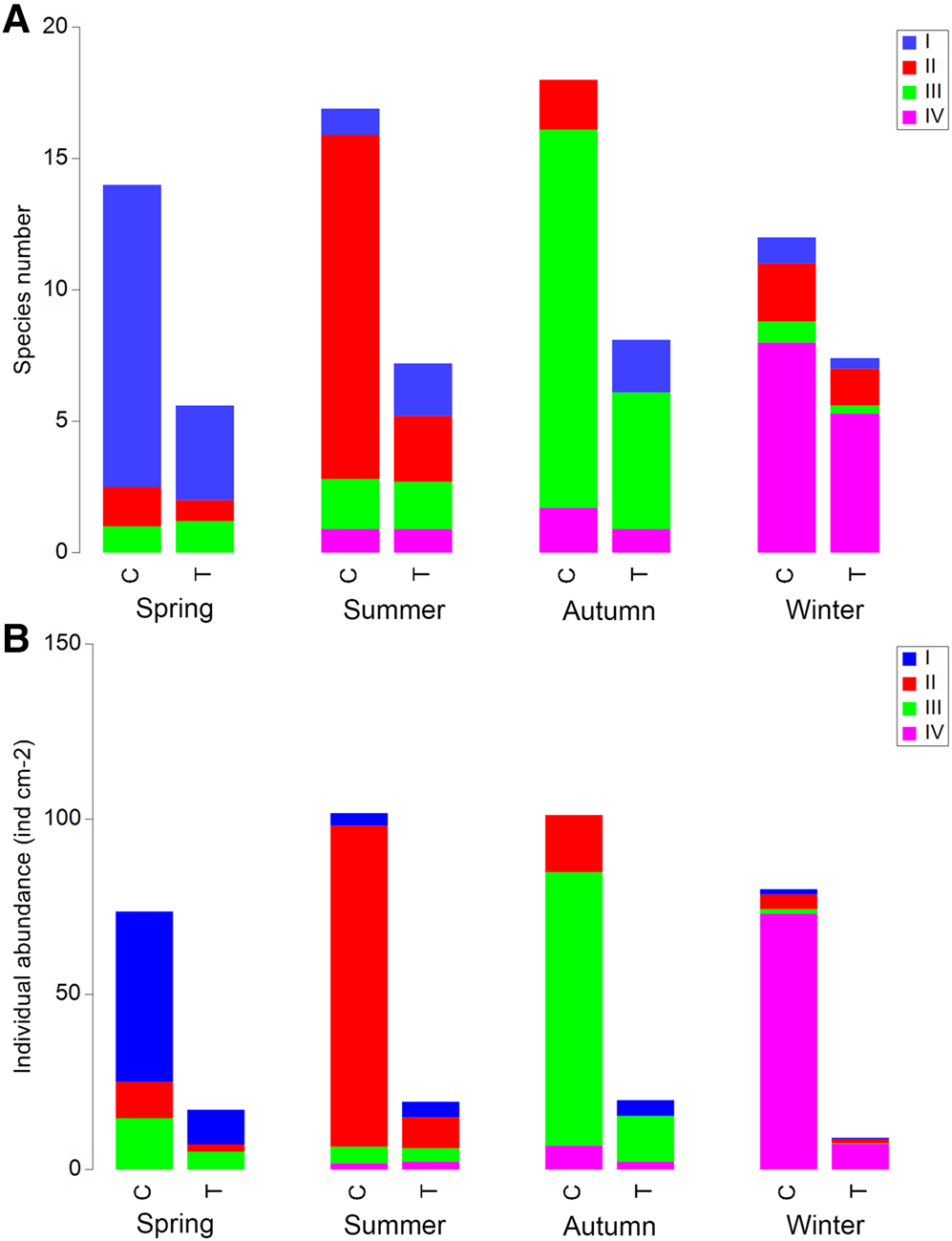
Figure 2 shows the species composition and changes in terms of average abundances, and ecological types of the test periphytic protozoan communities. A total of 60 protozoan species were identified. A total of 14, 15, 16 and 13 species were identified in the controls (C), while 6, 8, 8 and 11 species were observed in the treatments (T) from spring to winter, respectively (Figure 2 and Table 1).
Shade plotting with clustering analysis on the index of association showed seasonal variability in species distribution of periphytic protozoa and relative abundance in the controls (C) and treatments (T, NFZ concentration of 8 mg ml−1) (1, spring; 2, summer; 3, autumn; 4, winter; I–IV, Groups I–IV).

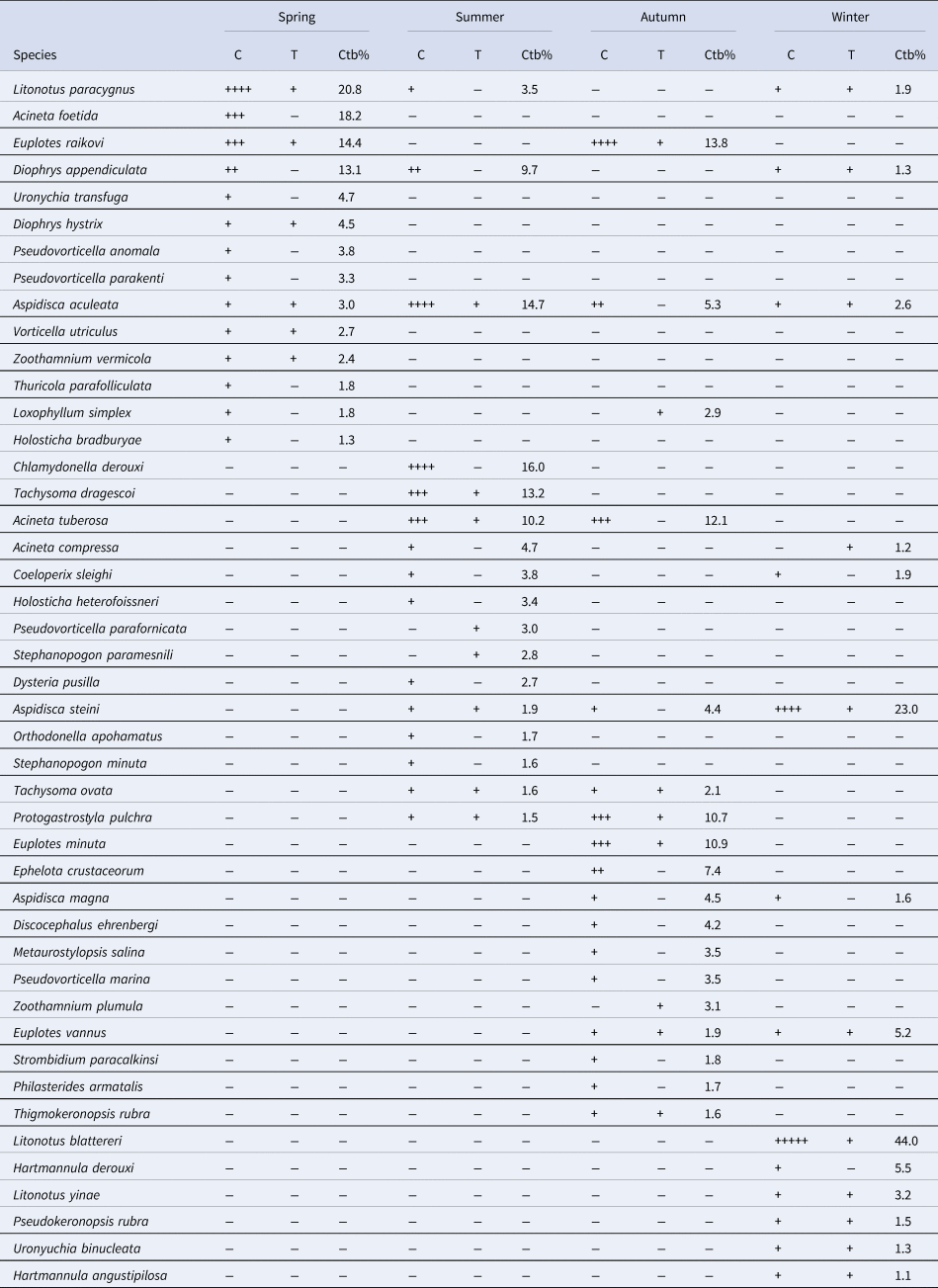
Typical species to the test organism communities in control and treatment during four seasons

Average abundance: ‘−’ = 0; ‘+’ = 0–1, ‘++’ = 1–5, ‘+++’ = 5–10, ‘++++’ = 15–20, ‘+++++’>20; C, control; T, treatment; Ctb, Contribution.
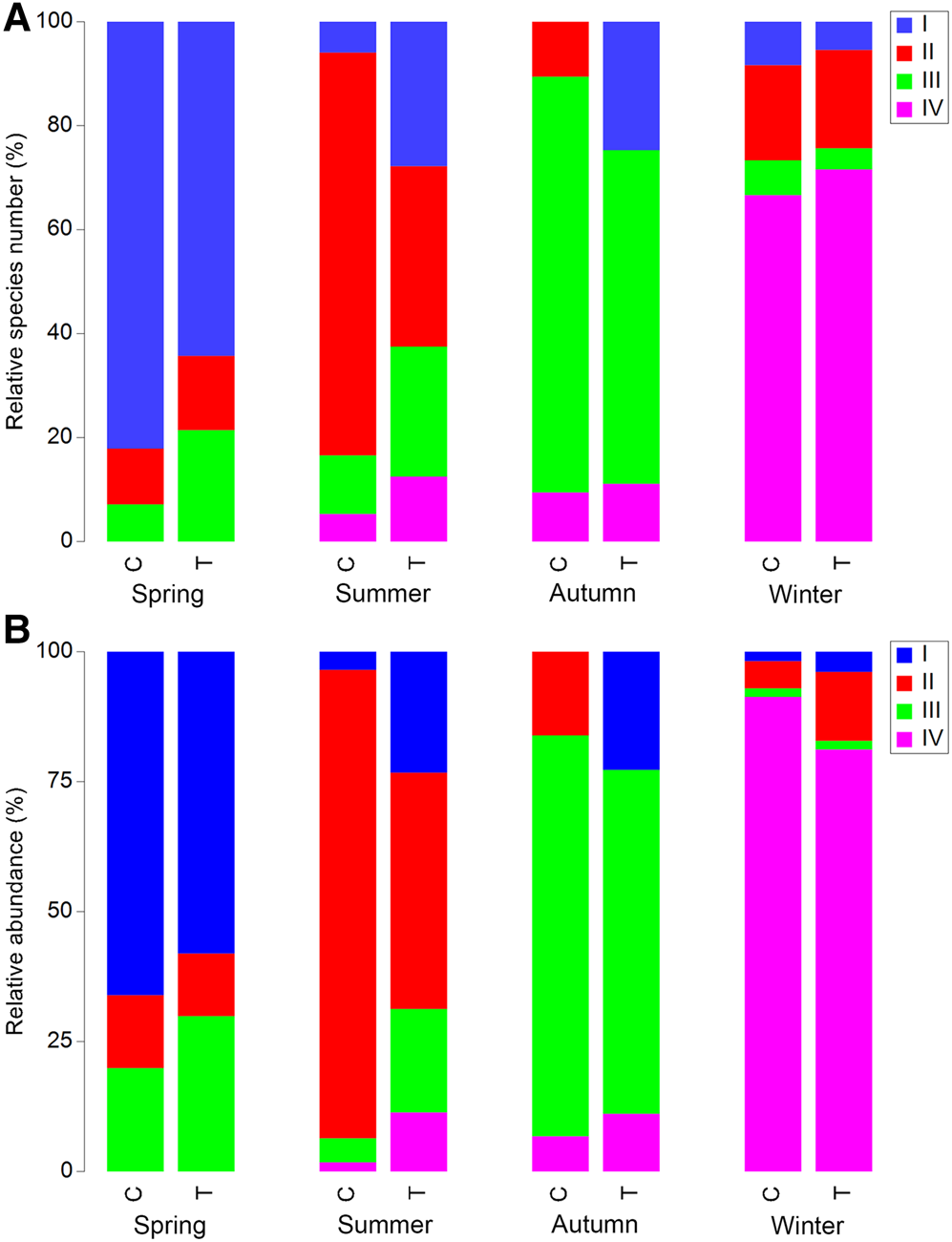
These species were roughly divided into four groups using clustering analysis with the SIMPROF test (Figure 2). The shade plotting with clustering analysis showed a clear seasonal variation in species distribution, and four groups (I–IV) dominated spring, summer, autumn and winter, respectively (Figure 2a, b). From spring to winter, the relative abundance and relative number of species of dominant contributors changed in the following order: Group I→II→III→IV, and sharply dropped from the controls and treatments (Figures 2 and 3). Species number and individual abundance followed the same variation (Figure 4). For example, Group I, Acineta foetida, was very sensitive, which was mainly present in the control group. Diophrys hystrix, which was ubiquitous in the treatment group, was tolerant to 8 mg ml−1 nitrofurazone (Figure 2 and Table 1).
Seasonal variability in relative species numbers (a) and relative abundance (b) of Yellow Sea coastal periphytic protozoa in the controls and treatments (I–IV, Groups I–IV).

Seasonal variability in species numbers (a) and individual abundance (b) of Yellow Sea coastal periphytic protozoa in Groups C and T (I–IV, Groups I–IV).

It should be noted that there were significant differences in both species number and individual abundance between the treatment and the control (P < 0.05).
Table 1 summarizes the abundance, frequency of occurrence and contribution of typical protozoan species of the test organisms in different seasons. The dominant contributors in each season showed different contribution rates in the treatment and control groups. For example, in spring, Litonotus paracygnus was the largest contributor with a contribution of 20.8%. Chlamydonella derouxi dominated the summer with its contribution of 16%. In addition, Euplotes raikovi with 13.8% and Litonotus blattereri with 44% contributed in autumn and winter, respectively.
Variation in protozoan community pattern
Distance-based redundancy analysis (dbRDA) ordinations showed that there were different colonization patterns of the protozoan communities among the four seasons (Figure 5). Taxonomic patterns at Group C were separated from Group T by dbRDA1.
Distance-based redundancy analysis (dbRDA), showing the seasonal variation of protozoan community patterns in Groups C and T in the coastal waters of the Yellow Sea (a, spring; b, summer; c, autumn; d, winter).

It can be clearly observed that the vectors of six species are pointed toward the data points of Group C, whereas only D. hystrix and Aspidisca aculeata pointed toward the data clouds of Group T (Figure 5a); the vectors of nine species point to the data of Group C and only three species (Stephanopogon paramesnili, Aspidisca steini, Pseudovorticella parafornicata) point to the Group T data (Figure 5b). In Figure 5c, there are eight and three species vectors in the Groups T and C, respectively; in Figure 5d, there are seven vectors of species pointing to the Group C data and four species pointing to the Group T.
Variations in taxonomic distinctness
Variations in taxonomic distinctness and average taxonomic distinctness (Λ+ and Δ+) are summarized in Figure 6. Ellipse tests on the 95% probability regions have a range with sublist sizes (10, 20 and 30 species) of the protozoan samples for all seasonal controls and treatments (Figure 6). It was clear that there were differences in taxonomic pattern of the protozoan communities between the controls and treatments, for example, all samples were fallen in 10, 20 and 30 species contour in the controls (Figure 6a), whereas a part of these showed a significant departure from the expected community pattern (Figure 6b).
Ellipse plots of 95% probability regions with a range of three sublist sizes (10, 20 and 30 species) for the taxonomic distinctness indices, i.e. average taxonomic distinctness (Δ+) and variation taxonomic distinctness (Λ+), of the protozoan communities in the treatment and control group, showing the deviation of the protozoan communities from an expected range of 10, 20 and 30 species contours (a, 0; b, 8 mg ml−1).

Discussion
Antibiotics are deposited in surface water through multiple sources, thus posing a serious ecological threat (Puckowski et al., Reference Puckowski, Mioduszewska, Bukaszewicz, Borecka, Caban, Maszkowska and Stepnowski2016; Bawa-Allah and Ehimiyein, Reference Bawa-Allah and Ehimiyein2022). Aquatic ecosystems primarily serve as the main repository for various kinds of antibiotics, posing ecological risks to aquatic organisms (freshwater algae, microphytes, macrophytes, zooplankton and fishes) (Kovalakova et al., Reference Kovalakova, Cizmas, Mcdonald, Marsalek, Feng and Sharma2020; Anh et al., Reference Anh, Le, Da Le, Lu, Duong, Garnier, Rochelle-Newall, Zhang, Oh, Oeurng, Ekkawatpanit, Nguyen, Nguyen, Nguyen, Nguyen, Tran, Kunisue, Tanoue, Takahashi, Minh, Le, Pham and Nguyen2021; Zhou et al., Reference Zhou, Shi, Lu, Song, Wang, Wu, Liang, Qian, Xu, Shao and Li2024). Protozoa, as important hubs in marine ecosystems, necessitate the study of their response to antibiotic toxicity. Recent investigations have demonstrated that the periphytic protozoan communities are sensitive particularly to NFZ at 8 mg ml−1 in the concentration (Kazmi et al., Reference Kazmi, Uroosa, Warren, Zhong and Xu2022a, Reference Kazmi, Uroosa, Xu and Xuexi2022b).
Due to environmental heterogeneity, differences in food availability between seasons significantly influenced the protozoan colonization dynamics, with significant seasonal changes in community structure and functioning (Sikder et al., Reference Sikder, Xu and Xu2020a, Reference Sikder, Xu, Xu and Warren2020b). In our study, it was found that 8 mg ml−1 caused a decrease in the relative species number and relative abundance in each season and therefore NFZ was toxic in each season. However, each season has different dominant species, and SIMPROF analysis allowed to divide the 60 protozoa observed into four groups. The contribution of these four groups was different in each season, Group I, II, III and IV were occupying the four seasons of spring, summer, autumn and winter, respectively, which indicated that there were seasonal differences in the toxic effects of NFZ. It is probably because NFZ affects the food supply of ciliates, and the difference in food supply can have a significant effect on ciliate colonization dynamics, which needs further confirmation.
The dbRDA analysis showed that nitrofurazone toxicity led to changes in the community structure of periphytic protozoa in different seasons, which may be due to differences in tolerance between species as well as seasonal variation. This reflects that 8 mg ml−1 concentration of NFZ respond to the protozoa tested with some variation depending on the season.
Taxonomic distinctness indices for analysing variability in taxonomic breadth of a community have the advantage of being low sensitivity to sampling effort and sample size, and being able to test the significance of departure from expectation within a statistical framework (Clarke and Warwick, Reference Clarke and Warwick1998; Leonard et al., Reference Leonard, Robert Clarke, Somerfield and Warwick2006; Somerfield et al., Reference Somerfield, Clarke, Warwick and Dulvy2008; Prato et al., Reference Prato, Morgana, La Valle, Finoia, Lattanzi, Nicoletti, Ardizzone and Izzo2009; Sikder et al., Reference Sikder, Xu and Xu2020a). Thus, in the present study these taxonomic indices (Δ+ and Λ+) may have played an auxiliary role exploring the adaptation of protozoa to the same concentration of NFZ across seasons. Ellipse plots of these metrics indicate that protozoan communities deviated significantly from the expected taxonomic width when NFZ concentrations were 8 mg ml−1, whereas in controls no samples deviated from the expected taxonomic pattern.
Thus, our study confirms that periphytic protozoa can be used as biomarkers for evaluating NFZ ecotoxicity, which is consistent with previous reports. In total, 8 mg ml−1 of NFZ does not lose its effect on protozoa toxicity due to seasonal variability. Because the major contributors differed in each season, when the season changed, new populations were substituted to cope with the NFZ toxicity effects. This finding could explain the ability of protozoa to transport material and energy from plankton to benthos when exposed to environmental pollutants, playing an important role in the functioning of microbial food webs and maintaining ecosystem stability.
In summary, differences in species composition and typical species were observed in the test organism fauna in the control and treatment among four seasons. However, the community patterns were significantly shifted under the sensitive concentration, with a part of test samples showed a significant departure from the respected taxonomic pattern. Therefore, it is suggested that periphytic protozoan fauna may be significantly changed at the sensitive concentration of 8 mg ml−1 in four seasons, although there were significant differences in both species composition and community pattern in marine environments.
Author contributions
All authors wrote the paper and approved the final manuscript.
Financial support
This work was supported by ‘The Natural Science Foundation of China’ (project numbers: 31672308 and 41076089).
Competing interest
The authors declare that they have no known competing financial interests or personal relationships that could have appeared to influence the work reported in this paper.
Ethical standards
This work meets ethical standards.
Data availability
The data that support the findings of the study are available from the corresponding author upon reasonable request.