


Introduction
There is increasing evidence that cognitive behavioural therapy is effective in the treatment of psychosis (Wykes, Steel, Everitt and Tarrier, Reference Wykes, Steel, Everitt and Tarrier2008), and has been recommended for the treatment of schizophrenia (National Institute for Clinical Excellence, 2009). It aims to help reduce distress and improve quality of life by evaluating appraisals and modifying behavioural, cognitive and emotional responses (Morrison and Barratt, Reference Morrison and Barratt2010). To date, the effectiveness of CBT for psychosis (CBTp) has focused on the reduction of psychotic symptoms and associated improvements in functioning (Greenwood et al., Reference Greenwood, Sweeney, Williams, Garety, Kuipers and Scott2010); however, psychotic symptoms may not be primary concerns for those seeking treatment (Pitt, Kilbride, Nothard, Welford and Morrison, Reference Pitt, Kilbride, Nothard, Welford and Morrison2007). Rather than focus on symptoms exclusively, several psychological models of psychosis encompass factors such as beliefs about self and others, emotional difficulties and problematic consequences of symptoms (Bentall, Reference Bentall2003; Chadwick and Birchwood, Reference Chadwick and Birchwood1994; Garety, Kuipers, Fowler, Freeman and Bebbington, Reference Garety, Kuipers, Fowler, Freeman and Bebbington2001; Morrison, Reference Morrison2001). Given the common differences between professionals’ and service users’ priorities for treatment (Byrne, Davies and Morrison, Reference Byrne, Davies and Morrison2010), it can be argued that these psychological approaches allow for greater consideration of service users’ individual priorities, which may prove more effective than treatment approaches focused primarily on the reduction of symptoms.
It has been argued that our limited understanding of the effectiveness of CBTp may be due to the relative lack of studies conducted to investigate service users’ subjective experiences (Fowler, Garety and Kuipers, Reference Fowler, Garety and Kuipers1995). A recent review of the qualitative literature on this topic reported eight such studies (Berry and Hayward, Reference Berry and Hayward2011), but four of these examined group-based interventions. Of those that focused on individual CBTp, two focused on very specific aspects: homework (Dunn, Morrison and Bentall, Reference Dunn, Morrison and Bentall2002) and formulation (Morberg-Pain, Chadwick and Abba, Reference Morberg-Pain, Chadwick and Abba2008). A qualitative study (Messari and Hallam, Reference Messari and Hallam2003) that interviewed five service users who received individual CBTp identified several central themes from their analysis of clients’ experiences, including: CBT as an educational process; CBT as a respectful relationship between equals; and CBT as a healing process. Another study interviewed eight service users and four practitioners, and focused more directly on factors that affect outcomes of CBTp, with both users’ and therapists’ accounts describing both deficits and skills, with a central theme being “understanding, holding and engaging with the therapist's model of reality” (McGowan, Lavender and Garety, Reference McGowan, Lavender and Garety2005).
While both studies offer valuable insights into CBTp practice and particularly users’ understanding of therapy, it may be suggested that similar studies will benefit from greater involvement of service users in the research process itself. User-involvement in mental health research has been recommended by the Department of Health (Department of Health, 2005), and by NICE (National Institute for Clinical Excellence, 2009). User-led research may offer advantages such as increased rapport between interviewers and interviewees, and may reduce interviewees’ potential concerns regarding confidentiality and criticism of professionals, and may also offer “a different view of the world of mental health” to that produced within mainstream research (Rose, Reference Rose2001, Reference Rose2008).
The present study has been designed and conducted as a user-led qualitative evaluation of service users’ subjective experiences and perceptions of CBTp. The study aims to inform user-oriented perspectives on treatment for psychosis.
Method
Participants
Participants had experience of CBTp within the last 12 months, and were aged between 18 and 65. Exclusion criteria included not being able to speak English, and not being able to give informed consent. Nine participants took part in the study; five females and four males. The sample had a mean age of 26 years (ranging between 21 and 65 years of age). Eight participants came from Early Intervention Services (EIS) and one was recruited from a Community Mental Health Team (CMHT), all based in or around Greater Manchester. Eight participants were white British and one was black British.
Design, procedure and analysis
Individuals with experience of CBT for psychosis were invited to take part in a user-led semi-structured interview. Interpretative Phenomenological Analysis (IPA) methodology was chosen to evaluate people's experiences and perceptions. IPA uses a “double hermeneutic”, which refers to the two-way interpretative process of this methodology. Investigators have an active role in aiming to make sense of the participant trying to make sense of their world, and to obtain an “insider perspective”. This aspect of IPA methodology was enhanced by having interviewers who had first hand experience of psychosis, although it is important to acknowledge that this enhanced degree of “shared understanding” between interviewers and participants may have increased the likelihood of user-oriented bias in either the tone or content of interviews. Similarly, the collective standpoint of the wider research team as proponents of CBT for people with psychosis may have increased the likelihood that a positive bias towards CBT could have influenced our analysis of participants’ accounts. However, we did seek to minimize this risk via discussion of such issues, awareness of our own biases during analysis, and explicitly seeking negative or unfavourable information throughout the interviews and analytic process. The analysis, which was led by user-researchers (RB and JP), involved an iterative process of repeated reading of interview transcripts, extraction of themes, discussion between user-researchers, and comparisons across transcripts. A final set of user-defined themes was produced and organized structurally in response to the research question.
Results
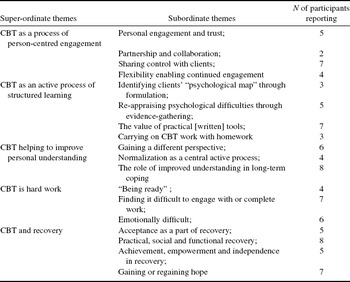
The research identified five major or “super-ordinate” areas of thematic consistency throughout the interviews, as listed in Table 1. Each of these thematic groupings had further subthemes, also summarized in Table 1 and discussed below.
Super-ordinate and subordinate themes (including number of participants endorsing each)

CBT as a process of person-centred engagement
The first theme reflects the value participants attribute to experiences of interpersonal engagement with their therapist, and to their therapists’ ability to offer “person-centred”, individualized approaches to therapy.
The importance of personal engagement and trust
The theme of interpersonal engagement emerged as a common element in clients’ discussions of valued experiences of CBT, with five of nine clients making specific reference to trust and personal comfort being central to their ability to engage with therapy:
If you don't trust them you aren't gonna tell them what you've been through and you aren't going to go into depth with people. (1)
I think it's just having someone there really. . .that you can trust and that. . .that knows what's going on and understands. (5)
Partnership and collaboration in CBT
Partnership and collaboration in CBT emerged as a valued aspect of engagement. The concept of partnership in particular was identified as a respectful recognition of participants’ personal worth as individuals capable of contributing meaningfully to the therapy process:
I'm not just a service user, I'm someone on her level you know, really as a service user you get looked down on and you don't get considered at all, your feelings don't get considered at all when you're ill, you know people tend to talk over you or at you, or at someone else for you, but people in [therapist's] position, and people on her level and people such as you don't do that you know. (2)
A number of participants compared previous mental healthcare experiences with CBT, identifying the role of a collaborative partnership as a distinct and even novel aspect of their care:
It was very much a partnership between myself and the psychologist, it was really put to me as team work, which I thought was great. It wasn't that someone else has an agenda. . .it was centred around me which I'd not come across before in anything really in medicine or psychiatry. (6)
Sharing control with clients
Most participants highlighted shared control of therapy as an integral part of their experience, and identified individualized, client-led agenda-setting in particular, as important:
. . .she puts an agenda down what we need to go through but she'll also ask if there's anything that I need to. . .if anything's been difficult that I want to talk through or if there's anything else I want to talk about. (5)
For other participants, the issue of control in therapy was framed as a natural process of client-led discussion, or as a “safe” therapeutic context for self-determined disclosure:
I felt like I've been in control of what I wanted to say and anything I did say I felt you know that no-one's gonna judge me. (4)
Flexibility enabling continued engagement
Flexibility was highlighted as an important attribute of therapy that improved participants’ ability to remain engaged. Flexibility was most often discussed as an attribute of the perceived control described above:
. . .if something wasn't so much of a problem later on we could reduce that, if something else came up we could add that in to the plan. (3)
Flexibility within therapy also meant being allowed to re-evaluate their difficulties and to determine their own priorities for therapy:
We did working out what my main problems were that I wanted to overcome and when you look at it that way you start thinking, well you know, you'd think it was the voice I was hearing nearly all the time but that actually wasn't much of a problem, it was kind of pleasant. It was the thinking people could hear my thoughts on the bus. (2)
CBT as an active process of structured learning
The second major theme that emerged from our analyses reflects participants’ perceptions and understanding of specific CBT exercises and techniques, which may best be summarized from our data as individualized processes of “structured learning”. Participants’ accounts of progress through therapy often included references to practical psychological exercises, with common outcomes of these including perceived improvements in their psychological wellbeing and quality of life.
Identifying clients’ “psychological map” through formulation
Most participants referred to experiences of working through psychological formulations with therapists, though only three identified structured formulations in clear terms as a distinct therapeutic technique. The majority of participants’ accounts of undertaking formulation exercises were described in broader terms and included common reference to the perceived value of “writing things down” and “drawing diagrams” to facilitate understanding:
. . .like maps of my mood and little things about different parts of your life and how they can fit together, he would just kind of draw little diagrams that to me they would make sense and I'd be like yeah yeah you're right. (8)
For those participants who did identify formulation as a key stage in their progress through CBT, perhaps the most effective element was the normalizing process of re-evaluating psychotic experiences within the wider context of their individual life experiences:
We'd go through various steps of my life sort of thing and break everything down, we'd go through what was good and what was bad, it was really helpful. . .what you think the cause of the voice hearing and any traumatic experiences, and explain like, me Mam died and stress at work. (7)
Re-appraising psychological difficulties through evidence-gathering
The process of re-evaluating beliefs about psychotic experiences by exploring the presence or absence of evidence was viewed as valuable:
I think the evidence thing's kind of good, sort of it is real and you have to sort of work out well, is it likely to be real. Like if you think, say, people taking thoughts out of my head, and erm, it's sort of well what's the proof that they are. (2)
Re-evaluation, as a means of assessing probability for themselves (is it likely to be real) was valued as a transferable and independently applicable skill:
We could test out our predictions, and like look for other explanations like, there was some exercises in the CBT that I could do. . .so eventually I'd feel, like I'd get a de-escalating feeling of anxiety. (1)
Monitoring progress in CBT
For a number of participants, filling out assessment measures enabled them to view their experiences in a formalized structured context, and this in turn enabled them to recognize progress:
. . .it's [measuring symptoms] a good idea because you can then look back at stuff and say, oh right, that's a similar situation and that made me feel like, 10 or whatever. (2)
Some acknowledged the value of written relapse-prevention exercises, or “blueprints” to enable them to act as “self-therapists” when therapy had come to an end:
. . .this is all my early warning signs I did, that we got out of the sessions, and on a day to day basis so I could score and I could see improvements in how I was doing. (1)
CBT “homework”
Although most participants’ accounts contained references to completing tasks or exercises outside therapy sessions, just three referred directly to homework as a distinct element of their experience. For those who did, engaging with homework tasks such as “thought diaries” helped to maintain a practical focus regarding their concerns between sessions:
I feel if I hadn't done the homework that I had, then, and showed up to the sessions as well, I think it would have taken me a lot longer. (1)
CBT helping to improve personal understanding
Along with discussions related to structured or practical “work”, all participants offered descriptions of the internal learning processes that characterized their experiences of CBT. Overall, “improved understanding” was identified as a central valued outcome.
Gaining a different perspective on psychosis through CBT
CBT was seen to offer opportunities to gain a “different perspective” on psychotic experiences and associated difficulties, and this was identified as an active element and an important outcome:
. . .she explained to me. . .was there a chance that it could be my thoughts. . .and I'd never thought of it that way. I always thought that the voice was coming from somewhere else. . .somebody else should I say. (5)
Normalization as a central active process in CBT learning
Normalization emerged as a significant element in the various CBT processes described by our participants, and was seen to have played an important part in the re-evaluation of psychological problems:
. . .all these thoughts, I was thinking when I felt fine, oh my god they're crazy but [therapist] helped me to see that the thoughts weren't crazy, after looking at what happened. (1)
A number of participants also described normalization as a means of re-evaluating their self-image:
I've learnt a lot. . .erm I guess about mental health it happens to a lot of people and things like. . . I thought I was abnormal, especially when I was down I thought what is wrong with me erm and [therapist] would always say well would you think somebody was normal if they had green eyes, and you'd be like yeah, and she'd say like. . . well more people have mental health problems than have green eyes. (8)
Understanding psychosis helping to improve long term coping
Improved understanding was a central factor in participants’ perceived ability to cope with their difficulties in the long-term. A central thread within participants’ discussions in this area relates to a shift in understanding of psychotic experiences from an expectation that treatment should stop them occurring, to learning to respond to them differently:
I don't think it's [CBT] used to eliminate them altogether it's knowing why you get the voices erm. . .how to deal with them basically. (7)
Improvements in understanding were also seen by a number of participants to represent improvements in their perceived ability to act independently of mental health services in the future:
. . .it just helped me be a bit more insightful, a bit more logical about it and yeah be more independent just to think yeah I can actually deal with this. (2)
CBT is hard work
The fourth of the super-ordinate themes identified relates to the potential difficulties of engaging with CBT, and was reflected in almost all participants’ accounts. Aspects of CBT that were commonly perceived as difficult were identified in terms of personal motivation, practical barriers to engagement, emotionally difficult disclosure and engagement with sensitive areas of personal experience.
“Being ready for CBT”
For some participants, the potential difficulty of engaging with CBTp initially, or over time, seemed related to their readiness:
I don't know if I had cognitive therapy many years ago if it would have helped, as I don't know if I'd be ready you know, but since having CBT I've never looked back. (2)
There was a recognition that the self-examination or cognitive “work” necessary for effective engagement with CBT was not always possible:
To be honest there would have been times where there was no way I would have engaged with it or benefited from it. . .think you've got to be ready and motivated for it cos there is quite a lot of thinking and you need to be fairly open minded. (3)
Finding it difficult to engage with or complete CBT work
Almost all participants referred directly to engagement with CBT as “hard work”, where personal motivation and agency were required to achieve progress. For a number of participants, CBT was considered effortful due to concentration on specific cognitive processes:
I couldn't think of the thoughts, I struggled identifying the thoughts, cos I had loads running through my head. (1)
Finding that therapy was more demanding than expected was often related to widely-held cultural understandings of psychological therapy, where clients are most often seen as passive recipients of therapists’ professional expertise, rather than as active partners within a more collaborative process:
. . .when I first like you know got told I was gonna have CBT you just expect you get better but it doesn't, there's a lot of like, you got a put a lot in yourself to get a lot out really. (7)
A number of participants found that homework tasks were difficult to complete outside therapy because their ability to undertake them was often dependent on their mood, memory or circumstances:
I think it's hard to get into them at first [thought diaries] because when you're stressed out you don't want to write it down. . . it kind of passes by and then you remember afterwards. (3).
CBT can be emotionally difficult
Difficulties around personal disclosure of either psychotic experiences themselves or difficult previous life experiences were associated with worries that such disclosures could have resulted in the therapist making negative personal judgements:
I found it hard sometimes as you don't want to write down what was going on in your head because people will think you're a bit weird. (6)
Emotional disturbance and distress was a common difficulty for participants when disclosing personal issues:
I suppose sometimes I had to face up to some of the problems I was having that I was trying to stick my head in the sand about so maybe, I suppose there were times when anxiety was a huge side effect of everything and I suppose it increased it at times. (2)
Participants often described the experience of strong emotions as a necessary prerequisite of achieving progress:
It was hard, it wasn't easy. . .to go through things that had happened in the past. Erm. . .I got upset a lot, so it wasn't easy but. . .I knew it had to be done. . .just to get past it. (5)
However, it was also evident that for at least one participant this highlighted limitations in therapy:
I think the worst thing is getting upset and being left with it once they've gone. (5)
CBT and recovery
The final super-ordinate theme that emerged from our data is drawn from participants’ discussions of recovery. All participants identified particular improvements that followed therapy. Recovery from psychosis through CBT involved reductions in the frequency of psychotic experiences and reductions in distress associated with these, improved understanding and coping ability, as described above, and improved social and functional ability.
The importance of acceptance in recovery
Acceptance as a part of recovery was most clearly related to participants’ recognition that psychotic experiences or serious emotional difficulties could continue after therapy, though with less distressing or disabling effects:
[Therapist] showed me that it's not just going to go away, I've had 10 years of this and yeah I am going to have blips, but the blips that I have had have been shorter and short-lived so I can look back and think yeah it is working. I've never had an episode that was like that first. So we are obviously doing something right. (1)
As well as acceptance of difficulties, acceptance of self was also identified as an important element of recovery:
I like myself a bit which I never did, I disliked myself intensely one time, I can notice the positive things about myself you know. (2)
Social and functional recovery
Improved social and functional ability was also an important element of recovery. For some this was the result of changes in relation to psychotic experiences:
I can deal with them [voices] a bit better now. . .cos they used to stop me going out an. . .on me own and stuff like that. They used to interfere with me life, they still interfere but not half as much as they used to. (5)
For others, this was as the result of changes in relation to emotional difficulties:
. . .the biggest impact actually which I didn't realize was anxiety actually, that's what stopped me doing things, that's what stopped me going out and to the shops and pubs, things like that. (2)
Achievement and independence in recovery
Another common dimension of participants’ perceived recovery was recognition of personal achievement within and outside of therapy, and consequential improvements in perceived empowerment and independence:
I struggled and struggled for the last 20 years and I felt that I wasn't making any ground, but I felt that in the last 4 years I have really moved forward, that have been times when I have had bad days, but I've really managed to pull myself round you know. (2)
The ability to personally employ CBT practices brought a sense of confidence in their ability to continue effectively on their own:
So once we had worked out that I was actually doing it right I could do it by myself. (1)
Gaining or regaining hope
The importance of gaining or regaining a hopeful attitude for continued recovery was evident, through a change of perspective from negative, “stuck”, or even hopeless, to more positive, future-oriented frames of mind:
The first time I came into contact with the mental health services I couldn't see anywhere forward, didn't want to be here, couldn't see the point of being here, now I've got things to aim for, it's like, okay, I've got things to aim for. (6)
Past experiences of feeling trapped by psychological difficulties were addressed through CBT, where evidence of their ability to affect positive change on their wellbeing had brought about a significant improvement in their perception of their coping ability, characterized by the emergence of a long-absent sense of optimism:
I was without any hope for many years, I would go around thinking I was going to jack it in or not live very long, I would always come up with some negative point, I actually feel now, well more recently, over the last 6, 12 months that there is actually hope, I can move forward. (2)
Discussion
We interviewed nine people with experience of CBTp and identified five major themes: “person-centred” engagement; a process of structured learning; improving personal understanding of both psychosis and self; hard work practically and emotionally; and recovery from psychosis. We found that participants most consistently valued: shared control in therapy (i.e. through collaboration), gaining improved understanding for long-term coping, and achieving social and functional recovery. In addition, normalization in CBT appeared both as a discrete subtheme within the area of “improved understanding” and throughout a variety of other discourses such as interpersonal engagement, the role of psychological formulation, and the development of acceptance in recovery. As such, we suggest normalization to be of central importance in CBTp.
A number of the central discourses previously identified (Messari and Hallam, Reference Messari and Hallam2003) are echoed in the present study, suggesting a degree of generalizability for these areas. They report that for their clients CBT constituted “an educational process”, and “a respectful relationship between equals”, while we identified from participants’ discussions the role of CBTp as a process of “structured learning” and “improved understanding” primarily conducted within the context of collaborative partnership. However, our findings differ from theirs in a number of ways, including the extent of therapeutic progress reported and in the language used to reflect participants’ beliefs about psychotic experiences. In their study (Messari and Hallam, Reference Messari and Hallam2003), personal beliefs about psychosis were represented either in psychiatric terms (e.g. “I am ill”), or in terms of unresolved delusional certainty (“this [psychotic experience] is truly happening”). None of our participants’ discussions reflected delusional certainty or continued uncertainty about the veracity of their earlier beliefs. In addition, few of our participants explicitly referred to themselves as having been “ill” or “mentally ill”. A final difference between our studies can be seen in their inclusion of the discourse “CBT participation as compliance with the powerful medical establishment” (reflecting a minority view among their participants); none of our participants referred to such a dynamic, perhaps reflecting differences in the delivery of CBT; for example, different CBT manuals place different emphasis on factors such as diagnosis, normalization and the amenability of psychotic experiences themselves to change. Thus, some approaches emphasize adjustment and coping with mental illness, whereas others aim to modify appraisals of and responses to psychotic experiences in order to create lasting change in psychological functioning.
Comparison of our findings with the study that sought to explore specific psychological processes implicated in outcomes from CBTp (McGowan et al., Reference McGowan, Lavender and Garety2005). highlights a similarity regarding “non-model-specific benefits of therapy” (e.g. personal engagement, or “having difficult experiences listened to and taken seriously”). Another element identified in both studies is referred to as “a move from old to new understanding” of psychotic experiences (McGowan et al., Reference McGowan, Lavender and Garety2005), which is similar to our “gaining a new perspective” of psychosis. The commonality of this finding suggests that such a shift may be central in effective CBTp.
A notable difference between our findings and those reported in both studies mentioned above relates to normalization in CBT. For our participants, normalization represented a highly valued element of CBT experience where, in contrast, neither of the other two studies explicitly identified the importance of normalization - although the review of the eight qualitative studies (Berry and Hayward, Reference Berry and Hayward2011) did identify normalization as a theme that emerged. This may reflect a substantial difference in the practice of CBT between therapists related to each research study or a substantial difference in the interpretations our respective researchers have given participants’ accounts of their CBTp experience.
A recent study examining user-defined outcomes of CBT for psychosis (Greenwood et al., Reference Greenwood, Sweeney, Williams, Garety, Kuipers and Scott2010) reported that the highest ratings of importance were given to goals such as achieving a sense of control, ways of dealing with unpleasant feelings and emotions, and having a positive purpose and direction in life. These goals can be seen to reflect our participants’ CBT experiences in terms of achieving control through improved coping with continued difficulties, along with regaining hopefulness. However, unlike Greenwood et al., our participants highly valued a number of internal change processes (especially improving understanding of psychosis) during therapy and in recovery. This difference may be explained by the fact that the majority of their participants were long-term service-users consulted at the beginning of CBTp involvement, whereas the majority of our participants generally had less lengthy experience of psychosis, and were interviewed following CBTp, where stages of recovery had commonly been achieved.
A study of service-user satisfaction with CBTp (Miles, Peters and Kuipers, Reference Miles, Peters and Kuipers2007) found that participants’ highest ratings of factors were for “therapist attributes”, suggesting that collaboration within CBTp along with “being able to talk to someone” were highly valued. However, they also found that overall satisfaction was best predicted by the extent to which participants believed they had gained specific CBT skills and knowledge in therapy, and that the perceived helpfulness of CBT homework tasks may also predict long-term satisfaction. These findings are complementary to our own, with a number of both specific and non-specific aspects highlighted by our participants.
Research into recovery from psychosis is also relevant to our findings. A study of user-defined attributes of recovery from psychosis (Pitt et al., Reference Pitt, Kilbride, Nothard, Welford and Morrison2007) reported a number of findings echoed by our own results: for example, their findings included themes of rebuilding self, rebuilding life, and hope for a better future. These factors may constitute central and generalizable aspects of recovery across treatment modalities; thus, CBTp may be a treatment that is likely to be acceptable and likely to address user-defined priorities.
There are several limitations of our research. In common with similar qualitative studies, we included only a small number of participants, and so our findings do not necessarily reflect a generalizable picture of CBTp experience. Our sample was self-selected and evidently satisfied with CBTp involvement; in future, it would be interesting to purposively sample participants who had dropped out of CBT in order to identify a more critical perspective. A combination of qualitative and quantitative analyses, perhaps using nested qualitative studies within clinical trials of CBT for psychosis, may be particularly fruitful in furthering our understandings of the factors that are most important in influencing engagement and outcome.
Our findings suggest that CBT is an acceptable treatment for people with psychosis, and have implications for clinical practice. Normalization processes (in engagement, re-evaluation of psychotic experiences, and improving self-esteem) emerged as one of the most important aspects of CBT for our participants, and may represent a key “active ingredient” of successful therapy; thus, normalization should be an essential element of CBT for psychosis, and therapists should have attitudes and beliefs that are compatible with such an approach. This reflects professional consensus regarding elements of CBT for psychosis (Morrison and Barratt, Reference Morrison and Barratt2010). The “human” element of CBT, embodied in factors such as collaboration, informality, and use of non-psychiatric language was often favourably compared with participants’ earlier experiences of mental health involvement, and may have significantly affected participants’ ability or willingness to engage with therapy; again, this is consistent with professional consensus (Morrison and Barratt, Reference Morrison and Barratt2010).
The collaborative approach, in particular, was often novel to our participants, who were more used to professional-led psychiatric treatment, and this was considered an integral part of the effectiveness of CBT; this suggests that mental health practitioners in general may improve engagement with clients through the adoption of increasingly collaborative approaches to care (e.g. offering flexibility and choice in treatment options). Participants’ appreciation for the use of written exercises such as diagrammatic formulations and diaries suggests these are important, perhaps especially where cognitive deficits impair clients’ concentration and memory. Similarly, homework tasks, where appropriately negotiated, may help clients “hold” therapeutic progress between sessions and following therapy. One of the clearest themes to emerge from our findings was the value attributed to skills learned during therapy, both for immediate reductions in psychosis-related distress, and for long-term ability to live with continued psychotic experiences; this is consistent with the aim of CBT to teach people to become their own therapist (Morrison and Barratt, Reference Morrison and Barratt2010).
Clinical trials of CBT for people with psychosis have focused primarily on psychotic symptom reduction, rather than, for example, distress or personal fulfilment. The findings of our study and others (Greenwood et al., Reference Greenwood, Sweeney, Williams, Garety, Kuipers and Scott2010; Pitt et al., Reference Pitt, Kilbride, Nothard, Welford and Morrison2007) suggest that recovery from psychosis does not necessarily involve the reduction of psychotic symptoms, and that the most helpful approach may be to assess treatment priorities and valued outcomes with service users on an individual and dynamic basis; the collaborative nature of CBT, which involves working towards shared goals, should facilitate this process. However, it is important that this approach is also reflected in the design of clinical trials, which could utilize outcome measures that more accurately capture the diversity of service user preferences and priorities, including user-defined recovery (Neil et al., Reference Neil, Kilbride, Pitt, Nothard, Welford and Sellwood2009). Finally, it is important to acknowledge that, while participants were positive about CBT, they also identified difficulties relating to the effortful hard work involved, the importance of being ready and the possible side effects, such as short-term increases in emotional distress. CBT practitioners should alert their clients to these possibilities, and be open and honest in their discussions of them, as well as problem solving proactively to minimize the potential problems. Similarly, clinical trials of CBTp should consider measuring such adverse effects in order to facilitate a comprehensive cost-benefit analysis.
Acknowledgements
Rory Byrne led the data collection, analysis and writing of the manuscript; Martina Kilbride is identified as first author in memoriam as she designed the study protocol and interview topic guide.



Comments
No Comments have been published for this article.