





No CrossRef data available.
Article contents
When is “now”? In the past to compensate for the sensation of time or in the future as a prediction of the temporal sensory horizon?
Published online by Cambridge University Press: 25 June 2026
Abstract
Fleming and Michel discuss the slowness of conscious vision and the predictions generated by an internal model of the world. However, these two points correspond to two different times. The slowness of consciousness puts the organisms in the past, whereas predictions give them a preview of the future. Given this tension between past and future representations, when is “now”?
Information
- Type
- Open Peer Commentary
- Information
- Copyright
- © The Author(s), 2026. Published by Cambridge University Press
References
Dainton, B. (2023). Temporal consciousness. In Zalta, E. N., & Nodelman, U. (Eds.), The stanford encyclopedia of philosophy (Spring 2023). https://plato.stanford.edu/archives/spr2023/entries/consciousness-temporal/
Google Scholar
De Valois, R. L., & De Valois, K. K. (1991). Vernier acuity with stationary moving Gabors. Vision Research, 31(9), 1619–1626. https://doi.org/10.1016/0042-6989(91)90138-u
CrossRefGoogle ScholarPubMed
Eagleman, D. M., & Sejnowski, T. J. (2000). Motion integration and postdiction in visual awareness. Science, 287(5460), 2036–2038. https://doi.org/10.1126/science.287.5460.2036
CrossRefGoogle ScholarPubMed
Fröhlich, F. W. (1923). Über die Messung der Empfindungszeit. Zeitschrift für Sinnesphysiologie, 54, 58–78.Google Scholar
Herzog, M. H., Drissi-Daoudi, L., & Doerig, A. (2020). All in good time: Long-lasting postdictive effects reveal discrete perception. Trends in Cognitive Sciences, 24(10), 826–837. https://doi.org/10.1016/j.tics.2020.07.001
CrossRefGoogle ScholarPubMed
Hogendoorn, H. (2022). Perception in real-time: Predicting the present, reconstructing the past. Trends in Cognitive Sciences, 26(2), 128–141. https://doi.org/10.1016/j.tics.2021.11.003
CrossRefGoogle ScholarPubMed
Jovanovic, L., & Mamassian, P. (2020a). Events are perceived earlier in peripheral vision. Current Biology, 30(21), R1299–R1300. https://doi.org/10.1016/j.cub.2020.08.096
CrossRefGoogle ScholarPubMed
Jovanovic, L., & Mamassian, P. (2020b). Temporal context affects the perceived time of visual events. Psychonomic Bulletin & Review, 27(1), 56–61. https://doi.org/10.3758/s13423-019-01682-x
CrossRefGoogle ScholarPubMed
Kerzel, D. (2010). The Fröhlich effect: Past and present. In Nijhawan, R., & Khurana, B.(Eds.), Space and time in perception and action (pp. 321–337). Cambridge University Press.10.1017/CBO9780511750540.019CrossRefGoogle Scholar
Kolers, P. A., & von Grünau, M. (1976). Shape and color in apparent motion. Vision Research, 16(4), 329–335. https://doi.org/10.1016/0042-6989(76)90192-9
CrossRefGoogle ScholarPubMed
Kwon, O.-S., Tadin, D., & Knill, D. C. (2015). Unifying account of visual motion and position perception. Proceedings of the National Academy of Sciences, 112(26), 8142–8147. https://doi.org/10.1073/pnas.1500361112
CrossRefGoogle ScholarPubMed
Shimojo, S. (2014). Postdiction: Its implications on visual awareness, hindsight, and sense of agency. Frontiers in Psychology, 5(196), 1–19. https://doi.org/10.3389/fpsyg.2014.00196
CrossRefGoogle ScholarPubMed
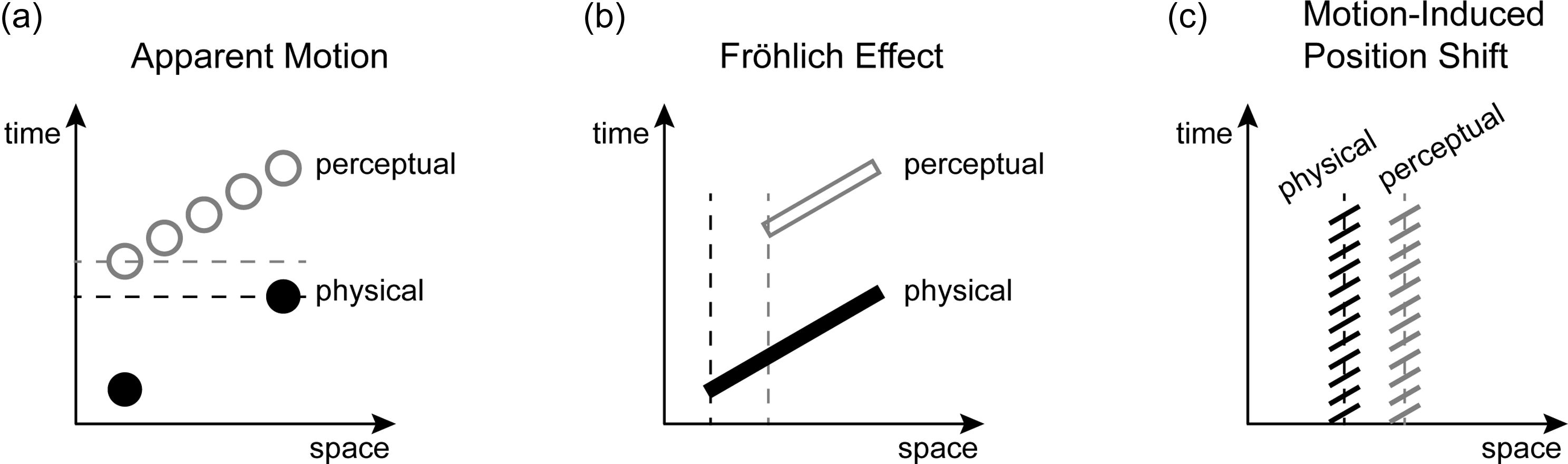
Figure 1. Space-time plots of postdictive (a, b) and predictive (c) effects. (a) In apparent motion, motion is perceived between two sequentially presented discs, suggesting that the percept is generated only after the appearance of the second disc. (b) In the Fröhlich effect, the perceived onset position of a moving object is biased in the direction of motion. (c) In the motion-induced position shift, the perceived position of a drifting Gabor is biased in the direction of motion.
Target article
Related commentaries (34)
Linking past and present worlds in the visual control of behavior
Model-based decision-making in fish: a dilemma for the extended-sensory-horizons hypothesis
Perceptual consciousness probably did not evolve for model-based planning
 You have
Access
Fleming and Michel (F&M) argue that the water-to-land transition gave some organisms the necessary time to build better internal models of the environment that would be relevant for conscious vision, with the caveat that this extended time makes conscious vision slow. But if conscious vision is slow, when is “now”? What is the physical time that corresponds to the perceived present?
Before addressing the “when is now” question, it is worth discussing how long “now” is. The perceived present is not just delayed because of incompressible neural processing time, but several authors have argued that it also has a duration (for a review, see Dainton, Reference Dainton, Zalta and Nodelman2023). William James popularized this idea with his discussion of the “specious present” (James, Reference James1890). Recent evidence comes from postdictive phenomena, where an object at time t acquires some new property because of an event occurring in the future (Eagleman & Sejnowski, Reference Eagleman and Sejnowski2000). The classic postdictive example is apparent motion (e.g., Kolers & von Grünau, Reference Kolers and von Grünau1976), where a first disc is flashed at some location and several tens of milliseconds later a second disc is flashed at a nearby location (Figure 1A). Motion between the two discs is perceived, but importantly the first disc is not perceived as static on its own before the second disc appears, suggesting that the perceived present includes at least the duration between the two discs. Another piece of evidence for the argument that the perceived present has a duration comes from simple experiences of succession. When we look at an LED that flickers at 10 Hz, we experience the flicker itself, not just the ON and OFF states of the light, and thus our experience of the present covers at least the duration of a period of the flicker. Therefore, the perceived present may have a duration, which makes it hazardous to be matched to a precise physical time, but we can still ask whether this moment represents an event in the past or in the future.
Space-time plots of postdictive (a, b) and predictive (c) effects. (a) In apparent motion, motion is perceived between two sequentially presented discs, suggesting that the percept is generated only after the appearance of the second disc. (b) In the Fröhlich effect, the perceived onset position of a moving object is biased in the direction of motion. (c) In the motion-induced position shift, the perceived position of a drifting Gabor is biased in the direction of motion.
F&M are relatively discreet on the perceived time that is represented by the internal model of their framework. One hint is their argument that conscious vision is slow, that it takes a long time for a physical stimulus to reach awareness. A century ago, Fröhlich thought he had found the ultimate paradigm to measure this “sensation time” (Fröhlich, Reference Fröhlich1923). A moving object was presented suddenly, and Fröhlich asked participants to locate its first perceived position (Figure 1B). Participants misperceived the onset position with a bias in the direction of motion, as if they missed the first few milliseconds of the motion. Unfortunately, this reasoning has been heavily criticized (for a review, see Kerzel, Reference Kerzel, Nijhawan and Khurana2010), and we are still looking for a good paradigm to measure sensation time. But we can nonetheless discuss what the perceived present is in the Fröhlich effect and other related postdictive phenomena like the flash-lag effect (Eagleman & Sejnowski, Reference Eagleman and Sejnowski2000). In his review of the literature, Shimojo emphasized that “The critical phenomenological observation here is that the updated representation is ‘experienced’ as a percept but ‘referred back’ in time to the original moment of focus.” (Shimojo, Reference Shimojo2014). Therefore, postdiction would place the perceived present in the physical past.
Another interpretation of the perceived time that F&M considers to be represented by their internal models comes from the quality of the predictions made by these models. In a sense, internal models give us a preview of the future. The limit of this preview can be called the “temporal sensory horizon,” by analogy to the spatial sensory horizon discussed by F&M. There is evidence that what we perceive is actually the prediction of our current internal model. An example is the motion-induced position shift phenomenon (Figure 1C). A Gabor patch (a vertically oriented luminance sine wave grating cropped by a Gaussian enveloppe) is presented in motion (the sine wave shifts to the right) while staying at the same location (the Gaussian enveloppe is fixed). When asked to locate the center of the Gabor patch, observers are systematically biased in the direction of motion (De Valois & De Valois, Reference De Valois and De Valois1991). It is as if observers predict where the Gabor patch would be in the future based on the motion information contained within its blurred boundaries (Kwon, Tadin, & Knill, Reference Kwon, Tadin and Knill2015). F&M abide by this idea that internal models predict what the world should be in the future. In fact, they seem to follow the ideal scenario, that the prediction is aligned with the physical present, when they write, “[…] conscious experiences are constituted by representations selected and tagged as reliably reflecting the world as it is now […].” From the perspective of the internal model, predictions are extending the temporal sensory horizon. Therefore, predictions would place the perceived present in the physical future.
In summary, it is not clear whether F&M believe that the organism lives in the past (because of sensation time) or in the future (thanks to the temporal sensory horizon). Alternatively, the perceived present could cover the whole temporal interval between these two times. This would confer a duration to the perceived present and make it consistent with ideas of the specious present discussed above (see Herzog, Drissi-Daoudi, & Doerig, Reference Herzog, Drissi-Daoudi and Doerig2020; Hogendoorn, Reference Hogendoorn2022). Such an effort to clarify when is “now” is important to better understand the contents of conscious vision and therefore its functions. This clarification will then help us explain biases in the perceived present, such as temporal events that are perceptually attracted to each other (Jovanovic & Mamassian, Reference Jovanovic and Mamassian2020b) or events that are perceived earlier in peripheral vision (Jovanovic & Mamassian, Reference Jovanovic and Mamassian2020a).
Acknowledgements
I thank Ljubica Jovanovic and Tarryn Balsdon for fruitful discussions.
Financial support
This work was funded by French ANR grants “IntegratedTime” ANR-22-CE28-0025 and “FrontCog” ANR-17-EURE-0017.
Competing interests
None.