


Introduction
Due to their simple tubular shell morphology and fragmentary preservation, Paleozoic scaphopods (tusk shells) are among the most poorly known mollusks. It is often difficult to determine whether such fragmentary specimens truly belong to Scaphopoda or to other groups of animals that produce similar calcareous tubes. Scaphopods are thought to have derived from conocardiid rostroconchs during the Devonian (Engeser and Riedel, Reference Engeser and Riedel1996; Peel, Reference Peel2004, Reference Peel2006). Previous authors emphasized that the finding of the apical feature is indispensable for the correct identification of Paleozoic scaphopods (Yancey, Reference Yancey1978; Yochelson, Reference Yochelson2004; Kues et al., Reference Kues, Mapes and Yochelson2006). Heretofore, unequivocally accepted scaphopods are from the Devonian or Carboniferous (Engeser and Riedel, Reference Engeser and Riedel1992, 1996; Peel, Reference Peel2004; Yochelson, Reference Yochelson2004; Godefroid et al., Reference Godefroid, Mottequin and Yochelson2006). These species were traditionally allocated to the modern genera Dentalium Linnaeus, Reference Linnaeus1758 and Entalis Gray, Reference Gray1847 (= Antalis Adams and Adams, Reference Adams and Adams1854) in classical literature (e.g., De Koninck, Reference De Koninck1863, Reference De Koninck1883), and later authors referred to Paleozoic and/or Mesozoic genera such as Prodentalium Young, Reference Young1942 (Devonian to Jurassic); Plagioglypta Pilsbry and Sharp, Reference Pilsbry and Sharp1898 (Devonian? to Early Cretaceous); Pipadentalium Yoo, Reference Yoo1988 (lower [early] Carboniferous); Quassidentalium Shimansky, Reference Shimansky1974 (Carboniferous); or the long-ranging genus Laevidentalium Cossmann, Reference Cossmann1888 (e.g., Emerson, Reference Emerson1962; Shimansky, Reference Shimansky1974; Palmer, Reference Palmer1975; Yoo, Reference Yoo1988; Engeser and Riedel, Reference Engeser and Riedel1992). Rhytiodentalium kentuckyensis Pojeta and Runnegar, Reference Pojeta and Runnegar1979 found from the late Middle Ordovician in central Kentucky, once thought to be the oldest scaphopod, has been reassigned to a ribeirioid rostroconch (Peel, Reference Peel2006).
A rich molluscan fauna of the Permian Akasaka Limestone in central Japan has been the subject of descriptive studies for over a century, and in particular, the limestone has attracted much attention for the occurrence of extraordinary large-sized specimens (Hayasaka, Reference Hayasaka1925, Reference Hayasaka1938, Reference Hayasaka1939, 1943; Hayasaka and Hayasaka, Reference Hayasaka and Hayasaka1953; Isozaki and Kase, Reference Isozaki and Kase2014; Asato et al., Reference Asato, Kase, Ono, Sashida and Agematsu2016, 2017). Hayasaka (Reference Hayasaka1925) reported the following four scaphopod species from the Akasaka Limestone: Dentalium akasakensis Hayasaka, Reference Hayasaka1925; D. neornatum Hayasaka, Reference Hayasaka1925; Dentalium (Laevidentalium) cf. D. priscum Münster in Goldfuss, Reference Goldfuss1842; D. (Plagioglypta) herculeum De Koninck, Reference De Koninck1863. Indeed, their occurrence within a single formation as well as the small area sampled highlights the richness of the fossil scaphopods in this limestone. Similar to other previously described Paleozoic scaphopods, the specimens from the Akasaka Limestone were all represented by fragmentary material lacking the apical orifice. However, our extensive search in museum/institution collections has revealed the presence of the apical orifices for the preceding four species and one additional species. Thus, these species are all safely referred to the Scaphopoda. This study is concerned with descriptions/redescriptions of six species of scaphopods from the Akasaka Limestone, of which one new genus and three new species are proposed.
Geologic setting
All the material used in this study is from the Akasaka Limestone, a unit exposed in quarries on Mt. Kinshozan in Ogaki City of Gifu Prefecture, central Japan. The Akasaka Limestone is a huge allochthonous limestone block (approximately 2 km long and 1 km wide) within the Jurassic accretionary complex of the Mino-Tamba belt in Southwest Japan (Isozaki, Reference Isozaki1997; Isozaki and Ota, Reference Isozaki and Ota2001; Ota and Isozaki, Reference Ota and Isozaki2006; Fig. 1.1) and deposited on a low-latitude paleo-atoll in the Panthalassan sea in the middle Permian (Zaw Win, Reference Win1999; Ota and Isozaki, Reference Ota and Isozaki2006; Kasuya et al., Reference Kasuya, Isozaki and Igo2012). It consists of lower, middle, upper, and uppermost members (or Ichihashi Formation; Kani et al., Reference Kani, Hisanabe and Isozaki2013; Fig. 1.2) and ranges in age from the Kungurian (latest early Permian) to Wuchapingian (early late Permian) on the basis of fusulinid biostratigraphic studies (Ozawa and Nishiwaki, Reference Ozawa and Nishiwaki1992; Zaw Win, Reference Win1999; Kobayashi, Reference Kobayashi2011).
(1) Location map of the Akasaka area within the Mino-Tanba belt, modified after Ota and Isozaki (Reference Ota and Isozaki2006). (2) Geologic overview of the Akasaka Limestone, modified after Ota and Isozaki (Reference Ota and Isozaki2006), Kobayashi (Reference Kobayashi2011), and Nishiwaki et al. (Reference Nishiwaki, Takagi, Hashimoto, Setta and Ono2013). (3) Stratigraphic column of the middle and upper members of the Akasaka Limestone, modified after Kobayashi (Reference Kobayashi2011). Arrows indicate the possible collected stratigraphic levels of the specimens examined in this study.

Materials
All the specimens used in this study are in the collections of three museums and two institutions; no information is available about their stratigraphic level in the Akasaka Limestone. However, they are all associated with a black muddy limestone matrix, and it is reasonably assumed that they were derived from either the middle or upper members. This is further elucidated by the slabs containing NMNS PM 28405 (Prodentalium neornatum) and NMNS PM 28408 (Minodentalium okumurai n. gen. n. sp.), which consist of muddy and laminated black limestone with micro-bioclasts, shell fragments, and calcareous algae. Such a limestone is common in the two members. In addition, Wakimizu (Reference Wakimizu1902) and Nakazawa (Reference Nakazawa2007) stated that the scaphopods were found in these members (Fig. 1.3).
Detailed fusulinid biostratigraphic studies have shown that the middle and upper members are within the Neoschwagerina to Yabeina globosa zones, which correlate with the Guadalupian (Roadian to Capitanian) (Ozawa, Reference Ozawa1927; Ozawa and Nishiwaki, Reference Ozawa and Nishiwaki1992; Zaw Win, Reference Win1999; Ota and Isozaki, Reference Ota and Isozaki2006; Kobayashi, Reference Kobayashi2011; Nishiwaki et al., Reference Nishiwaki, Takagi, Hashimoto, Setta and Ono2011, Reference Nishiwaki, Takagi, Hashimoto, Setta and Ono2014; Kani et al., Reference Kani, Hisanabe and Isozaki2013). Ozawa and Nishiwaki (Reference Ozawa and Nishiwaki1992) and Kobayashi (Reference Kobayashi2011) have shown that these members were deposited in an open lagoonal environment under low-energy conditions.
Repositories and institutional abbreviations
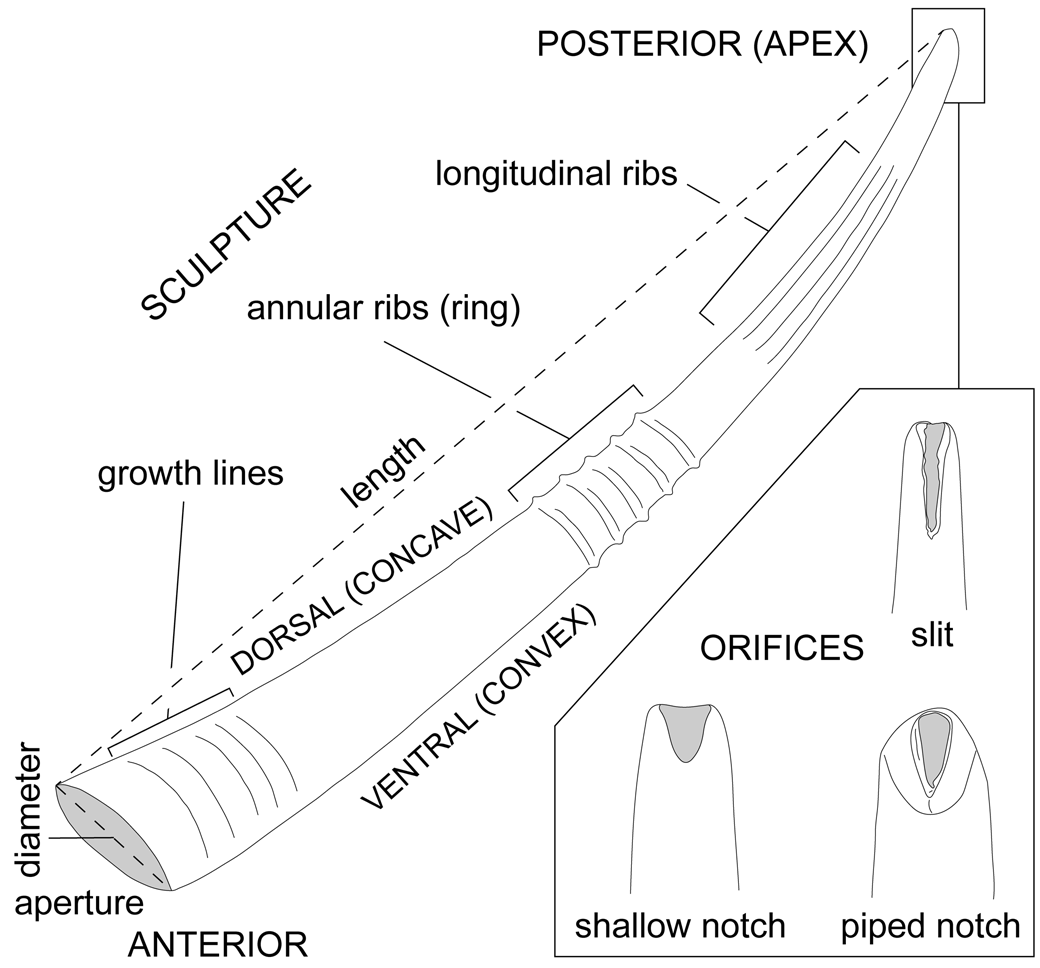
The specimens used in this study are reposited in the following museums/institutions: Department of Geology and Paleontology, National Museum of Nature and Science (NMNS), Tsukuba; Institute of Geology and Paleontology (IGPS) = Tohoku University Museum, Tohoku University, Sendai; University of Hokkaido Registration (UHR), Hokkaido University Museum, Hokkaido University, Sapporo; and Geological Society of India (GSI). The shell terminology used in this study follows Ludbrook (Reference Ludbrook and Moore1960) and Lamprell and Healy (Reference Lamprell and Healy1998) (Fig. 2).
Morphological features of Scaphopoda, modified after Ludbrook (Reference Ludbrook and Moore1960) and Lamprell and Healy (Reference Lamprell and Healy1998).

Systematic paleontology
Order Dentalida Da Costa, Reference Da Costa1778
Family Dentaliidae Gray, Reference Gray1847
Genus Prodentalium Young, Reference Young1942
Type species
Prodentalium raymondi Young, Reference Young1942 (M.C.Z. 27938), from the Pennsylvanian of New Mexico, by original designation.
Diagnosis
Shell very large, thick, and ornamented with prominent longitudinal ribs and lirae. Apical orifice a slit or shallow notch in juvenile specimens, whereas a V-shaped notch with secondary deposition of callus in adulthood.
Remarks
Prodentalium raymondi Young, Reference Young1942, the type species of the genus, was described on the basis of several fragmentary specimens from the Pennsylvanian of New Mexico. Young (Reference Young1942) diagnosed the genus by the presence of fine, longitudinal lirae that are periodically offset at growth interruptions. More complete specimens of P. raymondi from Texas were later reported by Miller (Reference Miller1949) and Tenery and Rowett (Reference Tenery and Rowett1979), and the latter authors clarified the characters of the apical orifice in this species, which possesses a ventral slit and a terminal pipe on some individuals.
Emerson (Reference Emerson1962) reviewed the suprageneric classification of the class Scaphopoda, including both extant and extinct taxa, and he regarded Prodentalium as one of the extinct genera ranging from the Devonian to the Permian. Yancey (Reference Yancey1973) was the first to clarify the apical characters of Prodentalium on the basis of the material from the Permian limestone in the Kinta Valley of Malaysia. According to Yancey, Prodentalium exhibits three types of apical orifices: (1) a simple opening with an entire apertural margin, (2) a V-shaped notch with secondary filling (resorption is greater on the ventral side than on the dorsal side), and (3) a keyhole opening similar to a slot. Yancey interpreted these apical character changes as ontogenetic growth stages in a single species. Although such an ontogenetic change of apical orifice is rare among extant dentaliid species (e.g., Dentalium exmouthensis Lamprell and Healy, Reference Lamprell and Healy1998), Lamprell and Healy (Reference Lamprell and Healy1998) have shown that these characters are still useful in differentiating closely related taxa in genus- and species-level taxonomy.
Prodentalium akasakensis (Hayasaka, Reference Hayasaka1925)
Figure 3
- Reference Hayasaka1925
Dentalium akasakensis Hayasaka, p. 23, pl. 8, fig. 17.
- Reference Makiguchi and Hachiya1995
Prodentalium akasakensis (Hayasaka); Makiguchi, p. 173, pl. 75, fig. 1.
- Reference Makiguchi and Hachiya1995
Prodentalium sp. Makiguchi, p. 181, pl. 76, fig. 2.
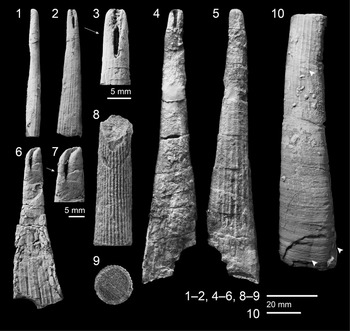
Prodentalium akasakensis (Hayasaka, Reference Hayasaka1925) from the middle Permian Akasaka Limestone. (1–3) NMNS PM 28403: (1) right lateral, (2) ventral, and (3) enlarged ventral views of the apex, showing a narrow and long slit of the apical orifice. (4, 5) NMNS PM 16758: (4) ventral and (5) dorsal views of the apex, showing narrow and long slit; (6, 7) NMNS P1 1929: (6) ventral and (7) enlarged views of the apex, showing a narrow and long slit. (8, 9) IGPS 22387, holotype: (8) ventral and (9) cross-section views. (10) NMNS PM 16759, probably dorsal view of the largest specimen preserved the middle to the apertural position of the shell, showing prominent longitudinal ribs and concentrated growth lines (white arrowheads).

Holotype
IGPS 22387 from the Akasaka Limestone, Gifu Prefecture, Japan, by monotypy.
Diagnosis
Very large, thick, posteriorly tapering cylindrical shell with circular to elliptical cross section. Apical orifice narrow with long slit. Shell surface ornamented with sharp longitudinal ribs, increasing in number from 16 to 37 and becoming obsolete toward aperture, growth lines predominant.
Materials
Five specimens, NMNS P1 1929 (with three individuals), PM 16758, 16759, 28403, and KPM NN0002579, from the Akasaka Limestone, Gifu Prefecture, Japan.
Remarks
Dentalium akasakensis Hayasaka, Reference Hayasaka1925 was described on the basis of a single specimen, the holotype (Fig. 3.8, 3.9). It is an undeformed shell fragment thought to be a posterior portion of the conch, 2 mm thick at the anterior end, and its shell surface covered by 37 sharp longitudinal ribs (Table 1). Three of the four additional specimens, although their anterior portions are strongly deformed through compaction, have characteristic sharp longitudinal ribs, the same as the holotype (Fig. 3.1–3.5). In addition, these three specimens preserve an apical orifice composed of a long, narrow slit (Fig. 3.2–3.4, 3.6, 3.7). This type of apical orifice is occasionally found in modern species of Dentaliidae (e.g., Fissidentalium yokoyamai [Makiyama, Reference Makiyama1931], Lamprell and Healy, Reference Lamprell and Healy1998). The apical orifice of this species distinguishes it from other known species of Prodentalium.
Measurements of the scaphopod species in this study.

NMNS PM 16758 (Fig. 3.4, 3.5) is a fragmentary specimen whose anterior portion is severely compressed. It exhibits an increase in the number of longitudinal ribs from 16 to 34 with shell growth through the addition of intervening finer ribs (Table 1). KPM NN0002579 is a virtually undeformed fragment, and its aperture is preserved intact (Fig. 3.10). The shell surface of this specimen is covered with 16 longitudinal ribs and numerous finer ribs in the preserved posterior half (Table 1). These ribs become progressively less distinct toward the middle, and they are totally absent on the anterior portion of the shell. The shell aperture is slightly oblique to the shell axis. We consider that KPM NN0002579 represents the posterior half of a Prodentalium akasakensis given its similarity in ornamentation to the anterior part of NMNS PM 16758. Judging from the rate of taper of NMNS PM 16758 and KPM NN0002579, P. akasakensis may attain a length of ~270 mm and a width of ~34 mm.
Prodentalium onoi new species
Figure 4
- Reference Makiguchi and Hachiya1995
Prodentalium sp. Makiguchi, pl. J, fig. 1, pl. 74, figs. 1, 2.
Prodentalium onoi n. sp. from the middle Permian Akasaka Limestone. (1, 2) NMNS P1 1736, holotype: (1) right lateral and (2) ventral views, showing concentrated growth lines of the aperture (white arrowheads). (3–5) NMNS PM 28404, paratype: (3) right lateral, (4) ventral, and (5) enlarged ventral views of the middle portion of the shell, showing fine and zig-zag longitudinal ribs and two fractural positions (white arrowheads). Bold arrows show position that lost fragmented shell(s).

Holotype
NMNS P1 1736 from the Akasaka Limestone, Gifu Prefecture, Japan.
Diagnosis
A species similar to P. akasakensis but with more-pronounced shell curvature with coarse and weak longitudinal ribs. Apical orifice a faint shallow notch instead of a long slit.
Description
Shell very large, 260.4 mm long in adult, 5 mm thick in apex, tapering rather slowly, gently curved in middle to anterior portion. Aperture round, ~30 mm in diameter, gently oblique to shell axis (Table 1). Apical orifice shallow with thickened notch. Longitudinal ribs on shell surface moderately strong, 32 in number (Table 1), slightly variable in prominence, round-topped, wider than interspaces, most distinct around mid-portion of shell but gradually becoming obsolete posteriorly and disappearing anteriorly; anterior one-third of shell only covered with weak transverse annulations of variable prominence as well as fine growth lines.
Etymology
The specific name is derived from Mr. T. Ono, who found a part of the specimen used in this study.
Materials
One paratype, NMNS PM 28404, from the Akasaka Limestone, Gifu Prefecture, Japan.
Remarks
The holotype, restored by assembling eight pieces of a shell, is an almost complete specimen except for its apical portion. However, there is a clear discontinuity in the longitudinal ribs between the fifth and sixth pieces from the apex (indicated by an arrow in Fig. 4.1, 4.2). According to the curation record in NMNS, this specimen was purchased from Y. Kashiwabara in 1906 and measured 272.7 mm at that time, but the specimen is recorded to have been damaged afterward (Fig. 4.1, 4.2). Most probably, the specimen was restored without the lost fragment of ~10 mm long.
NMNS PM 28404 (Fig. 4.3–4.5) consists of three shell fragments. The anterior and middle pieces are out of position laterally, and the posterior one seems to be stacked into the middle one. The apical orifice in this specimen has an intact margin on the left, while it is slightly destroyed on the right (Fig. 4.5). Therefore, the notch of the apical orifice is evidently much shallower than that of P. akasakensis.
The holotype is estimated to reach 270 mm in length when added to the lost part between the fifth and sixth pieces. The preserved posterior end of the holotype is 11 mm in width, and the shell length from the apex to the point with 11 mm width in NMNS PM 28404 is 46.3 mm. Therefore, the holotype can be estimated to reach a length of over 300 mm if the shell is complete.
Prodentalium onoi n. sp. is similar to and has been confused with P. akasakensis; therefore, this new species has been cataloged under the latter species name in the museum/institution collections. Both species are very large and have pronounced longitudinal ribs ranging from 16 to 30 in number. However, P. onoi is distinct from P. akasakensis primarily by the apical orifice, which forms a shallow notch in P. onoi while the notch is much deeper in P. akasakensis. Moreover, the cross sections of the longitudinal ribs are more rounded in P. onoi than in P. akasakensis.
Prodentalium neornatum (Hayasaka, Reference Hayasaka1925)
Figure 5
- Reference Hayasaka1925
Dentalium neornatum Hayasaka, p. 24, pl. 8, fig. 18.
- Reference Makiguchi and Hachiya1995
Prodentalium neornatum (Hayasaka); Makiguchi, p. 174.
Prodentalium neornatum (Hayasaka, Reference Hayasaka1925) from the middle Permian Akasaka Limestone. (1–4) IGPS 8208, holotype: (1) ventral view of whole specimen by three pieces and (2) cross-section, (3) right lateral, and (4) apertural views of the largest piece, showing concentrated growth lines (white arrowhead). (5, 6) NMNS PM 28405: (5) ventral and (6) enlarged apical views, showing concentrated growth lines and a thickened apical notch (white arrowheads).

Holotype
IGPS 8208 from the Akasaka Limestone, Gifu Prefecture, Japan.
Diagnosis
A large and gently curved Prodentalium ornamented by 80–90 fine longitudinal ribs near the aperture.
Materials
Two specimens, NMNS P1 6064 and PM 28405, from the Akasaka Limestone, Gifu Prefecture, Japan.
Remarks
The holotype of Dentalium neornatum is made up at least of nine pieces and assembled into three parts that imperfectly fit together (Fig. 5.1). Therefore, this specimen seems to be missing some pieces of shell in between. The largest assembled part in the holotype is 118 mm in length, 22 mm in diameter at the uncrushed aperture, and 9 mm in diameter and 3.5 mm in shell thickness at the preserved apical end (Fig. 5.2–5.4; Table 1). The shell thickness is 3.5 mm in the apical portion (Fig. 5.2). The anterior end of this specimen represents a fractured surface (Fig. 5.4), so that this end is not the actual anterior margin of the shell. However, we assume that this fractured end is very close to the original apertural margin because the shell gradually becomes thinner at about 1.3 mm length from the anterior end. The shell length of the holotype, if missing pieces are present, may reach 180 mm, and the original shell length is likely to reach 200 mm. The shell cross section is almost circular in both the apical and apertural portions (Fig. 5.2, 5.4), and the shell curves very slightly. The shell surface is sculptured with 87 fine and sharp longitudinal ribs of almost the same thickness, which are crossed by the growth (Table 1). The longitudinal ribs become obsolete near the aperture. In addition to these ribs, the shell has variably spaced and obscure annulations.
NMNS PM 28405 (Fig. 5.5, 5.6) preserves almost a whole shell, 173 mm long, 26 mm wide at the aperture and 5.5 mm wide at the apex (Table 1), although the anterior two–thirds of the shell is strongly compacted. The apical orifice of this specimen is a wide and shallow notch that is slightly thickened with calcareous deposits (Fig. 5.5, 5.6). The longitudinal ribs are narrower than their interspaces, becoming wider gradually toward the aperture; they number 27 in the apical portion, increasing in number by intercalating additional ribs, reaching 86 near the aperture (Table 1). The growth lines are slightly oblique and tilted ~80° relative to the shell axis. The zigzag lateral offsets of the longitudinal ribs, as seen in the type species of Prodentalium, are found in only a few portions in the holotype.
Prodentalium neornatum is easily distinguished from P. onoi n. sp. and P. akasakensis by a straight shell and by a doubling in the number of longitudinal ribs that are persistent throughout the shell.
Prodentalium neornatum most resembles P. raymondi from the Pennsylvanian of New Mexico. The holotype of P. raymondi described by Young (Reference Young1942) does not preserve its apex, while a more complete specimen described by Tenery and Rowett (Reference Tenery and Rowett1979) has a complete apical orifice. Compared with these specimens, P. neornatum has coarser longitudinal ribs (86/87 ribs on the shell with a 20 mm diameter) than the latter species (115 ribs on the shell with a 30 mm diameter). Moreover, the apical orifice in P. raymondi bears a sunken notch and a secondary terminal pipe, while it consists of a wide and shallow notch without the terminal pipe in P. neornatum. These characters strongly suggest that both species can be readily differentiated.
Prodentalium neornatum also resembles P. canna (White, Reference White1874) from the lower Permian of Nevada as the latter species is also large and has finer longitudinal ribs over the shell surface. However, P. canna is more gently tapered and more sharply curved than P. neornatum, and the longitudinal ribs decrease in number and become obsolete toward the aperture in P. canna, while they increase in number and persist throughout the shell in P. neornatum.
Prodentalium sp.
Figure 6
- Reference Hayasaka1925
Dentalium (Plagioglypta) herculeum De Koninck; Hayasaka, p. 23, pl. 8, fig. 17.
Prodentalium cf. P. raymondi Young, Reference Young1942 from the middle Permian Akasaka Limestone, IGPS 22386: (1) right lateral, (2) ventral, and (3) enlarged views of shell surface, showing fine zig-zag longitudinal ribs (white arrowheads). Note that (3) is an enlarged view of the white square of (2).

Materials
One specimen, IGPS 22386 from the Akasaka Limestone, Gifu Prefecture, Japan.
Remarks
IGPS 22386 is a single fragmentary specimen that Hayasaka (Reference Hayasaka1925) referred to Dentalium (Plagioglypta) herculeum De Koninck, Reference De Koninck1863. It consists of the anterior half of a conch, tapers very slowly, curves very gently, and is 113 mm long and 22 mm and 13 mm wide at the preserved anterior and posterior ends, respectively (Table 1). The shell cross section is elliptical. The shell is 3 mm thick at the anterior end and 2.5 mm thick at the posterior end. Although the shell surface is somewhat eroded, it is covered with very fine longitudinal lirae with a zigzag alignment and with variably spaced obscure annular swellings (Fig. 6.3). The growth lines incline 94° relative to the shell axis. We surmise that the original shell of IGPS 22386 might have reached 200 mm in length because its shell profile and apertural diameter are almost the same as those of the holotype of P. neornatum. We consider that IGPS 22386 belongs to Prodentalium because of its thick shell, gently tapering conch, and longitudinal lirae with a zigzag alignment. These shell characters of IGPS 22386 are almost the same as those of P. raymondi.
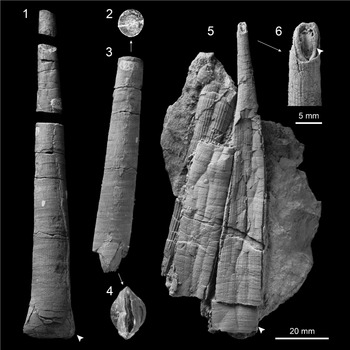
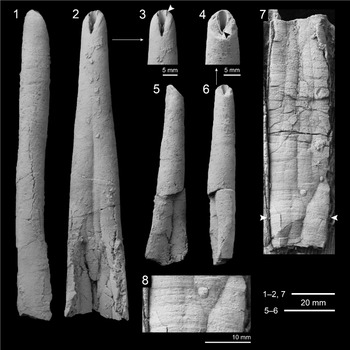
Dentalium (Plagioglypta) herculeum De Koninck, Reference De Koninck1863 (Plagioglypta herculea in Waterhouse, Reference Waterhouse1980) is from the middle Permian of the Salt Range, Pakistan. The type specimens of D. (P.) herculeum, stored in the Geological Survey of India, Kolkata, consist of at least four syntypes. Here, we illustrate three of the four syntypes (Fig. 7). GSI 3199 is among the best-preserved specimens and is composed of five pieces of a single specimen (Waagen, Reference Waagen1890, pl. 16, fig. 2; Fig. 7.1). GSI 3200 is represented by the apical portion of a conch with the apical orifice at its posterior end (Waagen, Reference Waagen1890, pl. 16, fig. 2; Fig. 7.2, 7.3), while GSI 3201 is the apertural portion of a conch and preserves the distinct growth lines (Waagen, Reference Waagen1890, pl. 18, fig. 3; Fig. 7.4, 7.5). On the basis of De Koninck's description and our observations on the specimens, the syntypes of D. (P.) herculeum do not show the presence of any longitudinal sculpture on the shell surface. We consider that the Akasaka specimen is not conspecific with the Salt Range specimens because the Akasaka specimen has very fine, zigzag-aligned longitudinal ribs in the middle portion of the shell as opposed to only growth lines in the Salt Range specimens. IGPS 22386 resembles Prodentalium raymondi, but the Akasaka specimen is too fragmentary to compare with the latter. IGPS 22386 is probably related to P. raymondi, but it is described here only in open nomenclature at the species level.
Dentalium (Plagioglypta) herculeum (de Koninck, Reference De Koninck1863) from the Permian limestone of Salt Range of India. (1) GSI 3199, specimens of five pieces showing approximately whole shell profile. (2, 3) GSI 3200z: (2) right lateral and (3) ventral views of the apical portion of the shell, showing a narrow and long slit on the ventral surface (white arrowhead). (4, 5) GSI 3201: (4) right lateral and (5) ventral views. All specimens are deposited in the Geological Survey of India illustrated as pl. 1, figs. 1–3 in Waagen (Reference Waagen1890).

Genus Minodentalium new genus
Type species
Minodentalium hayasakai n. gen. n. sp.
Other species
The following species are considered to belong to Minodentalium: Plagioglypta furcata Waterhouse, Reference Waterhouse1980 from the Permian of New Zealand, Pl. girtyi Knight, Reference Knight1940 from the upper Permian of Oklahoma, Pl. subannulata Easton, Reference Easton1962 from the Carboniferous of Montana, Pl. ingens (De Koninck, Reference De Koninck1843) from the lower Carboniferous of Belgium, Pl. meekiana (Geinitz, Reference Geinitz1866) from the Carboniferous of Nebraska, Pl. prosseri Morningstar, Reference Morningstar1922 from the Carboniferous of Ohio, Dentalium priscum Münster in Goldfuss, Reference Goldfuss1842, and D. (Pl.) herculeum De Koninck, Reference De Koninck1863.
Diagnosis
Medium to large, long, slender, mostly smooth dentaliid with growth interruptions, slender form, moderately thick apical shell wall, and thin apertural shell wall. Apical orifice shallow and V-shaped.
Etymology
The generic name is a combination of Mino- (the old province name of the type's locality) and dentalium.
Remarks
Minodentalium n. gen. differs from Pipadentalium Yoo, Reference Yoo1988 (type species Pipadentalium protruberans Yoo, Reference Yoo1988 from the early Carboniferous of Australia) because the latter genus is characterized by the presence of very fine longitudinal riblets and a distinct apical pipe, instead of shallow and V-shaped notch. Minodentalium is also differentiated from Quassidentalium Shimansky, Reference Shimansky1974 (type species Q. opiparum Shimansky, Reference Shimansky1974 from the Carboniferous of Russia) and Paleodentalium Gentile, Reference Gentile1974 (type species Dentalium (Pa.) kansasense Gentile, Reference Gentile1974 from the Pennsylvanian of Kansas) because of the presence of pronounced longitudinal ribs in the latter two.
Paleozoic scaphopods without any longitudinal ribs have typically been assigned to Plagioglypta Pilsbry and Sharp, Reference Pilsbry and Sharp1898, whose ornamentation consists mainly of fine, shallow, and regularly spaced annular growth lines and grooves (Yochelson, Reference Yochelson2011). The type species of Plagioglypta, Dentalium undulata Münster, Reference Münster, Wissmann, Münster and Braun1841, from the Upper Triassic of Italy, is a small, curved shell and has dense, concentrically arranged, oblique annular ribs on the shell (Münster, Reference Münster, Wissmann, Münster and Braun1841; Nützel and Kaim, Reference Nützel and Kaim2014). These shell characters are also observable in Pl. guizhouensis Stiller, Reference Stiller2001 from the Middle Triassic of southwestern China and Plagioglypta sp. from the Lower Triassic of Utah (Nützel and Schulbert, Reference Nützel and Schulbert2005). These species are quite different from the Paleozoic smooth-shelled scaphopods. Plate (Reference Plate1908) considered Plagioglypta as a subgenus of Dentalium Linnaeus, Reference Linnaeus1758 and referred three modern species (Pl. pertracheatum [Plate, Reference Plate1908], Pl. semitracheatum [Boissevain, Reference Boissevain1906] and Pl. tracheatum [Boissevain, Reference Boissevain1906]) to this subgenus. Scarabino (Reference Scarabino and Bouchet1995) followed this classification of the modern species but treated Plagioglypta as a genus rank. He emended the diagnosis for this genus by adding the radular characters. However, the three modern species of Plagioglypta have no morphological similarity to the type species of Plagioglypta, but instead are similar to the Mesozoic and Cenozoic Laevidentalium Cossmann, Reference Cossmann1888. Therefore, we conclude that the three modern species do not belong to Plagioglypta.
A taxonomic overview of the species previously referred to Plagioglypta reveals that they can be divided into two groups on the basis of shell size and ornamentations: one is small and has concentrically arranged ribs on the shell surface (as the ones to which the type species of Plagioglypta belongs), and the other is medium to large in size and has shallow growth lines and grooves on the shell surface. Here, we propose the new genus Minodentalium for the latter.
Minodentalium hayasakai new species
Figure 8
- Reference Hayasaka1925
Dentalium (Laevidentalium) cf. D. (L.) priscum Münster; Hayasaka, pl. 8, fig. 19.
- Reference Makiguchi and Hachiya1995
Plagioglypta sp. cf. Pl. prisca (Münster); Makiguchi, pl. 76, fig. 1.
Minodentalium hayasakai n. gen. n. sp. from the middle Permian Akasaka Limestone. (1–4) NMNS P1 307 holotype: (1) right lateral, (2) ventral, and (3) enlarged apical views and (4) microphotograph showing shallow notch and ornamentations. (5–8) UHR 58, paratype: enlarged views of the (5) apex, (6) microphotograph, (7) right lateral, and (8) ventral, showing ornamentations and shallow notch. (9) NMNS P1 1240, paratype, aggregated slab showing the ventral view of the largest specimen with apical orifice and a nearly apertural area (white arrowheads).

Holotype
NMNS P1 307, from the Akasaka Limestone, Gifu Prefecture, Japan.
Diagnosis
Minodentalium n. gen. with middle to large, thin and slightly tapering shell and shallow V-shaped apical orifice. Shell surface covered only with fine, shallow, and regularly spaced annular grooves.
Description
Shell reaching 100 mm in length, thin and curved 10° toward dorsal side. Shell cross section almost circular in most part, but elliptical at aperture. Shell surface smooth with distinct growth lines, being inclined 75° relative to shell axis. Apical orifice with shallow, wide notch.
Etymology
The specific name derived from I. Hayasaka, who greatly contributed to the paleontology of the Akasaka Limestone.
Materials
Three paratypes, NMNS P1 1240, NMNS P1 312, and UHR 58, from the Akasaka Limestone, Gifu Prefecture, Japan.
Remarks
Minodentalium hayasakai n. gen. n. sp. is dominant in the Akasaka Limestone and is sometimes found as a dense aggregation of fragmented pieces in black bituminous limestone. A severely crushed specimen in a limestone slab reaches 98 mm in length (Fig. 8.7, Table 1), and an unregistered and almost complete specimen housed in the Kinshozan Fossil Museum reaches 150 mm in length. To the best of our knowledge, this is the largest specimen of this species known.
A fragmentary specimen from the Akasaka Limestone, which Hayasaka (Reference Hayasaka1925) tentatively referred to as Dentalium (Laevidentalium) priscum Münster in Goldfuss, Reference Goldfuss1842, belongs to this new species. D. (L.) priscum is from the lower Carboniferous of Belgium. Godefroid et al. (Reference Godefroid, Mottequin and Yochelson2006) reported that the maximum shell of this species reaches a length of over 200 mm, and they questionably attributed it to Plagioglypta. M. hayasakai and D. (L.) priscum have a slightly tapering and curved shell sculptured only with annular growth lines, but the latter species is much larger and has a thicker shell and faint rib-like sculpture in the posterior part. Such shell characters of D. (L.) priscum suggest that this species belongs to Minodentalium n. gen. described in the following.
Among the six species allocated to this new genus, Pl. meekiana is close to M. hayasakai, but M. hayasakai has more-pronounced annular grooves than Pl. meekiana.
Minodentalium okumurai new species
Figure 9
- Reference Makiguchi and Hachiya1995
Prodentalium sp. Makiguchi, pl. 75, fig. 1.
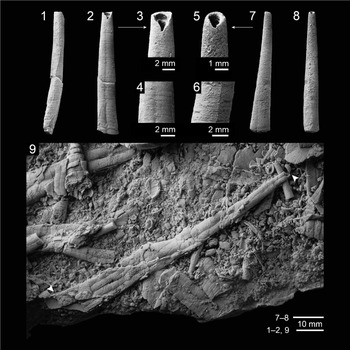
Minodentalium okumurai n. gen. n. sp. from the middle Permian Akasaka Limestone. (1–3) NMNS PM 28406, holotype: (1) right lateral and (2) ventral views and (3) enlarged view of the apex, showing V-shaped notch with a secondary pipe. (4–6) NMNS PM PM28407, paratype: (4) enlarged view of apex showing depressed and V-shaped notch with a secondary pipe, (5) right lateral and (6) ventral views. (7, 8) NMNS PM 28408, paratype: (7) middle to the apertural view of the shell and (8) microphotograph showing ventral surface with fine growth lines (white arrowheads in (7)) and in more detail.

Holotype
NMNS PM 28406 from the Akasaka Limestone, Gifu Prefecture, Japan.
Diagnosis
Minodentalium n. gen. with large, thick, and straight cylindrical shell and secondary piped notch in apical orifice. Shell surface smooth without longitudinal sculpture, with regularly spaced and weak encircling grooves throughout.
Description
Holotype (Fig. 9.1–9.3) consisting of posterior portion of conch, flattened by compaction except for apical portion, robust, 119 mm long and probably very gently curved (Table 1). Shell profile slowly tapering. Aperture not preserved. Shell surface smooth, ornamented only with very fine, regularly spaced, and encircling grooves throughout. Apical orifice with secondary pipe and keyhole-like notch.
NMNS PM 28408 (Fig. 9.7, 9.8), fragmentary, consisting of anterior portion of conch, flattened by compaction, robust, 88 mm long, and 25 mm wide (Table 1). Aperture preserved, diameter approximately 22 mm, gently oblique to shell axis. Shell surface sculpture same as holotype but becoming conspicuous toward aperture.
Etymology
The specific name is derived from Mr. H. Okumura, who found a paratype (NMNS PM 28407) of this species.
Materials
Four paratypes, NMNS PM 28407, NMNS PM 28408, PM 12421, and UHR 32943, from the Akasaka Limestone, Gifu Prefecture, Japan.
Remarks
We consider this species to be well over 200 mm in length because a large specimen in a private collection reaches 180 mm in length even though the apertural part of considerable length is still within the limestone matrix. Given that the shell width at the apical portion of the holotype is very large compared with other large species described in this study, this specimen may represent half or less of the full length. This assumption is further reinforced when we reconstruct the holotype by reconstructing NMNS PM 28408. The preserved anterior margin of the holotype (104.6 mm long) is 3 mm thick, and the preserved posterior margin of NMNS PM 28408 (88 mm long) is 1.5 mm thick. Because the scaphopod shells gradually become thinner in the anterior direction (e.g., Waagen, Reference Waagen1890), a shell of considerable length must have existed between these two fragments. Therefore, the holotype can be estimated to be at least 192.6 mm long.
We refer Dentalium (Plagioglypta) herculeum De Koninck, Reference De Koninck1863 from the Permian of the Salt Range, Pakistan, and D. priscum Münster in Goldfuss, Reference Goldfuss1842 from the lower (early) Carboniferous of Belgium to this new genus. A syntype of D. (Pl.) herculeum (see the preceding discussion; Fig. 6.1) reaches 200 mm in length, and 20 mm and 6.4 mm in diameter at the apertural and apical ends, respectively. This specimen becomes thicker toward the apex, 4 mm at the apex and 1 mm at the aperture, and the shell profile is cylindrical, tapers moderately, and curves about 10° toward the dorsal side. The shell surface of D. (Pl.) herculeum is covered only with growth lines with a somewhat unsmooth apertural surface (GSI 3201, Fig. 6.4, 6.5). These shell characters suggest that D. (Pl.) herculeum belongs to Minodentalium n. gen. but differs from M. okumurai n. gen. n. sp. in its more tapering shell profile.
Minodentalium okumurai resembles Dentalium priscum Münster in Goldfuss, Reference Goldfuss1842 from the lower (early) Carboniferous of Belgium. According to Godefroid et al. (Reference Godefroid, Mottequin and Yochelson2006), D. priscum reaches lengths greater than 200 mm, and its shell surface has only growth lines that become rough toward the aperture. These shell characters strongly suggest that D. priscum belongs to Minodentalium. However, M. okumurai differs from D. priscum by having a more rapidly tapering shell.
Discussion
Our study demonstrates that the scaphopods from the Permian Akasaka Limestone are classified into three genera and six species. The occurrence of the six species of scaphopods from a single formation and a single site is surprising as only one or two species have usually been reported in each formation, area, or site in previous studies (e.g., Alroy, Reference Alroy2020). As mentioned in the earlier reports, the Akasaka Limestone molluscan fauna is one of the richest in the Permian. In particular, gastropods are highly dominant (Nützel and Nakazawa, Reference Nützel and Nakazawa2012). Indeed, the scaphopod fauna of the Akasaka Limestone is the richest among contemporaneous strata worldwide. However, we consider that the occurrence of a high number of species from the Akasaka Limestone is also due to preservation and/or collection biases. The Akasaka Limestone includes several highly fossiliferous weathered limestone and calcareous sandstone beds. Although the fossils in these beds are often strongly compacted and severely recrystallized to calcite, they are often easily extracted from the matrix and preserve the morphological characters for taxonomic work. In addition, the Akasaka Limestone has been continuously quarried for over 150 years, and more important, quite a large number of amateur paleontologists and local fossil hunters have been collecting fossils extensively in this quarry for many years.
The Akasaka Limestone fauna contains unusually large invertebrate species together with species of normal and/or microscopic sizes (Hayasaka, Reference Hayasaka1925, Reference Hayasaka1943; Nützel and Nakazawa, Reference Nützel and Nakazawa2012; Asato et al., Reference Asato, Kase, Ono, Sashida and Agematsu2016, 2017). The origin of gigantism of fossil marine invertebrates has been an intriguing topic among paleontologists as well as evolutionary biologists for many years (Cope, Reference Cope1887; Klug et al., Reference Klug, De Baets, Kröger, Bell, Korn and Payne2015). These large-sized species include one bellerophontid gastropod (or monoplacophoran), two pleurotomariids, three neritopsid and one murchisoniid gastropod, one grammysiid and one alatoconchid bivalve, two liroceratid nautiloids, and an undetermined number of crinoids. In addition, there are several, yet undescribed, large gastropod and bivalve species (unpublished). The six species of scaphopods from the Akasaka Limestone are all very large and reach 200 mm in shell length. Prodentalium onoi is likely over 300 mm long. During the Permian, such gigantism is also known in the gastropod assemblage of Turkey (Enderle, Reference Enderle1900) and in the cone-shaped Macrotheca (Class Hyolitha) in the Salt Range, Pakistan, and Greenland (Peel and Yochelson, Reference Peel and Yochelson1984).
As suggested by Asato et al. (Reference Asato, Kase, Ono, Sashida and Agematsu2017), it is likely that large amounts of food resources were present during the deposition of the Akasaka Limestone, and only those successful in exploiting such food resources attained a large body size. A good example of such a modern benthic invertebrate community is the mollusks in the tropical Pacific mangrove swamps, where those gastropods and bivalves (Terebraria, Telescopium, and Geloina) evolved to exploit excessively large amounts of food resources from mangrove plants, thus exhibiting an unusually large shell size (Kase et al., Reference Kase, Kurihara, Aguilar, Pandita, Fernando and Hayashi2015).
Modern scaphopods are highly selective, infaunal-feeding microcarnivores, whose major diet is foraminifers (Dinamani, Reference Dinamani1964a, Reference Dinamanib; Shimek, Reference Shimek1988, Reference Shimek1990; Steiner, Reference Steiner1994; Langer et al., Reference Langer, Lipps and Guillermo1995; Glover et al., Reference Glover, Taylor, Whittaker, Wells, Walker and Jones2003; Gudmundsson et al., Reference Gudmundsson, Engelstad, Steiner and Svavarsson2003; Reynolds and Steiner, Reference Reynolds, Steiner, Ponder and Lindberg2008). The scaphopods described here are associated with abundant, large neoschwagerinid foraminifers. It is likely that the unusually large scaphopods from the Akasaka Limestone preyed upon large fusulinids and/or organic sediments.
Acknowledgments
We are very grateful to J. Nemoto (Tohoku University Museum, Sendai), Y. Kobayashi (Hokkaido University Museum, Sapporo), and K. Taguchi (Kanagawa Prefectural Museum of Natural History, Odawara), who allowed K.A. to examine the collections under their care. K.A. is indebted to the Geological Survey of India, Kolkata for kindly affording him the opportunity to examine the types and comparative specimens of the Permian Productus-Limestone from the Salt Range, West Pakistan. We also thank Y. Shigeta (National Museum of Nature and Science, Tsukuba) for coordinating the collection survey of GSI, and T. Ono and H. Okumura of the Kinshozan Fossil Research Association, who provided their materials to this study. We also thank T. Yancey and two anonymous reviewers for their constructive comments and suggestions. This study was funded by the Research Fellowships of Japan Society for the Promotion of Science for Young Scientists to K.A. and, in part, by the National Museum of Nature and Science, Tsukuba to K.A.