INTRODUCTION
Antiquities that surface on the art market have less to offer historians of the ancient world than their archaeologically excavated kin. Not helping matters are the vague, unverifiable reports of alleged find-spots that often accompany them. Claims such as “said to be from the region of Heraklion” or “probably from Rome” are passed along, rarely with further comment or discussion, in sales catalogues, gallery labels, exhibition catalogue “tombstones” (the first portion of a catalogue entry that typically gives a work’s basic data, such as its name, date, material, and current home, before a longer prose discussion or “chat”), and photo captions. In an article entitled, “Material Consequences of Contemporary Classical Collecting,” published in the American Journal of Archaeology in 2000, Christopher Chippindale and David Gill analyze the forms and quality of the find-spot data offered in seven recent museum exhibition catalogues. Footnote 1 The article presented a six-stepped scale by which the authors rated each entry’s provenance information, from best (p1) to worst (p6). The study was a follow-up to their important 1993 article, “Material and Intellectual Consequences of Esteem for Cycladic Figures,” also published in the American Journal of Archaeology, which exposed the material harm to the archaeological record and intellectual harm to our understanding of the past caused by the collecting of Cycladica in the twentieth century. Footnote 2 The dealer Jerome Eisenberg had responded to that publication by protesting that Cycladic material was “not at all typical of the ancient world” but, rather, a “famous mess,” which “sensible dealers of good reputation” know to avoid. Footnote 3 The purpose of the new article was to see if the same patterns they had uncovered in the Cycladic collections pertained to all classical materials more generally.
The 2000 study tabulates the data given about find-spot and collecting history for almost 1,400 ancient works in seven major, recently formed collections or exhibitions. These include the Metropolitan Museum of Art’s exhibition of the Leon Levy and Shelby White collection in 1990; Footnote 4 an exhibition of Etruscan art held at the Israel Museum in Jerusalem; Footnote 5 an exhibition of Gandharan art at the Fitzwilliam Museum; Footnote 6 the J. Paul Getty Museum exhibition of the Barbara and Lawrence Fleischman collection in 1994; Footnote 7 the Geneva-based George Ortiz collection; Footnote 8 the Greek vases in the San Antonio Museum of Art; Footnote 9 and an exhibition of classical bronzes that originated at the Arthur M. Sackler Museum at Harvard University and from there traveled to the Toledo Museum of Art and the Tampa Museum of Art. Footnote 10 From their tabulations, Chippindale and Gill draw far-reaching—and sobering—conclusions about the consequences of collecting for historical knowledge. The article’s combination of extensive empirical data and polemical analysis is a powerful one. It ranked eighth on a list of “highly cited papers in Classical Studies since 2000,” which was published by the Times Higher Education in 2009, the only article dealing with any aspect of material culture to make the list. Footnote 11
While I am entirely in sympathy with the broad conclusions that Chippindale and Gill reach, it is important to recognize that their study was intended to expose the harmful consequences of buying unprovenanced antiquities; in their words, the “focus is on the problems and consequences of collecting and acquiring under the market conditions of today.” Footnote 12 I am concerned more broadly with the harmful consequences of scholars and curators studying, publishing, and teaching antiquities that lack a secure archaeological find-spot, regardless of whether or not they were recently on the market. In my view, too much of the current discourse around “unprovenanced” antiquities shares Chippindale and Gill’s focus on the art market and fails to consider the larger epistemological limitations inherent in all such objects, regardless of the date of their surfacing. Footnote 13 This is evident in, for example, the emphasis on the year 1970 (the year of the UNESCO Convention on the Means of Prohibiting and Preventing the Illicit Import, Export and Transfer of Ownership of Cultural Property) in debates about museum acquisition policies and journal publication policies. Footnote 14 These policies seek to address the problem of looting (hence the focus on recently surfaced objects), not the hermeneutic problem of attempting to generate knowledge about the ancient world by relying on uncontextualized objects that we can only presume are ancient.
Both are serious matters, and both practices should be combatted. I do not mean to minimize the harmful effects of looting or to deny the link between the market’s demand for antiquities and the destructive means by which they are procured. But in both specialized scholarly studies and in the extensive media coverage of these debates, concerns about looting have largely eclipsed those about best practices in the production of historical knowledge. Even worse: as I will argue here, in Chippindale and Gill’s scale the two issues are pitted against each other in several ways in a zero-sum game. The values encoded in the six-step scale unintentionally affirm and even commend some of the field’s most epistemologically problematic conventions for talking about unknown archaeological find-spots. In addition, the scale condemns some of the field’s more epistemologically sound practices at the same time. I would like to say, before proceeding, that Gill and Chippendale have been entirely supportive of my work on this topic; the current study would not have been possible had they not shared the hundreds of pages of tabulations upon which their own analysis was based. I am deeply grateful for their generosity and delighted to participate in this conversation with them.
CHIPPENDALE AND GILL’S PROVENANCE SCALE
To assess the quality of the information given about the find-spots of the 1,396 objects in the seven catalogues, Chippindale and Gill devised what they call a provenance scale, rating the works in the following terms:
-
p1 named find-spot or “almost certainly” therefrom
-
p2 “said to be” or “allegedly” from a named find-spot
-
p3 “probably” from a named find-spot
-
p4 “possibly” or “perhaps” from a named find-spot
-
p5 unknown or unstated
-
p6 stated in some terms, but the source of that appears to be “affinity”: it has been deduced from diagnostic characteristics observed in the object itself rather than supplied by independent information. Footnote 15
By these criteria, 145 of the 1,396 objects analyzed earn the highest ranking of p1; 192 earn a p2; 14 a p3; 0 a p4; 933 a p5; and 112 a p6. Footnote 16 In their analysis, the authors take these numbers to mean that 25 percent of the objects have “some” provenance (those in categories p1–p4), while the remaining 75 percent (in categories p5 and p6) do not. Their main conclusions concern the enormous number of objects circulating on the market about which we have no reliable historical data as well as the failure on the part of many dealers and buyers to do even minimal due diligence. Again, these are assertions with which I am in complete agreement, and nothing I say here is meant to refute those basic arguments. There are, nevertheless, a number of telling and contestable assumptions built into Chippindale and Gill’s provenance scale.
P1: Named Find-Spot or “Almost Certainly” Therefrom
The first assumption has to do with the standard they set for their highest rating of p1. Some of the 1,396 objects they tabulated do indeed have a documented find-spot. The lion’s share of these appear in the Crossroads of Asia exhibition at the Fitzwilliam Museum, which drew heavily upon the stores in the British Museum filled with plunder from nineteenth-century colonial explorations. These include works such as an inscribed steatite casket excavated by Charles Masson in 1834 “at Stupa no. 2 at Bimaran, a village in the Darunta district, west of Jalalabad,” published in 1840. Footnote 17 But the vast majority of the objects in these seven catalogues, including most of those classified as p1 by Chippindale and Gill, have nothing even close to this amount of specific archaeological documentation. Their rating of 145 objects as p1 is possible only because of their extremely capacious definition of the category. Chippindale and Gill’s p1 includes not just objects with specific, documented find-spots but all works for which a find-spot is named in the “tombstone” portion of the catalogue entry, regardless of how precise or imprecise the geographical information, what it is based on, and whether or not bibliography is cited to support it. The only criterion is that the information not be encumbered by qualifiers such as “said to be” (which would make it a p2), “probably” (p3), or “possibly” (p4). As the authors acknowledge, “[w]e accept findspot in the broadest terms: sometimes it is a specific site, sometimes a region or even a whole country.” Footnote 18 Thus, a p1 rating is granted to a bronze statue of a man wearing a toga in the Fire of Hephaistos exhibition, which was, according to the tombstone, “found in France during the 19th century.” Footnote 19 Also earning a p1 is a beautiful marble portrait head of a female figure in George Ortiz’s catalogue, whose provenance is given as “Asia Minor,” which is surely a hypothesis based on carving style rather than on a secure archaeological find-spot. Footnote 20 Other geographically vague “find-spot” reports to which Chippindale and Gill award a p1 rating include “central Etruria”; Footnote 21 “Etruria”; Footnote 22 “Germany”; Footnote 23 “Egypt”; Footnote 24 “Iran”; Footnote 25 and “Afghanistan.” Footnote 26 A p1 is even awarded to a small, sitting, neolithic female figure in the Levy-White collection, about which we are told: “Some scholars believe that the type originated in Asia Minor, where this example almost certainly was found.” Footnote 27
In most of these cases and in many others granted a p1 by Chippindale and Gill, no bibliography was given in the catalogue to support the find-spot claim. While the assertion about the discovery of the togatus in France during the nineteenth century was presumably based on some preserved record (a letter? Diary entry? Sales receipt?), no such document is mentioned in the text nor cited in the bibliography. Given the fact that this was the statue’s first publication, one might have expected a full presentation of the data. Nor is there any mention of Tarquinia in the 150-word entry on a large bucchero olpe in pristine condition in the Etruscan exhibition, despite the tombstone’s confident assertion that the piece is “from Tarquinia” and Chippindale and Gill’s obliging rating of it as p1. Footnote 28 The catalogue bibliography gives references only for the comparanda noted in the entry; the olpe itself, like most of the objects in this exhibit, appears to be surfacing for the first time. On what basis, then, is it assigned to Tarquinia? There is no way to know if that is second-hand information passed from the vendor to the collector to the catalogue author; if it is an inference based on style; or if it is data obtained by some other means. The specific find-spots posited for at least 25 percent of the 145 objects Chippindale and Gill rate as p1 appear to be unsupported by documentation of any kind.
A related matter is the primacy Chippindale and Gill’s rating system places on the tombstone portion of the labels. In many cases, the entry for objects they rate as a p1 will name a specific find-spot in the tombstone, but the text below (that is, the “chat”) will explain that the find-spot information is second-hand (in which case, it should be classed as p2). One example of this can be found in the Crossroads of Asia catalogue, where a tombstone gives “Afghanistan” as the provenance, but the last sentence of the entry informs us that this figure and another one like it “reputedly were found together in the vicinity of the Helmand river in Afghanistan.” Footnote 29 In other cases, the chat makes it clear that a confidently asserted “find-spot” in the tombstone is actually an inference based on affinity (p6). So, again in Crossroads of Asia, entry no. 137 states simply “Taxila” for the provenance in the tombstone, but the last paragraph of the text explains that “[t]here are comparable figures at Taxila, which suggests a possible source for this one.” Footnote 30
My concern with these p1 ratings is how far most of the “find-spots” are from actual, documented archaeological origins. They tell us nothing about how, where, or when the objects were used or deposited in antiquity. They cannot provide even the most basic assurance that comes with a genuine find-spot, namely the very near certainty of the object’s antiquity (there are some known cases of archaeological sites being salted with precious objects in advance of an excavation, but for various reasons, this cannot be a common practice). The vagueness of many of these “find-spots” strongly suggests that they are nothing more than second-hand or third-hand reports or rumors (possibly calculated in their imprecision to avoid the attention of specific source countries) or inferences based on style.
Chippindale and Gill are aware of these problems and acknowledge them candidly and insightfully throughout the article. They admit to having “pervasive fears” that “inferred places of origin are equated to findspots.” They also stress that
a report of findspot in broad terms—“Egypt,” “Vulci”—is not a report of archaeological context in the contemporary sense of the word. An archaeological context would require a detailed report of locale, site stratigraphy, and associated artifacts and features. Footnote 31
Their explanation for their decision not to modify their criteria, despite “repeatedly encountering these difficulties in tabulating the collections,” is that
we do not think they resulted from a poor choice in our defined categories. It is because the very slim record of provenance is itself a mixture of record and supposition, melded together in a way that prevents the two components from being teased out. In this maze of doubt, it seems that we must even be uncertain about the degree of our certainty: we know it is great and fear it may be greater still—and by an uncertainly known amount.” Footnote 32
This is certainly true, but it seems to me that Chippindale and Gill here (and throughout the article) are perhaps claiming a more passive role—one of merely reflecting problems that are out there in the field already—than they have in fact taken. A numbered, six-tier scale codifies and reifies a hierarchy of values. Despite the authors’ repeated caveats, no reader could come away from the article doubting that p1 objects have the best provenance; that p2 objects have better provenance than p3 objects; that while the provenance of p4 objects is of only middling quality, it is still much better than that of p6 objects, and so on. Thus, to stay with the category of p1 for the moment, these highly regarded archaeologists are communicating to the whole field—to classicists, archaeology students, collectors, dealers, curators, amateur enthusiasts, and whoever else might be reading the American Journal of Archaeology—that the data “from Swat or Gandhara” is of equal value to the data “from Tomb 416 at Abydos, excavated in 1907” since both are rated p1. Footnote 33 To grant their highest seal of approval to the former sanctions the curatorial practices and conventions that make such a label possible. It teaches students and buyers that such information represents as full an archaeological record as we can hope to have. And it might even influence dealers’ decisions about what words they use to describe the “provenance” of the archaeologically undocumented artworks they are selling.
P2, P3, and P4: Said to Be, Allegedly, Probably, Possibly
A related problem results from the fact that within their six-stepped scale, Chippindale and Gill identify the critical divide as that between p4 and p5, with objects rated p1–p4 seen as having “some indication of provenance” and those in p5 and p6 having “no indication of provenance.” Thus, all of their tables are laid out with a visible break between p4 and p5, and their concluding calculations combine the totals for all of the objects ranging from p1 to p4 (351 objects or 25 percent of the total) and contrast them with the combined totals for all of the p5–p6 objects (1045 or 75 percent). In my view, the problem with this framework is the legitimacy it grants to the various linguistic conventions that Chippindale and Gill rate p2, p3, and p4. P2 objects are those with an “alleged” or “said to be” find-spot. Unsubstantiated second-hand accounts of an object’s place of discovery, usually passed on by vendors, is information of a kind, and curators are right to report it in their catalogue entries. Whether it belongs in the tombstone, a discursive space widely understood as the realm of basic, empirical facts, is another matter.
It is important to remember just how uninformative and unreliable “said to be” reports can be, especially when, as is almost always the case, they are passed along with no indication of when the rumor was reported, by whom, or in what context. Footnote 34 What exactly are we being told when we read that a bronze statuette in the Fire of Hephaistos exhibit is “reported to be from the eastern Mediterranean” or that three metal rhyta in the Ortiz collection are “allegedly from the region of the Black Sea”? Footnote 35 From the point of view of both the buyer and the seller, these are very convenient factoids, as they would appear to assure all parties of the objects’ authenticity while simultaneously leaving the specific, aggrieved (that is, looted) source countries unidentified. Everyone can claim to be acting in “good faith.” When curators and scholars repeat such allegations without due diligence to identify and critically analyze the source of the claim, they protect the possibly conflicted interests that the report may have been crafted to hide. To pass possibly fraudulent claims along without drawing attention to their possible fraudulence is, in my view, to condone the possible fraud. Scholars and curators who do so are, arguably, complicit in the system that perpetuates the looting and destruction of historical sites.
Less common than the “said to be” formula is the potentially even more obfuscatory insertion of words such as “probably” or “possibly” before an alleged, but presumably undocumented, find-spot (p3 and p4, respectively). When there is no further discussion of the probable/possible provenance in the longer chat portion of the entry below, as is often the case, there is no way to know what the suggestion means (is the alleged find-spot probable/possible because it makes sense stylistically? Because a reliable source claimed that that is where the object came from? Because the object is similar to others found there?). Fourteen works in the catalogues surveyed by Chippindale and Gill are described in this way, such as the bronze bust of Demosthenes, which the Ortiz catalogue informs us is “probably from Greece.” Footnote 36
Here again, the narrow focus on the tombstone portion of the entry is problematic. Chippindale and Gill’s scale rewards authors for putting “almost certain” (p1), “alleged” (p2), “probable” (p3), and “possible” (p4) provenance claims in the tombstone and pays no attention to whether or not these claims are discussed or even mentioned again in the chat. But these assertions are not empirical facts. They do not belong in the tombstone but in the chat; not only because they lack the epistemological status of data about the object’s size, material, or current owner. They also belong in the chat because that is where there is room for the author to discuss the claims in detail, to name their sources, assess their merits, present supporting evidence, and so on. This method has been used in exemplary fashion in a few cases in these catalogues, particularly in the Ortiz publication. Footnote 37 But in such cases—where hypotheses about undocumented find-spots are kept out of the tombstone and discussed in the chat instead—Chippindale and Gill rate the objects a much more ignominious p6.
The key point here is that, as far as our knowledge about the object’s archaeology is concerned, all of the tombstone phrases that earn a Chippindale and Gill rating of between p2 and p4 ultimately mean the same thing: the link between the work and its actual find-spot has been severed, so some vendor or owner, somewhere along the way, has filled in the missing information somehow. None of these objects, in my view, deserve to be counted in the “having some provenance” category. In a subsequent publication, Chippindale and Gill acknowledged some of these issues:
It was only after they had tabulated several hundred items from the classical collections that Chippindale and Gill began to fear that their distinction in the archaeological classifications between “findspot known” and “findspot inferred” cannot reliably be discerned from the information available, so these extremes in the range of archeological information offered might in fact be better melded together. Footnote 38
Such willingness to reconsider one’s own previous position is rare and admirable indeed. I see a need for further reconsideration. In my view, the 206 objects that Chippindale and Gill rate between a p2 and p4, and many of the 145 objects that they rate as a p1, are encumbered by too many epistemological uncertainties for them to serve as a foundation for scholarly theories or interpretation. To use them for this purpose would be to build houses upon sand. I would argue that, from an epistemological standpoint, the crucial divide is not between objects with “some” indication of provenance and “no” indication of provenance. Rather, it is between those with a specific, reliable, documented find-spot and those without one—the former a much smaller category than that encompassed by Chippindale and Gill’s p1–p4 rating or even just their p1 rating. I call such objects “grounded,” and those without a specific, reliable, documented find-spot “ungrounded.” The term “grounded” is meant to signal not only the fact that we can associate such objects with a particular place in the ground but also that interpretations of them are grounded or anchored by evidence external to the object itself. Footnote 39 Their authenticity is all but certain, and we have at least one data point—the place of their final use or deposition in antiquity—about their ancient function. The terms can also serve as alternatives to the overly laden “provenanced” and “unprovenanced,” which, in general usage, encompass a number of different concepts that desperately need to be distinguished from one another. Museum labels often have a single line designated for “provenance,” where one may encounter a wide range of types of information, from a secure archaeological find-spot, to a hypothesized place of manufacture based upon style, to distinguished previous owners, to the source of the raw materials. Conversely, the term “unprovenanced” is routinely used to characterize objects with an unknown archaeological find-spot, an unknown ownership history, or both. Attempts by some scholars to introduce the term “provenience” to indicate archaeological find-spot have not been successful, as many have understood it merely as a “dialectical variant” of provenance. Footnote 40
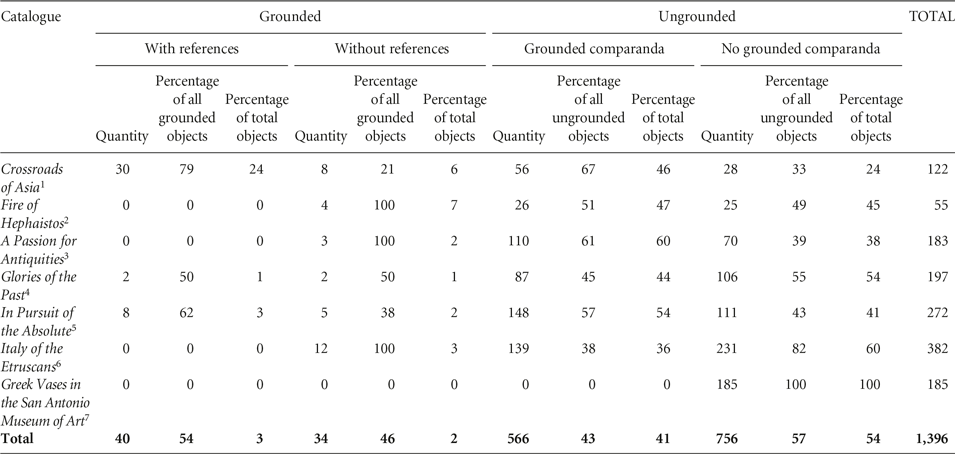
Scholarly hypotheses about ancient material culture are strongest when they are anchored by grounded objects. Attributions of ungrounded objects to particular dates and places are strongest when they are based on comparisons to specific, grounded objects. By my reckoning, 40 objects out of the 1,396 surveyed by Chippindale and Gill (or 3 percent) meet this higher standard (see Appendices 1 and 3). That is to say, 40 of the entries offered a specific find-spot and cited the bibliography in which that find-spot was first reported. An additional 34 also indicated a specific find-spot but offered no supporting references. It is precisely because they are so rare and so epistemologically valuable that grounded antiquities deserve a much brighter spotlight than they usually receive.
P5 and P6: Silence and Affinity
And what should be done with the 1,356 objects in these seven catalogues that are ungrounded? Chippindale and Gill’s scale implies that the most valuable thing curators can do is to pass along unsubstantiated rumors about the find-spot of these objects—whether identified as rumors (p2) or stated as fact—for example “from Kush”—and leaving it up to the reader to notice the geographical vagueness and its lack of documentary support (p1). Next best is to make a good guess (“probably” or “possibly”), without explaining the basis of that guess (p3 and p4). Any of those practices would earn the object a classification of “having some provenance.” A bad option—p5—would be to honestly and accurately state “provenance unknown” in the tombstone; worst of all would be to hypothesize about where the object might have come from based on comparisons to other, similar objects—p6.
Chippindale and Gill condemn the p5 and p6 objects most harshly and suggest that they are most likely to have been looted. This may or may not be so. But from an epistemological standpoint, the “information” that earns a p2–p4 rating—and, in fact, most of their p1 ratings as well—is actually more damaging to our knowledge of the past than that graded as a p5 or p6, since the “evidence” behind it is rarely ever explicitly presented and thus cannot be refuted; and since such soft rumor often congeals through repetition into hard “fact.” Footnote 41
Chippindale and Gill disdain any attempt at contextualization based upon what they call “affinity.” I assume they mean “affinity with other objects” or what art historians call connoisseurship. Connoisseurship, in the case of an ungrounded ancient artwork, might entail looking closely at its formal traits, noting that they are similar to the formal traits of another object, and thereby hypothesizing that the two come from similar, or the same contexts or sites or times and places more generally. Whatever they know about the other object, they apply to the one in question. Often, connoisseurship is the only tool available to scholars and curators seeking to say something about an ungrounded ancient work’s use or manufacture in antiquity. At its best, connoisseurship yields good hypotheses, which is achieved when the comparanda (the works to which the one in question is being compared) are explicitly identified and are themselves grounded. Sadly, these two “best practices” are not always followed. For example, the Ortiz catalogue suggests that a fine marble portrait of the empress Sabina might be from Greece (Catalogue no. 232: “Provenance: no indication; Greece?”). Ortiz offers no explanation for his hypothesis. It is assumed that those in the field will understand that it is based on unstated affinities (probably concerning the very skillful carving) with other, unspecified portraits found in Greece. This particular attribution may or may not be accurate, and Ortiz rightly indicates its uncertainty with the question mark. But Chippindale and Gill are, in my view, correct in their claim that such generic, imprecise attributions are largely meaningless and often circular. Footnote 42
However, if the “best practices” noted above are observed—if the “affinities” are with objects that are named, specific, and grounded and if the scholar has taken care to identify the results as hypotheses and not firm facts—then connoisseurship deserves more credit than Chippindale and Gill’s p6 rating implies. Such meaningfully compared and stylistically analyzed objects are still of an entirely different epistemological order than their excavated kin, but they have greater evidentiary legitimacy than ungrounded pieces on which such careful, methodologically conscious work has not been done. In his discussion of a bronze aryballos with red and blue enamel decoration in the Fleischman collection, for example, John Herrmann notes that
[t]his aryballos is clearly connected with a number of other bronze vessels with champlevé enameling that have been convincingly ascribed to northern Gaul. The use of pentagonal panels links it particularly to a locally excavated casserole in Bad Pyrmont in eastern Nordrhein-Westfalen (see Stupperich), a bowl from Rochefort (Jura, France) in the Metropolitan Museum of Art, and two bowls from the cemetery of La Plante in the Archaeological Museum at Namur, Belgium (see Forsyth). The bowls have been ascribed to a workshop that may have been at Anthée, also near Namur. They have been dated to the second century, but such a chronology may well be too late. A closely related enameled bronze bowl found in Braughing, Hertfordshire, has recently been dated to the first century on the strength of its connection with designs on contemporary South Gaulish terra sigillata (see Potter). Footnote 43
A detailed bibliography at the end of the entry gives all of the relevant citations. This is important, careful, scholarly work. Students and scholars who are intrigued by the aryballos in the Fleischman collection, and see its implications for, say, their research on links between Celtic and Islamic art, can read about it in the catalogue and know where to go for grounded examples. The entries for Catalogue nos. 151 and 165, also by John Herrmann, are similarly conscientious in their use of grounded comparanda.
Best practices are demonstrated in a handful of other entries on ungrounded objects in some of the other catalogues under consideration in this article. Footnote 44 The scrupulous reliance upon specific, epistemologically strong comparanda, however, is not the norm in the field. Indeed, for some classes of objects, such as Greek painted pottery, this practice is all but unheard of (for example, in the San Antonio show). Footnote 45 By my count, only 43 percent of the entries on ungrounded objects in the seven catalogues even mention a grounded comparandum, much less make it the primary basis of their attribution. More typical is the treatment of the ungrounded “bust of an older man” in the Levy-White collection, about which it is stated:
[T]he excellence of the carving and the subtle modeling of the surfaces point to an accomplished artist working in the period of the emperor Claudius. The probable place of manufacture would have been the environs of Rome or Naples. Footnote 46
However, no specific, grounded examples of works with comparably “excellent carving” and “subtle modeling of the surfaces,” securely attributed to the period of the emperor Claudius from the region of Rome or Naples, are adduced. My point is not that the hypothesis is incorrect but that as presented it is unsupported by evidence of any kind.
Greater methodological self-awareness and epistemological frankness in exhibition labels and catalogues are desirable for many reasons, not least of which is to mitigate the risk of being duped by forgeries. The demand for antiquities has long exceeded the supply, and we can never take the authenticity of ungrounded objects for granted. When exhibited in major museums and published in glossy, professional catalogues, forgeries have the power to radically distort our understanding of ancient material culture. A small number of entries in the catalogues surveyed here acknowledge the existence of forgeries in general. Footnote 47 Most, however, admit of no uncertainty, even in cases of highly unusual objects. As Chippindale and Gill note as well, it is precisely in such entries that we often encounter the most untroubled and even rapturous descriptions of the object’s uniqueness, its lack of comparanda (grounded or ungrounded) and/or pristine condition rarely presented as cause for alarm. Footnote 48 In the Levy-White catalogue, the complete chat for a 14-centimeter-high bronze figure mounted on a horse and holding his erect penis states: “This small but striking bronze sculpture of a nude, belted male figure mounted on the back of an equid—probably a horse—is unparalleled. It can be assigned to the Bronze Age in Central Asia both on the basis of its type and the treatment of the body of the figure.” Footnote 49 No comparanda are cited, perhaps because it is “unparalleled,” although one is left to wonder how a figure can be both “unparalleled” and an iteration of a “type,” and whether the “treatment of the body” refers to the fact that the figure is holding his erection or some other aspect of the work.
Equally puzzling, in the same catalogue, is a Cycladic figurine with a smaller figure conjoined to the top of her forehead. Footnote 50 The effect is that of a child standing on her mother’s head, even though both figures are otherwise in the standard pose for single Cycladic figures, with their arms across their midriffs and their knees slightly bent. The text notes:
This is one of very few well-preserved examples of a rarely attempted but clearly established type within the Cycladic sculptor’s repertory … For additional related sculptures, for which Ios, Paros, Tenos and the coast of Caria are among the reputed findspots, see ACC no. 257; Goulandris, 1983, no. 167.
How many is “very few”? What does it mean that four, geographically vague, “reputed findspots” are given for the two “related sculptures”? Most importantly, has the type been “clearly established” by grounded comparanda or only by ungrounded ones?
Particularly in cases of such extraordinary and puzzling iconography, the onus is on catalogue authors to find the grounded comparanda that would help audiences make sense of the work—or to discuss frankly the absence of such comparanda and what that might mean (this onus also extends to non-museum-based scholars who use ungrounded objects in their research). We need information like that provided by John Herrmann, quoted above, or that which is offered by George Ortiz in a noteworthy number of instances in his catalogue. Ortiz’s entry for Catalogue no. 79, a small bronze female figure seated on an ornamented crossbar (“bench”) raising an arm up to her head, offers a good model. There is a clear separation between fact and hypothesis in terms of the piece’s archaeological origins (“Provenance: no indication / Thessaly or Macedonia?”), some ownership history (although this is traced back only to the most recent previous owner; ideally, this would go back to the moment of the work’s first surfacing), and a careful report of its condition. The entry then continues with a lengthy text, which presents hypotheses about the work’s ancient significance, supported by numerous grounded comparanda from Thessaly and Macedonia (with bibliographic citations of their archaeological reports). It concludes with a frank discussion of remaining questions (“however appealing our female figure seated on a bench, we do not know what her gesture represents nor whether she is a divinity or a mourner”). Many additional examples of entries that demonstrate methodological self-awareness and epistemological clarity can be adduced in these catalogues: Catalogue nos. 146 and 212 in Crossroads of Asia; Catalogue nos. 97 and 30 in the Levy-White collection (“unfortunately, neither this vessel nor those like it have any controlled provenance, so their place of manufacture, function, and date have to be determined solely by stylistic and iconographic comparison with other objects that also float without provenances”) and Catalogue nos. 16, 23, 24, 30, 60, 61, 74, 81, 84, 109, 127, 137, 169, and 245 in the Ortiz collection. Chippindale and Gill’s scale, however, is not designed to recognize or encourage good work like this. Most of these careful, critically reflexive entries are rated as p2, p5, or p6, depending simply on whether or not a second-hand report of a find-spot is repeated in the tombstone.
DISCUSSION
This article has focused on Chippindale and Gill’s scale not only because of the wide readership it has gained but also because it makes very explicit some of the values and assumptions that have shaped the discourse around antiquities for more than a generation now. These include:
-
• the downplaying of the extraordinary epistemological importance of those rarest of creatures, grounded ancient artworks;
-
• the tolerance for the practice of not citing the archaeological documentation for grounded ancient artworks;
-
• the over-valuation of second-hand find-spot information relayed by financial stakeholders;
-
• the tolerance for the practice of passing these reports on without naming their source and without critical analysis;
-
• the tolerance for the intermingling of fact and hypothesis in catalogue and wall-label tombstones; and
-
• the belief that all attributions based on style are either equally useless or useful (depending on one’s disciplinary position), regardless of whether or not specific, grounded comparanda are adduced.
In Appendix 1, I present an alternative assessment of the 1,396 objects in these catalogues. This table foregrounds matters that I believe should be of the highest priority for those who are concerned about one of the major “material and intellectual consequences” of looting, namely the large numbers of ungrounded antiquities in our midst. The fundamental distinction this table makes is between grounded and ungrounded objects. This criterion is the only one that regards the “reality” of the objects; the others are matters of curatorial practice. The grounded objects are divided between those whose archaeological data is cited in the catalogues and those for which it is not. The ungrounded objects are divided between those for which grounded comparanda are offered (and it is worth noting that I was exceedingly—probably overly—generous in my assessments here, giving “credit” in all cases where even a single grounded object is mentioned in the text) and those for which they are not. The main conclusions I draw from this table are that 1) only 5 percent of the ancient objects presented in these exhibitions are grounded; (2) the archaeological documentation of grounded objects is cited only slightly more than half the time (54 percent) Footnote 51 ; and (3) grounded comparanda form the basis of attributions and interpretations of ungrounded objects only 41 percent of the time (at best). For those of us who hope to build a solid foundation of knowledge about the past through museum exhibitions and their catalogues, these are dispiriting numbers indeed.
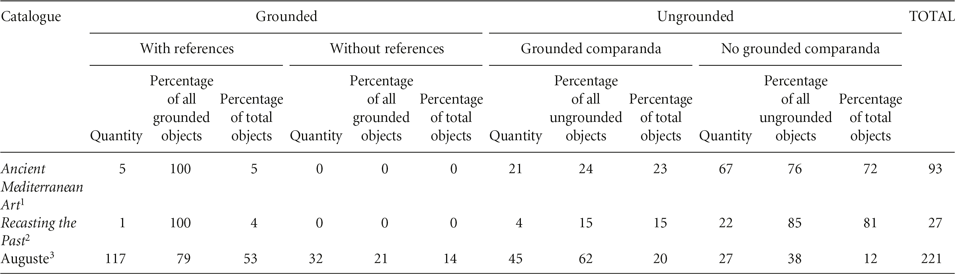
All of the catalogues analyzed by Chippindale and Gill were published in the early to mid-1990s, before the issue of looting exploded into the mainstream media and popular consciousness with, for example, the trials of middleman Giacomo Medici in 2004 and of Getty Museum curator Marion True (2005–07) and the return to Italy of the Euphronios Krater from the Metropolitan Museum in 2006. Footnote 52 These events had a significant impact on the field, demonstrated most explicitly by the Association of Art Museum Directors’s tightening of its guidelines concerning the acquisition of “archaeological material and ancient art” in 2008. The importance of archaeological context was a major theme in the debates and discussions. After retabulating Chippindale and Gill’s seven catalogues from the 1990s, I was curious to know whether the events of recent years had brought about changes in the ways archaeological context is talked about in museum scholarship and whether newer historiography is marked by greater epistemological reflexivity. Appendix 2 presents the tabulations on three additional catalogues, all published in the last three years. These include the catalogue of the William D. and Jane Walsh Collection of Ancient Mediterranean Art at Fordham University; the small catalogue timed to coincide with the opening of the Mary and Michael Jaharis Galleries of Greek, Roman and Byzantine Art at the Art Institute of Chicago, which highlights distinguished loans and “notable acquisitions” to the department made since 1994; and the catalogue that accompanied the massive exhibition of art from the reign of Augustus held at the Scuderie del Quirinale in Rome and the Grand Palais in Paris. Footnote 53 These catalogues were chosen somewhat at random, but they represent similar exhibition genres as those included in Chippindale and Gill’s study. The Walsh collection, assembled by a single private collector couple and donated to a large museum, is comparable to the Fleischman collection, and the Augustus exhibit, as a large, scholarly show that draws on deep European collections formed centuries ago, is not unlike the Gandharan exhibit at the Fitzwilliam Museum. The exhibit of highlights from the newly enlarged ancient galleries at the Art Institute of Chicago, which includes a mix of recent acquisitions, older acquisitions, and objects lent by private collectors, is less directly comparable, although there are similar objects in all of the catalogues surveyed by Chippindale and Gill.
The results of these tabulations are mixed. The sample is much smaller than Chippindale and Gill’s (fewer than half the number of catalogues and only a quarter of the number of objects), so they should be taken with a grain of salt. Nevertheless, they are interesting and perhaps revealing. The percentage of grounded objects in the catalogues of the two American institutions is still in the low single digits. Grounded comparanda are adduced in discussions of ungrounded objects in these two catalogues even less frequently than they are in the catalogues from the 1990s (19 percent of the time versus 43 percent). On the other hand, the American curators seem to be more diligently citing the archaeological bibliography for their grounded objects than had been the case in the past (100 percent of the time in the current catalogues versus 54 percent in the 1990s). The numbers for the Augustus show are also encouraging, insofar as two thirds of its contents had secure archaeological find-spots. This is perhaps not surprising given how heavily it drew on the regional archaeological collections in France. As far as how curators handled the grounded and ungrounded material, however, little seems to have changed since the 1992 Fitzwilliam exhibit. In both catalogues, the archaeological documentation of the grounded objects was cited 79 percent of the time. Of the ungrounded objects, grounded comparanda were offered 67 percent of the time in 1992 and 62 percent of the time in the Augustus show.
While I focus here only on the matter of how the grounded and ungrounded works in these three catalogues are presented, it is also worth noting, in the spirit of optimism, two further developments. One is the fact that a museum like the Getty Villa is now putting on exhibits such as “Sicily: Art and Invention between Greece and Rome,” which I did not include in my tabulations here because it is so radically uncomparable to the kinds of shows that were being curated in the 1990s. Footnote 54 Focused on a particular geographical region, and made possible thanks to the new spirit of collaboration between the Getty and the Italian archaeological authorities in recognition of the museum’s recent high-profile returns of looted antiquities, the exhibit consists almost entirely of grounded objects whose publication data was scrupulously cited and whose occasional uncertainties were carefully acknowledged. The show also refutes the oft-invoked, false dichotomy between beauty and context, wonder and resonance, art and archaeology.
Also encouraging is the fact that the Walsh catalogue, written by Jennifer Udell, discusses candidly and thoughtfully the ethical dilemma that Fordham University faced when deciding whether or not to accept the Walsh bequest (which consisted almost entirely of undocumented antiquities that surfaced on the art market during the previous three decades) and explains their reasons for choosing to do so. Footnote 55 Not everyone will agree with Fordham’s decision, but the candor is salutary, especially when compared with the catalogue of the Art Institute of Chicago. In this volume, there is no acknowledgement of the ethical or epistemological issues lurking below the surface (for example, the fact that one of its most celebrated objects, an exquisite, immaculately preserved, and quite unusual female portrait bust that adorns all the banners and publicity celebrating the Mary and Michael Jaharis Galleries, was purchased by the museum in 2002 on the occasion of its first surfacing). Footnote 56 Furthermore, the catalogue’s lone mention of shifting attitudes in the wake of the looting scandals suggests nothing but irritation at the new restrictions (“how were we now [having received the Jaharis pledge to build new ancient galleries] to fill an area more than four times as large, especially when it is increasingly difficult for museums to purchase high-quality works of ancient art with documented histories of ownership that satisfy the rigorous standards currently stipulated by the Association of Art Museum Directors?”). Footnote 57
Two steps forward, one step back. There is much to learn from the handful of scholars and curators who have been thinking critically about these issues, both in recent years and back in the 1990s. The aim of this article has been to encourage more of the methodological self-awareness and candor one occasionally finds in their publications. There is still a long way to go, as Appendices 1 and 2 make clear. I share Chippindale and Gill’s larger goals—the reduction of looting—but do not believe that the scale they devised to assess its “material and intellectual consequences” actually frames the issues in ways most likely to change attitudes or increase scholars’ and curators’ sense of their responsibilities. Although I have not explicitly framed my alternative model as a stepped scale, there is a strong hierarchy implicit in it, whereby grounded objects with cited archaeological documentation are prized most highly as evidence of ancient practices and ungrounded objects with only ungrounded comparanda (or no explicitly identified comparanda at all) are valued least highly. My hope is that more people, not just scholars and curators, but the general public—and collectors, in particular!—might be persuaded to think in these terms as well.
Appendix 1. Chippindale and Gill’s seven catalogues, analyzed according to the criteria of grounded versus ungrounded objects

Appendix 2. Three recent catalogues, analyzed according to the same criteria as listed in Appendix 1