Introduction
The secondary sex ratio, or the ratio of boys to girls at birth, usually expressed as the proportion of males to females, demonstrates a small male preponderance that is quite stable in human populations. However, gradual changes over long periods of time (Vartiainen et al., Reference Vartiainen, Kartovaara and Tuomisto1999), as well as slight fluctuations, occur that appear to be influenced by a number of racial, environmental and biological factors. A high offspring sex ratio has been reported in several conditions, such as during and after long-lasting wars (Graffelman & Hoekstra, Reference Graffelman and Hoekstra2000; James, Reference James2009), in primiparous women who smoked both before and during pregnancy (Beratis et al., Reference Beratis, Asimacopoulou and Varvarigou2008), and a number of medical conditions, such as the hepatitis B carrier state (Chahnazarian et al., Reference Chahnazarian, Blumberg and London1988), toxaemia, fatty liver of pregnancy, placenta praevia (James, Reference James1995) and dermatoses of pregnancy (James, Reference James2000a). Also, some forms of in vitro fertilization have been linked to an increased sex ratio (Ménézo et al., Reference Ménézo, Chouteau, Torelló, Girard and Veiga1999). Apparently, ethnicity plays a role as well, with Asian populations demonstrating high (James, Reference James1985) and black populations low (James, Reference James1984) sex ratios.
A low sex ratio has been found to be associated with placenta accreta (James, Reference James1995), methyl mercury intoxication caused by the ingestion of polluted fish (Sakamoto et al., Reference Sakamoto, Nakano and Akagi2001), hyperemesis gravidarum (James, Reference James2001), cytomegalovirous infection (Shields et al., Reference Shields, O'Hare, Nelson, Stewart and Coyle2002) and among the offspring of smoking multiparous women (Beratis et al., Reference Beratis, Asimacopoulou and Varvarigou2008). Of particular interest is the decline in sex ratios following major adverse life events, such as destructive earthquakes (Fukuda et al., Reference Fukuda, Fukuda, Shimizu and Møller1998; Saadat, Reference Saadat2008), intense short-lasting wars that impose a direct threat to the population (Zorn et al., Reference Zorn, Sucur, Stare and Meden-Vrtovec2002), economic decline (Catalano & Bruckner, Reference Catalano and Bruckner2005), death of, or a serious health problem in, a close family member (Hansen et al., Reference Hansen, Moller and Olsen1999) and terrorist attacks that caused extensive destruction (Catalano et al., Reference Catalano, Bruckner, Anderson and Gould2005a, Reference Catalano, Bruckner, Marks and Eskenazi2006). A cardinal characteristic of the destructive earthquakes and the other calamities mentioned above that are associated with a fall in the sex ratio at birth is the devastating human loss they impose on the population.
It is speculated that the psychological stress associated with adverse life events causes a decline in the secondary sex ratio by inducing a decrease in sperm mobility, particularly of the Y-bearing sperm (Fukuda et al., Reference Fukuda, Fukuda, Shimizu, Yomura and Shimizu1996; Fenster et al., Reference Fenster, Katz, Wyrobek, Pieper, Rempel, Oman and Swan1997), alteration of the parental hormone concentrations in the periconceptional period (James, Reference James1996), reduced coital rates (Martin, Reference Martin1997; James, Reference James1999) or preferential male fetal loss (Catalano et al., Reference Catalano, Bruckner, Anderson and Gould2005a, Reference Catalano, Bruckner, Gould, Eskenazi and Andersonb). It is well established that destructive earthquakes exert a psychological impact on the population exposed to the environmental insult. Of the psychiatric morbidity induced by earthquakes with devastating results, the most prevalent is post-traumatic stress disorder that reached the level of 74% among the Armenian 1988 earthquake victims (Goenjian, Reference Goenjian1993). In addition, earthquake disaster survivors have reported major depressive disorder, anxiety (Goenjian et al., Reference Goenjian, Steinberg, Najarian, Fairbanks, Tashjian and Pynoos2000) and minor psychiatrical morbidity, such as insomnia, palpitations, nervousness and headache with dizziness (Chen et al., Reference Chen, Yeh, Yang, Chen, Lee and Fu2001).
The Hellenic arc is a curved tectonic formation originating from the subduction of the African plate beneath the Aegean Sea plate. It extends from western Turkey through the islands of Rhodes and Crete to the Western Peloponnese and terminates offshore of the island of Zakynthos. The western segment of the Hellenic arc is one of the most seismic regions in western Eurasia. On August 12th 1953 a devastating earthquake of magnitude 7.3 on the Richter (R) scale took place that destroyed all but three of the buildings in the capital town Zakynthos and approximately 70% of the buildings on the island. Subsequently, Zakynthos town was ravaged by fires that spread from the kitchens of destroyed houses. Approximately 100 people were killed, 500 were injured and 35,440 were left homeless.
Based on the observation that destructive earthquakes and other psychological stress-inducing calamities are followed by a decline in the secondary sex ratio, it was decided to study the sex ratio at birth on the island of Zakynthos after an earthquake sequence that lasted for 5 weeks. A decline in the secondary sex ratio following the earthquake clustering would support the view that the repeated earthquakes, even though not destructive, induced in that particular population sufficient psychological stress to affect the biology of the sex ratio. Two sorts of reduction of the secondary sex ratio imposed by exogenous stressors have been observed in populations: early, 3 months after the shock of the adverse life event; and late, 9–11 months after the event to which the diminished sex ratio is attributed. Early reduction of the sex ratio because of preferential male fetal loss is observed in terrorist attacks (Catalano et al., Reference Catalano, Bruckner, Gould, Eskenazi and Anderson2005b, Reference Catalano, Bruckner, Marks and Eskenazi2006). Late reduction is reported after severe periconceptional life events, such as destructive earthquakes (Fukuda et al., Reference Fukuda, Fukuda, Shimizu and Møller1998; Saadat, Reference Saadat2008), which is attributed to reduced male conceptions. Several mechanisms induced by population stressors have been proposed to cause a decline in the conception of males, such as endocrine dysregulation with high maternal concentrations of gonadotrophins and progesterone around the time of conception (James, Reference James1996, Reference James2000c), reduced sperm mobility, particularly of the Y-bearing sperm (Fukuda et al., Reference Fukuda, Fukuda, Shimizu, Yomura and Shimizu1996), and reduced coital rate (Hilsenrath et al., Reference Hilsenrath, Swarup, Bischoff, Buster and Carson1997; James, Reference James2000b). An early relative reduction in male births compared with female births would support the mechanism of preferential male fetal loss, whereas a relative decline in male births at about 9–11 months following the earthquakes would support the reduction of male fertilization mechanism.
Methods
Between April 3rd and May 8th 2006 a moderate sized earthquake sequence occurred in the Ionian Sea with epicentres close to the south coast of the Greek island of Zakynthos. The depths of the earthquakes were between 2 and 25 km. During the sequence there were 26 events, with a magnitude of 4 R or greater. The four strongest earthquakes were between 5.2 R and 5.4 R, which occurred from April 4th to 12th. During the first 16 days, when seismicity was higher and the strongest events occurred, 33 earthquakes with a magnitude of 3.3 R or more were recorded (Serpetsidaki et al., Reference Serpetsidaki, Sokos, Tselentis and Zahradnik2010). After May 8th seismicity became sparser and up to November 11th six earthquakes with a magnitude between 4.0 R and 4.3 R were recorded. No casualties or appreciable damage occurred.
The monthly numbers of male and female live births were obtained from the Statistical Bureau of Greece. These include births that took place on the island as well as those of women who lived in Zakynthos but elected to deliver in a major hospital on the mainland, mainly in the cities of Patras and Athens. The secondary sex ratio is expressed as the ratio of male to female live births.
Since it was not known whether the hypothesized decline in the secondary sex ratio following the earthquake clustering would happen early according to the fetal loss mechanism (Catalano et al., Reference Catalano, Bruckner, Anderson and Gould2005a, Reference Catalano, Bruckner, Marks and Eskenazi2006) or late in agreement with the reduced male conception mechanism (James, Reference James1996; Fenster et al., Reference Fenster, Katz, Wyrobek, Pieper, Rempel, Oman and Swan1997; Martin, Reference Martin1997), the monthly sex ratio was estimated after the seismic sequence. Because a clear fall in the sex ratio was observed 11 to 12 months after the onset of the sequence and 10 to 11 months after its subsidence, the number of male and female births in this 2-month time period was compared with that during the previous 12 months, as well as with the total number of male and female births during the years 2004, 2005, 2006, 2008, 2009 and 2010. To exclude the possibility of a seasonality effect, the number of male and female births in the study period (March–April 2007) was compared with that of the same months in the control years.
In August 2007 extensive fires raged across the mainland Western Peloponnesus; these destroyed close to 1.5 million km2 of forested and cultivated land, burned down villages and isolated houses, reached the outskirts of several towns and killed 64 individuals. At the same time forest fires broke out on the island of Zakynthos as well. Because such an extensive and stressful life event could induce anxiety and disrupt the normal function of society, conditions that reportedly are associated with a decline in the secondary sex ratio 6–11 months later (Fukuda et al., Reference Fukuda, Fukuda, Shimizu and Møller1998; Zorn et al., Reference Zorn, Sucur, Stare and Meden-Vrtovec2002; Saadat et al., Reference Saadat2008), births during the year 2008 were analysed separately.
The data were analysed by applying odds ratios (OR) and 95% confidence intervals (CI). Significance was set at p≤0.05. GraphPad Software (San Diego, CA, USA) was used for the analysis.
Results
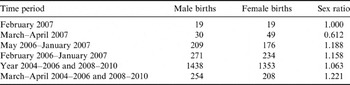
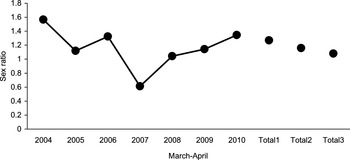
Fetuses conceived during the earthquake sequence between April 3rd and May 8th 2006, the time period with the strongest and most frequent events, would have been delivered at term between January and February 2007. In February 2007, 10 months after the onset and 9 months following the end of the earthquake sequence, the sex ratio fell to 1.000, and in the next two months (March and April) it declined further to a mean of 0.612. Table 1 lists the number of male and female live births during the time periods that were compared with the births of the 2-month period March–April 2007, during which the greatest decline in the sex ratio was observed. The number of boys relative to girls born in March–April 2007 was significantly lower than in the 9-month period between the earthquake clustering and the onset of the sex ratio decline (OR=0.51, 95% CI=0.31–0.83, p=0.01), and also lower than in the year before the fall in the sex ratio (OR=0.53, 95% CI=0.32–0.86, p=0.013). Also, the number of boys relative to girls born in March–April 2007 was significantly lower than during the 6-year period from 2004–2006 and from 2008–2010 (OR=0.57, 95% CI=0.36–0.91, p=0.023). To test the possibility of a low March–April seasonality, the number of male and female births in the March–April 2007 period was compared with that in the same month-period in the years 2004–2006 and 2008–2010. The number of boys compared with the number of girls born in March–April 2007 was significantly lower than that during the same months 3 years before and after the earthquake clustering (OR=0.50, 95% CI=0.31–0.82, p=0.007). Figure 1 illustrates: (a) the sex ratio during the months of March and April 2004–2010; (b) the total sex ratio during the months of March and April 2004–2006 and 2008–2010; (c) the sex ratio during the 12-month period before February 2007; and (d) the total sex ratio of the whole years 2004–2006 and 2008–2010.
Male and female live births during the time periods that were compared with the births during the 2-month period March–April 2007, with the greatest decline in the sex ratio following the April 3rd–May 8th 2006 earthquake sequence in Zakynthos

Sex ratio in March–April 2004, 2005, 2006, 2007 (year following the earthquake sequence), 2008, 2009 and 2010; all births in March–April 2004, 2005, 2006, 2008, 2009 and 2010 (Total1); all births in the 12 months before February 2007 (Total2); all births in years 2004, 2005, 2006, 2008, 2009 and 2010 (Total3).

In June 2008, 10 months after the August 2007 fires, the sex ratio fell to 0.769. When the male and female births in June 2008 were compared with those in the 5-year period 2004 to 2006 and 2009 to 2010, the difference did not reach the level of significance (OR=0.72, 95% CI=0.40–1.29, p=0.34). Also, there was no significant difference between the number of male and female births in June 2008 and those in the same month of the above 5-year period (OR=0.68, 95% CI=0.35–1.31, p=0.32).
Discussion
The findings of the study show that starting 10 months and 9 months from the onset and the decline of the earthquake sequence, respectively, there was a fall in the number of male compared with female births that became significant during the next two months. This led to a mean reduction in the sex ratio at birth during this 2-month time period to 0.612. The fall in the sex ratio occurred even though the earthquakes did not cause any casualties or appreciable damage to infrastructure, as was the case in previous reports of strong earthquakes that caused a reduction in the sex ratio (Fukuda et al., Reference Fukuda, Fukuda, Shimizu and Møller1998; Saadat, Reference Saadat2008). It appears that the moderate sized earthquake clustering in Zakynthos in 2006, composed of several events over a period of 5 weeks, induced significant psychological stress in the population by reviving memories in the community of the catastrophic earthquake that hit the island half a century earlier. This indicates that a hypothetical threshold of intensity of psychological stress required for causing a decline in the sex ratio may be reached even by mild environmental insults, depending on the nature of the insult, the underlying psychology of the particular population, and existing memories of related destructive events in the past. The fall in the secondary sex ratio that was noticed 10 and 9 months after the onset and the decline of the earthquake sequence, respectively, and its subsequent significant drop well below 1.000 during the next 2-month period, is in accordance with the reported declines in the sex ratios that were observed 9 months and 11 months after the destructive earthquakes of Kobe in Japan (Fukuda et al., Reference Fukuda, Fukuda, Shimizu and Møller1998) and Bam in Iran (Saadat, Reference Saadat2008), respectively. The greater duration of the sex ratio decline after the earthquake clustering in Zakynthos may be related to the different nature of the environmental insult that induced a prolonged stressful period. In the earthquakes of Kobe and Bam the apparent psychological stressors that led to the fall in the sex ratio were the extensive casualties and destruction caused by the earthquakes. In the earthquake clustering of Zakynthos there were no casualties and no destruction of the infrastructure. It is hypothesized that the prolonged nature of the clustering and the earthquakes that followed it had a cumulative traumatic effect on the population. In addition, they created the anticipation of an impending catastrophic earthquake that elongated the stressful period and reinforced psychological symptoms, such as anxiety, phobia, nervousness and insomnia.
The trend for a non-significant fall of the sex ratio 10 months after the destructive fires might be related to the stress of the population caused by the particular natural disaster. However, because of the absence of a significant association this issue remains unresolved at the present time.
The observed fall in the sex ratio of newborns delivered close to term after the earthquake sequence supports the theory that population stressors reduce the chances of male conceptions (James, Reference James1996; Fenster et al., Reference Fenster, Katz, Wyrobek, Pieper, Rempel, Oman and Swan1997; Martin, Reference Martin1997). The absence of a significant decline in the sex ratio early at around 3 months after the earthquakes should not be considered as an indication against the proposed mechanism of preferential male fetal loss following the application of exogenous stressors on the population (Catalano et al., Reference Catalano, Bruckner, Anderson and Gould2005a, Reference Catalano, Bruckner, Gould, Eskenazi and Andersonb). It is speculated that the nature of the psychological stressor and the underlying psychological background of the population may differentiate the impact on biological mechanisms that affect the sex ratio.
The adverse life event of the earthquake clustering, in conjunction with the fear of repetition of a destructive earthquake similar to the one that occurred half a century earlier, could have disrupted the normal function of the population by inducing intense stress and anxiety in the community that resulted in a decreased conception of males. Psychological stress caused by major life events may decrease the secondary sex ratio due to a lower coital rate, which reduces the probability of ovum fertilization by Y-bearing sperm and therefore the birth of fewer males (Hilsenrath et al., Reference Hilsenrath, Swarup, Bischoff, Buster and Carson1997; James, Reference James2000b). No data were available on the coital rates of couples during and following the earthquake sequence, but it is reasonable to assume that the severe emotional distress caused a fall in the coital rate during this period. It is also reported that psychological stress may induce endocrine imbalance, which has been proposed as a causal factor for the decreased conception of males (James, Reference James1996, Reference James2000c).
The possibility of a seasonality confounding effect on the association between earthquake sequence and fall in the number of male births during the months March and April is unlikely because the sex ratio during this 2-month period was significantly lower than that in the same months 3 years before and 3 years after the earthquake clustering.
The female-skewed secondary sex ratio that was initially observed 10 months after the onset of the earthquake sequence might be associated with psychological tensions caused by the repeated earthquakes. Stress, fear, anxiety and other similar psychiatric morbidity could induce the biological antecedents of a low sex ratio. The effect of population stressors on the secondary sex ratio is likely to depend on the nature of the stressor per se, the emotional response of the population that is based on specific endogenous psychological characteristics, the pertaining conditions that affect life, and existing community memories of similar calamities that occurred in the past. It appears that psychological stress has the potential to induce different mechanisms that may affect the secondary sex ratio, and different populations might respond in different ways to the same stimulus.
Although the underlying biology of how community psychological stressors affect the secondary sex ratio remains to be elucidated, the fall in the number of boys relative to girls following stress-inducing major adverse life events is a fine example of the interaction between psychological factors and basic biological functions, such as the sex ratio.