Introduction
The yellownose skate (Dipturus chilensis, Guichenot, 1848) and roughskin skate (Dipturus trachyderma, Krefft & Stehmann, 1975) are benthic batoids whose distributions have been reported in cold-temperate waters on the continental shelf and slope of South America between central Chile in the Pacific Ocean and southern Brazil in the Atlantic Ocean (Agnew et al., Reference Agnew, Nolan, Beddington and Baranowski2000; García de la Rosa et al., Reference García de la Rosa, Sánchez, Prenski, Cajal and Prenski2000; Lucífora et al., Reference Lucífora, Valero, Bremec and Lasta2000; Gomes and Picado, Reference Gomes and Picado2001; Koen et al., Reference Koen, Crespo, García, Pedraza, Mariotti, Berón, Vera and Mora2001; Bustamante et al., Reference Bustamante, Vargas-Caro, Oddone, Concha, Flores, Lamilla and Bennett2012). The taxonomic classification and distribution of D. chilensis (previously known as Zearaja chilensis) was reviewed by Concha et al. (Reference Concha, Caira, Ebert and Pompert2019), with this species currently considered to exclusively inhabit the Pacific Ocean (Gabbanelli et al., Reference Gabbanelli, de Astarloa J, González-Castro, Vázquez and Mabragaña2018, Reference Gabbanelli, Naylor, Weigmann, Yang, Vazquez, Last, de Astarloa and Mabragaña2022; Concha et al., Reference Concha, Caira, Ebert and Pompert2019). In Chile, both skate species seem to have the same distribution (32°S–56°S), including the inner channels and fjords of Chilean Patagonia (Vargas-Caro et al., Reference Vargas-Caro, Bustamante, Lamilla and Bennett2015).
Both elasmobranch species are caught as part of a skate fishery that began in Chile in the 1970s, initially yielding landings below 500 t year−1 between 36°00′ and 41°28′S, with combined species landing records until 2004 (Quiroz et al., Reference Quiroz, Wiff, Gatica and Leal2008). The yellownose skate was initially caught as bycatch in the industrial fishery for ling (Genypterus blacodes) and southern hake (Merluccius australis). After the 1990s, yellownose skate became a target species because of increased interest in Asian countries, especially South Korea (Céspedes et al., Reference Céspedes, Licandeo, Toledo, Cerna, Donoso and Adasme2005). Since 1993, there was a significant increase in catches by both artisanal and industrial fleets, yielding approximately 3000 t annually and reaching a historical peak in 2003 of 5193 t, primarily due to the fishing effort by the artisanal fleet (Quiroz et al., Reference Quiroz, Wiff, Gatica and Leal2008; Pérez et al., Reference Pérez, Gálvez, Garcés and González2017).
Such levels of exploitation resulted in reduced reproductive potential and a significant decline in its biomass, resulting in temporary and annual closures, as well as annual catch quotas for fishery management (Wiff et al., Reference Wiff, Flores, Canales, Segura, Gelcich, Rodríguez, Gacitúa, Queirolo, Ahumada and Montero2021). Recently, extractive closures were implemented in 2014, 2015, and 2017, as were catch quotas ranging between 70 t (in 2018) and 1200 t (in 2021 and 2022). However, quotas were exceeded by landings and quickly depleted due to this intensive exploitation (Garcés et al., Reference Garcés, San Juan, Moyano, Cerna, Cid, Villalón, Hunt and Muñoz2023).
Several species of benthic skates exhibit slow growth, late maturity, and low fecundity, with varying degrees of population resilience (Walker et al., Reference Walker, Howlett and Millner1997; Dulvy et al., Reference Dulvy, Metcalfe, Glanville, Pawson and Reynolds2000; Frisk et al., Reference Frisk, Miller and Forgarty2001; Dulvy and Reynolds, Reference Dulvy and Reynolds2002; Vargas-Caro et al., Reference Vargas-Caro, Bustamante, Lamilla and Bennett2015; Wheeler et al., Reference Wheeler, Connor, Johnson, Vance, Rosa, Mandelman and Rummer2020). For yellownose skate and roughskin skate, there is limited information regarding their life history parameters and spatial dynamics, as well as a lack of fisheries-independent abundance estimates. Both species are also listed as endangered on the IUCN Red List (Vargas-Caro et al., Reference Vargas-Caro, Bustamante, Lamilla and Bennett2015; IUCN, 2022). Among the commercially exploited species in Chile, the yellownose skate has the lowest resilience (Wiff et al., Reference Wiff, Flores, Neira and Caneco2018), and the roughskin skate, with its larger size, slower growth, and greater longevity, is particularly vulnerable to overexploitation (Licandeo et al., Reference Licandeo, Cerna and Céspedes2007; Quiroz et al., Reference Quiroz, Wiff, Cubillos and Barrientos2011; Dulvy et al., Reference Dulvy, Fowler, Musick, Cavanagh, Kyne, Harrison, Carlson, Davidson, Fordham, Francis, Pollock, Simpfendorfer, Burgess, Carpenter, Compagno, Ebert, Gibson, Heupel, Livingstone and Sanciangco2014).
The high degree of philopatry within benthic skate populations represents another significant vulnerability factor, even at low levels of exploitation (Casey and Myers, Reference Casey and Myers1998; Agnew et al., Reference Agnew, Nolan, Beddington and Baranowski2000; Wearmouth and Sims, Reference Wearmouth and Sims2009; Neat et al., Reference Neat, Pinto, Burrett, Cowie, Travis, Thorburn, Gibb and Wright2014; Lavender et al., Reference Lavender, Aleynik, Dodd, Illian, James, Wright, Smout and Thorburn2021). The movement patterns of fish constitute a fundamental element of their life history (Nathan et al., Reference Nathan, Getz, Revilla, Holyoak, Kadmon, Saltz and Smouse2009; Cooke et al., Reference Cooke, Bergman, Twardek, Piczak, Casselberry, Lutek, Dahlmo, Birnie-Gauvin, Griffin, Brownscombe, Raby, Standen, Horodysky, Johnsen, Danylchuk, Furey, Gallagher, Lédée, Midwood and Lennox2022) and are essential for proposing effective conservation management measures (Verhelst et al., Reference Verhelst, Brys, Cooke, Pauwels, Rohtla and Reubens2023). For the yellownose skate and roughskin skate, the basic aspects of migratory behaviour and the presence of subpopulations remain unknown, with current management relying on a single stock unit. However, genetic studies suggest the existence of three distinct stocks (Vargas-Caro et al., Reference Vargas-Caro, Bustamante, Bennett and Ovenden2017).
Tagging is a procedure that allows information on various aspects of the ecology and population dynamics of marine species populations to be obtained and is widely used to understand migratory and distribution patterns (Thorsteinsson, Reference Thorsteinsson2002). In general, three methods are used to study migrations in benthic skates: external or conventional tags, acoustic transmitters, and satellite transmitters. Each method has its own advantages and disadvantages, which must be evaluated in relation to the specific case being studied. External tags are recognized for their ease of use, low cost, long retention time, and minimal impact on fish behaviour, but they require recapture, tagging a greater number of fish, and collaborative work with fishers. These tags have been used in large-scale tagging programmes for various skate species, with the most common being the use of Petersen discs (Walker et al., Reference Walker, Howlett and Millner1997; Ellis et al., Reference Ellis, Morel, Burt and Bossy2011, Reference Ellis, Burt, Grilli, McCully, Catchpole and Maxwell2018; Bird et al., Reference Bird, Burt, Hampton, McCully and Ellis2020). In Chile, Lamilla et al. (Reference Lamilla, Barría and Flores2011, Reference Lamilla, Flores, Garcés and Miranda2012) used Dart-type tags to study the yellownose skate and reported the tagging of a total of 77 individuals, of which only one (a female, 73 cm long) was recovered after 24 days, with 7.3 km of displacement between release and recovery points.
Acoustic transmitters provide data independent of recapture. However, they are a higher-cost technology compared to external tags, and the number of tagged fish can be significantly lower. Its main advantage is the ability to monitor many active tags constantly and simultaneously. However, detections cannot be recorded outside the receivers' detection range, which can be either active (tracking movements from a moving vessel using a hydrophone) or passive (moored in a fixed location), the latter being the preferred method today (Matley et al., Reference Matley, Klinard, Barbosa, Aarestrup, Aspillaga, Cooke, Cowley, Heupel, Lowe, Lowerre-Barbieri, Mitamura, Moore, Simpfendorfer, Stokesbury, Taylor, Thorstad, Vandergoot and Fisk2022; Kraft et al., Reference Kraft, Gandra, Lennox, Mourier, Winkler and Abecasis2023). The receivers are typically deployed in shallow coastal areas or semienclosed zones (e.g. De Wysiecki et al., Reference De Wysiecki, Barnett, Cortés, Wiff, Merlo, Jaureguizar, Awruch, Trobbiani and Irigoyen2023). Using a setup with more receivers increases the probability of detecting tagged fish, enabling a more comprehensive study of their movements within the research area (Collins et al., Reference Collins, Heupel and Motta2007; Cerutti-Pereyra et al., Reference Cerutti-Pereyra, Thums, Austin, Bradshaw, Stevens, Babcock, Pillans and Meekan2014; Neat et al., Reference Neat, Pinto, Burrett, Cowie, Travis, Thorburn, Gibb and Wright2014; Braun et al., Reference Braun, Skomal, Thorrold and Berumen2015; Ramsden et al., Reference Ramsden, Cotton and Curran2017; Frisk et al., Reference Frisk, Shipley, Martinez, McKown, Zacharias and Dunton2019).
Satellite transmitter technology allows for the study of both vertical and horizontal migration patterns while also recording key environmental variables such as depth and temperature. A major advantage is that the fish do not need to be recaptured, as the release time of the satellite transmitters can be programmed. Although the cost is relatively high, the obtained data serve various research purposes, such as site fidelity (Dipturus batis; Wearmouth and Sims, Reference Wearmouth and Sims2009), large horizontal migrations (Beringraja binoculata; Farrugia et al., Reference Farrugia, Goldman, Tribuzio and SeitD2016), large vertical migrations (Amblyraja hyperborea; Peklova et al., Reference Peklova, Hussey, Hedges, Treble and Fisk2014), and postcapture survival (Amblyraja radiata; Knotek et al., Reference Knotek, Kneebone, Sulikowski, Curtis, Jurek and Mandelman2019). To promote the conservation of yellownose skate and roughskin skate populations, and considering the limited information available on the behaviour patterns of these species, this study aims to compare different tagging methods for potential use in the development of tagging programmes in Chile.
Materials and methods
Zone of the study
The tagging activities were conducted in two zones where historically the artisanal fisheries targeting skates operates. These areas have different geographical features corresponding to the exposed coastal area off Bahía Mansa (40°34′S–73°43′W) and to a protected area in the interior waters of Chiloé Island, in the Comau Channel, located 16 km south of the fishing village of Hualaihué, at the entrance of the fjord of the same name (42°17′S–72°29′W). Both areas are hereafter referred to as Bahía Mansa and Comau (Figure 1). The first stage involved capture, tagging, and release, which took place in August 2021. The second stage involved the recapture and retrieval of information from the released fish. This stage had varying durations depending on the type of tagging used, with a minimum of 60 days for satellite transmitters, 90 days for acoustic transmitters, and a maximum of 300 days for the use of external tags. The captures, tagging, and release of the fish were conducted onboard the artisanal fishing vessels ‘Llafdel’ in Bahía Mansa (7.8 m in length) and ‘Naviero’ in Comau (10 m in length).
Locations of the zones selected for the pilot tagging programme for yellownose skate and roughskin skate, Los Lagos Region, Chile: (A) Bahía Mansa and (B) Comau.

Tags
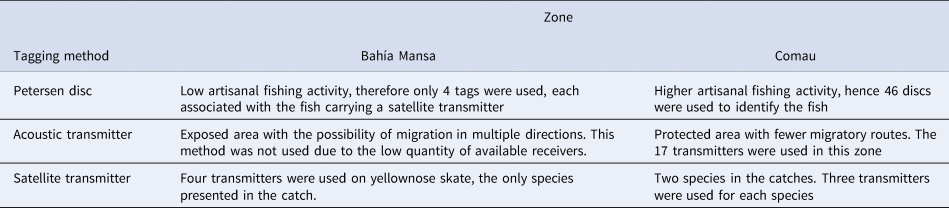
Three types of tags were used: Petersen Floy Tag® discs (50 units), Innovasea® V16 acoustic transmitters (17 units), and Wild-Life Computers® SPAT-355H pop-up satellite transmitters (10 units). The latter, optimized for short-term survivorship studies, was considered a suitable alternative for a pilot study due to funding constraints and was programmed to surface 60 days after release. For the acoustic transmitters, the emission frequency was once per minute, whereas for data reception, three Vemco® VR2W receivers operating at 69 kHz were used, with a maximum detection range of up to a 1200 m linear distance. The number of skates planned for tagging with Petersen discs was all the skates caught in both zones, given their low cost and the presence of commercial fishing activity in each area. We planned to tag four skates in Bahía Mansa and six in Comau with satellite transmitters to monitor potential movements between the two areas. More tags were allocated to Comau because of the greater likelihood of tagging both species of skates there, according to information from fishers. Additionally, the 17 acoustic tags were planned to be deployed only in Comau to be detected by three acoustic receivers, moored 7–11 km apart at depths ranging from 200 to 300 m, in a narrow channel between the Gulf of Ancud and the Comau Fjord, where the more complex seafloor topography made it easier to identify likely transit areas, improving the chances of detecting skates (Table 1).
Tagging method and tag number determination criteria by zone

Catch and onboard handling
In both zones, a horizontal longline with 2000 hooks was used to capture the skates. Salted whole herring (Strangomera bentincki) was used as bait in Bahía Mansa, and freshly chopped Chilean silverside (Odontesthes regia) was used in Comau. The longlines were set at sunset and soaked for 12 h at depths of 130 m in Bahía Mansa and between 320 and 490 m in Comau.
The fishing operations were conducted following the general working scheme of both fishing vessels. To prevent any external damage to the skates, the individuals caught were handled without boat hooks. In the case of ‘Naviero’, a mechanical hauler was used to lift the line, which was stopped after verifying the catch to finish the hauling manually. On the ‘Llafdel’, the hauling was done entirely by hand. Once on deck, the fish were inspected visually to eliminate any physical damage caused by hooks or sea lions. If any damaged fish were detected, they were released without undergoing the tagging procedure.
Before the biological information was recorded, each skate was placed on deck on a fishing net to allow proper handling and safe removal of the hook via pointy pliers. Each individual was then identified by species and sex, measured, and weighed, and the following data were recorded: total length, disc width, total weight, tag type, and number (Figure 2A). Additionally, the date, time, geographical position, and depth of both catch and release were documented. Weights were measured via a digital hanging scale with a 50 kg capacity and 10 g precision (Figure 2B).
Skate tagging process using Petersen disc, acoustic tag, and satellite tag: (A) measurement, (B) weighing, (C) installation of the Petersen disc, (D) disinfection, (E) installation of the acoustic transmitter, and (F) installation of the satellite transmitter.

All the skates caught were tagged on both sides of the pectoral fin via Petersen discs. The disc located on the dorsal side of the pectoral fin contained identification information and a contact telephone number for each skate. Tags were placed approximately at the midpoint between the tip of the rostrum and the distal end of the pectoral fin at a distance of 2.5 cm from the edge of the fin. A 0.9 mm diameter monofilament nylon (PA) thread, disinfected with 95% denatured alcohol via a needle, was used to pierce the fin (see Figure 2C). In accordance with the experimental design, some skates were also equipped with acoustic and satellite transmitters. All tags were secured to the nylon via 1/16-inch aluminium crimp sleeves. Before release, an antibiotic spray (oxytetracycline) was applied to reduce the risk of infection associated with the tagging process (Figure 2E). The total time involved in the tagging procedure ranged from 3 to 5 min, after which each individual was released. To prevent damage, only one fish was kept on deck at a time, while the release was carefully performed by depositing each skate on the sea surface.
In Bahía Mansa, four individuals of yellownose skates were tagged with Petersen discs and satellite transmitters, and they were released at an approximate distance of 11 km west of the coast. Moreover, in Comau, 46 skates were tagged with Petersen discs, 17 of which were fitted with acoustic transmitters (16 yellownose skates and one roughskin skate), and six were tagged with satellite transmitters (three yellownose skates and three roughskin skates).
Tag recovery
A communication plan was executed by disseminating an informative poster (Figure 3) via email to fisher associations in the Los Lagos Region, Chile, following a similar approach outlined by Wiff et al. (Reference Wiff, Flores, Gacitúa, Donovan, Canales, Ahumada and Queirolo2023) for tag recovery in southern rays bream (Brama australis). Additionally, the plan was presented in person to members of the Management Committee of the skate fishery. Before the reproductive ban was lifted, participants were informed about the project launch and the reward for tag recovery. To claim the reward, fishers were required to report the catch location, along with a photograph of the specimen and the respective tag code.
Original poster (in Spanish) used in the communication plan for tag recovery in the yellownose skate and roughskin skate fishery in the Los Lagos region.

Results
Tagging and release
A total of 50 skates were captured for a pilot tagging experiment, including 41 yellownose skates and 9 roughskin skates. In Bahía Mansa, only four yellownose skates, consisting of three females and one male, were caught. Moreover, in Comau, a total of 46 skates were captured: 37 yellownose skates (five males and 32 females) and nine roughskin skates (all females).
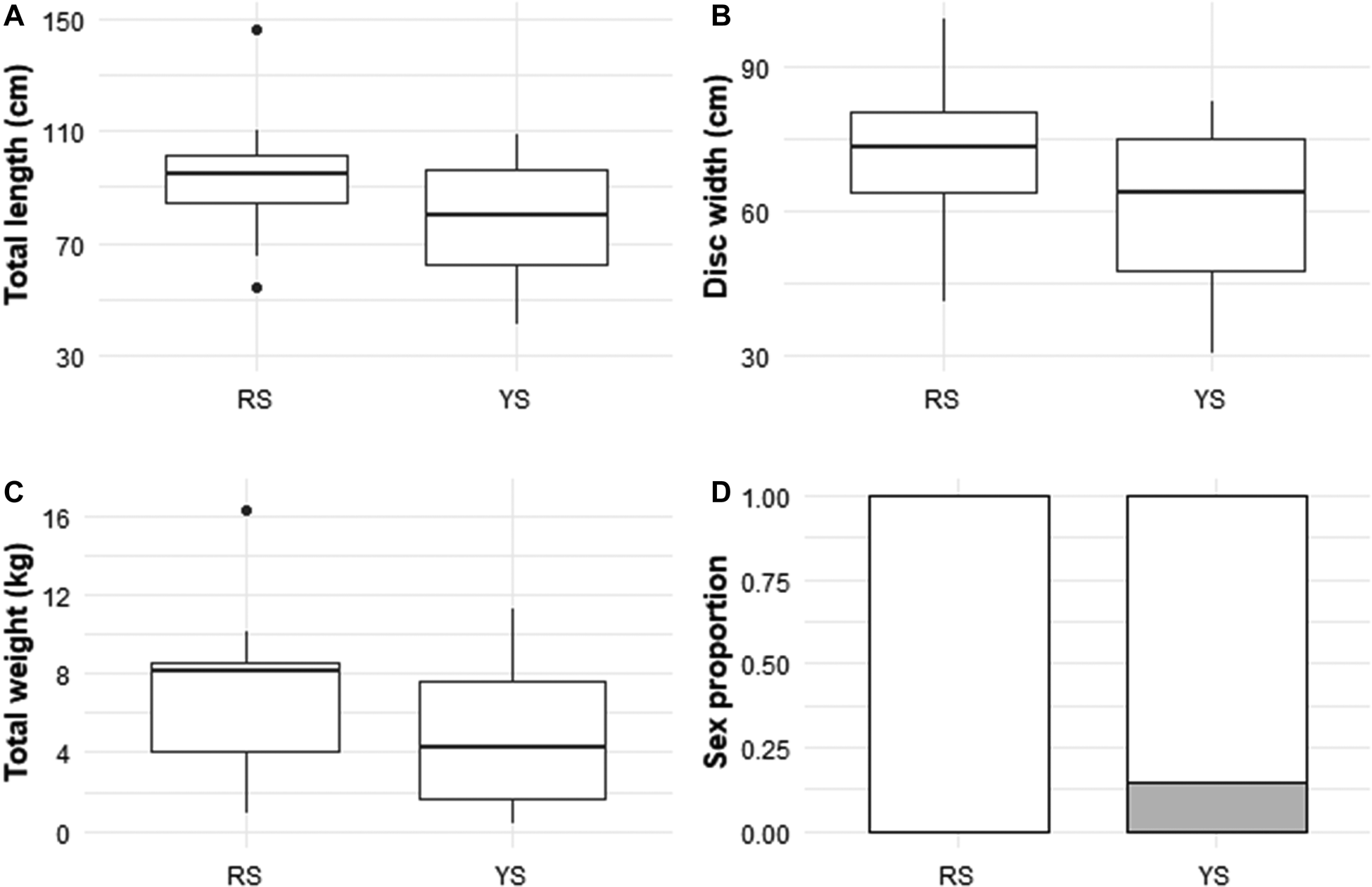
The roughskin skates were observed to be larger than the yellownose skates, as expected. The median total length was 95 cm for roughskin skates and 80 cm for yellownose skates, as illustrated in Figure 4A. In terms of disc width, roughskin skates had a median width of 73.5 cm, whereas yellownose skates had a median width of 64 cm (Figure 4B). In terms of total weight, the medians were 8.1 kg for roughskin skates and 4.3 kg for yellownose skates (Figure 4C).
Boxplots for total length (A), disc width (B), total weight (C), and sex ratio (D) of tagged skates. In (D), white and grey represent females and males, respectively. RS, roughskin skate; YS, yellownose skate.

Notably, 100% of the roughskin skates tagged were female, whereas 85.4% of the yellownose skates tagged were female. All the skates were in good condition in terms of mobility and showed no external injuries, thus meeting the basic requirements for being tagged and released.
Tagging effectiveness
Petersen discs
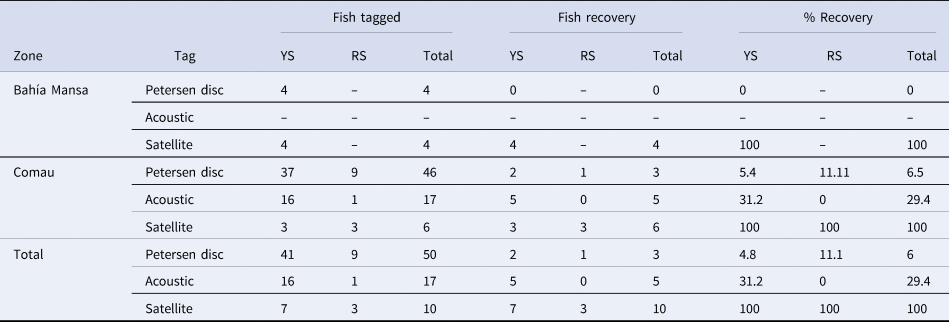
Between tagging and up to 275 days later, we received information on tagged fish. Among the 50 skates tagged with Petersen discs, only three were captured and reported during the study period. These captures involved two yellownose skates and one rough skin skate in Comau, resulting in a recovery effectiveness of 6.5% in that zone (Table 2). No recaptures were reported in Bahía Mansa, resulting in an overall effectiveness of 6% for the 50 tags used (Table 2).
Number of fish tagged and recovered per zone, type of tag, and species

YS, yellownose skate; RS, roughskin skate.
Acoustic transmitters
Out of the three installed acoustic receivers, two (R1 and R3) were successfully recovered, whereas one (R2) was lost. The receiver R1, retrieved after 60 days, yielded no detection records. Receiver R3, retrieved after 107 days, recorded the detections of five individuals, and all yellownose skates. The detection effectiveness associated with the 17 fish tagged with acoustic transmitters was 29.4% (Table 2).
Satellite transmitters
The satellite tags were programmed to be released 60 days after installation. Although two transmitters surfaced a few days earlier than scheduled, we managed to establish contacts via satellites and download data from all transmitters, achieving a 100% effectiveness rate (Table 2).
Distances and time elapsed after release
Petersen discs
In Comau, three female skates, all tagged exclusively with Petersen discs, were recaptured: one roughskin skate (146 cm TL, 13FT) and two yellownose skates (89.5 cm TL, 34FC and 104 cm TL, 11FC). The 13FT specimen was recaptured 48 days after tagging, 2.6 km west of the release point. The skate 34FC was recaptured 76 days postrelease, 8.1 km east of its release point, whereas the skate 11FC was recovered 275 days after release, within Comau Fjord, 9.3 km from the release point (Table 3; Figure 5).
Individuals of yellownose skate (YS) and roughskin skate (RS) tagged with Petersen discs that were recaptured in the Comau area

The dates of release and recapture are indicated, as well as the time at liberty (days) and the linear distance (km) between the point of release and the point of recapture. Sex: 1, male; 2, female.
Locations of release (in red) and recapture (in blue) of skates tagged with Petersen discs in Comau, including the numerical code for individual identification.

Acoustic transmitters
Five fish were detected between 8th September and 19th October 2021, by acoustic receiver R3 (Table 4). The distance between the tagging point and receiver R3 indicates that the linear displacement distance of these fish ranged from 5.9 to 18.7 km (Table 4). The first two (07FC and 08FC) were released east of the Comau Channel, whereas the last three (16MC, 18FC, and 22FC) were released to the west (Figure 6). All the detected individuals were yellownose skates: four females and one male.
Individuals of yellownose skate (YS) detected with acoustic transmitters in the Comau

The release and detection dates are provided, along with the elapsed time and linear distance between the release and detection points. Sex: 1, male; 2, female.
Location of capture (in red) of acoustic tagged skates and their numerical code. The locations of the acoustic receivers in the Comau are shown in blue. A 1200 m radius for range detection is indicated.

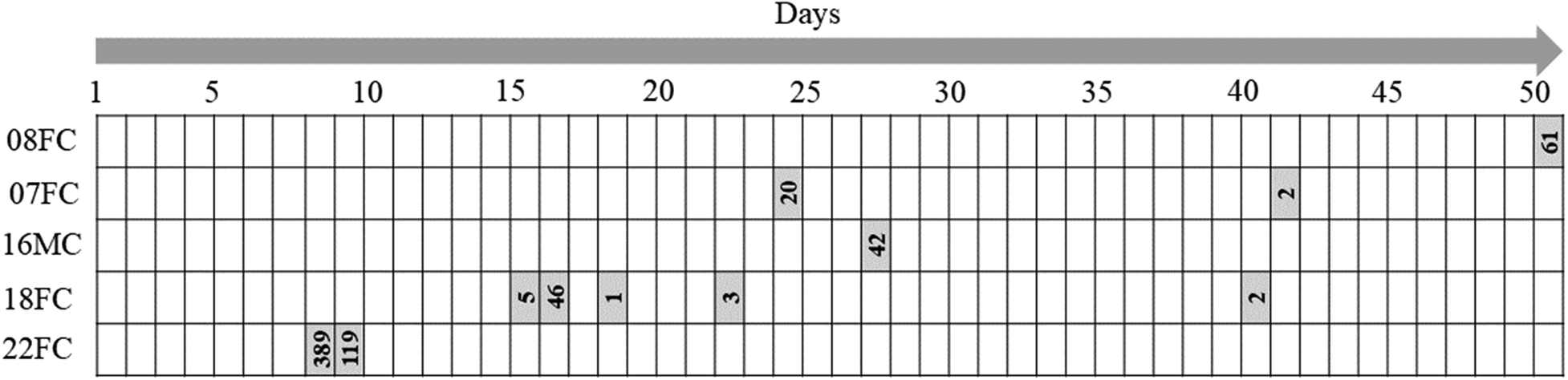
The first detected skate, tagged as 22FC, was recorded 8 days after its release at a linear distance of 5.93 km from the release point. It remained within the detection radius of the acoustic receiver for more than 30 h but was not recorded in that area again thereafter (Figure 7). The second detected skate, tagged as 18FC, was first detected 15 days after being released. This fish was within the detection radius of the acoustic receiver on several occasions over a period of 26 days and up to 41 days after release, suggesting that the location of R3 may represent a transit area (Figure 7).
Time elapsed (in days) between the release and detection of yellownose skate on the acoustic receiver R3. The number inside the boxes indicates the quantity of acoustic records obtained per day.

A similar pattern was observed in specimen 07FC, which was also detected multiple times at 24 and 42 days following its release, although only for brief intervals (Figure 7). Additionally, fish 16MC and 08FC were detected for only one day, at 27 and 51 days post-release, respectively.
Skates 11FC and 13FT, which were recaptured by artisanal fishermen on 16 November 2021 and 3 May 2022, respectively, within the Comau Channel were tagged with both Petersen discs and acoustic transmitters. Despite no contact being recorded with acoustic receivers in either case, it is plausible that these skates either remained in or visited the study area at some point during the research period.
Satellite transmitters
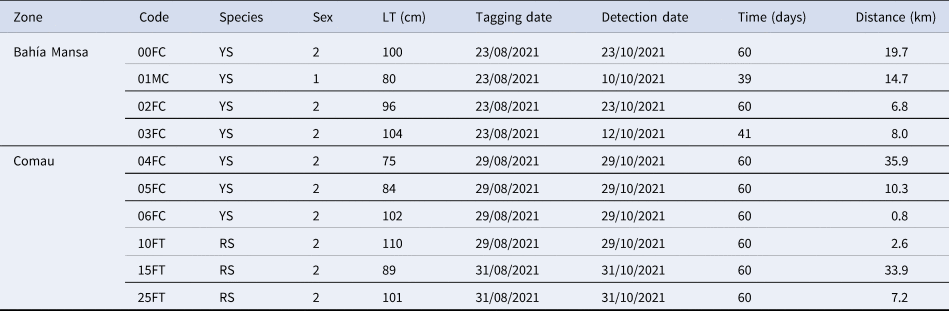
Out of the ten satellite transmitters deployed, eight surfaced at the scheduled release time (60 days), whereas two surfaced earlier. The data were obtained from fish 01MC and 03FC at 39 and 41 days, respectively, both of which were tagged in Bahía Mansa (Table 5).
Skates tagged and detected with satellite tags in Bahía Mansa and Comau

The tagging and detection dates are indicated.
YS, yellownose skate; RS, roughskin skate. Sex: 1, male; 2, female.
The distance at which the satellite transmitters on yellownose skates in Bahía Mansa surfaced varied between 6.8 and 19.7 km from the release point (Table 5; Figure 8A). The transmitters for fish 00FC and 01MC surfaced to the west of the release site at greater distances (19.7 and 14.7 km, respectively), whereas those for fish 02FC and 03FC surfaced at shorter distances (6.8 and 8 km, respectively) and towards the coast (Figure 8A).
Locations of release points (in red) and points of communication at the time of emergence (blue) of individuals with satellite transmitters, according to the identification code. The minimum horizontal movement between these points is represented in grey: (A) Bahía Mansa and (B) Comau.

In Comau, the distance at which the tags surfaced varied between 0.8 and 35.9 km in a straight line from the release point. The transmitters that surfaced farthest from the release point were 04FC and 15FT, corresponding to a yellownose skate and a roughskin skate, respectively (Table 5). These transmitters communicated at distances of 35.9 and 33.9 km from the release site, surfacing an area with increased exposure to currents, waves, and deeper waters towards the Gulf of Ancud (Table 5; Figure 8B).
The transmitter of the roughskin skate with code 25FT also surfaced in an area with increased exposure towards the Gulf of Ancud but at a distance of 7.2 km from the release point (Table 5; Figure 8B). On the other hand, the transmitter of the yellownose skate 05FC surfaced at 10.3 km but in the opposite direction and in a coastal area (Table 4; Figure 8B). The two fish with the shortest distance to the release point (<3 km) were 06FC and 10FT, corresponding to a yellownose skate and a roughskin skate, respectively (Table 5; Figure 8B).
Discussion
The pilot study demonstrated that the three methods used are viable for medium- and long-term conventional tagging programmes for yellownose skate and roughskin skate in Chile, yielding results similar to those reported in other related species. For Petersen discs, the recapture rate was 6%, which is comparable to results from other benthic rays, such as Raja binoculata and Amblyraja radiata, with recapture rates of 7 and 2%, respectively (King and McFarlane, Reference King and McFarlane2010; Kneebone et al., Reference Kneebone, Sulikowski, Knotek, McElroy, Gervelis, Curtis, Jurek and Mandelman2020). In contrast, higher recapture rates have been reported in other studies: 17% for three species of rays (Ellis et al., Reference Ellis, Morel, Burt and Bossy2011), 26% for Dipturus cf. intermedius (Neat et al., Reference Neat, Pinto, Burrett, Cowie, Travis, Thorburn, Gibb and Wright2014), and 29.7% for Raja clavata (Walker et al., Reference Walker, Howlett and Millner1997). The high recapture percentages in these study areas may be related to the number of individuals tagged, ranging from 280 to 3980, and the duration of the tagging programmes, which extended beyond 3 years.
The Petersen discs rely on recapturing individuals, providing insights into their movements while at liberty. Similar to other conventional (non-electronic) tags, their lower relative cost enables the description of movements, potentially based on much larger sample sizes compared to electronic tags (Bird et al., Reference Bird, Burt, Hampton, McCully and Ellis2020). However, these studies require ongoing fishing activity and fishers who are capable of detecting and reporting recaptures of tagged animals. Notably, the recapture results can be heavily influenced by the distribution of commercial fishing effort rather than the true extent of fish migration (Bolle et al., Reference Bolle, Hunter, Rijnsdorp, Pastoors, Metcalfe and Reynolds2005). In this context, the relatively lower recovery rate of conventional tags can be attributed to the specific nature of commercial fishing activities involving skates in Chile. Industrial fishing operations in central-southern Chile that target demersal crustaceans and teleost fishes are mandated to return any caught skate alive. Additionally, artisanal fishing operates in specific areas during restricted time periods when the closure bans are lifted. Because commercial fishing activities are both sporadic and region specific, relying on them for tag recovery introduces significant gaps in data collection, which in turn biases migration analyses. To accurately describe the movements of the yellownose skate and roughskin skate, researchers must implement a comprehensive tagging programme with effective monitoring. Given the depths at which these species inhabit, Petersen discs or satellite tags seem more suitable. However, monitoring the capture of tagged skates is challenging because of the specific characteristics of commercial fishing operations.
Acoustic telemetry is a powerful management tool for defining animal movement in specific regions. It provides valuable insights into the amount of time individuals spend in specific localities and is useful for research topics, including the spatial delimitation of marine protected areas (Lea et al., Reference Lea, Humphries, von Brandis, Clarke and Sims2016; Crossin et al., Reference Crossin, Heupel, Holbrook, Hussey, Lowerre-Barbieri, Nguyen, Raby and Cooke2017; Hays et al., Reference Hays, Bailey, Bograd, Don Bowen, Campagna, Carmichael, Casale, Chiaradia, Costa, Cuevas, Nico de Bruyn, Dias, Duarte, Dunn, Dutton, Esteban, Friedlaender, Goetz, Godley, Halpin, Hamann, Hammerschlag, Harcourt, Harrison, Hazen, Heupel, Hoyt, Humphries, Kot, Lea, Marsh, Maxwell, McMahon, Notarbartolo di Sciara, Palacios, Phillips, Righton, Schofield, Seminoff, Simpfendorfer, Sims, Takahashi, Tetley, Thums, Trathan, Villegas-Amtmann, Wells, Whiting, Wildermann and Sequeira2019). However, our findings revealed challenges with the placement and retrieval of acoustic receivers, which are crucial for inferring distribution patterns. The loss of one receiver and lack of data reception in another could be attributed to environmental factors such as strong currents or equipment malfunction. As a result, this limited the ability to draw definitive conclusions about potential migration routes. Nevertheless, the implementation of various programmes on other species, such as Dipturus maugeana, which exhibits short-distance movements in the estuaries of Tasmania (Australia) (Treloar et al., Reference Treloar, Neville, Barrett and Edgar2017), and Leucoraja ocellata, which demonstrates long-distance migrations detected via an acoustic network spanning over 300 km (Frisk et al., Reference Frisk, Shipley, Martinez, McKown, Zacharias and Dunton2019), has enabled the adoption of precautionary measures for the conservation and management of these species.
This study employed only three acoustic receivers. Among them, only one receiver detected five skates (5/17) within its coverage area, followed by a period of 56 days without any new detection towards the end of the deployment period. This suggests the need to incorporate a larger number of receivers to accurately describe movement and migration patterns. Previous studies have often utilized over 20 receivers (Collins et al., Reference Collins, Heupel and Motta2007; Ramsden et al., Reference Ramsden, Cotton and Curran2017; Frisk et al., Reference Frisk, Shipley, Martinez, McKown, Zacharias and Dunton2019), particularly in shallow coastal waters, with receiver overlap to increase detection rates. At a regional scale, ten acoustic receivers were successfully deployed in a narrow and shallow inlet in Argentinian Patagonia to assess the movement behaviour of the sevengill shark (Notorynchus cepedianus) (De Wysiecki et al., Reference De Wysiecki, Barnett, Cortés, Wiff, Merlo, Jaureguizar, Awruch, Trobbiani and Irigoyen2023). This suggests that the successful implementation of acoustic receivers is related to the number of receivers used, as well as the geographic and topographic characteristics of the study area. Specifically, deploying receivers in shallow and narrow areas seems to increase detection success.
In the waters of the Chiloé Inland Sea, the seabed characteristics, geographic complexity, and bathymetric distribution of the yellownose skate and roughskin skate, which inhabit depths of up to 500 m, demand receiver networks with extensive spatial coverage. Careful selection of installation sites along migration routes and the use of acoustic release mechanisms are essential because of the deep mooring of the receivers. Although this method is appropriate for detecting residency, it is associated with high costs for installation, maintenance, and recovery of the receiver network. According to the reviewed literature, the acoustic records obtained in this study represent the first of their kind in Chile.
The satellite transmitters proved highly effective, retrieving data from all tagged skates (10/10). Eight transmitters surfaced as scheduled, while two surfaced prematurely, likely due to the capture of both skates, as indicated by terrestrial location data and the fact that tagging occurred in a region with intensive artisanal fishing. Comparable studies using similar transmitters have reported slightly lower recovery rates: 75% in Alaska (6/8) for Beringraja binoculata (Farrugia et al., Reference Farrugia, Goldman, Tribuzio and SeitD2016), and 81.3% (61/75) for A. radiata in the Gulf of Maine (Knotek et al., Reference Knotek, Kneebone, Sulikowski, Curtis, Jurek and Mandelman2019).
One of the primary advantages of satellite tags is their ability to overcome biases associated with conventional tagging methods, which typically lack behavioural data during the period of freedom for the tagged fish (Siskey et al., Reference Siskey, Shipley and Frisk2018). However, for benthic rays that do not surface, positional data are only available at tagging and pop-up release points, limiting the information obtained. This constraint has led to the development of methods aimed at estimating more probable routes (Nielsen and Siebert, Reference Nielsen and Sibert2007). Furthermore, the use of electronic tags in relatively small fish presents challenges that complicate their application for determining migration patterns or movements.
Satellite tags enable data collection independent of fishing activities, which is a significant advantage for obtaining data on both skate species. This is particularly relevant given the characteristics of skate fishing in Chile, which is characterized by short legal fishing periods lasting only a few days each year, often in remote and logistically challenging areas.
The successful transmission of data from all the released satellite tags implies that all the tagged skates survived for at least 39 days. According to Queirolo et al. (Reference Queirolo, Apablaza, Ahumada and Wiff2022), 76% of surveyed artisanal fishers reported recapturing skates with some form of tag, often hooks, which suggests that both species tolerate external tagging procedures well. Notably, the use of detachable hooks as a tagging method has also been employed in other species (Horn, Reference Horn2003). Additionally, other investigations, such as that of Ellis et al. (Reference Ellis, Burt, Grilli, McCully, Catchpole and Maxwell2018), attributed mortality in tagged elasmobranchs to the capture event itself, whereas Hutchinson et al. (Reference Hutchinson, Itano, Muir and Holland2015) suggested that deaths that occurred within 10 days of release were more likely due to the fishing event rather than the tagging process. In general, tagging-induced mortality in elasmobranchs is expected to be very low, even with the use of invasive internal tags (e.g. De Wysiecki et al., Reference De Wysiecki, Barnett, Cortés, Wiff, Merlo, Jaureguizar, Awruch, Trobbiani and Irigoyen2023).
The horizontal movements of the tagged skates detected by any of the three employed methods showed considerable variability. For the yellownose skate in Bahía Mansa, movements ranged from 8 to 20 km, whereas in Comau, they varied between 0.8 and 36 km. The roughskin skates in Comau exhibited movements between 2.6 and 34 km. The longest period of freedom observed was for a yellownose skate, which was recaptured after 275 days, 9.3 km from its release point in Comau. Although this indicates reduced horizontal displacement for both species, the 60-day study duration prevents definitive confirmation of their residency status.
Skates and rays exhibit two distinct modes of locomotion via their pectoral fins: oscillatory and undulatory. Species with more flexible pectoral fins often use undulatory movements, which are typical in benthic batoids and may constrain their speed and mobility (Schaefer and Summers, Reference Schaefer and Summers2005; Hall et al., Reference Hall, Hundt, Swenson, Summers and Crow2018). Additionally, oviparous elasmobranchs, such as skates, tend to have more localized distributions than viviparous species do (Goodwin et al., Reference Goodwin, Dulvy and Reynolds2005). These factors likely contribute to the tendency of skates to inhabit restricted areas.
Nevertheless, evidence of residency in skates is scarce, with philopatry reported in only a few species within the Dipturus genus: Dipturus batis displaying site affinity (unclear whether individuals are continuously present in an area or have left and then returned) and D. cf. intermedius showing seasonal residency (individuals remain in an area for at least 90 days before moving elsewhere) (Flowers et al., Reference Flowers, Ajemian, Bassos-Hull, Feldheim, Hueter, Papastamatiou and Chapman2016). Recapturing tagged individuals near their tagging sites might mask seasonal migratory patterns, as observed in four skate species within the English Channel (Ellis et al., Reference Ellis, Morel, Burt and Bossy2011). Bird et al. (Reference Bird, Burt, Hampton, McCully and Ellis2020) conducted an extensive analysis of tagging and recapture data collected from 1959 to 2017 across 13 skate species. They reported that nine species (A. radiata, D. batis/D. intermedius, Leucoraja naevus, Raja brachyura, R. clavata, Raja microocellata, Raja montagui, Raja undulata, Dasyatis pastinaca) exhibited variable movements, ranging from a few metres to over 100 km, in individuals with more than 50 days of freedom postrelease. For D. cf. intermedius, a tagging programme conducted over 3 years, with seven repeated sampling periods, provided the evidence needed to establish a protected area of 720 km2, known as the Sound of Jura Marine Protected Area, on the west coast of Scotland. A capture–recapture model suggested a mixture of site-attached (resident) and vagrant (transient) individuals, with approximately 25% of those tagged falling into the transient category (Neat et al., Reference Neat, Pinto, Burrett, Cowie, Travis, Thorburn, Gibb and Wright2014; Benjamins et al., Reference Benjamins, Dodd, Thorburn, Milway, Campbell and Bailey2018).
Among the three tagging methods implemented, satellite tags seem the most appropriate, as they provide data independent of the fishery. Ideally, these tags should be used for longer periods. However, their higher cost and limitations when relatively small skates are used could be mitigated by combining them with traditional tagging methods. A similar approach to studying the behaviour of thorny skate (A. radiata) was conducted between 2002 and 2019 in the Gulf of Maine (USA) (Kneebone et al., Reference Kneebone, Sulikowski, Knotek, McElroy, Gervelis, Curtis, Jurek and Mandelman2020).
In Chile, the development of tagging programmes for economically important species, particularly demersal species, is not perceived as a priority. As Wiff et al. (Reference Wiff, Flores, Gacitúa, Donovan, Canales, Ahumada and Queirolo2023) indicated, tagging experiments for demersal species in Chile have been conducted only for Chilean hake (Merluccius gayi gayi) and Patagonian toothfish (Dissostichus eleginoides). The management authority in Chile has not prioritized investing resources in research in this area. As a result, tagging experiments for demersal species remain rare. This lack of prioritization is particularly concerning given that over the last 10 years, both species of skates in Chile have been declared depleted, leading to several closures and other administrative management actions that have impacted fishing operations (Wiff et al., Reference Wiff, Flores, Canales, Segura, Gelcich, Rodríguez, Gacitúa, Queirolo, Ahumada and Montero2021). The current exploitation status of skate populations in Chile, combined with the specific challenges of fishing operations, presents significant obstacles to collecting relevant data for stock assessment and evaluating the effectiveness of implemented management measures. This research contributes to the technical and methodological aspects of implementing a tagging programme for both skate species in Chile. Understanding population connectivity is essential for rationalizing management strategies and ensuring the conservation viability of these species. The use of tagging tools facilitates the generation of relevant information for these purposes.
Data
Data that support the findings of this study are available from the project FIPA 2019-13, upon reasonable request.
Acknowledgements
We thank the fishers from Bahía Mansa Harbor, Alejandro Llafquen and Hualaihué Harbor, Mario González, and the crew of artisanal boats ‘Llafdel’ and ‘Naviero’ for their crucial contribution during sample collections. We also express appreciation to the onboard scientific observer, Sergio Rojas, for his valuable fieldwork. And we are grateful to the editor and the anonymous reviewers for constructive review comments.
Author contributions
P. A.: field sampling onboard, data curation, analysis, and editing. D. Q.: funding acquisition and project administration. M. A.: analysis and writing – original draft. R. W.: review and editing. A. F.: review and editing. All authors have read and approved the published version of the manuscript.
Financial support
This study was funded by the Fisheries and Aquaculture Research Fund (FIPA) from the Undersecretariat of Fisheries and Aquaculture (SUBPESCA) under project code FIPA 2019-13. R. Wiff was partially funded by ANID-Programa Iniciativa Científica Milenio under the codes ICN2019-015 and ANID PIA/BASAL FB0002.
Competing interests
None.