Introduction
Psychosocial oncologists consist mainly of social workers, psychologists, nurses, and psychiatrists. These professionals provide support for patients and families across the cancer care continuum (Cohen, Reference Cohen, Surbone, Zwitter, Rajer and Stiefel2013). Their work is characterized by ongoing exposure to intensive emotional situations (Grassi et al., Reference Grassi, Fujisawa and Odyio2016); therefore, research suggests that psychosocial oncologists may be particularly vulnerable to burnout (Breen et al., Reference Breen, O'Conner and Hewitt2014).
Professional burnout is defined as a psychological syndrome experienced in response to chronic on-the-job stressors (Maslach et al., Reference Maslach, Schaufeli and Leiter2001). Maslach and Jackson (Reference Maslach and Jackson1986) developed a burnout model that is frequently used in the area of mental health that was found applicable for a wide range of professions (Girgis, Hansen, & Goldstein, Reference Girgis, Hansen and Goldstein2009; Shinan-Altman & Cohen, Reference Shinan-Altman and Cohen2009), including psychosocial oncologists (Turnell et al., Reference Turnell, Rasmussen and Butow2016). In this model, burnout has three central components: emotional exhaustion (EE) refers to feelings of being emotionally exhausted by one's work; depersonalization (DP) refers to impersonal responses and lack of feelings toward clients; and (reduced) personal accomplishment (PA) (Demerouti et al., Reference Demerouti, Bakker and Nachreiner2001). However, empirical research has suggested that PA is an independent construct, showing weak relationships with EE and DP; thus, PA was excluded from later definitions (Bakker et al., Reference Bakker, Demerouti and Verbeke2004; Turnell et al., Reference Turnell, Rasmussen and Butow2016). In oncology settings, 20.2% and 6.6% of 417 worldwide psychosocial oncologists reported high levels of EE and DP, respectively. Research suggests that burnout has a substantial negative impact on the well-being of oncology professionals as well as their patients and the organization (Jasperse et al., Reference Jasperse, Herst and Dungey2014).
In Israel, most psychosocial oncologists are female and predominantly work in hospital settings (all public), in which they are also involved in providing crisis interventions to patients and families facing accidents or terror attacks. This adds to the burden that they experience working within oncology departments and clinics (Gagin et al., Reference Gagin, Unger-Arnov and Shinan-Altman2011). This unique combination of job stressors may have a cumulative effect for Israeli psychosocial oncologists who are at risk to experience burnout.
Several theoretical models have been used to explain the development of professional burnout and identify important moderators (Cordes & Dougherty, Reference Cordes and Dougherty1993; Siegrist, Reference Siegrist1996). A dominant theoretical approach is the Job Demands-Resources (JD-R) model (Demerouti et al., Reference Demerouti, Bakker and Nachreiner2001), which consists of two core components: job demands and job resources. Job demands are psychological, social, or organizational aspects of the job that require sustained efforts that are associated with physiological or psychological costs. Job resources are psychological, social, or organizational aspects of the job that reduce demands and facilitate achievement of work goals. Studies showed that high demands, such as work–family conflict, mental and emotional demands, and role overload together with low job resources, such as low coworker support or lack of space for decision-making, predict burnout (eg, Schaufeli et al., Reference Schaufeli, Bakker and Van Rhenen2009).
A major resource for workers engaged in highly demanding jobs is high perceived value of their roles. It was suggested that workers who feel that their role is valued by others facilitate greater personal investments in the pursuit of organizational goals (May et al., Reference May, Gilson and Harter2004). Perceived value differs from task significance, which mainly refers to the degree to which the job has a substantial impact on the lives or work of other people (Hackman & Oldham, Reference Hackman and Oldham1976). Nevertheless, although perceived value may be an important resource for professionals working in highly emotionally demanding jobs, to the best of our knowledge, no study to date has previously examined perceived value in relation to burnout. Furthermore, perceived value was not included in the JD-R model, nor in other theoretical models used to explain professional burnout (Cordes & Dougherty, Reference Cordes and Dougherty1993; Siegrist, Reference Siegrist1996). Therefore, to fill these theoretical gaps in the literature and to examine the unique relationship between perceived value and burnout, in the current study, we examined perceived value separately from the other job resources.
Coping models are prevalent to examining the psychological outcomes of chronic stressors, including work stressors, because they enable researchers to study the mechanisms by which environmental demands and resources affect psychological outcomes, such as burnout (Ben-Zur & Michael, Reference Ben-Zur and Michael2007). According to the coping models (Folkman & Lazarus, Reference Lazarus and Folkman1984), coping strategies were found to mediate the associations between environmental demands and resources and between psychological and physical outcomes (Ben-Zur, Reference Ben-Zur2009; Cohen et al., Reference Cohen, Katz and Baruch2007). Coping strategies are considered effective if they reduce emotional distress and promote well-being (Folkman & Lazarus, Reference Lazarus and Folkman1984), whereas studies suggested various measures for these outcomes, including burnout (Shinan-Altman et al., Reference Shinan-Altman, Werner and Cohen2016).
Although most previous studies on coping used broad coping dimensions (ie, problem-focused and emotion-focused coping) that are general and applicable to various stressful encounters, recently researchers in the field of coping have stressed the importance of measuring coping in relation to specific contexts and environments (Carver & Connor-Smith, Reference Carver and Connor-Smith2010; Folkman & Moskovitch, Reference Folkman and Moskowitz2004). Moreover, Folkman and Moskovitch (Reference Folkman and Moskowitz2004) recommended studying various new coping strategies relevant to stressful encounters, such as meaning-focused coping. Therefore, in the current study, we chose to examine two work-specific coping strategies: work engagement and overcommitment because they meet the following definition of coping as “constantly changing cognitive and behavioral efforts to manage specific external and internal demands that are appraised as taxing or exceeding the resources of the person” (Lazarus & Folkman, Reference Lazarus and Folkman1984, p 141). In addition, these two strategies also tap into the widely accepted categorization of coping into engagement coping, which is aimed at dealing with the stressor and disengagement or avoidance coping, aimed at escaping the threat (eg, Carver & Connor-Smith, Reference Carver and Connor-Smith2010; Skinner et al., Reference Skinner, Edge and Altman2003).
Work engagement is defined as a positive work-related behavior, characterized by vigor, dedication, and absorption (Schaufeli & Salanova, Reference Schaufeli, Salanova, Gilliland, Steiner and Skarlicki2007). High levels of work engagement are associated with positive physical and mental health, productivity, and creativity (Schaufeli & Bakker, Reference Schaufeli and Bakker2004). Work engagement is an important burnout buffer (Maslach & Leiter, Reference Maslach and Leiter1997).
Overcommitment is defined as a set of attitudes, behaviors, and emotions that reflect excessive work effort (Siegrist, Reference Siegrist and Dunham2001). Overcommitment has been conceptualized as a set of often maladaptive coping strategies (Siegrist et al., Reference Siegrist, Starke and Chandola2004). It was found to be related to higher levels of burnout among professionals. In accordance with coping theories that conceptualize coping as behaviors in response to situational demands (Lazarus & Folkman, Reference Lazarus and Folkman1984), it may be assumed that high job demands trigger overcommitted working patterns, causing some workers to exaggerate their efforts beyond what is formally needed (Demerouti et al., Reference Demerouti, Bakker and Nachreiner2001).
Only a handful of studies have examined work engagement among oncology professionals. For example, a study conducted among 579 Australian oncology professionals (e.g., medical and radiation staff) found that 35% of the workers were highly engaged in their work (Poulsen et al., Reference Poulsen, Poulsen and Khan2011). In comparison, in a recent international study, over 95% of psychosocial oncologists reported average-high levels of work engagement (Turnell et al., Reference Turnell, Rasmussen and Butow2016).
Work engagement could be an effective coping strategy (in terms of adaptive outcomes), which is likely to be used when workers experience a high level of resources or when their work is perceived as being valued and appreciated. On the other hand, workers who experience their job as overdemanding and taxing and who feel they do not have sufficient resources to balance these demands will be engaged in less effective coping by employing overcommitment attitudes and behaviors. Overall, work engagement represents positive coping strategy, whereas overcommitment represents negative coping strategy.
Turnell et al. (Reference Turnell, Rasmussen and Butow2016) asserted that the theoretical basis of studies in the area of burnout among psychosocial oncologists needs to be strengthened. Nevertheless, only one study has explored the predictors of professional burnout (EE and DP (among psychosocial oncologists through the application of the JD-R model (Rasmussen et al., Reference Rasmussen, Turnell and Butow2016). In addition, the JD-R, which focuses on demands and resources as predictors of burnout, does not take coping strategies into account; however, these are essential components in the study of the effects of environmental demands and resources on psychological outcomes (Ben-Zur & Michael, Reference Ben-Zur and Michael2007). Therefore, the current study suggests an extended model to assess psychosocial oncologists’ burnout levels. This model integrates two coping strategies—work engagement and overcommitment—into the JD-R model. Examining work engagement and overcommitment is of importance because both have been found to predict job performance and well-being outcomes among different employee groups, although this is understudied among psychosocial oncologists (Hakanen & Schaufeli, Reference Hakanen and Schaufeli2012). In addition, perceived value has been added to the model because of its central role as a source for workers (May et al., Reference May, Gilson and Harter2004) and to extend the JD-R model.
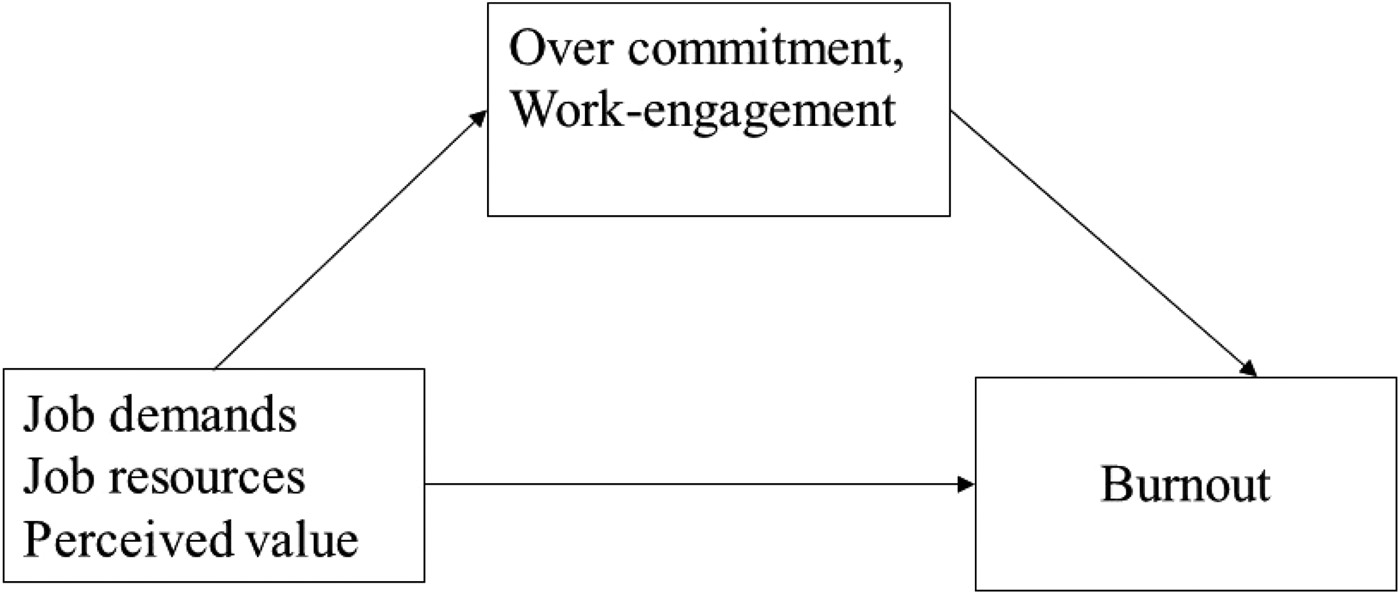
Based on the integration of the JD-R model and the coping model, the aim of the present study was to assess levels of burnout among Israeli psychosocial oncologists and their relations with the contextual variables of job demands, job resources, and perceived value. Work engagement and overcommitment were examined as mediators between work demands, work resources, perceived value, and burnout. The two main hypotheses of the study were that the higher the levels of job resources, perceived value, and work engagement, and the lower levels of job demands and overcommitment reported by the psychosocial oncologists, the lower their burnout. The second hypothesis was that work engagement and overcommitment will mediate the relationship of job demands, job resources, and perceived value with burnout (Figure 1).
Multiple mediator model for direct and indirect effects of job demands, job resources, and perceived value on burnout

Method
Participants and procedures
Participants were 85 psychosocial oncologists of all 128 psychosocial oncologists listed in the Israeli Psycho-Oncology Association (IPOA) to whom the questionnaires were distributed. The total response rate was 71%; however, about 10% of the respondents were not involved in direct practice (eg, researchers, managers) or were not being qualified to practice independently (eg, students) and were therefore excluded. This left in the sample only direct psychosocial oncology workers in Israel; social workers, psychologists, and nurses who perceive themselves as psycho-oncologists (eg, nurses who lead support groups [naturally a proportionally smaller group]). Thus, the sample consists of the majority of the population of psycho-oncologists in Israel. Participants returned the questionnaires either via e-mail (n = 80) or in hard-copy format (n = 11). Of the 91 questionnaires that were filled out, six were excluded because of missing data, leaving a total of 85 questionnaires.
Although the sample size is small, it is composed of 71% of the total population of psychosocial oncologists in Israel and mirrors the distribution by the gender and profession of the actual population of Israeli psycho-oncologists (IPOA, unpublished data).
No differences were found among social workers, psychologists, and nurses with regard to either demographic variables or study variables (burnout levels, job demands, job resources, overcommitment, perceived value, and work engagement). In addition, no differences in the participants’ background characteristics were found between the two modes of filling out the questionnaires.
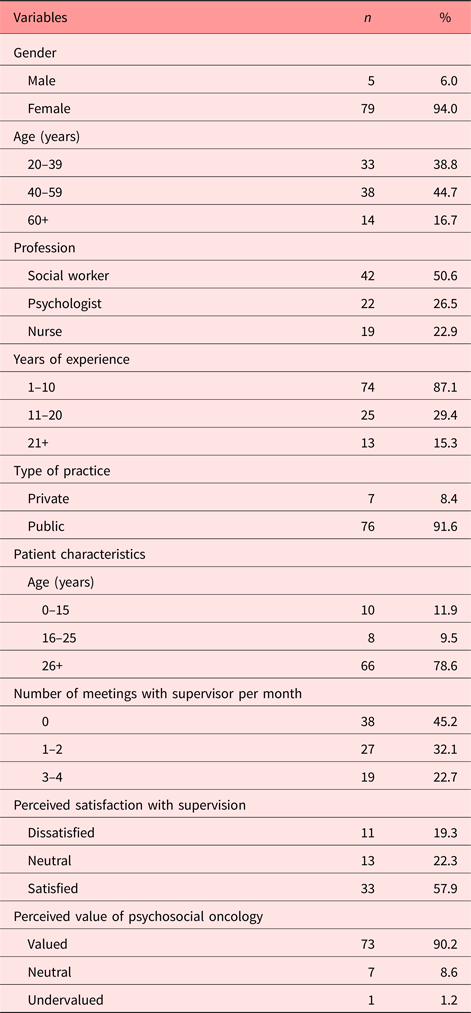
The sample's demographic and work characteristics are presented in Table 1. Participants were predominately female, and about 30% of the sample was aged 30–39 years. Social workers were the most represented profession, followed by both psychologists and nurses. Most participants practiced in a public setting and, more commonly, worked with adult patient populations. About one-third of the sample had 1–5 years of experience in oncology settings. On average, psychosocial oncologists worked about 29 hours per week; more than half of this weekly workload entailed direct patient contact. Sample characteristics, such as distribution by profession, gender, practice type, and years of experience, are consistent with the characteristics of psycho-oncologists in Israel, as reflected by the data of the IPOA (unpublished data), and are also similar to those of psychosocial-oncologists worldwide (Wiener et al., Reference Wiener, Oppenheim and Breyer2012).
Demographic and work characteristics of psychosocial oncologists (n = 85)

Measures
Burnout was assessed using the Maslach Burnout Inventory Human Services Survey (MBI-HSS) (Maslach et al., Reference Maslach, Schaufeli and Leiter2001). Responses were made on a 7-point scale (0 = never, 6 = everyday). The EE subscale consisted of nine items (eg, “I am emotionally exhausted by my work”) and the DP subscale consisted of five items (eg, “I feel I treat some of the residents as if they were objects”). A high score in each subscale indicated high levels of burnout. Scores ranged from 0 to 84. Cutoffs for high EE (>21) and DP (>8) are provided in the MBI-HSS manual (Karasek, Reference Karasek1985) and in other previous studies (Boccio et al., Reference Boccio, Weisz and Lefkowitz2016; Turnell et al., Reference Turnell, Rasmussen and Butow2016). Because of the high correlation between the subscales (r = 0.73), a total score for burnout was used, similar to previous studies (eg, Shinan-Altman & Cohen, Reference Shinan-Altman and Cohen2009). The internal consistency (α) was 0.92.
For job demands, a questionnaire comprising work–family conflict, mental demands, and emotional demands was used based on the conceptualization of job demands (Bollen & Bauldry, Reference Bollen and Bauldry2011). Because of high correlation coefficients between work–family conflict and mental demands (r = 0.39; p < 0.01), work–family conflict and emotional demands (r = 0.53; p < 0.001), and mental demands and emotional demands (r = 0.36; p < 0.01), a mean score was calculated from the standardized scores of the subscales. The internal consistency (α) was 0.72.
Work–family conflict participants were asked to indicate their degree of agreement on a 5-point scale (1 = strongly disagree, 5 = strongly agree) with eight statements concerning respondents’ beliefs of an inter-role conflict, whereby the strain created by the job interferes with performing family-related responsibilities and vice versa (eg, “My job makes it difficult to be the kind of spouse or parent I'd like to be”) (Houkes et al., Reference Houkes, Winants and Twellaar2008). Mean scores were calculated, with higher scores indicating higher levels of work–family conflict. The internal consistency (α) was 0.83.
Mental demands were measured using the Psychological Demands subscale of the Job Content Questionnaire (Karasek, Reference Karasek1985). Participants were asked to indicate their degree of agreement on a 4-point scale (1 = strongly disagree, 4 = strongly agree) with nine statements concerning demanding aspects of workload (eg, “My job requires working very fast”). Sum scores were calculated, and ranged from 9 to 36, with higher scores indicating higher levels of mental demands. The internal consistency (α) was 0.74.
Emotional demands were assessed by six items used in related oncology settings (de Jonge et al., Reference de Jonge, Le Blanc and Peeters2008). Items assessed the extent to which respondents are confronted with demands such as death, suffering, and expectations of patients and families (eg, “Feeling disturbed by emotional distress”). Scores ranged from 0 (never) to 6 (a few times a week). Mean scores were calculated, with higher scores indicating higher levels of emotional demands. The internal consistency (α) was 0.83.
Job resources comprised two different variables: coworker support and decision authority, based on the conceptualization of resources as was previously reported (Bollen & Bauldry, Reference Bollen and Bauldry2011). Because of high correlation coefficients (r = 0.40; p < 0.01), a mean score was calculated from the standardized scores of the subscales. The internal consistency (α) was 0.60.
Coworker support was assessed using the eight-item Co-Worker Support subscale of the Job Content Questionnaire (Karasek, Reference Karasek1985). Items assessed participants’ perceptions of both instrumental and socioemotional forms of support from colleagues (eg, “People I work with are friendly”). Participants were asked to indicate their degree of agreement on a 4-point scale (1 = strongly disagree, 4 = strongly agree); sum scores were calculated and ranged from 8 to 32, with higher scores indicating a higher level of coworker support. The internal consistency (α) was 0.84.
Decision authority was assessed using the 3-item Decision Authority subscale of the Job Content Questionnaire (Karasek, Reference Karasek1985). Participants were asked to indicate their degree of agreement on a 4-point scale (1 = strongly disagree, 4 = strongly agree) regarding their perceived autonomy to make decisions at work (eg, “I have a lot of say about what happens in my job”). Sum scores were calculated and ranged from 3 to 12, with higher scores indicating higher levels of decision authority. The internal consistency (α) was 0.77.
Overcommitment was measured by the six-item overcommitment subscale of the Short Version ERI Questionnaire (Siegrist & Montano, Reference Siegrist and Montano2013). Participants were asked to rate their agreement with each item on a 4-point scale from 1 = strongly disagree to 4 = strongly agree (eg, “People close to me say that I sacrifice too much for my job”). Mean scores were calculated, with higher scores indicating higher levels of overcommitment. The internal consistency (α) was 0.80.
Perceived value of work was assessed using one item: “Overall, how valued is the psycho-oncology role within your center?”, scored, 1 = highly undervalued, 5 = highly valued.
Work engagement was assessed using the nine-item Utrecht Work Engagement Scale (Schaufeli & Bakker, Reference Schaufeli and Bakker2004). Responses were made on a 7-point scale (1 = never, 7 = everyday) (eg, “My job inspires me”). Mean scores were calculated, with higher scores indicating a higher level of work engagement. The internal consistency (α) was 0.95.
Personal and work-related characteristics included age, gender, profession, years of experience, work setting, patient characteristics variables, number of hours worked per week and hours per week worked in direct patient contact, number of hours of supervision received per month, perceived satisfaction with supervision, and number of psychosocial oncologists in the multidisciplinary team.
Statistical analyses
All data were coded and analyzed using SPSS-20. The statistical analyses included descriptive statistics (eg, means, standard deviations, ranges, percentages). Because of different ranges of the subscales of job demands and job resources, these subscales were transformed to z-scores. Pearson correlations were used to assess the associations between study variables. Multiple mediation analysis was conducted using the model proposed by Hayes (Reference Hayes2013). For the analyses, we have used a macro developed for the SPSS software by Hayes (Reference Hayes2012), with 5,000 resamples.
Results
According to the MBI-HSS clinical cutoff scores for mental health occupations, 16.3% of the sample reported high levels of EE and 2.4% reported high levels of DP. The mean levels of EE and DP were 13.89 (standard deviation [SD] = 9.97) and 4.9 (SD = 4.19) respectively, which, contrary to expectations, were significantly lower than mental health occupations' normative scores for EE (M = 16.89, SD = 8.90) and DP (M = 5.72, SD = 4.62) in the MBI-HSS (Maslach & Jackson, Reference Maslach and Jackson1986).
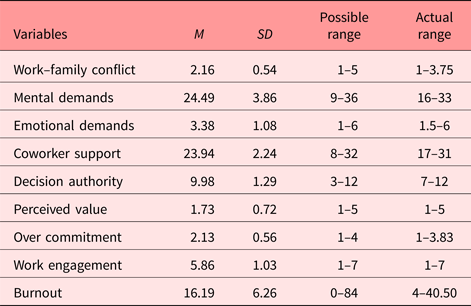
Table 2 summarizes the means, SDs, and ranges of the study's variables. It should be noted that the means, SDs, and ranges for job demands and job resources are not presented in this table because they were calculated from the standardized scores of the subscales. According to Table 2, the mean score of the two subscales of job demands, mental demands and emotional demands were relatively high, whereas the mean of the third subscale, job demands, work–family conflict, was relatively low. Mean scores of job resources subscales (namely, coworker support and decision authority) were relatively high. In addition, mean score of work engagement was also relatively high and the mean scores of overcommitment and perceived value were relatively low.
Means, SDs, and study's variables

The associations among the study's variables show that burnout was significantly and positively associated with job demands (r = 0 .69, p < 0.001), and overcommitment (r = 0.34, p < 0.01), and negatively associated with work engagement (r = −0.44, p < 0.01), and perceived value (r = −0.31, p < 0.01). Namely, the higher the job demands and overcommitment, and the lower the work engagement and perceived value, the higher the burnout. The correlations between burnout and job resources were not statistically significant.
In addition, the job demands variable was significantly and positively associated with overcommitment (r = .53, p < 0.001), but not with work engagement (p > 0.05). The job resources variable was significantly and positively associated with work engagement (r = 0.26, p < .05), whereas the association with overcommitment was not statistically significant (p > .05). Namely, the higher the job demands, the higher the overcommitment and the higher the job resources, the higher the work engagement. Finally, perceived value was significantly and positively associated with work engagement (r = 0.40, p < 0.01), but no association was found between perceived value and work overcommitment.
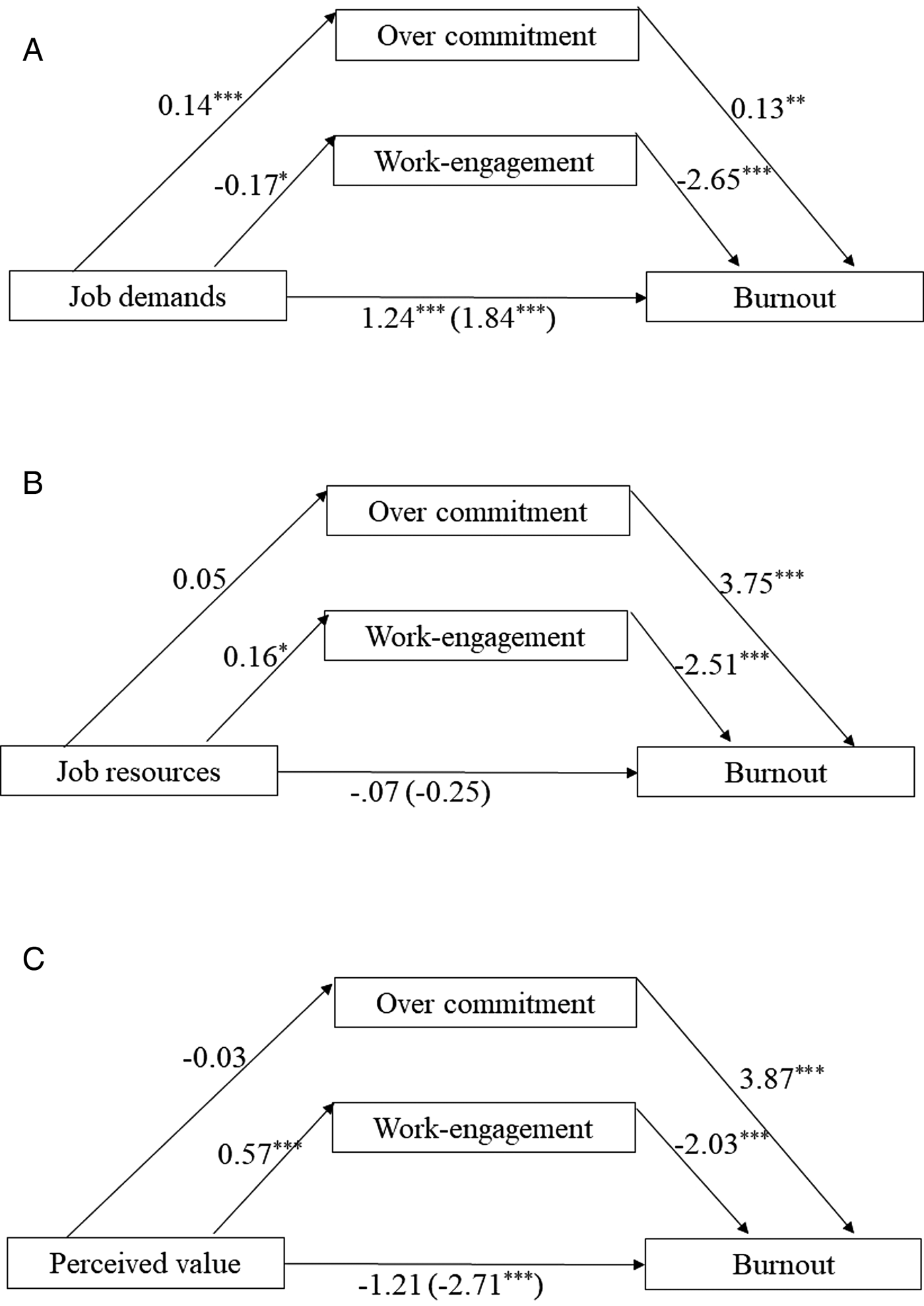
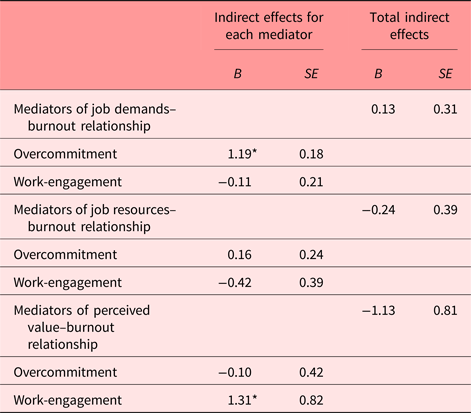
In the next step, multiple mediation analyses were conducted to assess the meditative role of the two coping strategies of work overcommitment and work engagement on the associations between the contextual variables (job demands, job resources, and perceived value) on burnout. Among the background variables, only age was significantly associated with burnout and therefore served as a covariate in the mediation analyses. Figure 2 displays the moderating effect of the two coping strategies, overcommitment and work engagement on the association between the contextual variables and burnout, controlling for age. Job demands was directly associated with burnout (Figure 2A). In addition, a partial mediation effect was statistically significant for overcommitment only (Table 3), suggesting that higher job demands are related to higher use of overcommitment as a coping strategy, which affects the level of burnout. Job resources were not directly related to burnout. In addition, although job resources were significantly associated with work engagement, and work engagement and overcommitment were related to burnout (Figure 2B), no mediation effect was found (Table 3). Finally, perceived value was directly associated with burnout (controlling for the effect of the mediators), whereas work engagement mediated this association (Figure 2C, Table 3), rendering the direct association to be statistically nonsignificant. This mediating effect suggests that although higher perceived value is related to lower burnout, higher perceived value is associated with higher use of the work engagement strategy, which is related to lower burnout.
Multiple mediator model depicting direct and indirect effects of job demands, job resources, and perceived value on burnout

Analyses of mediating effects of work-engagement and work overload on the associations of perceived value, job demands and job resources on burnout

*The mediation effect was found significant at alpha level of 0.05 (the 95% CI did not include zero).
Discussion
Overall, we found that average burnout levels were low, but a considerable number of participants experienced high levels of burnout. Two distinct patterns of associations were found between work characteristics and burnout: the positive-protective pattern (the relationship linking perceived value and work engagement with lower burnout levels) and the negative pattern (the relationship linking job demands and overcommitment with higher burnout levels).
In line with a previous study which found low EE (20.2%) and DP (6.6%) among psychosocial oncologists from 41 countries (Turnell et al., Reference Turnell, Rasmussen and Butow2016), in the current study, 16.3% and 2.4% experienced EE and DP, respectively. However, the low levels of burnout found in the current study are in contrast to a study conducted among oncology staff, which discovered relatively high burnout rates for EE (30.2%), but not for DP (8.2%), whereas doctors and nurses showed significantly higher EE mean scores than other staff members (Guveli et al., Reference Guveli, Anuk and Oflaz2015). Another study conducted in Israel among nursing aides in nursing homes found similar results with relatively high mean burnout scores for the dimensions of EE and DP, whereas more than three-quarters of the participants worked full time (Shinan-Altman & Cohen, Reference Shinan-Altman and Cohen2009). According to these findings, it can be assumed that overall psychosocial oncologists experience relatively lower levels of burnout than other cancer workers (who are not psychosocial oncologists). However, in the current study, participants reported working less than the average hours of workers in Israel (29 hours per week compared with 40 hours per week, respectively) (Organization for Economic Co-operation and Development, 2017). Therefore, it is possible that Israeli psychosocial oncologists have more time to recover and relax at the end of their demanding work day. Indeed, research has shown that working part-time can be a very effective way to prevent compassion fatigue (Mathieu, Reference Mathieu2007).
Scholars suggested that low levels of burnout are experienced when work demands equal or exceed work resources (Bakker & Demerouti, Reference Bakker and Demerouti2007). In the current study, even though participants reported relatively high levels of job demands (in most of the subscales) and relatively high levels of job resources, most of them still experienced low burnout levels. In line with the results of previous cross-sectional and prospective analyses (Niedhammer et al., Reference Niedhammer, Tek and Starke2004), we explored the separate effects of job demands and job resources to better understand the different influence of each construct on burnout. Consistent with the JD-R model, which suggests that job demands produce severe negative effects on well-being (Demerouti et al., Reference Demerouti, Bakker and Nachreiner2001), we found that the job demands variable was positively associated with burnout. This finding supports a previous study conducted among 417 psychosocial oncologists, which found that higher demands (conceptualized as efforts) were significantly associated with greater EE, but not with DP (Rasmussen et al., Reference Rasmussen, Turnell and Butow2016).
In contrast to the outline of the JD-R model (Demerouti et al., Reference Demerouti, Bakker and Nachreiner2001), job resources and burnout were not directly associated. This finding is also in contrast to a previous study conducted among psychosocial oncologists, showing that job resources (conceptualized as rewards) was a stronger predictor of burnout than effort (Rasmussen et al., Reference Rasmussen, Turnell and Butow2016). Although the most frequently studied resources that may act as buffers to burnout are coworker support and decision authority, which compose the job resources variable (Bollen & Bauldry, Reference Bollen and Bauldry2011), it is possible that psychosocial oncologists cope with emotionally charged situations by using other resources, as was previously suggested (Bakker & Demerouti, Reference Bakker and Demerouti2007). For example, perceived value, which is considered an important rewarding aspect of work (May et al., Reference May, Gilson and Harter2004), was found in the present study to be related to lower burnout. It might be that the perception of being valued by others “protected” the psychosocial oncologists from experiencing potential high levels of burnout. Therefore, future research should evaluate the longitudinal effects of perceived value as a main resource among psychosocial oncologists, which serves to reduce or even prevent burnout.
In the current study, the psychosocial oncologists reported overall low levels of overcommitment; nevertheless, these levels predicted burnout. As anticipated, overcommitment was also found to partially mediate the association of job demands with burnout, but not of job resources. It may be that serious job demands generate overcommitment behaviors to cope with the related overwhelming demands. In contrast, positive resources at work (eg, perceived value) are not related to lower overcommitment behaviors as a strategy to deal with work stressors.
Perceived value was directly associated with burnout, whereas work engagement mediated this association, rendering the direct association to be statistically nonsignificant. This mediating effect suggests that although higher perceived value is related to lower burnout, higher perceived value is associated with higher use of the work engagement strategy, which is related to lower burnout. Therefore, if psychosocial oncologists know that their work is highly appreciated, they are more likely to be mentally and emotionally engaged in their work. This engagement serves as a protective factor against burnout, but it may be possible only when resources such as perceived value exist.
According to coping theories (Lazarus & Folkman, Reference Lazarus and Folkman1984), work engagement could be an important coping strategy to sustain and increase personal well-being at work. This mediating effect is of importance, suggesting that the positive aspects at work, such as perceived value and work engagement, which are modifiable in their essence, are critical factors that must be addressed to reduce burnout among psychosocial oncologists.
Overall, the present study shows that the JD-R model (Demerouti et al., Reference Demerouti, Bakker and Nachreiner2001), and especially the job demands component, can be implemented to study burnout among the multiprofessional group of psychosocial oncologists. Relying on the coping model (Lazarus & Folkman, Reference Lazarus and Folkman1984), the present study expands the theoretical framework by demonstrating that these associations are mediated by the coping strategies of work engagement and overcommitment. Furthermore, these findings have several practical implications. In contrast to previous research suggestions to reduce negative factors that contribute to burnout (Shinan-Altman & Cohen, Reference Shinan-Altman and Cohen2009), the current study stresses the need to strengthen positive factors, such as perceived value and work engagement, in an attempt to reduce burnout. In addition, previous studies (eg, Guveli et al., Reference Guveli, Anuk and Oflaz2015) did not highlight the significance of perceived value as a protective factor against burnout. Thus, intervention programs with psychosocial oncologists to increase their self-perception of the value of their work should be considered. In addition, efforts should be invested to increase the value of the psychosocial oncologists’ role among other professionals in psychosocial oncologists’ work setting (eg., doctors, nurses). This can be done through discussions on the uniqueness and contribution of each of the professions to the team's work, and to patients' well-being. Psycho-oncologists should make an effort to increase the visibility of their interventions with cancer patients and their families. This will serve to increase the value of their work within the oncology setting and will further enhance their self-perceived value. The other main results—that work engagement mediated the association of perceived value with burnout—whereas overcommitment partially mediated the association between job demands and burnout—also have important implications. They suggest that an especially modifiable factor relates to coping strategies, such as increasing work engagement and reducing overcommitment. It was argued that interventions are efficient in modifying various coping strategies used at work. This is especially important for psychosocial oncologists, who may be particularly susceptible to burnout because of the emotional demands of their work (Poulsen et al., Reference Poulsen, Poulsen and Khan2011). Nevertheless, the present results stress the need to focus on the coping strategies that serve as mediators between work characteristics and burnout.
The present study has several limitations. First, the moderate, unbalanced sample and the cross-sectional study design limit the generalizability of the results to other groups of psychosocial oncologists worldwide. However, the sample consists of the majority of the population of psycho-oncologists in Israel and its characteristics are similar to those of psycho-oncologists in 40 other countries (Rasmussen et al., Reference Rasmussen, Turnell and Butow2016). In addition, the distribution by profession in the current study is consistent with the characteristics of psycho-oncologists in Israel, as reflected by the data of the IPOA (unpublished data), and are also similar to those of psycho-oncologists worldwide (Rasmussen et al., Reference Rasmussen, Turnell and Butow2016). Second, the perceived value variable was measured by only one item. It is suggested that further research will measure this complicated concept using additional items concerning perceived value in relation to various contexts such as family, friends, and society.
Despite these limitations, the study's findings expand the limited body of existing knowledge regarding psychosocial oncologists’ burnout, based on a theoretical framework. Further longitudinal research is needed to evaluate the causal relationships between work characteristics and burnout. In addition, it is suggested to test the model among different groups of professionals and in different oncology settings. Identifying additional coping strategies specific to work in oncology settings and assessing them within the expanded model may provide valuable information about the role of mediators in regard to burnout. Finally, intervention studies focusing on modifying these coping strategies may help managers and supervisors to prevent or decrease burnout among psychosocial oncologists.