The history of the ‘Zanzibari’ community in Durban, made up of people of predominantly northern Mozambican descent, provides an extraordinary illustration of the cultural linkages forged across the Indian Ocean, as well as of the particular importance of transnational Sufi Islamic networks in maintaining such linkages. The Indian Ocean slave trade not only involved the Cape, as documented by previous historians, but also encompassed the present-day area of KwaZulu-Natal. The history of Durban's Zanzibari community highlights the diverse ways in which descendants of freed slaves in Southeastern Africa harnessed the power of religion to give meaning to their lives amid dramatic processes of social change. In response to shifting politics in South Africa and further afield, they engaged Islamic and Sufi ritual and networks to craft and codify stories-of-origin that promoted internal cohesion, respectability, and community progress. At times, Zanzibaris emphasized their cosmopolitanism as members of an Indian Ocean world and, at other times, they focused on more narrowly defined ties to discrete territorial locations in South Africa and Mozambique.
This article focuses on South Africa in the period from the 1950s onwards, when Zanzibaris' aspirations for government recognition as non-Africans intensified. These efforts culminated in their classification in 1961, under the urban apartheid legislation of the Group Areas Act, as ‘Other Asiatics’, and their removal from their original settlement on the Bluff – the bar of land shielding Durban's natural harbour from the Indian Ocean – to the new Indian township of Chatsworth. I examine the significance of both Islam and the Makua language for Zanzibaris' efforts to keep their community together, and consider their relations with other Muslims in Durban and the Cape, and their ties to northern Mozambique through mosques in Maputo (Lourenço Marques until 1974) and the Rifaiyya, Qadiriyya, and Shadiliyya Sufi orders or ‘brotherhoods’ (in Arabic turuq, sing. tariqa).Footnote 1 The significance of these links changed during and after apartheid. In particular, Zanzibaris engaged Sufi networks after 1994 to develop a shared ‘Amakhuwa’ identity with Makua-speaking Muslims in Maputo and northern Mozambique.Footnote 2 They, thus, defied the secular tenets of public life in post-apartheid South Africa and post-independence Mozambique through the adaption and development of Sufi ritual practices of dhikr (Arabic for remembrance and prayer, and the main Sufi ritual); mawlid (the celebration of the Prophet Muhammad's birthday as well as that of the founders of the orders); and ziyara (pilgrimage to the tomb of the saints).Footnote 3
A small number of historical studies exist on South Africa's Zanzibaris.Footnote 4 But these studies do not consider their predicament in the post-apartheid period. Moreover, while other scholars have explored relations between the Zanzibaris and Indian Muslims in Durban – most importantly the Juma Musjid Trust, they have paid little attention to their links to Islam in the Cape, and no attention to their ties to Muslim communities in Mozambique. Zubeda Seedat's anthropological study of the Zanzibari community in the early 1970s emphasizes their Makua origins, but focuses on their relations with Durban's Indian Muslims.Footnote 5 Gerhardus Oosthuizen pays greater attention to Zanzibari ritual practices and their African indigenous dimensions, but does not explore the linkages through which these dimensions developed.Footnote 6 Abdul Sheriff's important historical study traces the origins of the freed slaves arriving in Durban in the 1870s from northern Mozambique and southeastern Tanzania, but touches only very briefly on the twentieth-century ‘Indian Ocean and Swahili connection’.Footnote 7 The present article is therefore innovative in two respects. First, it traces Sufi Islamic networks stretching along the African Indian Ocean coast into South Africa, rather than from South and Southeast Asia. Second, it demonstrates how these networks developed through continued interaction between Durban, Maputo, and northern Mozambique across the twentieth century.
THE EARLY HISTORY OF THE ZANZIBARIS IN DURBAN
The Zanzibari community developed from a group of 508 liberated slaves, who were brought to Durban as indentured labourers in the 1870s and 1880s. The majority were Makua-speakers, freed by British Navy vessels off the northern Mozambican coast en route to slave markets in Madagascar or Pemba.Footnote 8 Although most were taken to Durban by the British Navy, some went first to Zanzibar, the site of the headquarters of the British antislavery campaign. In Durban, they were advertised to labour-hungry settlers in local newspapers as ‘Liberated Africans from Zanzibar’. The Muslim majority of these freed slaves appropriated the name of ‘Zanzibaris’, marking themselves as distinct from local Zulu-speaking Africans. By contrast, a Christian minority among the freed slaves gradually becoming absorbed into the Zulu-speaking population.Footnote 9
At the end of indenture, both groups came under the wings of missionaries and were settled on the Durban Bluff by a ‘Mohammedan Trust’ of Sunni and Barelwi businessmen with links to the Juma Musjid mosque on Grey Street,Footnote 10 and by the Catholic St Francis Xavier's Mission.Footnote 11 The contrasting paths of these liberated slaves – one group choosing to identify themselves as Zulu-speakers, the other group emphasizing their provenance from Zanzibar – corresponded to competing religious strategies operating in Natal in this period: Catholic missionaries' expansionary drive on one hand, Muslim efforts to gather a faithful minority on the other.Footnote 12
However, the identification of the former slaves as Zanzibaris, rather than as ‘natives’ or ‘Africans’, was tested in 1937–8, when a Zanzibari named Hassan Fakiri was convicted for evading the poll tax, which all Africans were obliged to pay. With the financial and legal backing of the Juma Musjid Trust, Fakiri appealed the decision. As the grandchild of freed slaves who came from Zanzibar, a Muslim, and a ‘Swahili’-speaker, Fakiri stated that he was not ‘a Native within the definition of the legislation’, that is, not a member of ‘an aboriginal tribe or race of Africa’.Footnote 13 The case was lost but it demonstrated the possible political implications of Zanzibari identity: by figuring Zanzibar as outside of ‘aboriginal’ Africa and its inhabitants as ‘descendant of Arabs’, Fakiri could claim that he was not a ‘Native of Africa’.Footnote 14
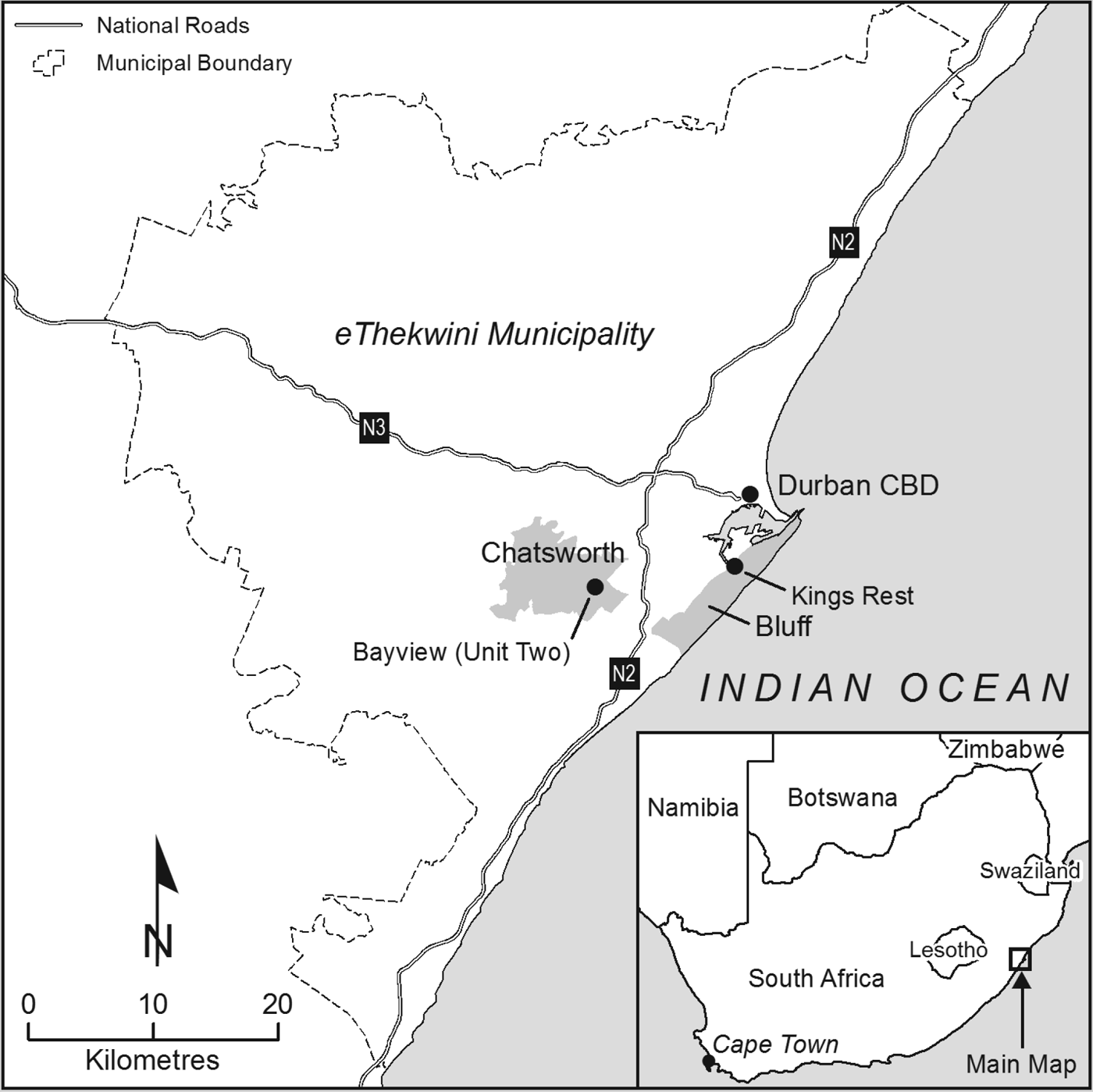
Zanzibari exceptionalism came to the fore in the high apartheid period of the 1950s, when the regime's efforts to categorize the population according to race reached its peak. In 1961, Zanzibaris were reclassified under the Population Registration Act – another central piece of apartheid legislation – as ‘Other Asiatics’. This meant that their forced removal in 1962–3 under the Group Areas Act, when the Bluff became a ‘white’ area, took them, not to the African township of Umlazi on the southern outskirts of Durban, but to Bayview (Unit Two) of the neighbouring Indian township of Chatsworth (see Fig. 1). Though the move meant the loss of proximity to Durban's central business district, it affirmed Zanzibari claims to being ‘non-native’, and enhanced opportunities for pursing education and achieving respectability. Because of its relative autonomy and the strength of its religious organisations, the Zanzibari community had long been a magnet for African Muslims visiting Durban, either as sailors or as migrant labourers from neighbouring countries. It also became a model for other African Muslim groups in the greater Durban area, and from the 1930s, African Muslims, mainly from Malawi, began to establish ‘Zanzibari’ societies in settlements like Mariannhill and Amaoti.Footnote 15 At the same time, members of the Zanzibari community served as religious instructors and teachers of Arabic in African townships.Footnote 16
Greater Durban area.

LANGUAGE, ISLAM, AND INDIAN OCEAN NETWORKS
Makua language and traditions have figured prominently in Zanzibaris' cultural entrepreneurship projects. Together with a particular dedication to Islam, the Makua language became a key marker of Zanzibari identity. This emphasis upon language gained new significance as the community came to incorporate new members, including poor Indian families as well as immigrants from Mozambique, Malawi, and Zambia. Such heterogeneity was nothing new; even the original group of 508 liberated slaves included a significant minority whose native languages were Ngindo and Yao rather than Makua. In the late nineteenth century, however, an extensive Makua diaspora emerged through the dispersal of slaves and freed slaves across the Western Indian Ocean region. Indeed, Makua may have been a lingua franca among the liberated slaves when they arrived in Durban in the 1870s. Thus, in her research on slave descendants in Madagascar, Klara Boyer-Rossol found that Makua had been spoken among different groups of slaves held on the African coast prior to their transportation across the Mozambique Channel.Footnote 17 In most of the Makua diasporas that have been documented in the Western Indian Ocean, including Somalia, Reunion, and Madagascar, the Makua language has been lost, importantly due to its association with slave status.Footnote 18 The same erasure of the past took place among Zanzibaris who converted to Catholicism but not among those who remained or became Muslims. Yacoob Ibrahim – born in 1934 – remembered having his tongue pinched by Zanzibari elders if as a child he slipped from speaking Makua into Zulu.Footnote 19
In the Fakiri case of 1938, Makua was presented as a Swahili dialect. In some regards, claims to a ‘Zanzibari’ identity in twentieth-century Durban were similar to claims to ‘Swahili’ identity common along the East African coast in the late nineteenth century. According to Jeremy Prestholdt, freedom for former slaves in Zanzibar involved ‘self-fashioning projects’ and ‘reinscription, making a new self out of the objectifying parameters of slavery [and] creating a desirable social space within the structures of coastal social hierarchies’.Footnote 20 This involved observing Islam. Along the East African coast, the Sufi brotherhoods and their mawlid rituals – festive celebrations of the Prophet Muhammad's birthday involving chanting, recitals, singing, and, controversially, drumming – facilitated the incorporation of former slaves into Muslim communities.Footnote 21 Similarly, speaking Swahili and adopting Swahili dress became signs of citizenship and belonging.Footnote 22 It would have been unthinkable, however, along the East African coast in the late nineteenth-century to pass off the Makua language – with its strong associations with slave status – as Swahili, or to associate speaking Makua with aspirations to ‘culturedness’ (utamaduni) and ‘Arabness’ (ustaarabu). But in Natal, people with little knowledge of the rest of Africa accepted Makua as a form of Swahili. Paradoxically then, Makua language and culture became defining features of Zanzibari identity in Durban.
The Zanzibari community, in turn, embraced forms of Islam that could accommodate Makua cultural practices. In accordance with matrilineal traditions, women played prominent roles in the community, and girls and boys underwent elaborate ritual initiations.Footnote 23 Zanzibaris' religious practice incorporated certain forms of ancestor propitiation like the leaving of msoro offerings at particular trees.Footnote 24 Oosthuizen offers a syncretist interpretation of such practices as examples of ‘indigenous Islam’, in which ‘[t]raditional African customs and Islam merged into one another so that it is not easy to discern between the two at any given point’.Footnote 25 Yet, I argue that, among Zanzibaris, rather than being blended together, Makua practices coexisted with Sufi-inspired Islam that included rituals, like mawlid, controversial among reformist Muslims. Durban Zanzibaris upheld a distinction between the domain of Islamic practice and that of cultural custom, as represented by initiation or msoro rituals. This distinction, however, was flexible and frequently the subject of theological debates among community members. Far from religious syncretism, as Oosthuizen argues, there were a variety of understandings of Islam – including ‘contextualized’ ones that viewed Islam as embedded in and interacting with local cultural settings and ‘purified’ ones that were more antagonistic to divergent practices – as well as a general endeavour to appear to the outside world as a unified Muslim community.Footnote 26
Sufism became an important influence among the Zanzibaris through three different trajectories: one coming across the Indian Ocean from South Asia,Footnote 27 another through Cape Town from Indonesia and the Malay world,Footnote 28 and a third trajectory which extended down the Indian Ocean coast from Zanzibar and the Comoros through northern Mozambique to Durban.Footnote 29 While the first of these trajectories has been explored in detail within South African historiography, limited attention has been given to the second one, and the third has not been studied at all.
One set of Sufi influences on the Zanzibaris in Natal came from interaction, beginning in the early 1880s, with Indian Muslims in Durban; that is, with representatives of the first of the three trajectories. Particularly influential were the group of Indian businessmen who controlled the Grey Street mosque and the Juma Musjid Trust.Footnote 30 Nile Green has described how such South Asian influence was rooted in the activities of ‘Islamic firms’ that operated within an ‘economy of religious enchantment’. These firms developed through the intensification of international trade and industrialisation, and catered to the needs of new groups of migrant and working-class Muslims in the Western Indian Ocean. As exemplified in Durban by the activities of Ghulam Muhammad and the Sufi Sahib network, such firms drew on brotherhood connections with Bombay-based firms and, with ‘entrepreneurial flair’, provided a variety of ‘religious productions’, ranging from healing, charms, and medicines to tracts, clothing, and festivals to a new ‘religious market of indentured rural migrants’.Footnote 31
Sufi religious practice among the Zanzibaris, however, was predominantly informed by Shafi, not Hanafi, understandings of Islamic law, as was the case also with the majority of Muslims in the Cape where Sufi brotherhoods including the Rifaiyya, the Qadiriyya, the Shadhiliyya, and the Alawiyya held sway. This second trajectory of Sufi influence emerged in South Africa in the seventeenth century, imported from Southeast Asia and channelled through the networks of the Dutch colonial empire via the importation of slaves and exiling of political leaders from Java and Sumatra to the Cape of Good Hope.Footnote 32 These immigrants' Sufi rituals included special forms of mawlid and ratib (the texts used during the ritual invocation of the name of God known as dhikr litanies and prayer recitation). A popular way of celebrating the birth of the Prophet – the mawlid al-nabi – was to have recitals and performances of the mawlid al-barzanji, the ratib al-haddad, and the ratib al-rifa'i.Footnote 33
Among these ritual practices, the ratib al-rifa'i became particularly well known (and controversial) as ratiep or khalifa – sometimes also called refai-ee, debus, or ‘fakir dancing’. This involved body piercings performed by dancing males, accompanied by drumming, and had its origins in the practices of the Rifaiyya brotherhood.Footnote 34 Controversies around mawlid celebrations and whether and in what form they were truly Islamic – questions familiar in East African contexts including Lamu, Mombasa, and Zanzibar – were given extra spice in South Africa by also involving ratiep.Footnote 35 Such debates centered on how inclusive Islam should be, and which forms of ritual practice should be deemed legitimate.Footnote 36
Ritual celebrations of mawlid – including the ratib al-rifa'i – became prominent among Durban Zanzibaris through relations with family members and other Muslims in Cape Town.Footnote 37 Indian Muslims accommodated ratiep alongside ritual performances related to muharram processions that competed with Hindu festivals like kavadi which included fire-walking and body piercing with hooks and swords.Footnote 38 Photographs of the Sufi Sahib shrine in the northern Durban suburb of Riverside show Zanzibari Muslims as early as 1912, in the words of Green, ‘performing the self-mutilating sword-and-skewer displays known as ratiep’ as part of an urs holy day celebrating the death of the Saint.Footnote 39
But most importantly, Sufi brotherhood initiatives reached Natal through the third trajectory: Islamic networks that extended from Mozambique Island and Angoche to the Comoros, Zanzibar, Lamu, Brava, and Hadramawt. This trajectory also found expression in practices of ratiep. Oosthuizen writes about ratiep among the Zanzibaris in Durban, that ‘[s]ome maintain that [it was] brought from the East to Durban, where the early Zanzibaris took it on. Others maintain that it came from Mozambique and that it is not derived from the Malay Khalifa. Yet others believe the Malays brought it here.’Footnote 40 Writing in 1982, he mentions that ‘Yusuf Abdul Rahman Mola, aged 56 … a dispatch controller with education up to Std. VI’ is the ‘Khalifa of the Ratieb among the Zanzibaris’ and has been so ‘for the past twenty years’.Footnote 41 Oosthuizen also describes the dhikr practices of commemorative chanting of Zanzibari women: a ‘women's devotional singing or dhikr is held on Thursdays and Sundays, at a specific home. The women seat themselves in a circle, after which they sway their heads and bodies rhythmically in African style.’Footnote 42 This is similar to female tufo dancing well known from Mozambique Island – with women chanting and dancing in a sitting position, accompanied by the drums. This, in turn, is a development of the mawlid naquira (in Makua the ‘dancing mawlid’) that in Zanzibar is known as mawlid ya hom, another seated dance still performed in Zanzibar by men.Footnote 43
Such links between Durban Zanzibaris and northern Mozambique have remained unexplored by scholars. Significantly, these links suggest that a coastal continuum of Islamic culture stretched into Natal and South Africa from the north across the boundaries that have usually been assumed in the Indian Ocean literature to exist around the historical centre of Sofala (near present-day Beira).Footnote 44 They also illustrate the central role of the Rifaiyya, Qadiriyya, and Shadhiliyya Sufi brotherhoods in maintaining links within this continuum, and demonstrate that these links were predominantly twentieth-century creations. While the Rifaiyya brotherhood was connected to earlier forms of Sufi Islam, the Qadiriyya and Shadhiliyya brotherhoods only entered northern Mozambique as part of Islamic reform endeavours from the late 1890s.Footnote 45 They therefore only became a presence among Zanzibaris through interactions with northern Mozambique that unfolded when the community was already well established in Durban. By contrast, according to Omar Bishehe Abdallah – a knowledgeable Qadiriyya shehe born in Nampula in 1920, ‘tufo rifaiyya’ and the Rifaiyya brotherhood arrived in Mozambique Island from Tanzania much earlier, and moved from there to Maputo and further south.Footnote 46
Through Maputo, Muslims in Natal connected to Sufi brotherhood networks centred on Mozambique Island. Liazzat Bonate writes that with the arrival of the Shadhiliyya and Qadiriyya brotherhoods in northern Mozambique in the late 1890s, ‘the centre of Islam moved away from the independent Swahili settlements, such as Angoche, to Mozambique Island’.Footnote 47 The cosmopolitan port cities of Durban and Maputo stimulated exchanges across large distances and, by the end of the nineteenth century, labour migration between Mozambique and Durban was well established. In Durban, local Zulu-speakers referred to Mozambican workers living at the Bluff as both Zanzibaris and as ‘Amanyambana’ – those from Inhambane, a major coastal city in southern Mozambique through which migrant labourers travelling to South Africa would pass.Footnote 48 At the same time, Zanzibaris who were employed in the Durban harbour travelled to Maputo to do ship repairs and other work, moving frequently between the two cities even at the height of apartheid. Other connections were forged by Mozambican sailors who abandoned ship in Durban and found accommodation among the Zanzibaris, and by anticolonial and anti-apartheid activists who clandestinely crisscrossed borders in pursuit of shelter and safety.Footnote 49 Significantly, brotherhood businesses (Green's ‘religious firms’) also forged networks of exchange and contact between Durban and Mozambique. These networks included travelling healers and drum makers as well as traders of herbs, medicines, daira hand drums, and other provisions needed for the performance of Sufi ritual.Footnote 50
Members of the present-day Zanzibari community recount how these diverse networks brought their family members to Durban. The grandfather of Eddie Osman, born in 1935 and now a Zanzibari elder, came to Durban in the early twentieth century as a herbalist, and both he and Eddie's father became renowned makers of the drums needed for ratiep.Footnote 51 Demonstrating the movement of community members between Durban and Mozambique, Yacoob Ibrahim remembered working in the 1950s for a French dredging company in the port of Durban, and then being transferred to work in Maputo harbour. He recalled visiting the Xipamanine market area and the townships of Mafalala and Minkajuine on the northern fringes of Maputo, home to Makua-speakers from Nampula and Ilha de Moçambique. At Mafalala, Zanzibaris would go to the Qadiriyya and Shadhiliyya mosques, whose imams were brotherhood members from northern Mozambique and also sometimes from further north, including the Comoros.Footnote 52
Important to forging and maintaining links between Durban Zanzibaris and the Qadiriyya and Shadhiliyya mosques in Mafalala was Shehe Basheko Abdulrazak Rajaab. Born in 1913, he was an imam at the Shadhiliyya mosque and in charge of a healer's clinic in Minkajuine. Shehe Basheko hailed from Mozambique Island, and worked for forty-three years for the maritime administration in Maputo as an inspector of immigrants' health cards.Footnote 53 On Mozambique Island, he is linked to families of prominent Sufi leaders, including Sayyid ba Hasan who, in the 1930s, formed the Qadiriyya Sadat – one of the most important branches of the Qadiriyya brotherhood in northern Mozambique.Footnote 54 Sayyid ba Hasan was, until his death in 1963, an active traveller who frequently visited Durban and had family there.Footnote 55 He was buried in Maputo, and people still visit his grave and sing songs about his good works.Footnote 56 Sayyid ba Hasan's granddaughter, Shifa Yussufo, who still lives in his house on Mozambique Island and is a khalifa – a subleader beneath the shehe – of the Qadiriyya Sadat, remembers that when they were young Shehe Basheko had wanted to marry her, but she declined.Footnote 57 The Qadiriyya Sadat in the island maintains active relations with Maputo and the mosques in Mafalala, and murides – ‘servants’ – of the brotherhood travel to Durban and South Africa on cultural visits and herbalist business. They sometimes represent the Mahafil Issilamo cultural and sporting organisation, a Muslim association founded on Mozambique Island in 1931 that has supported ratiep, tufo dancing, and Rifaiyya ritual practices among other activities even in the face of secularist or dogmatist adversity.Footnote 58
As we saw, coastal Sufis were active among the Zanzibaris in the early twentieth century when, for example, Mustapha Osman from the Comoros became an imam at Durban's Kings Rest mosque.Footnote 59 In the 1940s and 1950s, a prominent person representing the Sufi brotherhoods in Durban was a brother of Shehe Basheko named Mkotela, reputed to be ‘a very learned man’ who came to Kings Rest from Maputo and married a sister of Yussuf Mola. Mola, in turn, was a khalifa of the Shadiliyya brotherhood among the Zanzibaris for about thirty years.Footnote 60 Such familial connections established close links between Durban Zanzibaris and Makua-speaking northern Mozambicans imams at the Shadhiliyya and Qadiriyya mosques in Mafalala. Another important mediator between Durban and Mozambique was a Qadiriyya shehe named Habib Shali, who was simultaneously ‘a great shehe of Rifaiyya’ and travelled from the Qadiriyya mosque in Mafalala to Durban and Kings Rest in the 1940s.Footnote 61 At Kings Rest, Habib Shali worked together with a man named Juma Abdulkader, the grandfather of the current prominent Zanzibari elder Salim Rapentha. Both Habib Shali and Juma Abdulkader were taught by an earlier khalifa from Mozambique named Hamad Jamfar who is claimed to have been the first to bring ratiep to Durban. Elders today remember Habib Shali as ‘a respected spiritual guide’ during his stay at Kings Rest:
Habib Shali taught us Makua and Arabic. He wanted us to go to Lourenço Marques to learn. He was a big shehe, who had a lot of good songs, and he would hit you very hard, if you played around.Footnote 62
Habib Shali returned to Mozambique in 1948. His work was continued in Durban by his brother-in-law Hassan Siraji who was also a Qadiriyya shehe from Mafalala, and who was then succeeded as khalifa by the Durban-based Yussuf Mola.Footnote 63 As in Mozambique Island, performances in Durban of ratiep and the ‘chanting of the Rifai'yya râtib’ were sometimes viewed as ‘cultural’ rather than ‘religious’, but importantly included singing the popular mawlid al-barzanji (see Fig. 2).Footnote 64
The mawlid-al-barzanji recorded in an illuminated 1930s book of prayers and poems used by a Rifaiyya group in Mozambique Island (photo: Preben Kaarsholm, 31 January 2011).
Sufi orders in Durban remained informal with Zanzibaris largely relying on visiting shehes from Mozambique to represent the Qadiriyya and Shadhiliyya brotherhoods. Before 1928, no documentation exists of local Sufi leaders and religious authorities receiving ijazas, certificates awarded by an acknowledged tariqa leader to recognize the authority of a new shehe, or silsilas, documents, in the words of Bonate, ‘attesting to the legitimacy of the Order and its founder, containing a sequence of Sufi masters reaching back to the Prophet Muhammed’.Footnote 65 Senior community members agree that Hamad Jamfar was the first holder of a Shadhiliyya ijaza to arrive in Durban. In 1935, Habib Shali became the next holder of an ijaza in Durban. Juma Abdulkader, in turn, succeeded him in the early 1950s. Yussuf Mola was then given a Shadhiliyya ijaza by Sheikh Anwarudeen in late 1962 or early 1963. Finally, before his death in the late 1990s, Yussuf Mola did not pass on a Shadhiliyya ijaza to a successor. Instead a ‘ratiep club’, with which Mola had worked closely – and which included Salim Rapentha, Eddie Osman, and Cassim Canthitoo – took over, relying on linkages with Maputo for more formal Shadhiliyya authority.Footnote 66
Several possible reasons exist for this uneven formalization of Sufi orders among Durban Zanzibaris. The first reason was hinted at in my 2011 interview with Shehe Basheko when he commented that the Shadhiliyya dhikr began in Mozambique, and needed to be conducted there; thus, Durban, should be seen as an extension of Mozambican brotherhood.Footnote 67 A second reason may be that Zanzibaris were discreet about their Sufi affiliations, thinking it more important to emphasize the unity of Islam rather than sectarianism. Such concerns motivated Zanzibaris to engage Sufi networks more as benevolent societies or community development organizations rather than religious institutions. Third, by retaining a certain amount of informality as regards the Sufi orders, Zanzibaris maintained greater flexibility in defining the boundaries between Islam and cultural custom, and fending off criticism from scripturalist reform movements. Finally, on the Mozambican side, discretion to the point of invisibility became necessary during the late 1970s and early 1980s when secularisation was high on the Mozambique Liberation Front (FRELIMO) government's agenda and Sufi brotherhoods were accused of being Mozambique National Resistance (RENAMO) supporters. On Mozambique Island, for example, Sufi enterprises like Mahafil Issilamo organized performances under the pseudonym Estrela Vermelha (Red Star).Footnote 68
In any case, within the Durban Zanzibari community from the 1930s, the Sufi brotherhoods were an important benevolent presence, even if individuals involved represented only a minority of the community. This minority worked with tact and discretion, and became highly influential within the more broadly representative Rahmaniya Madressa Society, formed in 1947. It oversaw – and still does today – the larger of the two mosques in Bayview, and was an important forerunner of the Zanzibari Civic Association formed in the 1980s and the more recent Zanzibari Development Trust.Footnote 69 The second and smaller Iqbali mosque in Bayview was a weaker community organization. In recent years, however, it has become a stronghold of scripturally dogmatic interpretations of Islam as promoted both by the Tablighi Jamaat, an Islamic reform movement with roots in Pakistan and India, and by new Islamic non-governmental organizations, like the Africa Muslim Agency, with bases in the Arab world.Footnote 70
Sufi brotherhoods played a major role in helping Zanzibaris to define themselves and negotiate their place within segregation and apartheid-era South Africa. Internally, dedication to Islam, Sufi ritual, and Makua language encouraged community pride and self-respect. These connections made Zanzibaris well-placed recipients of Indian Islamic philanthropy through the Juma Masjid Trust, providing a model of community development for other groups of African Muslims. Within South Africa, ratiep and brotherhood connections added to the exoticism of the community as a ‘lost tribe’ and supported representations of its members as quasi-Arab Zanzibaris with origins in the Swahili world rather than in the less cosmopolitan South Africa of white domination. This was an impressive feat of religious and cultural entrepreneurship that allowed Zanzibaris some autonomy from restrictions imposed upon those classified as African.
The community's appellation of ‘Zanzibari’ did not correspond to the actual north Mozambican roots of its founders who, only by coincidence, had become associated with Zanzibar through the British antislavery campaigns of the 1870s. During the twentieth century, however, East African affiliations acquired a new reality through Sufi networks that unfolded along the Indian Ocean coast and came to encompass Durban's Zanzibari community. Through these networks, Sufi rituals and practices spread not only to Cape Town and Mozambique Island but also to Natal and Durban.Footnote 71
ZANZIBARIS OR AMAKHUWA AFTER APARTHEID?
As apartheid governance crumbled in the late 1980s and early 1990s, the challenges facing Zanzibaris changed. Representations of the community as non-African Muslims with their own Swahili-like language proved advantageous under the Group Areas Act. In the context of the Act's forced removals, it was a political achievement to be classified as ‘Other Asiatics’ and awarded housing and facilities in Chatsworth rather than in Umlazi. After apartheid, by contrast, policies of the African Renaissance and Black Economic Empowerment made recognition as black African more politically and economically advantageous. Thus, it became increasingly common for Zanzibaris to present themselves as ‘Amakhuwa’, and locate their Indian Ocean roots in northern Mozambique rather than Zanzibar.
Such representations came into dramatic play in Zanzibaris' bid to return to Durban's Bluff. As apartheid was dismantled, land restitution was introduced as an instrument of transitional justice. In 1995, the Zanzibari Civic Association registered a formal claim with the government's Advisory Commission on Land Allocation to repossess the land on the Bluff from which they had been removed in 1962. The Juma Musjid Trust lodged a competing claim for restitution of the same land, arguing that they had been forced to sell to the government under the Group Areas Act in 1958.Footnote 72 The two competing claims caused division between the Zanzibaris and the predominantly Indian South African members of Juma Masjid Trust who had long seen themselves as the community's benefactors. The case was resolved in 2003, when most of the land on the Bluff was given back to the Zanzibari community. The Juma Masjid Trust only retained a small area around the mosque and cemetery.Footnote 73
Resettlement plans for the Bluff further fuelled discussions about the identity, origins, and culture of the Zanzibaris.Footnote 74 An important source for these debates has been a 52-minute TV programme produced by the South African Broadcasting Corporation in 1996. Entitled ‘Zanzibaris’, the programme is a carefully prepared self-representation of the community.Footnote 75 Zubeda Seedat served as researcher for the programme, largely articulating the views of the Zanzibari Civic Association and of the Rahmaniya Madressa Society in which Sufi order members were prominently represented. Divided into two parts – ‘Identity and Community’ and ‘The Struggle for King's [sic] Rest’, the programme includes rich photographic materials, historical press coverage, interviews with elders like Yussuf Mola, and recordings of mawlid and dhikr performances including ratiep.
The programme demonstrates the community's reorientation since 1994. It contains many references to the community's Zanzibar and Swahili origins, but also signals a break with notions of the Zanzibaris as a non-African ‘mystery tribe’. Instead, it emphasizes the history of the slave trade, and depicts Zanzibaris as victims of a shared African legacy of suffering. Through this representation, Zanzibaris shed their apartheid designation of ‘Other Asiatics’ and claim a common African history of dispossession, bolstering their political claims in the new South Africa.
At the same time, alongside these indigenizing developments, Islamic brotherhood exchanges between Durban and Mozambique have intensified since 1994. Improved roads have facilitated these exchanges by making it possible to go from Durban to Maputo by minibus in ten hours. Small groups of Zanzibari Muslims – increasingly referring to themselves as Amakhuwa without discarding completely their earlier identification as Zanzibari – travel regularly to Maputo to see family and friends, and attend Friday prayers and consultations at the Shadhiliyya and Qadiriyya mosques in Mafalala. From Maputo, some community members travel on to Nampula and Mozambique Island where they interact with fellow Muslims in exchanges facilitated by cultural leaders like Shehe Basheko. Durbanites also visit northern Mozambique, bringing back photos and stories from Mossuril and other key sites of the late nineteenth-century slave trade. In December 2012 and January 2013, groups from Bayview travelled to Mossuril for a wedding attended by Shehe Basheko and for New Year celebrations. They also attended a Sufi ziyara celebration in Cabaçeira Pequena, organized by the Qadiriyya Sadat and its current leader, shehe Assane Issufu, a maternal grandson of Sayyid ba Hasan, as well as ba Hasan's daughter, khalifa Shifa.Footnote 76 Such visits stimulate discussion about local and transnational allegiances, both past and present.
By contrast, Sufi ritual practices like ratiep, mawlid celebrations, and dhikr performances have become less frequent in Durban's Bayview neighbourhood, and no formally accredited khalifa has presided since Yussuf Mola's death on 27 July 2007.Footnote 77 One reason for this is theological, linked to reform movements such as the Tablighi Jamaat and Ahlu Sunnah wal Jamaah. As described by Roman Loimeier and Felicitas Becker for Zanzibar and Tanzania, and by Goolam Vahed for Indian Muslims in Durban, reform movements aim to cleanse Islam of perceived cultural impurities including mawlids, ancestor worship, tomb visitations, and beliefs in spirits.Footnote 78 Among Zanzibaris, this impulse has led to debate around ritual practices and the role of Zanzibari initiation rites. Reformers argue that the nimwaris – young girls undergoing initiation – should shroud themselves in burkhas rather than traditional mkumi cloth or capulanas.Footnote 79 Reform efforts, however, have been checked by the elders in the Rahmaniya Madressa Society in which sympathisers with the Sufi orders are still a majority, and have retained control of the most important mosque in Bayview.
Another reason for the declining frequency of Sufi ritual in Durban may relate to lack of both funds and commitment among younger people. Further, the sense of ratiep performances has shifted from religious ritual towards cultural entertainment with ratiep groups performing at weddings.Footnote 80 In April 2013, however, extensive mawlid-al-nabi performances to celebrate the Prophet's birthday were held in Bayview, featuring what the chairman of the Zanzibari Development Trust described as ‘a cultural group from Mozambique [who] stole the show with their pulsating dancing and drumming, which brought tears of joy to some’ (see Fig. 3).Footnote 81
Performance of ratiep and Rifaiyya ritual at mawlid-al-nabi in Bayview, 28 April 2013 (photo from DVD recording courtesy of Ismail Fraser).
In Mozambique during the same period, mawlid celebrations increased. There has been a resurgence of Sufi Islam since the 1990s with the northern Mozambique-oriented Islamic Congress of Mozambique gaining influence vis-à-vis the reformist and wahhabi-oriented Islamic Council of Mozambique.Footnote 82 This has been the result of changing FRELIMO policies aimed at outmanoeuvring RENAMO in the north, which led to the inclusion in national government between 1994 and 2004 of Muslims like Minister of Justice José Abudo, who is from Angoche and a Shadhiliyya khalifa.Footnote 83
Despite the contrasting fortunes of Sufi practice in Durban and Mozambique, there have been parallel strivings in both contexts to promote notions of a distinct Amakhuwa identity. The Sufi resurgence in Mozambique has also been one of Makua culture, and in 2008 extensive mawlid and ziyara celebrations in the Makua language were held in Maputo. This brought together Muslims and Makua-speakers from throughout Mozambique and from the Makua diaspora, including a delegation from Bayview. One of the organizers was José Abudo who – as minister – had visited the Bayview community in 2003 and expressed appreciation for its language conservation efforts: ‘people must travel to Durban to learn to speak pure Makua’.Footnote 84 The 2008 ziyara was an occasion for Mozambique to acknowledge and build links with its Makua-speaking diaspora. President Armando Emilio Guebuza attended the celebration, addressing the congregation and meeting the Durban visitors.
Most recently, Sufi Islam has been weakened in Maputo and southern Mozambique by the death of Shadiliyya leaders like Shehe Basheko and the aging of other prominent leaders like Shehe Mohammad Ali Aboobacar (b. 1929) at the Qadiriyya mosque in Mafalala.Footnote 85 Older Sufi practices have also been overshadowed to some extent by the success of reform initiatives spurred by younger leaders trained in the Arab world.Footnote 86 Groups of Durban Muslims – including a son of the late shehe Yussuf Mola – have been taking active part in these debates, aiming to preserve the Shadiliyya mosque within the control of the brotherhood. By contrast, in northern Mozambique, the influence of the Sufi orders have increased, as indicated by the victory in the November 2013 local elections in Mozambique Island of a young Shadiliyya shehe, Saide Amur, as a FRELIMO candidate. This was duly celebrated at a spectacular mawlid-an-nabi ceremony, which I attended in Mozambique Island on 19 January 2014, beginning with a mass procession around the perimeter of the island, and replicated at another celebration of the Prophet's birthday in the port city of Nacala the week after (see Fig. 4).
Rifaiyya group performing during celebrations of the Prophet's birthday – mawlid-an-nabi – on Mozambique Island, 19 January 2014 (photo: Preben Kaarsholm).
CONCLUSION
As part of constructing an Amakhuwa identity, Durban Zanzibaris have emphasized their preservation of the Makua language, their Sufi faith, and their slave history. Such emphasis aims not to claim external origins but to give depth and authenticity to their South African citizenship and its attendant rights. This strategy resembles that of ‘Cape Malay’ groups in post-apartheid South Africa who claim to be both South African and members of a Malaysian or Indonesia diaspora.Footnote 87
The coming years will tell how Zanzibaris resolve or do not resolve these tensions in their self-representations and commemorations of the past. These are not theoretical issues but practical ones that will play out as the land restitution project on the Bluff moves forward. In a sense, the restitution project is an attempt to turn history backwards by recreating a community that was forcefully dismantled fifty years ago. Restitution in such a literal sense is, of course, not possible as many members and descendants of the original community have since died or moved away. Nonetheless, it compels community members to decide how they want their history as Zanzibaris and Amakhuwa to be represented in local archives and museums, and through educational and heritage tourism initiatives.
This complex history of identity formation and self-representation highlights a number of issues that have been largely overlooked in the literature on Islam in both South and Southeastern Africa. These include the importance of Sufi brotherhoods and ritual for the development of Islam among Africans, particularly in Durban and KwaZulu-Natal. This history also highlights the interaction between the three different trajectories by which Sufism travelled to South Africa: with migrants from South Asia; with other migrants from Malaysia and Indonesia who settled in Cape Town; and with still a third set of migrants who travelled down the Indian Ocean coast from Zanzibar and the Comoros through northern Mozambique to Durban. The connectedness of Durban's Zanzibaris to Mozambican networks challenges notions of South African ‘exceptionalism’ by providing a new perspective on the ways in which South Africa has been part of an Indian Ocean coastal continuum. Finally, this history of Durban's Zanzibaris adds to the growing number of studies that examine the large and diverse Makua diaspora that arose from the eighteenth- and nineteenth-century slave trade.
The two modes of communal self-understanding – Zanzibari and Amakhuwa – point to a tension between the local and the transnational, an uneasiness found in other Indian Ocean situations. As shown, membership in Indian Ocean and specifically Sufi religious networks can serve as a basis for both cosmopolitan connection and narrow territorial claims. The particular paradox involved in this case is that cosmopolitanism – as represented in arguments for membership in a Indian Ocean Zanzibari community – aided this group during segregation and apartheid, eras normally associated with a narrowing and hardening of forms of self-identification. By contrast, the more narrow territorial understanding of the community's origin in northern Mozambique emerged after the fall of apartheid in South Africa and the weakening of secular nationalism in Mozambique, shifts usually associated with multiculturalism and greater tolerance. Whether deployed as part of cosmopolitan connection or narrow territorial claims, Sufi networks offered vital resources for seeking recognition and citizenship.