


1. Introduction
In at least one respect, the popular music of the past sixty years falls short of the great masterpieces of the classical music tradition. Popular music can be, in certain respects, aesthetically rewarding. There may even be ways in which some popular music is more rewarding that a good deal of classical music. Still classical music is has more expressive possibilities. Classical music, at least the best classical music, has an expressive pallet that popular music seldom rivals. Consequently, classical music has a psychological depth and profundity that popular music rarely attains. No Beatles album has the profundity of Bach's St. Matthew Passion. None of Madonna's music can rival the expressive range of Mozart's Don Giovanni. Snoop Dogg's oeuvre cannot rival cannot rival Schubert's when it comes to expressive possibility. The expressiveness of classical music is attributable to harmonic (and other) properties that are not present, or present to a lesser degree, in popular music.
Before proceeding with my argument, I need to clarify what I mean when I talk of classical and popular music. By ‘classical music’ I mean music from the common practice period, which is often reckoned to include the baroque, classical and romantic periods. In other words, by classical music I mean music composed between 1600–1900, although much of what I have to say about classical music can be extended to the great works of renaissance polyphony. Classical music does not include atonal music of the past century. It is more difficult to say what I mean when I speak of popular music. Wikipedia's list of popular music genres contains literally hundreds of entries, from African heavy metal to Zouk.Footnote 1 What I mean by popular music is, perhaps, captured by talk of traditions of music making traceable to 1950s rock and roll. These traditions have increasingly abandoned certain features of common practice composition, including functional harmony, modulation and contrary motion. When I speak of popular music, I do not refer to jazz. Jazz, in many of its manifestations, is an extension of common practice music making.
While I doubt that popular music has a high degree of a certain kind of value, at least relative to the greatest works of the classical music canon, I do not endorse any of the assessments of popular music advanced by Theodore Adorno,Footnote 2 Allan BloomFootnote 3 or Roger Scruton.Footnote 4 I have no desire to deny that a good deal of popular music has aesthetic value. Popular music, as Theodore Gracyk has argued, can have aesthetic value in a variety of ways.Footnote 5 And in some respects, the aesthetic value of the best popular music may exceed that of a great deal of classical music. My claim is only that by possessing the profundity that results from expressive power, classical music (considered as a whole) surpasses popular music (considered as a whole).
My position also needs to be distinguished from that of some formalists who have been skeptical about the aesthetic value of popular music. Some formalists have argued that popular music is inferior to classical music because popular music (typically) has less formal complexity than classical music. My view is that there is no firm correlation between aesthetic value and formal complexity. For a start, very simple music can be quite lovely. Think, for example, of the various chant traditions from around the world: Byzantine, Tibetan and Gregorian, among others. Music from these traditions is often formally simple, but still characterized by exquisite beauty. (I also believe that formally complex works can have little aesthetic value. I am, for example, unconvinced of the aesthetic value of Milton Babbitt's music, formally interesting though it may be.) My position is simply that the expressiveness of music will tend to be limited when certain compositional techniques, common in classical music, are not employed. When expressiveness is limited, so is music's capacity for psychological insight and profundity. Music that does not employ these techniques will tend to be valued for reasons other than those for which classical music is valued.
In one respect, my position is akin to certain formalist views. Like formalists, I believe that the characteristic sophisticated harmony and counterpoint of the best classical music contributes to its aesthetic value. I differ from formalists in that I do not hold that sophisticated harmony and counterpoint is inherently valuable. Rather, I hold that sophisticated tonal harmony is an important contributor to musical expressiveness and that music that is not contrapuntally developed is unlikely to have a high degree of expressiveness.
The relationship between classical music and popular music is similar to that between literary fiction and genre fiction. (By genre fiction, I mean mysteries, adventure stories, romances, science fiction, and so on.) I do not believe that I say anything controversial when I say that literary fiction offers something that genre fiction (considered as a whole) does not. Literary fiction can be the source of valuable social, emotional and moral insights. In short, literary fiction can be profound. Many people have long believed this and we now have experimental evidence that indicates that literary fiction, unlike genre fiction, contributes to readers' capacity to gain insight into character and emotion and that non-literary fiction does not.Footnote 6 This is not to say that popular fiction is without aesthetic value. But genre fiction is primarily valuable qua entertainment not qua source of insight. The same is true, I believe, of popular music.
This said, it must be admitted that some popular fiction transcends its genre. I have in mind, for example, the mysteries of Dorothy Sayers and the science fiction of Ursula Le Guin. Both of these authors have produced moving and insightful works that bear comparison with excellent literary fiction. I also do not I deny that some literary fiction is rubbish. I mean only to say that few works of popular fiction achieve the profundity of the greatest works of Jane Austen, Leo Tolstoy, and Joseph Conrad. Similarly popular music can sometimes transcend its genre and is capable approaching the degree of expressiveness and profundity that we associate with the greatest works of Monteverdi, Purcell, and Handel. On the whole, however, this is rare.
2. Harmony in classical and popular music
In this essay I will identify a number of expressive resources that classical music possesses and popular music does not (at least not to the same extent). The absence of these resources helps account for popular music's comparative lack of expressive power. To start, I will discuss harmonic resources. In important respects, popular music is (on the whole) harmonically disadvantaged when compared to classical music.
A lot of evidence, anecdotal and statistical, can be marshaled for the view that popular music has abandoned many of the practices of classical tonal harmony. (Jazz, particularly in its pre-1960 period, did not.Footnote 7 ) Statistical evidence is provided by a study by Trevor de Clercq and David Temperley.Footnote 8 De Clercq and Temperley studied 100 songs from Rolling Stone's 500 Greatest Songs of All Time, a list compiled in 2004. From this list, de Clercq and Temperley chose to analyze the top 20 songs from five decades: the 50s, the 60s, the 70s, the 80s, and the 90s. It is worth noting that the songs chosen are widely regarded as among the best popular music of the past 60 years. These songs likely have more harmonic resources than run-of-the-mill popular music.
De Clercq and Temperley found several important respects in which popular music harmony differs from harmony found in common practice composition (in particular, the classical music of the eighteenth and nineteenth centuries). One difference is that popular music has a different distribution of chromatic roots than is found in classical music. In the popular music of the 1950s, I, IV, and V are over 95% of all chords as opposed to about 79% in classical music. In subsequent decades, popular music departed even more radically from common practice composition. Starting in the 1960s, the percentage of V chords fell dramatically and the percentage of IV chords became about triple that found in classical music. Also striking is that the percentages of ♭III and ♭VII are dramatically higher in popular music than in common practice composition. The distribution of chromatic roots in common practice and popular music is given in this table of De Clercq and Temperley's data:
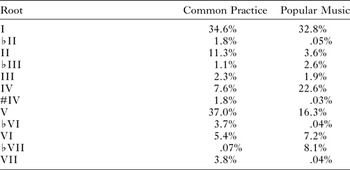
Several conclusions can be drawn from these data. For a start, the popular music of the 1950s is rather harmonically impoverished and it is unlikely to owe much of its expressive properties to its harmonic characteristics. This conclusion will come as no surprise to anyone familiar with early rock and roll music. It can be aesthetically pleasing and, indeed, there is empirical evidence that listeners without formal musical training are most pleased by familiar chord progressions even though they are capable of recognizing deviations from standard progressions.Footnote 9 This said, few people would say that expressive nuance and profundity are strong suits of early rock and roll.
Subsequent popular music has, however, a quite wide variety of chromatic roots. This apparent variety is, however, misleading. While in the genre as a whole chords with a wide range of chromatic roots are employed, in any given work the range of chords tends to be smaller than is usual in common practice composition. This fact, however, does not fully reveal the harmonic limitations of popular music. In order to find the comparative harmonic limitations of popular music we need to probe a little deeper.
The different distributions of chromatic roots in popular and classical music reflect differing scales and standard chord progressions. Common practice composition employs a diatonic scale. A standard progression in classical music is I, IV, V. (The progression is i, iv, v in the minor mode.) Given the comparative scarcity of the V chord (after the 1950s), this progression is much less common in popular music. Instead, popular music often, in effect, employs a modal scale. Rock music often employs an Aeolian scale: i, ii°, ♭III, iv, v, ♭VI, and ♭VII. (In practice, ii° is seldom used.)Footnote 10 i, ♭VI, and ♭VII is a very standard progression. Examples include Bob Dylan's, ‘All Along the Watchtower,’ Eric Clapton's ‘Layla,’ David Bowie's ‘1984,’ ‘Message in a Bottle,’ by The Police and R.E.M.'s ‘The One I Love’ (A section). The Mixolydian scale is also common: the progression I-♭VII is found in The Doors' ‘The End,’ (A section), Steppenwolf's ‘Born to be Wild,’ (chorus), and ‘Fire and the Mountain’ by the Grateful Dead. The Dorian scale is also frequently employed. Styx's ‘Renegade,’ Pink Floyd's ‘Another Brick in the Wall’ and Santana's ‘Evil Ways’ are examples.Footnote 11
The abandonment of the chord progressions of classical tonal harmony reduces the expressive capacity of popular music. In order to appreciate this point, a little needs to be said about Leonard B. Meyer's views on musical expressiveness. In common practice composition, there is a strong tendency of certain chords to precede certain other chords and not others. Some chords are experienced as unstable and in need of resolution by others. Specifically, a I chord is typically followed by a IV or V chord. Only rarely is a I chord followed by II or III. A II chord is usually followed by a V chord. Only rarely is a II chord succeeded by a I, III or IV chord. III is often followed by VI, and rarely by II or V.Footnote 12 And so on.
The patterns within classical music establish musical expectations in listeners. Meyer's hypothesis was that these expectations are crucial to the arousal of emotions by music. When expected patterns are followed, listeners experience satisfaction. When expected patterns are violated, listeners have a feeling of frustration. The arousal of emotion, in turn, contributes to its expressiveness. When a chord leads listeners to expect a second chord, it is said to be functional. A chord that does not naturally resolve to another is called non-functional. The creation of musical expectations is often described as giving rise to tension. This tension is released when resolution (in the form of an expected chord) is reached.
A psychological study has provided empirical support for Meyer's hypothesis.Footnote 13 The stimuli in the experiment were provided by six chorales by J.S. Bach, each of them with an unexpected chord. For example, these works will have an unexpected minor chord in place of an expected major chord. The experimenters then modified the chorales in two ways. First, they modified Bach's work so that an expected chord replaced an unexpected one. So, for example, a major chord replaced an unexpected minor chord. The second sort of modification involved replacing the unexpected chord by an even more one: a Neapolitan sixth. Test subjects, a group of well-trained musicians and an equally large group of non-musicians, listened to all eighteen versions of the chorales. While they listened, the experimenters recorded subjective reports of emotional arousal and perception of tension, finger temperature and electroencephalography (EEG) results. The experiment found that perception of tension, subjective reports of emotion, finger temperature and EEG results were all correlated with the increase of harmonic unexpectedness. Trained musicians, more familiar with the conventions of tonal harmony, had more marked responses to the degree of unexpectedness, but the non-musicians also responded. This suggests that the use of functional chords, which establish patterns of expectation, frustration, and satisfaction, contribute to the expressiveness of music.
Other psychological research has reached a related conclusion.Footnote 14 Listeners often report that music arouses a variety of physical responses that are associated with emotions. These physical responses include shivers down the spine, tears, a lump in the throat, and increased heartbeat, among others. Some of these physical responses to music are prompted by features found in both classical and popular music. For example, appoggiaturas (found in both types of music) tend to arouse tears. On the other hand, some physical responses seem to be prompted by features of music found only, or found much more frequently, in classical music. For example, shivers are associated with new or unprepared harmonies and sudden dynamic or textural changes. Other (rarer) physical responses are prompted by delay of a final cadence or harmonic or melodic acceleration to a cadence. I take these physiological findings to indicate that certain features of music are experienced as expressive. (This research was performed on subjects who were mainly trained musicians, so it can perhaps be discounted to some extent.)
These considerations bear upon the expressiveness of popular music because the chords in popular music are often non-functional.Footnote 15 That is, a given chord in popular music typically does not evoke in listeners the expectation that a particular chord will ensue. The patterns of chord progressions found in classical music are not found in popular music. Moreover, popular music does not replace the patterns found in classical music with new patterns that establish new patterns of expectation. A given chord in popular music moves to a variety of other chords.
Some popular music follows a i, iv, v pattern. It might be thought that popular music following this pattern continues to arouse Meyer emotions. To a certain extent, this may be true. However, as Alf Björnberg notes, ‘the tension-resolution effect of the cadence is weakened by the absence of the leading note in the v chord’.Footnote 16
All of this may seem a little technical but there is an easy way for the casual listener to notice non-functional chords. Every listener, casual or otherwise, will have noted that classical music almost always ends with a cadence, usually a perfect cadence (V to I). This gives the music a sense of closure and completeness that contributes to its expressive character. If a work of classical music does not end in a perfect cadence, this is quite a surprise and this feeling of surprise contributes to the expressiveness of the music. Popular music, in contrast, frequently fades out rather than ending in a cadence. A reason for this is that popular music frequently has no obvious candidate for the final chord that will provide a sense of completion (or whose absence will contribute to expressiveness in another way). Contrary to what might be expected, the end of a pop song is seldom the best part.
There is a second way in which popular music harmony is less expressive than that in classical music. Popular and classical music have different distributions of chromatic roots, but the distributions of chords in root position and inversion are even more different. In the popular music sampled by de Clercq and Temperley, 94.1% of chords are in root position. In contrast, in classical music, only about 60% of chords are in root position. It is worth remembering, however, that the classical music percentage is based on a survey of the whole corpus while the popular music percentage is based on a survey of only the best 100 songs. Likely if only the 100 best classical music compositions were analyzed, the percentage of chords in root position would be lower. If more popular music were studied, an even higher percentage of root position chords would probably be found.
The fact that chords in popular music are almost always in root position limits musical expressiveness. Musical expressiveness, as we have seen, is often described in terms of the creation and relaxation of tension within a composition. Tension can be created by the frustration of harmonic expectations, but it can also be created by other musical events. Fred Lerdahl hypothesized that these events include the use of inverted chords.Footnote 17 And experimental evidence confirms that this is the case. Several sorts of musical events, including inverted chords, are found to increase musical tension.Footnote 18 This, in turn, increases the potential for musical expressiveness.
The almost exclusive use of root position chords in popular music has another consequence. Almost all motion in a popular song is parallel motion. Contrary motion is almost never found. (Contrary motion occurs when one musical line rises in pitch while another falls.) The musicologist Allan Moore observes that in rock music, ‘Guitar chords tend to be held in a convenient position with the bass and treble pitches possible determinants: inner parts rarely have a linear role, merely existing to fill out the chord.’Footnote 19 In contrast, one of the principles of common practice composition is that contrary motion should predominate. (Contrary motion is also commonly found in jazz.) I cannot appeal to any psychological experiments to confirm that the use of contrary motion enhances the expressiveness of a work of music. (So far as I can determine, no such experiments have been done.) However, music theorists typically maintain that the introduction of contrary motion into compositional practice enhances musical expressiveness.Footnote 20 By eschewing contrary motion, popular music abandons a valuable expressive resource.
Next let us consider the contribution of modulation to the expressive character of music. Modulation is the movement from one key to another and is widespread in common practice composition. Modulation is widely held to contribute importantly to the expressive character of music. As long ago as 1754, Charles-Henri Blainville observed that, modulation ‘is the source of all of the most delicate and the most striking beauties of music’.Footnote 21 This is, I think, exactly right. Subtlety of musical expression depends on modulation. The mood of a composition often brightens as it modulates into a higher key, say from the tonic into the dominant. Similarly, modulation into a lower key can darken the expressive character of a work.
Recent experiments have confirmed that modulation contributes considerably to the expressive character of music.Footnote 22 Given the conventions of common practice composition, certain modulations are expected, others are unexpected, and still others are neither expected nor unexpected. Test subjects listened to a series of specially composed modulations of each sort and were asked to rate their mood valence (happy or sad; bright or dark), potency (strong or weak; firm or wavering) and pleasantness (pleasant or unpleasant; warm or cold) on scales from one to five. Overall, expected modulations were perceived as strongest and most positive. Modulation from the tonic to the dominant (the fifth degree of the scale), a highly expected modulation, was found to be the ‘happiest.’ The study found that both trained musicians and subjects without musical training perceived the expressive characters of modulations.
Popular music seldom employs modulation. That is, it almost always stays in a single key or mode. In this respect, popular music is unlike classical music. By forgoing the use of modulation, popular music does without a tool that contributes importantly to the expressiveness of common practice composition.
The contrast between major and minor tonality is essential to common practice composition and contributes greatly to its expressive power. This has long since been confirmed by psychological research.Footnote 23 In at least two ways, a great deal of popular music gives up the expressive power of the major/minor distinction. As has already been noted, a good deal of popular music does not employ a diatonic scale. Rather, it is organized modally. There are exceptions, of course. Most early rock and roll was still diatonic (and overwhelmingly in the major mode). Some popular music is written in the minor mode. (Pink Floyd's ‘Money’ is, for example, written in a minor key.) Still, diatonic harmony and, with it the distinction between major and minor modality has been eroded in popular music.
Power chords are the other factor that have eliminated the contrast between major and minor in popular music. The distortion that results from overloading a signal through an amplifier makes thirds dissonant. As a result, performers of heavy metal, punk and other genres eliminate the third from chords and play chords consisting of the first and fifth degrees of a scale. The result is that the chords are neither a major nor a minor triad. (A major triad is a chord based on a major third, while a minor triad is based on a minor third.)
The loss of the contrast between major and minor tonality has a negative effect on the expressive power of popular music. In particular, the absence of the minor mode is an obstacle to poignancy in popular music.
Interestingly, when philosophers or critics single out works of popular music as particularly successful, it turns out that these works have characteristics that are more typical of classical music than they are of popular music. Gracyk uses the Beach Boy's ‘God Only Knows’ as an example of a popular song that will stand the test of time.Footnote 24 I agree with Gracyk that it is an appealingly expressive song. What makes it so, however, is precisely that it employs techniques more typical of common practice composition than of popular music. It employs modulation, chord progressions more akin to those found in common practice composition than those in most popular music, several chords are inverted, and it contrasts major and minor tonality. So the employment of the sorts of techniques found in common practice composition seems to be what is responsible for making this song more expressive than many other popular songs. I take this to confirm that the omission of these techniques in most popular music is likely to limit its expressiveness.
The Beatles also produced some highly expressive music that is likely to stand the test of time.Footnote 25 Interestingly, they basically adhered to the chord progressions of common practice composition. The distribution of I, IV and V chords is similar to that found in common practice composition. The Beatles employ modulation more often than many other pop musicians. Most frequently, this modulation is between verse and bridge: the bridge is often in a key a minor third above the key of the preceding verse.Footnote 26 In the songs of the Beatles, chords are more likely to be inverted than they are in the songs of other pop musicians. Contrary motion is, however, still relatively rare. The vocal harmonies in Beatles songs are overwhelming lock step parallel thirds.
3. Other expressive resources
Harmonic properties, of course, are not the only expressive properties of music. Melody, rhythm, tempo, dynamics, timbre, and other properties contribute to the expressive character of musical works. Both popular and classical music employ these expressive resources. Consequently, there is no reason to believe that popular music can use these resources to compensate for its comparative harmonic poverty. That is, even if in all other respects popular music is the equal of classical music, its harmonic shortcomings will make popular music, on the whole, less capable of achieving profound expressiveness. However, the position of popular music is worse than this observation suggests. There is reason to believe that, just as popular music is comparatively harmonically impoverished, it is also at a disadvantage when it comes to some other expressive properties. Here I will focus on tempo, rhythm, and melody.
Tempo is an important expressive characteristic of music. Here, however, one might think that popular and classical music are pretty much on a par as far as expressive resources go. Both popular and classical music can and do employ both quick and slow tempi. Although a wide range of tempi is found in popular music, it has a tendency to employ quick tempi as an expressive devise. Here thrash metal comes to mind: the music of Anthrax, Megadeth, Metallica, Slayer, and similar groups is often characterized by extremely fast tempi, sometimes reaching 250–300 beats per minute (bpm).
An experiment indicates that quick tempi contribute less to the expressive character of popular music than they do to the expressive character of classical music. This experiment correlated tempi and skin conductive response (SCR), which has been shown to be a particularly reliable indicator of the arousal of emotion by music. Test subjects listened to examples of fast paced music: excerpts included part of ‘She Sells Sanctuary’ by The Cult (136 bpm) and part of Liszt's Hungarian Rhapsody No. 2 in c# minor (139 bpm).Footnote 27 The experimenters initially believed that SCR would increase as subjects listened to both works, but this effect was not found. High tempo led to increases in SCR when listening to classical music, but not when listening to rock music.
The experimenters hypothesized that quick tempi rock music failed to increase SCR because ‘fast-paced rock was viewed as predictable and somewhat mundane whereas classical music is more expected to be slow in tempo.’Footnote 28 In other words, a quick tempo is (in Kendall Walton's sense of the termFootnote 29 ) a standard property of rock music. Music in the 135 bpm range will be experienced as of a normal tempo, not as quick. The inability of rock music to increase SCR at tempi in this range explains why some rock sub-genres (such as thrash) increase tempi to the 250–300 bpm range. Anything less than that will not be experienced as quick.
Popular music faces another limitation when it comes to tempo. The tempo of a popular song typically does not vary from beginning to end. It starts out at some (usually quite brisk) tempo and it keeps the tempo for the length of the song. Classical music, in contrast, typically accelerates and decelerates. It has slow, fast and moderate movements. Of course, some popular songs have varying tempi, and the results can be striking. One of the reasons that Led Zeppelin's ‘Stairway to Heaven’ is so expressive is that it possesses the contra-standard property (relative to popular music) of varying tempi.
The expressive potential of popular music is restricted by another characteristic of the genre. Virtually all popular music is composed in 4/4 time. Some instances of unusual time signatures can be identified in popular music. The Alman Brothers' ‘Whipping Post’ is in 11/4, ‘Living in the Past’ by Jethro Tull is in 10/4, and Radiohead's ‘Paranoid Android’ has passages in 7/8. Pink Floyd's ‘Money’ is in 7/4 and Led Zepplin's ‘The Crunge’ is in 9/8. Unusual time signatures are employed in a number of works of death metal and contribute to the appealingly unsettling expressive qualities of these works. However, the ‘vast majority’Footnote 30 of popular songs are composed in 4/4.
In contrast, classical music employs a wide variety of time signatures. Of course, various sorts of duple and quadruple time, such as 4/4, are common in classical music. Works in triple time (3/2, 3/4, and 3/8) are also widely used in classical music. (Triple time is comparatively rare in popular music. Jimi Hendrix's ‘Manic Depression,’ Bob Dylan's ‘The Times They are A-Changin’’, ‘Nothing Else Matters,’ by Metallica, Jay-Z's ‘My First Song,’ and Guns N’ Roses' ‘You Ain't the First’ are exceptions to the rule.) Compound times (9/8 and 12/8, for example) are not unusual in classical music but scarce in popular music. Various non-standard time signatures are not uncommon in classical music. John Bull's In Nomine IX is in 11/4, the last movement of Bach's Partita Keyboard Partita No. 6 in e minor, BWV 830, is in 2/1, and in the Goldberg Variations, Variato 26, one part is in 18/16 while the other is in 3/4. Telemann's Gulliver Suite contains a passage in 3/32 and another in 24/1 and the first version of Schumann's Symphonic Studies, Étude IX is in 3/16. Some jazz compositions, including works by Dave Brubeck (including ‘Take Five’) employ unusual time signatures.
The time signature of any composition contributes greatly to its expressive character. In (very largely) limiting itself to 4/4, popular music limits its expressive resources. There is only so much that can be expressed using 4/4.
It may be objected to this argument that popular music employs syncopation in ways that are unusual or unseen in classical music. The most common form of syncopation in popular music is an accentuated backbeat. In a common practice composition in 4/4, the second and fourth notes of a measure are usually unstressed. In most popular music they are accentuated, usually with the snare drum. Sometimes the use of the backbeat is varied. For example, a delayed backbeat (accentuation of the final eighth note of a measure) is common in funk and a double backbeat (the off beats are played as two eighth notes and accentuated) is also fairly widely used. (Double backbeats are found in The Knack's ‘Good Girls Don't’ and Blondie's cover of ‘Hanging on the Telephone.’)
The syncopation found in popular music makes possible melodic rhythms not found, or found only rarely, in classical music. The trouble is that the stress on the backbeat in popular music is almost universal. Popular music has not replaced the wide variety of rhythms found in common practice composition with an equally wide variety. Even allowing for the various forms of syncopation of 4/4 in popular music (including delayed backbeats and double backbeats), the rhythmic resources available to popular music are, on the whole, more restricted than the resources available in classical music. The comparative lack of rhythmic resources places a restriction on the expressiveness of popular music.
Melody is the final expressive characteristic that I want to discuss. Melody certainly contributes importantly to the expressive character of any musical work. (At least, it contributes to the expressive character of any musical work that employs melody. Not all do. Melody essentially disappears from some hip hop music.) Unfortunately, the expressiveness of melody is more difficult to study than the expressiveness of harmony or rhythm. Melody does not lend itself to quantification. Consequently, it would be difficult for me to prove that the melodies in classical music are more expressive than those found in popular music and I do not intend to try. Here I have only two goals.
The first is to note that it is unlikely that melody gives popular music an expressive advantage over classical music. There can be no doubt that popular music has had some great melodists. Paul Simon, Brian Wilson, The Beatles and, whatever else you may think of them, Abba come to mind immediately. The Police and Queen also have some memorable melodies. That said, it is unlikely that writers of popular music have produced more expressive melodies than the greatest composers of classical music. Mozart, Handel, Hasse and Tchaikovsky are unlikely to have been surpassed, even if some popular musicians have equaled them. Certainly, there is no reason to believe that the disadvantages popular music has in respect of harmony and rhythm are compensated by melodic advantages.
My second goal here is to acknowledge that, while the harmonies and rhythms of popular music are simpler and less expressive than those found in the best classical music, popular melodies can be every bit as complex. Here I have in mind the tradition of great guitar solos of Chuck Berry, Jimi Hendrix, Jimmy Page, Eric Clapton, Kirk Hammett, Kurt Cobain, and many others. These solos are akin to some of the cadenzas of musicians such as Paganini. And they are often aesthetically appreciated for much the same reason: as works of astounding virtuosity and as thrilling joy rides.
4. The function of music
I conclude from these reflections that popular music is, on the whole, less expressive than classical music. Consequently, does not have the resources that make psychological insight and profundity possible. And yet it is, almost by definition, popular. One can wonder about how we are to account for this popularity. My hypothesis is that classical music and popular music, on the whole, are valued for different reasons.
There is empirical evidence for this hypothesis. A psychological study contrasts experience of (what the experimenters call) ‘sophisticated music’ with experience of various genres of popular music.Footnote 31 Sophisticated music, for the purposes of this study, included jazz, swing, and blues music as well as classical. This grouping of genres is not ideal for present purposes, but since all of these genres tend to share some features of common practice composition, they form a natural grouping. Those who enjoy this music find their preferred genres to be a source of intellectual stimulation and as a source of information. Fans of this music also reported that they could identify with artists who perform or compose their favoured music. I assume that this means that they regard music as a form of communication. The experimenters found that devotees of sophisticated music do not look to this music primarily for the arousal of emotion. In contrast, test subjects who enjoy popular music reported that they appreciate their favoured music because it places them in a valuable, even ecstatic, mental state. This finding was particularly marked in the case of fans of electronic music (techno, trance, house, and dance genres).
Other research, focusing on adolescents, has found that listeners value the experience of popular music for a variety of reasons. The most common reasons for listening to popular music include mood regulation, the arousal of desired emotional states, the establishment of a conception of self, and the building of connections with peers.Footnote 32 Certainly people listen to classical music for some or all of the same reasons. It seems noteworthy, however, that looking for psychological insight does not show up on lists of reasons people have for listening specifically to popular music. That said, the research to which I refer has focused on adolescents. Perhaps adults listen to popular music for different reasons.
Conclusion
Only when music is subtly expressive, can it probe the emotions, of which T.S. Eliot spoke. He wrote that,
beyond the nameable, classifiable emotions and motives of our conscious life when directed towards action…there is a fringe of indefinite extent, of feeling which we can only detect, so to speak, out of the corner of the eye and can never completely focus…feelings which only music can express.Footnote 33
Charles Batteux made a point similar to Eliot's when he wrote that,
Everyone is familiar with emotion up to a certain point. An artist who depicts only what everyone knows will scarcely deserve the merit due to a historian or a servile imitator….Music and dance, like painting, capture beauties that artists call fleeting and transitory: finely drawn features, sighs, and murmurs that betray depths of emotion, an inclination of the head: these are the features that engage, excite, and revive the mind.Footnote 34
Classical music, drawing upon the resources of common practice composition, including functional chords, inversion, modulation, contrary motion, the distinction between major and minor tonality, and a wide range of rhythms, is able (at its best) to express fleeting and elusive emotions and achieve profundity.
Popular music does not have the same resources and has difficulty attaining a precision of expressiveness that can rise to profundity. I want to stress again that, unlike some critics of popular music, I do not wish to deny that it can have considerable aesthetic value. It is seldom, however, valuable qua source of psychological insight and consequently seldom profound. Instead, it is valued for its capacity to provide pleasure and pleasing emotions. (In fairness to popular music, a good deal of classical music also falls well short of profundity. Moreover, popular music seldom aims at profundity.) Those who praise popular music for its psychological depth or psychological insightfulness are using the wrong critical criteria. (The songs of Led Zeppelin have been praised for their ‘psychological depth’Footnote 35 and Bruce Springsteen's music has been described as a source of ‘psychological insight.’Footnote 36 ) They are praising popular music using criteria developed to assess classical music. Popular music fares better when it is assessed according to its own criteria.
Popular music can move listeners in a variety of ways. It can regulate moods and arouse emotions. Sometimes we find in popular complex displays of virtuosity that thrill audiences. This more than enough to ensure that popular music has aesthetic value. The best classical music, thanks to its greater repertoire of expressive devices, can do something else. It can achieve fine-grained expressiveness difficult to attain in popular music. This expressive range may make possible psychological insight and profundity that is, by and large, lacking in popular music.Footnote 37


