Introduction
Late blight (LB, pathogen Phytophthora infestans) resistance mediated by the R genes is one of the integral elements of plant immune system (Dangl and Jones, Reference Dangl and Jones2001). Cultivated potato (Solanum tuberosum) lacks R genes active against P. infestans, apparently due to the vegetative propagation excluding natural selection for functional R loci under the recurrent pathogen attacks. On the other hand, wild Solanum species inhabiting regions with the most diverse populations of P. infestans acquired numerous R loci functional against LB and are essential genetic resources for potato breeding.
A set of 11 R genes was identified in the Mexican species S. demissum and introgressed into potato varieties, but resistance was supposedly defeated in the field by rapidly evolving P. infestans races (Fry, Reference Fry2008). Several genes of LB resistance were mapped on the linkage groups of various wild Solanum species (Hein et al., Reference Hein, Birch, Danan, Lefebvre, Achieng Odeny, Gebhardt, Trognitz and Bryan2009). A cluster of four resistance gene analogues (RGAs) located on chromosome 8 of S. bulbocastanum was cloned and RGA2 (Rpi-blb1/RB) conferred resistance to LB in both transient and stable expression systems (Song et al., Reference Song, Bradeen, Naess, Raasch, Wielgus, Haberlach, Liu, Kuang, Austin-Phillips, Buell, Helgeson and Jiang2003; van der Vossen et al., Reference van der Vossen, Sikkema, Hekkert, Gros, Stevens, Muskens, Wouters, Pereira, Stiekema and Allefs2003). Potato transformation with RB homologues isolated from S. bulbocastanum (Rpi-bt1), S. stoloniferum (sensu Spooner et al., Reference Spooner, van den Berg, Rodrigues, Bamberg, Hijmans and Lara-Cabrera2004; Rpi-sto1, Rpi-pta1) and S. verrucosum (RB ver) confirmed specificity of these genes against broad spectrum of P. infestans races (Liu and Halterman, Reference Liu and Halterman2006; Vleeshouwers et al., Reference Vleeshouwers, Rietman, Krenek, Champouret, Young, Oh, Wang, Bouwmeester, Vosman, Visser, Jacobsen, Govers, Kamoun and Vossen2008; Oosumi et al., Reference Oosumi, Rockhold, Maccree, Deahl, McCue and Belknap2009). However, recently, P. infestans races lacking Avr effectors compatible with RB ligand and thus virulent on potato plants transformed with RB have been identified (Champouret et al., Reference Champouret, Bouwmeester, Rietman, van der Lee, Maliepaard, Heupink, van de Vondervoort, Jacobsen, Visser, van der Vossen, Govers and Vleeshouwers2009; Förch et al., Reference Förch, van den Bosch, van Bekkum, Evenhuis, Vossen, Kessel and Schepers2010; Halterman et al., Reference Halterman, Chen, Sopee, Berduo-Sandoval and Sánchez-Pérez2010). Pyramiding broad-spectrum resistance genes from various sources with different specificity to pathogen races in potato genome is probably a more effective approach to durable LB resistance of potato cultivars (Tan et al., Reference Tan, Hutten, Visser and van Eck2010).
In the present study, we followed an effective and efficient allele mining approach (Wang et al., Reference Wang, Allefs, van den Berg, Vleeshouwers, van der Vossen and Vosman2008) to analyse distribution and diversity of RB-like candidate resistance genes in germplasm of the wild Solanum species section Petota. Conservative patterns of polymorphisms were specific for paralogous RB-like loci rather than for Solanum species, thus suggesting that RB homologues duplicated and diverged before Solanum speciation.
Materials and methods
Genomic DNA was isolated from 139 accessions representing 21 wild Solanum species (Supplementary Table S1, available online only at http://journals.cambridge.org), using AxyPrep™ Multisource Genomic DNA Miniprep Kit. To amplify RB-like homologues, we designed universal RB-1223 and locus-specific RB-629 PCR primers (Table 1 and Supplementary Fig. S1, available online only at http://journals.cambridge.org) and optimised them using OligoCalc (Kibbe, Reference Kibbe2007). We also modified the allele-specific PCR primers 1 and 1′ recognising a functional allele of bulbocastanum RB (Colton et al., Reference Colton, Groza, Wielgus and Jiang2006; RB-226) to increase reaction specificity. The amplification reactions contained 1 μl of 10 × PCR buffer, 100–150 ng of genomic DNA, 1 μl 2.5 mM dNTP, 10 pmol each of two primers, 1 U of either Pfu (cloning; Fermentas) or Taq (screening; Syntol) DNA polymerase and sterile water to a volume of 10 μl, and were run in an MJ PTC-200 thermocycler (Bio-Rad). PCR products were separated by electrophoresis in 1.5% (w/v) agarose and stained with ethidium bromide. Amplified fragments were cloned using InsTAclone™ and CloneJET™ PCR Cloning Kits (Fermentas) and sequenced using BigDye® Terminator v3.1 Cycle Sequencing Kit and ABI 3730 DNA Analyzer (Applied Biosystems). DNA sequences were analysed using BLAST 2.2.23 (Altschul et al., Reference Altschul, Gish, Miller, Myers and Lipman1990), Lasergene 6.0 (DNAStar) and ExPASy Translate tool (http://www.expasy.org). Cluster analysis was performed using Maximum likelihood algorithm with 1000 bootstrap replicates implemented in Phylip 3.69 (Felsenstein, Reference Felsenstein1989). LB resistance was assessed using a modified detached leaf assay (Filippov et al., Reference Filippov, Gurevich, Kozlovsky, Kuznetsova, Rogozhin, Spiglazova, Smetanina and Smirnov2004; Kuznetsova and Rogozina, unpublished data).
PCR primers for amplification of the RB-related SCAR markers

Results and discussion
Based on their structural polymorphisms, the functionally active RB-like loci can be arranged into three distinct groups: RB-group (RB, Rpi-blb1, Rpi-sto1 and Rpi-pta1), RB ver-group and Rpi-bt1-group. It is noteworthy that exonic regions of RB-like loci retained over 90% homology, while introns diverged dramatically after duplication of the RB-like loci. Apparently, these groups represent orthologous loci which emerged from different RB-like paralogues duplicated in ancient Solanum species and independently acquired defence function against LB under the selective pressure of the pathogen invasion events after Solanum speciation.
In order to investigate the distribution of RB-like genes in the wild Solanum germplasm, three sequence characterised amplified region (SCAR) markers were designed: RB-1223 tagging all three groups of RB-like loci, RB-629 specific for RB-group only and allele-specific RB-226 (Supplementary Fig. S1, available online only at http://journals.cambridge.org). Marker RB-1223 was used to screen 22 accessions representing 13 species (S. avilesii, S. bulbocastanum, S. ehrenbergii, S. demissum, S. hjertingii, S. hougasii, S. iopetalum, S. microdontum, S. pinnatisectum, S. polyadenium, S. polytrichon, S. stenophyllidium, S. stoloniferum and S. verrucosum); this marker was universally present in every tested accession, suggesting ubiquitous distribution of the RB-like loci in Solanum genomes. RB-1223 was present in several copies (one to three discernable bands/accession) and greatly varied in size (~800–1300 bp). Sequencing experiments revealed that polymorphic bands in various Solanum species corresponded to paralogous and orthologous RB-like loci. Observed variation in size was mainly due to the polymorphisms in introns (Pankin et al., unpublished data).
The panel of the 134 accessions of 19 Solanum species was screened with RB-629 and RB-226 markers. RB-629 was present in 54% of accessions representing 15 species, whereas allele-specific RB-226 was found only in 7% of accessions from five species (Supplementary Table S1, available online only at http://journals.cambridge.org). Our data suggest wider distribution of RB-group loci in Solanum germplasm than reported earlier (Wang et al., Reference Wang, Allefs, van den Berg, Vleeshouwers, van der Vossen and Vosman2008; Lokossou et al., Reference Lokossou, Rietman, Wang, Krenek, van der Schoot, Henken, Hoekstra, Vleeshouwers, van der Vossen, Visser, Jacobsen and Vosman2010). RB-226 was also found both in resistant and susceptible Solanum accessions, including S. bulbocastanum, and therefore cannot be universally used to discern the active RB allele even in S. bulbocastanum accessions.
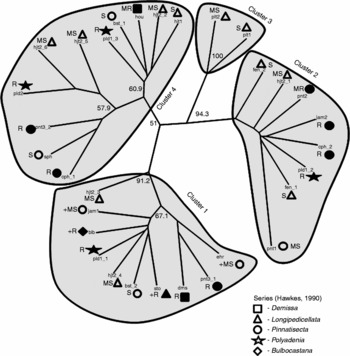
RB-629 was cloned from 16 accessions representing 12 Solanum species (Supplementary Table S1, available online only at http://journals.cambridge.org). Phylogenetic analysis of RB-629 sequences produced four distinct clusters: cluster 1 of bulbocastanum-like haplotypes, cluster 2 comprising pseudogenes except one pinnatisectum RB-629 (pnt2), cluster 3 specific for S. polytrichon and cluster 4 combining other RB-group sequences with open reading frame (Fig. 1). The described pattern of polymorphisms was neither species- nor series-specific; thus the observed diversity of RB-group loci emerged before Solanum speciation and probably is not linked to allopolyploidisation in Solanum species. Apparently, each cluster combines allelic variants of RB orthologues, whereas inter-cluster polymorphisms are indicative of different RB loci. Despite the defence function against LB unequivocally demonstrated in complementation experiments with RB genes, the presence and polymorphisms of RB sequences in various Solanum species were not immediately associated with higher LB resistance. Redundant copies of RB-like paralogues apparently serve as a backup pool essential to the adaptive evolution of R gene-related pathogen recognition when Solanum species respond to novel races of pathogen.
Phylogenetic analysis (maximum likelihood) of the RB fragments (RB-629).+, presence of allele-specific RB-226. Resistance ranks are as follows: open symbols: S, susceptible, MS, moderately susceptible; closed symbols: MR, moderately resistant, R, resistant. Bootstrapping was performed with 1000 replicates, and values higher than 50% are shown at the nodes. Cluster 1, Rpi-blb/RB-like haplotypes; cluster 2, pseudogenes; cluster 3, S. polytrichon-specific haplotypes; cluster 4, other haplotypes. Sequence abbreviations with underscore tag are either allelic or homeologous variants of RB-629. For the list of abbreviations and sequences, refer to Supplementary Table S1 (available online only at http://journals.cambridge.org).

Acknowledgements
We thank all colleagues who generously provided Solanum germplasm used in this study and the anonymous reviewer for constructive criticisms. The study was supported by the ISTC-USDA-ARS project 3714p.