Cultural explanations are frequent in social science research. In gender studies, they are especially common in cross-country comparative research that attempts to explain variations in everyday life situations for women and men. A noticeable example is found in the book Rising Tide: Gender Equality and Cultural Change Around the World, by Ronald Inglehart and Pippa Norris (2003). Inglehart and Norris construct a gender-equality scale from measurements on attitudes among citizens regarding women as political leaders, women's professional and educational rights, and women's traditional role as mother. The results show that Finland, Sweden, West Germany, Canada, and Norway are the countries most influenced by egalitarian values. At the other end of the spectrum countries like Nigeria, Morocco, Egypt, Bangladesh, and Jordan are found (p. 33). The authors demonstrate that egalitarian values are systematically related to the actual conditions of women's and men's lives. They conclude that modernization underpins cultural change, that is, attitudinal change from traditional to gender-equal values, and that these cultural changes have major impact on gender-equality processes.
Inglehart and Norris (Reference Inglehart and Norris2003) are not the first to emphasize culture as important in relation to gender equality. What this perspective alludes to are beliefs deeply embedded in society.Footnote 1 However, even though cultural explanations are commonly used, this approach has been criticized for being unable to capture short-term changes and for being almost a tautology (Rosenbluth, Salmond, and Thies Reference Rosenbluth, Salmond and Thies2006, 172; Sainsbury Reference Sainsbury, Lovenduski and Norris1993). In the article “Political Citizenship and Democratization: The Gender Paradox” (Reference McDonagh2002), Eileen McDonagh presents an interesting twist when she shows how certain principles embedded in government institutions affect women's officeholding. She states that women's political citizenship is strengthened not by a “sameness” principle (asserting women's equality to men as individuals) or a “difference” principle (asserting women's group difference from men), but rather by the paradoxical combination of both. One important conclusion from her work is that gender research should be sensitive to complexities when it comes to the kinds of principles that enhance gender equality.
In accordance with McDonagh's conclusion, we believe that current comparative gender research on culture and values has to move beyond dominant one-dimensional thinking. On the basis of studies in two—and by most standards used, top gender-equal—countries, Norway and Sweden, we suggest a distinction between gender-equality cultures influenced by radical versus liberal feminism. Nordic countries are often treated as one coherent category in worldwide analyses. Our data underpin the conclusion that despite many similarities within the region, there are substantial differences in the way gender equality is understood and talked about in public; that is, Nordic discourses on gender equality vary. The empirical results demonstrate that in Norway, features of liberal feminism dominate the national discourse, whereas in Sweden, features of radical feminism are more clearly in the forefront of the national discourse.
The data we rely upon consist of two large and unique surveys of Swedish and Norwegian economic, political, and social elite groups.Footnote 2 We are able to compare national discourses, but also differences between subgroups, like women and men, within each country. Our analysis displays the interplay between the gender and country context: Swedish women constitute the group most influenced by radical feminism, whereas this perspective is especially weak among Norwegian men. Swedish men and Norwegian women constitute a group in between. Our study should be seen as an important step toward the development of more fine-tuned instruments for capturing national characteristics. In this article, we present evidence that indicates that the strength of radicalism vis-à-vis liberalism is decisive for the actual conditions of women's and men's lives.
TRACING COMPLEXITY
Gender culture is broadly defined as societal ideals, meanings, and values that have gender connotations (Pfau-Effinger Reference Pfau-Effinger1998). In their book, Inglehart and Norris (Reference Inglehart and Norris2003, 8) present a picture of the mechanisms at work when a gender-equality culture facilitates the possibility of women's upward mobility:
Where a culture of gender equality predominates, it provides a climate where de jure legal rights are more likely to be translated into de facto rights in practice; where institutional reforms are implemented in the workplace and public sphere; where women embrace expanded opportunities to attain literacy, education and employment; and where the traditional roles of women and men are transformed within the household and family.
A major contribution of the work of Inglehart and Norris (Reference Inglehart and Norris2003) is the vast empirical data they provide, covering almost all parts of the world. Even though they cannot state that culture matters a particular percentage, their book demonstrates “that cultural traditions are remarkably enduring in shaping men's and women's worldviews” (2003, 3). A similar line of reasoning can be found in a study by Brigitte Liebig (Reference Liebig, Vianello and Moore2000). Her data consist of economic and political leaders in 27 countries. Using questionnaires, she identifies leaders who mostly encourage or resist equal chances for women and men. The results reveal a close relationship between orientation patterns and structural indicators of equality, such as the numerical presence of women. Liebig (p. 231) points out that where leaders' basic assumptions on gender are “progressive,” the number of women are high.
Even though we find the work of Inglehart and Norris (Reference Inglehart and Norris2003) and Liebig (Reference Liebig, Vianello and Moore2000) important, we argue that contemporary research on gender cultures runs the risk of oversimplifying what a gender-equality culture looks like. To use a sharp formulation, we argue that previous research is formed, to an excessive extent, by “more-or-less” and “either/or” ways of thinking.
In contrast to these studies, we will conduct a small-n study, comparing only two countries. This facilitates the emergence of a complex picture. Our ambition is to trace differences in gender-equality cultures. The analysis we present focuses on differences in national discourses about gender equality. Our hypotheses are 1) that variations in national discourses exist and 2) that the differences discovered matter for the actual conditions of women's and men's lives. However, our objective is not to conduct a strict test of hypotheses, but rather to suggest alternative ways of thinking about gender-equality processes. In addition to large-n studies, like those of Inglehart and Norris (Reference Inglehart and Norris2003) and Liebig (Reference Liebig, Vianello and Moore2000), this strand of research is characterized by a number of qualitative studies that suggest multifaceted perspectives but that lack strong empirical support. Our data provide a firm foundation for conclusions regarding the description of variations in national discourses, but when our analysis entails the second part regarding the effects of variations, it will build upon informed reasoning rather than empirical testing.
WHY EXPECT DIFFERENCES BETWEEN NORWAY AND SWEDEN?
This study builds upon two recent trends in Nordic feminist research, both of which emphasize differences within the Nordic region. One trend questions the picture of widespread Nordic egalitarianism, while the other questions the similarly widespread presumption of sameness (see Bergqvist et al. Reference Bergqvist1999; Borchorst Reference Borchorst and Melby2008; Rönnblom Reference Rönnblom2005; Skjeie and Siim Reference Skjeie and Siim2000; Teigen Reference Teigen2002; Wängnerud Reference Wängnerud, Esaiasson and Heidar2000).
Feminists who question the egalitarian picture of the Nordic countries tend to assert that the success story of Nordic gender equality is based on an exaggeration of women's inclusion into some formerly male-dominated areas like the political sphere.Footnote 3 The conclusion from this field of research is that alongside major transformations that have occurred, gender traditionalism prevails. In order to substantiate this view, we will consider the current situation in one of the most extreme spheres: the business elite. Data forthcoming in this article reveal that in 2001, the presence of women in top positions in the Norwegian and Swedish business elite was only 4%. Corresponding figures are reported from Finland and Denmark (Christiansen and Togeby Reference Christiansen and Togeby2007).Footnote 4 Another illustrative example can be found in the relatively high level of gender-segregated labor markets in Nordic countries (Nermo Reference Nermo2000).
The strand of feminist research that questions the description of sameness within the Nordic region relies on statistical facts and figures as well as analyses of public debates on gender-related matters. If we look more carefully at the Nordic countries, differences exist in relation to employment among women and in the extent of part-time work (Ellingsæter Reference Ellingsæter and Bojeand Arnlaug Leira2000a, Reference Ellingsæterb), fertility patterns (Rønsen and Skrede Reference Rønsen, Skrede, Ellingsæter and Leira2006), the organization of child care (Leira Reference Leira, Ellingsæter and Leira2006), and the number of women in leading positions (Christiansen and Togeby Reference Christiansen and Togeby2007; Göransson Reference Göransson2006; Skjeie and Teigen Reference Skjeie and Teigen2005), as well as the kind of strategies used to change power relations between women and men (Borchorst Reference Borchorst and Bergqvist1999; Christensen Reference Christensen and Bergqvist1999; NIKK 2008). Yet the differences between the Nordic countries are perhaps most striking in relation to the gender-related discourse, in the public understanding of the nature of the problem of gender equality.
Research on Nordic discourses points out that in Norway, gender equality is typically understood in terms of a harmonious, linear process of gradual development, whereas in Sweden, gender equality is typically understood in terms of a gender-power system, conflicting interests, and political deficiencies. Anette Borchorst, Ann-Dorte Christensen, and Birte Siim (2002) analyze academic discourses on gender, politics, and power in Denmark, Norway, and Sweden, and they differentiate among a discourse on gender differences (Norway), a discourse on women's subordination (Sweden), and an empowerment discourse (Denmark). Drude Dahlerup (Reference Dahlerup and Borchorst2002) analyzes discourses in political party programs in Sweden and Denmark, and concludes that gender equality is more highly politicized in Swedish, compared to Danish political life. There seems to be a competition among Swedish parties regarding who is most “feminist.”Footnote 5
Previous research on differences within the Nordic region has put us on track to compare Norway and Sweden; our expectation is that these are two distinct cases. However, we want to point out that studies on Nordic discourses are rather tentative, and there are contradictory pictures, especially concerning Sweden. In an analysis of the organization of women in Sweden, Maud Eduards (Reference Eduards2002) concludes that it is a “forbidden act” in Swedish political life to highlight men as a group in any negative terms. In a comparison between Norway and Sweden on gender discourses in policy documents on regional politics, Malin Rönnblom (Reference Rönnblom2005) substantiates this view; she finds that men as a group are curiously “invisible” in the Swedish documents. In her analysis of the Swedish gender-equality discourse, Carol Bacchi (Reference Bacchi1996) identifies a “politics of solidarity” discourse that places restrictions on policymaking within the gender-equality field, in particular depicted as a resistance against setting “women” up against “men.” These findings have alerted us to hybridism as a possible outcome of the empirical analysis.
Previous research also provides some insight to the question of why differences exist. Dahlerup (Reference Dahlerup and Borchorst2002) points out that in Norway and Sweden, but not in Denmark, there is an extensive interplay between the research community and political life. Along the same line, Borchorst, Christensen, and Siim (Reference Borchorst, Christensen, Siim and Borchorst2002) argue that it is reasonable to take into account the different paths that research on gender, politics, and power has taken in the Nordic region. We believe that research by Yvonne Hirdman, a Swedish historian, and Helga Hernes, a Norwegian political scientist, are especially important to mention (cf. Borchorst, Christensen, and Siim Reference Borchorst, Christensen, Siim and Borchorst2002).
Hirdman's theory (Reference Hirdman1990) of the gender system was one of the main contributions to the Swedish Power Investigation, a well-known social science project in Sweden during the 1980s and early 1990s.Footnote 6 Gender system theory is a version of contract thinking, where the contract serves as a general metaphor for the relationship between women and men. Hirdman presents a chronicle of gender contracts throughout the twentieth century, from the housewife contract and the equal-status contract to the present gender-equality contract. Her main point is that the way gender relations are organized tends to change, yet the gender structure prevails. Beneath the surface there are two types of logic, hierarchy and segregation, putting women and men in positions of domination (men) and subordination (women).
On the other hand, in her book Welfare State and Woman Power, Helga Hernes (Reference Hernes1987) contributes to explanations for changes that have occurred in the Scandinavian welfare states. Hernes emphasizes Scandinavian societies' potential for transforming into women-friendly societies. She presents an inclusion dynamic, whereby mobilization from “below,” that is, through social and feminist movements, combines with integration from “above,” that is, through the political elite and state bureaucracies. This inclusion dynamic describes the patterns of participation and policymaking of gender-equality policies. Thus, women's dependence in Scandinavia shifted from the private to the public sphere: from individual men to the state. This shift implies women's increased power in relation to men. Hernes introduces a state-friendly feminism and a more optimistic picture of the development of gender relations than the picture provided by Hirdman.Footnote 7
If we look at factors proposed in more quantitative-oriented comparative research we do not find many clues to why there should be differences between Norway and Sweden. Aspects like “modernity” (Bergh Reference Bergh2007; Inglehart and Norris Reference Inglehart and Norris2003) look pretty much the same in both countries, and other factors highlighted in research on gender-related attitudes, such as the age composition of the population and the level of education (Bergh Reference Bergh2007; Wilensky Reference Wilensky2002), do not differ in any systematic way either. Our contribution to the understanding of mechanisms at work will be to emphasize variations in the interplay between gender research, the women's movement and the political parties in Norway and Sweden during a period of economic recession (the 1990s), and the simultaneous decline in the representation of women in parliament.
SURVEYS OF ELITE PERCEPTIONS
Our analysis is organized around the comparison of ideals, values, and meanings among the Norwegian and Swedish elite. We analyze the existence of differences in discourses between our selected cases by examining the extent to which national elite groups provide different explanations for the reason why top positions in society are dominated by men. The assumption is that these elite perceptions serve as a lens that makes important national/cultural characteristics visible.
The data used are two survey studies of Norwegian and Swedish economic, political, and social elite groups conducted in 2000/2001 (Norway) and 2001 (Sweden). Our data consist of a sample of 2,734 persons in Sweden and 1,976 in Norway. In both countries, the samples included all persons (total selection) in top positions in the following sectors: politics, state bureaucracy, culture, mass media, business, interest organizations, universities and research institutes, the legal system and the police, the military, and the church.Footnote 8 The Norwegian data were collected through a questionnaire with 1,710 elite persons. The response rate was 87%.Footnote 9 The Swedish data were collected through posted questionnaires with 1,579 elite persons, which means a response rate of 58%.
The Norwegian and the Swedish data were collected by two different research groups, but due to collaborations at early stages of the research process, questions posed are comparable.Footnote 10 The Swedish sample is larger. This has mainly to do with the fact that Sweden is a larger country. Generally, more positions are included from each of the sectors. However, it also has to do with the inclusion of additional positions in the elite category. Sweden is a member of the European Union; Norway is not. The Swedish research team included some influential positions that Swedes hold in the EU, like Swedish members of the European Parliament (political elite), but also people appointed to the juridical or public administration sphere of the EU (state bureaucracy elite). Otherwise, the differences between the countries in the distribution of persons in elite sectors are rather small.Footnote 11
LIBERAL VERSUS RADICAL FEMINISM
One watershed finding in previous research on Nordic gender discourses concerns elements of confrontation. We will use the well-established distinction between liberal and radical feminism in order to trace different national characteristics. Liberal feminism is an individualist-centered perspective, based on claims for equal rights (Bryson Reference Bryson2003; McLaughlin Reference McLaughlin2003). The focus of liberal feminist explanations of gender-equality deficiencies tend to be women oriented; gender-equality problems are framed as “women questions,” and if women could only come forward or change their behavior in other ways, gender equality would be a reality. Radical feminism focuses on gender differences as caused by patriarchal structures, where men as a group dominate women as a group (Bryson Reference Bryson2003; McLaughlin Reference McLaughlin2003). The focus of radical feminist explanations of gender-equality deficiencies tend to be structurally oriented; gender as the basis for conflicts of interests is made explicit, and power is at the center for understanding gender relations.
THE GENDER EQUALITY DISCOURSE OF NORWAY AND SWEDEN: EMPIRICAL RESULTS
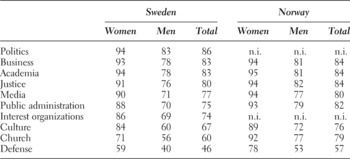
Before we explore the questions central to our analysis of differences in Swedish and Norwegian gender-equality discourses, we present a report on an indicator from the questionnaires that were designed to capture what we consider “more-or-less” ways of thinking. Both surveys included questions about the level of support among the elite for measures to promote gender balance in top positions within society. Table 1 shows the number who responded “very” and “fairly” important. For each country, we report results in the categories of women, men, and total level of support.
Support among women and men in Sweden and Norway for measures to promote gender balance in top positions within the following sectors (percentage very and fairly important)

Notes: Item designated n.i. not included in the survey. Question in the surveys: (i) Sweden: “How important do you think it is to implement measures to achieve gender balance in top positions within the following sectors? (very important, fairly important, neither important or not important, fairly unimportant, and completely unimportant)” and (ii) Norway: “Most top positions in Norwegian society are clearly male dominated. Do you think it is very important, pretty important, less important, or not important at all to implement measures to achieve gender balance, within the following sectors?” Minimum number of respondents: Sweden (men 1,138, women 461); Norway (men 1,416, women 308).
Source: Sweden Elite Study 2001 and Norway Elite Study 2000/2001.
The major result in Table 1 is the common feature of general support for gender-equality measures among the Norwegian and Swedish elite. There is a high level of agreement in ranking order between countries (Spearman's Rho 0.93) and between women and men, as well as a high level of agreement concerning the total level of support. It is only in one sector, the church, where there is a noteworthy difference: In Norway, 79% of respondents give a high level of support for measures to promote gender balance within this sector, whereas the corresponding figures in Sweden is 60% (a difference of 19 percentage points). The common picture of gender-equality support is important to bear in mind as we now turn to the presentation of empirical results concerning features of liberal versus radical gender-equality discourses.
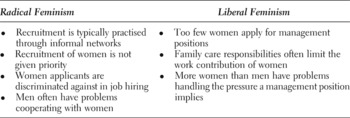
Both questionnaires included seven questions that all propose different explanations for male dominance in top positions. For each explanation, the respondents could answer “very important,” “fairly important,” “not very important,” or “not at all important.” We report the percentages of respondents who agree with each of the separate explanations (the categories “very important” and “fairly important” are merged). Table 2 shows how we have categorized the explanations.Footnote 12
Categorization of explanations as indicating radical versus liberal feminism

Notes: Question in the survey: (i) Sweden: “According to your experience, how important do you find each of these statements concerning why there are fewer women than men in top positions within your organization?” and (ii) Norway: “There are several possible explanations for why men continue to dominate top positions in work and organizational life. If we concentrate on your own organization, how important do you find each of these statements?”
Source: Sweden Elite Study 2001 and Norway Elite Study 2000/2001.
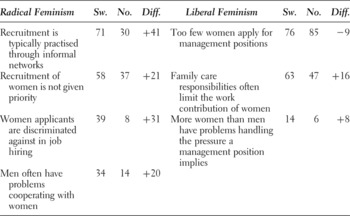
As already demonstrated in this article, there are good reasons to expect that Norway and Sweden are characterized by different gender-equality discourses. In the empirical analyses, we will focus on systematic patterns and the magnitude of differences; as a rule of thumb, we will emphasize differences between groups that entail approximately 20 percentage points or more. Table 3 shows the total level indicating either “very” or “fairly” important in each country to the explanations presented for male dominance in top positions.
Total support for radical versus liberal feminism explanations in Sweden and Norway (percentage)

Notes: For further information, see Table 2. Minimum number of respondents: Sweden (1,344), Norway (1,105).
The figures in Table 3 quite clearly support the assumption of a more radical gender discourse in Sweden. All explanations that are categorized as radical feminist receive stronger support in the Swedish case, with differences of 20 percentage points or more. Concerning the liberal feminist explanations, the results are more ambiguous. Differences between the two countries are smaller, and there is only one explanation (“too few women apply for management positions”) that gains stronger support in Norway (85%) than in Sweden (76%).
We have chosen to work with two levels of analysis: 1) the average level of support for different types of explanations in each country and 2) the level of attitudinal gaps between women and men (cf. Bergh Reference Bergh2007; Inglehart and Norris Reference Inglehart and Norris2003; Wilcox Reference Wilcox1991).Footnote 13 In the next two sections we report the responses of women and men in each country. We start with the responses categorized as radical feminism and then proceed to the responses to the explanations categorized as liberal feminism.
Radical Feminism among Women and Men in Norway and Sweden
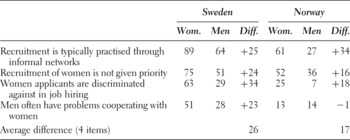
Table 4 shows that gender matters in both countries: Women give higher support for radical explanations both in Norway and Sweden. There is only one exception to this result: The explanation “men often have problems cooperating with women” is supported by 14% among men and 13% among women in Norway. However, it is interesting to note that differences between women and men are somewhat larger in Sweden (on average 26 percentage points) than in Norway (on average 17 percentage points).
Support for radical feminism explanations among women and men in Sweden and Norway (percentage)

Notes: For further information, see Table 2. Minimum number of respondents: Sweden (women 358, men 883); Norway (women 93, men 1,012).
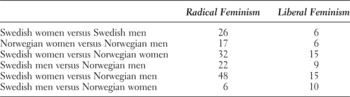
According to Table 4, Swedish men and Norwegian women appear to be rather similar. The average difference between these two groups among the four explanations is only 6 percentage points (Appendix, Table A1). The two groups that most clearly oppose each other are Swedish women and Norwegian men, with an average difference of 48 percentage points (Appendix, Table A1). Gender matters in both countries, but Norwegian women do not exceed Swedish men in radicalism. All in all, the analysis in Table 4 supports the previous finding that features of radical feminism are stronger in Sweden than in Norway. Differences do not disappear when the gender of the respondents is taken into account.
Liberal Feminism among Women and Men in Norway and Sweden
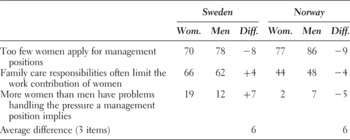
The previous results concerning features of liberal feminism, as reported in Table 3, are more ambiguous than the results concerning features of radical feminism. The difference between the two countries on these items was actually smaller in the total category than we had expected. The following analysis reveals results in the same direction: The distances are strikingly smaller between the subgroups in this analysis compared to the analysis of radical feminism. Table 5 shows the support for explanations categorized as liberal feminist among women and men in Norway and Sweden.
Support for liberal feminism explanations among women and men in Sweden and Norway (percentage)
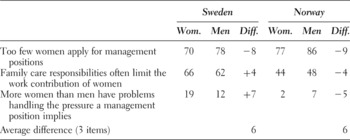
Notes: For further information, see Table 2. Minimum number of respondents: Sweden (women 383, men 971); Norway (women 93, men 1,012).
In the Norwegian case, all items show that the support for liberal feminist explanations is somewhat stronger among men than women, whereas this is not the case in Sweden. In Sweden, only men give stronger support than women to the explanation “too few women apply for management positions.” The explanations “family care responsibilities often limit the work contributions of women” and “more women than men have problems handling the pressure a management position implies” receive stronger support among women. However, in both countries, the average difference is only 6 percentage points, which is remarkably lower than in the analysis of explanations categorized as radical feminist.
In the analysis of radical feminism, it was quite easy to single out opposites: Swedish women and Norwegian men, which cannot be done as easily in this section. Norwegian men, to a greater extent, support the explanation “too few women apply for management positions” than do Swedish women, but for the other two liberal feminist explanations, the situation is reversed with greater support among Swedish women. However, what we really want to stress here is the flatter result. With only one exception, the average figures for the liberal feminist explanations are remarkably lower than the average figures for the radical feminist explanations. The exception shows up in a comparison between Swedish men and Norwegian women; the average difference between those two groups was somewhat smaller for the radical feminist explanations (6 percentage points) than for the liberal feminist explanations (10 percentage points; see Appendix, Table A1.)
A Mixture of Gender-Equality Cultures?
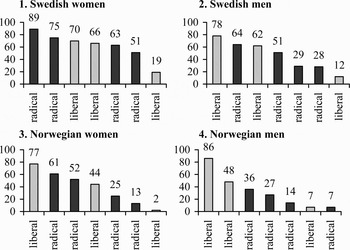
The analyses confirm our assumption that national differences exist in the perception of gender-equality matters. Still, it is important to take notice of the hybridism disclosed. Both a liberal/women-oriented and a radical/structure-oriented gender-equality discourse are present in both countries. However, features of radical feminism are more dominant in the Swedish than in the Norwegian case. Figure 1 includes four different diagrams: one for Swedish women, one for Swedish men, one for Norwegian women, and one for Norwegian men. In each diagram, the total percentages that agree with the different explanations are presented. Even though the diagrams do not display any new findings, we believe that they facilitate a reasonable overview of the strength of the two perspectives vis-à-vis each other.

Our conclusion that radical feminism is a dominant feature among Swedish elite women, and liberal feminism is a dominant feature among Norwegian elite men, is visualized in the diagrams. It is also envisioned that among Swedish elite men and Norwegian elite women, the mixture of perspectives is rather balanced. We have used other subcategories besides women and men in our analysis.Footnote 14 However, we have chosen not to report on these results in detail. The overall picture is that the main patterns, emphasizing differences between countries and between women and men, prevail even though the total level of support for the various explanations differs according to sector.Footnote 15
EXPLANATION OF DIFFERENCE
The empirical analyses presented in this article demonstrate that questions concerned with general support for gender equality evoked few differences between Norway and Sweden; however, questions concerned with explanations of male dominance clearly revealed different national characteristics.
The assumption guiding the empirical analyses has been that elite perceptions serve as a lens that makes gender cultures visible. When respondents are asked to evaluate explanations of male dominance, we stimulate different forms of gender-equality thinking to reach the surface, forms that reach beyond more-or-less or either/or ways of thinking. The labels used—radical versus liberal feminism—can be discussed; however, the difference between Norwegian and Swedish discourses documented in previous qualitative-oriented research is basically confirmed. Altogether, there are two major conclusions to be extracted from our research: First, it is clearly demonstrated that radical, structure-oriented explanations are displayed more in the Swedish than in the Norwegian elite. Second, hybridism of the national gender-equality discourse is revealed. There are only small differences between Norway and Sweden, and between groups, in support of explanations corresponding to the liberal, women-oriented explanations.
A common pattern is that in each country, women are the group most strongly influenced by radical feminism. However, Norwegian women do not surpass Swedish men in radicalism. Our interpretation is that within each national context, women serve as a “vanguard” for new forms of feminist thinking, but national characteristics still provide frames for the kind of problems represented by gender equality and for the assignment of responsibility (cf. Bacchi Reference Bacchi1999).
In the following discussion, we develop a possible explanation for why Sweden and Norway are featured by rather distinctive gender-equality discourses. Yet we underline that the presentation is preliminary, and future research should engage in exploring and explaining variation and change in Nordic gender-equality regimes.
A major reason for the differences in national gender-equality discourse relates to the development and direction of the third-wave feminism that arose in many countries during the 1990s (Christensen, Halsaa, and Saarinen Reference Christensen, Halsaa and Saarinen2004; Heywood and Drake Reference Heywood and Drake1997). There are probably several causes for the emergence of stronger and more radical third-wave feminism in Sweden than in Norway. We argue that in the 1990s, groups of women in Sweden forcefully “exploited” important events in that period, which led to a shift or an intensification of the national gender-equality discourse.
One important event for the escalation of the radical feminist debate in Sweden was the publication of the much-noticed Swedish Power Investigation (1990, 44), particularly the already mentioned analysis of the Swedish gender system by Yvonne Hirdman. Her analysis of the Swedish gender system has had a constitutive role for the remobilization of the Swedish women's movement, not least for the way in which it provoked intense debate and collided with the picture of Sweden's leading international position on gender equality.
Another, coincidental event was the parliamentary election in Sweden in 1991, wherein the number of women decreased in the Swedish parliament for the first time since the 1920s, from 38% to 33.5%. The decrease in the representation of women coincided with a shift in government from a social-democratic government to a coalition government formed by right-wing and midpositioned parties. For the first time in modern Swedish history, a party of the radical right also gained seats in the parliament. Soon after the election, some influential female journalists and academics emerged as leaders of the loosely formed network called the Support-Stockings. The network introduced the demand of “half the power, the whole salary,” focusing on women's low presence in elite positions and wage discrimination (Eduards Reference Eduards2002, 69–73; Freidenvall Reference Freidenvall2006, 130).
The different economic situations in Sweden and Norway in the 1990s, where the recession struck Sweden much more severely than Norway, provided a breeding ground for differences in the gender-equality discourse,Footnote 16 not the least because of the consequences the recession in Sweden had for welfare state arrangements, which was a focal point for policymaking and public debate (Daune-Richard and Mahon Reference Daune-Richard, Mahon, Jenson and Sineau2001; Earles Reference Earles2004; Ellingsæter Reference Ellingsæter2000b). With the decrease in the representation of women in parliament and the remobilization of the women's movement, this package of conditions constituted what could be called a “window of opportunity” for radical feminist elements in Sweden. The Support-Stockings network threatened to form a feminist party and alliances were built, especially with women in the Social Democratic Party and the Left Party in Sweden. The threat to form a feminist party was not realized; however, all the major parties in Sweden made adaptations to the network's demands.Footnote 17 In 1994, in the next general election in Sweden, the number of women in the Swedish parliament rose to 41% and the Support-Stockings network was dismissed. Issues of gender equality—more broadly understood than in terms of numbers of women—were also high on the agenda in the Swedish 1994 election.
The situation in Norway in the 1990s differed from that of Sweden. Indeed, in the 1997 parliamentary election, there was a decrease from 39% to 36% women in the Norwegian parliament, and there was also a shift from a social-democratic government to a coalition government between right-wing and midpositioned parties in this election. However, no special women's movement like the Swedish Support-Stockings network arose. Perhaps more importantly, except for state-initiated efforts to increase the number of women in politics, political parties, women's organizations, and so on, did not respond in any specific way to the decrease. The current (2008) number of women in the Norwegian parliament is 36%, whereas it is 47% in the Swedish parliament.Footnote 18
Regarding gender-equality measures, on the other hand, Norway emerged as more radical than Sweden. Hard measures have played a much more prominent role in Norway than in Sweden. Today, quotas and positive-action policies formally regulate admission into most areas of Norwegian society where gender imbalances exist (Teigen Reference Teigen2006). These policies, especially the strict quota procedures, evidently manage to secure a minimum 40% representation of women within important fields in Norwegian society, such as on publicly appointed boards and committees, in those political parties that have voluntary agreed upon quota arrangements, and recently on the boards of the public-limited companies.
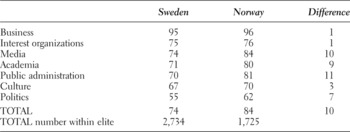
Despite the fact that the Norwegian quota regime appears to constitute a feature of radicalism in Norwegian gender-equality policy, women are actually more strongly represented in top positions in Sweden. The presence of women in elite positions in society is higher in Sweden than in Norway in all sectors: politics, culture, public administration, academia, mass media, interest organizations, and business (Table A2 in the Appendix). In other words, this situation indicates that the intense and radical Swedish gender-equality discourse has a more positive effect on gender equality than have the Norwegian quota measures. Quotas as expressions of state feminism “from above” may have had the effect of tempering the public gender-equality discourse. Norwegian quota policies may have the effect on the public that problems of gender equality are perceived as something that is dealt with as a matter for state intervention, and thus not a concern for the public.Footnote 19
DOES TYPE OF GENDER EQUALITY CULTURE MATTER?
Generally, men dominate national elite positions in Norway and Sweden. However, as mentioned previously, women are somewhat better represented in top positions in Sweden. In total, there are 16% women in the Norwegian elite and 26% in the Swedish elite (see Appendix, Table A2). The only sector that can be placed within a 40:60 ratio is actually the Swedish political elite.
The stronger presence of women in the Swedish elite could indicate that the stronger radical gender-equality discourse in Sweden, vis-à-vis liberal Norwegian gender-equality discourse, has an impact on actual situations for women. It is worth noting that women are comparatively better represented in Sweden in those elite groups that normally are the most engaged and that participate the most actively in public debates, for example, mass media, academia, state bureaucracy and politics.Footnote 20
We want to underscore the need for studies that scrutinize actual conditions for women and men in countries like Norway and Sweden. What we are able to point out here is that it seems easier for women in Sweden to reach top positions of society, but that is only one part of the story of what gender equality is about. What could be added to the picture is that when organizations like Social Watch, World Economic Forum, and International Alliance for Save the Children measure “real” gender equality, Sweden is presently (2007) ranked higher than Norway, even though both countries qualify among the absolute top in these international rankings.
We are reluctant to discuss the effects more thoroughly. Our main object in this article has been to develop and empirically underpin a new, more complex way of understanding what a gender-equality culture looks like. The conclusion we want to emphasize is that we should start to talk about gender-equality cultures (in plural forms) and also start to develop instruments that are able to differentiate between top-equal countries when it comes to gender equality in everyday life situations.
The complexities of gender equality need broader and more nuanced approaches than provided thus far in research. The core in this article is a description of gender-equality cultures in two top gender-equal countries—one influenced by features of liberal feminism (Norway), and one (Sweden) where features of radical feminism are clearly at the forefront. We hope that our analysis will contribute to future developments of more fine-tuned concepts and measurements. Cultural explanations are hard to ignore since national/regional patterns represent a recurrent result in cross-country comparative research on gender equality. However, the critiques that have emerged have to be taken seriously. There is a definite risk that culture will become a catchall category in social science research—when we cannot explain a phenomenon satisfactorily with other factors or variables, the cultural explanation is brought in. We believe that in order to expand research on gender equality, we need a new way of theoretical thinking—one that takes into account more dimensions than “more-or-less” or “either/or.”
A final note concerns the fact that current dominant thinking in the field on gender, culture, and values has no tools to help us develop our understanding of obstacles in countries like Norway and Sweden. What happens when values hit the roof on the Gender Equality Scale developed by Inglehart and Norris (Reference Inglehart and Norris2003)? Are these countries then to be seen as influenced by egalitarianism as any country ever could be? What should be stressed is that although our analysis actually strengthens the idea from Inglehart and Norris (Reference Inglehart and Norris2003) and also Liebig (Reference Liebig, Vianello and Moore2000) that values are important, the way gender equality is understood and discussed in public seems to have a decisive impact on the actual gender-equality situation.
APPENDIX
Comparisons of average differences between women and men in Sweden and Norway concerning explanations categorized as radical versus liberal feminism (percentage)

Variations in male dominance of the Swedish and Norwegian elite, by sector (percentage)

Notes: Table A2 shows the actual distribution of women and men in different elite sectors of Sweden and Norway. We have chosen to report the situation as of 2001 (Sweden) and 2000 (Norway) in terms of variances in male dominance. The ranking orders the sectors from most to least male dominated, with the situation in Sweden used as the reference point.
Source: Sweden Elite Study 2001 and Norway Elite Study 2000/2001.