Introduction
In all kingdoms of life, the adenosine triphosphate (ATP)-binding cassette (ABC) transporter family is one of the largest transporter protein superfamily; these proteins can bind and hydrolyze ATP while transporting multiple substrates on lipid membranes, including amino acids, peptides, xenobiotics, and drugs (Derumauw and Leeuwen, Reference Derumauw and Leeuwen2014). The functional ABC transporter consists of two cytosolic nucleotide binding domains (NBDs), which contain three conserved motifs (Walker A, Walker B, and ABC signature motifs), and two integral transmembrane domains (TMDs) (Davidson et al., Reference Davidson, Assa, Orelle and Chen2008). The NBDs can provide energy to transport substrates through binding and hydrolyzing ATP, and the TMDs participate in translocating the substrate (Rees et al., Reference Rees, Johnson and Lewinson2009). The ABC protein family can be classified into eight subfamilies (ABCA to ABCH), according to the sequence similarity and the domain structure of the NBDs (Dean and Annilo, Reference Dean and Annilo2005; Hollenstein et al., Reference Hollenstein, Dawson and Locher2007). However, members of the ABCH family have been identified only in Danio rerio, Dictyostelium discoideum, and arthropods (Derumauw and Leeuwen, Reference Derumauw and Leeuwen2014).
ABC transporters have been widely studied in humans. Multidrug-resistance proteins (MDRs), P-glycoproteins (P-gps), multidrug-resistance associated proteins (MRPs), and the breast cancer resistance protein are related to the multidrug resistance of cancer cells to chemotherapeutics (Kartner et al., Reference Kartner, Evernden-Porelle, Bradley and Ling1985; Riordan et al., Reference Riordan, Deuchars, Kartner, Alon, Trent and Ling1985; Hopper-Borge et al., Reference Hopper-Borge, Xu, Shen, Shi, Chen and Kruh2009; Juan-Carlos et al., Reference Juan-Carlos, Perla-Lidia, Stephanie-Talia, Mónica-Griselda and Luz-María2021). In addition, ABC transporters participate in lipid transport (Wenzel, Reference Wenzel2007), the import of long-branched chain acyl-CoA into peroxisomes (Morita and Imanaka, Reference Morita and Imanaka2012), the biogenesis of cytosolic iron–sulfur clusters, heme biosynthesis, iron homeostasis, and protection against oxidative stress in humans (Zutz et al., Reference Zutz, Gompf, Schägger and Tampé2009). Among arthropods, the ABC transporters in Drosophila melanogaster are the most widely studied. In D. melanogaster, ABC transporters are involved in the transport of eye pigment precursors (Mackenzie et al., Reference Mackenzie, Brooker, Gill, Cox and Ewart1999), cyclic guanosine monophosphate (Evans et al., Reference Evans, Day, Cabrero, Dow and Davies2008), biogenic amines (Borycz et al., Reference Borycz, Kubów, Lloyd and Meinertzhagen2008), development (Hock et al., Reference Hock, Cottrill, Keegan and Garza2000) and control of the transcription of circadian clock genes (Itoh et al., Reference Itoh, Tanimura and Matsumoto2011). In Tribolium castaneum, it has been proven that ABCG subfamily members are associated with insect development. Injection of TcABCG dsRNA into T. castaneum larvae resulted in growth arrest and localized melanization, eye pigmentation defects, abnormal cuticle formation, egg-laying and egg-hatching defects, and mortality due to abortive molting and desiccation (Broehan et al., Reference Broehan, Kroeger, Lorenzen and Merzendorfer2013). Similar phenomena have also been found in Tetranychus urticae and Bombyx mori (Grbic et al., Reference Grbić, Leeuwen, Clark, Rombauts, Rouzé, Grbić, Osborne, Dermauw, Ngoc, Ortego, Hernandez-Crespo, Diaz, Martinez, Navajas, Sucena, Magalhaes, Nagy, Pace, Djuranovic, Smagghe, Lga, Christianes, Veenstra, Ewer, Villalobos, Hutter, Dudson, Velez, Yi, Zeng, Pires-daSiva, Roch, Cazaux, Navarro, Zhurov, Acevedo, Bjelica, Fawcett, Bonnet, Martens, Baele, Wissler, Sachez-Rodiguez, Tirry, Blais, Demeestere, Henz, Gregory, Mathieu, Verdon, Farinelli, Schmutz, Lindquist, Fryerisen and Peer2011; Liu et al., Reference Liu, Zhou, Tian, Guo and Sheng2011). In addition, ABC transporters play important roles in insecticide resistance, in insect–Bacillus thuringiensis interaction and in the transportation of plant secondary compounds (Aurade et al., Reference Aurade, Jayalakshmi and Sreeramulu2010, Reference Aurade, Akbar, Goud, Jayalakshmi and Sreeramulu2011; Guo et al., Reference Guo, Kang, Chen, Wu, Wang, Xie, Zhu, Baxter, Zhou, Jurat-Fuentes and Zhang2015; He et al., Reference He, Liang, Liu, Wang, Wu, Xie and Zhang2018; Liu et al., Reference Liu, Jiang, Xiong, Peng, Li and Yuan2019; Guo et al., Reference Guo, Kang, Sun, Gong, Zhou, Qin, Guo, Zhu, Bai, Ye, Wu, Wang, Crickmore, Zhou and Zhang2020; Meng et al., Reference Meng, Yang, Wu, Shen, Miao, Zheng, Qian and Wang2020; Rosner et al., Reference Rosner, Tietmeyer and Merzendorfer2021; Shan et al., Reference Shan, Sun, Li, Zhu, Liang and Gao2021). However, little is known about the functions of ABC transporters in virus transmission in insect vectors.
Rice black-streaked dwarf virus (RBSDV) is transmitted by Laodelphax striatellus (Fallén) in a persistent propagative manner (Zhang et al., Reference Zhang, Chen and Adams2001; Wu et al., Reference Wu, Zhang, Ren and Wang2020). RBSDV belongs to the genus Fijivirus of the family Reoviridae and is the causal agent of rice black-streaked dwarf and maize rough dwarf disease (Wu et al., Reference Wu, Zhang, Ren and Wang2020). The epidemic of these viral diseases caused considerable yield losses in East Asia. The RBSDV genome includes ten double-stranded RNA (dsRNA) segments (S1 to S10), and encodes thirteen proteins. Each segment of S5, S7, and S9 encodes two proteins. P5-1, P6, and P9-1 proteins are components of the viroplasm (Li et al., Reference Li, Xue, Zhang, Yang, Lv, Xie, Meng, Li and Chen2013; Sun et al., Reference Sun, Xie, Andika, Tan and Chen2013; He et al., Reference He, Chen, Yang, Zhang, Li, Zhang, Zhong, Zhang, Chen and Yang2020). P10 protein is the outer capsid protein of RBSDV and plays key roles in viral infection (Lu et al., Reference Lu, Wang, Huang, Xu, Zhou and Wu2019a; Zhang et al., Reference Zhang, Tan, He, Xie, Li, Wang, Hong, Li, Taliansky, MacFarlane, Yan, Chen and Sun2019).
In the present research, the functions of ABC transporters in RBSDV infection in the insect vector L. striatellus were analyzed through treatment with the ABC transporter inhibitor verapamil. A total of 34 genes encoding members of the ABC superfamily were identified based on the genome of L. striatellus. The relative expression levels of 34 ABC transporters were compared in RBSDV-infected and virus-free populations of L. striatellus. Furthermore, the roles of LsABCF2 and LsABCG9 were analyzed during RBSDV infection in L. striatellus by RNA interference (RNAi). These results will provide insight into ABC transporter functions in response to virus infection in insects.
Materials and methods
Insect and virus
The population of L. striatellus was originally collected from Haian (32.57°N, 120.45°E; Jiangsu, China). The population was fed on rice seedlings at 25 ± 1°C with 70–80% humidity and 16 h light:8 h dark photoperiod. The RBSDV-infected rice plants, containing typical dwarf symptoms, were collected from the field.
Verapamil treatment
The verapamil was dissolved in the dimethyl sulfoxide, and diluted to 0.5, 0.25, and 0.1 mM in acetone. Third-instar nymphs of L. striatellus, reared on the rice seedlings infected with RBSDV for 2 days, were used in the study. After anesthetization on the ice, a droplet (100 nl) of verapamil solution was applied topically to the prothorax notum of the nymphs by a FemtoJet microinjector (Eppendorf, Germany). Acetone treatment was applied as a control. Each experiment was carried out with 30 nymphs, and each treatment included three independent biological replicates. The treated nymphs were transferred to healthy rice seedlings for 3 days. The RBSDV accumulation was determined by detecting the expression of S10 and the replication-related genes, S5-1, S6, and S9-1 by quantitative real-time polymerase chain reaction (RT-qPCR).
Identification of ABC transporter genes and phylogenetic analysis
Potential ABC transporter genes annotated in the L. striatellus genome were searched for, including ABC transporters, ABC transporters/proteins, MDRs, P-gps, and MRPs (Zhu et al., Reference Zhu, Jiang, Wang, Yang, Bao, Zhao, Wang, Lu, Wang, Cui, Li, Chen, Luo, Yu, Kang and Cui2017). The short (<500 bp) and repetitive sequences were removed, and the amino acid sequences of the remaining ABC transporter gene were blasted against the NCBI nonredundant (Nr) protein database to remove the redundant sequences and faulty annotated sequences. A phylogenetic tree was generated by the ClustalW alignment of the amino acid sequences with ABC transporter genes from other insect species, including Nilaparvata lugens, B. mori, Diaphorina citri, and Helicoverpa armigera, using the neighbor-joining method in MEGA 5.05 with 1000 bootstrap replicates.
Analyzing the expression of ABC transporters during RBSDV infection
The virus-free nymphs of L. striatellus were reared on rice seedlings infected with RBSDV for 2 days, and then transferred to healthy rice seedlings until molting into fifth-instar nymphs. The surviving nymphs were collected as RBSDV-infected samples. In addition, the virus-free nymphs of L. striatellus were reared on healthy rice seedlings until molting into fifth-instar nymphs, and collected as a control. Each treatment contained thirty nymphs, and each treatment included three independent biological replicates. The expression of ABC transporters was detected in both RBSDV-infected and virus-free samples.
L. striatellus tissue and instar samples
For tissue dissection, the L. striatellus were rinsed three times with 75% ethanol and washed three times with sterilized deionized water. With a stereomicroscope, the tissues of the midgut, fat body, ovary, and salivary gland of L. striatellus were dissected in chilled 1× phosphate-buffered saline (pH 7.4) with sterile forceps. Tissues dissected from 50 virus-free L. striatellus and each tissue sample included three independent biological replicates.
The first-instar to fifth-instar nymphs, and male and female adults of L. striatellus were collected. Each treatment included 50 insects, and was processed in three independent biological replicates.
Quantitative real-time PCR
L. striatellus total RNA was extracted by TRIzol reagent (Invitrogen, United States). The RNA quantity and quality were detected by spectrophotometry (NanoDrop 2000, Thermo Scientific) and agarose gel electrophoresis, respectively.
The PrimeScript™ RT reagent kit with gDNA Eraser (Takara, Japan) was used to synthesize cDNA. RT-qPCR experiments were performed using a SYBR PrimeScript™ RT-PCR Kit (Takara, Japan) and an IQ™5 multicolor real-time PCR detection system (Bio-Rad, USA). Each RT-qPCR reaction included three independent technical and biological replications. RPL5 (encoding ribosome protein L5) was used as an internal reference gene. The 2−ΔΔCt method was used for data analysis. The primers were designed by using Beacon Designer 7.7 and are listed in table S1.
RNA interference
The primers, amplifying the target fragment for RNAi, are listed in table S1. According to the manufacturer's instructions, the T7 high-yield transcription kit (Invitrogen, United States) was used to synthesize the dsRNA. After anaesthetization on ice, virus-free third-instar nymphs were injected with 100 nl dsRNA (2 μg μl−1) by using a FemtoJet microinjector (Eppendorf, Germany) in conjunction with the prothorax and mesothorax of L. striatellus. Enhanced green fluorescent protein dsRNA was used as a control. The RNAi efficiency of target genes was determined by calculating their relative expression levels at 1 and 3 days after dsRNA injection. The mortality rate of L. striatellus was checked at 1 and 3 days after dsRNA injection. Furthermore, virus-free third-instar nymphs reared on rice seedlings infected with RBSDV for 2 days were injected with 100 nl dsRNA (2 μg μl−1). After injection, the nymphs were transferred to healthy rice seedlings for 3 days. RBSDV accumulation was determined by detecting the relative expression levels of S5-1, S6, S9-1, and S10 by RT-qPCR. Each experiment was carried out with 30 insects and three independent biological replicates.
Statistical analysis
SPSS 20.0 (IBM Corporation, United States) was used for the statistical analysis. One-way analysis of variance with the least significant difference test was used in data analysis. The P values <0.05 and <0.01 were regarded as the thresholds of significant and very significant differences, respectively.
Results
The role of verapamil in RBSDV accumulation
Verapamil, an inhibitor of ABC transporters, was applied to explore the potential functions in RBSDV accumulation in L. striatellus. Compared to the control, the relative expression of the RBSDV coat protein gene S10 and replication-related genes S5-1, S6, and S9-1 were significantly reduced after verapamil treatment at three doses (fig. 1). These results indicated that inhibition of ABC transporters suppressed RBSDV accumulation in its insect vector.
Relative expression of RBSDV coat protein gene S10 and replication related genes, S5-1, S6, and S9-1 after acetone treatment and verapamil treatment with three doses. The letters a, b, and c present significant differences (P < 0.05) of the expression level.

Transcriptional response of 34 ABC transporters to RBSDV infection
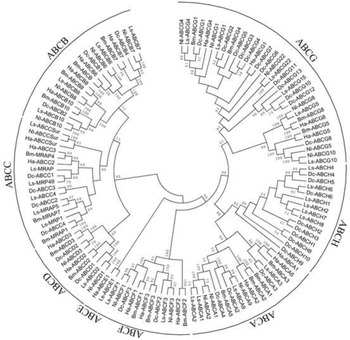
In insects, ABC proteins are classified into eight subfamilies, ABCA to ABCH. In this study, 34 ABC transporter genes were identified based on the genome of L. striatellus, including three ABCAs, four ABCBs, seven ABCCs, one ABCD, one ABCE, three ABCFs, seven ABCGs, and eight ABCHs (fig. 2, table 1). To identify the ABC transporters that might be involved in RBSDV infection, the relative expression levels of 34 ABC transporters in RBSDV-infected and virus-free populations of L. striatellus were compared by RT-qPCR. Two ABC transporters were significantly differently expressed after RBSDV infection (fig. 3). After RBSDV infection, the relative expression level of LsABCF2 was upregulated more than 15-fold, while LsABCG9 was reduced by 85% (fig. 3b).
Phylogenetic analysis of ABC transporter genes. The numbers above the branches indicated the support for the phylogenies, and only values above 50% are shown. Ls, L. striatellus; Nl, Nilaparvata lugens; Bm, Bombyx mori; Dc, Diaphorina citri; Ha. Helicoverpa armigera.

Expression induction of 34 ABC transporter genes between RBSDV-infected and virus-free populations. (a) The fold changes in the expression of ABC transporter genes from ABCA, ABCB, ABCC, ABCD, and ABCE subfamily. (b) The fold changes in the expression of ABC transporter genes from ABCF, ABCG, and ABCH subfamily. The significant differences were marked by asterisk. **Significantly at the 0.01 level. The ns represents no significant difference.

Summary of the 34 ABC transporters identified from L. striatellus genome

ORF, open-reading frame; Ls, Laodelphax striatellus.
Expression profiles analysis of LsABCF2 and LsABCG9
The tissues of the fat body, midgut, ovary, and salivary gland and different developmental stages were examined to determine the expression profiles of LsABCF2 and LsABCG9. LsABCF2 was expressed in all developmental stages and expressed at a high level in females (fig. 4a). The tissue expression profiles revealed that LsABCF2 had no expression differences in the tissues of the fat body, midgut, ovary, and salivary gland (fig. 4b). LsABCG9 was expressed in all developmental stages and had high levels in fourth-instar and fifth-instar (fig. 4c). The tissue expression profiles revealed that LsABCG9 was highly expressed in the midgut (fig. 4d).
Expression of ABCF2 and ABCG9 in different developmental stages and different tissues of L. striatellus. (a) The relative expression of ABCF2 in different developmental stages. (b) The relative expression of ABCF2 in different tissues. (c) The relative expression of ABCG9 in different developmental stages. (d) The relative expression of ABCG9 in different tissues. The letters a, b, c, and d present significant differences (P < 0.05) of the expression level.

LsABCF2 and LsABCG9 regulate RBSDV infection in L. striatellus
To confirm whether LsABCF2 and LsABCG9 regulated RBSDV infection in L. striatellus, the expression of LsABCF2 and LsABCG9 was knocked down via RNAi. The expression levels of LsABCF2 and LsABCG9 were significantly decreased at 1 and 3 days after dsRNA injection (fig. 5a, b). The mortality rate of L. striatellus was no significant difference at 1 and 3 days after dsRNA injection (fig. S1a, b). Knockdown of LsABCF2 significantly increased the relative expression of RBSDV S10 and the RBSDV replication-related genes, S5-1, S6, and S9-1 (fig. 5c, e). The results suggested that inhibition of LsABCF2 promoted RBSDV accumulation in L. striatellus. In addition, knockdown of LsABCG9 significantly reduced the relative expression of RBSDV S10 and the RBSDV replication related genes, S5-1, S6, and S9-1 (fig. 5d, f). The results suggested that inhibition of LsABCG9 suppressed RBSDV accumulation in L. striatellus.
dsRNA-mediated suppression of ABC transporter genes and effects on RBSDV accumulation in L. striatellus. (a) The relative expression level of ABCF2 at 1 and 3 days after dsABCF2 injection. (b) The relative expression level of ABCG9 at 1 and 3 days after dsABCG9 injection. (c) The relative expression of RBSDV S10 after knockdown of ABCF2. (d) The relative expression of RBSDV S10 after knockdown of ABCG9. (e) The relative expression of RBSDV S5-1, S6, and S9-1 after knockdown of ABCF2. (f) The relative expression of RBSDV S5-1, S6, and S9-1 after knockdown of ABCG9. The significant differences were marked by asterisk. *Significantly at the 0.05 level. **Significantly at the 0.01 level.

Discussion
Plant viral diseases cause great losses to crops worldwide every year. Most plant viruses rely on specific insect vectors for transmission and more than 76% of plant viruses are transmitted by these vectors (Hogenhout et al., Reference Hogenhout, Ammar, Whitfield and Redinbaugh2008). Virus transmission via insects is the main reason for the occurrence and prevalence of plant virus diseases in the field (Wu et al., Reference Wu, Zhang, Ren and Wang2020). L. striatellus is an important insect vector that has caused epidemics of several plant viral diseases, including rice stripe disease and rice black streaked dwarf disease (Lu et al., Reference Lu, Li, Zhou, Qian, Xiang, Yang, Wu, Zhou, Zhou, Ding and Tao2019b; Wu et al., Reference Wu, Zhang, Ren and Wang2020). Furthermore, persistent plant viruses move from the food canal of the insect vector to the midgut, then to the hemolymph and salivary gland, and finally are introduced back into plants with saliva secretion (Hogenhout et al., Reference Hogenhout, Ammar, Whitfield and Redinbaugh2008). Therefore, understanding how viruses break the infection barrier in insect vectors is the key step in controlling virus diseases.
In insects, ABC transporters are involved in trafficking a batch of substrates (Derumauw and Leeuwen, Reference Derumauw and Leeuwen2014). Several studies have uncovered that ABC transporters participate in the growth and development (Broehan et al., Reference Broehan, Kroeger, Lorenzen and Merzendorfer2013), as well as in insecticide resistance in insects (Gahan et al., Reference Gahan, Pauchet, Vogel, Heckel and Mauricio2010; Yang et al., Reference Yang, Zhou, Yang, Long and Jin2019; Shan et al., Reference Shan, Sun, Li, Zhu, Liang and Gao2021). However, the function of ABC transporters in virus transmission is little known. Verapamil has been widely used in the functional analysis of ABC transporters in various biological processes (Meng et al., Reference Meng, Yang, Wu, Shen, Miao, Zheng, Qian and Wang2020). In this study, RBSDV accumulation was significantly reduced in L. striatellus after verapamil treatment, indicating that ABC transporters could regulate the infection of the virus. We identified 34 ABC transporter genes based on the genome of L. striatellus, which is similar to the number of ABC transporters observed in some other insect species (Xiao et al., Reference Xiao, Zhang, Jing, Zhang, Miao, Wei, Yuan and Wang2018; Liu et al., Reference Liu, Jiang, Xiong, Peng, Li and Yuan2019). In addition, the expression profiles of the 34 ABC transporters were analyzed after RBSDV infection. Only LsABCF2 and LsABCG9 were significantly differentially expressed after RBSDV infection. Our results indicate that these ABC transporters respond to RBSDV infection.
A previous study reported that ABCF2 has key functions in resistance to cis-platin in ovarian cancer (Bao et al., Reference Bao, Wu, Dodson, Montserrat, Ning, Zhang, Yao, Zhang, Xu and Yi2017). ABCG9 was involved in the accumulation of steryl glycosides in Arabidopsis thaliana (Choi et al., Reference Choi, Ohyama, Kim, Jin, Lee, Yamaoka, Muranaka, Suh, Fujioka and Lee2014). Our experiments demonstrated that LsABCF2 and LsABCG9 were expressed in all developmental stages, indicating that they have key biological roles in the growth and development of L. striatellus. In addition, LsABCG9 was highly expressed in the midgut, and the midgut was a barrier for persistent virus infection (Hogenhout et al., Reference Hogenhout, Ammar, Whitfield and Redinbaugh2008), suggesting that LsABCG9 might be involved in RBSDV breaking the midgut barrier in L. striatellus. Knockdown of ABC transporter expression by RNAi has been widely used to study the contribution of these genes to various biological functions in insects. In this study, the knockdown of LsABCF2 promoted RBSDV accumulation in L. striatellus, while the knockdown of LsABCG9 suppressed RBSDV accumulation in L. striatellus. Therefore, it is concluded that L. striatellus might upregulate the expression of LsABCF2 and downregulate LsABCG9 expression to suppress RBSDV infection.
In conclusion, RBSDV accumulation was significantly reduced in L. striatellus after verapamil treatment. Thirty-four ABC transporter genes were identified in L. striatellus and their expression levels were analyzed after RBSDV infection. LsABCF2 and LsABCG9 respond to virus infection, and L. striatellus might upregulate the expression of LsABCF2 and downregulate LsABCG9 expression to suppress RBSDV infection. These results will contribute to our understanding of the effects of ABC transporters on virus transmission.
Supplementary material
The supplementary material for this article can be found at https://doi.org/10.1017/S0007485321000869.
Acknowledgements
This study was supported by the Natural Science Foundation of Shandong Province (ZR2019BC055) and the China Postdoctoral Science Foundation (2019M661772). We thank Prof. Yijun Zhou (Jiangsu Academy of Agricultural Sciences) and Prof. Qiufang Xu (Jiangsu Academy of Agricultural Sciences) for providing RBSDV materials.
Conflict of interest
The authors declare no conflicts of interest.