Introduction
The world is experiencing increasing habitat loss and fragmentation (Segan et al. Reference Segan, Murray and Watson2016), which are mainly caused by anthropogenic actions (Haddad et al. Reference Haddad, Brudvig, Clobert, Davies, Gonzalez, Holt, Lovejoy, Sexton, Austin, Collins, Collins, Cook, Damschen, Ewers, Foster, Jenkins, King, Laurance, Levey, Margules, Melbourne, Nicholls, Orrock, Song and Townshend2015, Kleinschroth & Healey Reference Kleinschroth and Healey2017). These actions have contributed to emptying, simplifying, and reducing the area of the tropical forests (Edwards et al. Reference Edwards, Socolar, Mills, Burivalova, Koh and Wilcove2019), as well as modifying the composition and configuration of landscapes (Theobald et al. Reference Theobald, Kennedy, Chen, Oakleaf, Baruch-Mordo and Kiesecker2020). This widespread habitat-altering process can be observed throughout the entire Brazilian Atlantic Forest (Lira et al. Reference Lira, Portela, Tambosi, Marques and Grelle2021), resulting in a large number of small and isolated forest patches, varying in shape, inserted into different types of matrices (Melo et al. Reference Melo, Arroyo-Rodríguez, Fahrig, Martínez-Ramos and Tabarelli2013). The effects of these processes in the forest patches found in these landscapes – mainly a reduction of overall forest cover and high levels of fragmentation – have increased the similarity of vegetation structure and floristic composition within and between forest patches (Thier & Wesenberg Reference Thier and Wesenberg2016, Salomão et al. Reference Salomão, Silva and Machado2019).
Pronounced edge effects, high levels of fragmentation, and human-modified matrices are highly related to the extirpation of plants from a local viewpoint, limiting essential ecological processes such as seed dispersal, seedling establishment, and plant survival in small forest patches (Santos et al. Reference Santos, Peres, Oliveira, Grillo, Alves-Costa and Tabarelli2008). Additionally, in small and isolated forest patches, plant species with particular traits, such as large seeds, shade tolerance, and emergent trees, have suffered from the deleterious effects of habitat loss and fragmentation (Tabarelli et al. Reference Tabarelli, Peres and Melo2012). Moreover, anthropogenic disturbances directly associated with plant communities (e.g., selective and indiscriminate logging, fire) potentiate the extirpation of some species. These impacts can lead to the homogenization of diverse elements of the community (Lôbo et al. Reference Lôbo, Leão, Melo, Santos and Tabarelli2011), such as the floristic composition and forest structure within and among forest patches at different scales (Arroyo-Rodríguez et al. Reference Arroyo-Rodríguez, Rös, Escobar, Melo, Santos, Tabarelli and Chazdon2013). Nevertheless, some species are adapted to survive in small forest patches in fragmented landscapes, despite a pronounced edge effect (Santos et al. Reference Santos, Santos, Nascimento and Tabarelli2012).
Among the parameters of a determined community, β-diversity is primordial for understanding the organization of species (Flohre et al. Reference Flohre, Fischer, Aavik, Bengtsson, Berendse, Bommarco, Ceryngier, Clement, Dennis, Eggers, Emmerson, Geiger, Guerrero, Hawro, Inchausti, Liira, Morales, Oñate, Pärt, Weisser, Winqvist, Thies and Tscharntke2011). β-diversity patterns are intrinsically associated with the processes managed at local (niche structure, biological interactions) and regional (dispersal, extinction, colonization) scales (Lawton Reference Lawton1999). In this scenario, β-diversity can increase (floristic differentiation) or decrease (floristic homogenization), and a multiscale approach is, perhaps, more suitable for visualizing such shifts (Harrison & Cornell Reference Harrison and Cornell2008, Karp et al. Reference Karp, Rominger, Zook, Ranganathan, Ehrlich and Daily2012). Besides possessing a high species richness at a local scale, tropical forests also have high rates of species turnover (Macía et al. Reference Macía, Ruokolainen, Tuomisto, Quisbert and Cala2007). This high turnover is linked to environmental variability within and between sites, as well as geographical distance, which tends to limit dispersal (Myers et al. Reference Myers, Chase, Jiménez, Jørgensen, Araujo-Murakami, Paniagua-Zambrana and Seidel2013). Thus, the increase of species turnover between forest patches (i.e., floristic differentiation) is often positively associated with the geographic distance between forest patches (Arroyo-Rodríguez et al. Reference Arroyo-Rodríguez, Rös, Escobar, Melo, Santos, Tabarelli and Chazdon2013). Similarly, landscapes with lower forest cover are associated, in some contexts, with more isolated forest patches (Lira et al. Reference Lira, Tambosi, Ewers and Metzger2012), which affects species occurrence (Boscolo & Metzger Reference Boscolo and Metzger2011; Damschen et al. Reference Damschen, Haddad, Orrock, Tewksbury and Levey2006), species turnover (Morante-Filho et al. Reference Morante-Filho, Arroyo-Rodríguez and Faria2016), and overall species diversity in the landscape (Martensen et al. Reference Martensen, Pimentel and Metzger2008). Additionally, reduced forest cover results in increased forest edges that demonstrate different abiotic characteristics, resulting in changes in floristic composition compared to the interior of forest patches (Oliveira et al. Reference Oliveira, Grillo and Tabarelli2004). Thus, edge density should influence the turnover between landscapes. Finally, changes in local conditions, especially regarding anthropogenic impacts, should affect both forest structure, such as plant basal area, and the composition of species which thrive in such environmental conditions, thus affecting the β-diversity between forest patches that experience different environmental conditions and anthropogenic pressure (Burrascano et al. Reference Burrascano, Lombardi and Marchetti2008).
There are still knowledge shortfalls regarding the quality of the forest patches in the Pernambuco Endemism Centre, located in the Atlantic Forest north of the São Francisco River, with the occurrence of an Endangered primate, the blonde capuchin monkey (Sapajus flavius) (Souza-Alves et al. Reference Souza-Alves, Guedes, Bastos, Valença-Montenegro, Ludwig, Martins, Medeiros, Castro, Ferreira and Bezerra2018). The natural habitat in this region is severely reduced, fragmented, and homogenized (Silva & Tabarelli Reference Silva and Tabarelli2000; Lôbo et al. Reference Lôbo, Leão, Melo, Santos and Tabarelli2011; Mendes Pontes et al. Reference Mendes Pontes, Beltrão, Normande, Malta, Silva Júnior and Santos2016), and is home to several threatened plant and animal species, such as red-handed howler monkeys (Alouatta belzebul) and Brazilwood (Paubrasilia echinata) (Fialho et al. Reference Fialho, Valença-Montenegro, da Silva, Ferreira and de Oliveira Laroque2014, Gagnon et al. Reference Gagnon, Lewis and Lima2020). Additionally, assessing the floristic composition and vegetation structure of the forest patches where blonde capuchin monkeys occur is one of the goals of the National Action Plan for the conservation of primates in northeastern Brazil (Brasil 2011). Therefore, understanding the vegetation structure and composition of forest patches is necessary for understanding ecological patterns and outlining conservation strategies (Oliveira & Amaral Reference Oliveira and Amaral2004).
Considering that species turnover may be related to landscape variables (Arroyo-Rodríguez et al. Reference Arroyo-Rodríguez, Rös, Escobar, Melo, Santos, Tabarelli and Chazdon2013), in this study we tested the influence of metrics related to landscape composition (forest cover) and configuration (edge density), and geographical distance between Atlantic Forest patches in the state of Pernambuco, northeast Brazil, on β-diversity in order to understand the potential variation between forest patches. We predict that greater differences in forest cover, edge density, and larger geographical distance between landscapes will result in greater floristic differentiation between patches in the landscape (Oliveira et al. Reference Oliveira, Grillo and Tabarelli2004; Arroyo-Rodríguez et al. Reference Arroyo-Rodríguez, Rös, Escobar, Melo, Santos, Tabarelli and Chazdon2013). We also tested whether the β-diversity between forest patches (and sampling plots) is related to differences in vegetation structure (assessed through plant basal area), predicting that higher β-diversity will be observed between patches/plots when vegetation structures demonstrate a greater level of differentiation.
Methods
Study area
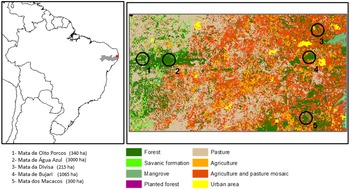
This study was conducted in five Atlantic Forest patches in the state of Pernambuco, northeastern Brazil. The sampled forest patches present different characteristics in terms of size (215 ha – 3,000 ha), shape, elevation, topography, matrix type, ownership (public/private), and level of legal protection (Figure 1; Supplementary Information I for more details). All the studied areas are present in the Atlantic Forest domain north of the São Francisco River, more precisely, within the limits of the Pernambuco Endemism Centre (Fialho et al. Reference Fialho, Valença-Montenegro, da Silva, Ferreira and de Oliveira Laroque2014).
Location of the sampled Atlantic Forest patches and landscape characterization for each forest patch. The black circle represents the 2-km radius buffer created for extracting the landscape metrics.

Data collection
The floristic composition and vegetation structure data were surveyed from May to November 2018. We surveyed ten 50 m × 2 m (0.1 ha) plots in each forest patch (Gentry Reference Gentry, Hecht, Wallace and Prance1982). The location of the first surveyed plot in each forest patch was determined using satellite images from Google Earth and was established at least 100 m from the forest edge. After this, we established each new plot at least 500 metres from the previous plot. This procedure was used due to the ease of implementation and low cost. We measured the diameter at breast height (DBH) and quantified all trees and lianas rooted within the plot limits. For this, we established a DBH ≥ 2.5 cm threshold for trees/shrubs and DBH ≥ 1.0 cm threshold for lianas (Gerwing et al. Reference Gerwing, Schnitzer, Burnham, Bongers, Chave, DeWalt, Ewango, Foster, Kenfack, Martínez-Ramos, Parren, Parthasarathy, Pérez-Salicrup, Putz and Thomas2006, Gentry Reference Gentry, Hecht, Wallace and Prance1982). We collected fertile branches from the individuals that could not be identified during the fieldwork for later identification, which was carried out in the Geraldo Mariz herbarium of the Federal University of Pernambuco and the Lauro Pires Xavier herbarium of the Federal University of Paraíba. Both herbaria possess large databases derived from this region. The botanical classification system used in this study followed The World Flora Online (www.worldfloraonline.org).
Predictor variables
We adopted a patch-landscape approach; that is, we collected response variables from each focal forest patch and landscape variables within a given radius from the geographic centre of each focal forest patch (Arroyo-Rodríguez & Fahrig Reference Arroyo-Rodríguez and Fahrig2014). We used the data collected from vegetational plots (see above) to characterize vegetation structure at the patch scale using basal area as a predictor variable. Thus, we used the software Fitopac version 2.1 (Shepherd Reference Shepherd2010) to extract the basal area for each plot. The landscape metrics were measured considering a 2-km radius buffer (total area: 12.7 km-2 – Figure 1) created from the centroid of each surveyed forest patch. The buffer size was defined based on the mean daily path length of blonde capuchin monkeys (ca. 2-km: Rodrigues Reference Rodrigues2013). Furthermore, we used 2-km buffers to avoid overlapping between the landscapes.
We extracted landscape composition (forest cover in km2) and configuration (edge density) metrics from within these buffers. Edge density was assessed from a division of the total perimeter of forested areas (km) by the total buffer area (km2). We used high-resolution images (30 m × 30 m) obtained from the MapBiomas Project version 5.0 (Souza et al. Reference Souza, Shimbo, Rosa, Parente, Alencar, Rudorff, Hasenack, Matsumoto, Ferreira, Souza-Filho, de Oliveira, Rocha, Fonseca, Marques, Diniz, Costa, Monteiro, Rosa, Vélez-Martin, Weber, Lenti, Paternost, Pareyn, Siqueira, Viera, Neto, Saraiva, Sales, Salgado, Vasconcelos, Galano, Mesquita and Azevedo2020) to extract landscape metrics from four of the surveyed forest patches (Mata de Bujari [MDB], Mata da Divisa [MDD], Mata dos Macacos [MDM], and Mata de Água Azul [MAA]) using ArcGis 10.2 (ESRI, Redlands, USA). When checking the classified images from MapBiomas in Google Earth Pro, we noticed that one of the forest patches, Mata dos Oito Porcos (MOP), presented an inconsistency in the MapBiomas classification, where areas of banana monoculture were classified as forested areas. To avoid this inconsistency, we evaluated the landscape metrics for the MOP through images from Google Earth Pro for the years 2018–2019. We obtained the geographical distance between forest patches and plots from a distance matrix using the geographical data (lat, long) of the centroid of each forest patch/plot.
Statistical analysis
To verify the floristic dissimilarities between forest patches, we conducted an Analysis of Similarity (ANOSIM) with 9999 permutations using a matrix of dissimilarities based on the Bray-Curtis index and considering species abundance. The R values indicate the biological importance of the differences, ranging from −1 to 1. Values greater than 0 indicate differences between groups, while 0 represents the absence of differences between groups. A negative R value indicates that dissimilarities within groups are greater than the dissimilarities between them (Clarke & Warwick Reference Clarke and Warwick2001). ANOSIM was performed using the software PAST 2.16 (Hammer et al. Reference Hammer, Harper and Ryan2001). We also created rank-abundance graphs for each forest patch aiming to identify the rare and dominant species (Moreno et al. Reference Moreno, Calderón-Patrón, Arroyo-Rodríguez, Barragán, Escobar, Gómez-Ortiz, Martín-Regalado, Martínez-Falcón, Martínez-Morales, Mendoza, Ortega-Martínez, Pérez-Hernández, Pineda, Pineda-López, Rio-Díaz, Rodríguez, Rosas, Schondube and Zuria2017). This ranking allows us to describe the structure of the community and infer about the potential effects of anthropogenic disturbance on species dominance (Arroyo-Rodríguez et al. Reference Arroyo-Rodríguez, Rös, Escobar, Melo, Santos, Tabarelli and Chazdon2013).
Before running the richness and diversity analyses, we searched for similarities in the sample coverage between forest patches. We assessed the sample coverage within each forest patch using the coverage estimator suggested by Chao & Jost (Reference Chao and Jost2012), which is a less biased estimator since it uses the total number of individuals within a community belonging to the species represented in the sample. We considered a minimum coverage value for all forest patches of 0.80 to obtain reliable and comparable estimates based on the equal coverage between them (Chao et al. Reference Chao, Chiu and Jost2014; Chao & Jost Reference Chao and Jost2012). All forest patches presented values greater than the determined value, thereby indicating that the estimates were adequate for the desired analyses (MDM = 0.93; MAA = 0.84; MDD = 0.91; MDB = 0.95 and MOP = 0.86). We performed the analysis of the sample coverage using the iNEXT online tool (Chao et al. Reference Chao, Ma and Hsieh2016).
We analysed and compared the β-diversity within forest patches (i.e., between plots) and between forest patches. Patterns of plant β-diversity were analysed with multiplicative diversity decompositions of Hill numbers: qDβ = qDγ/qDα, where qDγ refers to the observed total (gamma) diversity, and qDα refers to the mean local (alpha) diversity within the study communities (plots or patches). qDβ is interpreted as the ‘effective number of completely distinct communities’, as it ranges between 1 (when all communities are identical) and N (i.e., the number of communities) when all communities are completely different from each other (Jost Reference Jost2007; Tuomisto Reference Tuomisto2010). As described by Jost (Reference Jost2007, Reference Jost2010), α-diversity is independent of β-diversity and sample size. Nevertheless, it depends on the parameter q, which determines the sensitivity of the measurement of species’ relative abundances (Jost Reference Jost2007; Tuomisto Reference Tuomisto2010). We considered β-diversities of order 0 (0Dβ), 1 (1Dβ) and 2 (2Dβ). While 0Dβ does not consider species’ abundances, thus giving disproportionate weight to rare species, 1Dβ weighs each species according to its abundance in the community, measuring the turnover of ‘typical’ species; finally, 2Dβ favours very abundant species and can be interpreted as the turnover of ‘dominant’ species (Jost Reference Jost2007; Tuomisto Reference Tuomisto2010). These three β-diversity measures were calculated using raw estimators with the entropart package (Marcon & Hérault Reference Marcon and Hérault2015) for RStudio version 1.2.5 (R Core Team 2019). Thus, we calculated the β-diversity for each patch (qβpatch = qγland/qαpatch) and each plot (qβplot = qγpatch/qαplot). In order to evaluate the importance of β-diversity differences between spatial scales, we compared the relative compositional dissimilarities between communities using the transformation of qDβ proposed by Jost (Reference Jost2006) for communities with a different number of samples (i.e., forest patch: N = 5, plot: N = 50): qDS = 1 - [(1/ qDβ – 1/N)/(1 – 1/N)]. qDS ranges between 0, when all samples are identical, and 1, when all samples are completely different.
To identify the correlates of the turnover component of β-diversity between forest patches and sampling plots, we ran ordinary least squares models with all possible combinations of predictor variables and assessed model support through their AICc (Akaike Information Criterion corrected for small samples – Burnham & Anderson Reference Burnham and Anderson2002), selecting the model with greatest support. Specifically for this analysis, we used the Jaccard index to represent the dissimilarity between forest patches and plots (Carvalho et al. Reference Carvalho, Cardoso and Gomes2012), which was calculated in the package BAT (Cardoso et al. Reference Cardoso, Rigal and Carvalho2015) and was decomposed into turnover and nestedness components (Carvalho et al. Reference Carvalho, Cardoso and Gomes2012). Given that most of the β-diversity was represented by the turnover component (see results), and that the nestedness component is also related to the α-diversity of the forest patches, we focused our analyses only on the correlates of the β-diversity turnover component. We included the difference in basal area (patch variable), edge density, forest cover (landscape variables), and geographic distance as possible correlates of plant turnover. We calculated the Euclidean distance between forest patches and plots for each of these variables in the package vegan (Oksanen et al. Reference Oksanen, Blanchet, Friendly, Legendre, Minchin, O’Hara, Simpson, Solymos, Stevens and Wagner2019). We used RStudio software to run these analyses. The level of statistical significance throughout was p < 0.05.
Results
Overview
We recorded 1,682 individuals (trees = 1,463 and lianas = 219), grouped in 56 families, 116 genera, and 248 species (including 95 morphospecies; Supplementary Information II), with a mean of 33 ± 8 families, 52 ± 16 genera, and 78 ± 31 species per forest patch (Supplementary Information II). A more detailed description of the plant assemblage of the forest patches and their characteristics is provided in Supplementary Information II. The global analysis using ANOSIM showed differences in floristic composition and abundance among the forest patches (R = 0.52, p < 0.0001). When the pair-to-pair comparison was carried out between the forest patches, a difference was found in all possible pairs of combinations between the patches (Table 1). Most of the difference between forest patches (90.4%) was due to species turnover. A similar pattern was found when considering the surveyed plots: turnover represented 80.3% of the β-diversity among plots.
Results, R and (p-values), of the ANOSIM considering the pairwise dissimilarity in species richness between the forest patches with the occurrence of the blonde capuchin monkey (Sapajus flavius) in the state of Pernambuco, northeastern Brazil. MDM = Mata dos Macacos, MAA = Mata de Água Azul, MDD = Mata da Divisa, MDB = Mata de Bujari, MOP = Mata dos Oito Porcos

Correlates of plant β-diversity between forest patches and sampling plots
The β-diversity was lower for MAA at a landscape scale (i.e., between forest patches, qβpatch) and MDM at a site scale (i.e., among plots, qβplot) for all q orders (Supplemental Information III). Geographical distance was the only variable that explained the turnover component of the β-diversity between forest patches (Table 2), although the null model also presented high support (ΔAICc = 0.87). All the other models had little support (i.e., ΔAICc ≥2.52). The model containing only geographical distance explained 42.8% of the variance in the turnover component of the β-diversity between forest patches (Table 2).
Results of the best models that explained the turnover component of the β-diversity between the surveyed forest patches and between the surveyed plots in the Atlantic Forest of the Pernambuco Endemism Centre, northeastern Brazil

All the predictor variables (geographic distance, Δbasal area, Δedge density, and Δforest cover) positively affected the turnover component of the β-diversity between surveyed plots and were included in the model with highest support (Table 2). Thus, the turnover was greater between the plots that were more distant from each other and that had more contrasting vegetation structure, forest cover, and edge amounts in their landscape. Among these variables, geographical distance had the strongest effect on the turnover between plots (Table 2). The model containing all the variables explained 14.8% of the variance in the β-diversity turnover component between sampling plots (Table 2). All the other models had little support (i.e., ΔAICc ≥4.36).
Discussion
Our findings reveal that the studied forest patches in the state of Pernambuco differ in floristic composition and that geographical distance is a key correlater of plant species turnover between forest patches and plots. Additionally, the difference in forest structure (basal area) and in landscape context (edge density and forest cover) was also related to a greater turnover between the sampling plots.
The geographical distance had a strong and positive effect on plant species turnover between forest patches. This result may be related to the limited interchanging of seeds (and species) between forest patches, which is observed between more distant sites (Condit et al. Reference Condit, Pitman, Leigh, Chave, Terborgh, Foster, Núñez, Aguilar, Valencia, Villa, Muller-Landau, Losos and Hubbell2002; Myers et al. Reference Myers, Chase, Jiménez, Jørgensen, Araujo-Murakami, Paniagua-Zambrana and Seidel2013). Indeed, a lack of potential seed dispersers could enhance the turnover between more distant sites, although in our study site there is still a large number of birds and terrestrial mammals which may be able to carry seeds between the forest patches (Lobo-Araújo et al. Reference Lobo-Araújo, Toledo, Efe, Malhado, Vital, Toledo-Lima, Macario, Santos and Ladle2013; Mendes Pontes et al. Reference Mendes Pontes, Beltrão, Normande, Malta, Silva Júnior and Santos2016; Pereira et al. Reference Pereira, Araújo and Azevedo-Júnior2016; Campos et al. Reference Campos, Teixeira and Efe2018; Garbino et al. Reference Garbino, Rezende, Fernandes–Ferreira and Feijó2018). The effect of geographical distance on species turnover is also explained by the fact that distant areas will likely have more contrasting environmental (e.g., soil, climate, topography) and anthropogenic (e.g., different disturbance regimes) contexts which will affect floristic composition (Pyke et al. Reference Pyke, Condit, Aguilar and Lao2001; Arroyo-Rodríguez et al. Reference Arroyo-Rodríguez, Rös, Escobar, Melo, Santos, Tabarelli and Chazdon2013; Garibaldi et al. Reference Garibaldi, Nieto-Ariza, Macía and Cayuela2014).
In addition to geographic distance and landscape context, Δbasal area was related to the turnover between the surveyed plots. Different plant species have different allometry (Bohlman & O’Brien Reference Bohlman and O’Brien2006) and respond differently to environmental conditions (John et al. Reference John, Dalling, Harms, Yavitt, Stallard, Mirabello, Hubbell, Valencia, Navarrete, Vallejo and Foster2007, Bohlman et al. Reference Bohlman, Laurance, Laurance, Nascimento, Fearnside and Andrade2008) and to disturbance (Sagar et al. Reference Sagar, Raghubanshi and Singh2003, Kumar & Ram Reference Kumar and Ram2005). Since there is some variation in environmental conditions and disturbance levels within the forest patches (i.e., between plots), this should affect both the vegetation basal area and floristic composition.
We also found that differences in edge density in the landscape were related to the turnover between forest plots. The edge effect influences many abiotic conditions of the forest patches, such as temperature, light, wind and humidity (Didham & Lawton Reference Didham and Lawton1999; Davies-Colley et al. Reference Davies-Colley, Payne and Van Elswijk2000), which also affect floristic composition (Oliveira et al. Reference Oliveira, Grillo and Tabarelli2004). These effects shape the turnover between plots. This variable was assessed with buffers around the centroid of the forest patches and thus may also influence the turnover between forest patches; however, we were not able to detect this effect due to our small sample size.
ΔForest cover also affected plant species turnover between sampled plots. This result may be explained by the fact that changes in forest cover affect plant functional groups, where small-seeded softwood pioneer species colonize small forest patches in low forest cover landscapes more efficiently, while hardwood climax trees are more common in landscapes with greater forest cover (Michalski et al. Reference Michalski, Nishi and Peres2007). Thus, floristic composition varies not only in the edge-interior gradient within forest plots (Oliveira et al. Reference Oliveira, Grillo and Tabarelli2004) but also over larger scales considering different levels of forest cover in the landscape.
The fact that some of the species present in our sample were not identified has a limited effect on our conclusions. Firstly, the unidentified species were invariably rare, accounting for only a small proportion of the sampled individuals (<5%). Additionally, we collected samples of these individuals, which allowed us to confirm that they correspond to different morphospecies. Thus, this limitation does not change the turnover patterns that we examined in our analysis.
Studies related to the community structure of plants and inventories are an important tool for assessing the succession processes and conservation statuses of forest patches (Turchetto et al. Reference Turchetto, Araújo, Callegaro, Griebeler, Mezzomo, Berghetti and Rorato2017). Overall, our results indicate the need to conserve forest patches spread across a wide area (distant sites), encompassing different landscape contexts with different vegetation structures, in order to conserve greater floristic diversity. This strategy is in accordance with the current Brazilian law (federal law no. 12,651/2012), which determines that 20% of native vegetation cover must be maintained in each rural property in the Atlantic Forest as a Legal Reserve. This legal requirement should result in the maintenance of forest patches in different landscape contexts and spread throughout the whole biome area. However, landowners frequently do not comply with this determination and Brazilian lawmakers often try to change this conservation requirement (Carvalho et al. Reference Carvalho, Mustin, Hilário, Vasconcelos, Eilers and Fearnside2019; Ferrante and Fearnside Reference Ferrante and Fearnside2019). Here, we provide evidence to support the current law and the need to ensure law enforcement in order to conserve the great biodiversity of the Atlantic Forest (Tabarelli et al. Reference Tabarelli, Pinto, Silva, Hirota and Bede2005), especially that of the threatened Pernambuco Endemism Centre.
Supplementary material
For supplementary material accompanying this paper visit https://doi.org/10.1017/S0266467422000426
Acknowledgments
We are grateful to Marcos Fialho, Bruna Bezerra, and Inara Leal for the valuable comments and suggestions on the initial version of this manuscript. We also thank Víctor Arroyo-Rodríguez for the statistical advice and the landscape analyses. We are extremely grateful to Zé de Timbaúba, Seu Zé and Seu Lenilson, Camila Dutra, Lucas Bueno, Camila Nascimento, Armando Jr., Zoé, Rosano Lopes, Ana Lima, Winnie Rodrigues, William Martins, Rodrigo Aragão, Rafael, and Gleyce Nascimento for assistance during the fieldwork. Prof. Renata Ferreira and her students (Clayton, Erick, Felipe and Guilherme) during data collection, as well as Profs. Marlene Barbosa (Herbário Geraldo Mariz – UFPE) and Maria Regina Barbosa (Herbário Lauro Pires Xavier – UFPB) for support during the identification of plant species. We would like to thank CPRH, for authorizing collections in the Matas de Água Azul Wildlife Refuge, São José Agroindustrial, CAIG, and Banana Express, for allowing collections on their properties. We also are grateful to Ferry Slik and two anonymous reviewers for their valuable comments on the manuscript.
Financial Support
ICCG is grateful to Lotus Consultoria Ambiental for financial support during the initial steps of this study and CNPq for the master’s scholarship (Process no. 130543/2018-7). JPS-A is supported by FACEPE (BFP-0149-2.05/19).
Conflict of Interest
The authors declare no competing interests and no conflicts of interest.
Ethical statement
All research complied with Brazilian legal requirements.