Introduction
To date, few epidemiological studies on dementia have been conducted in low- and middle-income countries (Prince et al., Reference Prince2013), particularly in Africa. Even though such work is now starting, the populations of these countries are aging (Pison, Reference Pison2009), and an increase in age-related pathologies, principally dementia, is expected in the coming decades (Prince et al., Reference Prince2013).
Over the last ten years, research has focused on personality traits that may predispose to cognitive decline, mild cognitive impairment (MCI), and Alzheimer's disease (AD) (Wilson et al., Reference Wilson2005a; Reference Wilson, Bennett, Mendes de Leon, Bienias, Morris and Evans2005b; Reference Wilson, Arnold, Schneider, Li and Bennett2007a; Reference Wilson, Schneider, Arnold, Bienias and Bennett2007b; Reference Wilson, Schneider, Boyle, Arnold, Tang and Bennett2007c; Reference Wilson, Begeny, Boyle, Schneider and Bennett2011a; Duberstein et al., Reference Duberstein2011). According to the Diagnostic and Statistical Manual of Mental Disorders, 4th Edition (DSM-IV), dependent personality disorder (DPD) is “a pervasive and excessive need to be taken care of that leads to submissive and clinging behavior and fears of separation, present in a wide variety of contexts and present by early adulthood” (American Psychiatric Association, 2000). DPD has been correlated with certain personality dimensions: higher levels of neuroticism and lower levels of conscientiousness (Bornstein and Cecero, Reference Bornstein and Cecero2000) using the Five Factors Model; and harm avoidance using the Cloninger's Model (Mulder et al., Reference Mulder, Joyce, Sullivan, Bulik and Carter1999). Neuroticism and harm avoidance were found to be risk factors for cognitive disorders in old age (Wilson et al., Reference Wilson, Arnold, Schneider, Li and Bennett2007a; Reference Wilson, Schneider, Arnold, Bienias and Bennett2007c; Reference Wilson, Boyle, Buchman, Yu, Arnold and Benett2011b), and conscientiousness has been identified as a potential protective factor (Wilson et al., Reference Wilson, Schneider, Boyle, Arnold, Tang and Bennett2007b). Furthermore, a cross-sectional study showed that patients with AD were more likely than their cognitively normal spouses to present DPD (Clément et al., Reference Clément, Darthout and Nubukpo2003). This was confirmed by a recent case-control study (Nicholas et al., Reference Nicholas2010).
We therefore hypothesized that elderly people with DPD are at increased risk of cognitive disorders. The present study aimed to investigate the association between DPD, evaluated using a categorical approach, and cognitive disorders among elderly people in two Central African countries: the Republic of Congo (ROC) and the Central African Republic (CAR). This study is part of the EPIdemiology of DEMentia in Central Africa (EPIDEMCA) programme, the main objectives of which are to estimate prevalence of dementia and cognitive disorders in rural and urban areas of ROC and CAR and to evaluate factors associated with these disorders.
Methods
Study population
Our study population comprised participants in the EPIDEMCA programme – a multicenter community-based cross-sectional study conducted in rural and urban areas in CAR and ROC between November 2011 and December 2012. The detailed methodology is published elsewhere (Guerchet et al., Reference Guerchet2014). In brief, participants aged 65 years and above who had lived in the study area for at least six months were included. The study areas included the capitals of CAR (Bangui) and ROC (Brazzaville), and two rural regions (Nola in CAR and Gamboma in ROC). The sample size calculated was 500 in each site. In urban areas, the selection was carried out using random sampling proportional to the main city subdivision size. In rural areas, exhaustive sampling using a door-to-door approach was preferred due to logistic and financial constraints.
Approvals were obtained from the Ministry of Public Health in CAR, the Ministry of Public Health in ROC, and the Comité de Protection des Personnes du Sud-Ouest et d’Outre-Mer 4 (CPP-SOOM4) in France. All participants and/or their families gave informed consent before being included in the study.
Assessment of cognitive disorders
Cognitive disorders were assessed in two phases. During the first phase, cognitive testing was performed using the Community Screening Interview for Dementia (CSI-D; Hall et al., Reference Hall, Hendrie, Brittain and Norton1993) adapted, back-translated, and pre-tested in local languages (Sango in CAR; Lari, Lingala, and Kituba in ROC). A relative of each elderly person included was interviewed at the same time using the CSI-D informant section to assess daily activities. Every participant with a poor performance in the CSI-D cognitive tests (COGSCORE ≤ 24.5) was considered to have suspected cognitive impairment and invited for further clinical assessment.
The second phase was conducted at the hospital between 3 and 14 weeks later. Further psychometric tests were conducted, including the Free and Cued Selective Reminding Test (Grober et al., Reference Grober, Buschke, Crystal, Bang and Dresner1988), Zazzo's cancellation task (Zazzo, Reference Zazzo1974), and Isaac's Set Test of Verbal Fluency (Isaacs and Kennie, Reference Isaacs and Kennie1973). Neurologists performed examinations during which histories of stroke and depressive disorders were sought. Orientation skills and daily activities were also investigated to evaluate the level of dependence.
Dementia and AD were diagnosed according to the DSM-IV criteria (American Psychiatric Association, 2000) and the clinical criteria proposed by the National Institute of Neurological and Communicative Disorders and Stroke and the Alzheimer's Disease and Related Disorders Association (McKhann et al., Reference McKhann1984) respectively. Diagnoses of other types of dementia (principally vascular dementia) were based on the history of stroke and other clinical arguments. The Petersen criteria (Reference Petersen2004) were used to define MCI. We were not able to define the type of MCI. An experienced neurologist reviewed all medical records and test performances to reach a consensus on uncertain cases.
Assessment of dependent personality disorder
During the first phase, participants completed the dependent personality domain of the Personality Diagnostic Questionnaire-4+ (PDQ-4+), which enables screening for the presence of DSM-IV Axis II personality disorders (Hyler, Reference Hyler1994). The DPD domain contains eight true–false items, which as follows: “I cannot take any decision without advice or support from others,” “I need others to assume responsibility instead of me,” “I fear losing support from others if I do not agree with them,” “I have difficulty initiating projects on my own,” “I want so much for others to like me that I volunteer to do things that I find unpleasant,” “I feel uncomfortable or helpless when I am alone,” “I urgently seek another relationship when a close relationship ends,” and “I fear being left to take care of myself.” A person was considered to have DPD if she or he answered “True” to at least five items. In our study, the validated French version was used as the starting point for back translation into local languages (Sango for CAR; Lingala, Lari, and Kituba for ROC; Bouvard, Reference Bouvard2009). Due to high rates of illiteracy in the study areas, items were presented orally. If the elderly person was not able to respond due to cognitive impairment, informants answered for her/him.
Other data collected
All covariates were collected during the first phase. Socio-demographic data included age, gender, marital status, formal education, country (CAR, ROC), and area (urban, rural). Age was ascertained either from official documents or using historical events (Paraïso et al., Reference Paraïso2010), or from an informant if previous methods were unsuccessful. Vascular covariates included smoking status (yes/no), hypertension (defined as systolic blood pressure ≥140 mmHg and/or diastolic blood pressure ≥90 mmHg or prescription of antihypertensive drugs), diabetes (anti-diabetic drugs or glycaemia more than 126 mg/dL for more than two hours, or more than 200 mg/dL in non-fasting participants), body mass index (BMI; in three categories: <18.50 kg/m2; 18.50–24.99 kg/m2; ≥25.00 kg/m2), physical activity (defined as having walked or cycled for at least 150 min the previous week), lower-extremity peripheral artery disease (PAD; defined as ankle brachial index (ABI) ≤ 0.9; otherwise non-pathological if ABI was between 0.9 and 1.4; Aboyans et al., Reference Aboyans2012), and history of stroke. The Geriatric Mental State (GMS) version B3 was used to assess alcohol consumption as well as depressive and anxiety symptoms (Copeland et al., Reference Copeland, Dewey and Griffiths-Jones1986). The French version of GMS (ClinicalTrials.gov Identifier: NCT01061827) was used as the starting point for back-translation into local languages.
Data management and analysis
Cognitive disorders used as categorical variables were our dependent variable comprising three categories: cognitively normal, MCI, and dementia. DPD used as a binary variable was considered as our independent variable. All covariates were used as categorical variables except for age, which was used as a continuous variable because the linearity hypothesis could not be rejected.
Mean values with their standard deviation were used as summary statistics for age. Percentage values were calculated for all categorical variables. Univariate analyses were carried out between cognitive disorders and all potential covariates on one hand (data not shown), and between DPD and all potential covariates on the other, using the χ 2 test, Fisher exact test, or t-test, where appropriate.
We first estimated the univariate association between cognitive disorders and DPD using a multinomial logistic regression model. Analyses were then adjusted for all socio-demographic characteristics that were forced in all subsequent models (model 1: age, gender, education level, area, and marital status). We then adjusted for vascular covariates (model 2: model 1 + vascular covariates) and psychological covariates (model 3: model 2 + psychological covariates) that were significant with p < 0.20 in univariate analyses. To select the final models 2 and 3, we used a backward elimination procedure to select significant covariates at a level of 0.05. Specific interactions between DPD and sex, depressive symptoms, area (urban/rural), and country were examined in the final fully adjusted model. The level of statistical significance was fixed at 0.05 for all analyses. Statistical analyses were carried out using Stata version 10.1 for Windows (StataCorp, College Station, TX).
Results
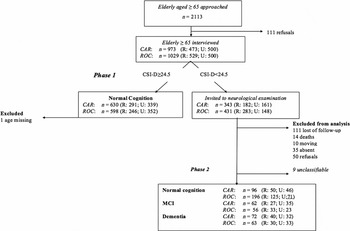
During the first phase in the general population, 2,113 people aged 65 years and above were approached; 111 declined to participate in the survey. Of the remaining 2,002 participants, 775 were invited to clinical interview and 555 actually came. At the end of the second phase, 118 had MCI, 135 had dementia (including 103 AD and 15 vascular dementia), and 1,519 had normal cognition. We did not have neurological data for 229 participants, who were therefore excluded from our analyses. One participant was excluded because of missing age, leaving 1,772 participants for analysis. A detailed flow chart is presented in Figure 1.
Flow chart of the EPIDEMCA study in CAR and ROC, 2011–2012. CAR: Central African Republic; CSI-D: community screening for dementia; MCI: mild cognitive impairment; R: rural area; U: urban area.

Participants excluded were younger (73.1 (SD 6.7) vs. 74.8 (SD 6.7); t(1999) = 3.5, p < 0.001), mainly females (79.5% vs. 59.1%; χ 2(1) = 35.58, p < 0.001, Cramer's V = −0.13), less likely to be a couple (19.2% vs. 38.9%; χ 2(1) = 33.78, p < 0.001, Cramer's V = 0.13), less educated (12.7% vs. 33.6%; χ 2(1) = 41.45, p < 0.001, Cramer's V = 0.14), and more depressed (49.3% vs. 36.6%; χ 2(1) = 13.91, p < 0.001, Cramer's V = −0.08) than participants who were included (data not shown).
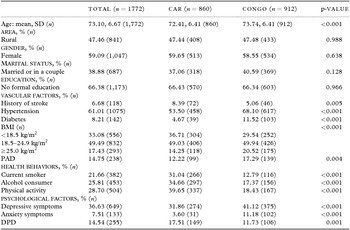
Table 1 presents the general characteristics of the 1,772 EPIDEMCA participants included according to their country of residence. The ROC participants were older than those from CAR (t(1770) = −4.21, p < 0.001), more hypertensive (χ 2(1) = 39.42, p < 0.001, Cramer's V = 0.15), diabetic (χ 2(1) = 26.95, p < 0.001, Cramer's V = 0.13) and corpulent (t(1653.93) = −4.66, p < 0.001), less likely to smoke (χ 2(1) = 86.50, p < 0.001, Cramer's V = −0.22) and consume alcohol (χ 2(1) = 68.41, p < 0.001, Cramer's V = −0.20), reported less physical activity (χ 2(1) = 94.45, p < 0.001, Cramer's V = −0.23), and were more depressed (χ 2(1) = 16.34, p < 0.001, Cramer's V = 0.10) and anxious (χ 2(1) = 36.63, p < 0.001, Cramer's V = 0.14). They were less likely to have DPD (χ 2(1) = 11.81, p = 0.001, Cramer's V = −0.08).
General characteristics of included participants according to their residence country, EPIDEMCA programme, 2011–2012

Note: BMI: body mass index; CAR: Central African Republic; DPD: dependent personality disorder; PAD: peripheral artery disease; SD: standard deviation.
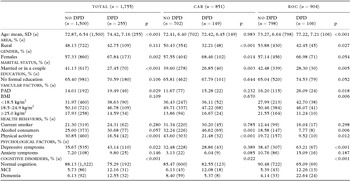
Of the 1,772 participants included, 255 had DPD (14.39%) and in the case of 17 data were missing (0.96%). Analysis of the association between cognitive disorders and DPD was then carried out among 1,755 participants (Figure 1). Overall, DPD participants were older, predominantly females (χ 2(1) = 9.94, p = 0.002, Cramer's V = 0.08), single or widowed (χ 2(1) = 17.13, p < 0.001, Cramer's V = −0.10), less active physically (χ 2(1) = 21.71, p < 0.001, Cramer's V = −0.11), and more depressed (χ 2(1) = 5.23, p = 0.022, Cramer's V = 0.05). We then repeated the analysis by country. In both countries, DPD participants lived preferentially in an urban area (CAR: χ 2(1) = 16.36, p < 0.001, Cramer's V = 0.14; ROC: χ 2(1) = 4.90, p = 0.027, Cramer's V = −0.07), were more likely to be single or widowed (CAR: χ 2(1) = 8.54, p = 0.003; Cramer's V = −0.10; ROC: χ 2(1) = 7.79, p = 0.005, Cramer's V = −0.09), less active physically (CAR: χ 2(1) = 25.08, p < 0.001, Cramer's V = −0.17; ROC: χ 2(1) = 6.39, p = 0.012, Cramer's V = −0.08), and likely to have cognitive disorders (CAR: χ 2(2) = 7.64, p = 0.022, Cramer's V = 0.09; ROC: χ 2(2) = 64.85, p < 0.001, Cramer's V = 0.27). In CAR, DPD participants were mostly females (χ 2(1) = 6.07, p = 0.014, Cramer's V = 0.08) and more likely to consume alcohol (CAR: χ 2(1) = 11.15, p = 0.001, Cramer's V = 0.11), while in ROC, DPD participants were older (t(902) = −5.69, p < 0.001), consumed less alcohol (ROC: χ 2(1) = 7.44, p = 0.006, Cramer's V = −0.09), and were more depressed (χ 2(1) = 23.60, p < 0.001, Cramer's V = 0.16) (Table 2).
Factors associated with DPD in CAR and ROC, EPIDEMCA programme, 2011–2012

Note: BMI: body mass index; CAR: Central African Republic; DPD: dependent personality disorder; MCI: mild cognitive impairment, ROC: Republic of Congo.
The prevalence of DPD was significantly different depending on cognitive status: 12.7% in normal, 26.5% in MCI, and 25.8% in participants with dementia (χ 2(2) = 30.35, p < 0.001, Cramer's V = 0.13). A significant interaction was observed between country and DPD (Wald χ 2(2) = 25.06, p < 0.001). In CAR, the prevalence of DPD was higher in MCI patients (29.5%) compared with normal participants (17.0%) and dementia (11.9%) patients (χ 2(2) = 7.64, p = 0.022, Cramer's V = 0.09). In ROC, the prevalence increased with the severity of cognitive disorders: 8.7% in normal, 23.2% in MCI, and 42.1% in dementia patients (χ 2(2) = 64.85, p < 0.001, Cramer's V = 0.27).
Table 3 presents the results of the analyses of the association between DPD and cognitive disorders using multinomial logistic regression models. DPD was associated with a higher probability of MCI in the unadjusted model and the association remained stable after several adjustments. DPD was also associated with dementia in the unadjusted model. The association remained significant after adjustment for socio-demographic covariates but not when adjusted for vascular and then psychological covariates. A significant interaction was observed between DPD and country (Wald χ 2(2) = 7.44, p = 0.02). We therefore conducted separate analyses. In CAR, DPD was significantly associated with a higher probability of MCI in the unadjusted model. This association remained stable with subsequent adjustments. However, no association with dementia was observed. In ROC, DPD was associated with a higher probability of MCI in the unadjusted model. The strength of the association was slightly attenuated by further adjustments but remained significant. However, DPD was strongly associated with a higher probability of dementia in unadjusted and adjusted models.
Unadjusted and adjusted odds ratios (ORs) measuring associations between cognitive disorders and DPD in CAR and ROC, EPIDEMCA programme, 2011–2012

Notes: Model 0: Model unadjusted.
Model 1: Model 0 adjusted for age, sex, formal education, living in couple, and area (rural/urban).
Model 2: Model 1 adjusted for smoking status, lower extremities peripheral artery disease, BMI, physical activity, and alcohol consumption.
Model 3: Model 2 adjusted for depressive symptoms.
CAR: Central African Republic; CN: cognitively normal; CI: confidence interval; MCI: mild cognitive impairment; ROC: Republic of Congo.
Because the source of data could be either the participant in person (64.4%) or an informant (35.6%), we wanted to know whether the source of data moderated the relationship between cognitive disorders and DPD. We therefore tested the interaction between DPD and source of data (informant or participant) in the total sample and for each country in fully adjusted multivariate models. The source of data did not moderate the relationship between cognitive disorders and DPD in the total sample (p = 0.615), CAR (p = 0.565), or ROC (p = 0.217).
Discussion
To our knowledge, this is the first study to investigate the association between personality and cognitive disorders in Africa, and the first to specifically investigate the relationship between DPD and cognitive disorders using a categorical approach. Previous researchers were interested in identifying personality traits that could predispose some individuals to develop cognitive disorders, principally dementia (Wilson et al., Reference Wilson, Bennett, Mendes de Leon, Bienias, Morris and Evans2005b; Reference Wilson, Arnold, Schneider, Li and Bennett2007a; Reference Wilson, Begeny, Boyle, Schneider and Bennett2011a; Reference Wilson, Boyle, Buchman, Yu, Arnold and Benett2011b).
Our results confirmed our initial hypothesis. We found that DPD was significantly associated with cognitive disorders except in CAR, where it was not associated with dementia. These associations were independent of factors traditionally linked to cognitive disorders such as age, gender, vascular factors, and depressive symptoms. Our results are congruent with previous studies (Clément et al., Reference Clément, Darthout and Nubukpo2003, Nicholas et al., Reference Nicholas2010). In CAR, odds ratios (ORs) calculated for the association between DPD and dementia were below 1, whereas these values were greater than 1 in ROC. The very small number of people with dementia and DPD in CAR (n = 8) could explain this difference. Furthermore, cultural values, familiarity with questionnaires, and education, among other factors that differ between the countries, may affect the responses to questions. Moreover, CAR and ROC experienced political disturbances and civil wars during recent decades. These events could also influence responses to PDQ-4+.
Due to the cross-sectional design of our study, we cannot know whether DPD is a risk factor for cognitive impairment, or DPD develops during dementia. Several arguments support DPD as a risk factor. People with DPD are more likely to be neurotistic (Bornstein and Cecero, Reference Bornstein and Cecero2000) and therefore prone to psychological distress (Wilson et al., Reference Wilson2005a). Several studies have related proneness to psychological distress to cognitive impairment and dementia (Wilson et al., Reference Wilson2005a; Reference Wilson, Schneider, Boyle, Arnold, Tang and Bennett2007b; Reference Wilson, Boyle, Buchman, Yu, Arnold and Benett2011b). The mechanism suggested involves the hypothalamic–pituitary–adrenal (HPA) axis, neuroticism having been associated with a blunted HPA axis (Oswald et al., Reference Oswald2006). DPD was positively correlated with harm avoidance (Mulder et al., Reference Mulder, Joyce, Sullivan, Bulik and Carter1999), which in turn was associated with lower serotoninergic pathway activity (Cloninger, Reference Cloninger1987). People with DPD therefore have lower serotoninergic pathway activity, which was implicated in dementia development (Rodríguez et al., Reference Rodríguez, Noristani and Verkhratsky2012). Furthermore, people with DPD are predisposed to depression (Bornstein, Reference Bornstein1995) and several studies suggest that depression is a risk factor for dementia (Kessing, Reference Kessing2012), particularly via a toxic effect of depression on hippocampal neurons (Olazarán et al., Reference Olazarán, Trincado and Bermejo-Pareja2013). Other arguments favor DPD occurring with cognitive impairment. Indeed, several studies have shown personality changes in MCI and dementia, with, notably, an increase in neuroticism and a decrease in conscientiousness (Robins Wahlin and Byrne, Reference Robins Whalin and Byrne2011; Donati et al., Reference Donati2013; Mendez-Rubio et al., Reference Mendez Rubio, Antonietti, Donati, Rossier and Von Gunten2013). These personality changes would reflect the impact of brain damages related to dementia (Robins Wahlin and Byrne, Reference Robins Whalin and Byrne2011). Longitudinal studies must be conducted to analyze further the temporality of the relationship.
The prevalence of DPD that we found (>14%) was surprisingly high compared with other population-based studies (Loranger et al., Reference Loranger1994; Grant et al., Reference Grant2004). There may be several explanations for this. We worked with older people and it is recognized that DSM-IV criteria for personality disorders are more focused on younger lifestyles and not adapted to the elderly population (Mohlman, Reference Mohlman2012). Physical illnesses are common in older age. Older people may thus be prone to respond “True” to most items due to physical diseases rather than psychological disturbances, leading to over-diagnosis (Oltmanns and Balsis, Reference Oltmanns and Balsis2011). The PDQ4+ was used here as a screening tool but may identify people who do not actually have DPD, as the false positive rate is high (De Reus et al., Reference De Reus, van den Berg and Emmelkamp2013).
Our study reported a higher prevalence of DPD in CAR than in ROC, which is more westernized. This result confirmed those from a study in Burkina Faso showing that individuals living in more traditional societies scored higher on the DPD trait than those in more westernized culture (Rossier et al., Reference Rossier, Ouedraogo, Dahourou, Verardi and Meyer de Stadelhofen2013).
Some limitations are also described. In addition, DPD domain of PDQ-4+ may not be valid in African settings as it is based on DSM diagnosis criteria, which is a culturally related concept. Some authors do not recommend its use in collectivistic contexts (Chen et al., Reference Chen, Nettles and Chen2009), which are characteristics of African culture.
In some cases, informants responded to PDQ-4+ for elderly people who could not do so for themselves. To our knowledge, no study has assessed validity of PDQ-4+ when informants answer on behalf of older people. Social norms could limit responses from informants, who are generally younger than participants (children or grandchildren). Moreover, PDQ-4+ asks psychological questions, and responses therefore relate to the inner self. The reliability of responses from informants is therefore uncertain. However, the prevalence of DPD did not differ significantly according to the source of data (participant or informant – data not shown) and our results have shown that the source of data did not moderate the relationship between cognitive disorders and DPD.
We cannot exclude the items that were considered by interviewees as features of person's current state rather than enduring personality characteristics. Therefore, DPD may reflect symptoms of cognitive disorder itself or increased dependency associated with cognitive impairment. In this case, DPD could not be considered as a risk factor in our study but rather as occurring with dementia.
The main strength of our study is the large sample comprising almost 1,800 participants from the general population and the mix of people from urban and rural areas. This is the first study about the relationship between cognitive disorders and DPD in the African continent.
In conclusion, DPD was associated with cognitive disorders. Despite the limitations of our work, this study paves the way for research on the association between personality and cognitive impairment in Africa, data hitherto restricted to Western countries. Further studies with cross-culturally validated tools are thus needed to confirm this association, and if confirmed, then to better understand the biological mechanisms underlying it.
Conflict of interest
None.
Description of authors’ roles
All authors worked collectively to design the EPIDEMCA protocol. S. Pilleron, M. Guerchet, B. Ndamba-Bandzouzi, and P. Mbelesso supervised the data collection. J-F. Dartigues, B. Ndamba-Bandzouzi, and P. Mbelesso were responsible for diagnosing cognitive disorders. S. Pilleron conducted data analysis and wrote the first draft. M. Guerchet and J-P. Clément were involved in data analysis and interpretation. All authors reviewed the manuscript, provided further contributions and suggestions, and approved the final manuscript.
Acknowledgments
The authors would like to thank all older people from CAR and ROC for participating in the EPIDEMCA study, as well as all the surveyors and nurses involved in this project for their assistance, the town halls, mayors, and chiefs of districts for their collaboration, the Universities of Bangui (CAR) and Marien Ngouabi in Brazzaville (ROC), and the health ministries of the Central African Republic and the Republic of Congo for their support. The French National Research Agency (ANR) through the ANR-09-MNPS-009-01 grant, the University of Limoges and Doctoral School 523 of Limoges University, and the Limousin Regional Council funded this study. The French Ministry of Higher Education and Research funded doctoral position of S. Pilleron.