Public health workers and other disaster responders experience acute and long-term distress and dysfunction from work-related exposure to natural and human-made disasters.Reference Johnsen, Eid, Løvstad and Michelsen1Reference Fullerton, McCarroll, Ursano and Wright2Reference Witteveen, Bramsen and Twisk3 In particular, sleep disturbance and hyperarousal, often described as feeling “revved up,” are common responses to natural and human-made disasters.Reference Lavie4Reference Ursano, Fullerton, Weisaeth and Raphael5Reference Hobfoll, Watson and Bell6 Sleep disturbance is associated with poor work performance, including decreased work quality and productivity, and long-term work disabilityReference Eriksen, Natvig and Bruusgaard7Reference Manocchia, Keller and Ware8Reference Owens9; disrupted mental health, including major depressive disorder, posttraumatic stress disorder (PTSD), and substance abuseReference Manocchia, Keller and Ware8Reference Owens9Reference Ford and Kamerow10Reference Koren, Arnon, Lavie and Klein11Reference Strine and Chapman12; physical healthReference Manocchia, Keller and Ware8Reference Owens9Reference Strine and Chapman12Reference Cohen, Doyle, Alper, Janicki-Deverts and Turner13; and day-to-day functioning.Reference Manocchia, Keller and Ware8Reference Strine and Chapman12
Increased arousal has been associated with poor mental healthReference Hobfoll, Watson and Bell6Reference Marshall, Schell, Glynn and Shetty14Reference Schell, Marshall and Jaycox15 and physical health.Reference Hobfoll, Watson and Bell6Reference Buitenhuis, de Jong, Jaspers and Groothoff16 The arousal symptom cluster is the strongest predictor of PTSD symptom severity; early treatment of arousal symptoms may even prevent future psychological distress.Reference Marshall, Schell, Glynn and Shetty14Reference Schell, Marshall and Jaycox15 Prolonged arousal may lead to agitation, depression, and other somatic complaints.Reference Hobfoll, Watson and Bell6Reference Buitenhuis, de Jong, Jaspers and Groothoff16 Empirical research examining these issues in public health workers postdisaster is limited, however.Reference Benedek, Fullerton and Ursano17Reference Grieger, Fullerton, Ursano and Reeves18Reference McCarroll, Fullerton, Ursano and Hermsen19
The 2004 Florida hurricane season was unprecedented. Four hurricanes (Charley, Frances, Ivan, and Jeanne) and 1 tropical storm (Bonnie) made landfall within a period of 7 weeks.Reference Acierno, Ruggiero and Galea2021 The $4.85 billion in costs incurred for hurricane relief accounted for nearly 88% of the total disaster aid in 2004.22 As such, the 2004 hurricane season provided a unique opportunity to examine public health workers in the Florida Department of Health (FDOH) who experienced repeated deployments, high work demand, and both work and family stressors in responding to the hurricanes. Specifically, we investigated the association of sleep disturbance and arousal with work performance, mental and physical health, and day-to-day function 9 months posthurricanes in public health workers.
METHODS
Participants and Procedures
In June 2005, approximately 9 months after the 2004 hurricane season and after institutional review board approval, FDOH employees were asked to report their work and personal experiences during and since the 2004 hurricane season. First, focus groups were conducted to gain valuable qualitative information that was used in the development of the questionnaire for the study. Then, questionnaires and a project description were distributed to FDOH employees using personnel e-mail distribution lists. Participation was voluntary and completed questionnaires were transmitted electronically anonymously. Participants indicated agreement to participate by completing the questionnaire. Two versions of the questionnaire (ie, A and B) were distributed randomly so that each potential participant received either version A or version B. Questionnaire versions contained some of the same items and some unique items, with version A focusing on mental health items and version B emphasizing workplace issues. This was done to reduce the length of the questionnaire.
A total of 17 366 questionnaires were distributed (versions A and B were sent to 8755 and 8611 employee addresses, respectively). Our previous experience, along with that of others,Reference Sheehan and Hoy23Reference Smith24Reference Swoboda, Mühlberger, Weitkunat and Schneeweiß25 indicate that between 5.3% and 25.5% of e-mail addresses are undeliverable and a minimum of 10% of this workforce is absent or is unable to retrieve e-mails at any given time due to the nature of their work. Based on FDOH data, we believe our questionnaire reached 12 955 individuals. Of these (based on our respondents' data), about 11 184 actually worked during the 2004 hurricanes. After reading a description of the study and the informed consent, 4323 personnel who worked for FDOH during the 2004 hurricanes agreed to participate (estimated response rate 38.7%) and completed and returned the questionnaire (version A 2249; version B 2074).
This study used respondents completing version A. The ages of the participants ranged from 20 to 78 years (median 49 years). The majority were female (80.4%; n = 1787) and currently married (66.5%, n = 1482). The majority were white (73.9%, n = 1623), 13.3% (n = 291) were African American, 8.7% (n = 190) were Hispanic, and 4.2% (n = 92) other. Nearly half of the participants held less than a bachelor of arts/bachelor of science degree (48.9%, n = 1091).
Measures
Work Performance
Current work performance at 9 months posthurricanes was assessed using the Presenteeism scale.Reference Stewart, Ricci, Chee, Hahn and Morganstein26 Respondents indicated the percentage of time that work performance was reduced within the past 2 weeks on each of 5 items using a 5-point scale: losing concentration, repeating a job, working more slowly than usual, feeling fatigued, and doing nothing at work. Responses ranged from 1 “none of the time (0%)” to 5 “all of the time (100%).” Scores were dichotomized, with high being ≥25% average reduced performance. Because this was a disaster response population in which working hours would range widely, we did not use the last (sixth) item of the scale that assesses the amount of time that respondents took to start working after arriving at their workplace.
Mental Health
Current mental health at 9 months posthurricanes was assessed using the “bad” mental health days item of the Centers for Disease Control and Prevention's Health-Related Quality of Life-4 (HRQoL).27 Respondents reported the number of days within the past month in which they characterized their mental health as “not good.” Scores were dichotomized, with high being ≥7 days.
Physical Health
Current physical health at 9 months posthurricanes was assessed using the “bad” physical health days item of the HRQoL.27 Respondents reported the number of days within the past month in which they characterized their physical health as “not good.” Scores were dichotomized, with high being ≥7 days.
Day-to-Day Function
Current day-to-day function at 9 months posthurricanes was assessed using the activities limitation item of the HRQoL.27 Respondents reported the number of days within the past month in which poor physical health/mental health hindered their performance of usual activities, such as “self-care, work, or recreation.” Scores were dichotomized, with high being ≥7 days.
Sleep Disturbance
Current sleep disturbance at 9 months posthurricanes was assessed using the sleep item of the Patient Health Questionnaire Depression Subscale.Reference Spitzer, Kroenke and Williams28 Participants reported how often they were bothered by “trouble falling, staying asleep, or sleeping too much” during the past 2 weeks, using a 4-point scale. Responses ranged from 0 “not at all” to 3 “nearly every day.” Scores for the sleep disturbance item were dichotomized, high being equal to “more than half the days” or “nearly every day.”
Arousal
Current arousal at 9 months posthurricanes was measured with the hyperarousal subscale of the PTSD Checklist.Reference Blanchard, Jones-Alexander, Buckley and Forneris29 Participants were asked to consider each item as it related to their experiences during the hurricanes. We used 4 of the 5 items from the hurricane-related hyperarousal subscale: anger/irritability, difficulty concentrating, hypervigilance/being on guard, and jumpy/easily startled feelings. Respondents were asked to indicate the extent to which they were bothered by each arousal symptom in the past month using a 5-point scale. Responses ranged from 1 “not at all” to 5 “extremely.” The hurricane-related arousal score was dichotomized, with high being ≥1 item scored moderately or above. The fifth item of this scale also assessed sleep disturbance and was measured in the same manner and with the same cutoff as the other 4 items. However, the Patient Health Questionnaire sleep disturbance item is the main focus of subsequent analyses.
Hurricane Injury
Injury at the time of the hurricanes was assessed by asking participants whether they had experienced any of the following 6 events during each of the 5 hurricanes: loss of electrical power, damage to vehicle, injury or harm to self, injury or harm to spouse/significant other, injury/harm to children, and injury/harm to pets. Responses ranged from 0 to 30. The injury scale was dichotomized, with high being ≥2.
Hurricane Work Demand
Work demand at the time of the hurricanes was assessed using 3 items: the number of hurricanes during which hurricane-related work was performed, the number of days during the hurricane response that at least 12 of 24 hours were worked, and the number of weeks that the hurricane response lasted before returning to a prehurricane work schedule. The work demand scale was dichotomized, with high being equal to meeting at least 2 of the following 3 criteria: working at least 2 hurricanes, working >12 hours on at least 7 days, and the hurricane response lasting at least 4 weeks.
Statistical Analysis
The relations of hurricane-related injury and work demand to sleep disturbance and hurricane-related arousal were first examined using χ2 analyses. Then, potential risk factors for impaired work performance, “bad” mental and physical health days, and impaired/limited day-to-day function at 9 months posthurricane in FDOH employees were evaluated using univariate logistic regressions and χ2 analyses. Odds ratios were defined as the likelihood of experiencing impaired work performance, “bad” mental and physical health days, or impaired/limited day-to-day function for individuals with vs without a risk factor. Sleep disturbance, arousal, and each potential demographic risk factor for impaired work performance, “bad” mental and physical health days, and impaired/limited day-to-day function were also evaluated while controlling for the remaining risk factors using logistic regressions. The estimate of the odds ratio and its 95% confidence interval (CI) were reported. The likelihood ratio χ2 (LR χ2) test was used to determine whether there was any difference between the odds for individuals with vs without a risk factor. Hosmer-Lemeshow goodness-of-fit χ2 analyses assessed how well the model predicted the data.Reference Hosmer and Lemeshow30 Statistical analyses were conducted using SPSS version 14.0.2 (SPSS Inc, Chicago, IL) and Stata version 9.2 (StataCorp, College Station, TX).
RESULTS
Nine months after the 2004 hurricanes, impaired work performance, “bad” mental health days, “bad” physical health days, limited day-to-day function, sleep disturbance, and hurricane-related arousal were prominent. A total of 18.2%(n = 394) of FDOH employees reported impaired work performance, with a ≥25% reduction in work performance. Slightly more than 15% (15.3%, n = 329) and 11.0% (n = 236) reported ≥7 “bad” mental and physical health days in the past month, respectively. Just above 6% (6.1%, n = 130) reported ≥7 days of impaired/limited day-to-day function in the past month. More than 43% (43.6%, n = 935) reported sleep problems at some point in the previous 2 weeks and 13.9% (n = 298) reported sleep problems on more than half of the days in the past 2 weeks. Nearly 59% (58.9%; n = 124) reported being bothered by ≥1 symptoms of arousal in the previous month and more than 21% (21.6%, n = 447) reported being bothered to at least a moderate degree by ≥1 symptoms of arousal in the past month.
It is important to note that those with greater hurricane injury were 1.64 (95% CI, 1.26-2.13, P < .001) times more likely to report greater sleep disturbance on more than half of the days in the previous 2 weeks (16.3%, n = 204) than those with less hurricane injury (10.6%, n = 92). They were also 1.69 (95% CI, 1.35-2.11, P < .001) times more likely to report increased hurricane-related arousal in the past month (25.2%, n = 304) than those with less hurricane injury (16.6%, n = 140). Similarly, those with high work demand were 1.54 (95% CI, 1.19-1.98, P < .005) times more likely to report greater sleep disturbance (17.8%, n = 115) than those with less work demand (12.3%, n = 183) and were 1.46 (95% CI, 1.17-1.81, P < .005) times more likely to report increased arousal (26.2%, n = 165) than those with less work demand (19.6%, n = 281).
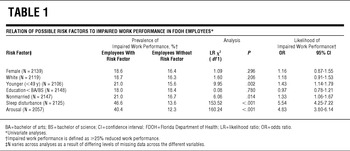
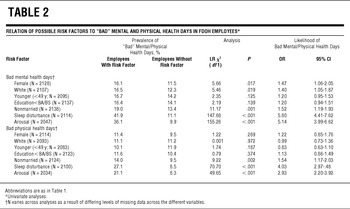
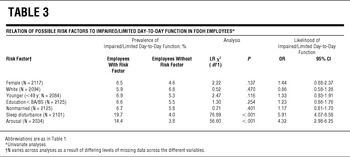
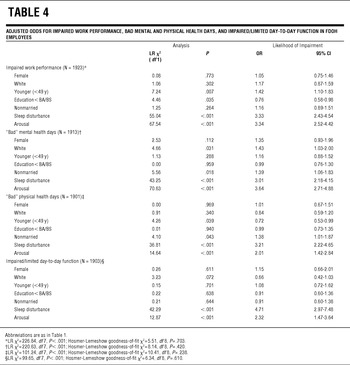
Tables 1 to 3 display the univariate relations among impaired work performance, mental and physical health, and day-to-day function with sleep disturbance and arousal. Table 4 displays the multiple logistic regressions for the aforementioned variables.
Relation of Possible Risk Factors to Impaired Work Performance in FDOH Employees*

Relation of Possible Risk Factors to “Bad” Mental and Physical Health Days in FDOH Employees*

Relation of Possible Risk Factors to Impaired/Limited Day-to-Day Function in FDOH Employees*

Adjusted Odds for Impaired Work Performance, Bad Mental and Physical Health Days, and Impaired/Limited Day-to-Day Function in FDOH Employees

Impaired Work Performance
Demographics
Those who were young were 1.43 times more likely to report impaired work performance (21.0%, n = 215) than older people (15.6%, n = 169; Table 1). Similarly, those who were not married were 1.33 times more likely to report impaired work performance (21.0%, n = 151) than those who were married (16.7%, n = 238).
Sleep Disturbance and Arousal
Those with sleep disturbance on more than half of the days in the previous 2 weeks were 5.54 times more likely to report impaired work performance (46.6%, n = 138 vs 13.6%, n = 249; Table 1) than those without sleep disturbance. Similarly, those with high hurricane-related arousal in the past month were 4.83 times more likely to report impaired work performance (40.4%, n = 180 vs 12.3%, n = 198) than those who did not have this level of arousal.
To investigate further the relation of sleep disturbance and arousal to reduced work performance, we examined a regression model that included all of the demographic variables and both sleep disturbance and arousal across the entire sample. Those with sleep disturbance on more than half of the days in the previous 2 weeks continued to be at increased risk (odds ratio [OR] 3.33; LR χ2 = 55.04, df 1, P < .001, 95% CI, 2.43-4.54; Table 4). Similarly, those with greater hurricane-related arousal in the past month continued to be at an elevated risk (OR 3.34; LR χ2 = 67.54, df 1, P < .001, 95% CI, 2.52-4.42). Those who were younger (OR 1.42; LR χ2 7.24, df 1, P = .007, 95% CI, 1.10-1.83) were at a greater risk and those with a lower level of education (at least a bachelor of arts or a bachelor of science degree; OR 0.76; LR χ2 = 4.46, df 1, P = .035, 95% CI, 0.58-0.98) had a decreased risk of impaired work performance.
Mental Health
Demographics
Women were 1.47 times more likely to report ≥7 “bad” mental health days in the past month (16.1%, n = 276) than men (11.5%, n = 47; Table 2). Similarly, those who were white were 1.40 times more likely to report ≥7 “bad” mental health days (16.5%, n = 259) than nonwhites (12.3%, n = 66). Those not married were 1.52 times more likely to report ≥7 “bad” mental health days (19.0%, n = 135) than those who were married (13.4%, n = 192).
Sleep Disturbance and Arousal
Those with sleep disturbance on more than half of the days in the previous 2 weeks were 5.80 times more likely to report ≥7 “bad” mental health days (41.9%, n = 124 vs 11.1%, n = 201; Table 2). Similarly, those with high hurricane-related arousal in the past month were 5.14 times more likely to report ≥7 “bad” mental health days (36.1%, n = 160 vs 9.9%, n = 159).
A regression model including all of the demographic variables and both sleep disturbance and arousal was used to further examine the relation of sleep disturbance and arousal to “bad” mental health days. Those with sleep disturbance on more than half of the days in the previous 2 weeks remained at a heightened risk (OR 3.01; LR χ2 = 43.25, df 1, P < .001, 95% CI, 2.18-4.15; Table 4). Similarly, those with greater hurricane-related arousal in the past month continued to be at increased risk (OR 3.64; LR χ2 = 70.63, df 1, P < .001, 95% CI, 2.71-4.88). Those who were white (OR 1.43; LR χ2 = 4.66, df 1, P = .031, 95% CI, 1.03-2.00) and those not married (OR 1.39; LR χ2 = 5.56, df 1, P = .018, 95% CI, 1.06-1.83) also continued to be at greater risk of ≥7 “bad” mental health days.
Physical Health
Demographics
Those who were not married were 1.54 times more likely to report ≥7 “bad” physical health days (14.0%, n = 99) than those who were married (9.5%, n = 135; Table 2).
Sleep Disturbance and Arousal
Those with sleep disturbance on more than half of the days in the previous 2 weeks were 4.03 times more likely to report ≥7 “bad” physical health days (27.1%, n = 79 vs 8.5%, n = 153; Table 2). Similarly, those with high hurricane-related arousal in the past month were 2.93 times more likely to report ≥7 “bad” physical health days (21.1%, n = 93 vs 8.3%, n = 133).
The regression model including sleep disturbance, arousal, and the demographic variables revealed that those with sleep disturbance on more than half of the days in the previous 2 weeks continued to be at increased risk of ≥7 “bad” physical health days (OR 3.21; LR χ2 = 36.81, df 1, P < .001, 95% CI, 2.22-4.65; Table 4). Similarly, those with greater hurricane-related arousal in the past month remained at an elevated risk (OR 2.01; LR χ2 = 14.64, df 1, P < .001, 95% CI, 1.42-2.84). Those who were younger (OR 1.38; LR χ2 = 4.26, df 1, P = .039, 95% CI, 1.01-1.88) had a decreased risk and those not married (OR 0.72; LR χ2 = 4.10, df 1, P = .043, 95% CI, 0.53-0.99) were also at greater risk of ≥7 “bad” physical health days.
Day-to-Day Function
Demographics
Those with ≥7 days of impaired/limited day-to-day function in the past month did not differ from those with <7 days of impaired/limited day-to-day function on any demographic characteristic (Table 3).
Sleep Disturbance and Arousal
Those with sleep disturbance were 5.91 times more likely to report ≥7 days of impaired/limited day-to-day function in the past month (19.7%, n = 57 vs 4.0%, n = 72; Table 3). Similarly, those with high hurricane-related arousal were 4.32 times more likely to report impaired/limited day-to-day function (14.4%, n = 63 vs 3.8%, n = 60).
The regression model including sleep disturbance, arousal, and the demographic variables revealed that those with sleep disturbance remained at a heightened risk (OR 4.71; LR χ2 = 42.29, df 1, P < .001, 95% CI, 2.97-7.48; Table 4). Similarly, those with high hurricane-related arousal continued to be at increased risk (OR 2.32; LR χ2 = 12.87, df 1, P < .001, 95% CI, 1.47-3.64). There were no significant demographic risk factors.
Finally, all of the aforementioned analyses were replicated using the PTSD Checklist hurricane-related sleep disturbance variable described above. All of the findings related to this variable were significant and similar to those described above.
COMMENT
The health of first responders, including public health workers, is critical to sustaining the nation's health. Experience with the terrorism-related events of September 11, 2001, Hurricane Katrina, and concerns about an Asian influenza pandemic further emphasize this issue. Disaster workers experience both acute and longer-term distress and dysfunction.Reference Johnsen, Eid, Løvstad and Michelsen1Reference Witteveen, Bramsen and Twisk3Reference Bills, Levy and Sharma31Reference Bryant and Harvey32Reference Fullerton, Ursano and Wang33Reference Marmar, Weiss, Metzler, Delucchi, Best and Wentworth34 The intensity and frequency of exposure is associated with these adverse outcomes.Reference Witteveen, Bramsen and Twisk3Reference Bryant and Harvey32Reference Fullerton, Ursano and Wang33Reference Marmar, Weiss, Metzler, Delucchi, Best and Wentworth34Reference Perrin, DiGrande, Wheeler, Thorpe, Farfel and Brackbill35 In particular, first responders often report sleep disturbance and hyperarousal after exposure to disasters.Reference Lavie4Reference Ursano, Fullerton, Weisaeth and Raphael5
Our data indicate that public health workers with greater exposure to the 2004 hurricanes reported greater sleep disturbance and high arousal even 9 months after the hurricanes. The public health workers in our study reported a 14.3% reduction in work productivity. As a conservative estimate, considering a minimum wage of $6.15 for the state of Florida in 2005,Reference Nissen36 this would result in a loss of $76 160/week or nearly $4 million ($3.96 million) per year for this group of employees. This would be nearly $32 million (31.8 million) for the entire FDOH. Such a reduction in workforce productivity warrants planned intervention.
Approximately 18.2% of disaster workers report impaired work performance. Our data indicate that sleep disturbance and elevated arousal are strong independent predictors of impaired work performance, as well as “bad” mental and physical health and limited day-to-day function, even after adjusting for sex, race, age, education, and marital status. People with sleep disturbance or elevated arousal were 2 to 4.7 times more likely to experience impaired work performance, “bad” mental and physical health, and limited day-to-day function. These findings are consistent with other studies of disaster workers.Reference Hobfoll, Watson and Bell6Reference Eriksen, Natvig and Bruusgaard7Reference Manocchia, Keller and Ware8Reference Owens9Reference Ford and Kamerow10Reference Koren, Arnon, Lavie and Klein11Reference Strine and Chapman12Reference Marshall, Schell, Glynn and Shetty14Reference Schell, Marshall and Jaycox15Reference Buitenhuis, de Jong, Jaspers and Groothoff16
The multiple aspects of impairment (eg, work performance, mental and physical health, day-to-day function) potentially affected by sleep disturbance and hurricane-related arousal supports the need for research on interventions for sleep and arousal with public health workers after a disaster. Behavioral interventions and pharmacological treatments are effective in treating sleep problems. For example, cognitive restructuring, imagery rehearsal therapy, and sleep hygiene are effective behavioral therapies.Reference Krakow, Hollifield and Johnston37 There are also effective pharmacological treatments for sleep disturbances, including nightmares.Reference Raskind, Peskind and Kanter38Reference Ursano, Bell and Eth39 There are also effective treatments for the arousal symptoms of PTSD.Reference Marshall, Schell, Glynn and Shetty14Reference Schell, Marshall and Jaycox15Reference Ursano, Bell and Eth39404142 Educating primary care providers, workplace health clinics, and specialty mental health care providers to assess and target sleep disturbance and arousal appears to be a valuable public health strategy to sustain the workforce after repeated disaster exposures.
The present findings must be interpreted in terms of several methodological considerations. Because this is a cross-sectional study, further research using longitudinal designs is recommended to better determine the course of sleep disturbance and arousal and its relation to work performance, mental and physical health, and day-to-day function. Retrospective recall could have affected respondents' memories of their hurricane-related experiences. Collecting early data postexposure is complicated and difficult but necessary to strengthen the validity of findings. Obtaining these data would allow for the inclusion of participants who may have left the FDOH shortly after the hurricane season; however, the present data capture those most likely to be present during the next hurricane or other disasters. In addition, the data for this study were gathered electronically. The electronic questionnaire method allowed for the collection of a large number of questionnaires in a cost-effective fashion; however, it would be useful to investigate the possibility of nonresponse bias. A comparison between the present sample and the FDOH employee population to whom the questionnaire was distributed on a few basic demographic characteristics was conducted to evaluate this. Although the comparisons between the proportion of men (19.6% and 22.5%) and between the proportion of younger people (48.7% and 59.1%) in the sample and population are relatively comparable, there is a notable difference between the proportion of whites (73.9% and 52.6%) in the sample and population. Taking into account the associations between occupational positions and race in this population, it is possible that differing occupational positions may reflect this difference. Specifically, administrators and professionals with greater computer access may be represented more in these data than are individuals providing logistical and other forms of support.
CONCLUSIONS
The different aspects of impairment, for example, work performance, mental and physical health, and day-to-day function, affected by sleep disturbance and arousal suggest the need for early intervention with public health workers after a disaster. Educating primary care providers, workplace health clinics, and specialty mental health care providers to assess and target sleep disturbance and arousal appears to be a valuable public health strategy to sustain the workforce after repeated disaster exposures.
Furthermore, understanding the spectrum of effects of disaster work on public health workers is important. They are an understudied group of first responders with a unique role in the aftermath of disasters. Because there are effective interventions for sleep disturbance and arousal, future research should continue to examine these outcomes in public health workers and other first responders.
Authors' Disclosures: The author reports no conflicts of interest.