


The World Health Organization ‘Global Burden of Disease’ report (Reference Murray and LopezMurray & Lopez, 1996) identified unipolar depression as a leading cause of disability worldwide. To reduce this morbidity, treatments should not only reduce depressive symptoms and restore functioning but also prevent relapse or recurrence. Outcome research has increasingly targeted relapse prevention and explored the use of psychological as well as pharmacological treatments to achieve this goal (Reference Elkin, Shea and WatkinsElkin et al, 1989; Reference ScottScott, 2000). Unfortunately, health economic research has not kept pace with this clinical agenda. Virtually all economic studies of depression have analysed cost in relation to short-term changes in symptoms and functioning (Reference Rosenbaum and HylanRosenbaum & Hylan, 1999). Most of these studies focus on the cost-effectiveness of older (tricyclic antidepressants: TCAs) v. newer (selective serotonin reuptake inhibitors: SSRIs) antidepressant medications (Reference Rosenbaum and HylanRosenbaum & Hylan, 1999) in the treatment of acute depressive episodes. This is unfortunate for two reasons: medication accounts for only 10-20% of the direct treatment costs of depression (Reference Simon, Von Korff and BarlowSimon et al, 1995); and it gives no information on the cost v. benefits of psychological compared with pharmacological approaches (Reference Wells, Sturm and SherbourneWells et al, 1996).
Background
Most acute treatment studies demonstrate that antidepressants and brief evidence-based psychotherapy are equally effective in the short-term treatment of depression (Depression Guideline Panel, 1993; Reference DeRubeis, Gelfand and TangDeRubeis et al, 1999). The limited economic data available suggest that the cost of therapy exceeds that of medication plus usual care in the acute phase (Reference Scott and FreemanScott & Freeman, 1992; Reference Gabbard, Lazar and HornbergerGabbard et al, 1997). However, these cost-effectiveness findings might be transformed if a psychological treatment had a durable post-intervention effect and the studies extended the follow-up period (Reference ScottScott, 2000). There is tentative evidence from follow-up studies of randomised controlled treatment trials of acute depression that a course of cognitive therapy or interpersonal therapy may significantly reduce the later risk of relapse (Reference Elkin, Shea and WatkinsElkin et al, 1989; Reference Evans, Hollon and DeRubeisEvans et al, 1992). However, the studies followed up small numbers of subjects, were relatively low powered, did not collect data on resource utilisation and the findings were prone to the ‘differential sieve’ effect, where the subjects involved in the follow-up phase of the study were no longer representative of those included at randomisation (Reference Paykel, Scott and TeasdalePaykel et al, 1999). Our UK-based randomised controlled trial avoided these pitfalls (Reference Paykel, Scott and TeasdalePaykel et al, 1999; Reference Scott, Teasdale and PaykelScott et al, 2000). It recruited 158 individuals with persistent depressive symptoms despite adequate treatment with antidepressant medication and appropriate clinical input. As reported, the group who received cognitive therapy had significantly fewer relapses during the 1-year follow-up period than the control group, as well as experiencing significant reductions in depressive symptoms and improvements in social functioning. However, we do not know whether the additional health gain achieved offsets the additional cost of providing cognitive therapy.
This study explores whether relapse prevention with a psychological therapy is cost-effective. The direct health costs of avoiding relapse were assessed in two ways: the total cost per depressive relapse avoided and the cost per additional relapse-free day.
METHOD
The methodology of the intervention study is described in detail in Paykel et al (Reference Paykel, Scott and Teasdale1999). With ethical approval, we invited 230 individuals with persistent depression to participate in the study.
Subjects
Subjects were 21- to 65-year-old psychiatric out-patients with unipolar depression who gave informed consent and who had satisfied DSM—III—R (American Psychiatric Association, 1987) criteria for major depression in an episode within the past 18 months but not in the past 2 months. At randomisation, subjects were required to have current residual symptoms of at least 8 weeks' duration that reached both 8 or more on the 17-item Hamilton Rating Scale for Depression (HRSD; Reference HamiltonHamilton, 1967) and 9 or more on the Beck Depression Inventory (BDI; Reference Beck, Ward and MendelsonBeck et al, 1961). Patients were excluded if they had a past history of bipolar disorder or a current history of significant Axis I or Axis II comorbidity or other factors precluding participation in the study. Patients currently receiving formal psychotherapy and those who had previously received cognitive therapy for more than five sessions were also excluded.
Treatments
All subjects were receiving antidepressants at a minimum dose equivalent to 125 mg or more of amitryptiline. Subjects then were randomised to receive clinical management alone, or clinical management plus cognitive therapy. Clinical management comprised 30-min appointments with a psychiatrist every 4 weeks during the treatment phase (20 weeks) and every 8 weeks during the 48-week follow-up phase. Cognitive therapy comprised 16 sessions over 20 weeks, with two subsequent booster sessions. Therapists were experienced in the approach and received regular supervision. A treatment manual was used. Clinical management and cognitive therapy sessions were audiotaped and monitored to ensure protocol adherence and competency. All subjects remained on continuation and maintenance antidepressants throughout the study. An antidepressant dosage increase of 30% greater than at inclusion was allowed. Lithium also could be prescribed.
Clinical assessments
Subjects were assessed every 4 weeks up to week 20 and every 8 weeks thereafter by a study psychiatrist blind to treatment group (interrater reliability in ratings and an audit of blinding status also were undertaken). The primary outcome measure of relapse was defined as either:
-
(i) meeting the DSM—III—R criteria for major depressive disorder for a minimum duration of 1 month and also having a score of 17 or above on the HRSD at two successive face-to-face assessments at least 1 week apart; or
-
(ii) having residual depressive symptoms that persisted between two successive ratings 2 months apart, reaching a score of at least 13 on the HRSD on both occasions combined with a level of distress or dysfunction at which withholding additional active treatment was not justified.
Resource utilisation and cost assessments
The economic analysis was undertaken from the perspective of the direct costs to the National Health Service. Non-health service expenditure and indirect costs were not considered in the analysis.
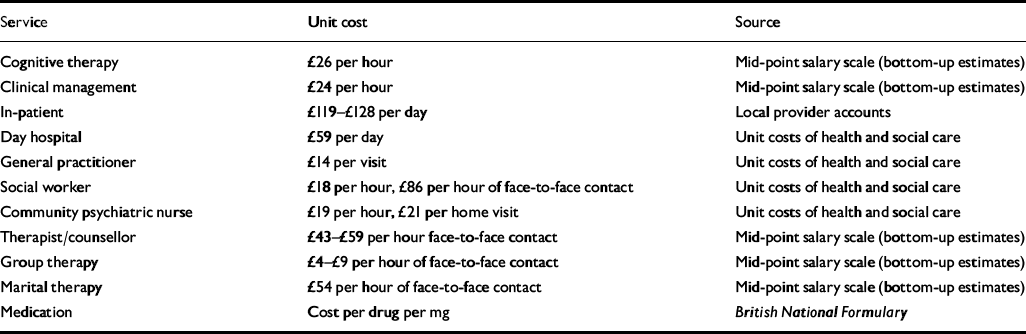
Information on health and social care utilisation was collected using an adapted version of the Client Service Receipt Inventory (Reference Knapp and BeechamKnapp & Beecham, 1990). The questionnaire was administered alongside the clinical assessments. Direct health care costs were derived by using activity data and applying an appropriate unit cost to each recorded consultation, contact or episode of care (see Table 1). All unit costs were adjusted to 1998/1999 prices using the relevant price indices. The unit cost estimates were obtained from a variety of sources, including the relevant local providers, the Personal Social Services Research Unit (Reference Netten, Dennet and KnightNetten et al, 1999) and the British National Formulary (British Medical Association & Royal Pharmaceutical Society of Great Britain, 1999). The treatment costs for cognitive therapy were calculated by using a cost per minute taken from the mid-point of the relevant 1998/1999 salary scales and included employers' national insurance and superannuation contributions, and overhead costs. The additional costs of non-face-to-face activities (e.g. writing up notes, supervision) were estimated by using a ratio provided by each therapist. The unit costs of other therapies were derived using a similar bottom-up approach.
Unit costs for services
| Service | Unit cost | Source |
|---|---|---|
| Cognitive therapy | £ 26 per hour | Mid-point salary scale (bottom-up estimates) |
| Clinical management | £ 24 per hour | Mid-point salary scale (bottom-up estimates) |
| In-patient | £ 119—£128 per day | Local provider accounts |
| Day hospital | £ 59 per day | Unit costs of health and social care |
| General practitioner | £ 14 per visit | Unit costs of health and social care |
| Social worker | £ 18 per hour, £86 per hour of face-to-face contact | Unit costs of health and social care |
| Community psychiatric nurse | £ 19 per hour, £21 per home visit | Unit costs of health and social care |
| Therapist/counsellor | £ 43—£59 per hour face-to-face contact | Mid-point salary scale (bottom-up estimates) |
| Group therapy | £ 4—£9 per hour of face-to-face contact | Mid-point salary scale (bottom-up estimates) |
| Marital therapy | £ 54 per hour of face-to-face contact | Mid-point salary scale (bottom-up estimates) |
| Medication | Cost per drug per mg | British National Formulary |
The unit cost estimates were combined with the resource utilisation data to obtain a net cost per patient over the entire trial. Costs are reported in net present value terms by discounting costs at the annual rate of 6%, as recommended by the UK Treasury.
Data analysis
Clinical outcomes
The pre-set sample size was 160 subjects (80 per treatment group), which gave 80% power to detect, by the log-rank test at P=0.05 (two-tailed), a reduction in relapse rates from 40% in one group to 20% in the other. Intention-to-treat analyses of relapse were by Cox regression, including as covariates the stratification variables used in randomisation and other relevant demographic and clinical variables (Reference Paykel, Scott and TeasdalePaykel et al, 1999).
Cost analysis
The results of the cost analysis are reported as mean (and median) values with standard deviations and as mean differences with 95% confidence intervals (CIs). Because costs were non-normally distributed (positively skewed), the robustness of the parametric assumptions concerning mean differences in costs was tested by using the non-parametric bootstrapping method, performing 1000 replications of the original data (Reference Efron and TibshiraniEfron & Tibshirani, 1993). This approach allows a comparison of arithmetic means without making any assumptions about the cost distribution (Reference Thompson and BarberThompson & Barber, 2000). The comparison of the parametric CIs with the bootstrap CIs demostrated the robustness of the parametric approach, so the parametric CIs are reported.
Two separate analyses of total costs were undertaken. First, direct health care costs were considered but the additional costs of cognitive therapy were excluded from this total. Because cognitive therapy was not considered a direct substitute for any other form of treatment in the study, this enables us to determine whether therapy itself has any impact on health care expenditure. A second analysis then explored the impact of including the costs of cognitive therapy into the analysis of total costs.
Resource utilisation questionnaires were available on 77 subjects in each group (86%). However, fully completed individual resource utilisation data-sets for every assessment period were available for only 65% of subjects. The small proportion of intermittent missing assessments exacerbated the problems associated with other missing data in the longitudinal analysis of costs. To compensate, the analysis imputed the missing assessments by using the last value recorded (last value carried forward: LVCF) at the previous assessment.
Two alternative approaches were used to impute missing data in the sensitivity analysis: mean imputation and multiple imputation. In the first approach, the missing cost values for individuals were replaced with the predicted mean estimate of the observed cost for the relevant group and assessment period. In the second approach, each missing value was replaced with five imputed values to create five complete data-sets using non-parametric multiple imputation. The five complete data-sets then are combined to yield a single combined estimate that formally incorporates missing data uncertainty in the estimate of costs. The advantage of this approach is that the uncertainty observed in real data is preserved by imputing several different values per missing data entry (Reference SchaferSchafer, 1999). The results of these alternative imputation methods are compared with the results obtained in the base-case analysis and then contrasted with the results obtained from a complete case analysis, which used only those 65% of patients with complete data for every single assessment.
Cost-effectiveness analysis
Cost-effectiveness was evaluated by relating the differential cost per patient receiving either the intervention or the control treatment to the differential effectiveness of each treatment in terms of the proportion of patients who were relapse-free. The incremental cost-effectiveness ratio (ICER) was calculated as the difference in mean cost divided by the difference in the proportion of patients who were relapse-free. A cost—acceptability curve was used for the statistical analysis of the ICER. This approach is becoming increasingly common in cost-effectiveness studies and avoids the difficulties associated with the estimation of CIs for the ICER (UK Prospective Diabetes Study Group, 1998; Reference Delaney, Wilson and RobertsDelaney et al, 2000). The curve indicates the probability of the intervention being more cost-effective than the control treatment for a range of potential maximum amounts of money (ceiling ratio) that a decision-maker might pay to prevent an additional bad outcome (in this case, depressive relapse). The x-axis shows a range of values for this ceiling ratio and the y-axis shows the probability that the data are consistent with a true cost-effectiveness ratio falling below these ceiling amounts (Reference van Hout, Al and Gordonvan Hout et al, 1994).
All data were analysed using SPSS 10.0 and Microsoft Excel 2000. The bootstrap re-sampling and the non-parametric multiple imputation were undertaken using STATA 6.0 for Windows and SOLAS 2.1 (Statistical Solutions, 1999), respectively.
RESULTS
Clinical outcome
Initial characteristics of the two treatment groups showed that they were closely comparable on all key variables (see Table 2). Subjects' mean age was about 43 years, and 50% were male. Severity ratings were now in the middle of the residual depression range, with a mean HRSD score of about 12 and a mean BDI score of 22, although over 50% of index episodes were originally classified as severe. The median duration of the current episode was about 14 months. Only 30% of subjects were in their first episode of depression. Doses of antidepressants were equivalent to 186 mg of amitriptyline daily for those on TCAs and 33 mg of fluoxetine for those on SSRIs. About 60% of subjects were on SSRIs and about 15% were receiving lithium augmentation.
Baseline characteristics of subjects

| Control group (n=77) | Cognitive therapy group (n=77) | |
|---|---|---|
| Mean age, years (s.d.) | 43.2 (11.2) | 43.5 (9.8) |
| Female, n (%) | 41 (53%) | 37 (46%) |
| Severe index episode, n (%) | 43 (55%) | 41 (51%) |
| Median duration of index episode, months | 13.0 | 14.5 |
| History of major depressive disorder, n (%) | 50 (65%) | 51 (64%) |
| Mean dose of medication at inclusion, mg (s.d.) | ||
| TCA, amitriptyline equivalent | 188 (45) | 186 (45) |
| SSRI, fluoxetine equivalent | 36 (15) | 31 (11) |
| Symptom ratings at inclusion, mean (s.d.) | ||
| Hamilton Rating Scale for Depression | 12.2 (2.9) | 12.1 (2.7) |
| Beck Depression Inventory | 22.3 (8.0) | 21.9 (7.7) |
As reported by Paykel et al (Reference Paykel, Scott and Teasdale1999), actuarial cumulative relapse rates for the cognitive therapy and the control group, respectively, in the intention-to-treat analyses were 10% and 18% at 20 weeks and 29% and 47% at 68 weeks (adjusted hazard ratio=0.51; 95% CI 0.32-0.93). The number needed to treat with cognitive therapy per additional depressive relapse avoided was six (95% CI 3-11).
Total costs
The mean direct health care costs (excluding the cost of cognitive therapy) were significantly lower in the cognitive therapy group in comparison with the control group (see Table 3). Cognitive therapy resulted in a mean cost saving of £385 (95% CI £ 1-£769). These cost savings accrued primarily from savings on inpatient admissions and day-patient services. When the additional costs of cognitive therapy were considered, patients in the intervention group were significantly more expensive than those who received conventional treatment. On average, patients receiving cognitive therapy were £779 (95% CI £ 387-£1170) more costly. However, because cognitive therapy resulted in significant cost offsets in other areas of health care expenditure, the incremental cost incurred by patients receiving cognitive therapy (£779) was lower than the overall mean therapy cost of cognitive therapy (£1164).
Mean cost of treatment using the last value carried forward (LVCF)1

| Control group (n=77) | Cognitive therapy (CT) group (n=77) | Mean cost difference: | |||||
|---|---|---|---|---|---|---|---|
| Mean | Median | s.d. | Mean | Median | s.d. | CT — control (95% CI) | |
| Cognitive therapy | 0 | 0 | 0 | 1164 | 1222 | 346 | 1164 (1084 to 1244) |
| Planned clinical management | 172 | 170 | 29 | 164 | 158 | 34 | -8 (-19 to 2) |
| Additional clinical management | 27 | 15 | 43 | 18 | 0 | 38 | -10 (-23 to 3) |
| In-patient services | 177 | 0 | 856 | 16 | 0 | 101 | -161 (-356 to 35) |
| Day patient services | 206 | 0 | 1144 | 0 | 0 | 0 | -206 (-466 to 54) |
| General practitioner | 110 | 98 | 71 | 107 | 95 | 81 | -4 (-28 to 21) |
| Community psychiatric nurse | 17 | 0 | 56 | 23 | 0 | 124 | 5 (-25 to 36) |
| Social worker | 13 | 0 | 71 | 0 | 0 | 0 | -13 (-29 to 4) |
| Counsellor/therapist | 32 | 0 | 135 | 40 | 0 | 195 | 8 (-46 to 61) |
| Group therapy | 8 | 0 | 47 | 7 | 0 | 46 | -1 (-16 to 14) |
| Marital/family therapy | 4 | 0 | 37 | 3 | 0 | 19 | -1 (-11 to 8) |
| Other mental health contacts | 8 | 0 | 38 | 28 | 0 | 104 | 20 (-6 to 45) |
| Neuroleptics | 3 | 0 | 11 | 2 | 0 | 5 | -1 (-4 to 2) |
| Hypnotics | 3 | 0 | 11 | 4 | 0 | 11 | 1 (-2 to 5) |
| Lithium | 6 | 0 | 11 | 7 | 0 | 15 | 1 (-3 to 5) |
| Antidepressants | 331 | 323 | 237 | 315 | 308 | 227 | -16 (-91 to 58) |
| All medication | 343 | 323 | 242 | 329 | 308 | 230 | -15 (-90 to 61) |
| Direct health care costs | |||||||
| Excluding cognitive therapy costs | 1119 | 700 | 1633 | 734 | 602 | 447 | -385 (-769 to -1)* |
| Including cognitive therapy costs | 1119 | 700 | 1632 | 1898 | 1870 | 564 | 779 (387 to 1170)** |
Cost-effectiveness
On the basis of a deterministic comparison of mean costs and effects, cognitive therapy is more effective but more costly than standard clinical management and antidepressants alone. The resulting ICER is £4328 per relapse prevented (£779/0.18). This translates to a cost of about £ 12.50 per additional relapse-free day.
Figure 1 presents the resulting cost-effectiveness—acceptability curve for cognitive therapy. The curve indicates the probability of adjunctive cognitive therapy being more cost-effective than clinical management and antidepressants alone for a range of potential maximum amounts (ceiling ratio) that a decision-maker is willing to pay to prevent an additional relapse. For example, if the decision-maker is prepared to pay £6000, the probability of cognitive therapy being cost-effective is over 60%, and at £8500 the probability of cognitive therapy being cost-effective is over 80%.
Cost-effectiveness—acceptability curve: probability that preventing an additional relapse is cost-effective as a function of a decision-maker's ceiling cost-effectiveness ratio.

Sensitivity analysis
The sensitivity of the cost-effectiveness analysis to the method of handling the missing data was examined by recalculating the ICER and the cost-effectiveness—acceptability curves using the alternative imputation approaches. The results indicate that the findings are relatively robust to the choice of method used to impute the missing assessments. The ICER increases to £4667 (£840/0.18) using mean imputation and to £ 5028 (£905/0.18) using non-parametric multiple imputation. In contrast to the imputation approaches, the ICER increases to £7056 (£1270/0.18) per relapse prevented using only the 65% of subjects in the complete case analysis. As shown in Fig. 2, the distance of the cost-effectiveness—acceptability curve using the complete case analysis from the three imputation curves (which are clustered together) clearly illustrates that the results are highly sensitive to the decision to impute the missing data.
Sensitivity analysis for cost—acceptability curves: imputation techniques v. complete case analysis. Curves: — last value carried forward; - - - mean imputation; — — — multiple imputation; — complete case data analysis only.

CONCLUSIONS
The morbidity and economic burden of depression are equal to or exceed that of other major disorders such as AIDS, cancer and coronary heart disease (Reference Greenberg, Stiglin and FinkelsteinGreenberg et al, 1993; Reference Murray and LopezMurray & Lopez, 1996; Reference Wells, Sturm and SherbourneWells et al, 1996). Clinically, patients with persistent depression are increasingly a focus of research because of the high prevalence (20% of index depressive episodes persist for more than 2 years), lost human capital (Reference Berndt, Koran and FinkelsteinBerndt et al, 2000), very high risk of relapse (Reference ScottScott, 2000) and high resource utilisation (Reference HowlandHowland, 1993). The poor prognosis despite intensive treatment suggests that these individuals are consuming resources that do not meet their needs. However, there is a paucity of data from randomised controlled trials on the costs and benefits of different treatment interventions (Reference Scott and FreemanScott & Freeman, 1992; Reference Johnsson and BebbingtonJohnsson & Bebbington, 1994; Reference Rosenbaum and HylanRosenbaum & Hylan, 1999).
We have demonstrated that cognitive therapy is likely to be cost-effective if a decision-maker regards paying about £4500 per additional relapse prevented as value for money (about £12.50 per additional depression-free day). This cost may seem high in comparison with the estimated cost of successful acute treatment with antidepressants (£785-£1024) (Reference Johnsson and BebbingtonJohnsson & Bebbington, 1994; Reference Simon, Von Korff and BarlowSimon et al, 1995; Reference Donaghue, May and SartoriusDonaghue, 1999). However, our study particularly targeted those who had already failed to respond to adequate antidepressant treatment and considerable clinical input. Also, our cost estimates should be seen as a ‘worst-case’ scenario because the analyses presented assume that the additional benefits of cognitive therapy ended abruptly at the 17-month follow-up assessment. Other studies suggest that subjects receiving cognitive therapy maintain their gains and continue to demonstrate lower relapse rates up to 6 years later (Reference Evans, Hollon and DeRubeisEvans et al, 1992; Reference Fava, Rafanelli and GrandiFava et al, 1998). We explored only health care costs and it is widely reported that effective treatment of depression often produces even greater reductions in indirect costs. Furthermore, a study of over 1600 patients with depression using a Medicaid programme in California, USA, demonstrated that those with treatment-resistant depression cost US$5321 (about £4000) more in total health care in the first year than patients who responded to acute treatment (Reference McCoombs, Stimmel, Hui, Amsterdam, Hornig and NierbenbergMcCoombs et al, 2001). Taken as a whole, the above findings suggest that efficient treatment of depression can be achieved if higher costs in the short term are balanced by better outcomes and therefore lower marginal costs in the long term (Reference Sturm and WellsSturm & Wells, 1995; Reference Wells, Sturm and SherbourneWells et al, 1996). In these circumstances, structured psychological therapies such as cognitive therapy, interpersonal therapy and similar approaches appear to have a major role to play in the treatment of residual depression.
Finally, it is useful to comment on health economic issues in this study. The results are sensitive to the imputation method and our use of multiple imputation is probably the more conservative approach. However, LVCF may be the more realistic approach because the majority of missing data arose from intermittent missing assessments, and the assessments were extremely frequent, which indeed exacerbated the problem. Applying imputation methods to the missing assessments enabled the study to incorporate the observed costs of all patients in the longitudinal costs, rather than the subset of patients with complete data. It is our view that the exclusion of patients without complete data from the complete case analysis ignores the potentially valuable information obtained for those patients for whom partial data were available.
The cost-effectiveness—acceptability curve framework can be used when considering the cost of extending an individual's survival time (to next relapse) and gives a measure of the sample uncertainty around both the cost and the outcome. When an intervention is both more costly and more effective, the amount that the decision-maker is prepared to pay per additional unit of outcome (relapse prevented) is critical in determining whether a treatment represents value for money. However, the value the decision-maker places on this gain in outcome is not explicit in practice. The advantage of the cost-effectiveness—acceptability curve framework is that it enables the results of the study to be presented in relation to a range of possible maximum values. This can be helpful to clinicians trying to digest such data. Clinicians can easily grasp the notion that effectiveness comes at a price: paying £x for treatment y may have a 50% probability of effectiveness but paying £2x may have a 75% probability. We would strongly support the application of these techniques to randomised controlled trials of structured psychological therapies.
Clinical Implications and Limitations
CLINICAL IMPLICATIONS
-
▪ In individuals with medication-refractory depression, the addition of cognitive therapy to intensive clinical treatment is more costly but more effective than intensive treatment alone.
-
▪ The cost of providing this therapy is about £12.50 per additional relapse-free day.
-
▪ The balance between the costs and benefits of psychological v. pharmacological treatments may change significantly if judged against the longitudinal course of depressive disorders.
LIMITATIONS
-
▪ Indirect costs, such as loss of earning by subjects or their carers, were not measured.
-
▪ The study assumes that all the benefits from cognitive therapy come to an abrupt end at 17 months, which may have led to an overestimate of the incremental cost-effectiveness ratio.
-
▪ Quality-adjusted life-years were not measured, so the findings for depression cannot be compared directly with cost-effectiveness studies of physical disorders with similar levels of morbidity.
Acknowledgements
We wish to acknowledge the input to the data collection process of current and past members of the research team: Rosemary Abbott, Robert Bothwell, Peter L. Cornwall, Carolyn Crane, Anne Garland, Alison Jenaway, Tony Johnson, Richard Moore, Marie Pope and Maxwell Saxty.




eLetters
No eLetters have been published for this article.