Legitimacy
In my understanding, any discussion of legitimacy in the multilevel European polity needs to start from a functional perspective: Socially shared legitimacy beliefs are able to create a sense of normative obligation that helps to ensure the voluntary compliance with undesired rules or decisions of governing authority (Scharpf, Reference Scharpf1999; Höffe, Reference Höffe2002: 40). By providing justification and social support for the ‘losers’ consent’ (Anderson et al., Reference Anderson, Blais, Bowler, Donovan and Listhaug2005), such beliefs will reduce the need for (and the cost of) controls and sanctions that would otherwise be needed to enforce compliance.Footnote 1 They should be seen, therefore, as the functional prerequisite for governments which are, at the same time, effective and liberal.
From this functional starting point, further exploration could take either an empirical turn, focusing on citizens’ compliance behaviour and justifying beliefs, or a normative turn, focusing on good reasons for such beliefs. Here, I will focus on the normative discussion.
Republican and liberal legitimating discourses
Contemporary normative discourses in Western constitutional democracies are shaped by two distinct traditions of political philosophy, which may be conventionally labelled ‘republican’ and ‘liberal’ (Bellamy, 2007). Even though individual authors may have contributed to both, the origins, premises, generative logics, and conclusions of these traditions are clearly distinguishable.
The republican tradition can be traced back to Aristotle. For him, the polity is prior to the individual and essential for the development of human capabilities.Footnote 2 What matters is that the powers of government must be employed for the common good – and the problem, under any form of government, is the uncertain ‘virtuousness’ of governors who might pursue their self-interest instead. The concern for the common good of the polity and its institutional preconditions had also shaped the political philosophy of republican Rome (Cicero, Reference Cicero1995) which was resurrected in the Florentine renaissance (Machiavelli, Reference Machiavelli1966). From there, one branch of the republican tradition leads through the ‘neo-Roman’ theorists of the short-lived English revolution to the political ideals of the American revolution (Pocock, Reference Pocock1975; Skinner, Reference Skinner1998; Dahl, Reference Dahl1989: Ch. 2) and to contemporary concepts of ‘communitarian’ democracy (Pitkin, Reference Pitkin1981; MacIntyre, Reference MacIntyre1984, Reference MacIntyre1988; Pateman, Reference Pateman1985; Michelman, Reference Michelman1989; Taylor, Reference Taylor1992; cf. Habermas, Reference Habermas1992: 324–348). The other branch leads to the radical egalitarianism of Rousseau’s Contrat Social, which shaped the political thought of the French revolution and continues to have a powerful influence on Continental theories of democratic self-government. With the classical heritage Rousseau shares the primacy of the polity and the emphasis on the common good, to which he adds the postulate of equal participation in collective choices.Footnote 3
But then, as for Aristotle, the ‘virtuousness’ of the collective governors becomes a critical problem – requiring the transformation of a self-interested volonté des tous into a common-interest oriented volonté générale. This theoretical difficulty was pragmatically resolved by the invention of representative democracy, coupling the medieval representation of estates with the aspirations of democratic self-government (Dahl, Reference Dahl1989: 28–30). Here, the orientation of representatives to the common good is to be ensured by the twin mechanisms of public deliberation (Habermas, Reference Habermas1962; Elster, Reference Elster1998) and electoral accountability, while the egalitarianism of democratic republicanism is reflected in the fundamental commitment to universal and equal suffrage.
Compared to republicanism, the ‘liberal’ tradition is younger, going back to the early modern period and Thomas Hobbes (Reference Hobbes1986), rather than to Greek and Roman antiquity. Here, priority is assigned to the individual, rather than to the polity; the state is justified by the need to protect individual interests, and individual self-determination replaces the value of collective self-determination. What matters, once basic security is established by the state, are strict limitations on its governing powers in order to protect the fundamental value of ‘negative liberty’, which – in the tradition of John Locke and Adam Smith – should be understood as the ‘freedom of pursuing our own good in our own way’ (Berlin, Reference Berlin1958: 11).
Where the need for governing powers cannot be denied, individual liberty is best preserved by a rule of unanimous decisions (Buchanan and Tullock, Reference Buchanan and Tullock1962) or, in any case, by the checks and balances of multiple-veto constitutions and pluralist patterns of interest intermediation (Dahl, Reference Dahl1967). If at all possible, decisions ought to be based on the consensus of the interests affected, rather than on majority votes.
In the Continental branch of enlightenment philosophy, by contrast, Immanuel Kant had grounded the individualist position not in self-interest, but in the moral autonomy and rationality of the individual. Being at the same time free and morally obliged to follow their own reason, they will see that their liberty is constrained by the equal freedom of all others – which means that their choices must be governed by the ‘categorical imperative’ (Kant, Reference Kant1961). But given the ‘crooked timber’ of human nature, the moral imperative alone does not suffice, in practice, to ensure the mutual compatibility of individual liberties. There is a need, therefore, for general laws that are effectively sanctioned by state authority. Such laws will approximate a state of universal liberty if they define rules to which all who are affected could agree in their capacity as autonomous and rational actors (Kant, Reference Kant1966, Reference Kant1992). As Isaiah Berlin (Reference Berlin1958: 29–39) pointed out, however, this potential-consensus test could justify a very intrusive regulatory state – especially when decisions are delegated to the ‘deliberation’ of politically independent agencies or courts (Somek, Reference Somek2008). In other words, Kantian liberalism based on the categorical imperative, just like Rousseau’s republicanism based the volonté générale, may well be invoked to legitimate laws and policies that depart widely from the empirical preferences of self-interested citizens.
Constitutional democracies – and the EU?
Obviously, this rough sketch exaggerates the differences between the dual traditions of Western political philosophy, and a fuller treatment would have to be more nuanced and differentiated. What matters here, however, is the fact that the legitimacy of Western constitutional democracies rests on normative arguments derived from both of these traditions. They are all liberal in the sense that governing powers are constitutionally constrained, that basic human rights are protected, and that plural interests have access to the policy-making processes by which they are affected. At the same time, they all are republican in the sense that they are representative democracies where governing authority is obtained and withdrawn through regular, universal, free, and equal elections, where policy choices are shaped through public debates and the competition of political parties, and where institutions that are exempt from electoral accountability will still operate in the shadow of democratic majorities or, at least, of a democratic pouvoir constituant. In other words, republican and liberal principles coexist, and they constrain, complement, and reinforce each other in the constitutions and political practices of all Western democracies (Bellamy, 2007). In a sense, they are mutual antidotes against each other’s characteristic perversion – as republican collectivism is moderated by the protection of individual liberties, whereas libertarian egotism is constrained by the institutions of collective self-determination.
Nevertheless, the actual combinations vary, and differences matter: Republican politics are facilitated in unitary states and impeded by federal constitutions; individual interests receive less judicial protection where the constitution emphasizes parliamentary sovereignty; and consensus-dependent pluralism is stronger in the United States or in Switzerland than it is in the UK, New Zealand, or in France.Footnote 4 But these differences seem to fade in importance if we now turn our attention from the world of democratic nation states to the European Union (EU). If seen by itself and judged by these standards, the Union appears as the extreme case of a polity conforming to liberal principles which, at the same time, lacks practically all republican credentials.
Its liberalism is most obvious in the priority accorded to the protection of (some) individual rights and the tight constraints impeding political action: The European Court of Justice (ECJ) is more immune from political correction than the constitutional court of any democratic state. It has, from early on, interpreted the Treaty commitment to establish a Europe-wide market and the free movement of goods, persons, services, and capital not as a programmatic goal to be realized through political legislation, but as a set of directly enforceable individual rights that will override all laws and institutional arrangements of EU member states. In the same spirit, the principle of non-discrimination on grounds of nationality and the politically rudimentary European citizenship have been turned into individual rights of EU nationals to access the social benefits and public services of all member states (Wollenschläger, Reference Wollenschläger2007). At the prodding of national constitutional courts, moreover, the ECJ has also begun to protect non-economic human rights, and with the inclusion of the Charter of Basic Rights in the Constitutional Treaty, the Court will be able to complete the European protection of individual rights.
At the same time, the capacity for collective political action of the European polity is impeded by extremely high consensus requirements, and the input-side of its political processes could not be more pluralist, and less majoritarian in character. The Commission itself, which has a monopoly of legislative initiatives, relies on an extended infrastructure of committees and expert groups that allow access for a wide range of organized interests. Through the Council of Ministers, moreover, whose agreement by at least a qualified-majority vote is required for all legislation, all interests that have access to the national ministries in charge will also have access to the European level. The European Parliament, finally, whose role in legislation was considerably expanded in recent Treaty revisions, also prides itself on giving voice to interests and concerns that might possibly have been ignored in the Commission and the Council. In short, European legislation is characterized by very open and diversified access opportunities which, combined with very high consensus requirements, make it unlikely that its effect on major (organized) interests might be ignored in the process. And consensus is of course also the hallmark of the ‘New Modes of Governance’ which are employed to achieve policy coordination through ‘soft law’, ‘benchmarking’, ‘deliberation’, and ‘institutional learning’ in fields where the Union may still lack the power to legislate (Héritier, Reference Héritier2003; Kohler-Koch and Rittberger, Reference Kohler-Koch and Rittberger2006; Héritier and Lehmkuhl, Reference Héritier and Lehmkuhl2008).
To complete the liberal model on the output-side, the EU has developed considerable effectiveness as a regulatory authority. It is most powerful in the field of monetary policy, where policies of the European Central Bank (ECB) are completely immunized against political intervention. Moreover, the Commission and the Court have enjoyed similar political independence in developing a very effective competition regime, not only for the private sector but also for state aids and the public-service and infrastructure functions that might distort market competition. Some of these regimes could be based directly on the Treaties, while others depended on political compromises and European legislation. Even there, however, the Commission, the Court, and standard setting agencies have come to play such important roles in the licensing of pharmaceuticals and the regulation of product safety, food qualities, environmental standards, or workplace discrimination, that its effectiveness as a ‘regulatory state’ could be described as the EU’s paramount legitimating achievement (Majone, Reference Majone1996, Reference Majone1998).
But if the EU might well qualify by liberal standards, it would definitely fail by the criteria of republican democracy. On the output side, the Union’s capacity to promote the common good is constrained by the extremely high consensus requirements of EU legislation. They prevent effective collective action in response to many problems that member states could not deal with nationally. The notorious inability to regulate competition over taxes on company profits and capital incomes is just one example (Ganghof and Genschel, Reference Ganghof and Genschel2008a, Reference Ganghof and Genschel2008b). Worse yet, these same decision rules are responsible for an extreme conservative bias of EU policy. New legislation may be based on broad consensus. But once it is adopted, it cannot be abolished or amended in response to changed circumstances or changed preferences as long as either the Commission refuses to present an initiative or a few member states object. Beyond that, rules derived from the judicial interpretation of the Treaties could only be corrected through Treaty amendments that must be adopted unanimously by all member governments and ratified by parliaments or popular referenda in all member states. In other words, once EU law is in place, the acquis is nearly irreversible and its correspondence with the common good becomes progressively more tenuous as time goes on.
The constraints of consensual decision-making cannot be significantly relaxed as long as the peoples of 27 member states lack a collective identity that could legitimate Europe-wide majority rule. And even if citizens were to develop a sense of common solidarity and a stronger attachment to the European polity than to their own nation state (perhaps in response to external challenges from America, Russia, or China), they would presently lack all the societal and institutional prerequisites of input-oriented democracy: No Europe-wide media of communication and political debates, no Europe-wide political parties, no Europe-wide party competition focused on highly salient European policy choices, and no politically accountable European government that must anticipate and respond to the egalitarian control of Europe-wide election returns. There is no theoretical reason to think that these deficits should be written in stone. But at present, input-oriented republican legitimacy cannot be claimed for the Union.
While these stylized diagnoses may be somewhat overdrawn, they suggest a prima facie plausible interpretation of current disputes over the existence of a ‘European democratic deficit’. Authors and political actors starting from a ‘liberal’ framework of normative political theory will find it easy to attest to the democratic legitimacy of the EU by pointing to its protection of individual rights, to its pluralist openness to policy inputs, its consensual decision rules, and the effectiveness of its regulatory policies (Moravcsik, Reference Moravcsik1998, 2002). By contrast, authors and political actors viewing the EU from a ‘republican’ perspective will point to deficiencies on the output side, where the concern for individual rights and the responsiveness to organized interests are accompanied by a systemic neglect of redistributive policy goals. Their more salient criticism is, however, directed at the glaring democratic deficits on the input side, emphasizing the lack of a common public space, the lack of Europe-wide political debates, party competition, and political accountability (Greven, Reference Greven2000; Harlow, Reference Harlow2002; Follesdal and Hix, Reference Follesdal and Hix2006; Hix, Reference Hix2008). If some of these authors, nevertheless, assume that these deficiencies might eventually be overcome through institutional reforms and the mobilization strategies of European parties, they seem to underestimate the disruptive potential of political mobilization and confrontation in an institutional framework which, in the absence of a strong collective identity, would still require consensual decision making (Bartolini, Reference Bartolini2005, Reference Bartolini2008).
Legitimacy in multilevel polities
In any case, however, the EU in its present shape is so far from meeting the republican criteria of democratic legitimacy that it cannot benefit from the coexistence and mutual reinforcement of liberal and republican principles that supports the legitimacy of constitutional democracies at the national level (Preuss, Reference Preuss1999). But does this matter if it is acknowledged that the EU is not a free-standing, single-level polity? In the two-level constellation of the European polity, the member states are indeed expected to conform to the full range of liberal as well as republican criteria of legitimacy. It seems reasonable to ask, therefore, how this constellation should be treated in normative discussions about the legitimacy of the European polity.
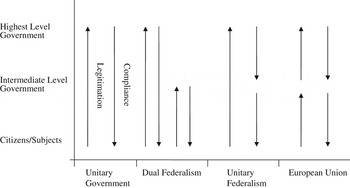
For an answer, it is useful to compare the compliance and legitimating relationships between citizens and governments in different institutional constellations. In a unitary state, these relationships are congruent: Compliance is demanded by the central government through its administrative agencies, and the legitimacy of these requests is established through national public discourses and the accountability of the central government to the national electorate. Congruence can also be achieved in two-level polities if their institutional architecture conforms to the model of ‘dual federalism’. There, each level of government has its own domain of autonomous legislative authority, its own implementation structures, and its own base of electoral accountability.
Matters are more complicated, however, in a ‘unitary federal state’ like Germany where most legislative powers are exercised nationally, whereas national legislation is implemented by the Länder. Hence Land authorities are expected to comply with federal mandates, and citizens are expected to comply with the rules enforced by the Land authorities, regardless of their national or local origin. In the unitary political culture of the German two-level polity, however, this two-step compliance relationship does not create problems of democratic accountability. Public attention and public debates are almost exclusively focused on politics and policy choices at the national level. Länder elections, which may affect party-political majorities at the national level (in the Bundesrat), are generally and justifiably considered as second-order national elections where parties fight about national issues and voters express their approval or disapproval of the national government’s performance (Burkhart, Reference Burkhart2008). In other words, while the compliance relationship runs between citizens and their respective Länder authorities, the dominant legitimacy relationship in Germany runs between citizens and the national government which is held accountable for public policies that affect the citizen.
The two-level polity, comprising the EU and its member states, shares some important structural characteristics with German federalism (Scharpf, Reference Scharpf1988) – but in the context of a discussion about political legitimacy, the differences appear to be much more important. Compared to Germany, the Union is far more dependent on its member states: European legislation must be transposed through national legislatures; European law must be implemented through the administrative agencies and courts of the member sates; and European revenue depends almost entirely on national contributions. As a consequence, compliance is even more a two-step process than is true in Germany (Figure 1).
Compliance and legitimation in multilevel governments.

From the perspective of citizens, compliance is exclusively demanded by national administrative agencies, tax authorities, and courts. And except where the Commission may directly prosecute the violation of competition rules, even business firms are never directly confronted with the EU as a governing authority. By the same token, the compliance that matters from the perspective of the Union is the willingness and ability of its member governments to ensure the implementation of European law. This is the compliance which the Commission keeps monitoring, and which is also the subject of a growing body of compliance research (Falkner et al., Reference Falkner, Treib, Hartlapp and Leiber2005; Zürn and Joerges, Reference Zürn and Joerges2005; Börzel et al., Reference Börzel, Dudziak, Hofmann, Panke and Sprungk2007).
As in Germany, therefore, we have a two-step compliance relationship – between citizens and their respective national governments, and between these and the EU. In contrast to Germany, however, we also have a two-step legitimating relationship in the European polity. While in German federalism, citizens address their demands and their electoral responses to the higher (national) level of government, the higher level of the European polity is beyond the horizon of citizen’s expectations and political demands; it is not the target of public debates and party competition, and it is not vulnerable to electoral sanctions (Mair, Reference Mair2008). As far as citizens are concerned, they are only connected to the lower (member-state) level of government through a legitimating feedback loop. And since voters are not obliged to be fair and, in any case, could not know the origin of the rules with which they are asked to comply, ‘the politics of blame avoidance’ (Weaver, Reference Weaver1986) is not a useful option for member governments. They must in fact carry the full burden of political accountability for their exercise of governing authority, regardless of how much European law may have contributed to it.
In the two-level European polity, therefore, the EU must be seen and legitimated not as a government of citizens, but as a government of governments. What matters foremost is the willingness and ability of member states to implement EU law and to assume political responsibility for doing so. It seems fully appropriate, therefore, that compliance research focuses exclusively on the relationship between the EU and its member states. But if that is so, then it is not obvious that normative discussions of EU legitimacy should treat the Union as if it were a free-standing polity, and that normative discussions of EU legitimacy should employ monistic concepts that ignore the two-step relationship and focus almost exclusively on the presence or absence of a ‘democratic deficit’ in the relation between the EU and its citizens or subjects. Instead, we need to discuss the legitimating arguments that justify the compliance of member states with EU mandates, and the conditions that allow member states to legitimate this compliance in relation to their own citizens.
Legitimating member state compliance
From the perspective of member governments, membership in the EU is fully justified by its contribution to peace and democracy on the European continent, while the record appears more ambivalent with regard to the economic promises of integration. In any case, the attraction of membership continues to exercise its pull in the near abroad, and secession does not seem to be on the agenda of any of the old and newer member states. But just as the fact that most citizens will not emigrate is no sufficient indicator of the democratic legitimacy of a nation state, the holistic assessment of the benefits of membership will not, by itself, establish the legitimacy of all Union mandates. As is true in democratic nation states, what matters are more specific characteristics of the policy-making institutions and processes that generate the mandates with which member governments are expected to comply. Here, I find it useful to distinguish between two fundamentally differing modes of EU policy making, for which I use the labels ‘political’ and ‘non-political’ (Scharpf, Reference Scharpf2001).
Political modes are those in which member governments have a voice – most directly in Treaty negotiations and in those policy areas where EU legislation still requires unanimous agreement. But even where legislation by the ‘Community Method’ depends on an initiative by the Commission and the agreement of the European Parliament, the requirement of qualified majorities in the Council and the consensus-enhancing procedures of the Council ensure member governments of a significant voice in the process. This is not so in the non-political modes of EU policy making. Member states, or the European Parliament, for that matter, have no voice when the ECB determines the course of monetary policy, when the Commission decides to prosecute certain practices of EU member states as Treaty violations, and when the ECJ uses its powers of interpretation to shape the substance of primary and secondary European law. Since the effects of policies so adopted may exceed the importance of many acts of EU legislation, their legitimacy needs to be explicitly discussed as well.
Political modes of policy making
From the perspective of member governments, the high consensus requirements of EU legislation seem to ensure its input legitimacy. Policies are adopted with their agreement, and even where Council votes are taken by qualified majority, consensus-seeking practices are so effective, that politically salient national interests that are vigorously defended by the respective governments are rarely overruled. But that does not mean that EU legislation is without problems from the perspective of member governments.
The most obvious problem is that high consensus requirements will oftenFootnote 5 prevent majorities of member states from achieving ‘European solutions’ to problems which, in their view should and could be resolved at the European level. From their perspective, therefore, the output legitimacy of European legislation remains systematically constrained. Nevertheless, where this is a first attempt at European regulation, failure to agree on common rules leaves member governments free to cope with the problem as best as they can at the national level. A potentially much more difficult problem arises, however, once a European rule is in place. Its ‘supremacy’ will not only displace all existing national law that is inconsistent with it, but it will also ‘occupy the field’ and pre-empt future attempts to deal with the same matter through national legislation.
At the same time, moreover, the existing European rule is now protected against changes by exactly the same high consensus requirements that had impeded its earlier adoption. So even if the policy does not work, or if circumstances or the political preferences of most member governments should have changed significantly, it will remain in force and cannot be reformed as long as it is still supported by either the Commission (without whose initiative no amendments are possible) or by a small blocking minority in the Council.Footnote 6 In other words, European legislation is much less reversible than national legislation which may be adopted, amended, and revoked by the same simple majorities.Footnote 7 As a consequence, the presumption that existing legislation continues to be supported by a political consensus is less plausible for the EU – and the potential discrepancy is bound to increase over time.
Non-political policy making
The presumption of consensus is, of course, even more attenuated for the non-political modes of EU policy making in which member states have no voice. For the monetary policy choices of the ECB, an unconditional preference for price stability over all other goals of economic policy was stipulated in the Maastricht Treaty (Art. 105 ECT). And even if governments might prefer a more flexible mandate today, they couldn’t adopt it over the objections of even a single member state. The same is true of the Court’s power to interpret European law (Art. 220 ECT). If the interpretation is based on provisions of the European Treaties, reversals by unanimous Treaty amendments are practically impossible, and they are extremely difficult for the ‘secondary law’ of European regulations and directives.
If the difficulty of reversing or amending EU law creates an asymmetry between the defenders of the status quo and the promoters of change, what matters here is that it also creates an asymmetry in the principal-agent relationship between those who are politically legitimated to formulate European law and those who have a mandate to apply it. Since application always requires some interpretation, the agents necessarily have some power to shape the content of the rules under which they operate. And the domain of that power will expand if legislators are unable to correct interpretations that deviate from the legislative intent (Tsebelis, Reference Tsebelis2002). Given the immense obstacles to amending the European Treaties and secondary European law, the potential scope for judicial legislation is wider in the EU than it is in all constitutional democracies at the national level. But should this wider scope of judicial review give rise to problems of legitimacy? If the question is considered at all, a negative answer is generally based on one of two arguments, neither of which seems fully convincing.
The first sees the Court in a role that was institutionalized by member states to serve their rational self-interest. They agreed to give to the Commission the power to prosecute, and to the Court the power to decide on, alleged violations of their obligations under the Treaties – and (like the ECB) Commission and Court are doing exactly what they are supposed to do, even if individual governments may not like the decision in a particular case that affects them individually (Garrett, Reference Garrett1992, Reference Garrett1995). The basic argument is analytical and game-theoretical. It presumes that Treaty commitments of member governments should be modelled as a (symmetric) N-person Prisoners’ Dilemma – that is, a constellation where all will benefit from cooperation, but all are tempted to free ride, in which case the cooperative arrangement would unravel and all would be worse off. Under these conditions, it was rational for all governments to create agencies beyond their direct political control, and to invest these with the authority to monitor and sanction violations of their commitments.
Empirically, this argument is surely over-generalized. The assumption that EU law reflects constellations of a symmetrical Prisoners’ Dilemma may be plausible for free-trade rules, but the jurisdiction of the Court extends to a wide range of policy areas that cannot be so characterized. Moreover, even within its empirical domain, the argument is theoretically over-extended. The Dilemma model provides justification for creating politically independent enforcement agencies that will monitor compliance and may prosecute and sanction free riders. But it provides no analytical or normative support for taking the rule-making function out of the hands of politically accountable principals.Footnote 8 Not much is gained, moreover, if the Dilemma-argument is complemented by an ‘incomplete-contracts’ extension (Maskin and Tirole, Reference Maskin and Tirole1999).
It suggests that in a contract situation, rational actors, realizing that they could not foresee and regulate all future eventualities, and appreciating the high transaction costs of continuous renegotiation, would agree on having future disputes over the interpretation of their contract settled by a neutral agent. In game-theoretic terms, this argument presupposes an underlying interest constellation resembling the ‘Battle of the Sexes’ – where all parties prefer agreement over non-agreement, but disagree over the choice among specific solutions (Scharpf, Reference Scharpf1997: Ch. 6). But while the argument may support a strong role of the Commission as an ‘honest broker’ in the process of European political legislation, it does not support judicial legislation.
For an explanation, assume two sets of member states, one with status-quo institutions resembling ‘liberal market economies’ and political preference for a liberal European regime, and the other one with the status-quo institutions of a ‘coordinated market economy’ and preferences for regulated capitalism at the European level (Hall and Soskice, Reference Hall and Soskice2001). In political legislation, it might be possible to find a compromise that both sides prefer over their respective status-quo solutions. If not, the different national regimes would remain in place. If the Court is allowed to define the European rule, however, it must do so in a specific case that challenges and may invalidate the existing law of a particular member state without its consent. In doing so, however, the Court could not create a new European regime to replace national solutions; it can only remove existing national impediments to the free movement of goods, services, capital, and persons, to the freedom of establishment, to undistorted competition, and to the principle of non-discrimination. In other words, for structural reasons (which are quite independent of any ‘neoliberal’ preferences of the judges), judicial legislation must have an asymmetric impact on our two sets of member states: By itself, it can only impose liberalizing and deregulatory policies. Under conditions of complete information, therefore, member states with coordinated market economies and concomitant political preferences would not be persuaded by an incomplete-contracts argument and would not accept rule making by judicial legislation.
In the actual history of European integration, however, that choice was not available. Since the ‘Luxembourg Compromise’ had reinforced the unanimity rule in the Council, the greater diversity of national interests after the original six had been joined by the UK, Denmark and Ireland had almost stopped the progress of integration through political legislation. In particular, attempts at harmonizing national trade regulations had bogged down in interminable bargaining rounds. Hence the Court was widely applauded when its Dassonville Footnote 9 and Cassis Footnote 10 decisions began to remove national non-tariff barriers by giving direct effect to Treaty-based economic liberties. In effect, ‘good Europeans’ everywhere came to welcome ‘Integration Though Law’Footnote 11 as an effective substitute for the perceived erosion of the ‘political will’ of member states.
Paradoxically, however, the immediate effect was a new stimulus to political integration. The Cassis decision had confronted all member states with the threat of having their own regulations displaced by a rule of ‘mutual recognition’ – a threat which, whenever the Commission so chose, could be made real through Treaty infringement prosecutions (Nicolaidis and Schmidt, Reference Nicolaïdis and Schmidt2007; Schmidt, Reference Schmidt2007). With this change of the ‘default condition’, agreement on political harmonization became considerably more attractive. Thus, member states responded positively to Jacques Delors’ Single-Market initiative and agreed to adopt the Single European Act, which introduced qualified-majority voting in the Council for the harmonization of rules affecting the functioning of the internal market (Art. 95 ECT). And since Cassis had reduced the bargaining power of high-regulation countries, the new legislation also had a liberalizing and deregulatory tendency.
In the 1980s, it is true, that effect did indeed correspond to the political preferences of a majority of ‘liberal’ governments in the Council (Moravcsik, Reference Moravcsik1998). But it is not explained by these preferences. And it was not reversed when, in the second half of the 1990s, there was a preponderance of left-of-center governments in the EU. Instead, the overall pattern is shaped by an institutional constellation in which political legislation must be negotiated in the shadow of judicial decisions which, for structural reasons, have a liberalizing and deregulatory impact. In other words, the empowerment of judicial legislation in the European polity cannot be justified by game-theoretic or contract-theoretic arguments that try to show that it would, or ought to be, chosen as an efficiency-increasing solution by self-interested member-states or their governments.
For most governments, of course, justifications derived from normative rational-choice theory are not of crucial relevance. What did, and does, matter much more for them is the socially shared expectation that they should operate as ‘a government of laws and not of men’, that courts should have the authority ‘to say what the law is’, and that respect for the rule of law obliges them to respect and obey the decisions of the ECJ (Alter, Reference Alter2001). By itself, of course, this syllogism would not define the proper domains of judicial and political legislation (Möllers, Reference Möllers2008). It is, of course, true that judge-made law, disciplined by its internal juristic logic and by the running commentary of the legal profession, continues to play a very important and legitimate role in common-law as well as in civil-law countries. But in constitutional democracies, it is developed in the shadow of democratically legitimated legislation, which could (but generally will not) correct it by simple-majority vote. Since ECJ jurisprudence cannot be politically corrected, the fact that member states have by and large acquiesced when decisions were going against them, cannot be invoked as an indirect legitimation of judicial legislation.
The more pertinent question is, therefore, whether the legitimacy of ECJ jurisdiction could be equated with that of national constitutional courts. These may indeed override parliamentary legislation – and for that reason, the legitimacy of judicial review continues to be considered problematic in polities with a strong democratic tradition (Bickel, Reference Bickel1962; Kramer, Reference Kramer2004; Bellamy, Reference Bellamy2007). But even if these fundamental doubts are postponed for the moment, the status of ECJ jurisprudence cannot be equated with that of judicial review under national constitutions. First, as Stefano Bartolini (Reference Bartolini2008) pointed out, it would have to ignore the fact that national constitutions are generally limited to rules that organize the institutions of government and protect civil liberties and human rights. By contrast, the European Treaties, as they are interpreted by the ECJ, include a wide range of detailed provisions which in constitutional democracies are matters for legislative determination, rather than constitutional interpretation. As a consequence, the politically unconstrained powers of the ECJ reach so much further than the powers of judicial review under any national constitution. Even more important, however, is a second difference:
The judicial review exercised by national constitutional courts is embedded in national political cultures with taken-for-granted normative and cognitive understandings and shared discourses about appropriate policy choices (March and Olsen, Reference March and Olsen1989). In public debates, the courts are important, but by no means the only, interpreters of common value orientations. They must assume that the commitment to the common values of the polity is shared by all branches of the national government, and that all are oath-bound to uphold the constitution. They will thus approach legislation in a sprit of judicial self-restraint, and with a presumption of its constitutionality. And if they must nevertheless intervene against the majorities of the day, the legitimacy of their intervention depends on their capacity to express ‘the sober second thought of the Community’ (Bickel, Reference Bickel1962: 26; Fisher, Reference Fisher1988; Höreth, Reference Höreth2008).
From the perspective of member states, these preconditions of judicial self-restraint, which at the same time limit and legitimate judicial review, are lacking in their relationship to the ECJ. Regardless of what may be true in its relationship to the Commission and the European Parliament, there cannot be such shared orientations between the Court and the governments, legislatures, and publics of the Union’s 27 extremely heterogeneous member states, and there is certainly no presumption of Treaty-conformity when the Court is dealing with national legislation. Instead, from the Court’s perspective, European integration is a mission to be realized against the inertia or recalcitrance of member states; and European law is not the expression of shared values but an instrument to discipline, and transform national policies, institutions and practices.
So where has this discussion led us? There is of course no question of the formal legality of the Court’s jurisdiction. Art. 220 ECT has clearly empowered it to apply and interpret European law. Lawyers will dispute some of its interpretations, but they will not judge them ‘ultra vires’.Footnote 12 Given the sweeping generality of some Treaty provisions and the intentional ambiguities in secondary law, it would in any case be extremely difficult for the Court to follow the ‘original intent’ of the masters of the Treaties or of the multiple authors of legislative compromises. But as Europeans had to learn through bitter experience: formal legality does not necessarily equate with legitimacy (Joerges and Ghaleigh, Reference Joerges and Ghaleigh2003). It suffices for ensuring acquiescence with the every-day constraints and demands imposed by governing authorities in fundamentally legitimate polities. But when highly salient interests and normative preferences are violated, positive legitimating arguments are needed to stabilize the routines of voluntary compliance.
In the relationship between member-states and the EU, the Roman-law maxims of pacta sunt servanda and volenti non fit iniurua will have considerable weight. Their governments or their predecessors have participated in creating present-day EU institutions, including the authorization of policy making in the non-political decision modes; and governments of the newer member states have knowingly joined the previously established institutions and the accumulated acquis. But these obligations are limited by the third Roman maxim of ‘ultra posse nemo obligatur’. And as I suggested above, the capacity of member states to comply with EU law reaches its limits when doing so would undermine their own legitimacy in relation to their national constituencies. In the following sections, I will first explore the general conditions of this legitimating relationship, and I will then turn to a series of recent decisions where the jurisdiction of the ECJ seems to pushing against the limits of legitimate national compliance.
The need for justification
Since the law of the Union must be implemented by its member states, it is the legitimacy of the member state that must ensure citizen compliance and citizen support. As conceptualized above, it is based on ‘liberal’ as well as ‘republican’ normative foundations. By and large, however, the EU law generated through judicial legislation is unlikely to challenge the specifically liberal principles of national constitutions.Footnote 13 But what may indeed be at stake is the ‘republican’ legitimacy of national governments.
Democratic republicanism requires not merely the formal existence of general elections and representative parliaments, but it presumes that the mechanisms of electoral accountability may make a difference for public policy. At a minimum, this (input-oriented) requirement implies that governments will be responsive to citizen interests and preferences, and that changing governments may have an effect on policies that are strongly opposed by popular majorities. At the same time, however, governments are under a ‘republican’ (and output-oriented) obligation to use the powers of government for the common good of the polity. In the normative traditions of constitutional democracies, both of these obligations are of equal and fundamental importance. But their implications may conflict when public-interest oriented policies are unpopular while popular policies may endanger the public interest. Under these conditions, normative political theory from Aristotle to Edmund Burke did accord priority to the public interest, whereas even theorists of democracy who reject the paternalistic or technocratic implications of output-oriented arguments (Greven, Reference Greven2000; Bartolini, Reference Bartolini2005; Hix, Reference Hix2008) will rarely defend radical populism as a normatively acceptable alternative (Mény and Surel, Reference Mény and Surel2002).
Instead, modern democratic theory focuses on the interactions between governors and the governed. Responsible governments must pursue the common good, but its substantive understanding, and the policies serving its attainment, should arise from deliberative interactions in the shared public space of the polity (Habermas, Reference Habermas1962, Reference Habermas1992, Reference Habermas2008; Dryzek, Reference Dryzek2000; Greven, Reference Greven2000; de Vreese and Schmitt, Reference de Vreese and Schmitt2007). More specifically, Vivien Schmidt (Reference Schmidt2004, Reference Schmidt2006) focuses on the role of policy-oriented ‘communicative discourses’ in which governors must explain and justify the unpopular policies which they consider necessary and normatively appropriate. The more these policies violate highly salient interests or deviate from the strongly held normative preferences of their constituency, the more urgent is the need for justification showing how the measures in question will serve the values of the polity under the present circumstances.
If these communicative discourses succeed in persuading the constituency, input-oriented policy legitimacy is maintained. If they fail to persuade, governments are at risk. In general, of course, electoral accountability is neither a precisely targeted nor a very sensitive mechanism of popular control. Voters only have a single ballot to express their pleasure or displeasure over a multitude of policy choices, assorted scandals, and the personality traits of leading candidates; and even if public protest was concentrated on a single issue yesterday, it may have disappeared from public attention by the next election.Footnote 14 But if a policy does violate highly salient interests or deeply held normative convictions of the constituency, a government that sticks to its guns but fails to convince may indeed go down in defeat.Footnote 15 If that happens, the government will not have established the input legitimacy of these policies. But it will have reaffirmed the institutional legitimacy of a system of responsible and democratically accountable government.
The opposite is true, however, if policies that violate politically salient interests and normative convictions in national polities are not, and cannot be explained and justified in communicative discourses. When that happens, the legitimacy of constitutional democracies will be undermined and may ultimately be destroyed. This is the critical risk if governments are required to implement European law that has been created without the involvement of politically accountable actors by institutionally autonomous judicial legislation.
That is not meant to say that judge-made European law that violates politically salient interests or deeply held normative convictions in member-state polities could never be justified as being necessary and appropriate. But it suggests that justification is more demanding here than it is in the case of political legislation in which governments had a voice and for which they, therefore, should be able to provide good reasons. In principle, there could be two types of justifications.
The first would appeal to ‘enlightened’ national self-interest. It would try to show how, all things considered, the country would benefit more from the policy or rule in question than from its absence. In essence, these are arguments that would facilitate agreement in a political bargaining process – and they would justify compliance with European rules that are in fact providing effective solutions under conditions which, in game-theoretic terms, resemble Pure-Coordination, Assurance, Battle of the Sexes, or (symmetric) Prisoners’ Dilemma constellations (Scharpf, Reference Scharpf1997: Ch. 6). But what if the constellation is characterized by asymmetric conflicts – so that the rule that is imposed by non-political European authority cannot be justified in terms of the enlightened self-interest of the member state in question? Analytically, one might then try to justify uncompensated national sacrifices by reference to the collective self-interest of the Union as a whole. However, depending on the salience of the sacrifice requested, this justification would presuppose a collective European identity that is strong enough to override concerns of national self-interest. Unfortunately, however, that is a precondition which not even the most enthusiastic ‘Europeans’ would claim to see presently fulfilled in the Union of 27 member states (Pollak, Reference Pollak2008).
But that does not mean that asymmetric national sacrifices could never be justified in national discourses. The most powerful of such justifications is, of course, the achievement of European integration itself. The outcome has not been, and may (and perhaps should) never be, the creation of a ‘United States of Europe’ modelled after successful federal nation states (Nicolaidis and Howse, Reference Nicolaidis and Howse2003). But integration has been able to establish peace and cooperation among European nations after centuries of internecine warfare, and to secure democracy and respect for human rights on a continent that has brought forth the most pernicious regimes in human history. These outcomes could not have been attained by the bloody-minded pursuit of national self-interest. Being part of the European community of nations presupposes member states whose institutions and policies are compatible with the basic requirements of communality, and whose preferences are modified by a normative commitment to the ‘inclusion of the other’ (Habermas, Reference Habermas1996) and by a ‘principle of constitutional tolerance’ that disciplines the assertion of national constitutional powers at the expense of shared values and interests (Weiler, Reference Weiler1999b, Reference Weiler2003). The preservation of these achievements may indeed justify constraints on national autonomy even where these may conflict with politically salient interests and preferences in member polities. Hence, European rules protecting the preconditions of communality, regardless of whether they are formulated in political or non-political processes, can be justified on substantive grounds – and if that is so, they also can and should be defended by member governments even against strong domestic opposition.
The Court is pushing against the limits of justifiability
Given the equally valid legitimation arguments supporting democratic self-determination at the national level and the normative claims of European communality, however, a convincing justification must assess the relative weights at stake in the specific case. The greater the political and normative salience of the national institutions and policy legacies that are being challenged, the greater must be the normative and practical significance of the countervailing European concerns. For many decades, however, the need to develop explicit criteria for that normative balance did not arise. Most of the issues of European law never caught the attention of national publics, and the Court itself seems to have taken care to develop its doctrines in a long series of decisions where the substantive outcomes at stake were of very low political salience or downright trivial. Thus, it was hard to get politically excited about the Cassis decision which told Germany that it could not exclude a French liqueur on the ground that its alcohol content was too low – but which, in doing so, also introduced the crucial doctrines of mutual recognition and home-country control.
That is why earlier warnings of the implications of ECJ jurisprudence for the viability of national social systems (e.g., Scharpf, Reference Scharpf1999) could be dismissed as unrealistic scares (Moravcsik and Sangiovanni, Reference Moravcsik and Sangiovanni2003). But now, as the legal principles seem firmly established in its case law and accepted by national courts, the European Court and the Commission seem ready to face more serious political conflicts. I will briefly mention only a few recent decisions that illustrate this more intrusive and potentially more damaging judicial strategy:
The first case has nothing to do with the neoliberal preferences which are often ascribed to the Court and the Commission. Austria, where university education is free and accessible to all graduates of a gymnasium saw its medical faculties overcrowded by applicants from Germany whose grades were not good enough to qualify under the German numerus-clausus regime. In defence, Austria had adopted a rule under which applicants from abroad had to show that they would also be eligible to study medicine in their home country. The Commission initiated a Treaty violation procedure, and the Court found that the Austrian rule was violating students’ rights to free movement and non-discrimination under Art. 12 ECT.Footnote 16 As an immediate result of the decision, more than 60 percent of applicants at some Austrian medical faculties came from Germany.
The second series of recent decisions was indeed about the priority of economic liberties over social rights guaranteed by member-state constitutions. In the Viking case,Footnote 17 a Finnish shipping company operating from Helsinki had decided to reflag its ferry as an Estonian vessel. The Finnish union threatened to strike, the company sued for an injunction, and the case was referred to the ECJ, which defined the strike as an interference with the company’s freedom of establishment. In the Laval case,Footnote 18 a Latvian company building a school in Sweden refused to negotiate about wages at the minimum level defined by Swedish collective bargaining agreements. The ECJ defined the Swedish union’s industrial action as violation of the company’s freedom of service delivery that was not covered by a narrow reading of the Posted Workers’ Directive.Footnote 19
If Viking and Laval were directed against the constitutionally protected rights of Finnish and Swedish unions to pursue collective interests through industrial action, the Rueffert Footnote 20 and Luxembourg Footnote 21 cases established the priority of free service delivery over national wage legislation. Rueffert disallowed a statute of Lower Saxony that required providers in public procurement to pay locally applicable collective-bargaining wages, whereas Luxembourg had transposed the Posted Workers’ Directive in a statute requiring all providers to observe local labour law including the automatic adjustment of wages to the rate of inflation. In both cases, the Court defined the Directive as setting maximum, rather than minimum standards, with the consequence that local legislation exceeding these were held to violate the freedom of service delivery. At the same time, the freedom of establishment is being used to hollow out the capacity of member states to shape the rules of corporate governance in their economies in accordance with national institutional traditions political preferences (Höpner and Schäfer, Reference Höpner and Schäfer2007).Footnote 22 In other cases, the Court has drastically reduced the capacity of member governments to protect their revenue systems against tax avoidance that is facilitated by decisions protecting the freedoms of capital movement and of service delivery (Ganghof and Genschel, Reference Ganghof and Genschel2008b; Genschel et al., Reference Genschel, Kemmerling and Seils2008). Here, as in the line of decisions enforcing the access of EU citizens to public services and social transfers in other member states (Ferrera, Reference Ferrera2005; Martinsen, Reference Martinsen2005, Reference Martinsen2009; Martinsen and Vrangbaek, Reference Martinsen and Vrangbaek2008), the Court gives priority to the subjective rights to free movement and non-discrimination without regard to reciprocal obligations to contribute to the resources of the polity.
The liberal undermining of republican legitimacy
In these decisions and others, the Court has obviously intervened against important and politically salient laws, institutions, and practices of individual member states. But why should it be impossible to justify these interventions in national communicative discourses? The root of the problem is a basic asymmetry in how the Court defines the balance between the legitimate concerns of member-state autonomy and the legitimate requirements of European community.Footnote 23 It has its origin in the very first decision postulating the direct effect of European law in Van Gend en Loos (1963).Footnote 24 In order to establish this doctrine, the Court had to interpret the obligation of a member state to maintain existing tariffs as the subjective right of a company against the state. Combined with its nearly simultaneous assertion of the supremacy of European law,Footnote 25 this construction has permitted the Court to define and expand subjective rights against member states, and thus to shift the balance between the rights and obligations of citizens or subjects that had been established in national polities.
Since the commitments in the original Treaty were primarily intended to achieve economic integration, their transformation into ‘economic liberties’ does account for the strongly ‘market-liberal’ effects of the Court’s jurisprudence. It should be noted, however, that where the primary or secondary European law provided a handle for the definition of non-economic subjective rights, the Court has been similarly ready to intervene against national impediments to their exercise. This has long been true for decisions enforcing and extending the equality of men and women in the work place under Art. 141 ECT (Cichowski, Reference Cichowski2004); and it is now also true of the extension of rights to the free movement of persons outside of the labour market, of rights of non-discrimination on accounts of nationality, and of the generalization of (non-political) citizenship rights. This has been hailed by some as a fundamental reversal of the Court’s market-liberal bias (Caporaso, Reference Caporaso2000; Caporaso and Tarrow, Reference Caporaso and Tarrow2008) – whereas it is, in fact, only the application of its negative-integration and liberalizing logic to fields that have newly become accessible to the Courts jurisdiction.
In the framework developed by the ECJ, the European concerns that might justifiably override democratically legitimated national institutions and policy legacies are defined as subjective rights of individuals and firms, rather than as substantive requirements on which the viability of the European community of nations, or the internal market, for that matter, would depend. Given the simultaneous assertion of the supremacy doctrine, this definition has the effect of transforming the hierarchical relation between European and national law into a hierarchical relationship between liberal and republican constitutional principles.Footnote 26 Subjective rights derived from (the interpretation of) European law may, in principle, override all countervailing national objectives, regardless of their salience as manifestations of democratic self-determination.
Given the impossibility of political correction, the Court was and is of course free to extend the reach of European rights. In field of free trade, for instance, the Treaty forbids quantitative restrictions and ‘measures having equivalent effect’ (Art. 28 ECT). Originally, that had been understood to exclude the discriminatory treatment of imports. In the early seventies, however, that understanding was replaced by the famous Dassonville formula, according to which ‘all trading rules enacted by member states which are capable of hindering, directly or indirectly, actually or potentially, intra-community trade are to be considered as measures having an effect equivalent to quantitative restrictions’.Footnote 27 In other words, instead of effective discrimination, a merely hypothetical impediment to free trade, free capital movement, free service delivery, or free establishment would now be enough to strike down a national rule.
It is true that after Dassonville, the Cassis decision also began to systematize the somewhat haphazard public-order exceptions (e.g., in Arts. 30, 39/3, 46/1, 55, or 58/1b ECT) through which the Treaty had tried to limit the obligations to liberalize national economies. In most areas, therefore, the Court does now allow for the possibility that the exercise of European liberties could be limited by (some) countervailing national concerns (Haltern, Reference Haltern2007: 742–755). But if this has the appearance of a balancing test, the balance is highly asymmetrical – which manifests itself in three dimensions.
First, some national concerns of major importance are simply defined as irrelevant to begin with. Of greatest practical importance among these is the consistent refusal to consider national fiscal concerns as a potential limit on the exercise of European liberties. Thus, in the Austrian case mentioned before, the effect which the free movement and non-discrimination of German students would have on the budgetary constraints of Austrian medical education is entirely ignored. The same is true in cases where the free movement of persons is invoked to allow the access of migrants to national social transfers,Footnote 28 or where the freedom of service provision requires national health (insurance) systems to pay for services consumed abroad (Martinsen, Reference Martinsen2005, Reference Martinsen2009).Footnote 29 Moreover, revenue concerns are declared irrelevant when national rules against tax avoidance are treated as violations of free capital movement (Ganghof and Genschel, Reference Ganghof and Genschel2008b).
By treating the fiscal implications of its decisions as irrelevant, the Court is destroying the link between the rights and duties of membership in the polity which is reflected in centrality of parliamentary taxing and spending powers in all constitutional democracies (Ganghof and Genschel, Reference Ganghof and Genschel2008a). In a republican perspective, German students and their taxpaying parents may have good reasons to protest against the spending priorities of their own governments, but that would not give them a legitimate claim against taxpayers in Austria. The same would be true of other tax-financed services, of social transfers or of public-health systems, and of compulsory health insurance systems in which total contributions must finance an adequate capacity on the supply side.Footnote 30 Similarly, firms and individuals availing themselves of the public infrastructure and public services in one country would be under a republican obligation to pay the tax price of their maintenance.
By replacing the reciprocal link between entitlements and contributions with the assertion of unilateral individual rights, the Court may seem generous. But its generosity ignores the club-good character of most of the benefits and services provided by the solidaristic nation state. Allowing the easy exit of contributors and the easy entry of non-contributors must undermine the viability of these clubs. If the logic of these decisions will shape national responses, the most likely outcome will not be universal generosity but private insurance, private education, and gated communities for those who can afford them, and eroding public benefits, public services, and public infrastructure for those who cannot pay for private solutions (including the no longer discriminated migrant students, workers, and their families).
Second, even where national public-interest objections, or nationally protected collective rights, are in principle considered as potential limits on the exercise of European rights, the Court’s treatment is highly asymmetrical. While European liberties, no matter how trivial their violation may be in the specific case, are accorded full value, all countervailing arguments are discounted by a substantive and procedural ‘proportionality’ test.Footnote 31 In this, the Court will first evaluate (by its own lights) the normative acceptability of the specific purpose that is allegedly served by a national measure. And even if the purpose is accepted in principle, the government must show that, first, the measure in question would, in fact, be effective in serving the stated purpose and, second, that this purpose could not also have been served by other measures that would be less restrictive on the exercise of European liberties (Haltern, Reference Haltern2007: 751–757). For all of these conditions, the burden of proof is on the member state defending a particular impediment to the exercise of European liberties and, as Dorte Martinsen (Reference Martinsen2009) is showing, the procedural requirements for establishing (scientific) proof can be tightened to an extent that will ensure a negative outcome for the member state.
For an illustration, take the decision striking down the Volkswagen statuteFootnote 32 which had defined 20 percent of all shares (instead of the usual 25 percent) as a blocking minority. In the Court’s view, this rule created a potential deterrent to direct investments from other member states,Footnote 33 while evidence showing that VW stock was in fact widely traded internationally and that the share of direct foreign investments was as high as in comparable companies, was declared irrelevant. In other words, the existence of an impediment to the free movement of capital is treated as an incontrovertible presumption.Footnote 34
Or take the Austrian case, where the Court did at least entertain the idea that the danger of overcrowding in Austrian universities might be a valid national concern. But the idea was quickly dismissed with the suggestion that this problem could be averted through non-discriminatory entry exams.Footnote 35 The fact that Austria may have needed to give priority to Austrian students in order to train a sufficient number of medical practitioners for its own health care system remained completely outside the range of permissible arguments. In the asymmetrical jurisprudence of the Court, in other words, European rights are substantively and procedurally privileged and will generally prevail over even very important and politically salient national concerns.
A third problem arises from the discrepancy between the uniformity of European law and the diversity of national republican institutions. The Treaty-based economic liberties are of course defined at the European level and without regard to national differences. The same is true where Court recognizes other subjective rights at the European level – which may increase in number and variety if the Lisbon Treaty will come into force.Footnote 36 And where countervailing national concerns are considered at all, these are also defined in uniform and (highly restrictive) terms by the Court. For an example, take the decision in the Laval case, where the Court would have accepted minimum wages to be set by state legislation, but disallowed the delegation to collective-bargaining agreements. In doing so, it ignored the fact that minimum-wage legislation, while common in many EU member states, was totally unacceptable in ‘neo-corporatist’ Sweden, where wage determination since the 1930s has been left entirely to highly organized unions and employers’ associations (Edin and Topel, Reference Edin and Topel1997).
In short, the Court’s regime of Treaty-based rights and of potentially acceptable national exceptions make no allowance whatever for the fact that uniform European law has an impact on national institutions and policy legacies that differ widely from one member state to another. Such differences exist not only in the field of industrial relations, but also in corporate governance, public services, public infrastructure, media policy, social policy, pension policy, health care, vocational and academic education, or public infrastructure, and so on. Present solutions differ because they have been shaped by country-specific historical cleavages and by difficult compromises between conservative, progressive and liberal political forces – which is why attempted changes tend to have very high political salience everywhere.
Political resistance to change is likely to be strongest where institutions and policies have a direct impact on the lives of citizens – which is most obvious for welfare state transfers and services, industrial relations, employment conditions, education, or health care. In many instances, existing policies have attained the status of a ‘social contract’ whose commitments support the legitimacy of the national polity. That is not meant to suggest that such normatively charged institutions and policy legacies should or could be immune to change. In fact, their continuing viability under external and internal pressures is often quite uncertain (Scharpf and Schmidt, Reference Scharpf and Schmidt2000). But if the legitimacy of the national polity is to be preserved, such changes must be defended and justified in national communicative discourses – by governments who must be ready to face the consequences of their electoral accountability.
In fact, the text of the Treaty does recognize the need to respect the autonomy of member-state political processes in precisely these policy areas. In Maastricht and Amsterdam, European competences have been explicitly denied in policy areas of high normative salience at the national level. Thus, Article 137/5 ECT stipulates that European competencies in the field of social affairs ‘shall not apply to pay, the right of association, the right to strike or the right to impose lockouts’. Similarly, European measures in the field of employment ‘shall not include harmonisation of the laws and regulations of Member States’ (Art. 129/2 ECT), and exactly the same formula is repeated for education (Art. 149/4 ECT), for vocational education (Art. 150/4), and for culture (Art. 151/5), while Art. 152/5 ECT provides that ‘Community action… shall fully respect the responsibilities of the Member States for the organisation and delivery of health services and medical care’. In other areas, the Treaty has for similar reasons maintained the requirement of unanimous decisions in the Council.
In the Court’s legal framework, however, these prohibitions could at bestFootnote 37 impede political legislation at the European level. But they are considered irrelevant for judicial legislation where it is protecting Treaty based liberties:Footnote 38 That is why the cases cited could and did indeed regulate strikes in Finland and Sweden, they did abolish national pay regulations in Germany and Luxembourg or national regulations of university admissions in Austria as well as national regulations of health services and medical care in Luxembourg or the Netherlands.
In short, even unanimous amendments to the Treaties, formally ratified in all member states, could not protect the autonomy of national political processes against judicial intervention. In the absence of a political mandate, and ignoring explicit Treaty provisions that were intended to limit the reach of European law, the Court is now intervening in areas that are of crucial importance for the maintenance of democratic legitimacy in EU member states.
Needed: a political balance of community and autonomy
From a pragmatic perspective, this appears dangerous: National welfare states are under immense pressure to cope with and adjust to external and internal changes (Scharpf and Schmidt, Reference Scharpf and Schmidt2000). But this adjustment must be achieved through legitimated political action. The Court can only destroy existing national solutions, but it cannot itself create ‘Social Europe’. At the same time, political action at the European level is impeded by the prohibitions stipulated in the Maastricht and Amsterdam Treaties, and if these were lifted, by high consensus barriers and the politically salient diversity of existing national solutions. In short, European law as defined by the Court is undermining national solutions without being able to provide remedies at the European level. The practical effect must be a reduction of the overall problem-solving capacity of the multilevel European polity.
From a normative perspective, what matters is that the Court’s interventions are based on a self-created framework of substantive and procedural European law that has no place for a proper assessment of the national concerns that are at stake, and in which the flimsiest impediment to the exercise of European liberties may override even extremely salient national policy legacies and institutions. Within this highly asymmetrical juristic framework a normatively persuasive balance between the essential requirements of European communality and the equally essential respect for national autonomy and diversity cannot even be articulated. By the same token, the legal syllogisms supporting these judicial interventions could not possibly persuade opponents in communicative discourses between member-state governments and their constituents. In short, the politically unsupported extension of judge-made European law in areas of high political salience within member-state polities is undermining the legitimacy bases of the multi-level European polity.
But this cannot be a plea for unconstrained member-state autonomy or a relocation of the Kompetenz-Kompetenz to the national level (Weiler, Reference Weiler1999a). The result might indeed be an escalation of protectionist and beggar my neighbour policies that could well disrupt the Union. It should be realized, after all, that Viking and Laval did obviously involve a distributive conflict between high-wage and low-wage member states whose fair resolution would have raised difficult normative issues – and the same may also be true of the Rueffert and Luxembourg cases.Footnote 39 There are, therefore, good theoretical reasons for some kind of European review of national measures impeding free movement among member states. But the review would need to allow for a fair consideration of all concerns involved – which the jurisdiction of the ECJ does not. Its self-referential legal framework prevents any consideration of the normative tension between solidarity achieved, with great effort, at the national level and a moral commitment to the ‘inclusion of the other’ in a European context.
But which institution would be better qualified to assess the balance between politically legitimate, and divergent, national concerns on the one hand, and the equally legitimate constraints that national polities must accept as members of a European community of states? In my view, the European institution that would be uniquely qualified to strike a fair balance is the European Council.Footnote 40 From the perspective of individual member states, its decision would be a judgement of peers who are aware of the potential domestic repercussions which may be caused by the obligation to implement European law, and who must realize that they might soon find themselves in the same spot. At the same time, however, these peers would also be fully aware of the dangers of protectionist free-riding, of beggar-my-neighbour policies, and of discriminatory practices that would violate solidaristic obligations. Moreover, and most important, in their role as ‘masters of the Treaties’, the members of the European Council would be best placed to determine whether and where the Court, in its interpretation of primary and secondary European law has so far exceeded the legislative intent that a political correction appears necessary.
Even if the basic logic of this suggestion should be accepted, however, its adoption by a unanimous Treaty amendment seems most unlikely. But there is a scenario that might change these probabilities. Remember what I said about the fundamental dependence of the EU and its legal system on the voluntary compliance of its member states, and about the lack of control of political actors over the expansion of judicial legislation. And now imagine that the governments of some member states, say Austria or Sweden or Germany, would openly declare their non-compliance with specific judgements that they consider to be ultra vires. Without more, such a declaration would surely trigger a constitutional crisis. There is of course a lot of incomplete compliance and tacit non-compliance among EU member states, but a declaration of open non-compliance would strike at the foundations of the European legal system. That is why governments would, and indeed should, hesitate to trigger this ‘nuclear option’. But what if the declaration was presented as a reasoned appeal to the political judgement of the European Council and coupled with the promise that a (majority) vote affirming the ECJ decision would be obeyed? This would separate the protest against the ECJ from the charge of disloyalty to the Union.Footnote 41
Whether the Council would accept the role thrust upon it by such a declaration is of course highly uncertain. If it did, however, the Union would finally have a forumFootnote 42 and proceduresFootnote 43 in which the basic tension between the equally legitimate concerns of community and autonomy could be fairly resolved.Footnote 44 Similarly, welcome would be the probable effects on the jurisprudence of the Court itself. Faced with the possibility of political reversal in the Council, it could be expected to pay more systematic attention to the relative weight of national concerns that might justify minor impediments to the exercise of the Treaty-based liberties. If that were the case, European law, even in the absence of ‘republican’ input legitimacy, would cease to be characterized by the single-minded pursuit of rampant ‘individualism’ (Somek, Reference Somek2008).
Acknowledgements
This paper has benefited greatly from discussions at EUI Florence and BIGSS Bremen and from the personal comments of Martin Höpner at MPIfG Cologne. As was true of all my recent work, Ines Klughardt’s research assistance has again been invaluable.