Polyphonic compositions of poems in ballata form represent a pivotal part of the musical tradition of the Italian Trecento. However, compared to the ample attention which musicologists have directed towards the analysis of the French song repertoire of the same period,Footnote 1 analytical studies of ballata music and questions of analytical methodology are not currently at the core of Trecento studies. This is partly due to the complex historiographic framework which has dominated studies of the music of the Trecento since the early twentieth century.Footnote 2 In the past, analyses of Trecento songs had often been spurred by the ambition to document Italy's participation in some kind of ‘Early Renaissance’. This precondition has prevailed in models of analysis, such as in Kurt von Fischer's and Dorothea Baumann's, whose analytical criteria and preconditions tend to persist even in recent publications.Footnote 3 Moreover, in terms of ballata production, the centrality of such a figure as Francesco LandiniFootnote 4 has led to a partial neglect of some of his less prominent younger contemporaries, such as Bartolino da Padova or Andrea and Paolo da Firenze, in such a way that Landini's procedures are often assumed as compositorial models for the genre of the ballata par excellence.Footnote 5 On other grounds, even Nino Pirrotta's influential hypothesis on the continuity of an unwritten Italian tradition from the fourteenth to the fifteenth centuryFootnote 6 possibly contributed to a weaker scholarly interest in more complex, written ‘standard’ ballatas of the same period.
This article aims to develop some analytical devices that can give a fresh, yet historically valid understanding of the techniques used in the composition of ballatas in the late phase of the Trecento, without evaluating them according to established master narratives about ‘lateness’, ‘mannerism’, ‘Early Renaissance’, or others. More precisely, the ambition is to develop an analytical approach to both text and music and their interplay from a standpoint that does not a priori presuppose one of them as governing the other.
The approach benefits from the fruitful research recently conducted on Trecento sources and their transmission,Footnote 7 on the literary aspects of the poems,Footnote 8 and on their cultural framework.Footnote 9 It is also indebted to recent researches on compositorial technique in the fourteenth and early fifteenth centuries, namely on contrapunctus procedures,Footnote 10 not to mention recent contributions on genres by younger Trecento scholars, such as Oliver Huck, Marco Gozzi, Pedro Memelsdorff, Tiziana Sucato, and others.Footnote 11
The distinguishing aspect of the analytical view proposed here is the category of ‘time’, set as a kind of tertium comparationis for textual and musical structure of fourteenth-century Italian ballatas. The focus on time structures reveals some common tendencies in compositional strategies of late Trecento composers despite the fascinating variety of techniques, idioms and melodic designs at the surface of the songs.Footnote 12 This larger corpus and the broader claims that may be made for it are examined at greater length elsewhere; this article aims solely to introduce the changes in the conceptualisation of time which form the cultural background to these songs, and then to exemplify the analytical approach through a case study of Andrea da Firenze's Non più doglie ebbe Dido.
The change of time concepts in the late Middle Ages and the function of time structures in polyphonic songs
In the last few decades, scholars from various disciplines have ascertained that the concept of time underwent substantial changes in the late Middle Ages. With the invention of the mechanical clock in the 1270s, time could be abstracted and objectified in unprecedented ways.Footnote 13 Time was no longer perceived as the diffuse, heteronomously defined ‘temps de l’église' of agricultural society, but it gained –especially in the mercantile life of the city-states – a status as an autonomous, monetarily valued ‘temps du marchand’ (Jacques LeGoff).Footnote 14 Instead of dividing the day into monastic-liturgical hours according to the altitude of the sun (therefore with deviation depending on the season), time now became calculable with the help of an external, invariable measure. The sovereignty of measuring time shifted thus – if we are to summarise a wealth of regionally and socially differing processes in a few lines – from an institution (the church) to the individual; this was aided by the mechanical clock which furthermore allowed for measurements of smaller increments of time.
Parallel with the ‘turning to physical clock-time’, there emerged a new theoretical discourse on the material quality of the phenomenon called ‘time’.Footnote 15 The new precision of time measurement implies the hypothesis that time, in fact, was a measurable phenomenon. This hypothesis challenged the fundamentals of the established scholastic-Aristotelian concept of time,Footnote 16 which defined time as an unquantifiable measure of motion; thereby also implying a cyclical conception of time. If time measures motion, it also follows that time can only be conceived together with motion as a continuum that is divisible, but does not possess a smallest unit. In the Aristotelian paradigm, time and motion were thought to be in opposition to discrete, calculable entities and the numbers which number them.Footnote 17 Anne Stone has demonstrated – on the basis of Aristotle commentaries by Pierre Durhem and William Ockham – the pains that scholastic natural philosophers took upon themselves when trying to define a constant, abstract measure of time that is valid even when the sun is not in the sky, or as Ockham formulated it, a measure that is conceptually independent from the motion that it measures.Footnote 18 Dorit Tanay has emphasised the fact that in the fourteenth century, mathematicians and theologians took part in a large discourse on questions of measuring and calculating, of subdivision and atomisation of formerly indivisible subjects, which in a quoted formulation of John E. Murdoch is described as a discourse where a massive ‘measure mania’ was reigning.Footnote 19
All of these tendencies constitute the intellectual context for mensural theory in notational treatises of the fourteenth century. These theorists solved the problem of measuring time in music through defining a specifically musical concept of time, independent from physical time. This concept of musical time was then accurately worked in to fit the properties of musical symbols in the musical notation and to maintain the internal coherency of the mensural system.
The earliest foundation of a specifically musical concept of time can be found in Franco of Cologne's principle of perfectio in his treatise Ars cantus mensurabilis. According to Michael Walter, Franco defines musical time as differing explicitly from physical time – a view that is absent in, for example, the earlier treatise De mensurabili musica attributed to Johannes de Garlandia:
The main characteristic of perfectio as a ternary basic temporal unit is that it no longer represents a real musical duration, but an imaginary one, in which longs and breves are grouped together … This means, however, that time is no longer thought of as linear (horizontal) process, but as an ‘isochrone unit’, which is open to internal differentiation. This temporal unit can be structured in past, present, and future.Footnote 20
For Franco, musical time is finitely divisible – delimited time; therefore, musical time does not just break off at the end of a piece, but has a qualitative end – it closes. A composer can consequently imagine and organise the musical process as an entity. Thus, in a nutshell, the possibility of visualising a piece's internal past, present and future is given.
Laurenz Lütteken summarises in the light of his research on fourteenth-century isorhythmic motets: ‘In the fourteenth century, the temporal organisation of music becomes a central subject for musical composition.’Footnote 21 This is in line with Stone and Tanay, who both argue for a new understanding of the so-called ars subtilior, contextualising the notational practices within the new idea of time conception circumscribed above.
The intention of this study will be to show that the composers' capacity to make use of temporal processes in the planning of a composition can also prove essential for the overall composition of polyphonic songs. The analysis concerns such time structures, which will be considered as preconditions for the composer's basic decisions when composing a song. They are to be regarded individually for every song, depending on its text and its relationship to the musical genre tradition to which it belongs.
Musical and textual time in Andrea da Firenze's Non più doglie ebbe Dido
It seems obvious when analysing a ballata that one needs to relate poetical and musical structures to one another. There are, however, different views on how to realise this task. Oliver Huck has emphasised the structure of the poem as the crucial reference point for the composer's choices in his musical setting – that is, the numbers of syllables and lines, the rhyme scheme, metrical models, caesuras within the line, etc.Footnote 22 The internal relationships that result from them are more important than semantic or rhetorical aspects. With this argument, Huck convincingly rejects older analytical trends in Trecento research, especially Kurt von Fischer's tendency to search for madrigalisms and musical self-expression as a legitimation for ascribing to the Italian musicians some sort of Early Renaissance qualities.Footnote 23
Huck's approach is eminently valid even for music of the late Trecento. The structure of the poem always merits a detailed look before moving on to a closer analysis of the music. But with respect to late Trecento songs – not only those of Ciconia and Zacara, but also of their Florentine contemporaries, Paolo and Andrea – self-referential procedures in their music attain a more important status of their own. Hence, even if there is a surface level which serves the text declamation, we can benefit from reading the songs on a meta-level as music reflecting about its own material and procedural status. When speaking of material and procedure, I mean very basic aspects of musical organisation: articulating qualified beginnings and endings, constituting relationships and contrasts by prominent melodic and/or contrapuntal elements, and thus confronting the informed listener's expectations and the conventions governing them.
The problem comes in addressing the music and text from a point of view that gives musical procedures their due without negating the structural role of the poetry. The potential solution lies in the observation of a song as it unfolds over time. For this reason, a song can be regarded as a twofold temporal process: declamatory and musical. As pragmatic labels for these two plans, I use the terms ‘musical time’ and ‘textual time’ (‘Musikzeit’ and ‘Textzeit’). The main idea is that a song should be seen as a temporal unfolding action, not as an architectural, static arrangement. The analytical tools should be formed accordingly with this in mind. One problem of established analytical practice is that the mostly visual representations of a ballata's text and music have a tendency to look like architectonic blocks: blocks of verses and stanzas in the poetry with symmetrical rhyme markings, and blocks of music in the case of the first and second section of the musical ‘ballata form’. If, instead, one is to see a ballata as a temporal process, it is essential to focus on the procedures that establish a set of internal relationships and dynamic tensions between its five parts: the first Ripresa, the two Piedi, the Volta and the second Ripresa.
When listening to the first element of a ballata, the Ripresa, the informed listener is aware of the repetitive structure of the song: the listener knows that the Ripresa will return in the end. The question that arises concerns the relationships which have been acquired en route: relationships that are not audible in its first presentation. The first Ripresa is, so to speak, a promise that spans a linear timeline as an arrow pointing to the future of its own second and final repetition. In this case, the Ripresa compares Dido's pains when killing herself for Aeneas with the pain that is caused by hearing melodies without organs (‘Non più doglie ebbe Dido/Che per Enea s’ancise/Che udir melodie da organ divise'). The two Piedi do not continue with this theme, but rather begin a little narrative of their own which states that God himself created ‘this’ melody to be combined with harmony with the aim of giving a buona rata (literally: ‘credit’), an economic expression for a foretaste of paradise on earth (‘Da Dio prima creata/Con tutt’i ciel' fu questa melodia/Per darci buona rata/Del paradiso con quest'armonia'). The two stories up to this point lack overall coherence, as it is not possible for the listener to reconcile them. The transgression of the boundary between the two worlds comes first in the Volta (‘Ma sol nell’alma pia/è posto questo fido/di melodia e del paradiso el nido'): only the ‘pious soul’ can rejoice in receiving this fido (financially speaking: ‘bill’), and thus will not need to suffer Dido's pains. Now, even if we cannot grasp with certainty what the formulation ‘pious soul’ really signifies, it can be assumed that it meant something that all contemporary listeners of this piece would have wanted to believe as valid to themselves. After this, the message of the final Ripresa (‘Non più doglie ebbe Dido’ etc.) is only valid for ‘others’, which considerably changes its meaning for the hearer, even if unaltered in its literal meaning.
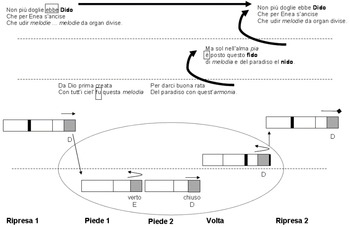
In terms of time-structures, the Ripresa thus foreshadows a future within the poetry's internal logic in that it will be sung again and that it receives its definitive meaning at that point, and, furthermore, allows the ballata to come to a qualified end. The Piedi narrate a separate story that takes place in the past (see the framed verb forms in Figure 1), but which has consequences for the Volta. The Volta itself is placed in the present – that is, on the ‘now’-level of the poem, even to the extent that it is the only point when the verb is in the present tense. From there the second Ripresa is reached, but with an altered meaning – present and past at the same time. It is remarkable that the Volta in the poem (and this is more the rule than the exception) is given such a crucial position, whereas the genre norms of the ballata as musical form do not consider the Volta to be an autonomous compositional space (because the music is identical to that of the Ripresa). Here, a paradoxical question should be kept in mind: Is music able to reflect the special status of the Volta in spite of its purely repetitive status?
The surprisingly incongruous comparison between Dido's pains and that which is caused by hearing music without organs is not very well understood and has led to different scholarly interpretations. Corsi, in his edition of Trecento poetry, assumes that the text was written in connection with one of the representative organ building projects in Florence – in Santissima Annunziata (ready in 1379) or in the cathedral (from 1387). Both projects were supervised by Andrea, and even Francesco Landini took part in the planning and supervision. These organ consultations may also provide the reason for the names ‘Andrea degli Organi’ and ‘Andrea Horganista’ which occur in some of the sources. Footnote 24 Thus, there were many occasions where the performance of this ballata could be imagined as a part of this typical urban, mixed sacred/secular socio-cultural environment, perhaps even with reference to theeconomic side of the organ building project. Others give the term ‘organ’ in the poem a broader meaning, as to signify ‘polyphony’.Footnote 25 This results in a text which one might understand and appreciate more easily, but it is also precisely for this reason that the interpretation seems dubious. In the analysis of the music, however, it can be said that this is not the most important word in the poem.
With regard to the text's poetical form, a central feature is its firmly built verse structure (see Figure 1). The Ripresa is comprised of two seven-syllable lines plus one of eleven syllables; the Piedi have one seven-syllable and one eleven-syllable line. In spite of the variation, there is a systematic alternation of syllable numbers where the weighty endecasillabo is always situated at the end of each stanza. This is a unifying device for the entire poem which effectively marks the caesuras between the stanzas. Another such feature is the classic ballata rhyme scheme with the concatenatio pulchra between Piede 2 and Volta: armonia – pia. What is not as common is that the Volta uses the first rhyme sound of the Ripresa (‘Dido’) as its second and third rhyme sound, so that a close rhyming connection between the Volta and the Ripresa 2 (fido – nido – Dido) is developed. The ballata's rhyme scheme works so that there is almost no connection between Ripresa 1 and the Piedi, but the way back is very neatly sewn. There is, though, one key word which maintains a connection throughout all the parts: melodia (and the associated concept of harmonia).
Andrea da Firenze, Non più doglie ebbe Dido – text, verse structure, time levels, musical structure.

The scheme beneath the text in Figure 1 is an attempt to give an overview of the musical process insofar as it is related to this multiplan time structure. The generic conventions require that the Piedi part should be in contrast to the Ripresa, recalling that they are called mutazioni in the contemporary musico-poetical treatises. The Volta, however, is to be sung to the music of the Ripresa, because the text follows the same verse and rhyme structure. In this song, the Ripresa–Piedi dualism even matches well with the above-named distinction between the first and the second narration. All the rhyme syllables sound on well-defined cadential passages with longer preparations so that their interrelation becomes easily audible, especially the sequence of the Piede 2, Volta and Ripresa rhyme sounds (bold black lines). From a certain point, the final cadences in both Ripresa and Piedi parts resemble each other (shaded grey), a widespread device in late Trecento compositions which weakens the difference between the parts. In fact, towards their end, all the stanzas reach the same close. This enhances the impact of the final lines with their weighty endecasillabi.
It is a remarkable aspect of ballata form that the final cadences of the two parts have a special task compared to all the other cadences. The Piedi must provide a twofold, and the Ripresa a threefold conclusion: in the Ripresa the final cadence has to lead convincingly first to the beginning of something else, namely the Piede 1; second, from the end (in the Volta) to its own beginning, the Ripresa 2; and third, to form the very end of the song, resulting in a qualified close (shown by the line with a point in Figure 1). Even the final cadence of the Piedi must allow for a return both to its own beginning and to the beginning of the Volta – that is, the Ripresa musical section. Many ballatas, including this one, solve this problem with the help of a verto/chiuso cadence, which gives the caesura between Piedi 1 and 2 a lesser weight than all other final caesuras (here cadencing on E, in contrast to D).
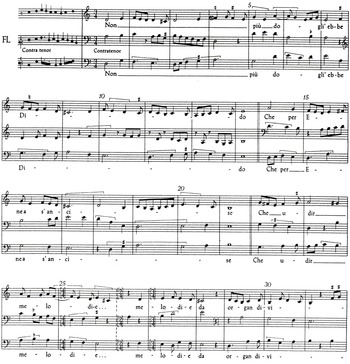
Looking now more closely at the textual and musical process discernible in Andrea's setting, there is an especially important role for the first cadence, particularly in the assumption that the music receives and reflects its own time process. It is with this cadence that the song's musical flow is established and a rhythmic impulse, a melodic frame, a qualified caesura within the chosen ambitus, metrum, and sonority are first defined (the music of Non più doglie ebbe Dido, edited by Nino Pirrotta, is reproduced in the Appendix). In this case, the first cadence in the song occurs already in bar 2 (to the D/a/d sonority in bar 3) and has two main characteristics. First, it does not correspond with the text declamation, but rather sounds in the middle of the opening melisma which ends in bar 5. It is true that the beginning of declamation is also marked with a cadence, but with a weaker one. Just one crotchet after having reached the implicit goal of the cadential progression, the cantus is already proceeding to e and breaks up the perfect g-d-g sonority. The first cadence is thus primarily a musical reference point and not essential in relation to the text structure.
The second important point is that the cadence consists of a set of elements which returns many times throughout the entire piece, even in the Piedi. There is the formulaic rhythmic motive ♪ ♪ ♪ ♩ ♪, typical for senaria perfetta, combined with the mutatio qualitatis in the tenor (perfect semibreves) and in the outer voices leading to the cadence at its end from perfect f-f (T/C) via e-c# to d-d. The rhythmic motive already returns at bar 8, but there it leads to an imperfect sonority. Then it turns up in both bar 11 and bar 12 in two cadential motions. The first is not directed towards, but starts from a perfect sonority (d-d in bar 11), the second avoids resting on the cadential sonority which was prepared from the first, and strives towards the next goal – the E cadence in bar 13 at the end of the first line. In the contratenor, there are in both cases rests at the start of the bar, on the sonorities where one is led to expect a cadence. The contratenor thus reinforces the cadential suspensions which are prepared by the outer voices. However, the most interesting point is that the formula motive is given a new context every time it occurs: in bar 8, motion towards imperfection; in bar 11, departure from cadential sonority; and in bar 12, evasion of a cadence.
The second line begins directly with a text declamation, here including the motive/cadence combination which does not really fit the text meter (‘Ché per E-néa s’ancíse'). Footnote 26 Now the formula motive leads to a G cadence (bar 15/16), only to be suspended after a minim by the cantus itself for a new motion into an extended imperfect sonority (e-c#, bar 17, on s'ancíse).
Line 3 is the crucial line of the Ripresa. It starts directly with the motive/cadence combination, this time leading to a cadence on A; this sonority is confirmed once more in the following bar (bar 24). The following passage is remarkable in its rhythmic design, as shown by Pirrotta's method of editing: he notates a mensuration change, which in fact is not indicated in the manuscript. From a formal standpoint this change is not necessary, because it would be possible to notate everything in 3/4. The reason for Pirrotta's decision is clear enough: the hitherto unbroken cantus flow becomes interspersed with rests, the syncopations do not lead to an expected resolution, the counterpoint is thinned out with hocket-like rests in the tenor. All of this is mirrored in the contratenor's phrase and even the text declamation, if we follow the Squarcialupi codex (the only source we have), is broken up through the repetition of the word ‘melodie’ so that the endecasillabo is split up into two halves, seven and six syllables long.Footnote 27 First, in bar 28 with the syllable ‘da’ on an imperfect sonority, it becomes clear that the line is not a complete settenario (‘che udir melodie’), but an endecasillabo with a musically prescribed caesura between the repeated words ‘melodie … melodie da organ divise’.
This is, as mentioned above, the key word for the entire ballata; and so here it is appropriate to look at the poem's structure once again. The poem is composed in such a manner that the word ‘melodia’ is included in the final line of every stanza. In the Piedi, it is even placed at the last penultima which has the longest melismas; and in the Ripresa and Volta, it turns up shortly before the final melisma. On these grounds, it is not too far-fetched to assume that the sudden discontinuity in musical metre and melodic shape in bars 24–8 has to do with the word ‘melodie’ in special connection with the message of the Ripresa: nothing is more painful than to hear melody separated from organ/polyphony. This instance of ‘melody’ is not a melody in the full sense of the word, as it would be lacking; instead, it should be clarified that in this context it is a compositional device which enhances the weight of the text's key word. The composer designs a contrast to the comparably well-ordered verse declamation heard earlier, and he therewith opens an interpretative level which allows the listener to relate the melodic design of this passage to the word ‘melodie’. A still closer musico-textual interaction on the word ‘melodie’ will be discussed shortly.
Meanwhile, to conclude the analysis of the Ripresa, after a recurrence of the formula motive in bar 30 and a cadence to b (bar 31), the music regains stable ground again with a penultima melisma including small imitations between the outer voices, unusually enough, even including the contratenor before it ends with a very common suspension-cadence to D. Such ‘neutral’ cadence techniques are very common at final cadences in ballata sections and it is significant that the formula motive is not used here. It is, so to speak, not within the local musical process, but rather on the larger scale of form definition.
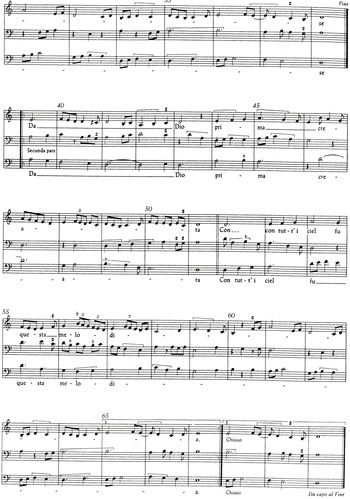
If we expect, in line with the genre's norms, that the Piedi section, the so-called mutazioni, should begin with a musical contrast, a bit of a surprise is in store here because the first two bars are formulated very similarly to the first two bars of the Ripresa. The only difference is that they begin on an a-e sonority, that the tenor holds the low d longer, reinforcing the cadential effect, and that the tenor (this time only!) does not employ mutatio qualitatis in the motion towards the cadence. The verse is sung in broader values, and the melodic shape is more even and buoyant than at the beginning of the Ripresa. The penultima melisma contains the formula motive again, but the real cadence is unexpectedly delayed by a sequence of six quavers until – one bar ‘too late’ – the ultima resolves the sustained imperfect sonority to a D-d octave (with a in the contratenor); again, this is a new ‘contextualisation’ of the motive.
In bar 52, the second Piede line begins. It is a special line opening, because it is the only one with imitation between tenor and cantus, and, consequently, a fair amount of non-simultaneous declamation. It is also interesting that the tenor has the prosodic impulse first. This might allude to the heavenly choirs singing in canon (as to allow for unum ad alteram, the perpetual singing sine fine, and the una voce assumption), a widespread musical topos in the Middle Ages.Footnote 28
This imitation leads to a cadence on the word ‘melodia’, which has two remarkable characteristics: (1) it is accompanied by the cadence formula with all its elements, and (2) the cantus continues in a wide melodic line, richly decorated by triplet fioriture, which in this form occur only at this point. Here, the text contains a demonstrative pronoun, ‘questa melodia’, which makes it possible within the performance for the listener to apply this to the music: this very melody, in fact, represents ‘questa melodia’ created by God in the first days, being enriched by Himself with harmony. Of course, at the same time, there is an insoluble logical contradiction here: the song ‘is’ melody for all of the other words as well, because the ballata is delivered melodically (i.e. sung) throughout. But with this passage, the word ‘melody’ receives a musical ‘present’ level in performance. Andrea then allows the melody to continue smoothly to the final passage (shaded grey in Figure 1), where the penultima imitations announce the final cadence of the Piedi: first verto on E and then chiuso on D. Hence, in the Piedi presentation the final cadence is embedded within the overall melodic structure, within the imitation and continuous flow of the preceding passage in contrast to the same passage in the Ripresa.
Here a possible answer can be suggested to the question of if and how the composer might contribute to the problem of the Volta: in Non più doglie ebbe Didothe music links the final Piedi passage – and with it, also the story it transmits about the key word, ‘melodia’ – both to the beginning and to the end of the Ripresa part, so that, when the Volta begins, its words together with the music have achieved a new meaning and a level of presence not inherent in the Ripresa music from the start. Thus, the music takes part in the construction of the Volta presence level via the potential to allude to its own procedures, even if the Volta for the composer, normally seen, has no reachable creative space at all.Footnote 29
In conclusion, in Non più doglie ebbe Dido, Andrea da Firenze uses a limited set of musical elements already present in the first cadence to construct a web of references within the music. In the course of the song, its elements acquire new significance and directional impact, successively establishing a differentiation between various temporal planes. Furthermore, the music is enabled to participate in the poem's time structure because the Piedi text contains an explicit reference to the key word, ‘melody’, so that musical and textual time structures are substantially related to each other, making the Volta the pivot point of the song.
Space here does not permit comparative study of the late Trecento ballata repertory to which this example belongs, but a number of preliminary observations can be posited to set the composition in context.Footnote 30Non più doglie ebbe Dido seems less indifferent to its musical ‘vestito’ (‘clothing’) than are many contemporary ballatas, which tend to draw from the standard vocabulary of amour courtois or moralising about everyday life, as do, for example, Bartolino da Padua's Non correr troppo Footnote 31 or Andrea's Presunzion da ignoranza procede.Footnote 32 Nevertheless, such ballatas often clearly display differentiated temporal planes, and procedures of managing temporal structures within the music – in line with the textual time or independent of it – are common, as are internal articulations of openings and closings with graduated quality (more or less independent of the formal characteristics of the poetry), the differentiated use of cadences with various closing capacities, and the explicit marking of passages, be it with melodic discontinuity, with motives, with sonority constellations, or vertical structures such as imitation or hoquetus, or a combination of the above. As a consequence of these measures, the musicians of the late Trecento – and in this respect Andrea, Paolo, Bartolino, Zacara and Ciconia are fully comparable – establish a set of internal musical relationships which together enable a compositional meta-discourse within the song's temporal process.
Appendix: Andrea da Firenze, Non più doglie ebbe Dido, ed. Nino Pirrotta in Corpus Mensurabilis Musicae, 8/5, 17–18
Reproduced by permission of the American Institute of Musicology, Inc., Middleton, Wisconsin.