Introduction
There is much evidence for the association of specific types of acute illness hospitalization (AIH) with post-hospitalization cognitive decline (PHCD). PHCD following intensive care unit admission has been observed in patients irrespective of diagnosis (Wolters et al., Reference Wolters, Slooter, van der Kooi and van Dijk2013). Numerous studies report PHCD following hospitalizations complicated by delirium (Jackson et al., Reference Jackson, Gordon, Hart, Hopkins and Ely2004; Salluh et al., Reference Salluh2015) as well as post-operative cognitive decline (POCD) (Berger et al., Reference Berger2015; Paredes et al., Reference Paredes, Cortinez, Contreras and Silbert2016). However, the possibility that any AIH could increase the risk of subsequent cognitive decline is less well recognized and of particular concern.
Older adults are vulnerable to dementia (Prince et al., Reference Prince, Wimo, Guerchet, Ali, Wu and Prina2015) and mild cognitive impairment (MCI) (Sosa et al., Reference Sosa2012), which impair an individual’s quality of life, and present challenges for health and welfare systems. Older adults are also most likely to require AIH. In 2015/16, patients aged over 65 accounted for over 40% of overnight hospitalizations in Australia (AIHW, 2017) and over 30% in the U.S.A. (Centers for Disease Control and Prevention). If AIH exposure contributes to cognitive decline, the risk should be quantified, the implications assessed and mitigating strategies implemented. The aim of this review is to collate the available evidence and use formal meta-analytical methods to best estimate the direction and magnitude of cognitive change after AIH.
We define an AIH as hospitalization for an acute illness causing sufficient physiological derangement to require overnight inpatient treatment. For example, this may include care following major surgery or emergency treatment for organ dysfunction such as a myocardial infarction, but not rehabilitation or psychiatric admissions. In the older adult population, the majority of AIHs (65%) are for the management of acute medical illnesses such as pneumonia, although a significant minority (23%) are for elective surgery (e.g. total knee replacement) or emergency surgery (e.g. laparotomy for large bowel pathology) (AIHW, 2017).
Regarding risk factors, older age is the patient factor consistently implicated in increasing the risk of PHCD in the surgical literature (Berger et al., Reference Berger2015). Contributory hospitalization factors are generally assumed to be specific. For example, POCD has been attributed to anesthesia or cerebral micro-emboli (Silbert et al., Reference Silbert, Evered and Scott2011), despite a lack of specific evidence to support these (Evered et al., 2011; Williams-Russo et al., Reference Williams-Russo, Sharrock, Mattis, Szatrowski and Charlson1995). In fact, there is increasing evidence that PHCD occurs following several types of AIH, and this suggests factors common to any AIH may be contributory such as pain, inflammation (Subramaniyan and Terrando, Reference Subramaniyan and Terrando2019), and sleep deprivation (Krumholz, Reference Krumholz2013).
Few studies have investigated PHCD in the majority acute inpatient population. There are two reviews focusing on depression, stress, delirium, surgery, and critical illness as contributory factors (Chinnappa-Quinn et al., Reference Chinnappa-Quinn, Bennett, Makkar, Kochan, Crawford and Sachdev2019; Mathews et al., Reference Mathews, Arnold and Epperson2014) but no systematic review to date. The objectives of this systematic review and meta-analysis (MA) are to synthesize longitudinal observational studies reporting cognitive outcomes in older age adults following AIH, identify potential moderating patient and hospitalization factors, and conduct an MA of the studies where statistical pooling is feasible.
Method
Eligibility criteria
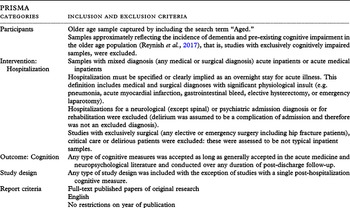
We followed PRISMA guidelines (Liberati et al., Reference Liberati2009). Selection criteria (Table 1) identified studies with older age participants with AIH exposure. Studies with exclusively medical patients were also included given they form the majority of older age acute inpatients (AIHW, 2017). Studies focusing exclusively on surgical patients (including hip fracture patients), intensive care patients, or patients with known dementia were excluded.
Inclusion and exclusion criteria for study selection

All cognitive measures, including neuropsychological testing or diagnosis of a cognitive disorder, were accepted to allow for the maximum number of studies to be considered.
Information sources, search strategy, study selection, and data collection
We conducted an initial search using the subject headings [Hospitalization] AND [Cognition OR Cognition Disorders] AND [Aged OR Aged over 80] as keywords in Embase, Medline, and Psycinfo databases. This yielded ten papers of direct interest (Brown et al., Reference Brown2015; Buckwalter et al., Reference Buckwalter, Crooks and Petitti2005; Chen et al., Reference Chen, Chang, Huang, Peng and Tseng2010; Davydow et al., Reference Davydow, Hough, Levine, Langa and Iwashyna2013; Ehlenbach et al., Reference Ehlenbach2010; Inouye et al., Reference Inouye, Zhang, Han, Leo-Summers, Jones and Marcantonio2006; Levine et al., Reference Levine, Davydow, Hough, Langa, Rogers and Iwashyna2014; Shah et al., Reference Shah2013; Wilson et al., Reference Wilson, Hebert, Scherr, Dong, Leurgens and Evans2012; Woods et al., Reference Woods, Mark, Pitts and Mennemeier2011). Examination of the keywords, subject headings, citations, and references for these papers were used to develop definitive electronic search strategies tailored to database-specific subject headings (Supplement). These were applied in MEDLINE, EMBASE, Psycinfo, and CINAHL databases, from inception to January 2020 (Figure 1).
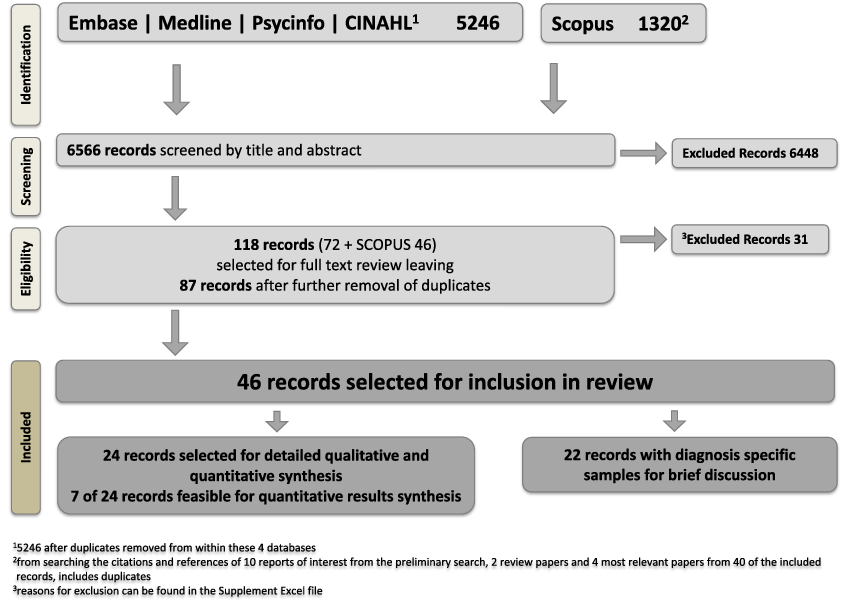
PRISMA Flowchart: This describes the study selection process and groupings for qualitative synthesis and meta-analysis. 6566 reports from five databases were screened, 87 reports were selected for full-text review, and 46 were selected for inclusion according to the inclusion criteria in Table 1. Exclusion reasons are classified and reported in the Supplement (Exclusion Coding Jan 2020 Supplement.xlsx).

Reports were initially screened by title and abstract to select papers for full-text review based on the criteria in Table 1. This stage was undertaken by two independent reviewers (LNPC-Q and SRM) for the Psycinfo database using identical search and exclusion criteria. Excluded reports were classified according to PRISMA categories and report characteristics (see Supplement Excel file).
Reports selected for full-text review were assessed using a coding form developed from the Cochrane Public Health Group Data Extraction and Assessment Template (Cochrane Public Health Group) combined with further recommendations (Cooper, Reference Cooper2009) (PDF in Supplement). This stage was also replicated by the second reviewer (SRM). Reliability between reviewers in relation to the coding of papers and the final decision to include papers was tested by computing Cohen’s kappa (κ), with κ = 1 indicating perfect agreement, κ = 0 indicating any agreement is due to chance, and negative values indicating the agreement is worse than chance. Following convention, kappa values larger than 0.60 and 0.80 represent good and very good agreement, respectively.
Finally, Scopus was used to identify the references and citations of included reports. These were screened for any remaining relevant reports. Included papers were also coded using the Cochrane template developed into a customized form (PDF in Supplement).
Summary measures and risk of bias
A qualitative review was prepared to classify studies by design and describe global and domain-specific cognitive outcomes and associated moderating factors.
Risk of bias within studies was assessed with the Newcastle–Ottawa Scale (NOS) for cohort studies (Zeng et al., Reference Zeng2015), which scores bias-reducing aspects of study design, providing qualitative and quantitative (≥6 indicates a study design less prone to bias) summaries of risk of bias for each study.
The random-effects MA model (DerSimonian and Laird, 1986) was used, and restricted maximum likelihood was used as the variance estimator. The random-effects model was chosen because of the likely clinical heterogeneity and the risk of bias inherent in cohort study design arising from potentially confounding variables such as heterogeneous follow-up durations and outcome measures, and moderating factors such as age, illness severity, length of stay, and preceding hospitalization exposures (Borenstein et al., Reference Borenstein, Hedges, Higgins and Rothstein2009; Cooper, Reference Cooper2017). The I 2 statistic, describing the percentage of variation across studies, was used to assess heterogeneity of effects. Meta-regression was planned to examine these moderating factors if there were more than ten studies, in line with Cochrane Collaboration advice (Cochrane Collaboration, Reference Higgins2019). Data were analyzed with Stata version 15.1 (StataCorp LLC, College Station, TX).
Studies were grouped by design/outcome to enable pooling of comparable studies (Cochrane Collaboration, Reference Higgins2019). Effect sizes together with sampling variance and standard error were computed using methods described by Borenstein (Reference Borenstein, Hedges, Higgins and Rothstein2009) and Morris and DeShon (Reference Morris and Deshon2002). Particularly, for studies reporting post-hospitalization cognitive outcomes compared to a control group, the means of the hospitalization and control groups and pooled standard deviations across groups were used to compute standardized effect sizes (Cohen’s d). For studies reporting pre- and post-hospitalization cognition change compared to a control group, the means and standard deviations of the cognition change scores from both groups were used to compute standardized mean differences in change (analogous to Cohen’s d). No correction was applied to the effect sizes from these two types of studies because separate pre-test and/or control group data were not available. Odds ratios (ORs) were used to pool studies examining risk of dementia or moderate-to-severe cognitive impairment and then converted to Cohen’s d to make an overall analysis possible (Borenstein et al., Reference Borenstein, Hedges, Higgins and Rothstein2009).
Funnel plots and Egger’s test for publication bias were planned for analyses with more than 10 studies (Sterne et al., Reference Sterne2011; Terrin et al., Reference Terrin, Schmid and Lau2005).
Results: systematic review
Study selection and classification
After removal of duplicates, 6566 reports were screened. Reliability between reviewers for screening of reports using Psycinfo was excellent (kappa (κ) = 0.84, percent agreement = 99%). Eighty-seven underwent full-text review. Forty-six reports met selection criteria for this review (Figure 1). Reliability between reviewers for this selection stage was excellent (κ = 1 for the type of report, κ = 0.77 for type of hospitalization, κ = 0.88 for the comparison group). Disagreements between reviewers were resolved through discussion. Although electronic searches were run from inception dates of databases (Supplement p3), the earliest included paper was from 1996.
Twenty-four reports had “general” hospital samples with mixed diagnosis AIH. These were considered for detailed qualitative synthesis with seven of these able to be statistically pooled (Figure 1).
The remaining 22 reports had samples with AIH for selected medical diagnoses (e.g. cardiovascular disease and chronic obstructive airways disease) rather than a “general” hospital sample. These had comparison non-hospitalized groups without AIH for the diagnosis under investigation. It could not be confirmed if these comparison groups had been exposed to other AIH, thereby potentially confounding the findings. Thus, although these 22 reports satisfied inclusion criteria, they could not address this review’s core research question. These are discussed briefly and separately at the end of this section and summarized in Supplemental Table S1.
What follows is a detailed synthesis of the 24 reports with general hospital samples. The results of the MA of seven studies are reported in the next section.
Characteristics
The 24 reports with mixed diagnosis samples were classified by study design into the secondary analyses of longitudinal cognitive data in community samples (Brown et al., Reference Brown2015; Davydow et al., Reference Davydow, Hough, Levine, Langa and Iwashyna2013, Reference Davydow, Zivin and Langa2014; Ehlenbach et al., Reference Ehlenbach2010; Eriksson et al., Reference Eriksson2019; Hallgren et al., Reference Hallgren, Fransson, Reynolds, Finkel, Pedersen and Dahl Aslan2018; James et al., Reference James2019; Liu et al., Reference Liu, Han, Gahbauer, Allore and Gill2017; O’Brien et al., Reference O’Brien, O’Leary, Scarlett, O’Hare and Kenny2018; Wilson et al., Reference Wilson, Hebert, Scherr, Dong, Leurgens and Evans2012), or inpatient samples with cognitive follow-up post-discharge (Asmus-Szepesi et al., Reference Asmus-Szepesi2013; Caplan et al., Reference Caplan, Coconis and Woods2005; Chen et al., Reference Chen, Chang, Huang, Peng and Tseng2010; Cole et al., Reference Cole, Mccusker, Dendukuri and Han2003, Reference Cole, Mccusker, Ciampi and Belzile2008; Dzierzewski et al., Reference Dzierzewski, Fung, Jouldjian, Alessi, Irwin and Martin2014; Garcez et al., Reference Garcez, Apolinario, Campora, Curiati, Jacob-Filho and Avelino-Silva2019; Inouye et al., Reference Inouye, Zhang, Han, Leo-Summers, Jones and Marcantonio2006; Martínez-Velilla et al., Reference Martínez-Velilla2016; McPhail et al., Reference Mcphail, Varghese and Kuys2014; Mendes-Chiloff et al., Reference Mendes-Chiloff, Torres, Lima and Ramos-Cerqueira2009; Sauve et al., Reference Sauve, Walker, Massa, Winkle and Scheinman1996; van Seben et al., Reference van Seben2018; Woods et al., Reference Woods, Mark, Pitts and Mennemeier2011).
The reports were heterogeneous in sample sizes, cognitive measures, follow-up, and statistical analysis. Most samples had either selected cognitively intact individuals (Brown et al., Reference Brown2015; Garcez et al., Reference Garcez, Apolinario, Campora, Curiati, Jacob-Filho and Avelino-Silva2019; Eriksson et al., Reference Eriksson2019; James et al., Reference James2019; McPhail et al., Reference Mcphail, Varghese and Kuys2014; Sauve et al., Reference Sauve, Walker, Massa, Winkle and Scheinman1996; Wilson et al., Reference Wilson, Hebert, Scherr, Dong, Leurgens and Evans2012; Woods et al., Reference Woods, Mark, Pitts and Mennemeier2011) or had rates of cognitive impairment or dementia at baseline consistent with those reported in the general older population (Kukull et al., Reference Kukull2002). Several samples documented mild functional impairment (Asmus-Szepesi et al., Reference Asmus-Szepesi2013; Caplan et al., Reference Caplan, Coconis and Woods2005; Davydow et al., Reference Davydow, Zivin and Langa2014; Garcez et al., 2019; Inouye et al., Reference Inouye, Zhang, Han, Leo-Summers, Jones and Marcantonio2006; Martínez-Velilla et al., Reference Martínez-Velilla2016; Mendes-Chiloff et al., Reference Mendes-Chiloff, Torres, Lima and Ramos-Cerqueira2009; van Seben et al., Reference van Seben2018; Wilson et al., Reference Wilson, Hebert, Scherr, Dong, Leurgens and Evans2012) and one to two pre-existing comorbidities (Asmus-Szepesi et al., Reference Asmus-Szepesi2013; Cole et al., Reference Cole, Mccusker, Ciampi and Belzile2008; Davydow et al., Reference Davydow, Hough, Levine, Langa and Iwashyna2013, Reference Davydow, Zivin and Langa2014; Dzierzewski et al., Reference Dzierzewski, Fung, Jouldjian, Alessi, Irwin and Martin2014; Ehlenbach et al., Reference Ehlenbach2010; Garcez et al., 2019; Inouye et al., Reference Inouye, Zhang, Han, Leo-Summers, Jones and Marcantonio2006; Liu et al., Reference Liu, Han, Gahbauer, Allore and Gill2017; O’Brien et al., Reference O’Brien, O’Leary, Scarlett, O’Hare and Kenny2018; van Seben et al., Reference van Seben2018; Wilson et al., Reference Wilson, Hebert, Scherr, Dong, Leurgens and Evans2012) consistent with prevalence in this age group (Divo et al., Reference Divo, Martinez and Mannino2014).
Hospitalization exposure data in community samples were obtained from self-report (Brown et al., Reference Brown2015; Davydow et al., Reference Davydow, Zivin and Langa2014; Liu et al., Reference Liu, Han, Gahbauer, Allore and Gill2017; O’Brien et al., Reference O’Brien, O’Leary, Scarlett, O’Hare and Kenny2018) or Medicare claims data (Davydow et al., Reference Davydow, Hough, Levine, Langa and Iwashyna2013; Ehlenbach et al., Reference Ehlenbach2010; Eriksson et al., Reference Eriksson2019; Hallgren et al., Reference Hallgren, Fransson, Reynolds, Finkel, Pedersen and Dahl Aslan2018; James et al., Reference James2019; Wilson et al., Reference Wilson, Hebert, Scherr, Dong, Leurgens and Evans2012). Three community sample studies reported high rates of hospitalization in their samples of 45%, 74%, and 53%, respectively (Brown et al., Reference Brown2015; Ehlenbach et al., Reference Ehlenbach2010; Wilson et al., Reference Wilson, Hebert, Scherr, Dong, Leurgens and Evans2012). Specific primary diagnoses were specified in most reports for surgical and medical conditions (Asmus-Szepesi et al., Reference Asmus-Szepesi2013; Brown et al., Reference Brown2015; Caplan et al., Reference Caplan, Coconis and Woods2005; Chen et al., Reference Chen, Chang, Huang, Peng and Tseng2010; Cole et al., Reference Cole, Mccusker, Dendukuri and Han2003, Reference Cole, Mccusker, Ciampi and Belzile2008; Davydow et al., Reference Davydow, Hough, Levine, Langa and Iwashyna2013; Ehlenbach et al., Reference Ehlenbach2010; Eriksson et al., Reference Eriksson2019; Hallgren et al., Reference Hallgren, Fransson, Reynolds, Finkel, Pedersen and Dahl Aslan2018; Inouye et al., Reference Inouye, Zhang, Han, Leo-Summers, Jones and Marcantonio2006; James et al., Reference James2019; Liu et al., Reference Liu, Han, Gahbauer, Allore and Gill2017; Martínez-Velilla et al., Reference Martínez-Velilla2016; McPhail et al., Reference Mcphail, Varghese and Kuys2014; Mendes-Chiloff et al., Reference Mendes-Chiloff, Torres, Lima and Ramos-Cerqueira2009; Sauve et al., Reference Sauve, Walker, Massa, Winkle and Scheinman1996; van Seben et al., Reference van Seben2018; Wilson et al., Reference Wilson, Hebert, Scherr, Dong, Leurgens and Evans2012; Woods et al., Reference Woods, Mark, Pitts and Mennemeier2011).
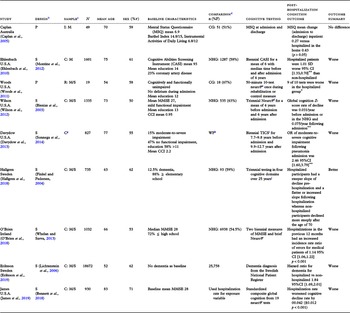
Validated cognitive tests were used (Table 2 and Supplemental Table S3): the Mini-Mental State Examination (MMSE), comprehensive neuropsychological test batteries with differing test selection, and/or formal dementia diagnosis. Follow-up ranged from one month to several years.
Reports selected for results synthesis with Newcastle–Ottawa Scale ≥ 6 a

Abbreviations: CCI, Charlson Comorbidity Index; CG, control group; NHG, non-hospitalized group; TICS, Telephone Interview for Cognitive Status.
*p ≤ 0.05, **p ≤ 0.01, ***p ≤ 0.001.
a Figures rounded to nearest whole digit or two significant places where appropriate.
b P: prospective data collection, S: secondary analysis of prospective data from another report with accompanying citation of the original study.
c Sample recruited from acute medical inpatients (I), rehabilitation following acute admission (R) or the community (C) with a medical or surgical primary diagnosis (M and/or S) when specified.
d Comparison group: within patient comparison (WP), non-hospitalized group part of overall sample (NHG) or separately recruited (CG).
e Trails A and B of the Trail Making Test, Controlled Oral Word Association Test, Animal Naming Test, MMSE, immediate and delayed recall of the Logical Memory Immediate and Logical Memory Delayed Recall, Visual Reproduction Immediate and Visual Reproduction Delayed (VR II), Subtests of the Wechsler Memory Scale – Revised, Modified Star Cancellation Test.
f Immediate and delayed recall of the East Boston Story, the oral version of the Symbol Digits Modalities Test, The Mini-Mental State Examination: composite of all four measures was the primary outcome.
g Pneumonia patients only.
h Patients also compared to those admitted with myocardial infarct and stroke.
i Telephone Interview for Cognitive Status.
j Verbal abilities assessed using Information Subtest (from the Wechsler Adult Intelligence Scale-Revised) Synonyms and Analogies, memory assessed using Digit Span (WAIS-R) and Thurstone’s Picture Memory Task, spatial/fluid abilities assessed by Figure Logic, Block Design (WAIS-R), and Card Rotation, processing speed assessed using an inverted version of the Symbol Digit Substitution Task and Figure Identification: principal component analysis used to create component scores for four domains (verbal, spatial/fluid, memory, and processing speed abilities) and a global cognitive composite score which was transformed into a T score.
Risk of bias within and across studies
Despite older age participants and lengthy follow-up, attrition was low. According to NOS criteria, eleven studies had attrition rates of 15% or less and four reported management of missing data. Most studies controlled for an exhaustive list of potential confounders. For detailed NOS assessment, see Table S2.
Outcomes
Overall cognitive outcomes
Of the 24 included reports, eleven (11/24, 46%) reported worse cognition following hospitalization (Brown et al., Reference Brown2015; Chen et al., Reference Chen, Chang, Huang, Peng and Tseng2010; Davydow et al., Reference Davydow, Hough, Levine, Langa and Iwashyna2013, Reference Davydow, Zivin and Langa2014; Ehlenbach et al., Reference Ehlenbach2010; Eriksson et al., Reference Eriksson2019; James et al., Reference James2019; Mendes-Chiloff et al., Reference Mendes-Chiloff, Torres, Lima and Ramos-Cerqueira2009; O’Brien et al., Reference O’Brien, O’Leary, Scarlett, O’Hare and Kenny2018; Wilson et al., Reference Wilson, Hebert, Scherr, Dong, Leurgens and Evans2012; Woods et al., Reference Woods, Mark, Pitts and Mennemeier2011), while one reported some improvement (4%) (Hallgren et al., Reference Hallgren, Fransson, Reynolds, Finkel, Pedersen and Dahl Aslan2018). Two showed no significant effect (8%) (Caplan et al., Reference Caplan, Coconis and Woods2005; Liu et al., Reference Liu, Han, Gahbauer, Allore and Gill2017). The remaining ten (42%) were inconclusive, either because they were comparing two types of inpatient groups (Dzierzewski et al., Reference Dzierzewski, Fung, Jouldjian, Alessi, Irwin and Martin2014; Martínez-Velilla et al., Reference Martínez-Velilla2016) or had no pre-hospitalization measure ( Asmus-Szepesi et al., Reference Asmus-Szepesi2013; Cole et al., Reference Cole, Mccusker, Dendukuri and Han2003, Reference Cole, Mccusker, Ciampi and Belzile2008; Garcez et al., Reference Garcez, Apolinario, Campora, Curiati, Jacob-Filho and Avelino-Silva2019; Inouye et al., Reference Inouye, Zhang, Han, Leo-Summers, Jones and Marcantonio2006; McPhail et al., Reference Mcphail, Varghese and Kuys2014; Sauve et al., Reference Sauve, Walker, Massa, Winkle and Scheinman1996; van Seben et al., Reference van Seben2018). Outcomes from studies with NOS scores ≥ 6 are summarized in Table 2 with the remaining summarized in Supplemental Table S3.
Wilson et al. (Reference Wilson, Hebert, Scherr, Dong, Leurgens and Evans2012) plotted individual cognitive trajectories in 7.5% of their sample over a 9-year mean follow-up. Despite reporting a mean decline in cognition, this plot demonstrated variability, with some individuals showing improvement or minimal change in cognition over time.
Cognitive domain outcomes
Nine reports used at least one domain-specific test as part of their cognitive assessment ( Brown et al., Reference Brown2015; Davydow et al., Reference Davydow, Zivin and Langa2014; Hallgren et al., Reference Hallgren, Fransson, Reynolds, Finkel, Pedersen and Dahl Aslan2018; James et al., Reference James2019; Martínez-Velilla et al., Reference Martínez-Velilla2016; O’Brien et al., Reference O’Brien, O’Leary, Scarlett, O’Hare and Kenny2018; Sauve et al., Reference Sauve, Walker, Massa, Winkle and Scheinman1996; Wilson et al., Reference Wilson, Hebert, Scherr, Dong, Leurgens and Evans2012; Woods et al., Reference Woods, Mark, Pitts and Mennemeier2011). Five reported domain-specific outcomes (Brown et al., Reference Brown2015; Hallgren et al., Reference Hallgren, Fransson, Reynolds, Finkel, Pedersen and Dahl Aslan2018; O’Brien et al., 2018; Wilson et al., Reference Wilson, Hebert, Scherr, Dong, Leurgens and Evans2012; Woods et al., Reference Woods, Mark, Pitts and Mennemeier2011) pertaining to memory, attention/processing speed, verbal ability, and executive function (Goldstein and McNeil, 2004) (Supplemental Table S4).
Memory
Three papers reported post-hospitalization memory decline. Woods et al. (Reference Woods, Mark, Pitts and Mennemeier2011) described memory impairments for prose passages (delayed) and designs (immediate and delayed) in the weeks following discharge, compared with community controls. Wilson et al. (Reference Wilson, Hebert, Scherr, Dong, Leurgens and Evans2012) reported a rate of decline 3.3 times (p = .005) greater on memory for prose passages in hospitalized compared to non-hospitalized participants. O’Brien et al. (Reference O’Brien, O’Leary, Scarlett, O’Hare and Kenny2018) reported decline in immediate and delayed word recall, as well as increased likelihood of errors on two prospective memory tests in hospitalized compared to non-hospitalized participants. Two papers did not find any evidence of a decline in memory (Brown et al., Reference Brown2015; Hallgren et al., Reference Hallgren, Fransson, Reynolds, Finkel, Pedersen and Dahl Aslan2018), with Hallgren observing a slight improvement in memory (based on a composite score of digit span and picture memory) in hospitalized participants (Hallgren et al., Reference Hallgren, Fransson, Reynolds, Finkel, Pedersen and Dahl Aslan2018).
Executive function
Three studies reported decline in executive function. Woods et al. (Reference Woods, Mark, Pitts and Mennemeier2011) reported a significantly poorer performance of hospitalized patients compared to controls in the weeks following discharge on word fluency (for letters and animals) and on a task of divided attention and mental flexibility (Trail Making Test B). In the years following hospitalization, O’Brien et al. (Reference O’Brien, O’Leary, Scarlett, O’Hare and Kenny2018) reported worsened verbal fluency and Brown et al. (Reference Brown2015) found that the word (letter) fluency test was worse in hospitalized subgroups with major surgery or multiple hospitalizations.
Attention and processing speed
Three papers reported decline in attention and processing speed. Woods et al. (Reference Woods, Mark, Pitts and Mennemeier2011) reported decline in the weeks following hospitalization using the Trail Making Test A and the Modified Star Cancelation Test. Brown et al. (Reference Brown2015) and Wilson et al. (Reference Wilson, Hebert, Scherr, Dong, Leurgens and Evans2012) both reported decline compared to non-hospitalized participants in the years following hospitalization in the Digit Symbol Substitution Test and the Symbol Digit Modalities Test, respectively. Conversely, Hallgren et al. (Reference Hallgren, Fransson, Reynolds, Finkel, Pedersen and Dahl Aslan2018) reported less decline in hospitalized versus non-hospitalized participants.
Risk factors for cognitive decline following hospitalization
Potential moderating factors reported in the 24 studies are summarized in Table S5. Regarding patient factors, increasing age was the most consistently associated with worsened PHCD (Chen et al., Reference Chen, Chang, Huang, Peng and Tseng2010; Davydow et al., Reference Davydow, Zivin and Langa2014; Dzierzewski et al., Reference Dzierzewski, Fung, Jouldjian, Alessi, Irwin and Martin2014; Garcez et al., Reference Garcez, Apolinario, Campora, Curiati, Jacob-Filho and Avelino-Silva2019; James et al., Reference James2019; McPhail et al., Reference Mcphail, Varghese and Kuys2014; Mendes-Chiloff et al., Reference Mendes-Chiloff, Torres, Lima and Ramos-Cerqueira2009; Wilson et al., Reference Wilson, Hebert, Scherr, Dong, Leurgens and Evans2012; Woods et al., Reference Woods, Mark, Pitts and Mennemeier2011). Other factors associated with worsened PHCD included poorer baseline cognition (Mendes-Chiloff et al., Reference Mendes-Chiloff, Torres, Lima and Ramos-Cerqueira2009; Wilson et al., Reference Wilson, Hebert, Scherr, Dong, Leurgens and Evans2012), depression (Chen et al., Reference Chen, Chang, Huang, Peng and Tseng2010; Mendes-Chiloff et al., Reference Mendes-Chiloff, Torres, Lima and Ramos-Cerqueira2009; Sauve et al., Reference Sauve, Walker, Massa, Winkle and Scheinman1996), lower functional status (Chen et al., Reference Chen, Chang, Huang, Peng and Tseng2010; Inouye et al., Reference Inouye, Zhang, Han, Leo-Summers, Jones and Marcantonio2006), and increased comorbidities (Davydow et al., 2014; Mendes-Chiloff et al., Reference Mendes-Chiloff, Torres, Lima and Ramos-Cerqueira2009). Regarding education, the results were mixed: two papers showed no relationship between cognition and fewer years of education (Chen et al., Reference Chen, Chang, Huang, Peng and Tseng2010; Wilson et al., Reference Wilson, Hebert, Scherr, Dong, Leurgens and Evans2012), one showed worsened PHCD in spite of a higher education level (Inouye et al., Reference Inouye, Zhang, Han, Leo-Summers, Jones and Marcantonio2006), and three showed that education was protective for PHCD (Davydow et al., Reference Davydow, Zivin and Langa2014; James et al., Reference James2019; Mendes-Chiloff et al., Reference Mendes-Chiloff, Torres, Lima and Ramos-Cerqueira2009).
Hospitalization factors associated with worsened cognitive decline included greater illness severity (Cole et al., Reference Cole, Mccusker, Ciampi and Belzile2008; Inouye et al., Reference Inouye, Zhang, Han, Leo-Summers, Jones and Marcantonio2006; Sauve et al., Reference Sauve, Walker, Massa, Winkle and Scheinman1996; Wilson et al., Reference Wilson, Hebert, Scherr, Dong, Leurgens and Evans2012), length of stay (Chen et al., Reference Chen, Chang, Huang, Peng and Tseng2010; Mendes-Chiloff et al., Reference Mendes-Chiloff, Torres, Lima and Ramos-Cerqueira2009; Wilson et al., Reference Wilson, Hebert, Scherr, Dong, Leurgens and Evans2012), increased number of hospitalizations (Brown et al., Reference Brown2015; Eriksson et al., Reference Eriksson2019; James et al., Reference James2019; Mendes-Chiloff et al., Reference Mendes-Chiloff, Torres, Lima and Ramos-Cerqueira2009), and critical care admission (Ehlenbach et al., Reference Ehlenbach2010; Eriksson et al., Reference Eriksson2019).
Given the historical evidence, surgical admission was explored as a potential moderating factor. Brown et al. found no significant difference in cognitive outcomes for major surgery hospitalizations when compared with non-surgical hospitalizations (Brown et al., Reference Brown2015). Both Eriksson et al. and O’Brien et al. reported greater cognitive decline following medical rather than surgical hospitalizations (Eriksson et al., 2019; O’Brien et al., Reference O’Brien, O’Leary, Scarlett, O’Hare and Kenny2018).
22 reports with specific AIH exposure
The remaining 22 of the 46 included reports consisted of samples exposed to AIH for specific medical diagnoses (Supplemental Table S1) with comparison groups potentially confounded by hospitalization exposures for other diagnoses. Nevertheless, several points of interest from these studies are worthy of consideration. Although eight studies investigating longitudinal cognitive changes reported mixed conclusions (Buckwalter et al., Reference Buckwalter, Crooks and Petitti2005; Dodd et al., Reference Dodd, Charlton, van den Broek and Jones2013, Reference Dodd, Novotny, Sciurba, Benzo and Group2015; Girard et al., Reference Girard2018; Poot et al., Reference Poot, Travers, Weatherall and McGinty2019; Scherwath et al., Reference Scherwath2013; Schou et al., Reference Schou2014; Reference SelnesSelnes et al., 2008), eleven reports suggested worsened global and executive cognitive function (Zhang et al., Reference Zhang2019), increased risk of dementia over time (Adelborg et al., Reference Adelborg, Horvath-Puho, Ording, Pedersen, Toft Sorensen and Henderson2017; Haring et al., Reference Haring2013; Li et al., Reference Li, Sundquist, Zöller and Sundquist2018; Marzona et al., Reference Marzona2016; Shah et al., Reference Shah2013; Smolina et al., Reference Smolina, Wotton and Goldacre2015; Tate et al., Reference Tate2014; Tsai et al., Reference Tsai, Yen, Lin and Kao2017; Whitmer et al., Reference Whitmer, Karter, Yaffe, Quesenberry and Selby2009), or decreased time to dementia conversion (Tate et al., Reference Tate2014) for hospitalized participants compared with those not hospitalized.
Two reports suggested a non-neurological primary admission diagnosis could, in some cases, have worse cognitive outcomes than a stroke or transient ischemic attack (Levine et al., Reference Levine, Davydow, Hough, Langa, Rogers and Iwashyna2014; Volonghi et al., Reference Volonghi, Pendlebury, Welch, Mehta and Rothwell2013).
Results: MA
We performed two separate analyses of studies examining the risk of dementia or moderate-to-severe cognitive impairment and studies examining post-discharge cognition or change in cognition. An overall analysis pooling these two groups of studies was also performed (Table 3). The studies not able to be pooled are listed in Table S6 with reasons for exclusion.
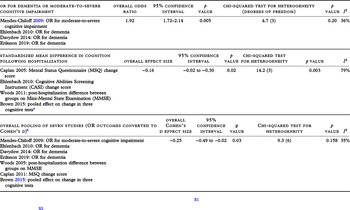
Random-effects meta-analysis results: These have been reported in two groups according to type of study, as well as overall pooled analyses for the seven studies

a Effects for three different cognitive tests (Delayed Word Recall Test, Digit Symbol Substitution Test, and Word Fluency Test) were first pooled. Sensitivity analysis revealed no change in the overall results by replacing the pooled effect with effects for each individual cognitive test (see Supplemental Figure S1).
b Ehlenbach et al. reported more than one type of outcome. Sensitivity analysis with Ehlenbach CASI change score substituted for OR for dementia revealed minimal change in the overall result (see Supplemental Figure S2).
Risk of dementia and moderate-to-severe cognitive impairment
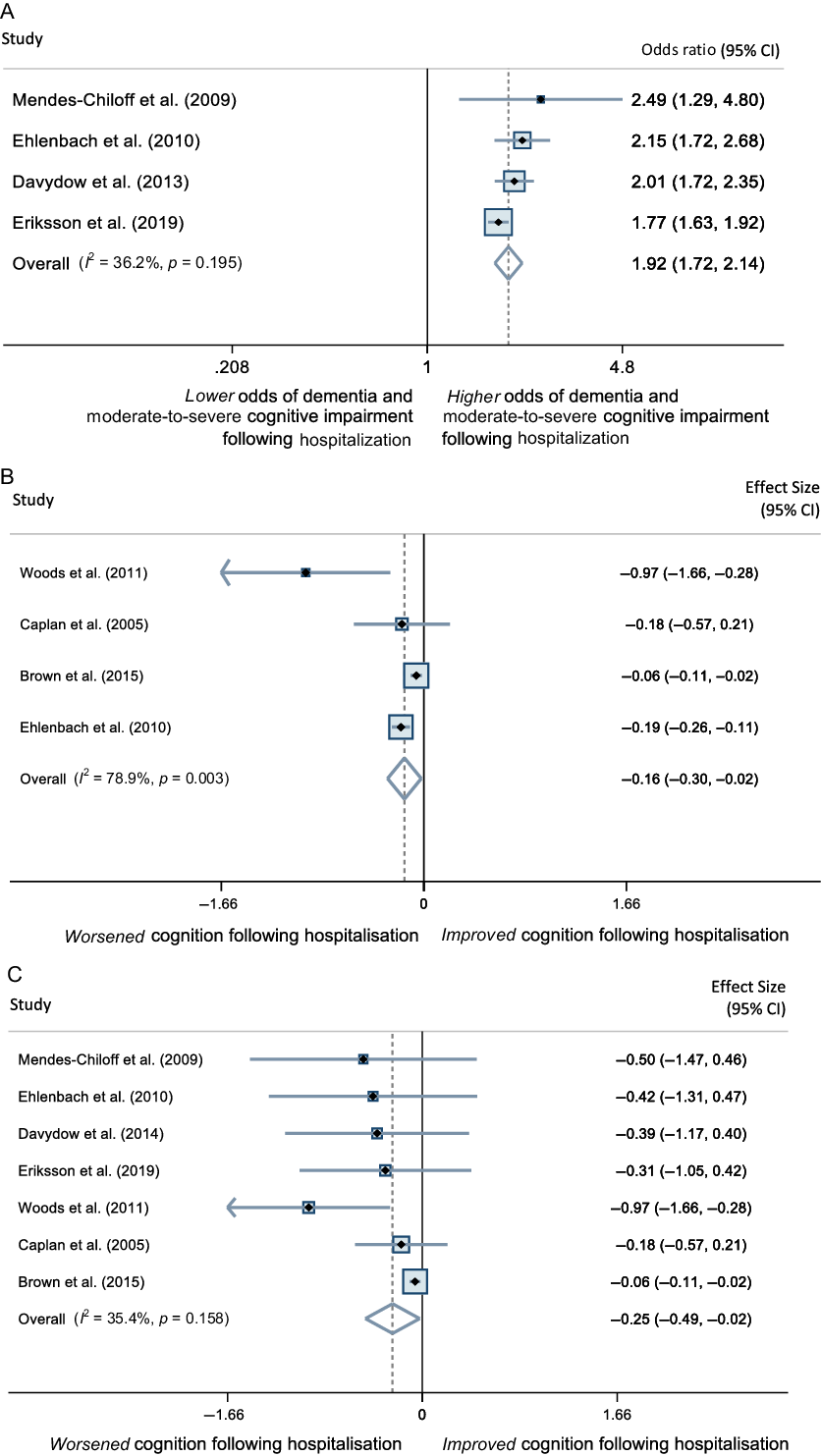
This analysis included three studies reporting the odds of conversion to dementia (Davydow et al., Reference Davydow, Zivin and Langa2014; Ehlenbach et al., Reference Ehlenbach2010; Eriksson et al., Reference Eriksson2019) and one reporting the odds of moderate-to-severe cognitive impairment (Mendes-Chiloff et al., Reference Mendes-Chiloff, Torres, Lima and Ramos-Cerqueira2009). The pooled OR for dementia or severe cognitive impairment following hospitalization on a total of 36,042 (21,717 hospitalized, 14,325 non-hospitalized) patients was 1.92 (95% CI [1.72, 2.14], p = 0.005; I 2 = 36%; Figure 2A).
A–C Forest plots: these plots from the meta-analyses in Table 3 show significant PHCD in the overall and separate analyses. This analysis reinforces the need for further investigation in this area to clarify the significance of the PHCD suggested by these studies. The remaining forest plots for sensitivity analysis can be found in the supplementary material. (A) Forest plot for pooled analysis of studies with OR outcomes relating to risk of dementia or moderate-to-severe cognitive impairment. (B) Forest plots of pooled analysis of studies reporting post-hospitalization cognition or change in cognition. (C) Forest plots for overall pooled analysis of cognition outcomes in hospitalized patients versus non-hospitalized patients (with OR studies converted to Cohen’s d).

Cognition reported with change from pre- to post-hospitalization measures
The pooled effect for four studies reporting post-hospitalization cognition (Woods et al., Reference Woods, Mark, Pitts and Mennemeier2011) or change in cognition (Caplan et al., Reference Caplan, Coconis and Woods2005; Brown et al., Reference Brown2015; Ehlenbach et al., Reference Ehlenbach2010) in 5411 (2621 hospitalized, 2790 non-hospitalized) participants revealed worsened cognition after hospitalization (d = −0.16, 95% CI [−0.02, −0.30], p = 0.02; I 2 = 79%; Figure 2B).
For Brown, the effect sizes of three neuropsychological tests were first pooled using the meta-analytical approach. Sensitivity analyses with the individual test effect sizes for Brown are included in Supplemental Figure S1A–C (Brown et al., Reference Brown2015).
To investigate the high heterogeneity in this analysis, we performed a sensitivity analysis removing Woods, because of potential clinical heterogeneity due to the absence of a pre-hospitalization cognition measure in this study. However, heterogeneity was not substantially reduced (I 2 = 76%, Supplemental Figure S1D). Given the small number of studies, there was no clear rationale for further sensitivity analysis and meta-regression was not feasible (Cochrane Collaboration, Reference Higgins2019).
Overall pooled analysis
The pooled analysis of seven studies with a total of 41,453 (24,338 hospitalized, 17,115 non-hospitalized) participants (Brown et al., Reference Brown2015; Caplan et al., Reference Caplan, Coconis and Woods2005; Davydow et al., Reference Davydow, Zivin and Langa2014; Ehlenbach et al., Reference Ehlenbach2010; Eriksson et al., 2019; Mendes-Chiloff et al., Reference Mendes-Chiloff, Torres, Lima and Ramos-Cerqueira2009; Woods et al., Reference Woods, Mark, Pitts and Mennemeier2011) indicated worsened cognition following hospitalization (d = −0.25, 95% CI [−0.02, −0.49], p = 0.03; I 2 = 35%; Figure 2C).
This analysis included the Brown pooled effect size similar to the previous analysis. Ehlenbach reported both an OR and Cognitive Abilities Screening Instrument (CASI) change. The OR outcome converted to Cohen’s d was the larger effect size and was included in this overall analysis. Sensitivity analyses with Brown individual test effect sizes and Ehlenbach CASI change outcome are presented in Supplemental Figure S2A–D.
Publication bias
There were insufficient studies for meaningful inspection of funnel plots (Terrin et al., Reference Terrin, Schmid and Lau2005) or Egger’s regression asymmetry test (Sterne et al., Reference Sterne2011).
Discussion
Overall effect of hospitalization on cognition
This is the first systematic review of studies investigating the effect of AIH on cognition in older adults. Eleven of 24 reports with participants exposed to mixed diagnosis AIH concluded cognition was worse following AIH, both in the short term (Woods et al., Reference Woods, Mark, Pitts and Mennemeier2011) and long term (Brown et al., Reference Brown2015; Chen et al., Reference Chen, Chang, Huang, Peng and Tseng2010; Davydow et al., Reference Davydow, Hough, Levine, Langa and Iwashyna2013, Reference Davydow, Zivin and Langa2014; Ehlenbach et al., Reference Ehlenbach2010; Eriksson et al., Reference Eriksson2019; James et al., Reference James2019; Mendes-Chiloff et al., Reference Mendes-Chiloff, Torres, Lima and Ramos-Cerqueira2009; O’Brien et al., Reference O’Brien, O’Leary, Scarlett, O’Hare and Kenny2018; Wilson et al., Reference Wilson, Hebert, Scherr, Dong, Leurgens and Evans2012), with three specifically reporting an accelerated rate of cognitive decline following AIH (Brown et al., Reference Brown2015; James et al., Reference James2019; Wilson et al., Reference Wilson, Hebert, Scherr, Dong, Leurgens and Evans2012). Only one study reported cognitive improvement following admission (Hallgren et al., Reference Hallgren, Fransson, Reynolds, Finkel, Pedersen and Dahl Aslan2018).
In the MA, the odds of either conversion to dementia or severe cognitive impairment after AIH from four studies with a total of 36,042 participants were 1.92:1 compared to those not hospitalized. Despite the small number of studies, this finding suggests there is a long-term risk of severe cognitive impairment following AIH exposure. Seven pooled studies with a total of 41 453 participants demonstrated a Cohen’s d value for poorer cognition by 0.25 standard deviation units for hospitalized compared with non-hospitalized participants, where a Cohen’s d value of 0.2 is considered to be a small effect (Cohen, Reference Cohen1988). This analysis suggests 60% of those hospitalized had cognition below the mean cognition of those not hospitalized.
Domain-specific effects of hospitalization
The handful of studies that examined specific cognitive domain outcomes (Brown et al., Reference Brown2015; Hallgren et al., Reference Hallgren, Fransson, Reynolds, Finkel, Pedersen and Dahl Aslan2018; O’Brien et al., Reference O’Brien, O’Leary, Scarlett, O’Hare and Kenny2018; Wilson et al., Reference Wilson, Hebert, Scherr, Dong, Leurgens and Evans2012; Woods et al., Reference Woods, Mark, Pitts and Mennemeier2011) suggest the greatest impact is observed on memory, processing speed, and executive function. However, the evidence is too sparse to clearly define domain-specific deficits. In particular, the assessment of executive function was restricted to verbal fluency. Nevertheless, such deficits in memory, thinking speed, and executive function are of concern as they may affect an individual’s ability to remain in the workforce and live independently following an AIH (Albert et al., Reference Albert, Tabert, Dienstag, Pelton and Devanand2002; Steinmetz et al., Reference Steinmetz, Christensen, Lund, Lohse, Rasmussen and Grp2009).
Risk factors for PHCD
Increased age was the most consistently reported risk factor for PHCD ( Chen et al., Reference Chen, Chang, Huang, Peng and Tseng2010; Davydow et al., Reference Davydow, Zivin and Langa2014; Dzierzewski et al., Reference Dzierzewski, Fung, Jouldjian, Alessi, Irwin and Martin2014; Garcez et al., Reference Garcez, Apolinario, Campora, Curiati, Jacob-Filho and Avelino-Silva2019; James et al., Reference James2019; McPhail et al., Reference Mcphail, Varghese and Kuys2014; Mendes-Chiloff et al., Reference Mendes-Chiloff, Torres, Lima and Ramos-Cerqueira2009; Wilson et al., Reference Wilson, Hebert, Scherr, Dong, Leurgens and Evans2012; Woods et al., Reference Woods, Mark, Pitts and Mennemeier2011), and this is consistent with age being the main risk factor for cognitive decline in the community. In contrast, despite well-cited evidence of a higher education level being protective for cognitive decline and dementia, any contribution of education to PHCD was unclear ( Chen et al., Reference Chen, Chang, Huang, Peng and Tseng2010; Davydow et al., Reference Davydow, Zivin and Langa2014; Inouye et al., Reference Inouye, Zhang, Han, Leo-Summers, Jones and Marcantonio2006; James et al., Reference James2019; Mendes-Chiloff et al., Reference Mendes-Chiloff, Torres, Lima and Ramos-Cerqueira2009; Meng and D’Arcy, Reference Meng and D’Arcy2012; Wilson et al., Reference Wilson, Hebert, Scherr, Dong, Leurgens and Evans2012). The degree of physiological insult from the AIH was also associated with worse PHCD: more severe illness (Eriksson et al., 2019; Inouye et al., Reference Inouye, Zhang, Han, Leo-Summers, Jones and Marcantonio2006; Mendes-Chiloff et al., Reference Mendes-Chiloff, Torres, Lima and Ramos-Cerqueira2009; Sauve et al., Reference Sauve, Walker, Massa, Winkle and Scheinman1996; Wilson et al., Reference Wilson, Hebert, Scherr, Dong, Leurgens and Evans2012), longer hospital stay (Cole et al., Reference Cole, Mccusker, Dendukuri and Han2003; Chen et al., Reference Chen, Chang, Huang, Peng and Tseng2010; Mendes-Chiloff et al., Reference Mendes-Chiloff, Torres, Lima and Ramos-Cerqueira2009; Wilson et al., Reference Wilson, Hebert, Scherr, Dong, Leurgens and Evans2012), and more preceding hospitalizations (Brown et al., Reference Brown2015; Eriksson et al., Reference Eriksson2019; James et al., Reference James2019; Mendes-Chiloff et al., Reference Mendes-Chiloff, Torres, Lima and Ramos-Cerqueira2009; Wilson et al., Reference Wilson, Hebert, Scherr, Dong, Leurgens and Evans2012). Our review suggests that, apart from age, there is inadequate evidence to draw firm conclusions regarding other etiological factors.
Interestingly, AIH for major surgery was associated with similar or less PHCD compared to admission for acute medical illness (Brown et al., Reference Brown2015; Eriksson et al., Reference Eriksson2019; Selnes et al., Reference Selnes2008; Wilson et al., Reference Wilson, Hebert, Scherr, Dong, Leurgens and Evans2012). Although preliminary, this finding is further evidence that POCD may be misidentified as a specific consequence of anesthesia and surgery, and rather is part of the broader phenomenon of PHCD.
The subtype of dementia following AIH may be less likely to be Alzheimer’s disease (Ehlenbach et al., Reference Ehlenbach2010), being similar to the findings regarding dementia following inpatient delirium (Davis et al., Reference Davis2012). This suggests different etiological mechanisms contributing to PHCD compared with cognitive decline in the general older adult community.
Improvements in study design
With regard to comparison groups, there were several different approaches across these studies, including within-person comparisons (Davydow et al., Reference Davydow, Hough, Levine, Langa and Iwashyna2013; Wilson et al., Reference Wilson, Hebert, Scherr, Dong, Leurgens and Evans2012), non-hospitalized control groups from the same community ( Brown et al., Reference Brown2015; Davydow et al., Reference Davydow, Zivin and Langa2014; Eriksson et al., Reference Eriksson2019; Hallgren et al., Reference Hallgren, Fransson, Reynolds, Finkel, Pedersen and Dahl Aslan2018; Liu et al., Reference Liu, Han, Gahbauer, Allore and Gill2017; Wilson et al., Reference Wilson, Hebert, Scherr, Dong, Leurgens and Evans2012), community control groups (Caplan et al., Reference Caplan, Coconis and Woods2005; Woods et al., Reference Woods, Mark, Pitts and Mennemeier2011), and retrospective exposure to hospitalization (Mendes-Chiloff et al., Reference Mendes-Chiloff, Torres, Lima and Ramos-Cerqueira2009). These designs represent significant advances in methodology compared with the use of inpatient samples recruited after admission (Asmus-Szepesi et al., Reference Asmus-Szepesi2013; Chen et al., Reference Chen, Chang, Huang, Peng and Tseng2010; Cole et al., Reference Cole, Mccusker, Dendukuri and Han2003, Reference Cole, Mccusker, Ciampi and Belzile2008; Dzierzewski et al., Reference Dzierzewski, Fung, Jouldjian, Alessi, Irwin and Martin2014; Inouye et al., Reference Inouye, Zhang, Han, Leo-Summers, Jones and Marcantonio2006; Martínez-Velilla et al., Reference Martínez-Velilla2016; McPhail et al., Reference Mcphail, Varghese and Kuys2014; Sauve et al., Reference Sauve, Walker, Massa, Winkle and Scheinman1996; van Seben et al., Reference van Seben2018). These studies allow cognition to be compared before and after hospitalization or between contemporaneous hospitalized and non-hospitalized groups.
Regarding AIH exposure, James is the first paper to consider hospitalization as a continuous rate rather than a binary exposure (James et al., Reference James2019). This is a good first step in exploring analysis options to investigate the burden of hospitalization exposure over time.
The potential contribution of an overnight hospital stay
Two studies (Caplan et al., Reference Caplan, Coconis and Woods2005; Schou et al., Reference Schou2014) recruited patients with acute illness requiring hospitalization and randomized them to care at home or in hospital. Both demonstrated the inpatient stay itself can worsen cognition, possibly due to disorientation, unfamiliar lighting, sleep deprivation, anxiety, and discomfort from leaving the home environment. Caplan demonstrated those treated at home were cognitively better a week after acute illness care commenced. This is the only study design able to assess the effects of the acute illness separately from the hospital stay itself and is relevant because home care for milder acute illness may represent a prudent use of health care expenditure.
Limitations of the review
The conclusions of this review are limited by the paucity of reports and the lack of pre-hospitalization and control group data for comparison in several studies. Statistical synthesis was limited by the inadvisability of pooling heterogeneous outcomes and a lack of key data points in the published manuscripts to facilitate comparison of outcomes. The authors acknowledge that the search strategy may not have identified all relevant reports and coding was limited to English language reports.
These studies only address parts of the complex clinical jigsaw that is PHCD. Annual or less frequent follow-up provides a bird’s eye view of cognitive trajectory (Brown et al., Reference Brown2015; Davydow et al., Reference Davydow, Hough, Levine, Langa and Iwashyna2013, Reference Davydow, Zivin and Langa2014; Ehlenbach et al., Reference Ehlenbach2010; Eriksson et al., Reference Eriksson2019; Garcez et al., Reference Garcez, Apolinario, Campora, Curiati, Jacob-Filho and Avelino-Silva2019; Hallgren et al., Reference Hallgren, Fransson, Reynolds, Finkel, Pedersen and Dahl Aslan2018; Levine et al., Reference Levine, Davydow, Hough, Langa, Rogers and Iwashyna2014; Liu et al., Reference Liu, Han, Gahbauer, Allore and Gill2017; O’Brien et al., Reference O’Brien, O’Leary, Scarlett, O’Hare and Kenny2018; Shah et al., Reference Shah2013; Wilson et al., Reference Wilson, Hebert, Scherr, Dong, Leurgens and Evans2012) but misses intervening fluctuations. Conversely, short-term fluctuations during and just after an inpatient stay may not have long-term implications (Inouye et al., Reference Inouye, Zhang, Han, Leo-Summers, Jones and Marcantonio2006). Furthermore, three studies demonstrated significant individual variation (Chen et al., Reference Chen, Chang, Huang, Peng and Tseng2010; Inouye et al., Reference Inouye, Zhang, Han, Leo-Summers, Jones and Marcantonio2006; Wilson et al., Reference Wilson, Hebert, Scherr, Dong, Leurgens and Evans2012), likely to be missed when analyses focus on mean changes in participant groups.
The NOS indicated that most studies controlled adequately for confounding factors and non-random attrition bias was minimal. However, the possibility that cognitive decline was present prior to hospitalization was the factor most likely associated with bias and an insurmountable issue for the studies with samples recruited from inpatients (Asmus-Szepesi et al., Reference Asmus-Szepesi2013; Caplan et al., Reference Caplan, Coconis and Woods2005; Chen et al., Reference Chen, Chang, Huang, Peng and Tseng2010; Cole et al., Reference Cole, Mccusker, Dendukuri and Han2003, Reference Cole, Mccusker, Ciampi and Belzile2008; Dzierzewski et al., Reference Dzierzewski, Fung, Jouldjian, Alessi, Irwin and Martin2014; Garcez et al., Reference Garcez, Apolinario, Campora, Curiati, Jacob-Filho and Avelino-Silva2019; Inouye et al., Reference Inouye, Zhang, Han, Leo-Summers, Jones and Marcantonio2006; Martínez-Velilla et al., Reference Martínez-Velilla2016; McPhail et al., Reference Mcphail, Varghese and Kuys2014; Sauve et al., Reference Sauve, Walker, Massa, Winkle and Scheinman1996; van Seben et al., Reference van Seben2018; Woods et al., Reference Woods, Mark, Pitts and Mennemeier2011). The outcomes of these studies are limited to comparisons with published rates of decline in the community (Chen et al., Reference Chen, Chang, Huang, Peng and Tseng2010), thereby significantly limiting the accuracy of their conclusions.
Furthermore, the alternative approach of secondary analyses of prospectively collected data, although preferable, may underestimate the effect of missing data (Brown et al., Reference Brown2015; Davydow et al., Reference Davydow, Hough, Levine, Langa and Iwashyna2013, Reference Davydow, Zivin and Langa2014; Ehlenbach et al., Reference Ehlenbach2010; Hallgren et al., Reference Hallgren, Fransson, Reynolds, Finkel, Pedersen and Dahl Aslan2018; James et al., Reference James2019; Liu et al., Reference Liu, Han, Gahbauer, Allore and Gill2017; O’Brien et al., Reference O’Brien, O’Leary, Scarlett, O’Hare and Kenny2018; Wilson et al., Reference Wilson, Hebert, Scherr, Dong, Leurgens and Evans2012).
The ideal control group for the older hospitalized population is yet to be defined. Both contemporaneously matched controls (Caplan et al., Reference Caplan, Coconis and Woods2005; Woods et al., Reference Woods, Mark, Pitts and Mennemeier2011) and non-hospitalized samples defined retrospectively (Brown et al., 2015; Ehlenbach et al., Reference Ehlenbach2010; Wilson et al., Reference Wilson, Hebert, Scherr, Dong, Leurgens and Evans2012) can be biased.
Retrospective hospitalization data from claims (Davydow et al., Reference Davydow, Hough, Levine, Langa and Iwashyna2013; Ehlenbach et al., Reference Ehlenbach2010; Eriksson et al., Reference Eriksson2019; James et al., Reference James2019; Levine et al., Reference Levine, Davydow, Hough, Langa, Rogers and Iwashyna2014; Wilson et al., Reference Wilson, Hebert, Scherr, Dong, Leurgens and Evans2012) or self-report may be incomplete with regard to complications, inflammatory markers, surgery, and anesthesia details and hospital environmental factors, thus limiting the accuracy of defining risk factors for cognitive decline.
Cognitive assessments ranged from comprehensive neuropsychological batteries (Brown et al., Reference Brown2015; James et al., Reference James2019; Wilson et al., Reference Wilson, Hebert, Scherr, Dong, Leurgens and Evans2012; Woods et al., Reference Woods, Mark, Pitts and Mennemeier2011) to the less sensitive MMSE (Chen et al., Reference Chen, Chang, Huang, Peng and Tseng2010; Inouye et al., Reference Inouye, Zhang, Han, Leo-Summers, Jones and Marcantonio2006; Mitchell, Reference Mitchell2009; Shah et al., Reference Shah2013). Some are vulnerable to practice effects (Collie et al., Reference Collie, Maruff, Darby and Mcstephen2003) or non-blinded assessors (Millat et al., Reference Millat, Borie and Fingerhut2005). Dementia diagnosis (Davydow et al., Reference Davydow, Zivin and Langa2014; Ehlenbach et al., Reference Ehlenbach2010; Eriksson et al., Reference Eriksson2019; Garcez et al., Reference Garcez, Apolinario, Campora, Curiati, Jacob-Filho and Avelino-Silva2019), although formalized, is not sensitive to more subtle cognitive decline.
The heterogeneity of measures complicated the comparison and pooling of results across studies. Only seven of the 24 reports were able to be pooled in the MA and every study able to be pooled used different cognitive measures, necessitating pooling of a range of cognitive outcomes. Thus, the MA cannot provide nuanced neuropsychological detail on PHCD.
Despite having a relatively large overall sample size, the small number of studies reduces statistical power and hinders the use of meta-regression to understand heterogeneity. This significantly limits the generalizability of the MA results and highlights the need for more investigation in this area.
Several of these limitations could be addressed with an a-priori objective to investigate cognition following AIH exposure. Although patients cannot easily be randomized to hospitalization exposure, any prospective design confers methodological advantages where protocols can be tailored specifically to the question of interest. This review was not able to identify any prospective studies investigating PHCD.
Future research challenges
Prospective longitudinal cognition data from community samples (Sachdev et al., Reference Sachdev2013) and linked electronic hospitalization records should facilitate the investigation of the effect of AIH on detailed within-person cognitive trajectory. The pathological mechanisms associated with the “insult” of AIH on central nervous system physiology and are yet to be clarified. Pain, inflammation, and oxidative stress from acute illness, patient factors such as metabolic syndrome, diabetes, or frailty, and inpatient environmental factors may have contributions to cognitive decline. All need investigation (Berger et al., Reference Berger2015; Goldwater et al., Reference Goldwater, Dharmarajan, Mcewan and Krumholz2018).
Furthermore, it is possible that a unidirectional relationship between acute illness and cognition is a simplistic model. The brain is not independent of the physiological insult occurring due to pathology in other systems (Shah et al., Reference Shah2013). Indeed, four studies reported cognitive decline prior to hospitalization (Hallgren et al., 2018; Levine et al., Reference Levine, Davydow, Hough, Langa, Rogers and Iwashyna2014; Scherwath et al., Reference Scherwath2013; Shah et al., Reference Shah2013). Cognition and AIH need to be studied in a bidirectional fashion to clarify whether pre-hospitalization cognitive decline is a predictor for worsened PHCD following an AIH. Clarification of this bidirectional relationship will properly contextualize the significance of AIH within a person’s overall cognitive trajectory.
Computerized cognitive testing presents the opportunity for brief, repeatable, and inexpensive assessments with normative data, allowing the use of parallel forms to reduce practice effects (Collie et al., Reference Collie, Maruff, Darby and Mcstephen2003) and facilitating the blinding of test operators (Murkin et al., Reference Murkin, Newman, Stump and Blumenthal1995). A consensus on testing in the longitudinal post-hospitalization setting will facilitate the comparability and pooling of results across studies.
Several specific aspects of the interaction between cognition in the elderly and hospitalization have been investigated thus far, including several papers in International Psychogeriatrics: POCD considerations relating to nomenclature (Evered et al., Reference Evered, Silbert and Scott2016), treatments (Tian et al., Reference Tian, Zhao, Li, Guo, Wang and Jiang2015), and associations with dementia and delirium (Scott et al., Reference Scott, Silbert and Evered2013; Witlox et al., Reference Witlox2013), the outcomes of AIH in patients with delirium and pre-existing MCI and dementia (Cole and McCusker, Reference Cole and Mccusker2009; Mukadam and Sampson, Reference Mukadam and Sampson2011; Power et al., Reference Power2017), and the risk of hospitalization in those with cognitive impairment (Wolf et al., Reference Wolf, Rhein, Geschke and Fellgiebel2018). This review is an attempt to contextualize evidence from these and other papers by collating an albeit incomplete bird’s eye view of the broad clinical problem of PHCD in the overall acute inpatient population.
The evidence reviewed here suggests an acceleration in the rate of cognitive decline and the onset of dementia in some older patients who have been hospitalized, regardless of type of illness. This refutes the assumption that cognitive decline following hospitalization is confined to specific inpatient contexts. Indeed, these specific contexts appear to be subsets of a broader PHCD phenomenon, which is to date, poorly defined. Multidisciplinary research involving acute care clinicians and policy makers is needed to clarify PHCD because both cognitive decline and hospital admissions are common in the older population and associated with significant costs to public health systems globally.
Conflict of interest
None.
Description of authors’ roles
This review forms one aspect of the doctoral work by the first author LC-Q. LC-Q, PSS, MB, and NAK conceived the research question for this review. NAK provided neuropsychological expertise, and SRM, BCPL, JWL, and JDC provided statistical expertise. SRM was the independent reviewer for data collection and supervised the analysis conducted by LC-Q. LC-Q wrote the first draft, and all authors made extensive editorial contributions.
Supplementary material
To view supplementary material for this article, please visit https://doi.org/10.1017/S1041610220001763