Introduction
Stress is widely acknowledged to be an important factor in the etiology of psychiatric and somatic disease. A large body of evidence shows that major stressful events, such as a divorce or the death of a spouse, play a key role in the precipitation of depression and other psychiatric disorders (e.g. Bebbington et al. Reference Bebbington, Tennant and Hurry1981; Brown & Harris, Reference Brown and Harris1982; Paykel, Reference Paykel2003; Kendler et al. Reference Kendler, Kuhn and Prescott2004; Leichsenring et al. Reference Leichsenring, Leibing, Kruse, New and Leweke2011). Stress has also been linked to somatic health problems, such as atopic disorders (Chida & Hamer, Reference Chida and Hamer2008), cardiovascular disease (Yusuf et al. Reference Yusuf, Hawken, Ounpuu, Dans, Avezum, Lanas, McQueen, Budaj, Pais, Varigos and Lisheng2004) and functional somatic syndromes (Deary et al. Reference Deary, Chalder and Sharpe2007). Stress is thus a generic risk factor for both psychiatric and somatic ill-health.
Given the presumed relevance of stressful life events and chronic stress in disease, it is remarkable that well-validated instruments to measure these concepts in population cohorts are scarce. There are many instruments measuring the occurrence of acute life events but only a few studies have evaluated the psychometric properties of these questionnaires. A widely used instrument for the measurement of major life events is the List of Threatening Experiences (LTE; Brugha et al. Reference Brugha, Bebbington, Tennant and Hurry1985; Brugha & Cragg, Reference Brugha and Cragg1990). This list is often regarded as a well-validated instrument but the sample on which it was validated consisted of 50 psychiatric in-patients (Brugha & Cragg, Reference Brugha and Cragg1990). This raises questions about the influence of mood and distress on the reliability and validity of the LTE. In addition, the list covers events of the past 6 months (Brugha & Cragg, Reference Brugha and Cragg1990) whereas epidemiological studies are also interested in lifetime stress accumulation.
With respect to the more enduring stressors, most instruments focus on a specific area of stress, such as job stress or social relationships. The Long-term Difficulties Inventory (LDI) has been used as an instrument to measure different domains of chronic stress (Hendriks et al. Reference Hendriks, Ormel and van de Willige1990; van Eck et al. Reference van Eck, Berkhof, Nicolson and Sulon1996). The study by Hendriks et al. (Reference Hendriks, Ormel and van de Willige1990) in 297 primary care patients showed an acceptable concurrence between this self-report questionnaire and a semi-structured interview in which the observer rated the reported difficulties. Validity is suggested by the association between LDI scores and scores on the perceived stress scale (van Eck et al. Reference van Eck, Berkhof, Nicolson and Sulon1996). However, validity data obtained from a large sample of the general population are lacking, and the reliability and validity of lifetime LDI data are unknown.
In the present study we therefore examined the psychometric properties of instruments measuring the lifetime occurrence of stressful life events and chronic stress. We decided to combine the validation of life events and chronic stress because the validation steps overlap, and to gain insight into the specific validity aspects related to instruments measuring these constructs. Stressful life events were measured using the LTE, and the LDI was used to assess the presence of chronic stressors. Both stressful life events and long-term difficulties were assessed retrospectively for the previous year and also for five different age categories in an attempt to cover the entire lifespan. The age categories might aid recall of the occurrence and timing of life events that occurred many years ago, while at the same time enabling the study of crucial periods of stress exposure and interactions between stress exposure earlier and later in life (Surtees & Wainwright, Reference Surtees and Wainwright1998).
A test–retest design with a time window of 2 years was used to study the stability of retrospective reports of life events, as assessed by the LTE, and long-term difficulties, as assessed by the LDI. We then examined to what extent these test–retest correlations were deflated by differences in momentary psychological distress at the different assessment points.
The validity of the LTE and LDI was studied by testing the association of LTE and LDI scores with perceived stress, psychological distress, anxiety and depression during the same periods. We also studied the extent to which variance in LTE and LDI scores is explained by neuroticism.
Method
Participants
The study was performed on a cohort derived from PREVEND (Prevention of REnal and Vascular ENd stage Disease), a Dutch population-based cohort study at the University Medical Center Groningen that investigates risk factors for renal and cardiovascular disease. The recruitment of participants for PREVEND has been described elsewhere (Pinto-Sietsma et al. Reference Pinto-Sietsma, Janssen, Hillege, Navis, de Zeeuw and de Jong2000). The PREVEND baseline sample consisted of 8592 subjects randomly selected from the population of the city of Groningen with oversampling for albuminuria (T1). Selection of subjects for the present study was aimed at recruiting a representative sample of the general population of Groningen, while simultaneously rectifying PREVEND's oversampling for albuminuria. Research assistants approached participants (n = 2554) in the PREVEND study during their visit to the out-patient clinic during follow-up.
Questionnaires were completed by a total of 1094 participants (43%), forming the population cohort of the present study. There was no significant difference in gender, age or scores on a 12-item neuroticism scale between PREVEND participants who were invited to participate in the present study but declined and PREVEND participants who agreed to participate. The sample consisted of 588 females (53.7%) and 506 males (46.3%). The mean age of the sample participants was 53.5 years (s.d. = 11.3, range = 33–80) and their ethnicity was predominantly Caucasian.
Baseline measurements for the current study took place between January 2002 and November 2003 (T2). Follow-up measurements were made approximately 2 years later, between April 2004 and November 2006 (T3), and were completed by a total of 976 participants (89%). The study was approved by the medical ethics committee and was conducted in accordance with the guidelines of the Declaration of Helsinki. Written informed consent was obtained from all participants.
The LDI
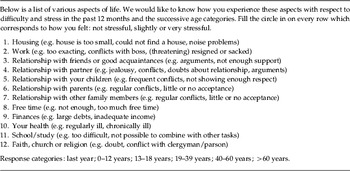
The LDI is a self-report questionnaire intended to measure long-term difficulties (Hendriks et al. Reference Hendriks, Ormel and van de Willige1990). The questionnaire consists of 12 items referring to aspects of life, including housing, work, social relationships, free time, finances, health, school/study and religion (exact item formulations are listed in Appendix A). Respondents indicate how they experienced these aspects with respect to difficulty and stress on a three-point scale: 0 = not stressful, 1 = slightly stressful, 2 = very stressful. This is done for a response category covering the past year and also for each of the following age categories: 0–12, 13–18, 19–39, 40–60 and >60 years. Respondents were instructed not to include the past year when scoring the age categories because this period was covered by a separate response category. Item scores are summed to derive total scores for each response category. Thus, total scores can range from 0 to 24, with higher scores indicating more problems. We also calculated a ‘lifetime LDI score’ by adding the total scores of all age categories that were completed at the time of assessment [maximum = 120 (5 × 24)].
The LTE
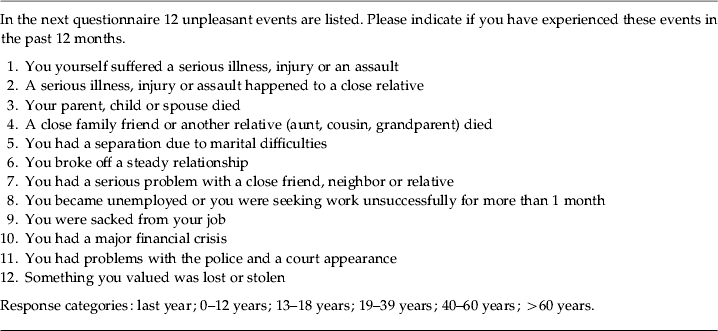
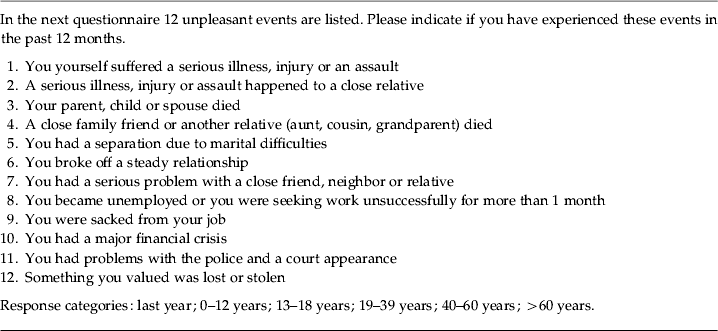
Stressful life events were assessed by means of the Dutch version of the LTE, a 12-item self-report questionnaire (Brugha & Cragg, Reference Brugha and Cragg1990). The LTE comprises 12 major categories of stressful life events that were selected for their established long-term consequences (exact items are listed in Appendix B). The original LTE covers the past 6 months but we used an adjusted version of the LTE with response categories for the past year and for five age categories: 0–12, 13–18, 19–39, 40–60 and >60 years. Respondents were instructed not to include the past year when scoring the age categories because this period was covered by a separate response category. For each response category, participants indicated whether or not each of the 12 different life events occurred (yes/no). The LTE total score for each response category is the sum of the item scores for that category (maximum score = 12). We also calculated a lifetime LTE score by adding the total scores of all age categories that were completed at the time of assessment [maximum = 60 (5 × 12)]. We included an open item for ‘other events’. We checked this open item for events that belonged to one of the 12 life event categories and corrected the data when this was the case.
Perceived life stress
Following Lucini et al. (Reference Lucini, Norbiato, Clerici and Pagani2002), we assessed subjective levels of stress (‘perceived stress’) by means of a Likert scale ranging from 1 (not at all stressful) to 10 (very stressful). This was done for each of the previously mentioned age categories: 0–12, 13–18, 19–39, 40–60 and >60 years. Despite the known complexity of the stress concept, simple, integrated self-assessment of overall stress levels has been proven valuable for clinical studies (Yusuf et al. Reference Yusuf, Hawken, Ounpuu, Dans, Avezum, Lanas, McQueen, Budaj, Pais, Varigos and Lisheng2004).
Psychological distress
Psychological distress was assessed using the Dutch translation of the 12-item General Health Questionnaire (GHQ-12), which is a measure of current psychological distress (Koeter, Reference Koeter1992). Respondents are asked whether they have recently experienced a particular symptom or item of behavior on a four-point scale ranging from ‘less than usual’ to ‘much more than usual’. We calculated a GHQ sum score using the Likert scoring method, adding the full-scale item responses (range 0–36) (Goldberg et al. Reference Goldberg, Gater, Sartorius, Ustun, Piccinelli, Gureje and Rutter1997).
Depression/anxiety
Levels of depression and anxiety were assessed with the Symptom Checklist (SCL-8). The SCL-8 is an abbreviated version of the SCL-25, which consists mainly of items from the depression and anxiety subscales of the SCL-90-R (Jorgensen et al. Reference Jorgensen, Fink and Olesen2000). In this study, items were scored on a five-point Likert scale ranging from 1 (not at all) to 5 (very much). Item scores were recoded (ranging from 0 to 4) and summed to derive the SCL-8 total score (range 0–32).
Neuroticism
Participants completed the Dutch translation of the 12-item neuroticism scale of the Eysenck Personality Questionnaire – Revised Short Scale (EPQ-RSS-N; Sanderman et al. Reference Sanderman, Eysenck and Arrindell1991). The EPQ-RSS-N is composed of 12 questions representing nervousness, emotional instability, feelings of guilt and low self-esteem, in a yes/no format. The EPQ-RSS-N sum score represents the total number of neuroticism symptoms reported.
Statistical analysis
Temporal stability of the LDI and LTE total scores was estimated by computing Pearson's correlation coefficients between the scores at baseline and follow-up. For the different age categories, we selected participants who had completed that age category at both assessment points. For these participants, no new difficulties or events could have emerged in the interval between baseline and follow-up. Therefore, the correlation between the scores for the different age categories at the two assessment points can provide an indication of the stability of the recall or appraisal of past difficulties and events over the study period. The influence of momentary psychological distress on the LDI and LTE scores was examined by regressing the LDI or LTE scores for the different age categories on the GHQ-12 score for each assessment point and saving the respective residuals. We subsequently calculated Pearson's correlation coefficients between these residuals, again only for the participants who completed a particular age category at both assessment points.
The construct validity of the LDI and LTE was evaluated by examining the relationships between these variables and psychological variables at baseline, using Pearson's correlation coefficients, independent-sample t tests, and an ANOVA. Missing data on items of the GHQ-12, SCL-8 and EPQ-RSS-N were imputed according to the method of corrected item mean substitution if at least half of the items were completed (Huisman, Reference Huisman2000). LDI and LTE total scores for each response category were calculated only for participants with complete data for that category.
As the LDI total score, LTE total score, and the scores for perceived stress, depression/anxiety and neuroticism showed skewed distributions, we used the natural logarithms of these scores in the statistical tests on temporal stability and construct validity. Statistical analyses were carried out using PASW Statistics 18 (SPSS Inc., USA). A two-tailed significance level of 5% was used.
Results
Frequency of long-term difficulties and stressful life events
Of the 1094 participants, seven had missing values on all items of the baseline LDI measurement and four had missing values on all items of the baseline LTE measurement. Follow-up LDI measurements were present for 944 (LDI, 87%) and 948 (LTE, 87%) of these participants. Participants whose data were missing at T3 were older, scored higher on measures of psychological distress, depression/anxiety and neuroticism, and were more often female (independent-sample t tests and χ2 tests, p < 0.05). They did not score significantly differently on measures of long-term difficulties and life events at baseline.
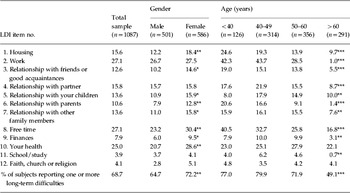
The frequency of endorsement of the different long-term difficulties is presented in Table 1. None of the items had more than 1.7% missing values. In the total sample, 747 participants (68.7%) reported that they had suffered from one or more long-term difficulties in the past year. The difficulties reported most often were in the area of leisure time and work, followed by health. Women reported more difficulties than men, and this difference was significant for most of the items (χ2 tests). The frequency of endorsement also differed considerably by age; older participants generally reported fewer difficulties, not only in expected areas such as school/study and relationship with parents but also in many of the other areas. The only items for which no age differences existed were health and religion.
Frequency of endorsement (%) of long-term difficulties for ‘past year’, by gender and age at time of assessment

LDI, Long-term Difficulties Inventory. Proportion of participants endorsing each item (dichotomized responses: 0 = not stressful, 1 = slightly or very stressful).
* p < 0.05, ** p < 0.01, *** p < 0.001.
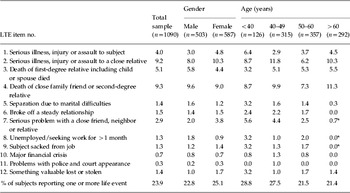
The frequency of endorsement of the different life events is presented in Table 2. None of the items had more than 0.7% missing values. In the total sample, 260 participants (23.9%) reported that they had experienced one or more life events in the past year. The life events reported most often were the death of a close family friend or second-degree relative (9.3%) and serious illness, injury or assault to a close relative (9.2%). Women did not report significantly more life events than men (χ2 tests). The frequency of endorsement differed by age for only some of the items; fewer older participants reported a serious problem with a close friend, neighbor or relative. The frequency with which people reported being unemployed/seeking work for more than 1 month and being fired from their job also differed by age: these events were reported most often by the youngest participants whereas none of the participants in the oldest age category reported them. The total percentage of life events reported tended to decrease with increasing age, although the difference between the categories did not reach significance [χ2(3) = 5.92, p = 0.116].
Frequency of endorsement (%) of stressful life events for ‘last year’, by gender and age at time of assessment

LTE, List of Threatening Experiences. Proportion of participants endorsing each item.
* p < 0.05.
Long-term difficulties and stressful life events total scores
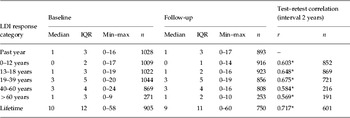
Table 3 presents the LDI total scores for the ‘past year’ category and for the different age categories of the questionnaire, at baseline and at follow-up. Because the LDI total scores were skewed to the right, we present the median scores with interquartile ranges (IQRs). The median amount of long-term difficulties that subjects experienced was generally low, although considerable variation existed between subjects and between age categories. The highest amount of difficulties was reported for the ‘19–39’ and ‘40–60’ age categories. The bottom row of the table shows the lifetime LDI score, which is the sum of the LDI scores for all completed age categories. The median lifetime amount of long-term difficulties was 10 and the maximum was 60.
LDI total scores at baseline and follow-up

LDI, Long-term Difficulties Inventory; IQR, interquartile range.
n varies because of missing data and because not all participants reached all age categories at the time of assessment. Test–retest correlations (Pearson's r correlation coefficients between natural log-transformed LDI scores) were computed only for participants who completed a particular age category at both assessment points. For the highest age category, subjects aged >60 years were selected.
* All p values <0.001.
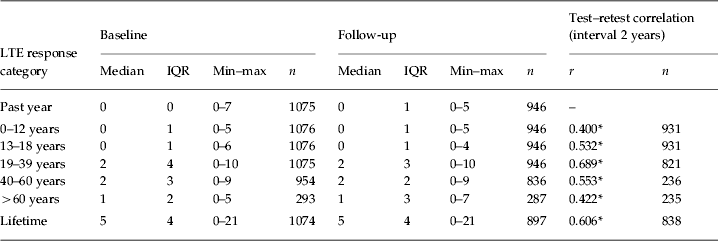
Table 4 presents the total scores for the life events as assessed with the LTE. The LTE total score is the total number of different events reported, computed separately for each response category (past year and age categories 0–12, 13–18, 19–39, 40–60, >60 years). The median LTE score was generally low, although considerable variation existed between subjects and between age categories. The highest LTE score was reported for the ‘19–39’ and ‘40–60’ age categories. Scores ranged from 0 to 10 events. The bottom row of the table shows the lifetime LTE score, which is the sum of the LTE scores for all completed age categories. The median lifetime LTE score was five and the maximum lifetime LTE score was 21.
LTE total scores at baseline and follow-up
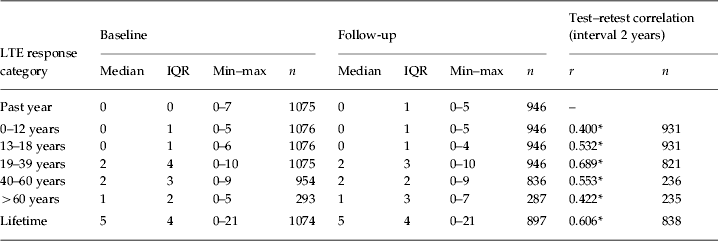
LTE, List of Threatening Experiences; IQR, interquartile range.
n varies because of missing data and because not all participants reached all age categories at the time of assessment. Test–retest correlations (Pearson's r correlation coefficients between natural log-transformed LTE scores) were computed only for participants who completed a particular age category at both assessment points. For the highest age category, subjects aged >60 years were selected.
* All p values <0.001.
Temporal stability of the LDI and LTE scores
The median interval between the baseline and follow-up measurements was 106 weeks (IQR = 100–112). LDI scores at follow-up were lower than at baseline (paired t tests on natural log-transformed LDI scores, p <0.05 for all response categories except the ‘ > 60’ category). LTE scores at follow-up were also lower than at baseline for the lowest age categories (paired t tests on natural log-transformed LTE scores; p < 0.05) and higher for the ‘ > 60’ category (p < 0.05). The difference between the lifetime LTE score at baseline and follow-up was not significant.
We also examined the rank-order stability of the LDI scores by calculating Pearson's correlation coefficients between the LDI scores at baseline and at follow-up. The test–retest correlations for the different age categories were computed by selecting the participants who had completed the relevant age category at both assessment points.
Table 3 shows that these correlations were large for the LDI: between 0.569 and 0.675. The test–retest correlation for the lifetime LDI score was also large: 0.717. Table 4 shows that these correlations ranged from 0.400 to 0.689 for the LTE, which can be considered medium to large according to the guidelines provided by Cohen (Reference Cohen1988). The test–retest correlation for the lifetime LTE score was large: 0.606. All correlations were highly significant.
We examined the extent to which these test–retest correlations were deflated by differences in momentary psychological distress at the different assessment points. Adjusting for momentary psychological distress did not substantially affect test–retest correlation estimates: correlations were slightly lower but still large in size for the LDI (0.454 to 0.640), whereas correlations for the LTE were almost identical to those in Table 4.
Relationship between long-term difficulties, stressful life events and perceived stress
As shown in Table 5, the correlations between long-term difficulties and life events were all significant, except for the highest age category (>60). The size of these relationships, according to the guidelines provided by Cohen (Reference Cohen1988), was medium to large. The correlation between the LDI and LTE scores for the ‘past year’ category was also significant, but its size was small. The correlation between the lifetime LDI and LTE scores was large (r = 0.486, p < 0.001).
Correlations between long-term difficulties, life events and perceived stress

LDI, Long-term Difficulties Inventory; LTE, List of Threatening Experiences.
Pearson's r correlation coefficients. All variables are natural log-transformed.
Perceived stress was not assessed for the ‘past year’ category.
* All p values <0.001.
The LDI scores were also largely correlated with subjective levels of perceived stress for all age categories. These correlations were all highly significant. The correlations between life events and perceived stress were of medium size for most age categories, and lower than the correlations between long-term difficulties and perceived stress.
Relationship between long-term difficulties and psychological variables
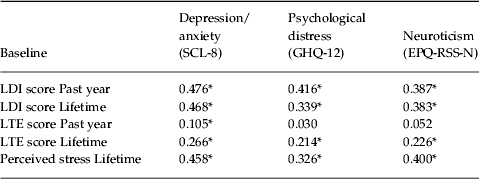
We expected that individuals reporting more long-term difficulties and more life events would have more psychological complaints and more neurotic personalities. For the LDI, all correlations were highly significant and in the expected direction: the correlations were large for depression/anxiety, psychological distress and neuroticism. These expectations were also confirmed for the lifetime LTE score but not for the ‘past year’ score: only the SCL-8 showed a significant correlation with the LTE score for the past year (see Table 6). The correlations between the lifetime LTE scores and the psychological variables were all significant and small to medium in size.
Pearson's correlations between long-term difficulties, life events and psychological variables
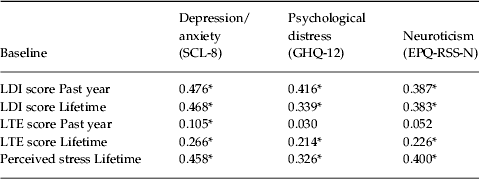
LDI, Long-term Difficulties Inventory; LTE, List of Threatening Experiences; SCL-8, Symptoms Check List; GHQ-12, General Health Questionnaire; EPQ-RSS-N, neuroticism scale of the Eysenck Personality Questionnaire – Revised Short Scale.
n varies because of missing data (minimum 859, maximum 1075). LDI, LTE, perceived stress, SCL-8 and EPQ scores are natural log-transformed.
* All p values <0.001.
We also present the correlations between the psychological variables and subjective levels of stress over the lifetime as measured with perceived stress (last row of Table 6). These correlations were very similar to those obtained with the LDI: they were also positive, medium to large in size, and highly significant.
Discussion
This study examined the psychometric properties of the LTE and the LDI, for both the past year and the subject's lifetime. The stability of the retrospective reporting of long-term difficulties and life events was satisfactory. The construct validity of these lists is indicated by their positive associations with psychological distress, mental health problems and neuroticism.
A major strength of this study was the sample: we used a large population sample with a wide age range whereas previous studies have used small, selected populations. This is especially important because these questionnaires are used increasingly in large epidemiological population cohorts. We measured the retrospectively reported stressors twice, which allowed us to estimate the stability of the scores. In addition, our study captured many aspects of validity, including the associations with other stress measures, personality and psychological distress.
One drawback of this study is that it lacks truly objective measures of life events or long-term difficulties, largely because truly objective measures only exist for some of the items (such as separation) but are impossible to define for most of them. The second drawback of this study is that, although the design is longitudinal, the stress measures are based on retrospective reports, covering an extensive time lag, especially for the younger age categories.
The stability of retrospective reports of life events and long-term difficulties was assessed by calculating the test–retest correlation between the scores at baseline and follow-up. Given the more subjective content of the LDI, the test–retest correlations would be expected to be higher for the LTE, but our results show the opposite. The factors that influence the retrospective reports of life events and long-term difficulties remain unknown. Recall bias may be due to momentary psychological distress at the time of the retrospective assessment of life events and long-term difficulties, but we did not find evidence of a substantial effect of momentary psychological distress on the test–retest correlation of the LDI or LTE scores. The coefficients of 0.7 for the lifetime LDI and 0.6 for the lifetime LTE scores are satisfactory, especially given the 2-year interval between the measurements. These coefficients indicate a reasonable stability in the retrospective reporting of long-term difficulties and life events. They also indicate the degree to which the scores on the questionnaires contain error variance, which is important for the interpretation of the effect sizes obtained using these lifetime scores as predictors of health-related outcomes.
Older individuals in our sample reported fewer long-term difficulties and life events than younger individuals. Several effects that may play a role in the described effect of age can be hypothesized. First, a cohort effect: younger participants in our cohort may have a lower threshold than older participants when rating an aspect of their life as difficult, perhaps as a result of social comparison or a different mentality. Second, a selection effect: if the experience of long-term difficulties or life events is associated with an increased risk of ill-health, it might be associated with mortality, and the older participants in the sample are those with the lowest stress levels. Third, a recall effect: older participants may have forgotten certain long-term difficulties and life events. Fourth, an appraisal effect: older participants might rate some of the long-term difficulties as less stressful in retrospect (i.e. they become milder). A recall effect or change in appraisal of past long-term difficulties might also explain why LDI scores at follow-up were lower than at baseline for all age categories except ‘ > 60’.
As expected, the scores on life events and long-term difficulties for the past year and for the lifetime all correlated, with the highest correlations found in the age categories covering adulthood. Perceived stress had a stronger correlation with long-term difficulties than with life events, as can be expected because of the more subjective character of the former. Another explanation for this difference may be that only the presence or absence of life events is assessed, so there is no information on the number of times a specific life event was experienced, or the impact of the events. In a pilot study we attempted to assess the number of times a specific life event was experienced within an age category, but found that this resulted in a very complex questionnaire that was too difficult for many participants to complete. Another explanation might be that stressors in particular contribute to subjectively experienced stress when they are not incidental but persist over longer time periods, which would be consistent with the evidence mentioned in the introduction about the relevance of the chronicity of a stressor in determining its impact.
Content validity is further indicated by the finding that participants reporting a higher number of long-term difficulties in the past year and in their lifetimes had more mental health problems and more neurotic personalities. The lifetime score of life events showed a comparable pattern, although the correlations were typically smaller, whereas the score for the past year was only significantly associated with anxiety/depression and not with neuroticism or psychological distress. The fact that life events in the past year are more related to state than to trait measures would fit with content validity. Life events probably do contribute to scores on personality questionnaires over the course of a lifetime (Ormel et al. Reference Ormel, Rosmalen and Farmer2004), but an effect on state measures of psychopathology is more likely in the short term. The above suggestion that stressors may have the most impact when they are chronic may also be one of the explanations for the fact that we found higher correlations between psychological measures and LDI scores than with LTE scores.
We conclude from this study of a large population-based sample that the LDI and LTE have sufficient validity to include them in major epidemiological cohort studies. This is especially so with respect to the scores for the ‘past year’ category, although the lifetime score also seems to be a valid measure of stress. This latter measure may be especially relevant in gaining a lifetime perspective on stress, given the presumed relevance of stress accumulation to disease. Different cohort studies include various measures of stress, hampering their comparison and the pooling of data for analyses of gene–environment interactions. The LTE and LDI might function as gold standards, enabling harmonization of the cohorts with respect to measures of stress.
Declaration of Interest
None.
Appendix A: The Long-term Difficulties Inventory (LDI)

Appendix B: The List of Threatening Events (LTE)