Introduction
Pension reform is one of the most prominent issues for debate in international policy and academic circles. As populations age the ratio of those of ‘working age’ to retirees declines. As state pensions largely operate on a ‘pay-as-you-go’ (PAYG) basis, with people in employment funding the pensions of those in retirement, this raises concerns about the ability of countries to pay for the pensions of future retirees. Pierson (Reference Pierson and Pierson2001: 411) further argues that we may now be entering a situation of permanent austerity in developed countries, caused by population ageing and declining economic growth, as less productive service employment replaces manufacturing. Whether or not economic austerity is permanent remains to be seen; GDP growth per capita has tended to fluctuate or increase rather than decline in the English-speaking world – the subject of this article – between the 1970s and 2000 (Organisation for Economic Co-operation and Development (OECD), 2003: 32–3). Nevertheless, governments across the Organisation for Economic Co-operation and Development have recognised the longer-term costs of population ageing with a series of pension reforms in the 2000s (Organisation for Economic Co-operation and Development, 2009: 80–4).
Despite these common demographic pressures, it would be wrong to assume that country responses will be identical. Some scholars have argued that countries with different policy infrastructures are likely to respond differently (Esping-Andersen, Reference Esping-Andersen1999; Pierson, Reference Pierson and Pierson2001; Castles, Reference Castles2004), and recent work by Aysan and Beaujot (Reference Aysan and Beaujot2009) appears to confirm this in the field of pensions. A key starting point for these arguments is the work of Esping-Andersen (Reference Esping-Andersen1990), which argued that welfare states in industrial countries have historically clustered around three ‘ideal types’. Welfare states in general are said to ‘de-commodify’: they reduce individuals’ reliance on the market − and the need to sell their labour as a commodity − for meeting their welfare needs. ‘Liberal’ welfare states, found in English-speaking countries and Japan, are ‘weakly de-commodifying’: cash benefits are residual, set at very low levels, typically means-tested and/or flat-rate, and allow plenty of space for private provision to develop. Esping-Andersen (Reference Esping-Andersen1990: 79–104) considered pensions particularly consistent with these liberal principles in the UK, USA, New Zealand and Canada. In contrast, benefits in ‘social democratic’ welfare states in Scandinavian countries were said to be extensive, universal, solidaristic and strongly ‘de-commodifying’. Between these two extremes were ‘Conservative’ welfare states in continental Europe, which operated under principles of ‘status maintenance’: social insurance benefits and pensions replaced previous earnings at high levels, but lacked the redistributive nature of social democratic countries. In later work, Esping-Andersen (Reference Esping-Andersen1999) continued to make this distinction between Liberal, Conservative and Social Democratic welfare states.Footnote 1
Assuming that countries designated as belonging to a welfare state type have similar policies to start with, we would expect the reform paths to be similar for a number of reasons. First, ‘path dependency’ is said to be a key factor shaping reform (Pierson, Reference Pierson1994, Reference Myles, Pierson and Pierson2001). The choices available to policy reformers are said to be strongly shaped by past policies; for example, it might be politically difficult to shift the balance to private provision if employees have high state pension expectations because of generous state pensions received by current retirees. Second, countries might continue to follow similar paths where they belong to the same ‘family of nations’, sharing historical, linguistic and institutional roots as do ‘liberal’ countries (Castles, Reference Castles1993); this makes ‘policy transfer’, the process of learning from other countries more straightforward (Hudson and Lowe, Reference Hudson and Lowe2004).
Pierson (Reference Pierson and Pierson2001) is of relevance here because he relates welfare reform to Esping Andersen's (1990) typology. Pierson argues that all three types of welfare state will seek a strategy of cost-containment in reforming welfare policy in the context of permanent austerity. Pressures to contain costs will be strongest in social democratic and conservative countries and weakest in liberal countries where spending is anyway lower. Different welfare state types will complement this with other approaches which will influence the reform outcomes differently:
• Social democratic welfare states will face ‘recalibration through rationalisation’: seeking to achieve established (egalitarian) goals in new ways that contain costs.
• Conservative welfare states will face ‘recalibration through updating’, reforming policies so they address groups and contexts that were ignored or less significant during expansion.
• Liberal welfare states will follow the previous path of further ‘re-commodification’, making individuals even more reliant on the market for securing their needs, by tightening up eligibility conditions and reducing benefit levels.
This article therefore explores the extent to which a similar path of re-commodification and cost-containment has occurred in pension reform in Anglo-Saxon Countries in the 2000s. A recent article by Aysan and Beaujot (Reference Aysan and Beaujot2009: 702) is one of the few to ‘seek to determine the extent to which pension reform follows a path associated with a particular welfare regime’; it concludes that liberal ‘countries have followed their traditional path’ of re-commodification (ibid.: 711). The evidence for this rests primarily with the spread of private savings (although it does not assess whether this was re-commodification in the sense that it replaced secure state provision) and increases in state pension ages (which have not been confined to Anglo-Saxon countries). Instead, we argue that state pension provision differed considerably across these countries from the outset, and consequently the nature of reform also differed.
The context of retirement reform: how alike were Anglo-Saxon state pensions?
The reforms that resulted in the UK Pensions Acts of 2007 and 2008 provide a useful window into reforms in other Anglo-Saxon countries because there was considerable deliberation about what the UK could learn from these countries (see, for example, Pensions Commission, 2004: 58–61, 2005: 102–9). In the UK, there was a near-consensus that the low level of state pension provision was problematic because it resulted in a central role for means-tested benefits. To draw on Palier (Reference Palier2007), pension reform was eased by a shared diagnosis that challenged previous policy instruments, in this case an over-reliance on means-tested benefits. The main political parties and a wide range of business groups were concerned that benefits were undermining saving (Bridgen and Meyer, Reference Bridgen, Meyer, Meyer, Bridgen and Riedmuller2007: 67); Trade Unions, social researchers and NGOs were concerned that failure to claim these benefits resulted in poverty, especially for women. The Pensions Commission, comprising a former industrialist, a trade unionist and a social scientist, was therefore established in 2003.
The need for reform was strongly shaped by the legacy of previous policies. The UK basic state pension had been introduced in 1948 as a flat-rate pension but, contrary to the intentions of the Beveridge Report, below subsistence levels (Williamson and Pampel, Reference Williamson and Pampel1993). This, combined with the contributory requirements for getting a full pension (forty-four years for men, thirty-nine for women), meant that people with no other source of income and/or broken career records needed supplementary means-tested benefits.Footnote 2 The level of this basic pension was further undermined when the basis for uprating shifted from increases in average earnings to prices from 1980 (Bozio et al., Reference Bozio, Crawford and Tetlow2010: 13). Without doubt, the numbers receiving means-tested income assistance (called ‘pension credit’ from 2003) would have been higher had it not been for the introduction of the state earnings-related pension in 1978 and its successor, the ‘state second pension’ in 2002. However, it was only to provide a very modest pension at best (representing a replacement rate of around a fifth of earnings for a narrow band of earnings in the mid 2000s). As a result, in the mid 2000s around half of pensioner households were entitled to pensions credit (Department for Work and Pensions, 2008), although the proportion actually receiving a means-tested benefit was below this, at around a third (Department for Work and Pensions, 2007: 35).Footnote 3
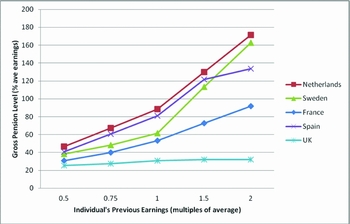
The first Pensions Commission report demonstrated that UK state pension levels were much lower than in selected ‘earnings-related’ systems (Pensions Commission, 2004: 58–9); Figure 1 replicates this data for 2006, just before the Pensions Act 2007. Following the logic of path dependency, the possibility of the UK changing direction and adopting similarly generous earnings-related pensions was ruled out in the second Pensions Commission report. Indeed, the Pensions Commission's decision to confine its proposals to a ‘range for debate’ of between 7.5 and 8 per cent of GDP spending on state pensions would limit such options. This range was considered ‘politically acceptable’ (Pensions Commission, 2005: 194), but was considerably below spending levels in countries with ‘earnings-related systems’ (ibid: 119).
Gross mandatory pension levels in 2006: the UK versus the ‘earnings-related’ systems
Notes: 1 The figure shows 2006 pension levels based on a full contribution record, if required (see Table 1). 2 Earnings-related pensions in the Netherlands are not mandatory, but near-universal in covering over 90 per cent of employees (OECD, 2009: 233).
Source: Compiled from OECD (2009).

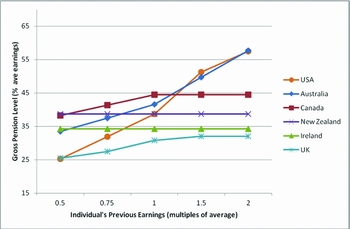
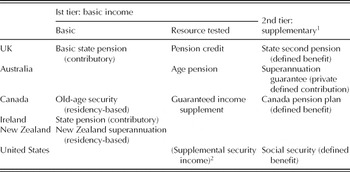
Figure 2 shows pension entitlements at different levels of earnings for English-speaking countries examined in the first Pensions Commission report. Pension levels were higher overall than in the UK for all other countries, but not as high as in ‘earnings-related systems’. This suggests that these countries might offer some feasible policy solutions. Nevertheless, pension levels still differed in a non-trivial fashion across countries, and more than we might expect from ‘liberal’ countries. Someone on half average earnings throughout their career would be entitled to a pension of only 25 per cent of average economy-wide earnings in the UK and US, compared with around 40 per cent in New Zealand and Canada. To understand why, it is useful to take into account the different combinations of flat-rate basic and supplementary pensions provided by countries (see Table 1). Supplementary pensions were earnings-related defined-benefit pensions in all countries, except for Australia where defined contribution pension levels were dependent on investment returns. In the UK, the low level of pensions reflected a weak basic state pension and a very modest contribution from the earnings-related state second pension. In contrast, in the US the state pension rises more dramatically for higher earners, reflecting the earnings-related nature of provision (see below). All other countries managed to provide a pension of at least a third of average earnings, which reflects a more generous ‘first-tier’ provision of basic and resource-tested pensions.
Gross mandatory pension levels in 2006:1 the UK versus other Anglo-Saxon countries
Note: 1 The figure shows 2006 pension levels based on a full contribution record, if required (see Table 1).
Source: Compiled from OECD (2009).

State mandated pensions in Anglo Saxon countries: the mid 2000s

Notes: 1 all 2nd-tier pensions are contributory.
2 SSI was very marginalised and cannot be considered a significant part of the US pensions system.
Source: OECD (2009).
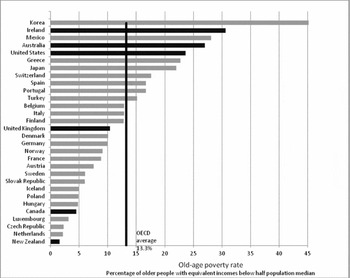
It should be noted that Figure 2 gives a somewhat optimistic impression for countries offering contributory rather than residency-based pensions (see Table 1). Contributory pensions are dependent on the contributions made, even when they are ‘flat-rate’. Women, in particular, often fail to make sufficient contributions due to family career breaks and receive a partial pension as a result, either on the basis of their own employment or by virtue of being married. Figure 3 shows that poverty levels, defined as having less than 50 per cent of median equivalised household disposable income, differed significantly between Anglo-Saxon countries for people over sixty-five in the mid 2000s. Poverty as measured in this way was very low in two countries: Canada and New Zealand. In these countries state pension provision was underpinned by residency-based pensions received by men and women. Ireland, in contrast, had only a modest contributory pension, so those with broken career records and no supplementary provision ended up in poverty. Of course, poverty rates are influenced by the culmination of pension provision over time, and the high rates of poverty amongst Australians was likely to reflect to a degree the fairly recent introduction of supplementary pensions (in 1992). The United States had high levels of poverty because it had an earnings-related pension with few credits for periods of inactivity, no compensatory basic pension, unlike its counterpart, Canada, and limited means-tested provision (see Lain, Reference Lain2011, and below). The UK's poverty level was below that of the USA, despite similar pension levels for those on half average earnings (Figure 2), because of a more generous and accessible system of means-tested benefits (see Lain, Reference Lain2009).
Poverty rates amongst over 65s in the mid-2000s: OECD countries Source: OECD (2009: 64).

From this brief overview from the mid 2000s, we can see that Anglo-Saxon countries started from quite different positions, and would therefore be unlikely to follow exactly the same pension reform paths. Indeed, in contrast to Aysan and Beaujot's (2009) argument of continued re-commodification, Myles and Pierson (Reference Myles, Pierson and Pierson2001) argue that in the field of pensions reforms will differ between countries that are otherwise labelled ‘Liberal’. Countries such as the USA and Canada that introduced pay-as-you-go earnings-related pensions before the late 1970s will find retrenchment difficult because these schemes are so well established. Countries failing to introduce such pensions during this period have had a broader range of options. The UK introduced the state earnings-related pension late (in 1978), and its ‘immaturity’ made it relatively easy to undermine from the 1980s onwards. Private pensions were promoted as an alternative through tax incentives (Myles and Pierson, Reference Myles, Pierson and Pierson2001), and its generosity reduced for people retiring after 1999 (Bozio et al., Reference Bozio, Crawford and Tetlow2010: 35). Likewise, countries failing to introduce supplementary pensions by the early 2000s, such as New Zealand, had fewer constraints on the reform process. It stands to reason that in Canada and the USA reformers would be more likely to focus on cost-containment. In the UK and New Zealand, opportunities for re-commodification through retrenchment would be greater. We therefore explore pension reform in both sets of countries.
Pension reform in New Zealand and the UK: re-commodification?
State pension reforms in recent decades in the UK and New Zealand demonstrate interesting parallels. Both countries have sought to promote private savings in the context of a general decline in defined-benefit occupational pensions, albeit from a higher initial level in the UK. However, in neither country can this be said to represent re-commodification because it did not replace generous secure state provision. Indeed, basic state pensions were strengthened in New Zealand (in the late 1990s) and in the UK (in the 2000s). ‘New Zealand superannuation’ was introduced in 1993, but it builds on a long and influential history of providing flat-rate pensions dating back to 1898 (Overbye, Reference Overbye1997). Its predecessor ‘National superannuation’ was introduced in 1977 as a fairly generous residency-based flat-rate pension with a surcharge from 1985 that clawed back the pension from higher earners (St John and Gran, Reference St John, Gran, Ginn, Street and Arber2001). This acted as a mild disincentive to save as some people might consume savings prior to retirement to avoid the surcharge (ibid: 209–210). In 1998 the surcharge was dropped as a result of a government coalition agreement. New Zealand Superannuation therefore became a universal pension; it was pegged at 65–72.5 per cent of average earnings for a couple, following an accord between the three major political parties.
The prospect of a ‘citizens pension’ above the level of means-tested income benefits, similar to universal New Zealand superannuation, was attractive to the Pensions Commission as a replacement for the basic and second pension (2005: 212–13). However, it was felt this option would result in a large and immediate increase in pension spending, and that much of the benefit would flow to higher earners (ibid.). Instead, the Pensions Commission wanted to gradually arrive at the situation of a more generous and universal flat-rate state pension system. This would reduce means testing over time compared with projected levels (ibid.: 10). Accruals to the basic state pension would become residency-based, and increases would be pegged to average earnings rather than prices. This would expand the coverage of people receiving the ‘full pension’ and halt its long-term decline. The state second pension would also become flat-rate over time, although it would remain contributions-based, completing the two ‘tiers’ of flat-rate state pension provision. The state second pension had replaced the state earnings-related pension in 2002; it was aimed at providing more generous pension incomes for those on lower earnings (Bozio et al., Reference Bozio, Crawford and Tetlow2010: 38). Over time, this pension was to become flat-rate; the Pensions Commission proposed a speeding up of this process so that it was flat-rate by 2030. Finally, the Pensions Commission abolished the right to opt out of the second state pension unless the individual had a defined-benefit occupational pension, expanding the numbers receiving both state pension elements.
The main thrust of the Pensions Commission's proposals were accepted in the Pensions Act 2007, although the basic state pension accruals were not to become residency-based. Instead, the number of contribution years required for a full pension were to be reduced to thirty (with allowances for caring responsibilities) (Price, Reference Price2007). This, it was hoped, would lead to ‘near-universality’ in state pension provision. The reforms, whilst welcomed by many groups, were not without critics. Price (Reference Price2007) argued that it will take a long time for modest benefits for women to materialise, and that a citizen's pension would more effectively address the problem of years spent by women doing part-time work and not accruing pensions. Furthermore, although the reforms will reduce the need for means-tested benefits, government projections have suggested that a third will still be entitled to pension credit in 2050 (Department for Work and Pensions, 2008: 21, 2011: 22). Conscious of these criticisms, the Coalition government has proposed in a green paper moving to a single-tier flat-rate pension above pension credit levels (Department for Work and Pensions, 2011). This would bring UK state pension provision much closer to the New Zealand model. This enhancement of the state pension could have quite a significant impact for many pensioners retiring in future, particularly women, and would arguably encourage saving. However, unlike New Zealand a full pension will require thirty years of contributions and people will have to wait longer to receive it. The UK state pension age is to rise to sixty-eight, reaching sixty-six as soon as 2020; in New Zealand there are no plans to raise the state pension age above sixty-five.
Some have argued that the promotion of private saving rather than enhancement of earnings-related provision in the UK is undesirable because investment returns are unpredictable, as evidenced by the financial crisis (Waine, Reference Waine2009). However, in both countries such an approach in the 2000s represented a continuation of 1990s policy. In New Zealand, the Taskforce on Private Provision for Retirement was established in 1991. In the UK, Labour Prime Minister Tony Blair committed early in his premiership to increasing the share of retirement incomes from private sources to 60 per cent (Rowlingson, Reference Rowlingson2002: 628). The UK government's attempt to promote private saving among low and medium earners through personal stakeholder pensions had, however, been a failure, as few chose to invest in them (Waine, Reference Waine2009). The UK Pensions Commission therefore looked to defined contribution savings schemes in other countries where individuals were automatically enrolled, including New Zealand and Australia. These showed greater promise of widespread coverage than voluntary saving via, for example, equivalent 401k schemes in the United States. One possible ‘compulsory’ model was provided by Australia's superannuation guarantee, which was introduced in 1992 and mandated all employers to contribute 9 per cent of an employee's earnings into a private pension. However, the UK Pensions Commission anticipated an employee contribution, and thought that if individuals were forced to save it would be a seen as a tax and would reduce public willingness to support flat-rate state pension provision (Pensions Commission, 2005: 3). New Zealand's planned defined contribution Kiwisaver offered a solution to this problem through ‘auto-enrolment’, people would be enrolled onto a savings scheme but with the right to opt out (see the discussion in ibid: 108). Kiwisaver was introduced in 2007, after the Pensions Commission had reported; however, the plans offered the possibility of dealing with the problem of savings inertia and of greatly expanding private coverage. The default contribution rate was to be 4 per cent of average earnings, split between the employer and employee. The Pensions Commission recommended the creation of a ‘National Pension Saving Scheme’ (NPSS), later renamed ‘Personal Accounts’ and then the ‘National Employee Savings Trust’ (NEST). Employees will contribute 4 per cent of earnings, employers 3 per cent and the government 1 per cent (Waine, Reference Waine2009). Employees will be automatically enrolled if the employer does not have an approved occupational pension, but will be able to opt out. The scheme differs in a number of respects from Kiwisaver, not least the attempt to reduce costs through a central administration (Rashbrooke, Reference Rashbrooke2009: 99). Nevertheless, in terms of general principles the schemes are similar (Organisation for Economic Co-operation and Development, 2011: 11). NEST is currently scheduled to be rolled out across employers between 2012 and 2017, starting with the largest employers.
Overall, then, pension reform in the 2000s cannot be described as re-commodification; the UK in the 2000s and, to a lesser degree, New Zealand in the 1990s actually enhanced their state pensions in order to promote saving. Private saving was promoted through Kiwisaver and NEST, through the innovative use of auto-enrolment, but not as a replacement for more secure state provision. Reforms therefore represented recalibration through rationalisation, using new methods to advance established goals, in this case the promotion of private saving.
The USA and Canada: cost-containment?
Although Pierson (Reference Pierson and Pierson2001) links the USA and Canada together because of their established PAYG earnings-related pensions, their pensions systems differ considerably because of the historical route they have taken. Canada's pension system developed out of the same ‘social assistance’ tradition as the UK and New Zealand being concerned with addressing poverty as a key pensions aim (Overbye, Reference Overbye1997). Unlike its counterparts, Canada had supplemented the universal flat-rate pension (old age security) with the earnings-related Canada pension plan by the end of the 1960s (Béland and Myles, Reference Béland, Myles, Bonoli and Shinkawa2005: 252). It represented a ‘small scale version of the traditional Swedish design’, with middle and upper level earners supplementing their incomes through private pensions (ibid.). Social policy in Canada has been subject to some retrenchment (Lightman and Riches, Reference Lightman, Riches, Alcock and Craig2009: 53); however, as Béland and Myles point out, the pensions model has proved remarkably resilient over the decades. An income test for old age security introduced in 1989 to claw back benefits from higher earners was perhaps the most significant change, but this only affected around 5 per cent of the richest seniors (Béland and Myles, Reference Béland, Myles, Bonoli and Shinkawa2005: 259). This could be considered a form of cost-containment, albeit a modest one. Later attempts to target OAS payments to poorer families at the expense of the middle classes were shelved in 1998 because the proposals lacked public support (Lightman and Riches, Reference Lightman, Riches, Alcock and Craig2009: 53).
Reforms to the earnings-related Canada pension plan can be viewed as a form of recalibration through rationalisation: attempting to meet established goals through new means. Béland and Myles (Reference Béland, Myles, Bonoli and Shinkawa2005: 253) argue that in the context of concern about sustainability:
contribution rates were raised to create a surplus to be invested in equities markets with future revenues used to finance future benefits . . . maintaining [Canada pension plan] benefit levels while smoothing out the effects of demographic change on contribution rates across successive cohorts of workers.
There were no plans to raise the Canadian state pension age above sixty-five, although at the time of writing it looks likely that the age of the old age state pension will rise gradually to sixty-seven (Curry and Chase, Reference Curry and Chase2012).
In the USA, first impressions suggest that little has changed, beyond some cost-containment measures, as we would expect. Weaver (Reference Weaver, Bonoli and Shinkawa2005: 232) argues that ‘it has enacted no major changes to the social security programme since . . .1983’ (see Organisation for Economic Co-operation and Development, 2009: 94, for the period after 2004). Attempts at cost-containment have involved an increase in the ‘normal’ state pension age from sixty-five to sixty-seven between 2003 and 2027. More fundamental reforms have also been mooted by previous Republican administrations, including attempts to shift individuals to private savings plans from social security (Hacker, Reference Hacker2006). Harrington Meyer (forthcoming) also argues that contribution holidays during the recession may undermine social security long term. However, up until the present time at least, social security has remained relatively unchanged because of the difficulties of reforming an established, popular programme (Weaver, Reference Weaver, Bonoli and Shinkawa2005).
If we look to the poorest, however, this group have faced a considerable degree of re-commodification via changes to their retirement incomes. To understand why this would happen, we need to understand why social security has come to be seen as an earned entitlement whilst means-tested benefits are unearned and therefore vulnerable to retrenchment. Earnings-related social security was introduced in 1935 as a result of the dire consequences of the 1929 Wall Street Crash (Williamson and Pampel, Reference Williamson and Pampel1993: 107). As Rimlinger (Reference Rimlinger1971: 229) makes clear, ‘Congress [wanted] forms of protection that were consistent with the dominant values of self help and rewards related to individual effort.’ Social security met this requirement by mimicking private occupational pensions by linking payments directly to earnings and work history. Later social security reforms led to some redistributive alterations, most notably a higher replacement rate for lower bands of earnings. Nevertheless, without a basic or minimum state pension it fails to provide adequate pensions to a significant share of older people, particularly women, blacks and Hispanics (Harrington Meyer and Herd, 2007).
Means-tested supplementary security income was introduced in 1974, to bring social assistance, then provided at the state level, under control and prevent it from undermining the ‘earned’ social security pension (Cates, Reference Cates1983). As an ‘unearned’ benefit, it lacked the support of a powerful base of middle-class recipients (Pampel, Reference Pampel1998). Benefit levels are very low, only ‘guaranteeing’ an income of around a fifth of average earnings for a single person (Lain, Reference Lain2011). Furthermore, capital eligibility conditions have become much more difficult to reach over time. It has therefore become what Elder and Powers (Reference Elder and Powers2006) call the ‘incredible shrinking programme’; by the early 2000s, only around one in twenty received the benefit (Lain, Reference Lain2009) despite poverty levels of 25 per cent (Figure 3). This retrenchment was less to do with reforms per se, but instead reflected a lack of political will to maintain eligibility criteria in real terms. The allowable assets level has remained at $2,000 since 1989 and experienced an overall decline of 63 per cent in real terms between 1974 and 2002 (Elder and Powers, Reference Elder and Powers2006: 343); its value has obviously continued to decline further in the following ten years. This is in contrast to the UK, where savings restrictions on eligibility for pension credit were actually lowered during the 2000s.Footnote 4 Lain (Reference Lain2009) has argued that the decline in support for the poorest older people in the US must be viewed in the context of attempts to make people more financially responsible for their retirement timing. Key to this development was the abolition of mandatory retirement under the Reagan Administration to enable those with inadequate retirement incomes to continue working. It should be noted that a reduction in support for the poorest was not confined to older people in the US, and although Canadian welfare state was subject to retrenchment, the consequences for the poorest have been less severe in general (Myles, Reference Myles1998).
Discussion and conclusion
Since Esping-Andersen (Reference Esping-Andersen1990), comparative research has often assumed that Anglo-Saxon welfare states will follow the same liberal, residual path. In the field of pensions, the analysis in this article suggests this is somewhat simplistic. They started in different places in the 2000s, as evidenced by the differing poverty rates, and consequently followed different reform paths. In making sense of these changes, the distinction made by Pierson (Reference Pierson and Pierson2001) between re-commodification, cost-containment and recalibration is very useful. However, our analysis suggests these paths are often played out in ways under-appreciated by comparative research, and we found little evidence of uniform re-commodification in Anglo-Saxon countries as suggested by Aysan and Beaujot (Reference Aysan and Beaujot2009).
In two of the countries reviewed here, we might instead expect retrenchment to be rather difficult and the emphasis to rest on modest cost-containment: Canada and the United States (Myles and Pierson, Reference Myles, Pierson and Pierson2001). In neither country were these long-established, politically popular earnings-related pensions undermined significantly by reforms. However, the poorest in the US did experience significant re-commodification. This occurred in part because of a strong dualism between the pensions of the majority (including the politically powerful middle class) and the benefits received by the poorest minority. In these instances, it may be possible for political actors to allow provision for the poorer, weaker group to become undermined over time whilst the pensions of the majority are protected. This ‘dual’ path did not happen in Canada, as reflected in the low poverty rates in the 2000s. This suggests that when the incomes that the poorest rely on are received by (almost) everyone, as is the case with residency-based old age security, they are popular and therefore less vulnerable to retrenchment. Canada is additionally interesting because they moved to increase contributions to the earnings-related Canada pension plan, in order to retain pension levels and smooth out the financial costs of population ageing. This example of ‘recalibration through rationalisation’ shows that when provision is popular and it is not obvious where cuts will fall, an option is raising contribution levels. This possibility is often marginalised in debates about the ‘pensions crisis’.
Finally, the concept of recalibration though rationalisation is useful for understanding polices to promote private saving through new means in the UK and New Zealand. In the UK, means-tested benefits have been a central aspect of the pensions system because of the low level of state pension provision; this has discouraged saving. The UK therefore appears to be moving in the direction of enhancing state pension provision in order to promote saving. New Zealand also followed this path to a degree in the 1990s, with the abolition of a surcharge on its state pension. Earlier research on welfare state retrenchment (for example, Pierson, Reference Pierson1994) would have had difficulties explaining this phenomenon through attempts at retrenchment or re-commodification. Furthermore, the notion of recalibration helps us to understand attempts to meet the established goal of promoting savings through auto-enrolment into individual savings accounts. Re-commodification is too simple a means of understanding this, however, as individual savings accounts were not a replacement for generous state provision.
Anglo-Saxon countries have therefore used different strategies of cost-containment, recalibration and/or re-commodification depending on their historical legacies. Often the paths adopted have been under-theorised by previous comparative research, for example the possibility of state pension expansion under certain conditions, or a dualisation occurring between retirement incomes received by different groups. These differences between Anglo-Saxon countries are also likely to persist. Indeed, the choices available to policy makers may be wider than in Scandinavian and Continental European countries because of lower spending pressures.